
Accident with Uninsured Driver in California? Find Out What to Do
Disclaimer: This article is for informational purposes and not to be construed as legal advice. No attorney-client relationship exists based on the review of this this article and none of the information in this article is legal advice.
Getting hit by a driver who doesn’t have insurance throws an immediate wrench into an already stressful situation. It’s overwhelming, for sure. But what you do in those first few minutes at the scene is absolutely critical for protecting yourself, both physically and financially. Your actions here lay the groundwork for everything that comes next.
Your Immediate On-Scene Action Plan
The moments after a crash are a blur of adrenaline and confusion. Finding out the other driver has no insurance only adds another layer of complexity. It’s easy to panic, but keeping a clear head and following a methodical plan is your best defense. This is how you take control and gather what you need for your claim.
First thing’s first: check on yourself and anyone else in your car. Adrenaline is a powerful pain-masker, so a quick self-assessment for injuries is crucial before you do anything else.
Prioritize Safety Above All Else
If your car is in a dangerous spot, like the middle of a traffic lane, try to move it to the shoulder or a safe spot nearby. Flip on your hazards to warn oncoming traffic. If the car won’t move or it’s not safe to do so, stay put with your seatbelts on until help arrives.
And if your vehicle is too damaged to drive, you’ll need to arrange for reliable car transport services to get it off the road. Leaving a disabled car in a traffic lane is a major hazard you want to avoid.
As this infographic shows, your safety and the safety of others is always priority number one.
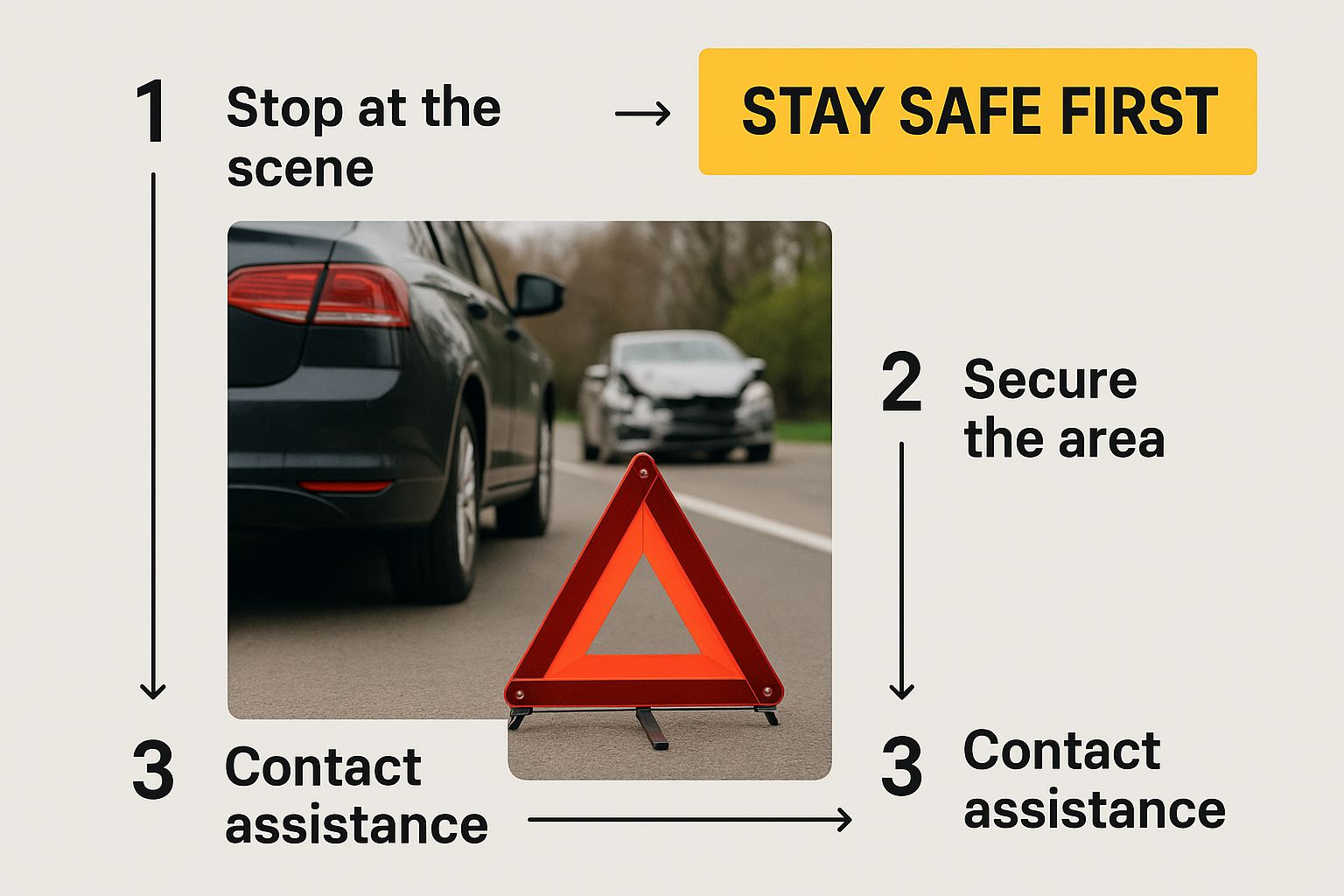
Securing the area and checking on everyone’s well-being is the foundation of your response, long before you start worrying about insurance details.
To simplify things during a high-stress moment, here’s a quick checklist of what to do right at the scene.
On-Scene Accident Checklist
This table is a quick reference for the essential actions you must take immediately after being hit by an uninsured driver.
| Action Item | Why It’s Critical | What to Do |
|---|---|---|
| Ensure Safety | Your health is the top priority. | Move vehicles out of traffic if possible. Turn on hazard lights. Check on all passengers for injuries. |
| Call 911 | An official police report is vital evidence. | Report the accident, regardless of severity. Request medical assistance if anyone is injured. |
| Exchange Info | You need their details for any future claim or action. | Get their full name, address, phone number, and driver’s license number. |
| Document Everything | Photographic evidence is hard to dispute. | Take pictures of the cars, license plates, VIN, damage, and the overall scene from multiple angles. |
| Speak to Witnesses | Third-party accounts strengthen your case. | Get names and contact information from anyone who saw the accident happen. |
Following these steps methodically ensures you don’t miss a critical piece of information that could impact your ability to recover your losses later.
Call the Police and Document Everything
I can’t stress this enough: always call 911. It doesn’t matter if the damage looks minor. An official police report is one of the most powerful tools you’ll have, especially when the at-fault driver is uninsured. It creates an objective, third-party record of what happened and often includes an initial assessment of who was at fault.
Crucial Disclaimer: This article is for informational purposes and not to be construed as legal advice. No attorney-client relationship exists based on the review of this article, and none of the information in this article is legal advice.
While you’re waiting for the police to arrive, start gathering information from the other driver:
- Full Name and Contact Information: Get their phone number and current address.
- Driver’s License Number: The easiest way is to snap a clear picture of their license with your phone.
- Vehicle Information: Jot down the make, model, color, and license plate number.
- Vehicle Identification Number (VIN): You can usually find this on a small plate on the driver’s side dashboard, visible through the windshield.
Why You Should Never Accept a Cash Deal
The uninsured driver might try to talk you out of calling the police. They might even offer you a few hundred dollars on the spot to “just forget about it.” Never, ever accept this offer.
That on-the-spot cash will almost certainly not be enough to cover your car repairs, let alone medical bills for injuries that might not show up for a few days. For a closer look at post-accident steps, our guide on the first 72 hours after an automobile accident offers more crucial advice. Once you take their money, you’re effectively settling the claim on their terms, and you lose your right to seek further compensation.
How to Document and Gather Crucial Evidence
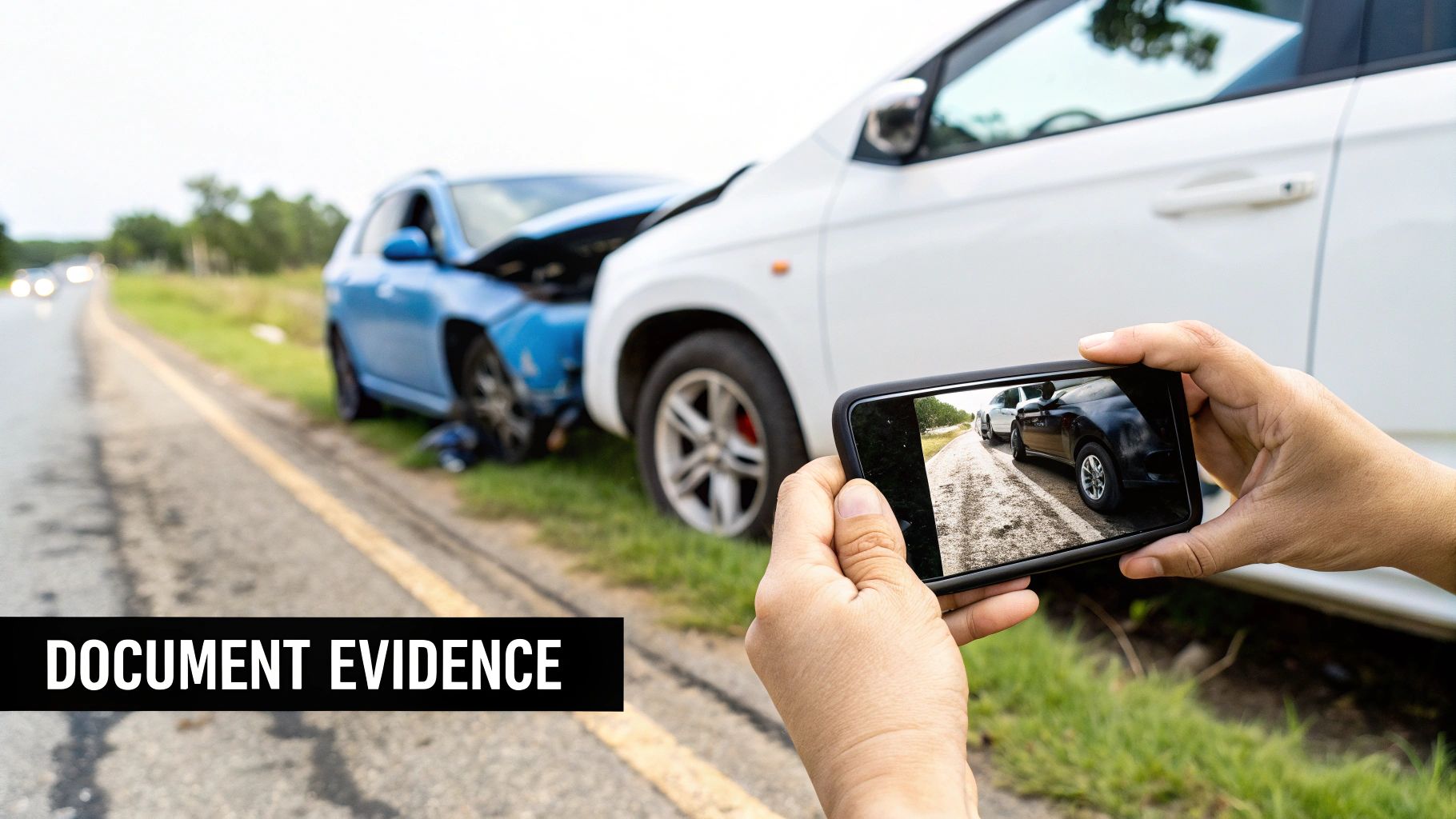
After getting hit by an uninsured driver, the strength of your case boils down to one thing: the quality of the evidence you gather on the spot. What you do in those first few minutes and hours is your most powerful tool. This is the information you’ll rely on to prove the other driver was at fault and to get your insurance claim paid.
Think of yourself as an investigator at a crime scene. Your job is to create a detailed, undeniable record of exactly what happened before everything gets cleared away. This goes way beyond just swapping names; it’s about capturing a complete snapshot of the incident.
Create a Photographic Record
Your smartphone is your best friend here. Don’t just snap one or two quick pictures of the damage. You need to document everything from every possible angle. Trust me, you can never have too many photos.
Make sure you get shots of:
- All Vehicle Damage: Start with wide shots showing both cars’ positions, then get close-ups of every single dent, scratch, and point of impact on all vehicles involved.
- The Entire Scene: Back up and take photos of the whole intersection or stretch of road. Include any traffic signs, stoplights, and lane markings in the frame.
- Road Conditions: Look for skid marks, debris from the crash, or anything else that might have played a part, like potholes or wet pavement.
- Visible Injuries: If you have any cuts, bruises, or scrapes, take pictures of them immediately.
This visual proof is what insurance adjusters and lawyers use to piece together what happened. Without it, you’re stuck in a “he said, she said” battle that’s tough to win.
The Power of an Official Police Report
Your photos are vital, but an official police report gives your claim a layer of objective authority. It typically includes the officer’s initial assessment of fault, a diagram of the crash site, and statements from everyone involved. It’s a cornerstone document for any claim against an uninsured driver. If you’re unsure how to get a copy, our guide explains how to get a police report for your accident.
Remember, the police report is often the very first piece of evidence an insurance company will request. Not having one can seriously complicate or delay your claim.
Don’t Overlook Witness Statements
Independent witnesses are gold. Why? Because they have nothing to gain or lose from the outcome. If anyone saw the crash or stopped to help, politely ask for their name and phone number.
Jot down a few notes about what they told you right then and there, while it’s still fresh. A neutral third party who can confirm the other driver blew through a red light or was texting provides an incredibly powerful, unbiased account that backs up your story. Their testimony can absolutely make or break a disputed claim.
Making Your Uninsured Motorist Coverage Work for You
When you’re hit by a driver who doesn’t have insurance, your own policy suddenly becomes your most important financial tool. It’s the whole reason Uninsured Motorist (UM) coverage exists—to protect you when someone else on the road drops the ball.
This coverage is more than just a smart add-on; it’s becoming a flat-out necessity. The hard truth is that the number of uninsured drivers is climbing. Recent stats show that around 15.4% of drivers in the U.S. don’t have insurance. That’s more than one out of every seven cars you pass on your daily commute.
It’s really important to get a handle on your policy before you’re in a situation where you need to use it. The language can be dense and confusing, so let’s unpack the key pieces you’ll find in a typical California auto policy.
What Are UMBI and UMPD?
Your Uninsured Motorist coverage is usually broken down into two main parts. Each one is designed to cover a different kind of loss after a crash with an uninsured driver.
- Uninsured Motorist Bodily Injury (UMBI): This is the part of your policy that steps in to cover medical bills for you and anyone in your car who gets hurt. It can also help with lost wages if you’re out of work and even provide compensation for pain and suffering.
- Uninsured Motorist Property Damage (UMPD): This coverage helps pay to get your car fixed. In California, UMPD is capped at $3,500, but it provides a critical buffer, especially if you don’t carry collision coverage on your policy.
A simple way to think about it: UMBI is for the people, and UMPD is for the car. Knowing which is which clarifies what you can expect when you file a claim. For a deeper dive, you can check out our detailed guide on what is uninsured motorist coverage.
While UMPD handles the bulk of vehicle repairs, accidents often lead to specific problems that need special attention. For instance, a cracked windshield might not seem like a big deal at first, but it can get worse over time. It’s good to know that professional windshield repair services are available to handle that specific issue.
The Claim Process: Dealing With Your Own Insurance Company
Filing a UM claim feels different because you’re not dealing with the at-fault driver’s insurer. Instead, you’re working directly with your own company. You need to let them know about the accident as soon as possible and give them all the evidence you collected, like the police report number and photos from the scene.
From there, your insurer will launch its own investigation, just like they would for any other claim. They’ll want to see your medical records, get repair estimates for your car, and review all the proof showing the other driver was both uninsured and at fault.
A Word of Caution: Even though it’s your own insurance company, remember that their primary goal is to pay out as little as possible. When you report the accident, be very careful with what you say. Stick to the facts. Don’t guess about what happened or admit any fault, because anything you say can be used to lower your final settlement.
The limits on your policy dictate the absolute maximum your insurer will pay. If your UMBI coverage is set at $50,000, that’s the most you can get for your injuries, no matter how high your medical bills climb. Understanding these limits ahead of time will help you set realistic expectations for your recovery.
What Happens When Your Damages Exceed Your Policy Limits?
It’s a nightmare scenario. You did everything right—you bought uninsured motorist (UM) coverage to protect yourself. But after getting hit by an uninsured driver, you’re staring at a stack of medical bills and repair estimates that are way higher than what your policy will actually pay out.
Suddenly, you’re in a tough spot, left with a massive financial gap and a whole lot of stress. This is where things get complicated.
Once your UM policy is maxed out, you have to start looking for other ways to cover the rest of your losses. The most direct, and often the only, path forward is to pursue a personal injury lawsuit directly against the driver who caused the accident.
Should You Sue the Uninsured Driver?
Filing a lawsuit means you’re taking the at-fault driver to court to get a judgment for the remaining amount your insurance didn’t cover. This can include all your medical bills, lost wages from being out of work, future medical care, and even compensation for your pain and suffering.
The goal is to get a court order that legally forces the uninsured driver to pay you what you’re owed.
But here’s the harsh reality: suing someone and actually collecting money from them are two completely different things. Think about it—if someone is driving around without insurance, it’s often because they don’t have the money to pay for it. They likely don’t have significant assets to cover a large court judgment either.
A Realistic Perspective: Even if you go to court and win a huge judgment, that court order might not be worth more than the paper it’s printed on. If the at-fault driver has no savings, no property, and no steady income, they are what we call “judgment-proof.”
Before you jump into a lawsuit, you have to be practical and weigh the cost of hiring a lawyer and going to court against the actual odds of ever seeing a dime.
Are There Any Other Options for Recovery?
While suing the driver is the most obvious next step, it’s worth looking under every rock for other potential sources of compensation. The financial stakes are just too high to overlook any possibility.
A good attorney will investigate a few key areas:
- Other Potential Insurance Policies: Was there another policy in play that could offer coverage? For instance, if you were driving a company vehicle for work, there might be a commercial auto policy you can tap into. Or, if you have a personal umbrella policy, it could provide another layer of protection.
- Third-Party Liability: Was the driver the only one at fault? Sometimes, another party shares some of the blame. Maybe a city was negligent in maintaining a dangerous road, or a bar knowingly over-served an obviously intoxicated driver. These cases are complex, but they can open up entirely new avenues for recovery.
This isn’t a small problem. Across the United States, the number of uninsured and underinsured drivers is a shocking one in three. The financial impact of uninsured drivers is enormous, placing a heavy burden on responsible drivers and the healthcare system.
You’re at a critical point where the decisions you make next will have a lasting impact on your financial future. Given how complicated it is to investigate assets and navigate the legal system, getting professional legal advice is essential. An experienced lawyer can help you figure out if a lawsuit is even worth it and uncover other paths to compensation you might have never considered on your own.
Knowing When to Hire a Personal Injury Attorney
Figuring out if you need a lawyer after a car wreck can be tough. Not every little fender bender requires you to call for legal backup, but when the other driver is uninsured, things get complicated fast. Suddenly, you’re not just dealing with the other guy’s insurance—you’re going up against your own company.
And let’s be honest, even though you pay your premiums on time, their primary goal is to protect their bottom line. Recognizing when you need a professional in your corner is the most critical decision you’ll make. Many people put off calling an attorney because it feels like a drastic step, but certain situations are giant red flags telling you it’s time to get an expert opinion.
Your Insurance Company Is Pushing Back
This is probably the biggest reason people end up hiring a lawyer. When you file an Uninsured Motorist (UM) claim, your relationship with your insurance company changes. They are no longer your helpful provider; they are the entity responsible for paying your damages, and that puts you in an adversarial position. Their goal is to pay out as little as possible.
You should seriously think about getting legal help if:
- You get a lowball settlement offer. Insurance adjusters are professional negotiators. Their first offer is almost guaranteed to be way less than what your claim is really worth. They’re banking on you being too stressed or inexperienced to fight for more.
- They start questioning your injuries. It’s a common tactic. The adjuster might suggest your medical treatments are unnecessary or that your injuries aren’t as bad as you’re saying. It’s all about minimizing their payout.
- They delay or deny your claim for no good reason. If your insurer is dragging their feet, not returning your calls, or flat-out denying your claim with a flimsy excuse, they might be acting in bad faith. This is a serious issue.
Important Takeaway: In a UM claim, your insurance company isn’t your friend. Their business model depends on minimizing payouts. An attorney levels the playing field and makes sure they treat you fairly.
You Suffered Serious Injuries
If your accident with an uninsured driver left you with significant injuries, trying to handle the claim by yourself is a huge gamble. Serious injuries aren’t just about the immediate hospital bills. They often mean long-term physical therapy, lost income from being out of work, and a heavy toll of pain and suffering.
An experienced personal injury attorney understands how to calculate the true, long-term cost of these injuries. They’ll bring in medical and financial experts to build a solid case that accounts for every future expense, so you don’t get a settlement that dries up long before you’ve recovered.
You Are Considering a Lawsuit
We talked about this earlier, but it’s worth repeating. If your damages are more than your insurance policy will cover, your only other option might be to sue the at-fault driver directly. This is not something you want to do on your own.
First off, an attorney can run an asset search to see if the other driver even has anything worth pursuing. There’s no point in spending time and money on a lawsuit if there’s nothing to collect at the end. If a lawsuit makes sense, your lawyer will manage the entire legal maze for you, from filing the initial complaint to fighting for you in court.
Disclaimer: This article is for informational purposes and not to be construed as legal advice. No attorney-client relationship exists based on the review of this article, and none of the information in this article is legal advice.
Common Questions After an Accident with an Uninsured Driver
Getting into a crash is stressful enough, but when the other driver doesn’t have insurance, it opens up a whole new set of worries. Here are some clear, straightforward answers to the questions we hear most often from California drivers in this situation.
Will My Rates Go Up if I Use My Uninsured Motorist Coverage?
This is the number one concern for most people, and thankfully, the answer in California is a firm no. Thanks to state law (Proposition 103), it’s illegal for your insurance company to penalize you for an accident where you weren’t the one “principally at fault.”
Think about it: an Uninsured Motorist (UM) claim is only triggered when the other driver caused the crash and broke the law by driving without insurance. You’re simply using the protection you’ve been paying for. Filing a claim won’t affect your rates.
What if the Uninsured Driver Was a Hit-and-Run?
It’s an incredibly frustrating scenario, but this is exactly why Uninsured Motorist Bodily Injury (UMBI) coverage exists. Your policy can step in and cover your injuries even if the at-fault driver is long gone.
However, to use this coverage for a hit-and-run, you have to follow a few critical steps. Insurers need proof that an actual “phantom” vehicle caused the crash.
You’ll need to show there was physical contact between your car and the unknown vehicle. Just as importantly, you must take two immediate actions:
- Report the hit-and-run to the police, usually within 24 hours.
- Notify your own insurance company about what happened right away.
Any scrap of information you can remember—a partial license plate, the car’s color, or a witness’s description—can make a huge difference in getting your claim approved.
Can I Sue the Uninsured Driver Directly?
Legally, yes. You absolutely have the right to file a personal injury lawsuit against the at-fault driver to recover compensation for your medical bills, lost income, and pain and suffering, especially if your costs exceed your own policy limits.
But the real question is, is it worth it? A person driving without insurance often doesn’t have the money or assets to pay a court judgment. You can win a lawsuit and still never see a dime if the person is “judgment-proof.”
An experienced attorney can run an asset check on the other driver. This simple step can tell you if they have anything to collect, helping you decide if a lawsuit is a practical move or just a waste of time and money.
What’s the Difference Between Uninsured and Underinsured Motorist Coverage?
People often use these terms interchangeably, but they cover two distinct—and equally frustrating—scenarios. Knowing the difference is key to understanding your own policy.
- Uninsured Motorist (UM) Coverage: This protects you when the at-fault driver has no car insurance at all.
- Underinsured Motorist (UIM) Coverage: This kicks in when the at-fault driver has insurance, but their policy limits are too low to cover all your medical bills and other damages.
Both are designed to bridge the financial gap left by irresponsible drivers, making sure you have a way to recover what you’ve lost.
Disclaimer: This article is for informational purposes and not to be construed as legal advice. No attorney-client relationship exists based on the review of this article, and none of the information in this article is legal advice.
If you’ve been injured in an accident with an uninsured driver, you don’t have to face the insurance companies and legal system alone. The experienced team at LA Law Group, APLC can protect your rights and fight for the compensation you deserve. Contact us today for a free, no-obligation consultation to discuss your case by visiting https://www.bizlawpro.com.
Attorney Advertising. This article is general information, not legal advice, and does not create an attorney-client relationship. Prior results do not guarantee a similar outcome.