
Amazon Seller Account Suspension Appeal Guide
Disclaimer: This article is for informational purposes and is not to be construed as legal advice. No attorney-client relationship exists based on the review of this article and none of the information in this article is legal advice.
An Amazon seller account suspension appeal is your chance to get your selling privileges back. It’s not just a simple email; it’s a formal request that hinges on a detailed Plan of Action (POA). This document needs to show Amazon you know exactly what went wrong, what you’ve done to fix it right now, and what systems you’re putting in place so it never happens again. A winning appeal proves you understand their rules and are serious about playing by them.
What to Do When Your Amazon Account Is Suspended
Disclaimer: This article is for informational purposes and is not to be construed as legal advice. No attorney-client relationship exists based on the review of this article and none of the information in this article is legal advice.

That email notification from Amazon—the one that says “Your selling privileges have been removed”—is enough to make any seller’s heart stop. Your first impulse might be to dash off a panicked, emotional reply. Don’t. That’s the absolute worst thing you can do.
Getting your account back starts with a calm, methodical approach the moment you get that notice. You need to switch from panic mode to problem-solving mode. Take a deep breath. Your goal isn’t to fight with Amazon; it’s to present yourself as a professional partner who can diagnose a problem and implement a lasting solution.
Decoding the Suspension Notice
First things first: read the suspension notification. Read it again. Amazon will give you a reason for the deactivation, but it can often feel vague or generic. It’s your job to pick it apart and figure out what they’re really talking about.
Generally, suspensions boil down to one of three areas:
- Performance-Related Issues: This is all about your metrics. Things like a high Order Defect Rate (ODR), Late Shipment Rate, or Pre-fulfillment Cancel Rate. An ODR climbing over 1% is a classic trigger.
- Policy Violations: This is a broad category that can cover anything from intellectual property (IP) complaints and claims of inauthentic products to review manipulation.
- Linked Accounts: This is a big one. If Amazon’s system flags your store as being connected to another suspended account, it’s a serious violation of their multiple accounts policy.
Pinpointing the Root Cause in Seller Central
Once you’ve analyzed the email, your next stop is the Account Health Dashboard inside Seller Central. This dashboard is your command center, showing the specific data points and warnings that got you into this situation. Look for any metrics in the red or yellow.
A huge mistake I see sellers make is only addressing the surface-level issue mentioned in the email. You have to dig deeper. For instance, if you were suspended for a high ODR, the ODR itself isn’t the root cause. The real question is why it’s high. Are your products defective? Are your listings misleading? Is your shipping partner unreliable?
You need to become a detective. Investigate every performance notification, every customer message, every A-to-z claim, and every piece of negative feedback. This deep dive is non-negotiable. Without a precise understanding of what truly went wrong, you can’t write a convincing Plan of Action. Get this foundational step right, and you’re on the path to reinstatement.
Why Amazon Suspends Seller Accounts
Disclaimer: This article is for informational purposes and is not to be construed as legal advice. No attorney-client relationship exists based on the review of this article and none of the information in this article is legal advice.

To have any shot at a successful Amazon seller account suspension appeal, you first have to understand the beast you’re dealing with. Amazon’s entire platform is built around aggressive, customer-first policies, and it’s mostly enforced by automated systems. This unforgiving combination means that even the most buttoned-up sellers can get locked out of their accounts with little to no warning.
These suspensions are never random. They’re always triggered by a violation of Amazon’s massive—and constantly changing—rulebook. The platform casts an incredibly wide net to shield its brand and its buyers, which results in accounts getting shut down every single day for a huge range of reasons. It could be anything from claims of inauthentic products, intellectual property complaints (even baseless ones), or slipping performance metrics like a high late shipment rate.
Common Triggers for Account Suspension
The reasons for a suspension are often more complex than they appear. What might seem like a small, isolated issue can spiral quickly when Amazon’s risk-averse algorithms get ahold of it. For instance, a single customer review questioning if a product is truly authentic can trip an algorithmic wire and trigger a full account review.
Here are some of the most common landmines that get sellers deactivated:
- Intellectual Property (IP) Complaints: This happens when a brand owner files a complaint saying you’re infringing on their trademark or copyright. Sometimes they’re legitimate, but they’re also frequently used by shady competitors to knock you out of the running.
- Inauthentic Product Claims: This is a big one, and it doesn’t mean you’re selling knockoffs. A customer complaining that an item “doesn’t seem new” or arrived with a dented box can be enough to get you flagged for this violation.
- Dropshipping Policy Violations: Many sellers don’t grasp just how strict Amazon’s dropshipping policy is. If you ship from another retailer or your invoices fail to identify you as the official seller of record, you’re breaking the rules.
- Linked Accounts: Amazon’s systems are scarily good at connecting the dots between seller accounts. If you have any link to a previously suspended account—even a tenuous one—yours is likely to get deactivated by association.
It’s absolutely critical to remember that Amazon’s loyalty is to its customers, not to you, the seller. The platform is designed to sniff out and eliminate anything it sees as a potential risk to the buying experience. Its automated systems often act first and ask questions later, catching honest sellers in the crossfire.
Navigating Compliance and Policy Changes
Beyond these typical triggers, just staying compliant is a full-time job. Amazon updates its policies all the time, and you’re expected to keep pace.
Lately, new legislation has added yet another layer of complexity. If you want to get into the weeds on these evolving rules, check out our guide on understanding the INFORM Act and its impact on Amazon sellers. Not complying with new verification or transparency requirements is a fast track to suspension.
Staying on top of this stuff is simply the price of admission for selling on the world’s biggest marketplace. The best defense against a sudden, business-killing suspension is being proactive about compliance.
Crafting a Powerful Plan of Action
Disclaimer: This article is for informational purposes and is not to be construed as legal advice. No attorney-client relationship exists based on the review of this article and none of the information in this article is legal advice.
When your Amazon seller account gets suspended, your Plan of Action (POA) is everything. It’s the single most critical document you’ll submit, and it will make or break your appeal. Let’s be clear: this isn’t the place for excuses, complaints, or sob stories. It’s a professional, factual business document designed to do one thing—convince an Amazon investigator that you’re a competent seller who has solved the problem for good.
A weak, defensive, or vague POA is the fastest ticket to a denied appeal. Your goal here is to show complete ownership. You need to prove you’ve not only figured out what went wrong but have also built a rock-solid system to make sure it never, ever happens again.
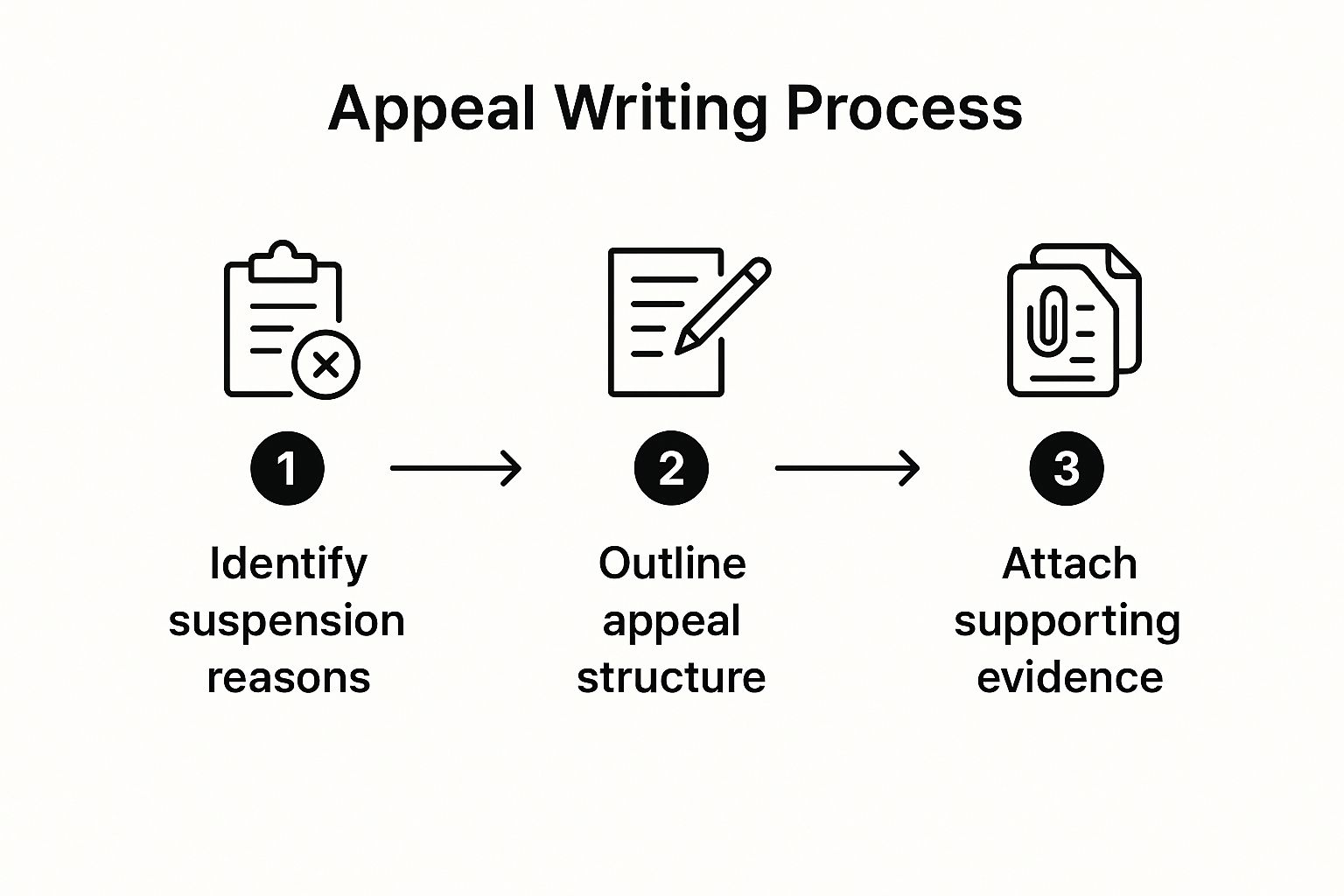
This visual flow really breaks down how a successful appeal is built on a logical foundation: you identify the problem, structure your response, and back it all up with concrete proof.
Deconstructing a Winning POA
I’ve seen countless POAs over the years, and the successful ones always have three core sections. Think of them as the past, present, and future of your solution. If you miss one, your appeal will almost certainly be rejected, forcing you to start over and costing you weeks of lost sales.
The POA you submit to Amazon must be broken down into three specific, non-negotiable parts. Each one answers a critical question for the Seller Performance team.
Here’s a simple table to help visualize how these components work together.
Plan of Action Component Breakdown
| POA Section | Objective | Example Focus |
|---|---|---|
| Root Cause(s) | Explain why the problem truly happened, going beyond surface-level issues. | “Our failure to implement a receiving-dock quality check for supplier shipments…” |
| Immediate Actions Taken | Detail the specific steps you’ve already completed to fix the current issue. | “We have recalled all units from FBA for ASIN B00XXXXXXX and issued full refunds…” |
| Long-Term Preventative Measures | Outline the new systems and processes you’ve implemented to stop this from ever recurring. | “A new 3-point inspection protocol has been implemented, requiring sign-off from two team members…” |
Let’s dig a little deeper into what each section requires.
-
The Root Cause: This is where you need to do some real detective work. It’s not enough to say, “We shipped some orders late.” Why did you ship them late? A strong root cause analysis might sound like this: “The root cause of our high late shipment rate was an inadequate inventory management system that failed to sync with our supplier’s live stock levels, which resulted in us selling products we didn’t have on hand.” See the difference? You’ve identified a systemic failure, not just a symptom.
-
Immediate Corrective Actions: This section is about the now. What have you done right this second to fix things for any customers who were affected? This could be something like, “We have issued full refunds and a 10% future discount coupon to all 17 customers impacted by the late shipments,” or “We immediately closed the listing for the ASIN that received the inauthenticity complaint and disposed of all remaining inventory.”
-
Long-Term Preventative Measures: This is where you really prove to Amazon that you’re a safe bet for the future. You need to describe the new systems, processes, or personnel changes you’ve put in place to eliminate the root cause permanently. This is what shows Amazon you’re a low-risk partner.
The biggest mistake I see sellers make is being too vague. Statements like “We will monitor our account more closely” are completely useless to an investigator. A strong POA says, “We have assigned a dedicated staff member to audit our Account Health Dashboard daily at 9 AM and 4 PM PST. Any new warnings will be documented in a shared compliance log and addressed within two hours.” That’s specific. That’s actionable.
From Weak to Persuasive Language
The words you choose matter. A lot. The reviewers at Amazon read hundreds of these appeals a day and can spot a seller who isn’t taking full responsibility from a mile away. You have to be direct, own the mistake entirely, and focus only on solutions.
Let’s look at a couple of quick transformations.
| Weak Statement (Avoid This) | Strong Statement (Use This) |
|---|---|
| “It wasn’t our fault; the supplier sent the wrong items.” | “The root cause was our failure to implement a quality control check upon receiving inventory from our supplier.” |
| “We will try to ship orders faster in the future.” | “We have integrated new inventory management software for real-time stock updates and have extended our handling time by 24 hours to create a buffer.” |
Writing a powerful POA is a skill, and it requires understanding exactly what Amazon’s performance teams need to see to reactivate your account. For a much more detailed breakdown of the process, you can learn more about how Amazon seller appeals are done right to pick up some extra insights. Ultimately, your ability to clearly explain the problem and your solutions is what will get your selling privileges back.
Gathering the Essential Supporting Documents
Disclaimer: This article is for informational purposes and is not to be construed as legal advice. No attorney-client relationship exists based on the review of this article and none of the information in this article is legal advice.
A well-written Plan of Action is a great start, but a POA backed by solid, irrefutable evidence is what actually gets accounts reinstated. Your words promise you’ve fixed the problem; your documents prove it.
You can’t just tell Amazon your products are legitimate and expect them to take your word for it. You have to provide the hard evidence that an investigator can look at and quickly verify. This is what turns your Amazon seller account suspension appeal from a simple claim into a verifiable case.
Think about it from the investigator’s perspective. They need clear, legitimate proof to justify flipping the switch on your account again. Your job is to make their decision as easy as possible by giving them exactly what they need, in the format they expect.
Sourcing Invoices That Meet Amazon’s High Bar
For any suspension related to inauthenticity or product quality, your supplier invoices are the most important pieces of evidence you have. But not just any invoice will do. Amazon is incredibly strict, and sending in documents that don’t meet their requirements will get your appeal rejected almost immediately.
To be considered valid, your invoices must:
- Be dated within the last 365 days. This shows your inventory is recent and relevant to your current sales.
- Include your supplier’s full contact info. Their name, address, phone number, and website all need to be clearly visible.
- Show your business information. The name and address on the invoice absolutely must match the details in your Seller Central account.
- Display item quantities. The number of units on your invoices should roughly line up with your sales volume for that time frame.
A word of caution: Never submit pro forma invoices, sales orders, or commercial invoices meant for customs. Amazon needs to see final, itemized invoices from a real supplier. If they can’t call or look up your supplier, they’ll likely consider the documents fake.
Proving Your Corrective Actions and Authorization
Beyond invoices, other documents can be crucial for different kinds of suspensions. If you’re dealing with an intellectual property (IP) complaint, a letter of authorization from the brand owner is the gold standard. This single document gives you explicit permission to sell their products on Amazon and can resolve the complaint almost instantly.
Screenshots are also a surprisingly powerful tool for showing the corrective actions you’ve taken.
Did you say you updated a problematic listing? Include a screenshot of the corrected product detail page. Implemented a new quality check process? Show a snapshot of the checklist template. These visuals make your claims tangible and real.
The entire reinstatement process can be a real headache, with timelines varying wildly based on the suspension’s cause and the quality of your appeal. For a deeper dive, you can explore expert insights on reinstatement and prevention strategies.
Finally, how you present this documentation is just as important as what you gather. Compile everything into a single, clearly labeled PDF. This makes the review process seamless for the Amazon investigator and shows you’re a professional, organized seller who’s worth reinstating.
Submitting Your Appeal and Navigating Follow-Ups
Disclaimer: This article is for informational purposes and is not to be construed as legal advice. No attorney-client relationship exists based on the review of this article and none of the information in this article is legal advice.
You’ve put in the hard work, your Plan of Action is sharp, and your supporting documents are all lined up. Now comes the final, crucial step: submitting the appeal. Getting this part right sets a positive tone from the very beginning.
To get started, head into Seller Central, find the Performance tab, and click on Account Health. You’ll spot a “Reactivate” button at the top of the page. That’s your gateway to getting everything uploaded.
The single biggest mistake I see sellers make is attaching the wrong file types or using confusing names. Stick to PDFs, and give them clear, simple labels.
Once you click that “Reactivate your account” button, you’ll be taken to a form. It will ask for details like a case ID, a description of what happened, and a place to upload your files. I can’t stress this enough: double-check every single field before you hit that submit button.
Getting Through the Seller Central Submission Process
The appeal interface itself is fairly straightforward. It guides you through entering your root cause analysis and the corrective actions you’ve taken. It also allows you to attach multiple documents in a single go, so being familiar with the layout can save you a lot of stress.
Your key attachments will be your Plan of Action, any supplier invoices that meet Amazon’s strict criteria, and letters of authorization if applicable. Make sure the quantities and dates on your invoices line up with your sales history.
Here are a few practical tips for managing your files:
- Group similar documents into a single zipped folder or a combined PDF.
- Label your files clearly, like POA.pdf, Invoices.pdf, and AuthorizationLetter.pdf.
- Keep an eye on the total file size. It needs to stay under 5 MB to avoid frustrating upload errors.
| Document Type | Format | Key Details to Include |
|---|---|---|
| Plan of Action | A detailed breakdown of the root cause, immediate fixes, and your long-term preventive plan. | |
| Supplier Invoices | Must be dated within the last 365 days and include complete supplier contact information. |
Effective Follow-Up Strategies
After you submit your appeal, you should receive a confirmation email from Amazon, usually within two business days. This email will have your case ID and an estimated timeframe for a response. Keep this information handy—it’s essential for timing your next move.
Sometimes, Amazon will come back asking for more information. Their requests can be a bit cryptic, asking for “additional documentation” or “clarifications.” You need to read their message very carefully and respond only with what they’ve asked for. Don’t use this as an opportunity to rewrite your entire POA.
If 48 hours go by and you haven’t heard a thing, a brief, professional follow-up can help nudge your case along. Just don’t overdo it. Two or three polite, focused messages are plenty.
- Always put your case ID in the subject line.
- Provide only the new information or specific documents they requested.
- Keep your tone respectful and professional no matter how frustrated you feel.
Bombarding Seller Performance with daily emails is a bad look. It signals desperation and can actually hurt your chances. Patience, combined with timely and targeted follow-ups, shows them you’re organized and serious about resolving the issue.
You might also be interested in our guide on suspended Amazon account reinstatement, which covers some additional high-level strategies.
When you finally receive a decision, act fast. If you’re reinstated, get your listings active again and keep a close watch on your account health metrics. If you’re denied, don’t lose hope. Use the feedback Amazon provides to build an even stronger Plan of Action for your next attempt.
How to Prevent Future Account Suspensions
Disclaimer: This article is for informational purposes and is not to be construed as legal advice. No attorney-client relationship exists based on the review of this article and none of the information in this article is legal advice.

You got your account back. Take a moment to celebrate that hard-won victory, but don’t get too comfortable. Getting reinstated after an Amazon seller account suspension appeal is just the beginning; the real goal is building a business that never has to go through that again.
That painful suspension needs to become a powerful lesson. It’s time to shift from reactive damage control to proactive prevention. Your Account Health Dashboard shouldn’t be a place you visit in a panic. It needs to be part of your daily routine, a quick check-in to catch small issues before they snowball.
Proactively Monitoring Account Health
Think of every metric and notification as an early warning flare. One of the most critical areas to watch is your “Voice of the Customer” (VoC) dashboard. I’ve seen Amazon’s enforcement rely more and more on this data, which is essentially a rollup of buyer feedback about everything from product quality to whether your listing was accurate.
If an ASIN’s VoC score slips into ‘Poor’ or ‘Very Poor’, Amazon can suppress the listing without any warning. A few of those, and your entire account is back on the chopping block.
Proactive monitoring is non-negotiable. Waiting for a formal warning from Amazon means you’re already behind. A successful seller treats their Account Health page like an EKG for their business, spotting irregularities before they become critical.
Implementing Robust Internal Systems
Vigilance is great, but it’s useless without a system to back it up. When you wrote your Plan of Action, you promised better oversight. Now you have to actually build it into your daily operations.
Here’s what that looks like in practice:
- Regular Listing Audits: Put a recurring event on your calendar—weekly or bi-weekly—to audit your top-selling listings. Are your images and copy still compliant with the latest policy updates? Has a hijacker jumped on your page?
- Inventory and Supplier Checks: Create a rock-solid quality control process for every shipment that comes through your door. This is how you stop authenticity complaints and product condition issues before they ever reach a customer.
- Customer Service Protocols: Your team needs a playbook for handling customer complaints. A fast, professional response can de-escalate a problem and stop a negative experience from turning into a dreaded A-to-z claim.
Making sure your listings are fully compliant also helps. For instance, correctly adding videos to your Amazon listings can clarify product features and reduce customer confusion, which in turn improves your metrics.
By weaving these preventative habits into the fabric of your business, you drastically lower your risk of another suspension and build a much more stable, resilient Amazon store.
Disclaimer: This article is for informational purposes and is not to be construed as legal advice. No attorney-client relationship exists based on the review of this article and none of the information in this article is legal advice.
Facing a suspension or need to protect your brand? The team at LA Law Group, APLC combines deep eCommerce experience with legal expertise to fight for sellers. From drafting a powerful Amazon seller account suspension appeal to handling complex intellectual property issues, we offer the direct attorney access you need. Secure your business’s future by visiting us at https://www.bizlawpro.com.
Attorney Advertising. This article is general information, not legal advice, and does not create an attorney-client relationship. Prior results do not guarantee a similar outcome.