
Are Personal Injury Lawyers Worth It in 2026
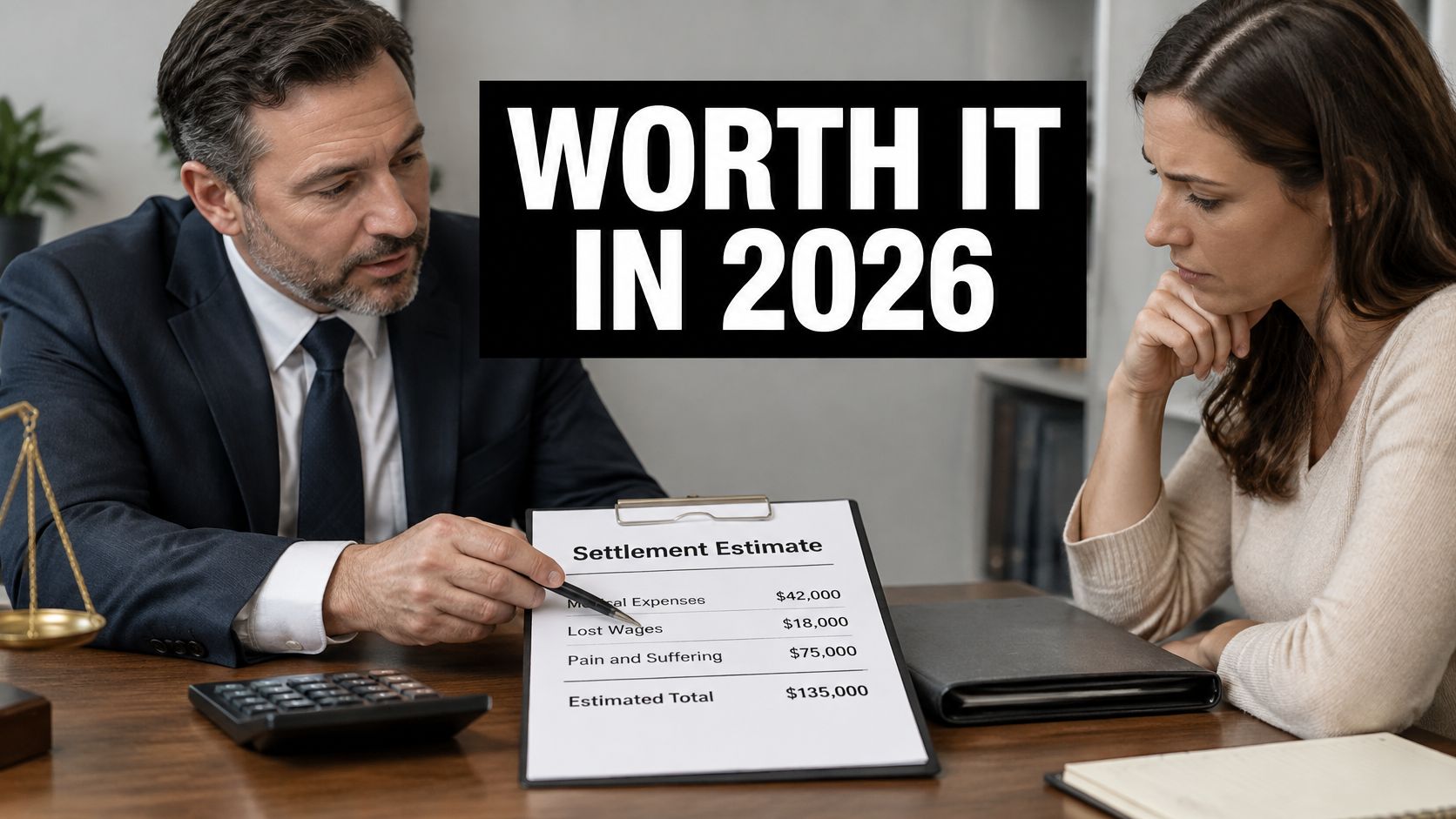
A personal injury lawyer is worth it when the extra money they’re likely to recover, after the contingency fee and case costs, beats what you’d net alone. A bigger headline settlement isn’t enough if fees, liens, and unpaid bills leave you with less.
That distinction changes how you should read every statistic that follows. A lawyer can improve your access to settlement, build evidence an adjuster can’t ignore, and find coverage you didn’t know existed. None of that matters unless the net check grows by more than the fee, the costs, and the extra months you wait. Judge representation the way you’d judge any hired help paid from the proceeds. The work has to add more value than it takes.
When the Fee Beats Handling the Claim Alone
A personal injury lawyer earns the fee only when the extra recovery they can realistically produce, after the percentage fee and case costs, leaves you with more than you would net handling the insurer alone. The test is the net check after the fee, costs, and liens. A higher headline offer can still leave you with less.
Counsel works like a contractor paid from the job proceeds. On a damaged, undervalued claim, good work can raise the final value enough to cover the cut. On a small claim where the insurer’s payment is already fair, the same percentage mostly shrinks what remains.
Three figures decide whether personal injury lawyers are worth it for you: your chance of a paid resolution, the likely gross recovery, and the money left after deductions. Injury claims usually settle rather than go to trial, so what you buy is evidence, valuation, negotiation, and deadline control. A free consultation with the attorney who would handle the matter can review those figures and explain what the firm would seek for medical bills, recovery costs, and lost wages.
To apply the test, subtract the fee, case costs, unpaid medical bills, and any liens from the projected gross. Compare that net with the offer you can realistically close on your own, adjusted for the months you would wait. The same break-even test applies to every reader, whatever language they read in, so the three figures below are the place to start. For a comparison from outside California, legal guidance for injured Big Island residents addresses the same question under different rules.
Settlement Odds With and Without Counsel
The cleanest published comparison puts a number on the access gap. A dataset of 308,317 personal injury cases terminated in U.S. district courts in fiscal years 2010 through 2025, excluding multidistrict litigation, records settlements in 56.8% of represented cases and 9.6% of cases where the plaintiff proceeded without a lawyer (the federal injury-case dataset). Motor-vehicle claims track it closely at 62.4% against 19.9%.
Failure, not compromise, explains much of that spread. A summary of personal injury statistics reports self-represented injury suits were dismissed 59.0% of the time, which means those plaintiffs never reached a negotiation at all. Widen the frame from federal filings to injury claims generally, and settlement is the ordinary exit: a 2024 On Point Legal Leads analysis of the personal injury market placed roughly 95% of matters in settlement rather than trial.
| Setting | With a lawyer | Without a lawyer | How to read it |
|---|---|---|---|
| Federal personal injury cases, FY 2010 to 2025 | 56.8% settled (284,080 cases) | 9.6% settled (24,237 cases) | 5.9-fold gap, and lawyers also select stronger cases |
| Federal motor-vehicle cases | 62.4% settled | 19.9% settled | Same pattern, still not proof of causation |
| Self-represented federal injury suits | Represented suits settled far more often | 59.0% dismissed | Many unrepresented suits never reach a deal |
| Personal injury matters, 2024 industry analysis | About 95% resolved by settlement | Trial was the exception | Trial outcomes are a poor guide to one claim |
What the federal gap shows
Those rates measure process, not persuasion. Counsel typically runs the claim, drafts pleadings, assembles evidence, negotiates with the insurer, and holds the procedural deadlines that decide whether a case reaches the bargaining table at all. A self-represented plaintiff who misses a filing rule or cannot frame admissible proof exits through dismissal, and dismissal is an outcome no settlement offer ever touches. That dismissal rate makes the cost concrete: the loss happens before negotiation begins, not during it.
What the gap does not prove
A higher settlement rate among represented plaintiffs shows association, not proof that hiring a lawyer alone caused the result.
Lawyers screen. Attorneys decline thin-evidence files, muddled liability, and minor injuries before a retainer is signed, so the represented pool starts stronger than the underlying population of claims. The weakest files land in the unrepresented pool precisely because nobody would front costs on them. That selection bias inflates the represented group’s numbers before any lawyering happens.
The scope limit matters just as much. Federal terminations exclude the phone-and-letter insurance claims that resolve most California crashes and falls, and they exclude state court entirely. Reading a federal termination rate as your personal probability is a category error, not a forecast.
What survives is narrower and more useful. Representation appears to buy access to the settlement process, and that access pays most when fault is disputed, medical bills are large, several insurers are involved, or litigation is a realistic threat. Whether the access leaves more money in your pocket is a separate subtraction problem, and that arithmetic, not a 5.9-fold headline, is what should decide your signature.
What You Actually Keep After the Fee
| Scenario | Gross or measure | Fee or represented result | What remains or the contrast |
|---|---|---|---|
| Minor clear-liability claim | $15,000 hypothetical | About $5,000 at 33.3% | About $10,000 before costs and liens |
| Larger disputed claim | $100,000 | About $33,300 at 33.3% | About $66,700 before costs and liens |
| Auto claims per $1 of medical bills | After fees and out-of-pocket costs | About $1.40 with a lawyer | About $1.80 without a lawyer |
| Median time to close auto claims | Represented claims | Nearly 440 days | Unrepresented claims closed in under half that time |
Run the percentage before you celebrate the gross
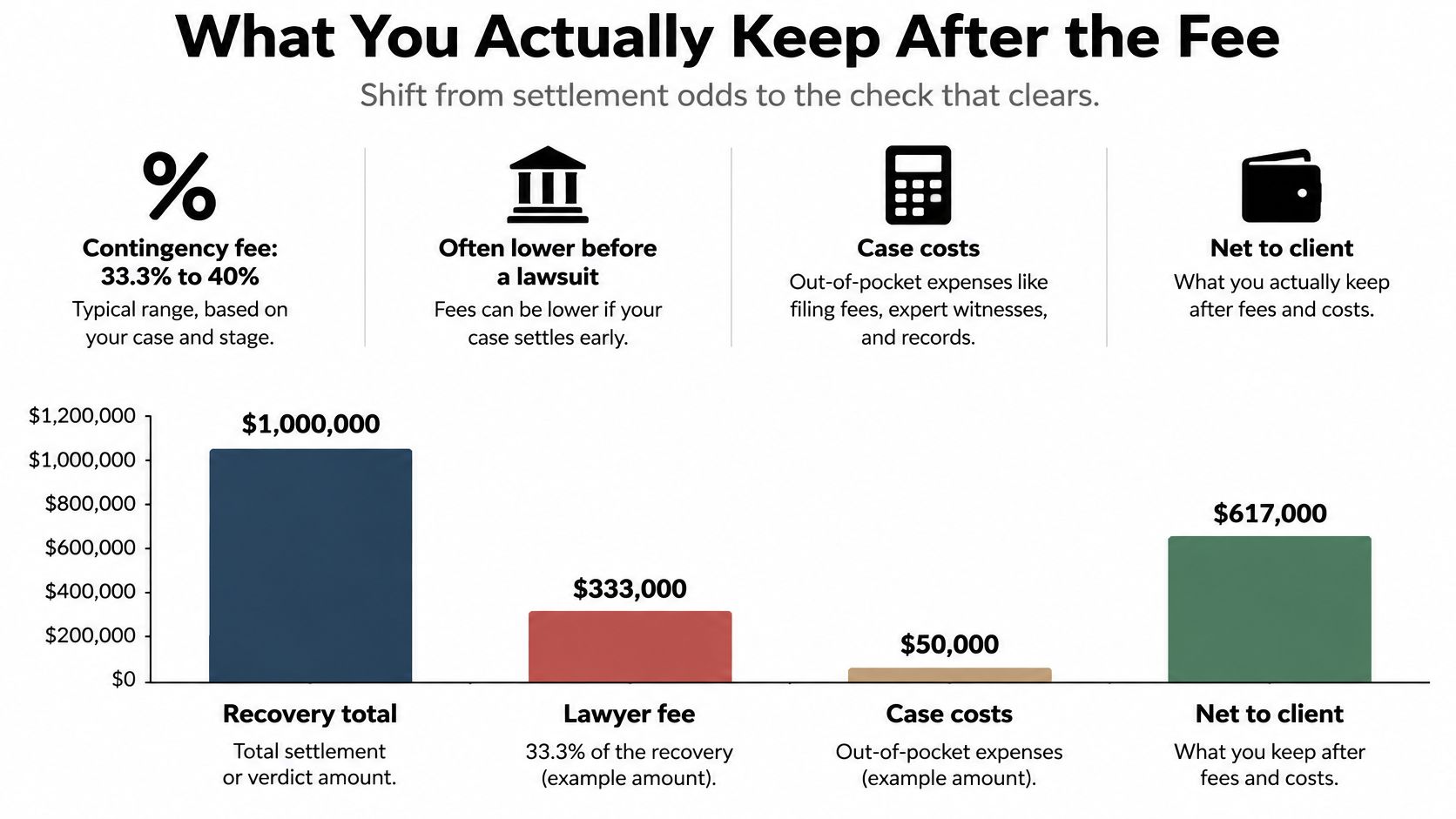
Contingency means the lawyer takes a percentage of the recovery, commonly discussed in a 33.3% to 40% range, often lower before a lawsuit and higher after filing. On a hypothetical $15,000 minor claim, a one-third fee consumes about $5,000, so counsel must add more than $5,000 in gross value just to break even before costs. Read a contingent fee agreement explained in plain terms before you compare percentages across firms.
Order matters as much as percentage. If costs come off before the fee, the fee is calculated on a smaller base, and you keep more. If the fee comes off the gross first, the same costs then reduce your share again. Health-plan reimbursement and provider liens are also paid from the recovery, so they’re not optional extras.
We seek reimbursement for economic damages such as medical and surgical bills, recovery costs, and lost wages. For some cases, we value non-economic harm by applying a multiplier to those economic damages. That method means documented bills and wage proof drive the starting number, which is why incomplete records shrink both parts of the claim.
Why higher gross can still mean lower net
The Insurance Research Council analysis of more than 7.4 million bodily-injury auto claims closed from mid-2017 through mid-2022 found represented claimants received $1.40 per dollar of medical expenses after legal fees and out-of-pocket costs, versus $1.80 for unrepresented claimants. Represented claims also took a median of nearly 440 days to close, more than twice as long.
Treat that $1.40 figure as a caution about net pay, not proof lawyers reduce value. Counsel isn’t assigned randomly. Severe, disputed, and liability-uncertain injuries attract lawyers, and those claims carry larger bills that pull the ratio down.
Representation has also become routine. Insurance industry research summarized in an Insurance Research Council social inflation report found attorney representation in bodily-injury auto claims rose from 47% in 2002 to 52% in 2017. Many of our cases take six months to reach settlement, and some lawsuits can take up to three years, so delay belongs in your calculation too. Ordinary California auto, premises, and rideshare claims aren’t automatically governed by medical-malpractice fee caps, so your written percentage controls.
Which Injury Claims Justify Hiring Counsel
| Case type | Usually worth counsel when | Often reasonable alone when | Rule that changes the math |
|---|---|---|---|
| Auto accident | Disputed fault, serious care, several insurers, or a low first offer | Clear fault, minor treatment, and an offer already near full value | Recovery is reduced by your share of fault |
| Rideshare passenger | The app was on, policies conflict, or driver and company blame each other | Minor injury and the insurer accepts fault and pays bills promptly | The rideshare policy, not only the driver’s policy, may apply |
| Premises injury | Notice is denied, video may be lost, or future care is likely | Hazard is documented and the early offer is fair | The fight is owner negligence and notice, not only the bills |
| Government defendant | Most viable claims, because the procedure is unusual | Rarely, the short claim deadline is easy to miss | A government claim can be due in months, not two years |
| Medical malpractice | Damages can cover expert costs and the proof is technical | A small matter with a fast, fair offer | Specialized proof and statutory fee caps apply |
Use the table as a screen
Find your row before you look at any dollar example. Counsel tends to earn the fee when fault is disputed, treatment is substantial, more than one insurer is involved, coverage may be stacked, or the first offer ignores future care. A straightforward minor claim with clear fault can reasonably be handled alone if the offer already sits near your medical bills plus a modest amount for inconvenience.
The types of personal injury cases differ mainly in what must be proved and which policy pays. That proof burden, not the label, decides whether professional help adds value. A simple rear-end claim and a contested fall can involve identical bills and opposite answers.
The wrinkle in each row
- Auto claims: A low California offer may reflect your assigned share of fault rather than insurer stinginess, so ask the adjuster to state the percentage they’re using.
- Rideshare claims: Ask early whether the driver’s personal policy or the transportation-network company’s policy applies, because coverage often turns on whether the app was on, a trip was accepted, or a passenger was in the car.
- Premises claims: The fight is usually whether the owner knew or should have known about the hazard, and video or incident reports can be overwritten or lost.
- Government claims: A claim against a city, county, or other public entity can require a formal government claim within months, which is a reason to get help quickly.
- Medical malpractice: Expert proof is expensive and technical, so damages must be large enough to absorb that cost before the fee makes sense.
Dollar Examples That Show the Break Even Point
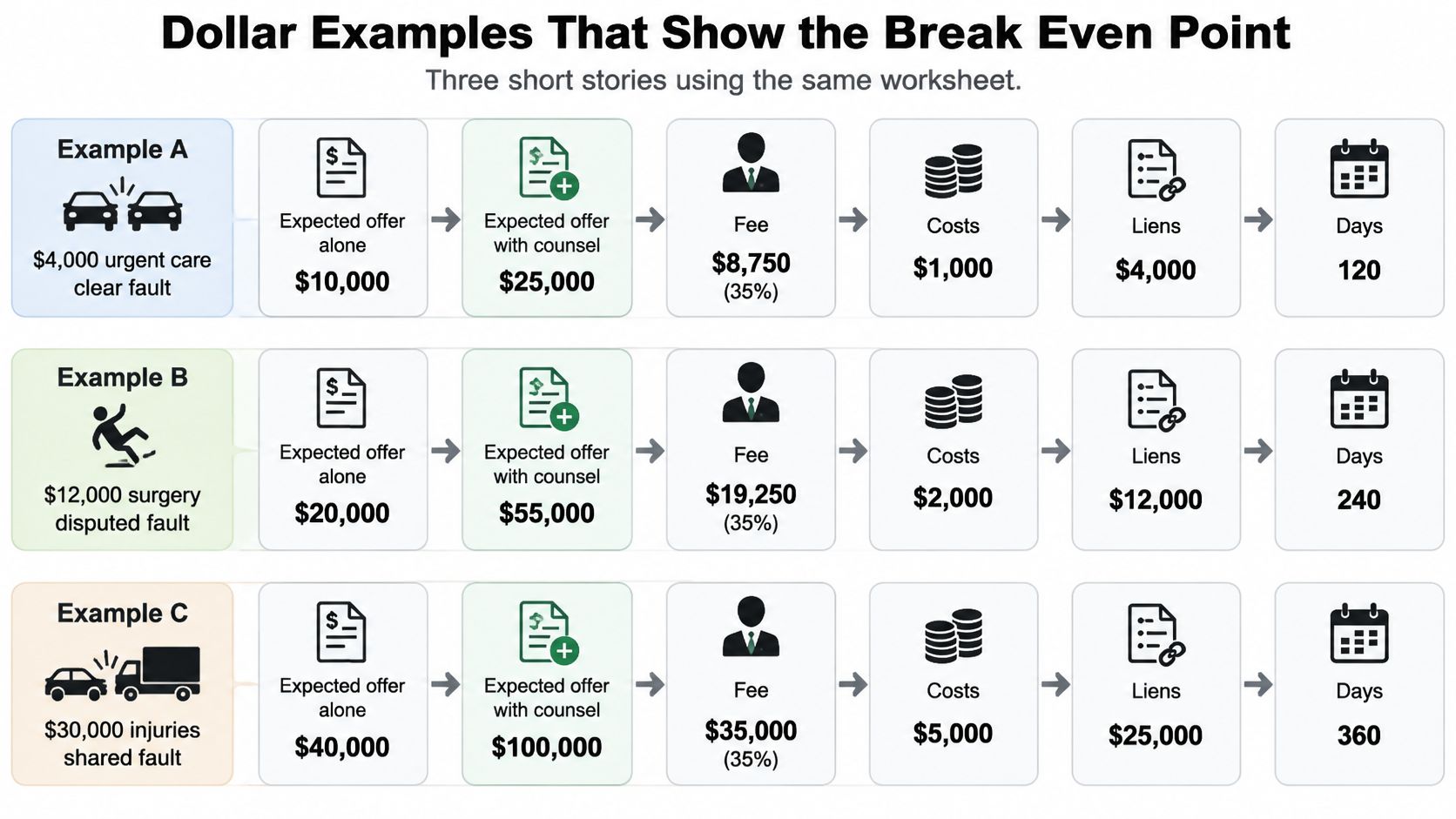
Three stories, one worksheet
Example A is a rear-end crash with $4,000 in urgent care, clear fault, and a $7,500 offer already in hand. A one-third fee on that same $7,500 would be about $2,500. Unless you believe counsel can push the gross well past $10,000 after costs, signing leaves you behind. A newly discovered policy or documented wage loss would flip that answer. Without one, it doesn’t.
Example B is a disputed left-turn crash with $28,000 in treatment, lost wages, and a $20,000 offer that assumes heavy shared fault. If counsel can support a $50,000 settlement, a 33% fee leaves about $33,500 before costs and liens. That can beat $20,000 even after a modest cost deduction. A bad fault finding would erase the advantage, which is why the liability evidence matters more than the multiplier.
Example C is a premises fall with future surgery and a recorded hazard the store denies noticing. The projected gross may look large, but a health-plan lien and unpaid treatment can consume the apparent gain. Ask for a sample closing statement before you sign. A negotiated lien reduction could be worth more than a small increase in the settlement itself.
Break-even rule: Counsel must add more gross value than the fee, the added costs, and any lien increase combined, or you’re paying for a larger number and a smaller check.
If negotiation fails, the matter may proceed to litigation. Filing can raise both the fee percentage and the timeline, stretching a months-long claim toward a multi-year lawsuit. That tradeoff can still be right, but you should choose it knowingly.
Your six-line scratchpad
- Current offer: Write the number you can accept today.
- Projected gross: Write the lawyer’s realistic estimate, not the best case.
- Fee: Subtract the stated percentage at the stage likely to apply.
- Costs: Subtract case costs and note whether they come off before the fee.
- Liens: Subtract liens and unpaid bills that must be repaid from the recovery.
- Comparison: Compare that net with today’s offer, and weigh the extra months.
These figures are illustrations for testing a fee quote. They aren’t predictions for any real claim, and no lawyer can guarantee that a projected gross will materialize.
California Deadlines Fault and Fee Limits

The two-year rule and its exceptions
The California Courts statute of limitations guidance states a person generally has two years from the date of a personal injury to file a civil lawsuit under Code of Civil Procedure section 335.1. Missing that deadline can prevent a court from hearing the claim at all. A fuller overview of the statute of limitations for personal injury helps you spot why your date may not be the standard one.
Don’t treat two years as universal. Medical malpractice, claims against government entities, minors, and delayed discovery can follow different or shorter timelines. A public-entity claim often must be presented within months, long before a lawsuit deadline arrives.
How shared fault shrinks the number
California follows pure comparative fault, so your recovery falls by your percentage of blame rather than disappearing. If a jury values harm at $100,000 and finds you 30% at fault, the recovery is $70,000 before fees and costs. It isn’t zero, and it isn’t the full amount.
That reduction explains some offers that look insulting at first glance. The adjuster may be pricing shared blame, not denying your injury. Ask which fault split produced the number, because changing that split is often where counsel adds the most gross value.
The malpractice fee cap is separate
Business and Professions Code section 6146 limits contingency fees in professional-negligence cases against health-care providers to 25% when the matter settles before a complaint or arbitration demand, and 33⅓% after filing. A higher fee after trial or arbitration requires a motion showing good cause and court approval.
Those ceilings don’t automatically govern ordinary automobile, premises, or rideshare cases. For those claims, the percentage comes from your written agreement, so don’t assume a statutory cap protects you. The practical rule stays simple. Hire when the expected added gross from evidence, valuation, negotiation, or litigation exceeds the fee and added costs.
Questions That Expose a Bad Fee Deal
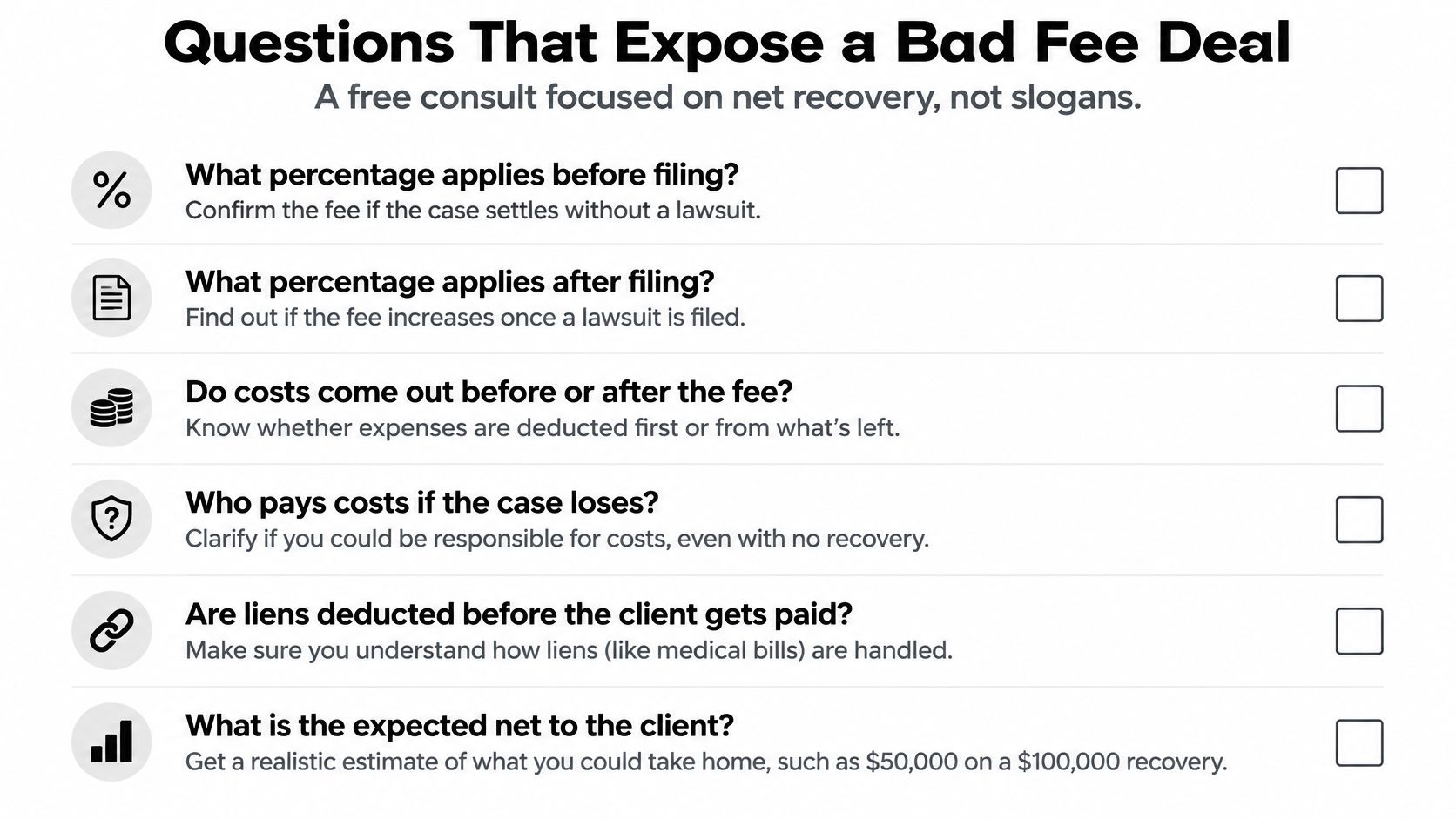
Seven questions separate a workable fee from one that eats the recovery. Bring them to a free consultation, write down the answers, and compare the projected net against the offer already in hand.
- Percentage by stage: What is the fee before filing, after filing, and after trial?
- Fee order: Do costs come out before or after the percentage is calculated?
- Loss costs: Who pays expert, filing, and record expenses if the claim loses?
- Settlement authority: Can any offer be accepted without your approval?
- Sample closing statement: Can you show fees, costs, and medical liens on a sample number?
- Net comparison: How does the projected net compare with the offer you have now?
- File handling: Who handles your file, and how often will you receive updates?
Fee order changes the answer more than the headline percentage. A 33% fee calculated after costs leaves more in hand than the same percentage applied before costs, especially when medical liens take another share. Ask for the sample closing statement so the sequence appears on one page.
LA Law Group discusses the specifics of your case and what to expect during the initial consultation, reviews what happened, and explains injury claim options in plain language. Everything you share is protected by attorney-client privilege and remains confidential. Asking questions does not create a representation agreement by itself.
Pricing deserves directness. A 2025 survey of 1,274 consumers found nearly 20% identified pricing as a major hiring factor, while respondents frequently emphasized experience and track record. Ask for relevant results, but do not treat advertisements as promises.
Walk away from pressure to sign before the fee order is explained, a guaranteed dollar result, refusal to say who pays costs after a loss, or advice to inflate treatment. Spanish-speaking Californians should ask to consult in Spanish and receive the fee agreement in a language they can review carefully.
Decide With a Written Net Recovery Estimate
If your current offer already sits close to your medical bills and fault is clear, get the fee quote in writing and sign only if the projected net beats it by enough to justify the wait. If fault, coverage, a rideshare policy, a premises video, or a short government deadline is in play, treat the consult as the comparison rather than a commitment.
Bring the offer letter, medical bills, wage proof, and photos. Our first consultation is free and confidential and is held with the attorney who will handle the matter, and it should end with clear options rather than a slogan. We help injured people with car accidents, rideshare crashes, pedestrian and bicycle injuries, and premises claims.
One boundary matters. If your problem is a suspended Amazon seller account with inventory or funds withheld, that’s a platform and contract dispute, not a bodily-injury contingency case, so this worth-it test doesn’t apply. General information still can’t set your deadline, value, or fee, and only a qualified attorney can give case-specific advice.
Leave with one page in hand. It should show the offer today, the projected gross, the percentage, the costs, the liens, and the net difference. That page, not a headline settlement, answers whether are personal injury lawyers worth it for your claim.
Bring your current offer, medical bills, and wage records to LA Law Group, APLC and ask us to run the net recovery comparison line by line before you sign anything. We’ll tell you plainly if handling the claim yourself leaves you ahead, and if counsel can realistically beat your offer after fees, costs, and liens, we’ll show you the written estimate that proves it.
Attorney Advertising. This article is general information, not legal advice, and does not create an attorney-client relationship. Prior results do not guarantee a similar outcome.