
Your Guide to Auto Insurance for Illegal Immigrants
Disclaimer: This article is for informational purposes only and is not to be construed as legal advice. No attorney-client relationship exists based on the review of this article, and none of the information in this article constitutes legal advice.
It’s a question we hear all the time: Can you really get car insurance if you’re an undocumented immigrant? The answer is a clear and simple yes.
Your ability to get a driver’s license—and therefore, car insurance—is decided at the state level, not by federal immigration status. If you have the right documents, like a foreign passport or an Individual Taxpayer Identification Number (ITIN), you can absolutely get the coverage you need to drive legally and protect your family financially.
Your Roadmap to Getting Car Insurance
Figuring out insurance can feel like a maze, but getting auto insurance as an undocumented immigrant is completely achievable. In fact, it’s one of the most important steps you can take to drive safely and with peace of mind. The whole process really comes down to your state’s driving laws, not your federal status. Think of it this way: the DMV calls the shots on who gets to drive, not immigration authorities.

This guide is here to cut through the confusion and give you the practical knowledge you need. We’ll walk through how forward-thinking state laws, especially California’s landmark Assembly Bill 60 (AB 60), have created a straightforward path for undocumented residents to get a driver’s license. That license is your golden ticket to the insurance market.
Important Disclaimer: This article provides general information for informational purposes only and should not be taken as legal advice. Reading this does not create an attorney-client relationship, and the information contained herein is not legal advice.
What This Guide Covers
Our mission is to break this down into simple, easy-to-follow steps. We’ll cover the essentials, including:
- Key Documents: We’ll look at what you need if you don’t have a Social Security Number, like an Individual Taxpayer Identification Number (ITIN).
- State-Specific Rules: Why your very first step is always to understand the laws in your specific state.
- Finding the Right Insurer: Tips on how to find insurance companies that are happy to work with immigrant drivers.
- Protecting Yourself: The real-world consequences of driving uninsured and why coverage is so critical.
Getting a handle on these key points will help you navigate the process with confidence. Remember, car insurance isn’t just about following rules—it’s about putting a vital shield of financial protection between your family and the unpredictable nature of the road.
How State Laws Shape Your Ability to Get Insured
When you’re trying to get car insurance as an undocumented immigrant, it’s easy to assume your federal immigration status is the biggest hurdle. But the reality is actually much more local. The single most important factor isn’t federal policy at all—it’s the laws in the state where you live.
Think of it this way: the federal government handles the rules for who can live in the country, but it’s your state’s Department of Motor Vehicles (DMV) that makes the rules for who can drive on its roads. This is a crucial distinction. It turns what seems like an immigration problem into a state licensing and road safety issue.

The Power of State Licensing Laws
More and more states are realizing that our roads are safer when all drivers are properly licensed, tested, and insured, no matter their immigration status. This commonsense approach has led to new laws that allow undocumented residents to get a legal driver’s license.
These laws are the key that unlocks the door to car insurance. Without a valid driver’s license, it’s virtually impossible to buy a policy from any reputable insurance company.
Key Takeaway: Your journey to getting insured really starts with one simple question: “Does my state let undocumented residents get a driver’s license?” If the answer is yes, you’ve got a clear path forward.
California’s Assembly Bill 60 (AB 60) is the most famous example of this. Signed into law back in 2015, this landmark legislation lets eligible California residents apply for a driver’s license even if they can’t show proof of legal U.S. presence. Applicants just need to prove who they are and that they live in the state.
Following California’s lead, many other states have passed similar laws. Today, 19 states and the District of Columbia now have laws on the books that allow undocumented immigrants to get a driver’s license, creating a legal way for millions of people to become insured drivers.
States That Allow Licenses for Undocumented Residents
These forward-thinking states have decided that public safety comes first. They ensure all drivers meet the same standards for testing and accountability. The states currently offering this opportunity include:
- California
- Colorado
- Connecticut
- Delaware
- Hawaii
- Illinois
- Maryland
- Massachusetts
- Minnesota
- Nevada
- New Jersey
- New Mexico
- New York
- Oregon
- Rhode Island
- Utah
- Vermont
- Virginia
- Washington
- District of Columbia
Compulsory Insurance: The Universal Rule
Once you have that state-issued driver’s license in hand, the next piece of the puzzle is understanding compulsory insurance laws. Almost every single state has them, and they apply to every driver on the road—no exceptions.
These laws require all licensed drivers to carry at least a minimum amount of liability insurance. This isn’t just a good idea; it’s the law. It’s designed to protect everyone by making sure there’s a financial safety net to cover damages and injuries if a driver causes a crash.
The exact coverage amounts can vary a lot from state to state. For example, our guide on the minimum insurance requirements in California details the specific liability coverage you need for bodily injury and property damage. If you have a valid state license, an insurer cannot legally refuse to sell you this required coverage just because of your immigration status. This is the legal foundation that makes getting insured a real possibility in states with inclusive licensing laws.
The Real Impact of Licensing Laws on Insurance Access
Think of a driver’s license as more than just a piece of plastic. For an undocumented immigrant, it’s the master key that unlocks the door to the auto insurance market. Without that key, getting legal, affordable coverage is nearly impossible.
The connection is straightforward. Insurance companies determine your risk level based on your official driving record, and that record starts the moment you’re issued a state license. When a state creates a legal path for undocumented residents to get licensed, it completely changes the game.
This isn’t just a win for one person trying to get insured; it creates positive ripples throughout the entire system. More licensed drivers mean more insured drivers. It’s a simple formula with a huge impact on road safety and financial security for all of us.
How Licensing Laws Create Safer Roads for Everyone
When states pass laws allowing undocumented immigrants to obtain driver’s licenses, they aren’t just handing out permits—they’re promoting accountability. To get a license, every applicant has to pass the same vision, written, and road tests as any other resident. They have to learn the rules of the road and prove they can drive safely.
This process makes our roads safer, period. Understanding specific state policies, like California’s law allowing undocumented immigrants to obtain driver’s licenses, shows just how directly licensing ties into insurance eligibility. When drivers are insured, they become financially responsible, which protects every other motorist on the road.
The proof is in the data from states that have already embraced these inclusive policies. These laws have been shown to significantly reduce the number of uninsured drivers, a benefit that helps all policyholders by stabilizing the insurance market and even potentially lowering premiums down the road.
The Big Picture: At their core, licensing laws for undocumented immigrants are public safety initiatives. They bring a hidden population of drivers out of the shadows, turning them into tested, licensed, and insured members of the community. That makes the roads safer for every single person.
Real-World Data: The Proof Is in the Numbers
The benefits of these licensing laws aren’t just a theory; they’re backed by hard evidence. States that pioneered this approach have seen clear, measurable success. By creating a system where more drivers can participate legally, these states watched their uninsured motorist rates drop.
Multiple studies have confirmed this trend. Expanding license access directly correlates with a lower percentage of uninsured drivers, which in turn reduces the costs that usually get passed on to everyone else.
Look at New Mexico. After passing its law in 2003, the state’s uninsured motorist rate plummeted from around 33 percent in 2002 to just 10.6 percent by 2007. Utah saw a similar result after changing its law in 1999, with its uninsurance rate falling from about 10 percent to 5.1 percent over the next several years.
These numbers tell a powerful story. Denying licenses doesn’t stop people from driving—it just stops them from getting insured. Smart, forward-thinking laws that create a path to licensure build a stronger, more inclusive, and financially sound insurance system for all residents.
Disclaimer: This article is for informational purposes only and does not constitute legal advice. No attorney-client relationship is formed by reading this article.
Your Checklist for Getting Insurance Paperwork Together
Nothing’s more frustrating than showing up to apply for something, only to realize you’re missing a key piece of paperwork. Let’s walk through exactly what you’ll need to feel prepared and confident when you apply for auto insurance. Even without a Social Security Number (SSN), plenty of insurance companies have a process for applicants just like you. The trick is knowing what they’ll accept instead.
Getting your documents in order ahead of time just makes everything smoother. Think of it like gathering your ingredients before you start cooking—it shows you’re serious and organized, and it helps the whole process go off without a hitch.
The Most Important Document: Your ITIN
For many undocumented immigrants trying to secure auto insurance, the single most valuable document you can have is your Individual Taxpayer Identification Number (ITIN). This is a tax-processing number issued by the IRS for people who need to file taxes but don’t have and aren’t eligible for an SSN.
For an insurance company, an ITIN is a solid substitute for an SSN. It allows them to create a profile for you, run the necessary background checks, and process your application. It’s a sign of financial responsibility and is widely recognized in the industry. For many, getting an ITIN is the critical first step.
Why the ITIN Matters: An ITIN isn’t just for taxes. It’s a key that unlocks access to financial products, including the car insurance you need to drive legally and safely. It’s the most common and accepted alternative to an SSN in this situation.
Building Your Document Portfolio
Once you have your ITIN, the next step is pulling together the other essential documents. Insurers need to verify who you are, where you live, and the details of the car you want to cover. Having these ready will seriously speed things up.
Here’s a simple checklist of what you’ll likely need to bring:
- A Valid Driver’s License: This has to be a state-issued license. In California, that means your AB 60 license, which proves you’ve passed the necessary tests to drive safely.
- Proof of Identity: A foreign passport is the gold standard here, but other official documents might also be accepted.
- Consular Identification: A consular ID card, like the Matricula Consular issued by Mexican consulates, often works as another valid form of ID.
- Proof of Residence: You have to show you live in the state. A recent utility bill, a bank statement, or a rental agreement with your name and address on it will do the job perfectly.
- Vehicle Information: Get your car’s Vehicle Identification Number (VIN), make, model, and year ready. If you already own the car, bring the title or registration.
The Application Process, Step-by-Step
With your documents organized, you’re ready to apply. The process is probably more straightforward than you think.
- Contact Insurance Providers: Before you go anywhere, call a few companies and ask specifically if they accept an ITIN and an AB 60 license. This little step saves a ton of time and makes sure you’re only dealing with companies that are ready to help.
- Submit Your Application: Hand over all your documents to the insurance agent. They’ll use this info to build your profile and figure out a quote.
- Review Your Quote: The agent will come back with your insurance options and prices. This is your chance to ask questions. Don’t be shy—make sure you understand what each type of coverage actually means.
- Make Your First Payment: To get the policy started, you’ll need to make the first premium payment. Once that’s done, you’ll get your proof of insurance card. Always keep this in your vehicle.
Choosing the Right Coverage and Understanding Your Costs
Once you have your documents ready, the next step is picking an auto insurance policy that fits your life and your budget. The world of insurance can feel like a maze, but if you grasp a few key ideas, you’ll be able to make a smart choice. Securing auto insurance for illegal immigrants is all about matching the right protection to your unique situation.
Think of an insurance policy as a shield. You get to decide how strong that shield is. The three main pieces are liability, collision, and comprehensive coverage, and each one offers a different kind of protection.
Decoding Your Coverage Options
Getting a handle on these core types of coverage is the first step toward building a policy that actually works for you. Each one has a specific job, and knowing the difference is everything.
-
Liability Coverage: This is the bare-bones foundation of any policy and is required by law in almost every state. If you cause an accident, liability pays for the other person’s car repairs and medical bills. It does not cover your own car or your own injuries.
-
Collision Coverage: This is the part of the policy that pays to fix or replace your own car after a crash that was your fault. Whether it’s a minor fender bender or something more serious, collision coverage is what gets your car back on the road without you having to pay for it all out of pocket.
-
Comprehensive Coverage: This protects your car from just about everything else that isn’t a crash. Think of it as the “life happens” coverage—it handles things like theft, vandalism, fire, storm damage, or hitting a deer. For a deeper dive, understanding comprehensive auto insurance can help you make a more informed choice.
This flowchart gives you a clear picture of the documents insurance companies are looking for when you apply.
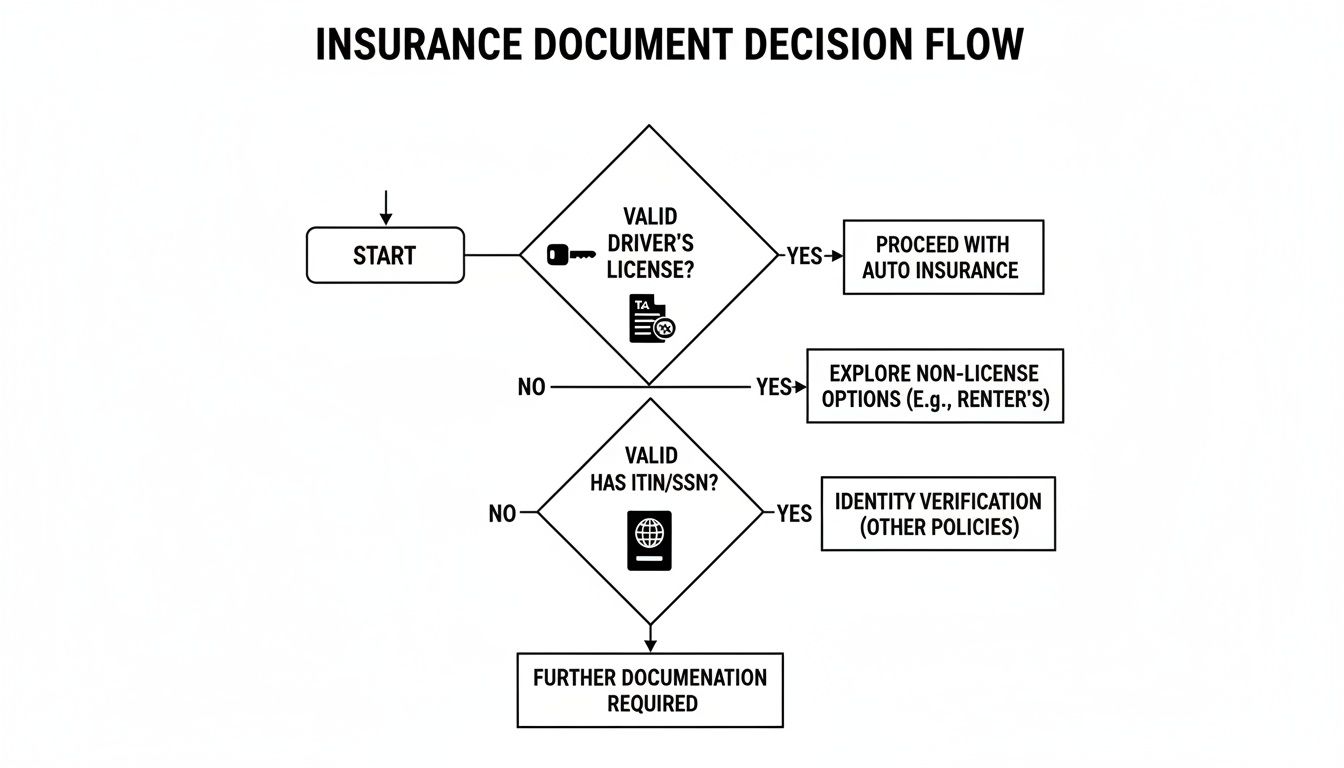
As you can see, getting a state-issued driver’s license is the most important first step. After that, securing an ITIN is your best alternative to a Social Security Number.
What Determines Your Insurance Premium
Your insurance premium—what you pay for your policy—is all about risk. Insurance companies look at a bunch of different factors to guess how likely you are to file a claim. While your immigration status isn’t a direct factor, some related circumstances can play a role.
Here are the key things they look at:
- Your Driving Record: A clean record with no accidents or tickets will always get you a better rate. It’s as simple as that.
- Your Address: Rates can change from one ZIP code to the next based on things like local traffic, theft rates, and accident statistics.
- Your Vehicle: The make, model, and age of your car directly impact how much it costs to repair, which in turn affects your premium.
- Your Driving History: This can be tricky for new immigrants. Without a long driving history in the U.S., insurers might see you as a higher risk at first, which can mean higher quotes.
It’s also worth noting that policies allowing undocumented immigrants to get licensed and insured actually help everyone. Research shows these laws are linked to a modest increase in the number of insured drivers on the road.
Studies looking at 41 states found that these inclusive driver’s license policies were tied to a roughly 1 percent increase in both licensed drivers and the amount of liability insurance coverage. This confirms that new licensees are, in fact, getting insured.
Protecting yourself from drivers who don’t have insurance is also critical. We’ve put together a guide to help you understand what is uninsured motorist coverage and how it can be a lifesaver.
What to Do If You Are in a Car Accident
No one wants to be in a car accident. The screech of tires, the jolt of impact—it’s a terrifying experience for anyone behind the wheel. But when you’re an undocumented immigrant, that initial shock can be compounded by a deep-seated fear of what comes next.
Don’t let that fear take over. Having a clear, step-by-step plan is the key to navigating the aftermath calmly, protecting your rights, and handling the situation with confidence. The absolute most important thing is to stay safe and follow a methodical process.

Your first move, always, is to check yourself and your passengers for injuries. If you can, move your vehicle out of traffic to a safer spot. Then, call 911 immediately.
This call is non-negotiable. It gets medical help to anyone who needs it, and it brings law enforcement to the scene to create an official police report. That report will become the single most critical piece of evidence for any insurance claim you make, providing an objective record of what happened.
Exchanging Information and Documenting the Scene
While you wait for help to arrive, you’ll need to exchange some basic information with the other driver. It’s crucial to know exactly what to share—and what to keep to yourself.
Let’s be crystal clear: your immigration status has absolutely nothing to do with a car accident. You are under no obligation to discuss it with the other driver, or even with the police.
Stick to the essential facts. You’ll want to collect:
- Full Name and Contact Information: Get the other driver’s name, phone number, and address.
- Insurance Details: You need their insurance company’s name and policy number.
- Vehicle Information: Jot down the make, model, color, and license plate number of their car.
Pull out your phone and become a detective. Take pictures of everything from multiple angles—the damage to both vehicles, any skid marks on the road, and relevant traffic signs or signals. For a more detailed guide on what to do in those first few moments, check out our post on what to do after a car accident.
Crucial Reminder: Never, ever admit fault at the scene. Not to the other driver, not to the police. Just state the facts of what happened. Let the insurance companies and the official reports sort out who is legally responsible.
This is where having your own insurance policy becomes your best defense. It shields you from what could be a devastating financial blow. When states create pathways for all residents to get a driver’s license, it directly leads to more insured drivers on the road, which makes everyone safer.
Starting the Insurance Claim Process
Once the dust has settled and you’re away from the scene, your very next call should be to your insurance company. Report the accident as soon as possible to get the claims process started.
Give your agent all the information you gathered, especially the police report number. They will walk you through the next steps, which usually involves an adjuster coming to assess the damage to your vehicle.
This is the moment your preparation pays off. By staying calm, gathering the right information, and having coverage in place, you put yourself in the strongest possible position to be treated fairly and get the protection you’ve paid for. Your actions right after an accident are what set the stage for a successful resolution.
Answering Your Top Questions About Immigrant Auto Insurance
Trying to get car insurance can feel complicated enough on its own. When you’re also navigating your immigration status, a lot of questions—and worries—can pop up. The good news is, getting insured is more straightforward than you might think. Getting clear, honest answers is the first step to moving forward with confidence.
We’ve put together some of the most common and urgent questions we hear about auto insurance for illegal immigrants. Our goal is to clear up the confusion and give you some peace of mind.
Can I Get Car Insurance With a Foreign Driver’s License?
This is where most people start, and it’s a great question. While a handful of insurance companies might give you a very short-term policy with a valid foreign license, this is really just a temporary band-aid, not a sustainable solution.
For reliable and affordable coverage, almost every insurer is going to require a U.S. state-issued driver’s license. In states like California, laws like AB 60 were created specifically to open up this path for everyone. Getting that state license is your best and most direct route to being properly insured.
Will an Insurance Company Report Me to Immigration?
This is a huge source of fear for many, but you can put this worry to rest. The answer is a firm no. Insurance companies are private businesses, not an extension of immigration enforcement. Their job is to evaluate financial risk, not police your status.
They operate under strict privacy laws that protect your personal information. Their business is to sell you an insurance policy, not to report your status to agencies like ICE. It’s simply not part of their business model, and doing so would land them in serious legal trouble.
Important Takeaway: Your relationship with an insurance provider is a confidential business deal. They are legally bound to protect your data. Their focus is on your driving record, not your immigration status.
Is Insurance More Expensive for Undocumented Immigrants?
The price you pay isn’t directly based on your immigration status, but on how much of a risk an insurer thinks you are. That said, certain factors that are common for new immigrants can lead to higher rates at first. Insurers love to see a long, clean U.S. driving record and a solid credit history—things many newcomers just haven’t had the time to build yet.
But this doesn’t mean you’re stuck paying high prices forever. You can take control and bring those costs down.
- Drive Safely: Nothing lowers your premium over time like a clean record. It’s the number one factor.
- Shop Around: Don’t just take the first offer. Get quotes from several different companies to see who gives you the best rate.
- Ask for Discounts: You’d be surprised what you can get. Insurers offer discounts for everything from safe driving apps to taking a defensive driving course.
What Happens If I Drive Without Any Insurance?
Driving uninsured is one of the biggest financial risks you can take. The consequences are severe in every state, and it’s just not worth it.
If you’re pulled over, you could be looking at thousands of dollars in fines, having your license suspended, and even getting your car impounded. Even worse, if you cause an accident, you’re on the hook personally for all the medical bills and property damage. That kind of debt can be financially devastating. Getting at least the state-minimum liability coverage isn’t just a suggestion—it’s a critical legal and financial shield for you and your family.
Navigating legal questions after an accident can be stressful. At LA Law Group, APLC, our experienced team is here to protect your rights and help you secure the compensation you deserve, regardless of your immigration status. For a free, confidential consultation, visit us at https://www.bizlawpro.com.
Attorney Advertising. This article is general information, not legal advice, and does not create an attorney-client relationship. Prior results do not guarantee a similar outcome.