
What Is the average car accident settlement california?

Disclaimer: This article is for informational purposes and is not to be construed as legal advice. No attorney-client relationship exists based on the review of this article, and none of the information in this article constitutes legal advice.
While there’s no single magic number for what a car accident case is worth, the latest data for 2025 shows the average settlement in California hovers around $29,700. But that number can be misleading. In reality, most claims for more common, minor injuries—like whiplash or bad bruising—usually settle somewhere between $5,000 and $25,000.
Of course, these are just ballpark figures. Every accident is different, and every person’s story has a unique value.
What to Expect From a California Car Accident Settlement
Disclaimer: This article is for informational purposes and is not to be construed as legal advice. No attorney-client relationship exists based on the review of this article, and none of the information in this article constitutes legal advice.
After a crash, one of the first questions on anyone’s mind is, “What is my case actually worth?” It’s a completely practical and urgent concern. You’re suddenly facing medical bills, you’re missing time from work, and you’re dealing with the real physical pain of your injuries. Getting a clear idea of what kind of compensation you might receive is the first step toward getting your life back on track.
It helps to think of a settlement not as a fixed price tag, but as a range. That range is determined by how severe your injuries are and the real-world impact they’ve had on your daily life. An insurance adjuster isn’t just going to hand over a check; they have a process for calculating an offer based on tangible losses and internal formulas, all designed to minimize what they have to pay out. This is exactly why understanding the different tiers of settlements is so critical.
Breaking Down the Settlement Tiers
To really make sense of the numbers, we break down accidents by the severity of the injuries. Each category tends to fall within a general settlement range, which gives you a much more realistic picture of what to expect.
- Minor Injuries: These are usually soft tissue injuries like sprains, strains, bruises, or a minor case of whiplash that gets better with minimal medical treatment.
- Moderate Injuries: This category is a step up, covering things like broken bones, concussions, or herniated discs that require more extensive medical care and could even involve surgery.
- Severe Injuries: We’re talking about life-altering injuries here. This includes traumatic brain injuries (TBI), spinal cord damage, or permanent disabilities that will require long-term, or even lifelong, care.
This chart illustrates the typical settlement ranges you might see for each of these categories right here in California.
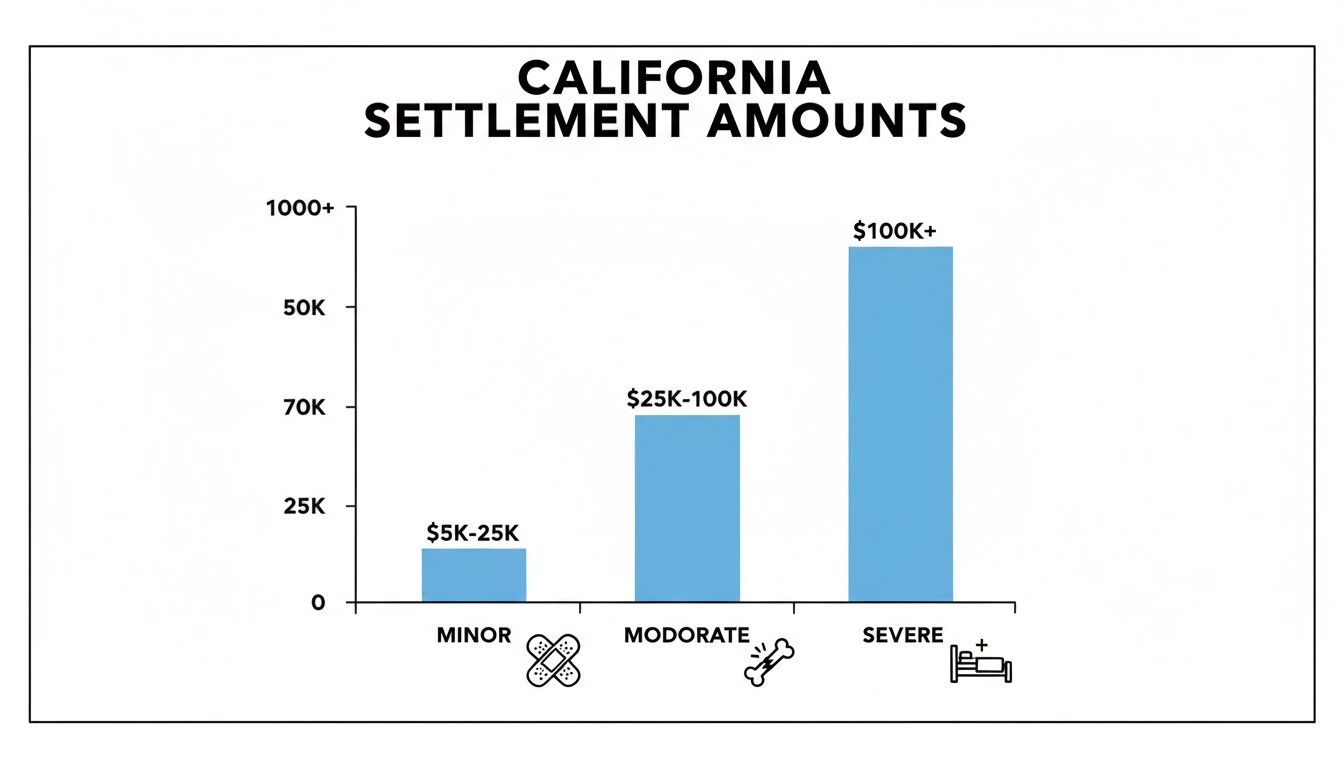
As you can see, the potential settlement value skyrockets with the severity of the injury. That’s a direct reflection of the higher medical costs and the much greater impact these injuries have on a person’s life.
California Car Accident Settlement Ranges At A Glance
To give you a clearer picture, this table breaks down the settlement ranges and the key factors that drive the value in each category.
| Injury Severity | Common Injuries Included | Typical Settlement Range | Primary Influencing Factors |
|---|---|---|---|
| Minor | Whiplash, sprains, bruises, minor cuts | $5,000 - $25,000 | Short-term medical bills, minimal lost wages |
| Moderate | Broken bones, concussions, herniated discs | $25,000 - $100,000+ | Surgical costs, physical therapy, significant lost income |
| Severe | Traumatic brain injury (TBI), paralysis | $250,000 - Millions | Lifelong medical care, loss of earning capacity, pain & suffering |
Remember, these ranges are a guide. The specific details of your case, like who was at fault and the available insurance coverage, will ultimately shape the final number.
Understanding the Averages
The hard truth is that insurance companies often rely on formulas to spit out initial offers. For people trying to handle a claim on their own, without a lawyer, these offers are often disappointingly low. Recent reports confirm that while the average settlement for injured California drivers is around $29,700, most minor cases resolve for much less. You can discover more insights about California settlement statistics to get a better handle on the landscape.
Your settlement needs to cover far more than just your immediate medical bills. It must account for future treatments, all the income you’ve lost, and the physical and emotional pain you’ve been forced to endure. If you don’t factor in everything, you risk accepting an offer that leaves you shortchanged down the road.
At the end of the day, the “average” settlement is much less important than what is fair for your specific situation. Every detail matters, from the cost of your physical therapy sessions to the hours you were forced to miss at work. In the sections ahead, we’ll dig into the specific factors that build the true value of your claim.
The Key Factors That Shape Your Settlement Amount
Disclaimer: This article is for informational purposes and is not to be construed as legal advice. No attorney-client relationship exists based on the review of this article, and none of the information in this article constitutes legal advice.
It’s tempting to look for a simple, one-size-fits-all number, but your potential settlement is more like a custom-built car than something off an assembly line. While averages can give you a rough idea, the real value comes down to the unique details of your accident. Several critical factors come together to build your claim, and each one plays a huge role in what a fair average car accident settlement in California looks like for you.

This isn’t some random process. It’s a methodical accounting of everything you’ve lost—from the concrete, like medical bills, to the deeply personal, like your pain. Every single piece has to be carefully documented and justified. Let’s break down the core components that will make or break your settlement.
Documented Economic Damages
Think of this as the foundation of your entire claim. Economic damages are the cold, hard financial losses you’ve suffered because someone else was careless. These are the numbers you can prove with a paper trail of receipts, invoices, and pay stubs.
These damages typically include:
- Medical Expenses: This is a big one. It covers everything from the ambulance ride and ER visit to surgery, physical therapy, medications, and any future medical care you’ll need down the road.
- Lost Wages and Earning Capacity: This isn’t just about the paychecks you missed while you were recovering. If your injuries are serious enough to keep you from returning to your old job, or if you have to take a lower-paying position, this calculation also has to account for that loss of future earning potential.
- Property Damage: The cost to fix or replace your vehicle is a major part of any settlement. Getting a handle on these expenses is key; you can even research things like the typical costs associated with common car damages like a side mirror replacement to get a better sense of things.
Documenting every penny is non-negotiable. You can get a deeper look by reading our guide on https://www.bizlawpro.com/understanding-economic-damages-in-a-personal-injury-claim/.
Non-Economic Damages: Pain and Suffering
A car accident is so much more than a stack of bills. It takes a massive physical and emotional toll, and that’s where non-economic damages come in. These are harder to put a price tag on, but they’re an absolutely essential part of your compensation. They’re meant to address the human cost of the crash.
This part of your settlement addresses the real-world impact on your quality of life. It covers the physical pain from your injuries, the emotional distress of the trauma, anxiety, loss of enjoyment of daily activities, and the overall disruption to your life.
Figuring out this value is subjective, which is precisely why having an experienced legal team fighting for you makes all the difference.
California’s Pure Comparative Negligence Rule
Here’s a rule you need to understand: California operates under a “pure comparative negligence” system. It sounds complicated, but the idea is actually pretty simple. It means your final settlement gets reduced by your percentage of fault in the accident.
For example, let’s say your total damages add up to $100,000. If the court finds you were 20% at fault—maybe you were going just a little over the speed limit—your final recovery gets cut by that percentage. In this case, you’d be able to receive $80,000 ($100,000 minus that 20%). This rule makes proving the other driver was completely at fault a top priority.
Insurance Policy Limits
Finally, we have to talk about the practical reality of insurance. There’s a hard ceiling on what you can recover: the at-fault driver’s policy limits. It doesn’t matter if your damages are calculated at $500,000; if the other driver only has a $50,000 policy, that’s typically the most the insurance company will pay out.
This is a major issue on California’s packed roads. The California Highway Patrol (CHP) reported around 224,592 injury crashes back in 2021, and by 2023, the state had over 27.7 million registered drivers. If your damages blow past the other driver’s policy limits, a good attorney will start looking for other options, like your own underinsured motorist coverage.
How a California Settlement Is Actually Calculated
Disclaimer: This article is for informational purposes and is not to be construed as legal advice. No attorney-client relationship exists based on the review of this article, and none of the information in this article constitutes legal advice.
Figuring out a fair settlement isn’t a guessing game; it’s a structured process. Think of it like building a house. You have to start with a solid foundation of concrete, verifiable costs—the stuff you can prove with a receipt—before you can add the walls, roof, and finishing touches.
In the legal world, that foundation is built with your special damages. These are the straightforward, tangible expenses tied directly to your accident. Each receipt, bill, and pay stub adds another brick to this foundation, creating a clear, undeniable picture of your direct financial losses that insurance companies have a hard time arguing against.
Starting with Special Damages: The Concrete Costs
Special damages, often called economic damages, are the starting point for any settlement negotiation. This is just the math—the sum of all the money you’ve lost or had to spend because someone else was negligent.
Here’s what typically gets tallied up:
- All Medical Bills: This covers everything from the initial ambulance ride and ER visit to surgery, hospital stays, prescriptions, and physical therapy.
- Future Medical Expenses: If your injuries need long-term care, like ongoing physical therapy or another surgery down the road, an expert will estimate these future costs.
- Lost Wages: This is the income you lost because you were out of work recovering. It’s simple to prove with pay stubs.
- Loss of Earning Capacity: This is a big one. If your injuries stop you from returning to your old job or earning what you used to, this calculates the wages you’ll lose over your entire working life.
- Property Damage: The cost to fix or replace your car and anything else that was damaged in the crash, like a laptop or phone.
Every single dollar has to be documented. A higher total of special damages doesn’t just mean you have more financial losses to recover; it also signals a more severe injury, which heavily influences the next part of your claim.
Adding General Damages: The Multiplier Method
Once the foundation of special damages is set, we calculate your general damages. These are the non-economic losses—the human cost of the accident. We’re talking about pain and suffering, emotional distress, and loss of enjoyment of life. Since you can’t put a price tag on pain, attorneys and insurance adjusters often use the “multiplier method” to assign a value.
With this method, your total special damages are multiplied by a number, usually between 1.5 and 5. The more severe, painful, and permanent your injuries, the higher that multiplier will be.
Let’s break that down with a quick example.
Imagine your total special damages (medical bills plus lost wages) add up to $20,000.
- With a 2x Multiplier: If your injuries were painful but you made a full recovery, the multiplier might be 2. Your general damages would be $40,000 ($20,000 x 2), making your total settlement target $60,000 ($20,000 + $40,000).
- With a 4x Multiplier: Now, let’s say that same accident required surgery and left you with chronic pain. The multiplier could easily be a 4. Your general damages would jump to $80,000 ($20,000 x 4), and your total settlement target climbs to $100,000 ($20,000 + $80,000).
As you can see, that multiplier makes a huge difference. Justifying a higher number is where the skill of an experienced attorney really comes into play. We use your medical records, expert testimony, and powerful personal impact statements to argue for a multiplier that truly reflects your suffering.
You can learn more by exploring our detailed guide on how to calculate a personal injury settlement. This meticulous approach ensures your claim is built not just on numbers, but on the full human cost of the accident.
Seeing It in Action With Real-World Scenarios
Disclaimer: This article is for informational purposes and is not to be construed as legal advice. No attorney-client relationship exists based on the review of this article, and none of the information in this article constitutes legal advice.
It’s one thing to talk about formulas and multipliers. But seeing how those numbers actually play out in real-world situations is what really makes it all click.
Let’s walk through a few anonymized scenarios based on common California accidents. You’ll see exactly how different variables—like the evidence we can find or the severity of an injury—can completely change the final outcome.

These examples show how a smart legal strategy can cut through the noise, prove who was at fault, and turn an insurance company’s initial lowball offer into a genuinely fair recovery.
Scenario One: The I-5 Rear-End Whiplash Case
Maria was sitting in the usual stop-and-go traffic on the I-5 when a distracted driver slammed into her from behind. At first, the impact didn’t seem like much, but within 24 hours, she was dealing with severe neck pain and stiffness.
Her doctor diagnosed her with whiplash, a classic soft tissue injury from these kinds of crashes. Getting better meant weeks of physical therapy and chiropractic visits, forcing her to miss a full week of work.
- Injuries: Whiplash and soft tissue strain.
- Evidence: A clear police report putting the other driver at fault, photos of the damage, and solid medical records from her doctor and physical therapist.
- Settlement Factors: Her economic damages were easy to tally: $6,000 in medical bills and $1,500 in lost wages. Because the injury was painful but not permanent, a lower multiplier of 2x was applied for her pain and suffering.
For a case like this, the final settlement typically lands between $15,000 and $25,000. This covers all her expenses and provides fair compensation for the pain and disruption to her life.
Scenario Two: The Disputed Red-Light Fracture
Next up is David, who got T-boned at a busy intersection in Los Angeles. He swore he had the green light, but the other driver claimed the exact same thing. The crash left David with a fractured arm that needed surgery to fix.
This case got complicated fast because fault was up in the air. If he couldn’t prove his side, California’s comparative negligence rule could have slashed his compensation.
A skilled legal team didn’t wait. They immediately tracked down traffic camera footage from the intersection. That video was the smoking gun—it clearly showed the other driver blowing through a red light, putting 100% of the liability on them.
This one piece of evidence changed everything.
- Injuries: Fractured ulna that required surgery.
- Evidence: The crucial traffic camera footage, surgical reports, and testimony from an orthopedic specialist about his risk of long-term arthritis.
- Settlement Factors: David’s medical bills and lost income were significant, totaling $45,000. Because he needed surgery and faced potential long-term issues, a higher multiplier of 3.5x was totally justified.
With clear proof of fault, this moderate injury case settled in the $85,000 to $110,000 range—a number that would have been a fantasy without that video evidence.
Scenario Three: The Complex Rideshare Passenger Injury
Finally, let’s look at Chloe. She was a passenger in a rideshare when her driver attempted an illegal U-turn and got hit by a truck. Chloe’s injuries were serious: a concussion and a herniated disc, which left her with chronic back pain and nerve issues.
This situation was a maze of insurance policies involving the rideshare company, the rideshare driver, and the truck driver. Untangling this requires a lawyer who knows this specific area of law inside and out.
It was quickly determined the rideshare driver was primarily at fault. The legal strategy then zeroed in on the rideshare company’s massive commercial insurance policy.
Settlement values are always tied directly to the severity of the injuries. For context, NAIC data from 2021 showed the average bodily injury liability claim in California was $51,634.68 per payout. With inflation, that number has only gone up. Minor injuries might settle for $10,000-$25,000, but severe cases like Chloe’s can easily climb into six-figure territory. You can discover more insights about California settlement amounts to see how these ranges work.
- Injuries: Concussion and a herniated disc with permanent nerve pain.
- Evidence: Expert testimony from a neurologist, rideshare app data proving the illegal U-turn, and Chloe’s own journal detailing her daily pain and limitations.
- Settlement Factors: Her economic damages for ongoing medical care and reduced earning ability were projected to be over $100,000. Given the permanent pain she now lives with, a multiplier between 4x and 5x was argued.
Cases like Chloe’s, with life-altering injuries and multiple parties involved, often result in settlements ranging from $250,000 to over $500,000. That’s what it takes to cover a lifetime of medical needs and make up for a permanently diminished quality of life.
Navigating the Settlement Timeline and Avoiding Pitfalls
Disclaimer: This article is for informational purposes and is not to be construed as legal advice. No attorney-client relationship exists based on the review of this article, and none of the information in this article constitutes legal advice.
Figuring out what your case might be worth is only one piece of the puzzle. The road from the day of the crash to the day you get a check is a journey, and it’s filled with potential traps that can sink your claim. Getting a fair average car accident settlement in California takes patience and a smart approach to sidestep the common mistakes that can cost you dearly.
Think of the settlement process as a marathon, not a sprint. A straightforward case where fault is obvious and injuries are minor might wrap up in a few months. But more complex claims, the ones with severe injuries or where the other driver is fighting liability, can easily take a year or even longer. It’s during this long wait that many people, understandably stressed and anxious, make crucial errors.
The Typical Settlement Process Unfolded
While no two cases are exactly alike, the journey usually follows a pretty standard path. Knowing these stages can help you manage your expectations and prepare for what’s coming.
- Investigation and Treatment: Right after the crash, the focus is on two things: gathering evidence (police reports, photos, witness info) and your medical recovery. Your most important job here is to follow every piece of advice your doctors give you.
- Reaching Maximum Medical Improvement (MMI): This is a huge milestone. MMI is the point when your doctors say you’ve recovered as much as you possibly can from your injuries. It’s only after you reach MMI that your attorney can get a true picture of your total medical damages, both for what you’ve already been through and what you’ll need in the future.
- The Demand Letter: With MMI reached and all your damages tallied up, your lawyer drafts and sends a detailed demand package to the insurance company. This packet lays out the facts, proves liability, breaks down your injuries, and makes a formal demand for a specific settlement amount.
- Negotiation: The insurance company will respond, and you can bet their first offer will be low. This is normal. It kicks off a period of back-and-forth negotiation, where your attorney uses the strength of your evidence to fight for a number that’s actually fair.
- Settlement or Litigation: The vast majority of cases get resolved right here, in the negotiation phase. If the insurer absolutely refuses to be reasonable, the next step is filing a lawsuit. This doesn’t mean you’re automatically going to trial—most cases still settle before then—but it shows you mean business.
This timeline can feel complicated. For a deeper dive, check out our guide on how long a personal injury case can take to settle.
Critical Pitfalls That Can Wreck Your Claim
As you move through this process, remember that the insurance adjuster is always looking for a reason to pay you less—or nothing at all. They are masters at twisting your words and using your actions against you.
The most dangerous period for your claim is often in the weeks right after the crash. You are in pain, stressed about bills, and not thinking like a legal strategist—and the insurance company knows it.
Here are three major traps to avoid at all costs:
- Giving a Recorded Statement: The other driver’s insurance adjuster will call you. They’ll be friendly and act like giving a recorded statement is just a routine part of the process. It is a trap. They are trained to ask tricky, leading questions to get you to downplay your injuries or accidentally admit some fault. Just politely decline and tell them your attorney will handle all communications.
- Posting on Social Media: It feels natural to want to update friends and family, but your social media is a goldmine for the defense. That one photo of you smiling at a birthday party can be spun to argue that your injuries aren’t as bad as you claim. The safest bet? Stay off social media entirely until your case is closed.
- Missing the Statute of Limitations: This is the one mistake you can’t come back from. In California, you generally have just two years from the date of the accident to file a lawsuit. If you miss that deadline, your right to seek compensation is gone forever, no matter how strong your case was.
Your Next Steps After a Car Accident
Disclaimer: This article is for informational purposes and is not to be construed as legal advice. No attorney-client relationship exists based on the review of this article, and none of the information in this article constitutes legal advice.
Feeling overwhelmed after a car crash is completely normal. The chaos, the adrenaline, the uncertainty—it’s a lot to handle. But what you do in the moments and days that follow is critical. Your immediate priorities set the foundation for any future claim, directly influencing the average car accident settlement California insurers will even consider.

First things first: seek immediate medical attention. This isn’t just about feeling hurt; it’s about being smart. Injuries like whiplash or even a concussion might not show symptoms for hours, sometimes days. Getting checked out creates a medical record, which is the single most powerful piece of evidence linking your injuries directly to the accident.
While you’re at the scene and if you’re able to, start gathering evidence. Snap photos of everything—the damage to all vehicles, the wider accident scene, and any visible injuries. Make sure to exchange information with the other driver and, just as importantly, get the names and numbers of anyone who saw what happened. This groundwork is invaluable later on.
Protecting Your Claim from the Start
Here’s one of the most expensive mistakes people make: they talk to the other driver’s insurance adjuster without getting legal advice first. You have to remember the adjuster’s goal is simple: pay out as little as possible for their company. They are expertly trained to ask questions that can get you to say something that weakens your own claim.
The best response is a polite but firm refusal. Just tell them you’ll be getting legal advice and your attorney will be in touch. This one simple move stops them from twisting your words against you.
This is the point where you shift from being a victim of the accident to being an advocate for your own recovery. It’s also where the true value of an experienced attorney really shines through. They step in and immediately take over all communications, shielding you from the insurance company’s tactics.
But a good lawyer does much more than just field phone calls. They take on the mountain of paperwork, meticulously gather all the evidence needed, and work with medical experts to calculate the true, long-term cost of your injuries. We’re not just talking about the medical bills you have today. We mean future treatments, lost earning capacity, and the very real cost of your pain and suffering. They build a powerful, evidence-backed case designed from the ground up to secure the compensation you rightfully deserve.
Your Top Questions About California Accident Claims Answered
Disclaimer: This article is for informational purposes and is not to be construed as legal advice. No attorney-client relationship exists based on the review of this article, and none of the information in this article constitutes legal advice.
When you’re dealing with the chaos after a car accident, a million questions are probably running through your mind. It’s completely normal. We’ve gathered some of the most common questions we hear and provided clear, straightforward answers to help you make sense of it all.
Will I Have to Pay Taxes On My Settlement Money?
For the most part, no. The IRS and the State of California do not consider compensation for physical injuries and medical bills to be taxable income. So, that portion of your settlement is yours to keep, tax-free.
However, if part of your settlement is specifically for lost wages or if you are awarded punitive damages (which are rare), those amounts could be considered taxable.
How Much Time Do I Have to File a Claim in California?
This is one of the most critical deadlines in any injury case. In California, you generally have two years from the date of the accident to file a personal injury lawsuit. If you miss this deadline, known as the statute of limitations, you almost certainly lose your right to recover any compensation for your injuries.
The rule is set by California Code of Civil Procedure Section 335.1. Waiting too long is one of the few mistakes that can completely sink an otherwise strong case. It’s crucial to speak with an attorney long before this two-year window starts to close.
What Happens If the Driver Who Hit Me Doesn’t Have Insurance?
It’s a scary thought, but it happens all the time on California roads. If the at-fault driver is uninsured or doesn’t have enough insurance to cover your damages, you can turn to your own policy if you have Uninsured/Underinsured Motorist (UIM) coverage.
This is an optional but highly recommended part of your own auto insurance policy, designed to protect you in exactly this situation. It allows you to file a claim with your own insurance company to cover your losses.
Is My Case Going to End Up in a Courtroom Battle?
It’s highly unlikely. The reality is that the vast majority of personal injury cases—well over 90%—are settled out of court.
Going to trial is expensive and time-consuming for everyone involved, including the insurance company. It’s usually a last resort when the insurer simply refuses to offer a fair settlement. A good attorney prepares every case as if it’s going to trial, because that’s what gives you the leverage to secure a fair deal during negotiations.
Disclaimer: This article is for informational purposes and is not to be construed as legal advice. No attorney-client relationship exists based on the review of this article, and none of the information in this article constitutes legal advice.
If you’ve been injured in an accident, you don’t have to face the insurance companies alone. The team at LA Law Group, APLC is ready to fight for the full compensation you deserve. Contact us today for a free, no-obligation consultation to discuss your case. https://www.bizlawpro.com
Attorney Advertising. This article is general information, not legal advice, and does not create an attorney-client relationship. Prior results do not guarantee a similar outcome.