
How much is the average settlement amount for car accident?

Disclaimer: This article is for informational purposes and not to be construed as legal advice. No attorney-client relationship exists based on the review of this article, and none of the information in this article is legal advice.
When people ask about the average settlement amount for a car accident, they’re searching for a simple, straightforward number. But the reality is far more complex. While settlements can range from a few thousand dollars for a fender-bender to over a million for catastrophic injuries, a typical payout often lands somewhere between $15,000 and $80,000.
Think of that range as a starting point. Every single case has its own unique financial story.
Understanding Typical Car Accident Settlement Ranges
Trying to pin down one “average” settlement number is a lot like asking for the average price of a house in America. It doesn’t really tell you much, does it? The answer completely depends on the location, the size, and the condition of the house.
A much better way to look at car accident settlements is to group them into tiers based on how severe the injuries are. Each tier reflects a totally different impact on a person’s life, from temporary pain to a permanent, life-altering disability. This approach helps set realistic expectations by connecting the financial outcome directly to the human cost of the crash.
Minor to Severe Injury Payouts
Let’s start with minor injuries. Things like whiplash, sprains, or soft-tissue bruising usually fall on the lower end of the payout spectrum. These cases generally involve less medical treatment and a faster recovery, which is reflected in the final settlement amount.
As the injuries get more serious, the settlement values climb, and they climb fast. For perspective, settlements for soft-tissue injuries might be in the $5,000 to $25,000 range. But if an injury requires surgery, that number can easily jump to $75,000 to $250,000 or more. And for the most tragic cases involving catastrophic harm like traumatic brain injuries, settlements can soar past $2 million. If you want to dive deeper, you can find more by exploring these car accident claim value insights.
This infographic gives you a clear visual of how dramatically settlement values increase as the injuries get worse.
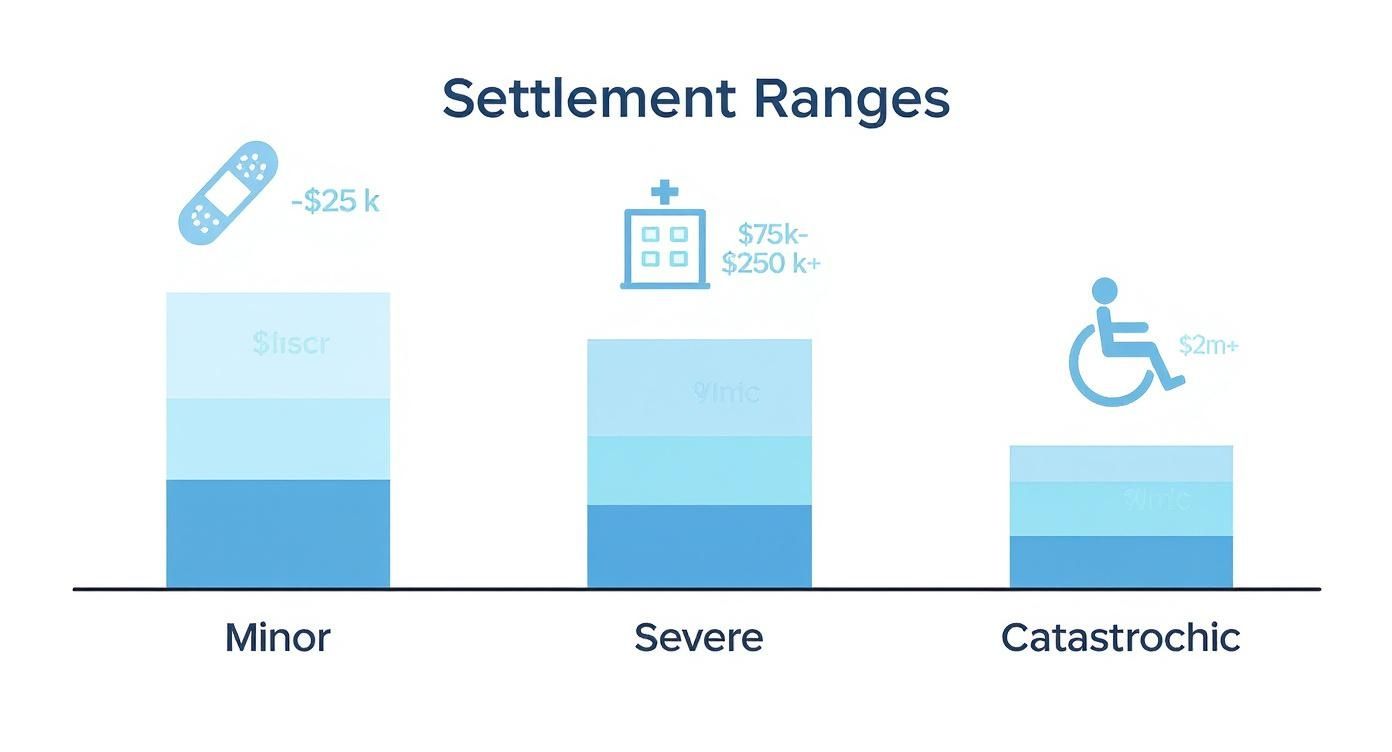
As you can see, the financial compensation is directly tied to the level of medical care and long-term support someone needs after a collision.
To give you a clearer picture, let’s break down these ranges into a simple table.
Estimated Settlement Ranges by Injury Severity
This table provides a quick overview of potential settlement ranges based on the type and severity of injuries sustained in a car accident.
| Injury Severity | Common Injury Types | Typical Settlement Range |
|---|---|---|
| Minor | Whiplash, bruises, minor sprains | $5,000 – $25,000 |
| Moderate | Herniated discs, simple fractures, concussions | $25,000 – $75,000 |
| Severe | Complex fractures, injuries requiring surgery | $75,000 – $250,000+ |
| Catastrophic | Traumatic brain injury (TBI), paralysis, permanent disability | $250,000 – $2,000,000+ |
Disclaimer: This article is for informational purposes and not to be construed as legal advice. No attorney-client relationship exists based on the review of this article, and none of the information in this article is legal advice.
Remember, these are just estimates. The specific details of your accident, your medical treatment, and the impact on your life will ultimately determine the final value of your claim.
Key Factors That Drive Your Settlement Value

While looking at averages gives you a general map of settlement ranges, the real value of your claim is always in the details. Every single car accident case has its own unique financial story, pieced together from specific, measurable elements that insurance companies and courts examine to land on a final number.
Think of it like building a case brick by brick. Each piece of evidence—from a doctor’s report to a pay stub—adds weight and value. Grasping these core components is the key to understanding why one settlement might be $10,000 while another, seemingly similar crash, could result in a payout over $100,000.
Economic Damages: The Foundation of Your Claim
The most straightforward part of any settlement calculation starts with the tangible, out-of-pocket costs you’ve paid because of the accident. These are known as economic damages, and they form the concrete foundation of your claim’s value.
These are the black-and-white numbers—the figures you can prove with receipts, bills, and employment records. Because they are so clear-cut, they become the critical starting point in any negotiation.
Key examples of economic damages include:
- Medical Expenses: This covers everything from the initial ambulance ride and ER visit to surgeries, physical therapy, prescription drugs, and any medical care you’ll need in the future.
- Lost Wages: If your injuries kept you from working, you can claim the income you lost during your recovery. This isn’t just salary; it includes hourly wages and even missed overtime opportunities.
- Loss of Earning Capacity: This applies to severe injuries that permanently impact your ability to do your job or even work at all. It compensates you for the income you will lose over the rest of your working life.
- Property Damage: This is simply the cost to repair or replace your vehicle and any other personal property, like a laptop or phone, that was damaged in the collision.
Calculating these figures requires meticulous record-keeping. To dig deeper into this crucial aspect, you can read our detailed guide on what economic damages are and how they are calculated.
Non-Economic Damages: Valuing the Human Impact
Beyond the stack of bills, a car accident takes a massive human toll. This is where non-economic damages come into play. These damages are meant to compensate you for the intangible, personal losses that don’t have an obvious price tag.
While they are harder to put a number on, these losses are just as real and impactful as any medical bill.
Valuing non-economic damages is more of an art than a science. It’s an attempt to place a monetary figure on the physical pain, emotional distress, and disruption the accident has caused in your daily life.
Common types of non-economic damages include:
- Pain and Suffering: This is compensation for the physical pain and discomfort you’ve already endured and will continue to deal with because of your injuries.
- Emotional Distress: This covers the psychological fallout from the crash, like anxiety, depression, fear, and even PTSD.
- Loss of Enjoyment of Life: If your injuries stop you from participating in hobbies, activities, or relationships you once loved, you can be compensated for that loss.
Since these damages are subjective, their value is often linked to the severity of the injuries and the strength of the evidence. A well-documented case with detailed medical records and powerful personal testimony is essential to getting fair compensation for these very personal harms. Of course, how clear fault is and the limits of the available insurance policies also play a massive role in shaping that final figure.
Disclaimer: This article is for informational purposes and not to be construed as legal advice. No attorney-client relationship exists based on the review of this article, and none of the information in this article is legal advice.
How Specific Injuries Shape Your Claim’s Worth
When it comes to the average settlement amount for a car accident, the nature and severity of your injuries are, without a doubt, the most powerful factor. Think of your injury as the central pillar holding up your entire claim—the more significant the injury, the stronger the foundation and the higher the settlement value needed to make things right.
Insurance companies have a system for this. They categorize injuries to get a ballpark idea of a claim’s potential value, creating a clear ladder from minor issues to truly life-altering conditions. As you might guess, each step up that ladder represents a major jump in financial compensation.
Soft Tissue and Minor Injuries
At the bottom of the value pyramid, you’ll find soft tissue injuries. This is a broad category that covers things like whiplash, muscle sprains, and deep bruises. While they can be incredibly painful and disrupt your life, they typically heal within weeks or months and don’t always require massive medical intervention beyond physical therapy or a good chiropractor.
Because the treatment is shorter and less intensive, settlements for these types of injuries tend to be on the lower end of the scale. The value is mainly calculated to cover the initial medical bills, some lost time from work, and the related pain and suffering.
Moderate Injuries with Long-Term Impact
Moving up a level, we get into moderate injuries like simple bone fractures, concussions, or herniated discs. These injuries mark a serious jump in settlement value because they often require much more than just time to heal.
We’re talking about potential surgery, months of physical therapy, visits to specialists, and a much longer time away from your job. The impact on a person’s daily life is far more pronounced, which naturally leads to higher compensation for both the measurable financial losses and the intangible suffering.
To give you an idea, car accident settlements for back and neck injuries can swing wildly depending on the severity. In a state like Washington, for example, a mild whiplash case might settle for $2,500 to $10,000, but a herniated disc requiring intervention could easily push that settlement into the $20,000 to $100,000 range.
Catastrophic and Severe Injuries
At the very top tier are the catastrophic injuries—the kind that permanently change someone’s life. This includes traumatic brain injuries (TBIs), spinal cord damage that leads to paralysis, severe burns, or the amputation of a limb.
A catastrophic injury isn’t just about a single medical event; it’s about a lifetime of necessary care. The settlement must account for future surgeries, ongoing therapy, in-home nursing assistance, and a permanent loss of earning capacity.
The financial need that comes with these injuries is massive, which is why their settlement values can easily reach hundreds of thousands or even millions of dollars. Properly documenting these injuries is absolutely critical. For those interested in the technical side of this, there are comprehensive guides on teleradiology services and imaging for injury documentation that explain the importance of medical imaging.
You can also learn more from our own guide on catastrophic and severe injuries caused by accidents. Ultimately, the goal is to provide enough financial security for a future that has been forever and fundamentally altered.
Navigating State Laws and Insurance Policy Limits

Beyond your specific injuries and financial losses, two powerful forces can dramatically shape the average settlement amount for a car accident: state laws and insurance policy limits. Think of these as the rules of the game for your claim. They set the boundaries and ultimately decide who pays for what.
It’s crucial to get a handle on these factors early on. Why? Because they can place a hard ceiling on your potential compensation, no matter how severe your injuries are. The theoretical value of your claim is one thing; what you can actually recover is another story entirely.
Disclaimer: This article is for informational purposes and not to be construed as legal advice. No attorney-client relationship exists based on the review of this article, and none of the information in this article is legal advice.
At-Fault vs. No-Fault State Laws
One of the first things to figure out is your state’s approach to accident claims. Most states, including California, are “at-fault” states. In simple terms, this means the person who caused the wreck is responsible for the damages. The injured person files a claim against that driver’s insurance to get compensated.
A handful of states follow a “no-fault” system. In those places, you first turn to your own insurance policy’s Personal Injury Protection (PIP) coverage. It pays for your initial medical bills and lost wages up to a set limit, regardless of who was at fault. You can only step outside this system and sue the other driver if your injuries are serious enough to meet a specific legal threshold.
How Shared Fault Can Reduce Your Payout
What happens if you were partially to blame for the accident? This is where comparative negligence rules kick in, and they can have a huge impact on your bottom line. California uses a “pure comparative negligence” standard, which means your total settlement gets reduced by your percentage of fault.
Example: Let’s say your total damages add up to $100,000. But a court decides you were 20% at fault—maybe you were going a little over the speed limit. Your final award would be slashed by that 20% (or $20,000), leaving you with a maximum recovery of $80,000.
This rule is exactly why proving the other driver was clearly at fault is so critical. Even a small assignment of blame can take a significant bite out of your final compensation.
The Critical Role of Insurance Policy Limits
Finally, we have the most practical hurdle of all: the at-fault driver’s insurance policy limit. This is often the biggest reality check in a car accident case.
You could have a claim that’s legitimately worth $200,000, but if the driver who hit you only carries California’s minimum liability coverage of $15,000 for a single injury, their insurance company is only on the hook for that $15,000. That’s it.
This is where the fine print on an insurance policy becomes everything. Understanding what a full coverage auto insurance policy entails versus a bare-bones minimum plan shows just how wide the gap can be. If the other driver’s policy is too small to cover your damages, your best option may be to turn to your own Underinsured Motorist (UIM) coverage—if you had the foresight to purchase it. At the end of the day, these policy limits create a firm cap on what is realistically available.
Why Online Settlement Calculators Fall Short

If you’re trying to figure out the average settlement amount for a car accident, you’ve probably come across a few online settlement calculators. They promise a fast, simple estimate of what your claim is worth. While it’s tempting to plug in your numbers, relying on these tools can give you a dangerously false sense of security.
Let’s be clear: a simple online form can’t possibly grasp the complex, deeply human elements of your case. It’s just an algorithm, and an algorithm can’t understand the true depth of what you’ve lost.
These calculators are built to spit out a ballpark figure based on a few inputs. But your case isn’t a ballpark—it’s your life. They completely miss the unique variables that give a claim its real value.
An online tool can’t measure the day-to-day impact of your injuries. It also has no way of factoring in the skill of a seasoned attorney or the specific legal nuances that apply in your state.
The Missing Human Element
Think of a settlement calculator like a vending machine. You put in a few bits of data, and it gives you a pre-packaged, generic number. A real personal injury claim, however, is more like a custom-tailored suit—it has to be measured and crafted to fit your exact circumstances.
A calculator will always miss the critical details, such as:
- The true extent of your pain and suffering and how it has turned your daily life upside down.
- The strength of the evidence you have and how persuasively it can be presented.
- The reputation and tactics of the specific insurance adjuster you’re dealing with.
These tools just scratch the surface. They might ask for your total medical bills, but they rarely dig into the long-term emotional and psychological trauma that follows a serious accident. For a better sense of how these non-economic damages are actually valued, it helps to understand the factors behind a real pain and suffering settlement calculator when used by a legal expert.
Ultimately, there’s only one way to get an accurate assessment: talk to a professional. A consultation with a personal injury lawyer gives you a personalized evaluation, not a generic guess. It’s the only real first step toward understanding what your claim is truly worth.
Disclaimer: This article is for informational purposes and not to be construed as legal advice. No attorney-client relationship exists based on the review of this article, and none of the information in this article is legal advice.
Answering Your Top Settlement Questions
After going through all the numbers and factors, it’s completely normal to still have a few key questions floating around. Let’s tackle some of the most common ones head-on.
How Long Does a Settlement Take?
There’s no single answer here; the timeline can be anything from a few months to several years. A straightforward case, where fault is crystal clear and injuries are minor, might wrap up relatively quickly.
But when you’re dealing with serious injuries or a dispute over who’s to blame, things slow down. These complex claims often take much longer, especially if filing a lawsuit becomes necessary to get a fair result.
Is My Settlement Money Taxable?
For the most part, no. The portion of your settlement that’s meant to cover physical injuries and medical bills is not taxable in the eyes of the IRS.
However, if you receive compensation for lost wages or for emotional distress that isn’t directly linked to a physical injury, that part might be taxed. It’s always a smart move to run this by a tax professional to be sure.
Should I Take the First Offer?
Accepting the first offer from an insurance company is almost always a bad idea. Think of it this way: their goal is to close your claim for the absolute minimum amount possible. That initial offer is just their opening bid, not their best one.
Jumping on it too quickly can leave you high and dry, especially if you need medical care down the road. Keep in mind that the average auto liability claim for bodily injury has been climbing. In 2022, that average hit $26,501, and it stayed in that ballpark for 2023—way more than the average property damage claim of around $6,550. You can see more details on these personal injury statistics on clio.com.
Important Reminder: This article is for informational purposes and not to be construed as legal advice. No attorney-client relationship exists based on the review of this article, and none of the information in this article is legal advice.
Navigating a car accident claim is a complex maze of legal and financial hurdles. The team at LA Law Group, APLC has the expertise in both law and business to protect your rights and fight for the full compensation you deserve. For a personalized look at your case, contact us today for a free consultation at https://www.bizlawpro.com.
Attorney Advertising. This article is general information, not legal advice, and does not create an attorney-client relationship. Prior results do not guarantee a similar outcome.