
What Are Typical Brain Injury Settlement Amounts?

Disclaimer: This article is for informational purposes only and is not to be construed as legal advice. No attorney-client relationship is formed by reading this article.
One of the first questions on everyone’s mind is, “What’s my case worth?” The truth is, brain injury settlement amounts can swing wildly, from tens of thousands for what seems like a “mild” concussion to many millions of dollars for severe, life-altering trauma.
There’s no magic “average” number because no two injuries are the same. The final settlement value is deeply personal and hinges on how the injury has impacted every corner of your life.
Decoding Brain Injury Compensation

Disclaimer: This article is for informational purposes and not to be construed as legal advice. No attorney-client relationship exists based on the review of this article and none of the information in this article is legal advice.
When you hear about a big settlement, it’s easy to picture a single lump sum. The reality is much more like building a case piece by piece. Each piece represents a specific loss you’ve suffered, and only when they’re all put together do you get a full picture of the compensation needed to make you whole again.
This isn’t like winning the lottery; it’s a carefully calculated financial recovery plan. The process involves identifying every single way the injury has affected you—from concrete medical bills to the deeply personal loss of enjoying your life—and assigning a fair monetary value to each.
The Two Pillars of a Settlement
To really get how a settlement is built, you need to understand its two main parts: economic and non-economic damages. Think of them as two separate buckets you fill with different kinds of losses. Both are absolutely critical to making sure your settlement reflects the true cost of the injury.
The table below breaks down these two essential categories.
Types of Damages in a Brain Injury Claim
This table summarizes the two main categories of compensation available in a brain injury settlement, helping you quickly understand what your claim can cover.
| Damage Category | What It Covers |
|---|---|
| Economic Damages | These are all the tangible, billable costs. Think medical bills, surgery, physical therapy, lost income from missed work, future medical needs, and any modifications needed for your home. |
| Non-Economic Damages | This covers the intangible, human cost of the injury. It includes compensation for physical pain, emotional distress, anxiety, loss of companionship, and a diminished quality of life. |
Understanding these two buckets gives you a solid framework for how attorneys and insurance adjusters start to build a settlement offer.
Recent data shows just how serious the financial toll of a traumatic brain injury (TBI) can be. As of 2023, the average TBI settlement in the U.S. climbed to $1.2 million, with a typical range falling between $700,000 to $1.2 million. These figures underscore the immense resources needed for proper recovery and care. You can learn more about these TBI settlement trends from recent analyses.
A fair settlement is one that accounts for every piece of the puzzle—past, present, and future. It provides the financial stability needed to focus on what truly matters: healing and rebuilding your life.
By separating the calculable losses from the personal ones, you can begin to see how a settlement offer is constructed. This foundation is essential as we dive into the specific factors that can dramatically move the needle on the final value of your claim.
The Key Factors That Determine Your Settlement Value

Disclaimer: This article is for informational purposes and not to be construed as legal advice. No attorney-client relationship exists based on the review of this article and none of the information in this article is legal advice.
There’s no magic formula for calculating a brain injury settlement. Think of it more like building a detailed case, piece by piece, where every single element contributes to the final number. Insurance adjusters and legal teams don’t just pull a figure out of thin air; they meticulously analyze a handful of critical factors to get a true picture of the injury’s total impact.
Each of these factors is a building block for your claim. To get a fair and comprehensive settlement, every single one must be backed up with solid proof. It’s not just about covering today’s bills, but about securing your future. Let’s unpack the factors that matter most.
Medical Expenses Past and Future
The most concrete part of any settlement is the cost of medical care. This starts with every bill you’ve already paid or owe—from the first ambulance ride and ER visit to surgeries, hospital stays, prescriptions, and therapy sessions. These are the hard costs, the receipts that form the financial foundation of your case.
But a traumatic brain injury (TBI) is rarely a short-term problem. The settlement must also account for all future medical needs, and this is where the value can increase significantly.
- Ongoing Rehabilitation: Many people need physical, occupational, or speech therapy for months, sometimes years, just to regain basic functions.
- Long-Term Care: A severe TBI might require a lifetime of support, whether in an assisted living facility or through in-home nursing care.
- Specialized Treatments: This could include future surgeries, neuropsychological counseling, or adaptive equipment like wheelchairs and home modifications.
Accurately projecting these costs isn’t guesswork. It often requires bringing in medical experts and life care planners to create a detailed, professional report outlining the lifelong financial support needed because of the injury.
Lost Wages and Diminished Earning Capacity
A brain injury doesn’t just affect your health; it can derail your entire career. This part of the settlement is broken down into two crucial pieces: the income you’ve already lost and your ability to earn a living in the future.
First, there are the lost wages—the straightforward calculation of the income you missed while you were out of work recovering. We use pay stubs and employment records to prove exactly what you would have earned.
The second, and often much larger, component is diminished earning capacity. This looks at the long-term career damage. What happens when a surgeon’s TBI leaves them with a tremor, making operations impossible? Or when a programmer can no longer focus on complex code? Their ability to earn at their previous level is gone for good. Economic experts are often needed to project this lifetime income loss, which can become one of the most substantial parts of a settlement. For more insight, you can learn more about how to calculate personal injury settlement values in our detailed guide.
A settlement isn’t just about covering today’s bills. It’s about providing financial security for a future that has been permanently altered by the injury.
The Human Cost of Pain and Suffering
Beyond the numbers on bills and pay stubs, a settlement must address the very real human toll of a brain injury. This is what we call pain and suffering—compensation for all the non-financial ways your quality of life has been shattered. There are no receipts for this kind of damage, but it’s an absolutely essential piece of a just settlement.
This compensation is meant to acknowledge a wide range of personal hardships:
- Chronic physical pain, like constant headaches or nerve damage.
- Emotional distress, including anxiety, depression, and PTSD that often follow a TBI.
- Loss of enjoyment of life—being unable to play with your kids, participate in hobbies, or even just socialize like you used to.
- Cognitive struggles like memory loss, confusion, or difficulty concentrating.
- Loss of consortium, which recognizes the devastating impact the injury can have on a relationship with a spouse or family.
Because these damages are subjective, their value depends heavily on the severity of the injury and how well we can demonstrate that impact. A mild concussion will have a much different pain and suffering value than a severe TBI causing permanent disability. This is where powerful evidence and skilled legal storytelling make all the difference.
How California Law Shapes Your Settlement Calculation
Disclaimer: This article is for informational purposes and not to be construed as legal advice. No attorney-client relationship exists based on the review of this article and none of the information in this article is legal advice.
While the core components of a brain injury claim—medical bills, lost income, suffering—are pretty universal, California’s specific laws are what truly shape the final number on your settlement check. Think of the state’s legal framework as the rulebook for the negotiation. It dictates everything from how your pain is valued to what happens if you’re partially at fault for the accident.
California has become a key state for traumatic brain injury settlements, with compensation often ranking among the highest nationwide. Comprehensive data shows the average TBI settlement in California lands somewhere between $500,000 and $1,250,000. This highlights just how seriously these cases are taken here. You can find more details about California TBI settlement data on levinsonlawgroup.com.
The Multiplier Method for Non-Economic Damages
So, how do you put a price on something as intangible as pain and suffering? One of the most common approaches used by attorneys and insurance companies in California is the multiplier method. It’s a way to translate your real-world suffering into a concrete dollar amount.
First, we add up all your clear-cut financial losses—every medical bill, every lost paycheck. This is your “economic damages” base number. That total is then multiplied by a number, usually between 1.5 and 5, though it can go even higher in catastrophic situations.
The multiplier isn’t random. It’s chosen based on the severity of your injury and how profoundly it has impacted your life. A minor concussion where you bounce back quickly might only get a 1.5 multiplier. But a severe TBI that leaves you with permanent cognitive challenges could easily justify a multiplier of 5 or more.
Let’s See It in Action: Imagine your medical bills and lost wages (your economic damages) total $100,000. If your injury was moderately severe and disrupted your life significantly, your attorney might argue for a multiplier of 3.5.
That calculation would put your non-economic damages at $350,000 ($100,000 x 3.5). This brings the total initial settlement demand to $450,000.
To help visualize how this works, we can look at how different levels of injury severity influence the multiplier.
Impact of Injury Severity on Settlement Multiplier
This table shows how the severity of a brain injury typically affects the multiplier used to calculate non-economic damages in California.
| Injury Severity | Typical Multiplier Range | Example Scenario |
|---|---|---|
| Mild TBI (e.g., Concussion) | 1.5 - 2.5 | Symptoms resolve within a few weeks or months with minimal long-term impact on daily life. |
| Moderate TBI | 2.5 - 4 | Longer recovery period, noticeable cognitive or physical deficits, and a significant disruption to work and personal life. |
| Severe TBI | 4 - 5+ | Permanent cognitive or physical disabilities, requiring lifelong care, and a complete loss of pre-injury quality of life. |
Ultimately, the goal is to use a multiplier that fairly reflects the true human cost of the injury, not just the documented financial losses.
California’s Pure Comparative Negligence Rule
Here’s another key California rule you need to know: pure comparative negligence. This legal doctrine comes into play when there’s a question of you being partially to blame for the accident that caused your injury.
In some states, if you’re even 1% at fault, you can’t recover a dime. California is much fairer. Here, your final settlement is simply reduced by your percentage of fault. So, if a jury decides you were 20% responsible for the accident, your total settlement award is just reduced by 20%. This system ensures you can still hold the other party accountable for their share of the blame, even if you made a mistake. You can learn more by reading our guide to traumatic brain injury laws in California.
The Practical Cap of Insurance Policy Limits
Finally, we have to talk about a hard reality that every claimant faces: insurance policy limits. No matter how severe your injuries are or how clear the other party’s fault is, their insurance policy has a maximum payout amount. This number often acts as a firm ceiling on what you can realistically recover.
For instance, if the person who hit you has an insurance policy with a $250,000 limit, their insurance company is not legally required to pay a penny more than that, even if your damages are calculated at $1 million. While you can sometimes sue the at-fault person for their personal assets, it’s often a difficult, drawn-out process with no guarantee of success. Understanding these policy limits early on gives you a realistic picture of your case’s potential outcome.
Building a Powerful Claim with Critical Evidence
Disclaimer: This article is for informational purposes and not to be construed as legal advice. No attorney-client relationship exists based on the review of this article and none of the information in this article is legal advice.
A strong brain injury claim isn’t built on a story alone; it’s built on proof. Think of it like constructing a fortress. Every piece of evidence is a stone, and the more stones you have—and the better they fit together—the stronger your position becomes when you face the insurance company.
This isn’t about just checking off a list of documents. It’s about creating a blueprint that proves the full, true extent of your damages.

Simply telling an insurance company you have a brain injury won’t get you very far. You have to show them with a compelling, evidence-backed narrative that leaves no room for doubt. This means weaving together different types of proof to paint a complete picture of how this injury has upended your life.
A skilled personal injury attorney acts as the architect, gathering these materials to construct an undeniable case for the compensation you deserve.
The Medical Narrative
The foundation of any brain injury claim is the pile of medical paperwork. These records tell the clinical story of what happened, from the initial moments after the accident to the long-term prognosis. This evidence is objective, scientific, and absolutely essential.
The most critical medical evidence usually includes:
- Diagnostic Imaging: Things like MRIs and CT scans are crucial. They provide visual proof of physical damage to the brain—bruising, bleeding, swelling. It’s hard to argue with a picture.
- Neuropsychological Evaluations: These are comprehensive tests that measure cognitive function, memory, attention, and other critical skills. The results clearly show the functional impact of the injury on your daily life.
- Physician and Therapist Notes: The detailed records from your neurologist, physiatrist, and rehab therapists document your symptoms, track your progress (or lack thereof), and contain professional medical opinions about your future.
Every report and scan adds another layer of validation, making it incredibly difficult for an insurer to downplay how serious your condition truly is.
The Financial Story
Once you’ve established the medical severity, you have to prove the financial devastation this injury has caused. This goes way beyond just collecting old medical bills. To get a settlement that will actually cover a lifetime of needs, you have to present a detailed financial story.
This is where expert witnesses come in. Their job is to put a price tag on your future.
- Life Care Planners: These professionals create a detailed report that outlines every single anticipated future need, from in-home nursing and physical therapy to special adaptive equipment for your home.
- Vocational Experts: They analyze how the TBI has torpedoed your ability to work. They provide testimony on lost future paychecks and your diminished capacity to earn a living.
- Economists: An economist takes all the numbers from the other experts and crunches them into a single, total lifetime financial loss. This gives the insurance company a clear, defensible number to work with.
These expert reports are what transform abstract “future needs” into cold, hard figures. They form the bedrock of the economic damages portion of your settlement demand.
The Personal Impact
Finally, you have to show the human cost. This is the evidence that gives a voice to the pain and suffering that numbers on a spreadsheet just can’t capture. It helps an insurance adjuster—or a jury—understand how your quality of life has been fundamentally shattered.
One of the most powerful tools for this is a simple daily journal. Writing down your day-to-day struggles—the splitting headaches, the frustrating memory lapses, the mood swings, the anger you feel when a simple task is now impossible—creates a raw, firsthand account of your new reality.
Statements from family, friends, and even coworkers can also be incredibly powerful. They can paint a vivid “before and after” picture, showing the person you were and the challenges you face now. This personal evidence is what gives weight to your claim for non-economic damages, ensuring your compensation reflects the full, human experience of your injury.
Navigating the Settlement Process from Start to Finish
Disclaimer: This article is for informational purposes and not to be construed as legal advice. No attorney client relationship exists based on the review of this this article and none of the information in this article is legal advice.
Figuring out what a brain injury settlement might be worth is just one piece of the puzzle. The path from the day of your injury to actually receiving compensation can feel like a marathon, full of twists and turns. We’re going to break down the entire process into clear, manageable steps so you know exactly what to expect along the way.
Think of it as a roadmap guiding you from the initial shock and crisis to a final resolution. Each stage builds on the one before it, getting you closer to the financial support you need for your recovery. While every case has its own unique details, these core phases are almost always the same.
The Immediate Aftermath and Investigation
Your first priority, without a doubt, is getting medical help. This isn’t just crucial for your health; it also creates the official medical records that become the bedrock of your injury claim. Once you’re stable, the focus immediately shifts to the investigation.
This is the evidence-gathering stage. We’re talking about collecting everything: police reports, witness statements, every single medical bill and doctor’s note, and anything else that proves who was at fault and the extent of your injuries. A deep, thorough investigation is what transforms a simple claim into a powerful, undeniable case for compensation.
The sheer number of brain injuries makes this process incredibly important. In 2021 alone, there were 20,837,466 new cases of traumatic brain injury (TBI) across the globe, and a staggering 56.63% were classified as moderate to severe. These aren’t just numbers; they represent people whose lives were turned upside down, underscoring why a structured approach is so vital. You can learn more about the global impact of traumatic brain injuries on frontiersin.org.
The Demand Letter and Negotiation Phase
Once all the evidence is in and we’ve calculated the full scope of your damages—past, present, and future—your attorney drafts a demand letter. This is sent to the at-fault party’s insurance company, but it’s much more than a simple request for money. It’s a comprehensive legal document that lays out the facts, proves liability, and makes a detailed argument for the specific settlement amount you deserve.
After the insurance company gets the letter, they’ll review it and almost certainly come back with a lowball counteroffer. Don’t panic. This is standard procedure for them.
It is crucial to remember that an insurer’s first offer is almost never their best offer. Accepting it prematurely can mean leaving significant money on the table that you need for future care.
This is where the real negotiation starts. An experienced lawyer becomes your advocate, shielding you from the insurance adjuster’s pressure tactics. They handle all the back-and-forth, hitting back against low offers with hard evidence and fighting to close the gap between what the insurer wants to pay and what you actually need. Most brain injury cases are settled during this critical negotiation phase.
As you get closer to a final agreement, it’s also important to understand the difference between a structured settlement vs lump sum payout. This decision affects how you receive your funds and plays a big role in your long-term financial stability and your ability to manage ongoing medical needs.
How an Experienced Attorney Maximizes Your Compensation
Disclaimer: This article is for informational purposes only and does not constitute legal advice. Reading this article does not create an attorney-client relationship.
Trying to navigate the aftermath of a brain injury is tough enough. When you add the stress of securing a fair settlement, it can feel completely overwhelming. While you need to focus on healing, a good attorney steps in to be your advocate and strategist. They handle the fight, making sure your financial recovery truly covers the staggering cost of an injury like this.
An experienced legal team does far more than just fill out forms. They build your case from the ground up. That means digging deep into the cause of your injury—whether it was a car crash, a slip and fall, or a rideshare incident. They’ll gather every piece of evidence, bring in medical and financial experts to paint a clear picture of your losses, and most importantly, handle all communication with the insurance companies, shielding you from their high-pressure tactics.
A Strategic Approach to Your Case
Getting to a fair settlement isn’t random; it’s a structured process designed to build leverage and secure the best possible outcome for you. Your lawyer manages every step of this journey, from the first day of fact-finding to the final round of negotiations.
The path your case will likely follow looks something like this:
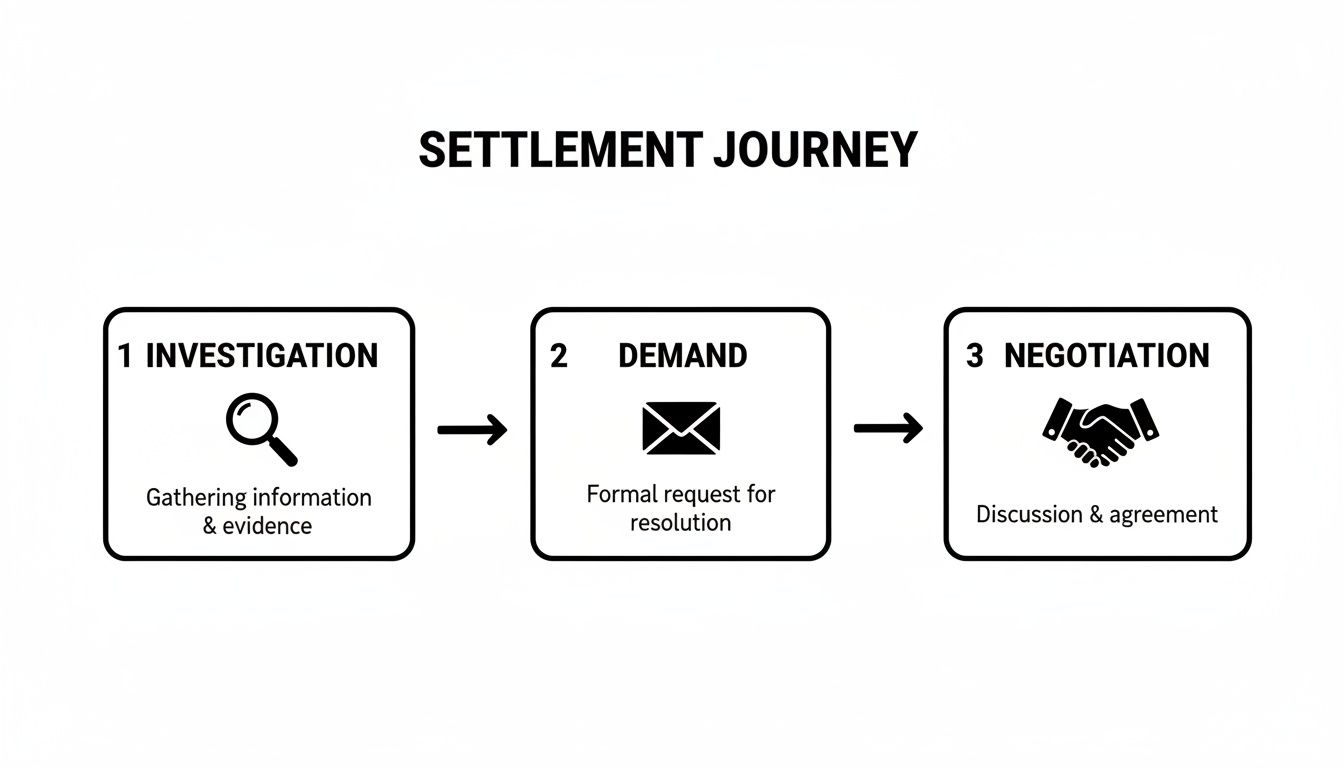
This process shows how a strong, evidence-based foundation leads directly to more powerful negotiations and a much better chance of a solid settlement without needing a drawn-out court battle. For a deeper look at this, check out our guide on how a personal injury lawyer can maximize your compensation.
At LA Law Group, we pride ourselves on being hands-on. You’ll have direct access to your attorney every step of the way. We pair our legal work with a genuine commitment to personal service. We want to make sure your voice is heard and your needs come first.
Securing fair brain injury settlement amounts is about more than just knowing the law. It demands a real understanding of the medical, financial, and personal toll these injuries take. A great attorney makes sure every single loss is accounted for.
We know that legal fees are the last thing you should be worrying about right now. That’s why we always offer a free consultation to discuss your case with zero pressure or obligation. Our team is also proud to serve our entire community, offering full legal support for our Spanish-speaking clients.
Don’t let an insurance adjuster decide what your future looks like. The steps you take today can protect your rights and provide the financial stability you and your family need to move forward. Contact LA Law Group for a personalized case evaluation and let us help you get the compensation and peace of mind you deserve.
Frequently Asked Questions About Brain Injury Settlements
Disclaimer: This article is for informational purposes and not to be construed as legal advice. No attorney client relationship exists based on the review of this this article and none of the information in this article is legal advice.
When you’re trying to recover from a head injury, the legal questions can feel overwhelming. We get it. Here are some straightforward answers to the questions we hear most often, designed to give you some clarity.
How Long Do I Have to File a Brain Injury Lawsuit in California?
In California, the clock starts ticking the moment the injury happens. You generally have two years to file a personal injury lawsuit. This deadline is known as the statute of limitations.
While there are a few rare exceptions, missing this two-year window almost always means you lose your right to seek compensation forever. Acting quickly is crucial to preserving evidence and protecting your legal options.
Will I Have to Go to Court for My Settlement?
This is a huge source of anxiety for many people, but here’s the reality: the vast majority of personal injury cases are settled without ever going to trial. In fact, more than 95% of claims are resolved through negotiations between your lawyer and the insurance company.
Filing a lawsuit is usually a strategic move made only when an insurer refuses to offer a fair settlement. Even then, most cases settle long before a trial date. Our goal is always to get you the maximum compensation as efficiently as possible, keeping you out of the courtroom if we can.
How Much Does It Cost to Hire a Brain Injury Lawyer?
Concerns about legal fees should never be a barrier to getting the help you need. Like most reputable personal injury firms, we work on a contingency fee basis.
This means you pay zero upfront costs. We only get paid if we win your case, taking a percentage of the final settlement. If you don’t receive compensation, you don’t owe us a dime for our time.
This approach ensures everyone gets a fair shot at justice, regardless of their financial situation. It also means our goals are perfectly aligned with yours—we are fully invested in getting you the best possible result.
Can I Get a Settlement for a Mild Brain Injury?
Yes, absolutely. The word “mild” can be incredibly misleading when it comes to brain injuries like concussions. While they aren’t as visibly catastrophic as severe TBIs, they can still turn your life upside down with persistent headaches, brain fog, and emotional struggles that affect your job and daily happiness.
Your settlement is based on the actual impact the injury has on your life. Any injury that leads to medical bills, missed work, and pain and suffering is a valid reason to file a claim. To get a better sense of how different factors play out, it can be helpful to review the average settlement for a traumatic brain injury and see how cases are valued.
The legal system can feel like a maze, but you don’t have to navigate it by yourself. The team at LA Law Group, APLC is here to answer your questions and fight for your rights. For a free, no-pressure consultation to discuss your case, contact us today.
Attorney Advertising. This article is general information, not legal advice, and does not create an attorney-client relationship. Prior results do not guarantee a similar outcome.