
Brand Protection Amazon: Tools, Takedowns and Escalation
Your best-selling listing has disappeared, a reseller you don’t recognize has joined the offer page, and the notice in your account doesn’t clearly explain whether Amazon suspects counterfeiting, trademark misuse, or a catalog problem. You have genuine inventory and supplier invoices, but they’re scattered across email, accounting software, and your warehouse records.
Brand protection on Amazon is as much about procedural readiness as detection. The right tool matters, but so does proving what happened, selecting the correct reporting category, and answering the actual allegation before the deadline expires. A legitimate seller needs a defensible response process, not just access to a takedown button.
Which Amazon Brand Protection Tool Fits Your Problem
This guide is for informational purposes only, isn’t legal advice, and creates no attorney-client relationship through reading or reviewing it; none of its information should be construed as legal advice.
Amazon brand protection tools and what each one solves
| Tool | Who Can Use It | Use It For | What It Does Not Do |
|---|---|---|---|
| Brand Registry | Trademark owner; authorized agents added after enrollment | Enrolling brand identity so Amazon can match listings | Remove a listing on its own |
| Report a Violation | Brand Registry users on an enrolled brand, subject to relevant permissions | Filing intellectual-property, store-policy, and compliance reports | Guarantee a takedown |
| Project Zero | Eligible Brand Registry rights owners | Self-service removal of counterfeit listings | Settle a disputed report |
| Transparency | Brands enrolled in the program | Unit-level authentication of products | Stop unauthorized resellers by itself |
| Proactive controls | Enrolled brands, automatic | Blocking suspected infringing listings before reports | Correct false positives on your behalf |
Start by naming the problem without naming the seller’s motive. A counterfeit unit, an unauthorized offer, and an altered detail page are different problems. Calling all of them counterfeiting makes your complaint less precise and can send it down the wrong review path.
Say another seller offers your genuine product below your preferred price. The absence of your permission doesn’t, by itself, establish that the product is counterfeit. You need to investigate the goods, their sourcing, and any specific infringement or policy issue before choosing a reporting category.
A copied product photograph presents a different question. The relevant evidence concerns ownership of the photograph and the seller’s use of it, not whether the physical item passes an authenticity check.
Match the remedy to the evidence
Brand Registry establishes identity. Report a Violation communicates a specific allegation. Project Zero addresses qualifying counterfeit removals, while Transparency checks enrolled product units. Proactive controls operate in the background, but a mistaken block still needs someone to investigate and respond.
These tools aren’t interchangeable, and access to one doesn’t prove that every complaint you submit is valid. Before acting, write a short internal statement identifying the affected ASIN, marketplace, seller offer or content, alleged violation, and supporting document.
Practical rule: Choose the narrowest accurate allegation you can prove, not the strongest-sounding allegation available in the menu.
Amazon’s enforcement extends beyond listing reports: by 2023, its Counterfeit Crimes Unit had pursued more than 21,000 alleged bad actors through civil litigation and criminal referrals, according to Amazon’s 2023 Brand Protection Report. That layered approach helps explain why an individual marketplace complaint is only part of a broader enforcement process.
Decide what outcome you actually need
A request to restore accurate product information should identify the correct content. A counterfeit complaint should identify authenticity evidence. A sourcing response should explain how the inventory reached your business.
Don’t combine unrelated problems into a broad request to remove every seller associated with a brand. That makes it harder for a reviewer to connect each requested action to supporting evidence.
Find your problem in the table’s Use It For column and start with the corresponding tool. For brand owners, Brand Registry comes first for almost every route, but enrollment is a foundation, not a blanket right to exclude other sellers.
Set Up Brand Registry Before Anything Else
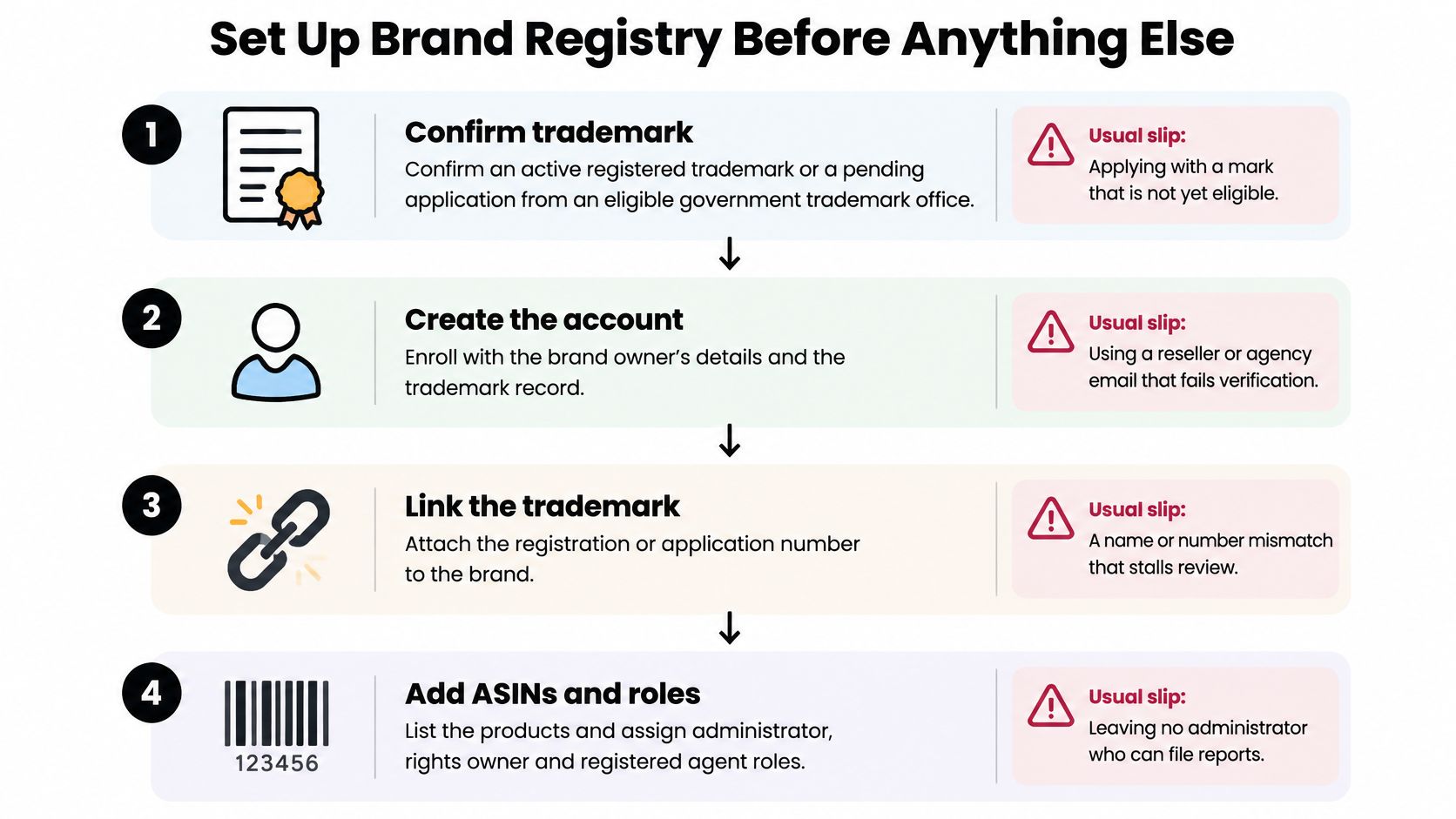
Prepare the trademark record and physical product evidence before opening the enrollment form. Amazon’s Brand Registry eligibility requirements call for an active registered trademark or eligible pending application, permanently affixed branding, and enrollment by the trademark owner rather than an agent acting independently.
Use the process flow to organize the application, then check the details against the official record.
Prepare an application a reviewer can verify
-
Confirm trademark eligibility. Check that your active registration or pending application comes from an eligible government trademark office in a country corresponding to an Amazon store. The usual slip is treating any filing, regardless of its status or issuing office, as sufficient.
-
Use the trademark owner as the applicant. An authorized agent can be added after the owner completes enrollment, but shouldn’t attempt to enroll independently. Compare the owner’s legal name with the official record rather than substituting a reseller, agency, or related company.
-
Check permanent branding on the goods or packaging. Use a logo containing the brand name that is permanently affixed to the product or packaging. A website logo or loose promotional insert doesn’t establish the required physical branding.
-
Enter the brand name exactly as recorded. Preserve capitalization and spacing instead of using your storefront abbreviation or preferred marketing shorthand. A mismatch forces the reviewer to reconcile identities that should already agree.
-
Add the registration or application number and product categories. Copy the identifier directly from the official record and check that you selected the correct trademark office. Don’t substitute an internal filing reference or an unrelated company-registration number.
-
Upload clear photographs of the branded product or packaging. For an image-based mark, the submitted logo must match the trademark-record image. A redesigned logo on current packaging can create a verification problem even when your business considers it the same brand.
-
Check approval and reporting access. Confirm the enrollment status and whether Report a Violation is available to the appropriate user. A saved application isn’t an approval, and a missing reporting option calls for checking enrollment and permissions before filing another application.
Amazon’s application-materials guidance specifies matching brand details, the registration or pending-application number, relevant categories, and an image showing permanently affixed branding. Keep a copy of everything submitted so a later reviewer can compare the approved identity with your current products.
Correct inconsistencies before resubmitting
A pending application can support enrollment when it meets Amazon’s eligibility rules. An expired record or a mismatch between the application, trademark, and physical branding can prevent approval.
If enrollment is rejected, compare the brand name, logo, owner, identifier, and mark type character by character. Correct the identified discrepancy and explain the correction rather than repeating the same submission.
The Amazon Brand Registry requirements checklist can help organize that review. Keep the rejection notice alongside the corrected materials so your response addresses the reason Amazon gave.
For a visual walkthrough of enrollment, use the video alongside your official trademark record.
Build an Evidence File Before You Report Anything
A strong complaint starts before a dispute, when records are still easy to collect. Build a file that lets someone outside your business distinguish ownership, authenticity, sourcing, and catalog history without reconstructing your operations from disconnected attachments.
Amazon reported that valid infringement notices submitted through Brand Registry decreased by more than 35% in 2022 as automated and proactive protections expanded, according to its 2022 Brand Protection Report. Less manual reporting doesn’t remove the need to preserve evidence for the matters that still require human judgment.
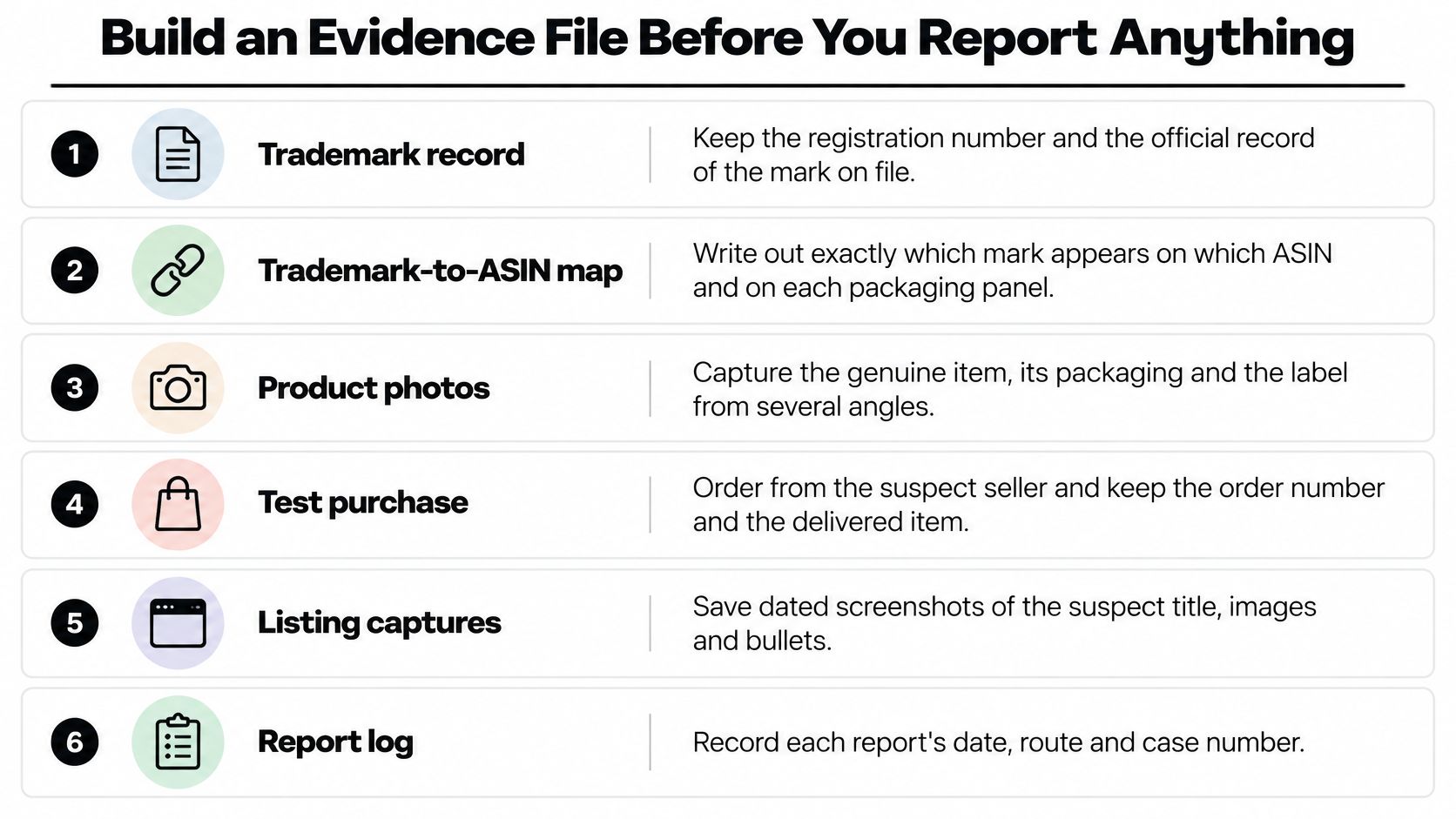
Use this checklist to organize the underlying proof.
Keep records that answer distinct questions
- Trademark record and identifier: Preserve the official record and ownership details so the reviewer can identify the right you’re asserting.
- Trademark-to-ASIN map: Record each ASIN, marketplace, product identifier, and packaging variant so a report doesn’t target the wrong listing.
- Manufacturing and supplier authorization: Keep agreements and authorization documents that explain who may manufacture or supply the goods.
- Invoices and serial numbers: Connect purchases to identifiable product lines, batches, or units so sourcing claims can be checked.
- Genuine-product photographs: Capture packaging panels, labels, seals, and distinguishing features to provide an authenticity baseline.
- Dated listing captures: Save the title, images, seller information, and relevant detail-page changes to show what appeared and when.
- Test-purchase materials: Retain the receipt, order details, delivered item, packaging, and photographs linking the suspected counterfeit to the purchase.
- Correspondence log: Preserve every notice, submission, response, case number, and stated deadline so another person can understand the procedural history.
Keep originals intact. If you annotate an image or redact an unrelated commercial detail for submission, retain the unaltered source separately and label the submitted version clearly.
Make the packet usable under pressure
Create a short index that connects each allegation to its supporting attachment. A reviewer shouldn’t need to guess which invoice corresponds to the affected product or which packaging photograph shows the relevant difference.
Supplier invoices and authorization letters serve different purposes. An invoice documents a transaction; an authorization letter addresses the authority described in that letter. Submit the documents needed to answer the actual sourcing question rather than assuming one proves everything.
Gray-market goods, altered packaging, and disputed authorization still need human review. A complete file helps prevent a catalog misunderstanding or incomplete sourcing response from developing into a broader account problem.
Could a reviewer confirm your ownership and sourcing from this file within one day, without asking you to explain every attachment?
Report, Escalate and Appeal by Violation Type
Violation type, route, evidence and escalation trigger
| Violation Type | Right Route | Evidence to Attach | Escalate When |
|---|---|---|---|
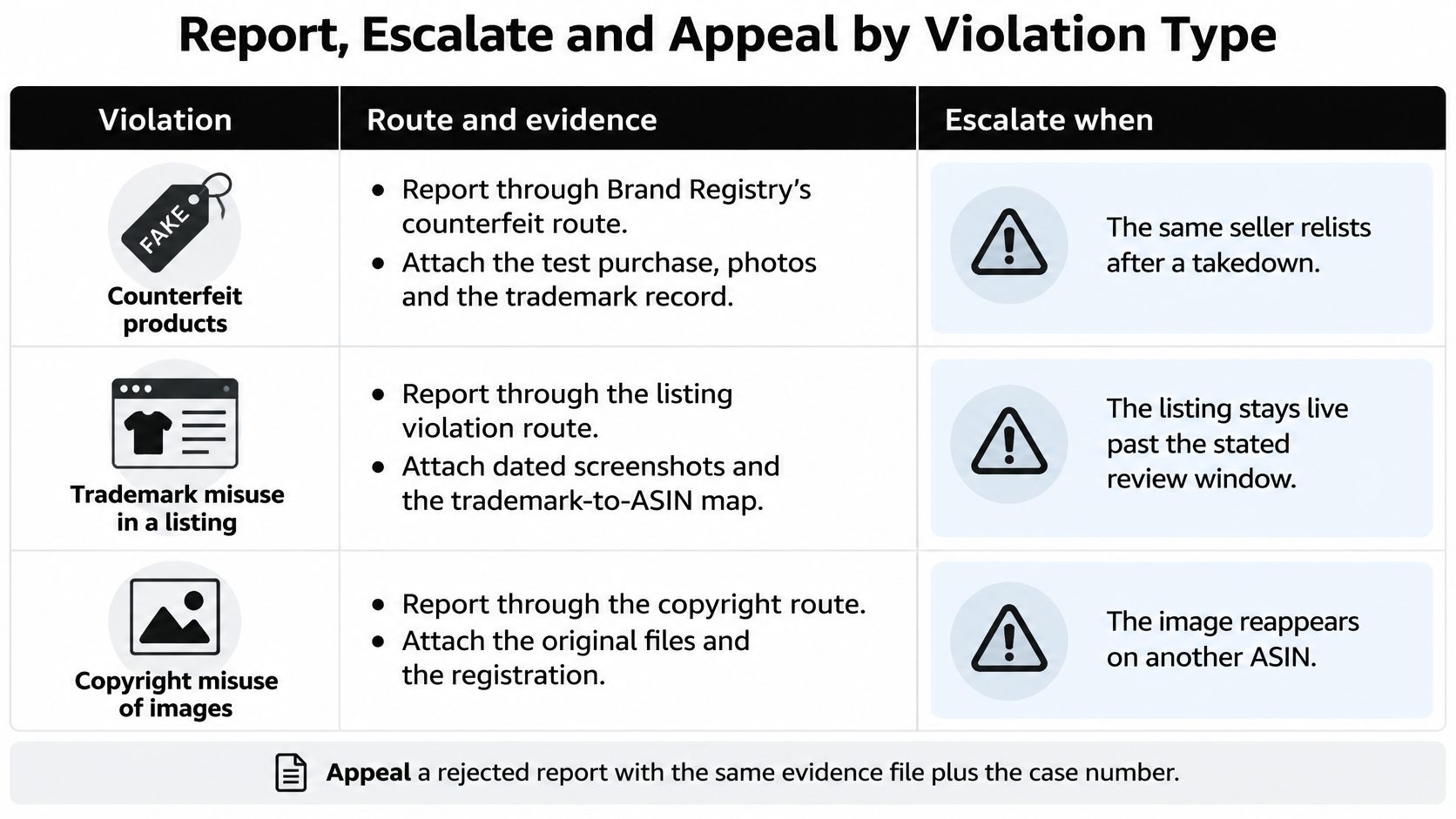
| Counterfeit product | Report a Violation, counterfeit category; Project Zero if eligible | Test buy, genuine and suspect unit photos, serial numbers | The same seller repeats after removal |
| Trademark misuse in a listing | Report a Violation, intellectual-property category | Trademark registration number, listing URL, ASIN | The reported listing stays live after review |
| Copyright misuse of images or copy | Report a Violation, intellectual-property category | Proof of ownership and original file | The seller files a counter-notice |
| Store-policy violation | Report a Violation, store-policy category | Dated screenshots and relevant policy clause | The pattern spans multiple ASINs |
| Gray-market or unauthorized reseller | Report a Violation with distribution proof when a specific reportable violation exists | Invoices, authorization letters, supply-chain records | Authorization to sell is disputed |
| Hijacked detail page | Report a Violation or Seller Central contact | Brand Registry proof and before-and-after screenshots | The page changes again without owner approval |
Unauthorized resale alone isn’t a substitute for a specific infringement allegation. Distribution documents may explain the relationship, but you still need to identify what Amazon should investigate and why its selected reporting category applies.
Amazon’s Report a Violation guidance covers intellectual-property infringement, store-policy violations, and regulatory-compliance concerns for enrolled brands. It also states that associated Brand Registry users can report store-policy violations without the Rights Owner role, so check permissions against the report type rather than assuming every user has identical access.
This routing chart summarizes the evidence to prepare for common intellectual-property complaints.
Follow the case’s actual instructions
-
File under the matching category. Identify the affected marketplace, ASIN, seller offer or content, and right or policy involved. Check Project Zero eligibility in your account before relying on self-service counterfeit removal; otherwise, use Report a Violation for the counterfeit allegation.
-
Attach a focused evidence packet. Include an index and explain what each attachment establishes. Avoid sending a large folder of loosely related documents that leaves the reviewer to construct your argument.
-
Record and meet the stated deadline. Use the deadline shown in the notice or case, including any specified time zone. Don’t assume an informal follow-up or support conversation pauses it.
-
Address the reason for rejection. If Amazon identifies missing proof, supply it and request review through the available case or appeal path. Repeating an unchanged packet doesn’t answer a request for a clearer ownership link or product comparison.
-
Escalate a documented pattern. When conduct repeats across ASINs or sellers, summarize the connections and include prior case numbers. Use the escalation or appeal route displayed in your account rather than opening disconnected cases with inconsistent descriptions.
If your own listing is restricted, respond through the notice’s designated appeal path. Filing a complaint against another seller won’t substitute for answering an allegation directed at your account.
Show what changed and what happened next
Say a brand’s product page changes from its genuine packaging images to unrelated accessories. The brand submits before-and-after captures, its enrollment proof, and the correct product identifiers, then explains the precise content correction it seeks.
If the page changes again, the next submission should document the recurrence and reference the earlier case. That gives the reviewer a pattern to investigate rather than another isolated screenshot.
Amazon’s internal review is separate from remedies under applicable national law. Civil claims, criminal referrals, and responses to litigation threats require jurisdiction-specific assessment; a marketplace removal doesn’t settle those questions.
Use Transparency Codes When Counterfeits Are the Risk
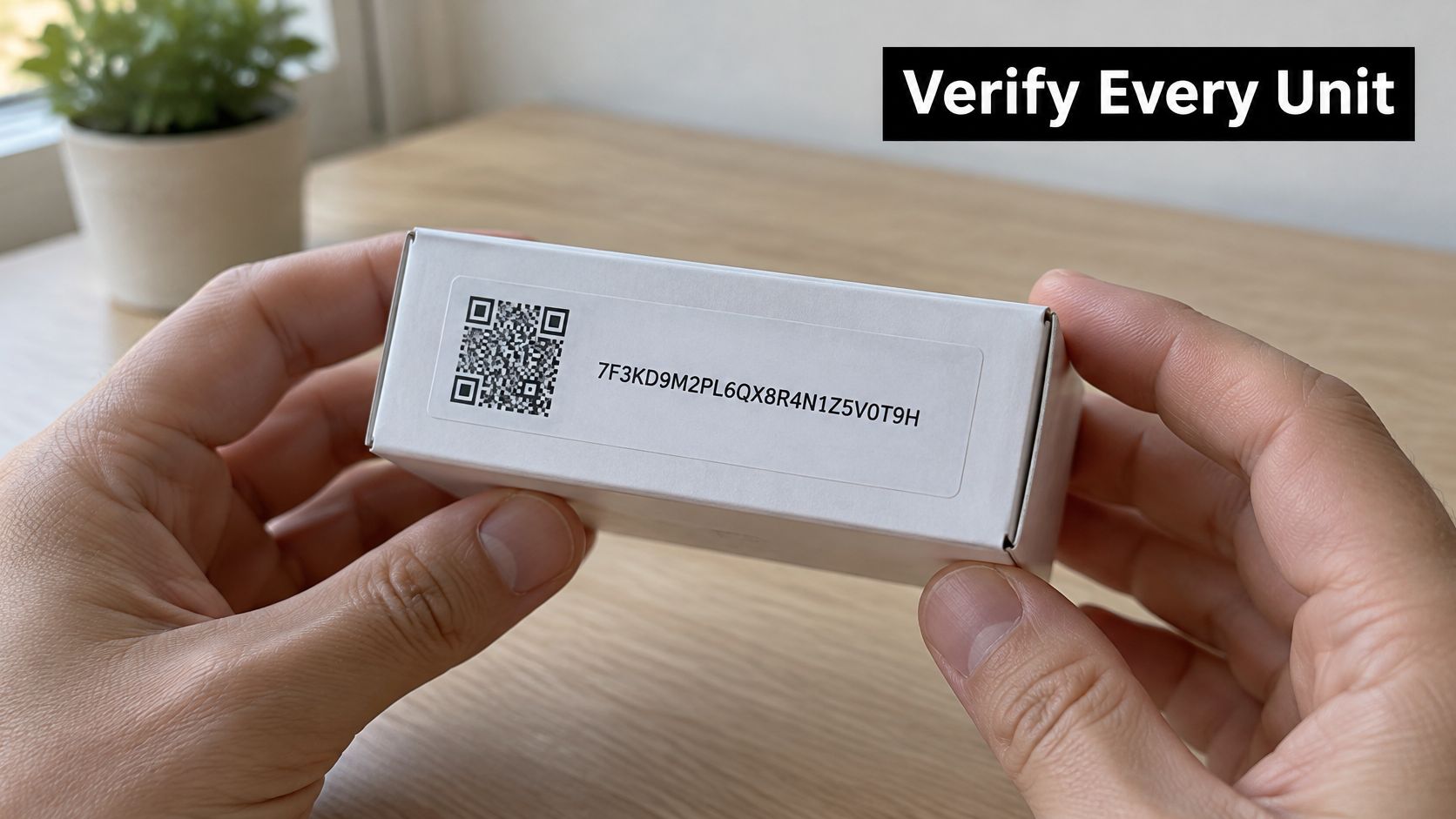
Transparency addresses the identity of individual units, not just the appearance of a listing. Amazon states in its Transparency program guidance that protected units need a valid Amazon-issued code or an existing serial code connected to the program, and fully protected products can’t be listed in supported stores unless the code matches the enrolled product.
The mechanism is straightforward: identify the unit, scan its code, and reject missing, invalid, or mismatched authentication information before distribution proceeds through the supported workflow. That makes serialization useful when your central problem is distinguishing genuine inventory from fake goods.
The image illustrates unit-level identification on product packaging.
Treat serialization as a manufacturing control
Amazon’s Transparency technical guidance describes a 26-character alphanumeric code and specifies a data-matrix code of at least 12.7 mm by 12.7 mm, with a minimum 0.635 mm blank quiet zone, doubled when a larger code is used.
Map each serialized unit to its GTIN, apply codes consistently during manufacturing and packaging, and preserve the production records needed to trace a disputed unit to its batch. Assign responsibility for code application, print inspection, and exceptions before inventory leaves the factory.
Poor contrast, damaged labels, or inadequate blank space can create scan failures that resemble authenticity problems. Test actual printed packaging, not just the artwork file, and check the current label guidance before approving a production run.
Decide whether the operational work is justified
- High counterfeit exposure: Serialization is a stronger fit when fake units are the documented problem, rather than merely unfamiliar sellers.
- Higher unit value: Evaluate whether the protection justifies labeling, handling, integration, and exception-management work.
- Multi-country sales: Check supported-store coverage and coordinate packaging across the markets where protection is needed.
- Low-risk products: Investigate simpler recordkeeping and distribution controls before adding a new manufacturing requirement.
- Complex supply chains: Confirm that manufacturers, packers, and distributors can maintain code integrity and traceability.
Serialization won’t independently resolve unauthorized resale or gray-market distribution. A genuine serialized unit can still raise a separate question about its route to market or the seller’s contractual relationship with the brand.
Use the counterfeit goods on Amazon guide to distinguish an authenticity complaint from other seller disputes before committing to a rollout. Start with the products whose actual counterfeit risk supports the added work, and measure operational exceptions as carefully as blocked units.
Mistakes That Get Legitimate Listings Removed
Say a small brand sells a product in two packaging variants through its own account and a reseller. A team member reports the reseller’s offer as counterfeit, but the internal catalog sheet points to the wrong ASIN, and the reseller’s response omits the invoice linking its genuine inventory to the supplier.
The resulting dispute isn’t resolved by insisting that everyone knows the goods are real. The brand needs to correct the mistaken target, while the reseller needs to answer the sourcing question with documents tied to the affected product.
Put the mistake beside the correction
| Mistake | Corrected response |
|---|---|
| An old catalog sheet maps the trademark to the wrong ASIN | Verify the live ASIN and packaging variant before submitting a complaint |
| Staff assume an automated block must be correct | Assign someone to review the notice and compare it with genuine-product records |
| An employee uses the wrong account and reports the brand’s own offer | Verify the signed-in account, reporting role, and target seller before submission |
| A sourcing response contains explanations but no invoices | Attach transaction records and relevant authorization papers, indexed to the product |
The same documents can produce a better result when they’re organized around the allegation. A corrected response should identify the mistaken ASIN, explain the packaging difference, and connect the relevant invoice or authorization to the inventory under review.
Don’t conceal the original mistake beneath a new description of events. Preserve the submission history and state clearly what was wrong and what has been corrected.
Automation doesn’t eliminate review
Amazon’s 2024 Brand Protection Report states that proactive controls blocked more than 99% of suspected infringing listings before brands had to find and report them. That measure describes proactive blocking of suspected infringement; it doesn’t establish a false-positive rate or reinstatement outcome for small sellers.
Treating that metric as proof that every removal is correct is a category error. A legitimate seller still needs someone who can interpret notices, distinguish allegations, and collect responsive records.
A restriction is a reason to investigate, not proof that the targeted product is counterfeit.
Use these warning signs to trigger an immediate review:
- Sudden listing removal: Pull the evidence file and check whether the notice identifies the correct ASIN and packaging variant.
- An unclear allegation category: Compare the notice with the ASIN map, then identify whether Amazon is questioning content, authenticity, ownership, or sourcing.
- A document request with a short deadline: Retrieve the indexed records, verify the affected inventory, and assign an owner to submit the response on time.
Keep a log even when the restriction is reversed. The useful operational lesson is what caused the mismatch and which record would have prevented it.
When to Bring in Counsel
This guide is for informational purposes, isn’t legal advice, and creates no attorney-client relationship through reading or review. None of the information in this article should be construed as legal advice.
For routine preparation, use a four-week implementation calendar. Don’t use the calendar to delay an active appeal or urgent document request. A deadline already displayed in your account takes priority over preventive work.
A practical implementation calendar
- Week 1, verify enrollment identity: Compare your approved Brand Registry details with the official trademark record and correct unresolved inconsistencies. Assign responsibility for maintaining the record when ownership, branding, or account personnel change.
- Week 2, validate the catalog map: Reconcile ASINs, marketplaces, and packaging variants against actual inventory. Resolve ambiguous entries before anyone uses the sheet to select a reporting target.
- Week 3, test readiness: Assemble a sample dispute packet and evaluate whether serialization fits the products with meaningful counterfeit exposure. Check whether your team can retrieve the necessary records without relying on a single employee’s inbox.
- Week 4, establish recurring review: Schedule a weekly review of notices and record the relevant escalation trigger for each open matter. Assign a backup reviewer so absence doesn’t leave a deadline unattended.
Situations that need counsel now
Seek legal review promptly when the dispute affects more than a correctable listing detail:
- Suspension with inventory or funds withheld: The response needs to address the account allegation and the business consequences together.
- Organized cross-border counterfeiting: Marketplace reports may need coordination with evidence preservation and jurisdiction-specific enforcement.
- Disputed authorization to sell: Counsel should assess the relevant agreements, sourcing documents, and rights instead of assuming a distribution objection establishes infringement.
- A litigation threat or counter-notice: Preserve the communication and obtain advice before making substantive admissions or selecting a legal response.
Prepare for a consultation by bringing the notice, case history, current deadline, affected ASINs, and indexed supporting documents. The Amazon sellers lawyer guide provides context for deciding when an operational dispute needs legal assistance.
Our eCommerce and Amazon practice helps online sellers before and after suspensions or complaints, including reinstatements and appeals, chargebacks and disputes, brand protection, and intellectual-property violations. Once a matter reaches one of these triggers, contact LA Law Group, APLC for a consultation rather than relying on another unchanged submission.
We help online sellers address Amazon brand-protection disputes, account appeals, and intellectual-property complaints, and offer federal trademark and copyright registration as flat-fee services so clients know the cost up front. Visit LA Law Group, APLC to request a consultation, and bring your latest notice, response deadline, and evidence file so the discussion can focus on the action your matter requires.
Attorney Advertising. This article is general information, not legal advice, and does not create an attorney-client relationship. Prior results do not guarantee a similar outcome.