
Brand Protection Strategy: A California Seller's Guide
A California skincare seller checks Amazon one morning and finds a product with nearly identical packaging, product language, and photographs. The unknown seller is charging less, buyers are asking whether the products come from the same company, and negative reviews are beginning to appear on the wrong listing. A takedown may remove that listing, but it won’t answer the larger questions: Was the brand properly protected? How will the next copycat be found? Which evidence matters? And when does a marketplace dispute require a lawyer?
A brand protection strategy answers those questions before a crisis spreads. It combines trademark registration, domain and asset control, marketplace safeguards, monitoring, evidence collection, enforcement, and business-focused measurement. The objective isn’t to build an expensive IP fortress. It’s to deploy the right protection at the right stage, then escalate when the exposure justifies it.
This article is for informational purposes only and isn’t legal advice. No attorney-client relationship exists based on your review of this article, and none of the information in this article is legal advice.
What Brand Protection Strategy Means for a Growing Business
Brand protection is a business-control system, not a stack of takedown requests. A useful program protects four things at once: revenue, reputation, customer trust, and the legal rights that support enforcement.
The skincare seller in the opening scenario has several separate problems. A competitor may be copying the brand’s trade dress or product content. An unauthorized reseller may be confusing buyers about authenticity. The marketplace may be receiving complaints that belong to the genuine seller. If she responds only by reporting one listing, she treats the visible symptom while leaving her registration, monitoring, evidence, and channel controls underdeveloped.
A practical program has four layers:
- Registration: Secure the word marks, logos, and other protectable assets that support complaints and litigation.
- Marketplace controls: Use available enrollment and reporting systems, including Amazon Brand Registry tools, to establish a verified rights-owner position.
- Monitoring and enforcement: Find suspicious listings, domains, social accounts, and reseller activity, then preserve evidence and choose the right response.
- Business metrics: Track whether the program protects sales, margin, customer experience, and channel integrity, not merely how many listings disappear.
Protection should match the business stage
A small seller doesn’t need every commercial monitoring platform on day one. She does need a clear asset inventory, ownership of important domains, a trademark clearance plan, consistent product records, and a repeatable process for documenting suspicious activity.
DIY works best for routine, low-risk administration. A founder can save screenshots, record listing URLs, compare product photographs, and submit a properly supported marketplace report. The situation changes when the alleged infringer is persistent, the mark is challenged, the dispute involves a distributor, or the business needs a demand letter that won’t create unnecessary admissions or legal exposure.
Practical rule: A takedown removes content. A brand protection strategy reduces the chance that the same harm will return through another seller account, domain, or platform.
The right question isn’t, “How fast can I remove this listing?” It’s, “What control would have prevented or limited this problem, and what evidence will support the next action?” That shift turns enforcement from emergency work into risk management.
The Core Components Every Protection Program Should Act On
Counterfeiting operates at a scale that should change how owners think about brand protection. The OECD estimated that counterfeit and pirated goods accounted for USD 467 billion, or 2.3% of global imports, in 2021, and reported that counterfeit goods represented 4.7% of EU imports that year. Those figures come from the OECD’s overview of counterfeit and pirated goods. A California seller may be small, but the risk environment is global.
The program rests on four connected components.
Registration and ownership
Start with the legal foundation. Register the marks that customers use to identify the business, secure the relevant domains, preserve original product photography and copy, and document who owns logos, packaging artwork, and other brand assets. A weak or unclear ownership record makes platform complaints slower and can complicate a later lawsuit.
Marketplace controls
Amazon Brand Registry, marketplace reporting portals, product-authentication programs, and seller controls can give a rights owner useful administrative advantages. These tools work best when the business has an active trademark, consistent brand records, and clean evidence showing why a listing is unauthorized or confusing.
Monitoring infrastructure
Monitoring should cover more than an Amazon search. Review Google Shopping, social commerce, major reseller channels, relevant domains, and importer or distributor information where appropriate. A small operation can combine recurring manual sweeps with alerts for brand names, product names, and distinctive phrases. Businesses with broader exposure may evaluate specialized monitoring vendors, but software can’t replace judgment about legitimate resellers, nominative use, or fair competition.
Enforcement mechanics
The response ladder may include a platform report, a domain or content complaint, a cease-and-desist letter, a negotiated resolution, or litigation. Customs and border measures may also matter for physical goods. For businesses that need to assess sensitive physical-security risks around facilities, inventory, or confidential operations, a specialized resource such as bug sweeps London illustrates how a separate investigative service can fit into a broader risk program, although it isn’t a substitute for IP enforcement.
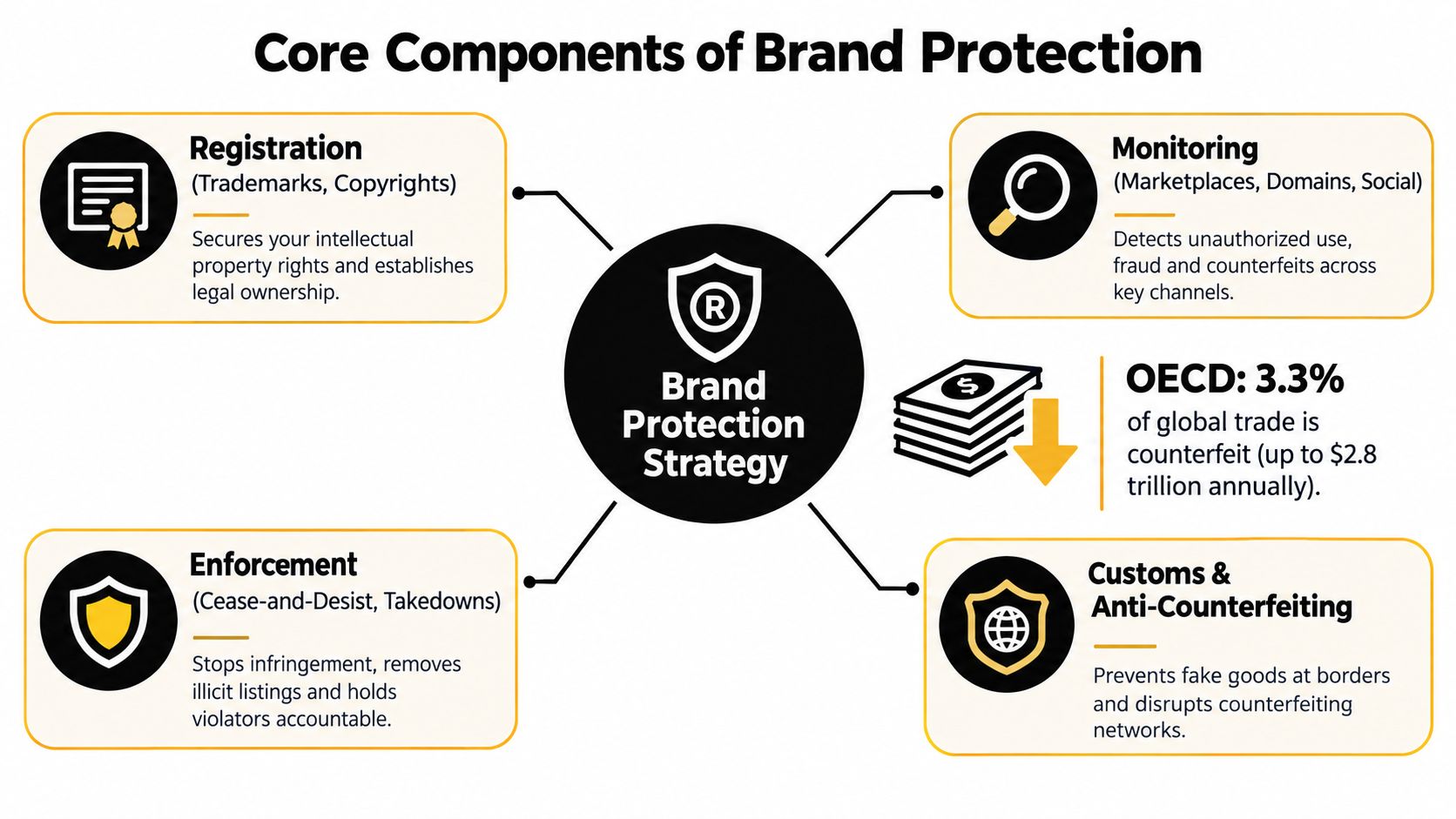
These components reinforce one another. Registration strengthens marketplace reports. Monitoring supplies evidence. Enforcement creates consequences. Customs and supply-chain controls address physical movement rather than only online visibility. The following decisions turn each component into an operating program.
Trademark Registration as the Legal Foundation
A marketplace complaint is stronger when the business can identify a registered mark, the owner, the relevant goods, and the specific use that creates confusion. Registration isn’t a magic shield, but it gives a growing seller a clearer legal position than an unregistered brand name supported only by invoices and social posts.
Clear the mark before you adopt it
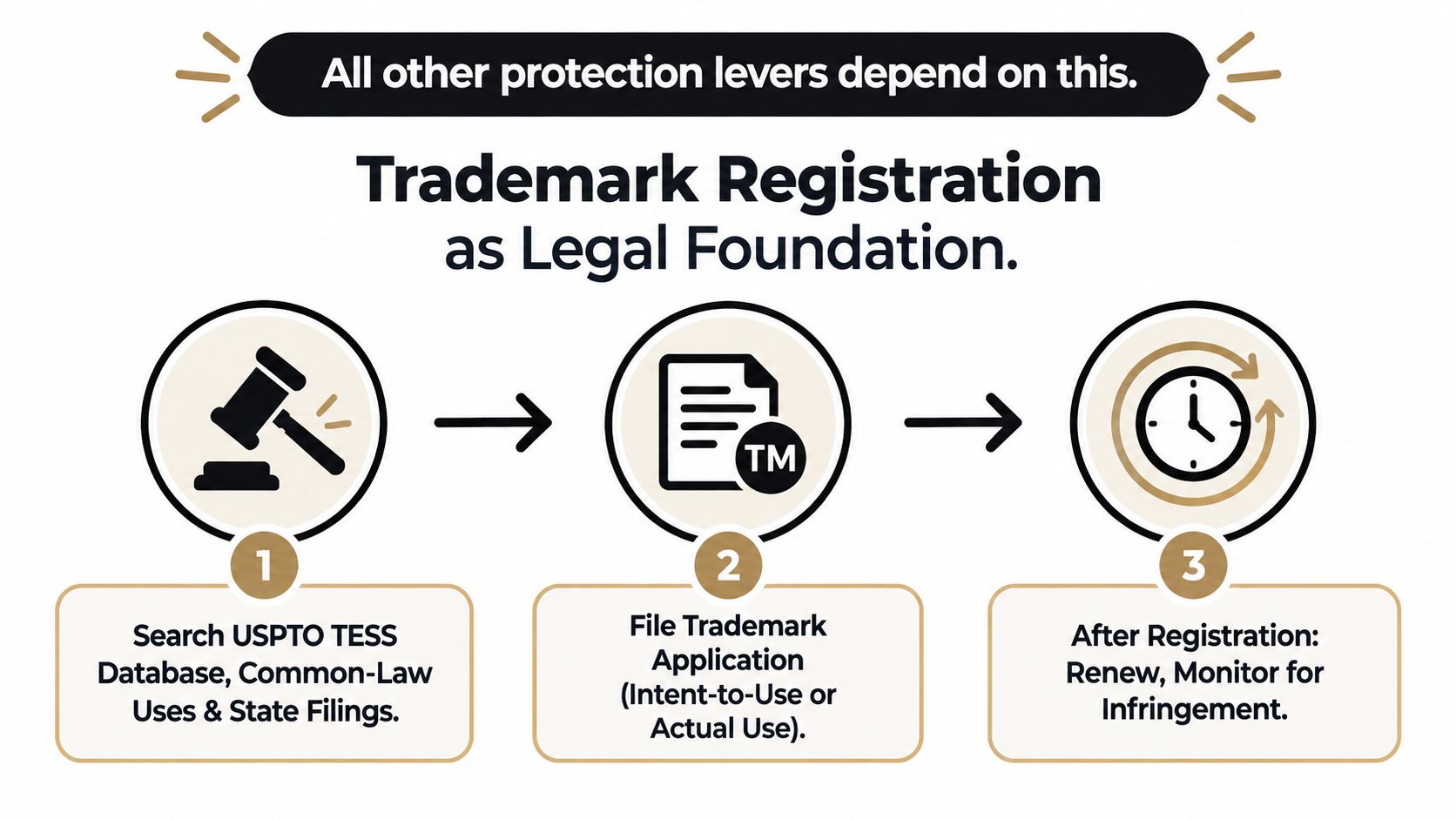
Search the USPTO TESS database, common-law uses, state filings, and domain records before investing in packaging, advertising, or inventory. Look for similar marks used with related goods and services, not only exact matches. A name that feels distinctive to a founder may already create a conflict in the marketplace.
Then choose what to protect first. A word mark generally protects the wording independent of a particular design, while a design mark protects the submitted logo or stylized presentation. Many businesses eventually need both, but a limited budget requires prioritization based on what customers recognize and what competitors are most likely to copy.
Choose the filing basis carefully
A use-based application under Section 1(a) requires the applicant to claim current use in commerce and submit appropriate specimens. An intent-to-use application under Section 1(b) can fit a brand preparing for launch, but the applicant must later satisfy the use requirements before the registration process is complete.
The goods and services description also matters. The Nice Classification system organizes those goods and services, but selecting a class isn’t a substitute for drafting an accurate identification. Overbroad or poorly supported descriptions can create avoidable problems.
For practical guidance focused on the state filing process, review how to register a trademark in California, then decide whether your facts justify attorney review.
Plan for publication and maintenance
After examination, an application may move toward publication, where third parties receive an opportunity to oppose it. A registration certificate confirms the federal registration, but it doesn’t eliminate the need to monitor confusingly similar marks or unauthorized uses. Maintenance filings are required at years 5 and 10, so calendar those obligations rather than treating registration as a one-time task.
For international expansion, evaluate the Madrid System. It rests on the Madrid Agreement concluded in 1891 and the Protocol adopted in 1989. The Protocol entered into force on December 1, 1995, and became operational on April 1, 1996, according to WIPO’s Madrid System treaty history. One international framework can reduce administrative duplication across participating jurisdictions, but centralized filings also create a concentrated point of risk if the underlying filing is attacked. A California seller should choose the first mark, filing basis, geographic scope, and level of counsel deliberately.
Enforcing Your Brand on Amazon and Other Marketplaces
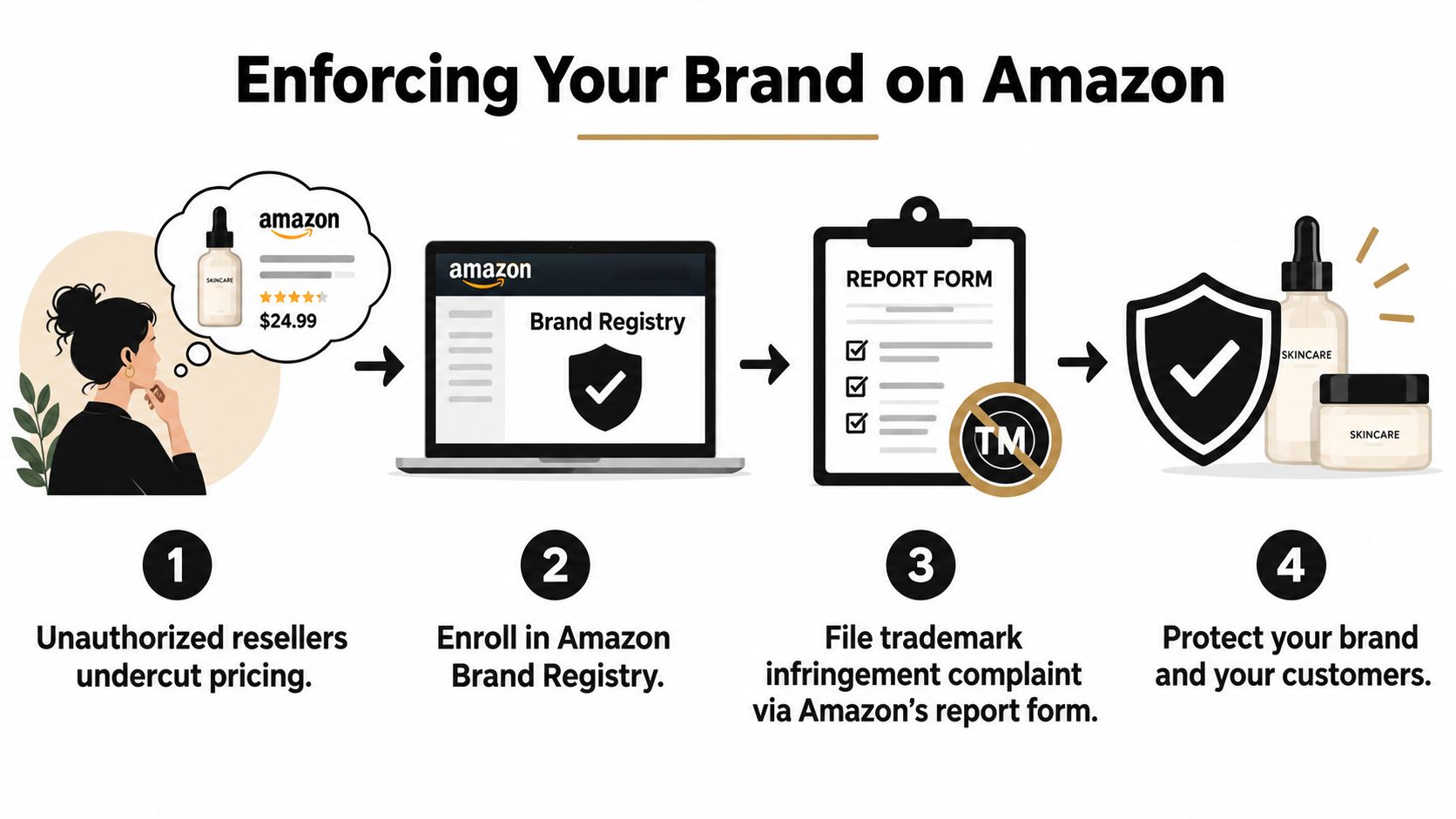
A California direct-to-consumer skincare founder discovers that unauthorized resellers are using her registered mark on Amazon. They offer the product below her advertised price, reuse her images, and create review confusion because buyers can’t tell whether the seller is authorized. Her first instinct is to report the listing, but effective marketplace enforcement requires more than clicking a complaint button.
Amazon Brand Registry generally requires an active trademark registration and a brand operating in the marketplace’s selling country. Enrollment can provide access to tools such as Report a Violation, Brand Analytics, transparency programs, and Project Zero’s self-service counterfeit removal features. Sellers should confirm current eligibility and program terms before relying on any particular tool.
Build the evidence package first
Before submitting a report, assemble:
- Registration details: The mark, registration information, owner identity, and the goods connected to the mark.
- Listing evidence: URLs, seller names, ASINs, screenshots, dates, and the specific brand use at issue.
- Authenticity evidence: Product photographs, packaging differences, invoices, test-buy records, and an explanation of why the goods or listing are unauthorized.
- Customer-impact records: Buyer messages, review confusion, return information, or support tickets that connect the listing to actual business harm.
- Ownership consistency: Matching business names, authorized representatives, and marketplace account information.
A report should identify the exact violation rather than make a broad accusation. Amazon’s administrative process favors the rights owner who can show a valid mark and explain the infringement precisely.
The platform’s tools have limits. They generally don’t reach external websites, offline sellers, independent importers, or infringers operating outside the platform. They also don’t automatically produce damages or prevent a competitor from adopting a confusingly similar business model elsewhere.
Merch sellers facing account complaints can also review guidance on how to protect your Merch account from complaints. For broader requirements and enrollment considerations, see Amazon Brand Registry requirements.
A short educational video can help sellers understand the platform context before they submit a report.
If the same actor returns under new accounts, sells unsafe counterfeits, threatens the business, or operates across several channels, stop treating the matter as an isolated listing. Preserve the evidence and assess platform-independent remedies with counsel.
Monitoring, Cease-and-Desist Letters, and Takedowns in Practice
Monitoring fails when nobody owns the task. A one- or two-person California operation doesn’t need to inspect every website every hour, but it does need a documented routine that makes suspicious activity visible before customers report it.
Review Amazon search results, Google Shopping, social commerce listings, domain registrations through WHOIS services, and available customs or importer records. Monthly sweeps are a workable starting point for a small business, supplemented by automated alerts for the brand name, product names, distinctive slogans, and common misspellings. Amazon Brand Registry reports and basic Boolean Google Alerts can support the process, while larger catalogs may justify a specialized monitoring vendor.
Preserve evidence before contacting the other side
Capture the full listing, seller identity, product description, images, price, reviews, and date. Save original product records that establish the genuine version. A test buy may help compare packaging or product contents, but the business should document who ordered it, when it arrived, what was observed, and how the item was stored.
A cease-and-desist letter should be specific and proportionate. It should identify the sender, the mark and registration information, the allegedly infringing acts, the requested corrective action, a response deadline, and a reservation of rights. It doesn’t need theatrical threats to be effective. An unsupported demand for damages can distract from the immediate goal and invite an avoidable dispute.
Use an escalation ladder
A sensible sequence often looks like this:
- Informal contact: Use only when the issue appears minor and the business can communicate without revealing unnecessary information.
- Platform complaint: Submit the correct trademark, copyright, counterfeit, or policy report with organized evidence.
- Formal demand: Send a letter when the conduct continues, the actor is identifiable, or the harm warrants a documented legal demand.
- Negotiated resolution: Consider undertakings, inventory handling, account separation, authorized resale terms, or other documented outcomes.
- Litigation or domain remedies: Evaluate court action when the infringement is willful, persistent, commercially significant, or resistant to administrative solutions.
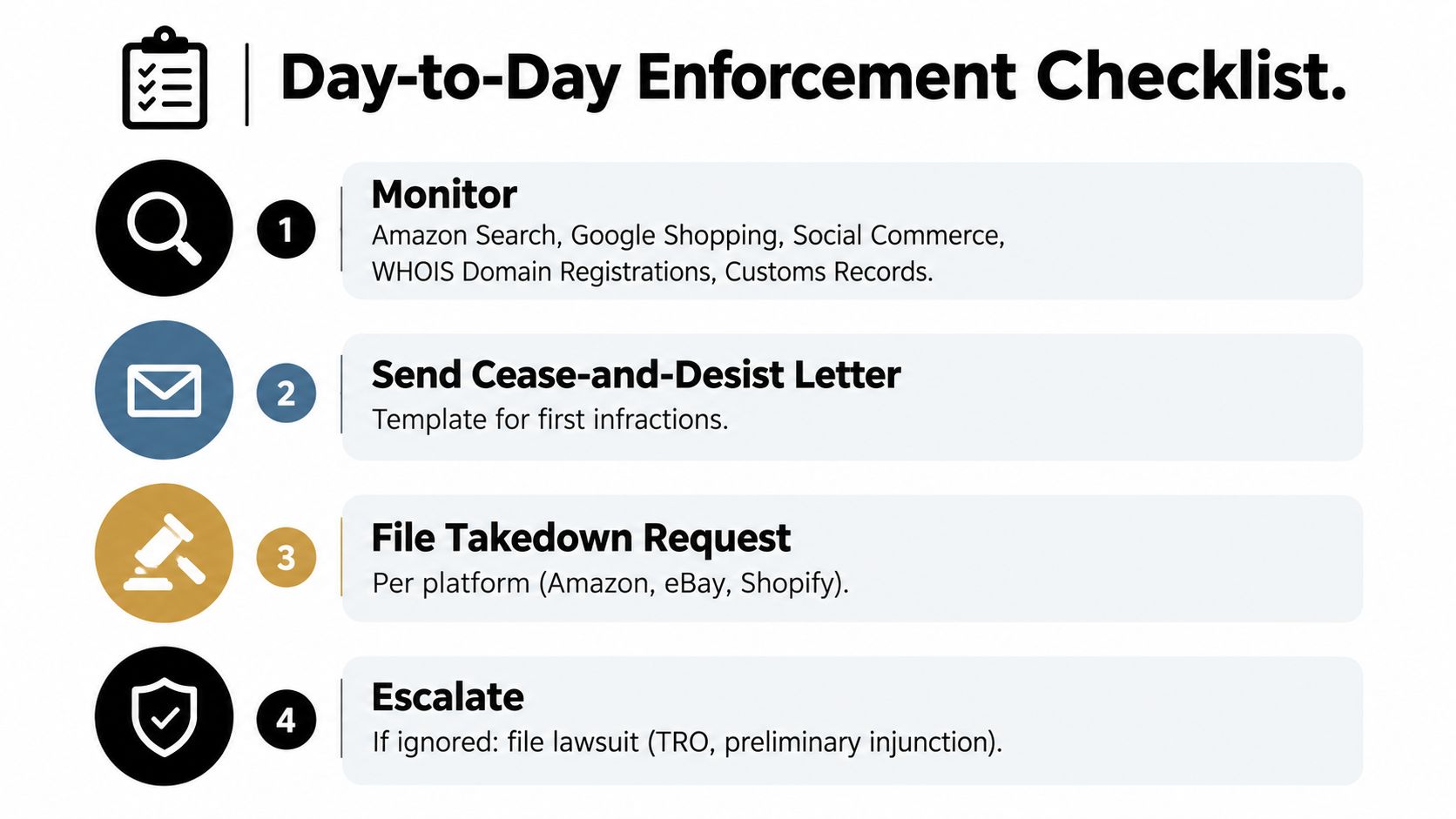
California counsel becomes the right call when there’s an urgent need for injunctive relief, cross-border activity, a threatened counterclaim, a contested trademark, a repeat offender, or evidence that must support court proceedings. For a broader discussion of response options, review brand protection enforcement.
Rethinking the Metrics That Actually Matter
A takedown count is easy to present and often weak as a business measure. It rewards the removal of visible, low-impact listings while overlooking a repeat counterfeiter who reappears under a different seller account. A brand protection strategy should rank threats by revenue exposure, customer confusion, channel contamination, and repeat behavior.
One 2026 industry report found that 50% of brands still use total takedowns as their primary metric, while only 35% track revenue recovered or protected. The same report found that 85% of respondents said brand protection should shift toward revenue-focused measurement, and 85% of brands reported AI-accelerated threats involving fake listings, impersonation accounts, or synthetic brand assets. Those figures appear in the 2026 Brand Integrity Report.
| Metric Category | Vanity Metric, Easy to Count | Outcome Metric, Tied to Business Value |
|---|---|---|
| Detection | Total suspicious listings found | Time from appearance to detection |
| Enforcement | Number of complaints submitted | Time from validated report to removal |
| Seller activity | Total seller accounts reported | Repeat-infringement rate by account or network |
| Financial effect | Number of listings removed | Revenue recovered or preserved |
| Customer experience | Total notices sent | Customer complaints connected to suspected counterfeits |
| Channel quality | Number of blocked offers | Improvement in authorized listing control and buyer clarity |
The measurement system should also reflect risk. A listing using a copied logo on a high-volume product deserves more attention than a low-visibility seller using a generic keyword. A repeat actor deserves a different response from a reseller who may have obtained genuine goods through an unauthorized channel.
Revenue is the point of prioritization. If enforcement activity doesn’t connect to sales protection, margin preservation, customer confidence, or fraud reduction, the business may be measuring activity instead of value.
Registration supplies the rights and identifiers. Monitoring supplies the observations. Enforcement creates the business outcome. The metrics should connect all three without confusing administrative volume for commercial success.
When to Bring in California Counsel and How LA Law Group Fits In
Hiring counsel isn’t an admission that the business failed at DIY enforcement. It’s a decision to stop taking legal, evidentiary, or financial risks without a professional review.
Escalation is usually warranted when one of these triggers appears:
- Urgent harm: The counterfeit or impersonation activity threatens immediate customer confusion, safety concerns, sales disruption, or the need for court-ordered relief.
- Material exposure: The potential loss is large enough that an error in a demand letter, settlement, or platform submission could materially affect the company.
- Repeat conduct: The same party returns after takedowns, operates across channels, or appears connected to a broader seller network.
- Procedural conflict: The USPTO issues an office action, another party files an opposition, or the business receives a formal challenge.
- Evidence gaps: The business can’t prove ownership, first use, authenticity, authorization limits, or the connection between the infringer and the harmful activity.
- Cross-border complications: The seller, goods, payment flow, or domain operator sits outside the United States.
Match the issue to the legal work
Trademark prosecution counsel can help with clearance, filing strategy, office actions, and opposition proceedings. Intellectual-property counsel can structure infringement claims and evaluate trademark, copyright, packaging, and content issues. Business litigation counsel can address federal court enforcement, emergency relief, discovery, and settlement strategy. E-commerce and brand protection counsel can help coordinate marketplace takedowns with broader legal action rather than allowing each report to operate in isolation.
LA Law Group, APLC is one California option for these matters. Its described practice includes intellectual property and trademark prosecution, business litigation, and e-commerce and brand protection support, including infringement response strategy, takedown campaigns, trademark and copyright matters, and litigation planning.
Before renewing a vendor, marketplace listing, reseller arrangement, or license, ask:
- Does the agreement define who owns the mark and content?
- Does it limit where and how the other party may use them?
- Does it require cooperation with complaints and evidence requests?
- Does it address termination, inventory, domains, and account access?
- Can the business enforce the arrangement in the jurisdictions that matter?
California businesses may face overlapping state and federal enforcement paths. Counsel should review the facts before an owner sends a demand that creates a bad record or signs a settlement that gives away future control.
A Practical Action Plan and Important Disclaimers
Use this week to establish the minimum viable program:
- Day one: Inventory the names, logos, domains, product images, packaging, and seller accounts that matter.
- Day two: Search the USPTO database, common-law uses, state filings, and domain records for the most valuable mark.
- Day three: File or audit the trademark strategy, including the mark format, goods description, and filing basis.
- Day four: Enroll eligible brands in Amazon Brand Registry and organize the ownership records.
- Day five: Run marketplace and search sweeps, then activate alerts for brand terms and common variations.
- Day six: Document one complete enforcement touchpoint, including screenshots, URLs, seller information, and the selected response.
- Day seven: Schedule a counsel review if there’s an office action, opposition, repeat infringer, cross-border issue, urgent harm, or material exposure.
This layered brand protection strategy protects more than takedown totals. Registration creates advantages, monitoring supplies facts, enforcement addresses misuse, and outcome metrics show whether the program protects the business.
This article provides general information for California sellers and small businesses and isn’t legal advice. No attorney-client relationship exists based on reviewing this article or receiving its information, and nothing here substitutes for advice from a qualified California attorney. Specific facts require a case-specific consultation with licensed counsel, such as the attorneys at LA Law Group, APLC. A disclaimer from Orrick, Herrington & Sutcliffe similarly explains that website materials may be general, not current, and not a substitute for qualified legal advice, while the Los Angeles County legal-ethics model disclaimer addresses when an attorney-client relationship begins. The Oregon State Bar Professional Liability Fund guidance also discusses clarifying that website and email materials aren’t legal advice and may not be confidential.
LA Law Group, APLC helps California sellers address trademark registration, marketplace takedowns, infringement response, and broader e-commerce disputes with direct attorney involvement. Visit LA Law Group, APLC to request a consultation about building or strengthening your brand protection strategy before the next copycat or platform dispute becomes a larger business problem.
Attorney Advertising. This article is general information, not legal advice, and does not create an attorney-client relationship. Prior results do not guarantee a similar outcome.