
How to Write a Breach of Contract Letter in California
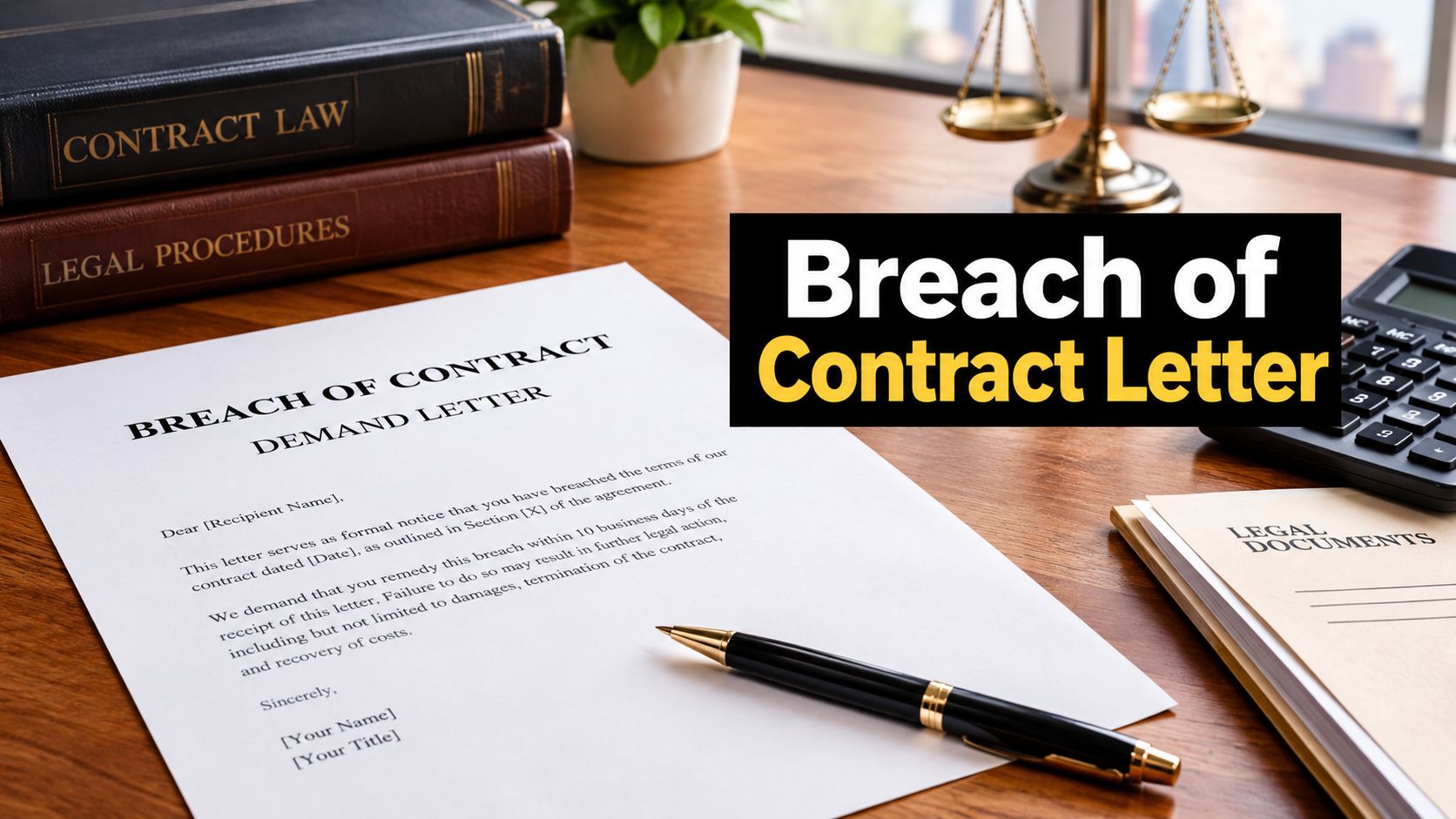
You discover that a vendor missed a delivery, a client stopped paying, or a business partner failed to perform a core obligation. The relationship may still matter, but ignoring the problem could weaken your position. A well-drafted breach of contract letter gives you a way to address the failure clearly, preserve a useful record, and choose the right level of pressure before filing a lawsuit.
Understanding the Purpose of a Breach of Contract Letter
A breach of contract letter is more than a complaint. It’s typically a formal pre-litigation notice that identifies the agreement, the specific obligation allegedly violated, the facts supporting the claim, the remedy requested, and a deadline for cure. Legal drafting guidance recommends using observable details, such as missed deadlines, undelivered goods, unpaid invoices, dates, amounts, and supporting evidence. Many demand letters use response periods of about 10 to 15 business days. Legal Clarity’s guidance on writing a breach of contract letter explains these practical components.
In California business disputes, the contract itself should control your first move. Review any notice provision, cure language, delivery requirement, dispute-resolution clause, and termination provision before sending anything. A contract may require written notice to a particular address or representative, and failing to follow that procedure can create an avoidable dispute about whether notice was effective.
Practical rule: Treat the letter as a structured record that another lawyer, mediator, judge, or arbitrator may read later.
Start with the agreement, not your frustration. Name the parties, identify the contract and its date, quote or accurately summarize the relevant clause, and explain what happened in chronological order. Avoid conclusions that the facts don’t support. If the issue is an allegedly late shipment, identify the promised delivery date, the communications exchanged, and the actual status. If the issue is nonpayment, identify the invoice, payment obligation, amount due, and prior requests.
The remedy should also be clear. You might request payment, delivery, correction of defective work, access to information, or another form of contractual performance. You can reserve rights without making every possible threat. For California-specific context outside California law, businesses can also consult this 2026 guide to Florida contract disputes to compare how another jurisdiction approaches breach notices and dispute strategy.
This article is for informational purposes only and isn’t legal advice. No attorney-client relationship exists based on your review of this article, and none of the information in it is legal advice. Your contract, industry, facts, and applicable law may change the proper approach.
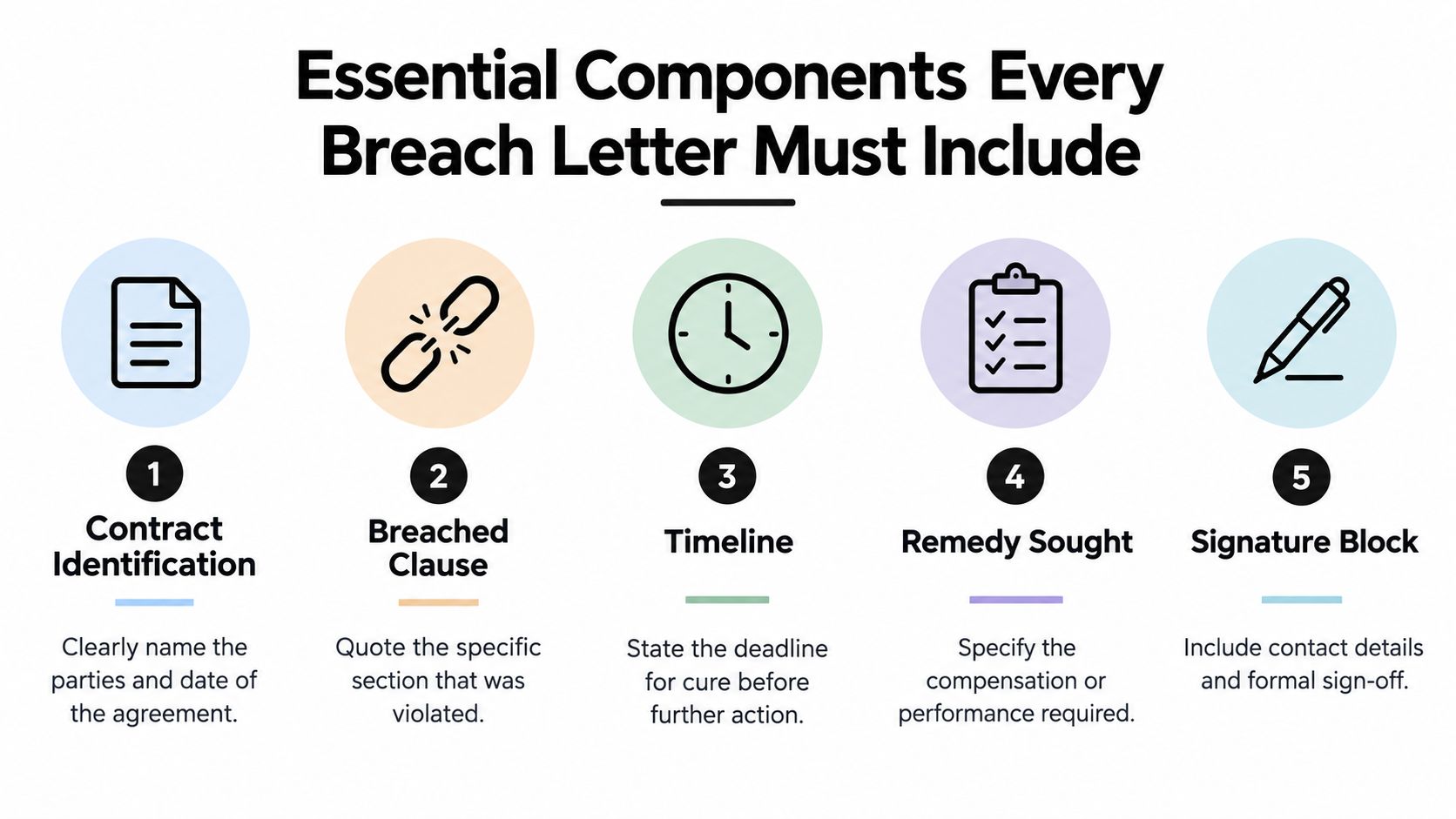
Essential Components Every Breach Letter Must Include
A strong letter works as a chronological proof package. It should let a neutral reader understand what agreement existed, what each side promised, what failed, what the failure caused, and what resolution you’re requesting.
Identify the agreement and the obligation
Name the parties and the contract date. If the agreement has an order number, statement of work, amendment, or exhibit, identify it. Then point to the exact clause or clauses involved. A general statement that the other party “breached the contract” forces the recipient to guess what you mean and makes later evaluation harder.
State the facts in sequence
Use dates, amounts, communications, and performance records. Explain what was due, when it was due, what occurred, and what remains incomplete. Keep separate facts from argument. An invoice, purchase order, delivery record, email, change order, or project report may provide useful support, but attach only material that helps prove the particular breach.
Quantify the demand
If you’re seeking payment or damages, show the calculation in line items. Identify the amount tied to the contract, credits or payments already received, and any additional amount you can support. If the figure remains uncertain, say what information is missing rather than overstating the claim.
State the cure and deadline
Tell the recipient exactly what must happen. A demand for “prompt resolution” is weaker than a defined request for payment, delivery, repair, or confirmation of performance. Set a response or cure deadline that fits the contract and the dispute. Contract Counsel’s demand-letter guidance emphasizes factual accuracy, specific remedies, supporting exhibits, a clear deadline, and traceable delivery.
Preserve proof of delivery
Use certified mail or another verifiable delivery channel when appropriate. Keep the final signed letter, attachments, delivery confirmation, returned receipt, email transmission record, and all responses together. The paper trail matters because the letter may later help establish what notice was given and when.
Generic templates often fail because they encourage broad accusations while leaving the contract language and evidence unstated. A template can organize the document, but it can’t supply the facts. Before sending, compare every sentence against the agreement and your records.
Drafting the Letter, Tone, Language, and Common Mistakes
The hardest drafting decision often isn’t what to include. It’s how hard to push. A letter can function as a formal demand, a notice preserving rights, or an invitation to cure and negotiate. The right choice depends on the clarity of the breach, the urgency of the harm, and whether the commercial relationship is worth preserving.
Use a firmer tone when the obligation is clear, the recipient has already ignored specific requests, the breach is continuing, or delay threatens your business. State the clause, facts, remedy, deadline, and consequences plainly. Avoid theatrical threats. “If you don’t cure by the stated deadline, our client reserves all available contractual and legal remedies” is generally more useful than an emotional accusation.
A softer notice may be appropriate when the facts are incomplete, performance depends on disputed information, or both sides need to continue working together. You can identify the apparent issue, request a meeting, ask for a proposed cure, and reserve rights while avoiding an unnecessary declaration that the relationship is over.
Choose the tone based on the likely response
Ask how the recipient is likely to react. A company with an internal legal team may respond to a precise demand. A small vendor who made an operational mistake may become defensive if the first communication reads like a complaint. A long-term customer may need a path to fix the problem without losing face.
| Situation | More useful approach |
|---|---|
| Clear nonpayment or missed contractual deadline | Firm demand with itemized amount and cure date |
| Ambiguous performance dispute | Notice of concern, facts, requested discussion, and rights reservation |
| Ongoing strategic relationship | Specific cure request with professional, non-accusatory language |
| Repeated refusal or concealment | Formal notice that documents prior communications and consequences |
Don’t exaggerate damages, accuse the other party of fraud without a factual basis, or threaten criminal action in a commercial dispute. Don’t include confidential settlement discussions if doing so could create a separate issue. Before adapting a form, review practical guidance on writing a demand letter for another perspective on organizing a clear demand.
The underserved question is whether every notice should be written as an ultimatum. It shouldn’t. A well-calibrated letter can preserve negotiating position while leaving room for a business solution. The more uncertain the breach, the more important it is to distinguish an allegation from an established fact.
Sending the Letter, Delivery Methods, and Timelines
A carefully written letter can still fail as a practical tool if you can’t show where, when, and how you sent it. First check the contract’s notice clause. It may specify an address, recipient, delivery method, or event that triggers a cure period. Follow that language before relying on a preferred method.
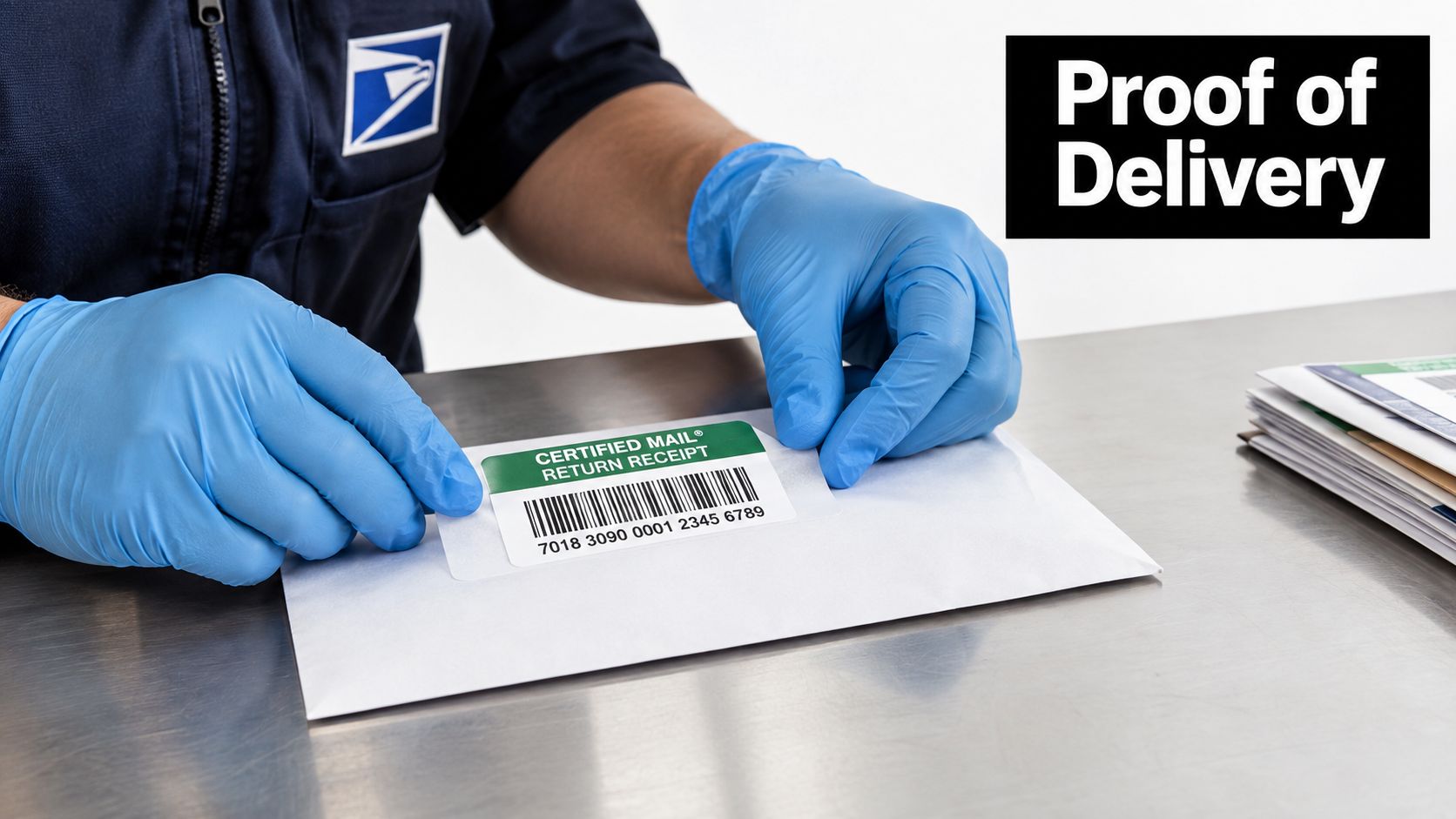
Certified mail with a return receipt can create a useful delivery record. Depending on the contract and circumstances, a courier, acknowledged email, contractual portal, or another verifiable channel may also be appropriate. Consider sending through more than one contractually permitted channel, but don’t create confusion by using inconsistent versions or deadlines.
Separate the relevant dates
The breach date and the demand-letter date serve different purposes. One legal guidance source explains that the statute of limitations should be calculated from the breach date, while the demand date may control a contractual cure period or a statutory notice-waiting period. This explanation of breach dates, cure periods, and notice requirements is a useful reminder not to treat every deadline as starting from the letter.
Calendar the dates separately:
- Breach date: Record when the contractual failure occurred or became apparent.
- Notice date: Preserve when the recipient received the letter, not merely when you sent it.
- Cure deadline: Calculate it under the contract and state the date clearly.
- Follow-up date: Decide what you’ll do if the recipient doesn’t respond.
A demand letter doesn’t automatically stop every filing deadline. If the dispute is significant, ask counsel to analyze limitation periods, notice requirements, preservation obligations, and any arbitration or mediation clause. A California business may also benefit from reviewing an alternative dispute resolution lawyer before escalating a dispute that the contract directs away from court.
The following video provides general background on demand-letter strategy. It isn’t a substitute for reviewing the agreement or obtaining advice about your facts.
When to Seek Legal Representation in California
Self-drafting can make sense when the dispute is narrow, the contract is straightforward, the facts are well documented, and the requested cure is simple. It gives you direct control over tone and may open a conversation without immediately increasing the level of conflict. The trade-off is that an incomplete demand can omit a notice requirement, misstate damages, or make an unnecessary admission.
Attorney involvement is more valuable when the other party has counsel, the agreement contains complex remedies, the breach affects ongoing operations, or the demand may lead directly to litigation. Counsel can test whether the contract supports the theory of breach, identify defenses, preserve evidence, and frame the remedy without sacrificing negotiation flexibility.
Weigh leverage against relationship cost
Industry settlement benchmarks cited by Common Counsel estimate that plain demand letters resolve disputes at 25–40%, while attorney demand letters resolve disputes at roughly 60–80%. The same source estimates that adding a simultaneous court filing raises resolution to 85–97%. These figures are industry benchmarks, not court-wide statistics, and they shouldn’t be treated as a prediction for a particular California dispute. The source’s discussion of demand letters and filings nevertheless illustrates the central trade-off: stronger escalation may increase bargaining power while also making a commercial relationship harder to restore.
| Self-drafted letter | Attorney-drafted letter |
|---|---|
| Lower immediate expense | Professional review and representation cost more |
| Direct control over tone | Greater scrutiny of notice, defenses, and remedies |
| Suitable for simple disputes | Better suited to material or contested claims |
| Risk of missing legal issues | May signal litigation readiness |
A lawyer may recommend a measured notice rather than an aggressive demand. That isn’t weakness. It can preserve credibility when the facts are disputed or the parties still need to perform under the contract. For a broader discussion about when to hire a lawyer selling a business, consider how transaction size, risk, and complexity affect the timing of legal help.
California businesses seeking contract-focused assistance can review contract lawyer services in California when they need help evaluating a notice, negotiating a cure, or preparing for possible litigation.
Sample Template for a California Breach of Contract Letter
Use the following structure as a drafting aid, not as a substitute for contract review. Replace every bracketed item with accurate information, remove sections that don’t apply, and confirm that the notice method matches the agreement.
Subject: Notice of Breach and Demand to Cure, [Contract Name and Date]
Date: [Month Day, Year]
To: [Legal name and address of recipient]
From: [Your legal name, address, email, and phone number]Contract identification: On [date], [your name or entity] and [recipient] entered into [name or description of agreement]. The relevant obligations appear in Section [number], together with [exhibit, statement of work, purchase order, or amendment].
Breach: Section [number] requires [quote or accurately summarize the obligation]. On [date or dates], [describe the specific event]. The records show [state observable facts, including delivery status, invoice information, communications, or other relevant evidence].
Performance by sender: [Describe your performance, payment, delivery, or readiness to perform]. If your performance is disputed, state the relevant facts accurately and avoid claiming more than the records establish.
Loss or amount due: The current amount requested is [amount, if known], calculated as follows: [line item one], [line item two], and [credit or payment already received]. Supporting documents are attached as Exhibits [letters].
Demand to cure: Please [pay, deliver, repair, complete, provide information, or take another defined action] by [specific date]. Please confirm in writing by [response date] how you will cure the breach.
Reservation of rights: If the breach isn’t cured by the stated deadline, [your entity] reserves all rights and remedies available under the contract and applicable law, including the right to pursue further action.
Signature: [Name, title, signature, contact information]
Attachments: [Contract excerpt, invoice, correspondence, delivery records, photographs, or other exhibits]
The modern breach-of-contract letter grew from older legal notice and demand-letter traditions. In standardized commercial contracting, its practical value is the written record it creates before suit, as explained in this notice of litigation letter template.
Don’t attach an unorganized document dump. Number exhibits, refer to each one in the text, preserve the originals, and retain proof of delivery with the final copy.
Next Steps If Your Breach Letter Is Ignored
Suppose a customer receives the letter, misses the cure deadline, and says nothing. Don’t send a series of increasingly angry messages. Gather the contract, notice, delivery proof, invoices, correspondence, performance records, and damages calculation into one file. Then determine whether the agreement requires mediation, arbitration, a second notice, or another pre-suit step.
If the recipient responds but disputes the facts, compare the response against the contract and your evidence. A short meeting or mediation may resolve a factual misunderstanding, particularly when both sides want to continue doing business. If the recipient refuses to cure and the evidence is strong, counsel can evaluate filing, preservation, settlement, and enforcement options. A California business owner considering litigation can review this guide to filing a breach-of-contract complaint in California.
Before escalating: Confirm the contract, notice procedure, deadlines, evidence, damages, and desired business outcome.
The letter may be ignored because the recipient disputes liability, lacks funds, expects you won’t pursue the claim, or believes the notice was defective. Each explanation calls for a different response. Don’t assume silence proves your case, and don’t allow negotiations to obscure a filing deadline.
This material is for general informational purposes only, may not be current, and may change without notice. You shouldn’t act on it without seeking advice from a qualified attorney. Reading this article or contacting a firm through its website doesn’t create an attorney-client relationship, and no attorney-client relationship is formed by receiving its materials or communications.
LA Law Group, APLC assists California businesses with notice-of-breach and demand-letter matters, contract formation, evidence review, negotiation, and potential civil litigation. Visit LA Law Group, APLC to request a consultation about the contract, breach records, cure strategy, and next step that fits your business objectives.
Attorney Advertising. This article is general information, not legal advice, and does not create an attorney-client relationship. Prior results do not guarantee a similar outcome.