
Business Law for Entrepreneurs: A Practical Guide

You launch an online store, sign a vendor agreement, hire a contractor, and apply for a marketplace account. Then the platform freezes your funds, a contractor claims ownership of your product assets, or an investor’s lawyer finds a missing signature in your corporate records. None of those problems feels like “business law” in the abstract. They’re operational emergencies with legal consequences.
This guide treats business law for entrepreneurs as a practical risk-management system. Use it to rank problems, protect cash flow, and identify the issues that require a licensed attorney. It’s for general informational purposes only and isn’t legal advice. No attorney-client relationship exists based on your review of this article, and none of the information in this article is legal advice.
Why Legal Problems Hit Founders in Clusters
A single product launch can pull a supplier contract, advertising claims, customer data, contractor-created content, employment classification, intellectual property, and platform terms into the same week. One disagreement can then spread across several areas before you have identified the first problem.
A formation checklist will not manage that exposure. Business law governs how a company forms, contracts, hires, protects intellectual property, handles information, and responds to disputes. For a digital or hybrid business, risk often appears inside an ordinary workflow, such as publishing an advertisement, using an AI tool, onboarding a contractor, or relying on a marketplace account.
Practical rule: Treat every recurring business process as a legal process with documents, owners, deadlines, and escalation points.
Start with fast triage. Ask four questions whenever something feels legally uncertain:
- Can this issue stop revenue or access to critical assets?
- Could it expose you personally, rather than only the company?
- Could it affect ownership, fundraising, or the value of the business?
- Will delay make the problem harder or more expensive to fix?
A platform suspension, regulatory inquiry, threatened lawsuit, or disputed ownership claim belongs near the top of the list. A routine policy update may not. This ranking directs legal spending toward mistakes that could interrupt operations, freeze funds, or weaken the company’s position.
The reason entity law matters is historical as well as practical. New York became the first U.S. jurisdiction to allow incorporation by statute in 1811, and the U.S. Supreme Court’s 1819 decision in Dartmouth College v. Woodward helped establish that states could not revoke corporate charters arbitrarily. Moving from special legislative approval to repeatable incorporation made business formation more predictable and scalable for founders. EBSCO’s history of incorporation laws explains how general incorporation laws later spread widely.
The modern lesson is direct: formation creates a legal framework, but daily conduct determines whether it works. Build enough legal literacy to make fast, risk-ranked decisions. Involve counsel before acting when an issue involves a specific jurisdiction, a material contract, equity, regulated data, or a serious dispute.
Choosing an Entity and Protecting Personal Assets
Entity selection is not a branding exercise. It’s a decision about who bears the risk when the business owes money, causes harm, or loses a dispute.
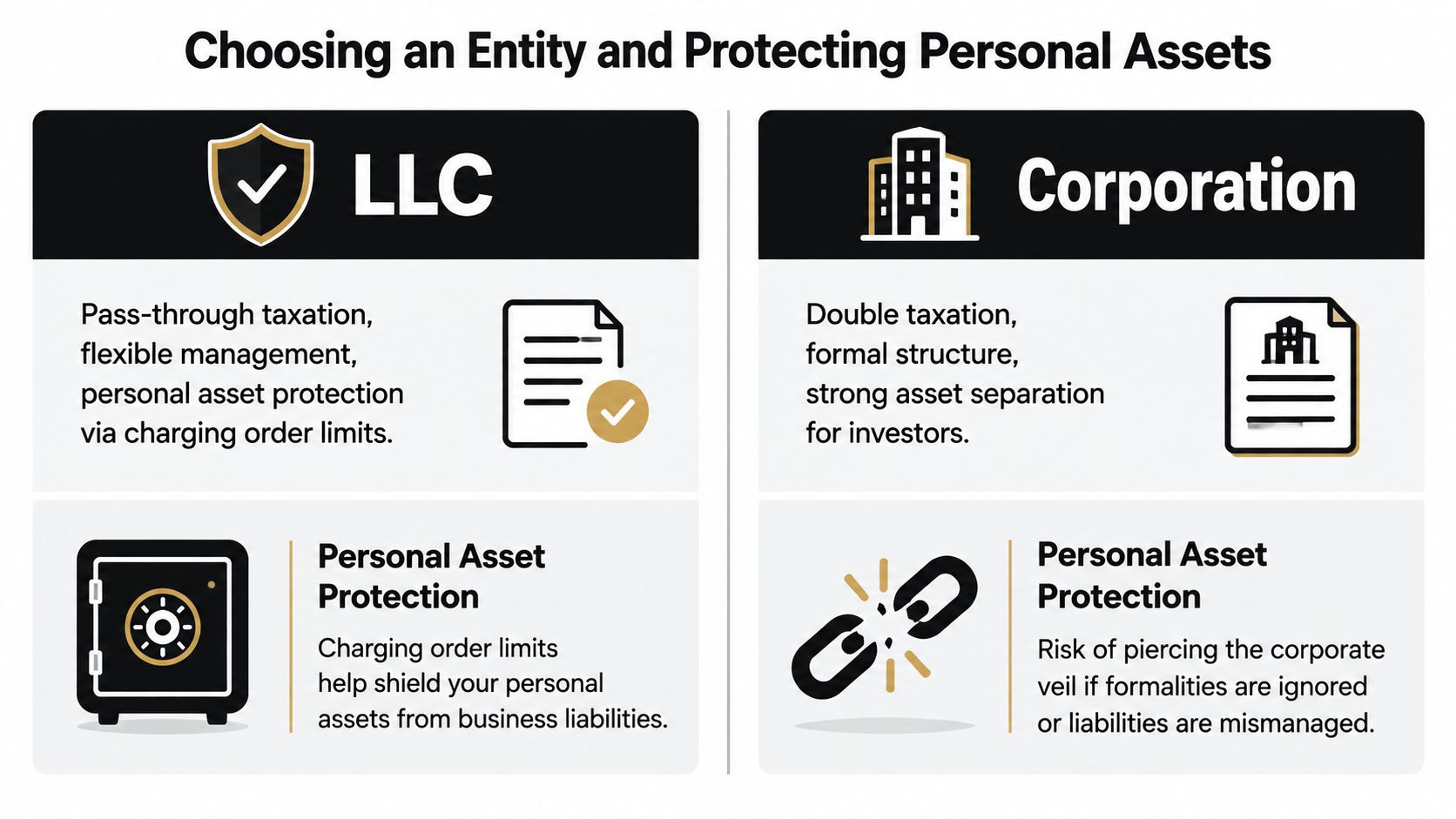
A sole proprietorship and a general partnership don’t create legal separation between the owner and the business. Business debts can become personal debts, and creditors may reach personal assets. By contrast, an LLC, corporation, LP, LLP, or LLLP creates a separate legal entity that can materially reduce personal exposure when the entity is properly maintained. Wolters Kluwer’s comparison of risky business forms explains this distinction.
Form the right structure
An LLC often suits a founder who wants flexible management and liability protection without adopting every corporate governance feature. A corporation can make sense when the company expects formal governance, outside investment, or an ownership structure that benefits from stock issuance. Partnerships may fit multiple-owner ventures, but the agreement must address authority, contributions, profits, exits, and deadlock.
Don’t choose based only on a tax slogan or a template’s default setting. Consider:
- Ownership: Who owns the company, and how can ownership change?
- Control: Who can sign contracts, borrow money, hire staff, or sell assets?
- Investment: Will outside investors require a corporation, preferred equity, or formal board action?
- Operations: Which state governs formation, and where will the business operate?
- Exit planning: What happens if a founder leaves, dies, stops contributing, or wants to sell?
For California founders, a practical guide to forming an LLC in California can help organize the initial filing steps. It can’t replace advice about tax treatment, ownership disputes, regulated activities, or multistate operations.
Operate like a separate entity
Formation is only the first part of the liability strategy. Use the practical pattern form, operate, and comply.
Form the entity correctly, obtain the required registrations, and document ownership. Operate only in the entity’s name. Sign vendor agreements as the company, invoice customers through the company, and use the company’s account for company expenses. Comply with filings, internal records, approvals, licenses, and other obligations.
Keep personal and business money separate. Maintain a dedicated bank account, record capital contributions accurately, and avoid paying household expenses from company funds. Use insurance appropriate to the business, because an entity shield isn’t a substitute for coverage.
Common failures include signing a major agreement personally, using a personal payment account for business sales, ignoring annual filings, and treating company money as a personal wallet. Courts evaluate the facts of how you operate, not just the name printed on the formation document. Commingling funds and ignoring formalities can undermine the liability shield and increase personal risk.
The recommendation is simple. Form the structure that fits your ownership and financing plans, then build habits that prove the company is separate every day.
Drafting Contracts and Securing Intellectual Property
Your contracts are business infrastructure. They define what you receive, what you owe, who owns the work, what happens after a breach, and where a dispute gets resolved. A weak agreement can turn a manageable commercial problem into a financing problem.
A 2026 legal industry summary reported that 67% of B2B disputes originate in unclear or missing contract clauses, while the median cost to litigate a single U.S. contract dispute was $91,000. The contract-risk summary from Legal Chain provides those figures and connects drafting failures with fundraising risk.
Put the commercial deal in writing
A contract should answer practical questions, not merely sound formal. Define the deliverables, acceptance standards, payment dates, ownership, confidentiality, warranties, limits on liability, termination rights, notice procedures, and dispute process.
Pay special attention to clauses that founders often treat as boilerplate:
- Scope: State exactly what the vendor or contractor must deliver.
- Acceptance: Explain how and when you can reject incomplete or defective work.
- Payment: Tie payment to milestones where the work develops a critical asset.
- Ownership: Identify whether the company receives an assignment, a license, or nothing beyond permission to use.
- Exit: State what happens to data, credentials, inventory, and unfinished work after termination.
- Governing law: Select a governing law and forum that make practical sense for the parties and the business.
Use a focused contract drafting and review resource when you need to create or negotiate an agreement. A template may help you spot topics, but it won’t understand your negotiating position, dependencies, regulatory exposure, or intended exit.
Secure ownership before the asset matters
Intellectual property problems usually surface after the asset has become valuable. That’s the worst time to discover that a contractor owns the code, a former founder retained rights to a logo, or a designer never assigned the source files.
Use written IP assignment agreements with founders, employees, and contractors. Cover software, designs, copy, photographs, product specifications, customer-facing materials, inventions, domain-related assets, and other work created for the business. Confirm that the person assigning rights owns the work and hasn’t incorporated third-party material without permission.
Trademarks protect brand identifiers. Copyright can protect original creative expression. Patents may be relevant to qualifying inventions. These rights serve different purposes, so don’t treat “filing something” as a complete IP strategy.
IP ownership also affects financing. The referenced legal summary reports that ownership issues discovered during due diligence can delay a funding close by about 90 days. That delay can affect cash planning, investor confidence, and negotiating power. Clean assignments are therefore not administrative housekeeping. They’re a valuation asset.
Ownership should be settled when the work begins, not when an investor asks who owns it.
Create an IP register, retain signed assignments, document licenses, and preserve evidence of creation and transfer. If the business relies on a brand, software platform, proprietary process, or substantial content library, get counsel involved before the asset becomes central to revenue.
Navigating Employment and Independent Contractor Rules
The label on a contract doesn’t decide whether someone is an independent contractor. The working relationship does.
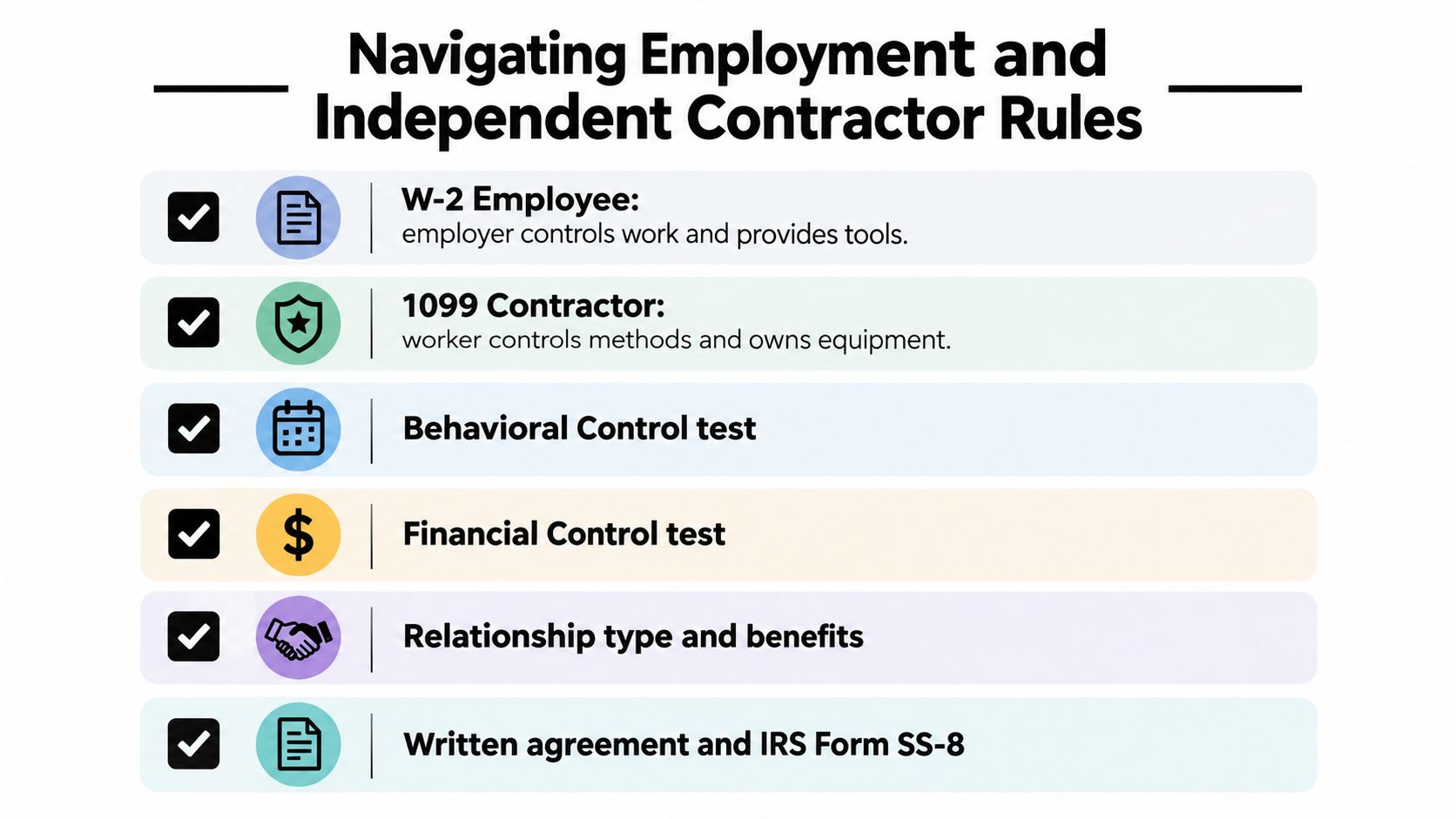
A W-2 employee generally works within the employer’s direction and systems. The business may control schedules, methods, tools, supervision, and the way the work integrates into operations. A 1099 contractor generally operates an independent business, controls the method of performance, supplies equipment, and serves clients under a defined project or service arrangement.
Compare the working relationship
| Question | Employee | Independent contractor |
|---|---|---|
| Who controls the work? | The business may direct how work is performed | The worker generally controls the method |
| Who supplies tools? | The business often provides tools and systems | The worker commonly uses independent equipment |
| How is work structured? | Ongoing role integrated into the business | Defined service or project |
| What matters legally? | Actual relationship and applicable employment rules | Actual independence, not merely a signed label |
Agencies and courts may examine behavioral control, financial control, and the nature of the relationship. A written agreement helps, but it can’t cure a relationship that operates like employment.
Use this decision process before hiring:
- Describe the work and who controls the method.
- Identify whether the worker operates an independent business.
- Review equipment, payment, scheduling, supervision, and exclusivity.
- Check the rules in every jurisdiction where the worker performs services.
- Document the conclusion and revisit it if the relationship changes.
Don’t use contractors as a payroll shortcut
Misclassification can create exposure for unpaid wages, overtime, payroll taxes, benefits, penalties, and related claims. The risk becomes sharper when a business directs a worker’s daily activity but calls the worker a contractor to reduce administrative cost.
Employees also need compliant wage and hour practices, workplace safety procedures, required notices, and policies that match the business. An employee handbook should address conduct, confidentiality, reporting channels, leave, technology use, and discipline without promising terms the company can’t support.
Watch the embedded overview for a visual explanation of classification concepts:
Insurance belongs in the same hiring conversation. Depending on the work and jurisdiction, founders may also want to protect their business with accident insurance from ISU Insurance Services as part of a broader risk-management plan.
When facts are close, don’t guess. Ask counsel to assess the relationship before the worker starts, especially if the role is central to operations or spans multiple states.
Regulatory Compliance and California Business Rules
Taxes matter, but they aren’t the whole compliance picture. A digital business can follow its tax obligations and still face serious exposure through customer data, artificial intelligence, worker classification, platform rules, or fraudulent filings.
Modern business risk increasingly sits inside operations. Bloomberg Law identifies litigation, transactions and contracts, regulatory compliance, and artificial intelligence as major business-law pressure points in its 2025 legal trends report. Wolters Kluwer’s 2025 business and legislative outlook highlights AI governance, consumer data privacy, beneficial ownership information reporting, and business identity theft as active concerns.
Build a compliance map
Start by listing what the business does with real-world specificity:
- Collects customer names, addresses, payment details, or behavioral data.
- Uses AI to generate content, screen applicants, recommend products, or make decisions.
- Sells through Amazon, Shopify, Etsy, social platforms, or other marketplaces.
- Employs people or engages workers across state lines.
- Files registrations or maintains licenses in multiple jurisdictions.
- Stores vendor, customer, employee, and intellectual property records.
For each activity, identify the rule source, responsible owner, required notice or consent, recordkeeping duty, review date, and escalation trigger. This converts compliance from an annual scramble into an operating process.
AI deserves its own review. Ask what data enters the tool, whether the provider retains it, whether outputs include third-party material, whether a human reviews important decisions, and whether the business can explain the system’s role. Don’t upload confidential customer, employee, or product information into a tool until the contract and privacy terms have been reviewed.
California needs active monitoring
California businesses may face obligations under the California Consumer Privacy Act, including rules affecting the collection, use, disclosure, and handling of consumer information. The correct analysis depends on the business, its data practices, applicable thresholds, and the current law.
California also takes worker classification seriously. AB5 and the ABC test can create a different result from a business’s preferred contractor label. A remote worker or online service provider may trigger questions that a founder never considered when the relationship began.
Marketplace operations add another layer. An account suspension, withheld funds, or removal of product listings can interrupt revenue without a traditional lawsuit. Preserve notices, invoices, communications, product records, and appeal submissions. Don’t assume the platform’s internal process eliminates the need for legal review.
Beneficial ownership reporting and business identity fraud also deserve attention. Monitor state filings, registered-agent communications, corporate records, and unexpected changes to company information. If a filing, notice, or data request looks unfamiliar, verify it through an independent official channel before responding.
Managing Funding Agreements and Dispute Resolution
Fundraising exposes the quality of your legal housekeeping. Investors and their counsel look for ownership clarity, authority, signed agreements, accurate capitalization records, and unresolved obligations. A founder who treats those items as paperwork creates avoidable friction precisely when speed matters.
Before discussing a financing, confirm that the company can answer basic questions:
- Who owns the company today?
- What equity, options, promises, or convertible instruments exist?
- Which board or member approvals were required?
- Does each founder have a signed ownership and IP agreement?
- Are material customer, vendor, employment, and license contracts complete?
- Do the governing-law and dispute provisions fit the intended transaction?
The legal industry summary cited earlier reports that IP ownership issues can delay a funding close by about 90 days when discovered during due diligence. The same summary reports a $91,000 median litigation cost for a single U.S. contract dispute. Those figures make the strategic point clear. Corporate hygiene and contract precision protect financing momentum as well as litigation budgets.
Design the exit before the conflict
A dispute clause should do more than say “the parties will negotiate.” Decide whether disputes go first to internal escalation, mediation, arbitration, or court. Specify the forum, governing law, notice method, emergency-relief rights, fee treatment, and whether confidential information can be protected.
Negotiation works best when the parties have authority, information, and a defined decision deadline. Mediation can help preserve a commercial relationship. Arbitration may offer a private process, but it can also limit procedural tools and create costs. Litigation may be necessary when you need court orders, broad discovery, or a binding judgment.
Use a written dispute file from the first warning sign. Preserve the contract, amendments, invoices, delivery records, messages, meeting notes, and mitigation steps. Don’t send an angry message that admits liability, threatens improper action, or destroys a future negotiating position.
If you’re evaluating a purchase, merger, or other ownership transition, specialized financing guidance such as GoSBA Loans business acquisition help may be useful alongside legal and accounting advice. Financing support doesn’t replace diligence. It should sit inside a coordinated review of debt, assets, liabilities, contracts, employees, and transfer restrictions.
The strongest dispute strategy is built before disagreement. Clear authority, clean records, precise obligations, and a workable resolution path give the business options when relationships deteriorate.
When to Consult a Business Attorney
You don’t need a lawyer to approve every routine email or purchase. You do need one when the decision could change ownership, expose personal assets, interrupt revenue, trigger a government response, or create an obligation that is difficult to unwind.
Use a clear escalation test
Consult counsel before signing or acting in these situations:
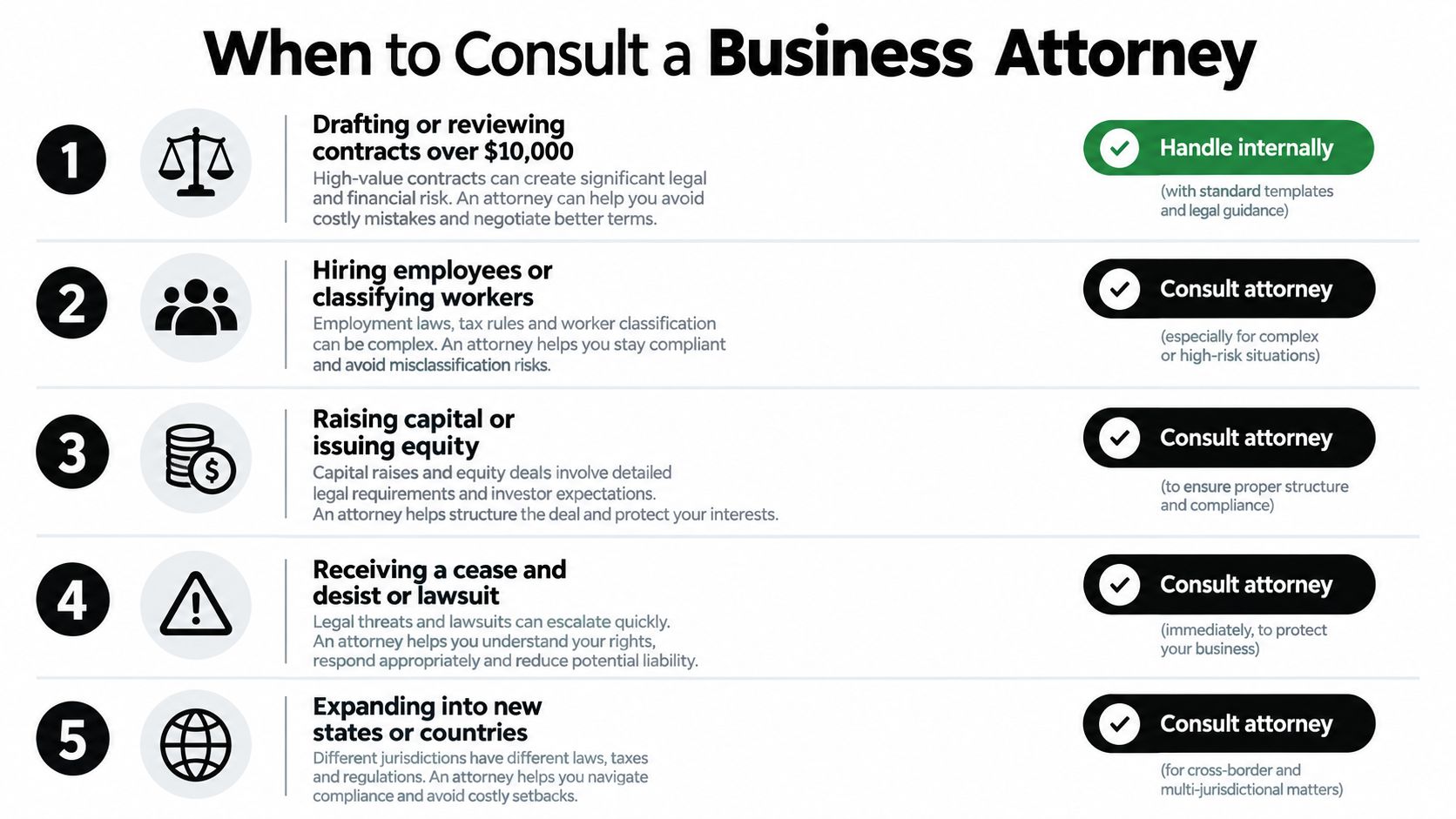
- A major commercial contract: Get review for a complex lease, exclusivity provision, long-term vendor commitment, unusual indemnity, uncapped liability, or contract involving a critical supplier.
- A worker classification decision: Ask for help before treating a core role as a contractor, especially in California or across multiple states.
- Equity or fundraising: Involve counsel before issuing stock, options, convertible instruments, profit interests, or ownership promises.
- A threat or formal notice: Don’t answer a cease-and-desist letter, lawsuit, regulatory inquiry, demand letter, or platform enforcement notice casually.
- A new jurisdiction or market: Review licensing, privacy, employment, tax, marketplace, and consumer rules before expanding into another state or country.
- A valuable IP asset: Secure assignments and assess trademark, copyright, patent, licensing, or infringement issues before launch or investment diligence.
- A founder breakdown: Get advice when a co-founder wants out, stops working, disputes ownership, blocks approvals, or threatens to compete.
Triage the problem before you call
Prepare a short packet. Include the entity documents, relevant contract, timeline, key communications, financial impact, requested outcome, and any deadline. Tell the attorney what has already happened, not what you wish had happened.
Founders planning a raise can also search for seed and angel investors while counsel reviews the company’s structure and financing materials. Keep those workstreams coordinated. Investor outreach won’t fix missing assignments, unclear ownership, or an inaccurate cap table.
You can handle routine recordkeeping, contract intake, renewal calendars, policy maintenance, and basic compliance organization internally. Stop DIY-ing when the issue is fact-specific, adversarial, time-sensitive, or financially material. A targeted consultation often costs less than repairing a rushed signature, an avoidable admission, or a preventable filing failure.
For founders who want to understand available legal support and consultation options, review the business law attorney free consultation information. It is worth using any consultation to ask focused questions about jurisdiction, urgency, scope, fees, conflicts, and the documents the attorney needs.
This article remains for general informational purposes only and isn’t legal advice. No attorney-client relationship exists based on your review of this article, and none of the information in this article is legal advice. Only a qualified attorney who understands your facts, business model, and jurisdiction can provide advice for your situation.
LA Law Group, APLC helps entrepreneurs with entity formation, partnership and business contracts, intellectual property, eCommerce disputes, and operational issues such as account suspensions and withheld marketplace funds. Visit LA Law Group, APLC to request a consultation and discuss the legal risk that needs attention first.
Attorney Advertising. This article is general information, not legal advice, and does not create an attorney-client relationship. Prior results do not guarantee a similar outcome.