
Can a Personal Injury Lawyer Drop Your Case in California?

A California personal injury lawyer can withdraw, but only on recognized grounds, and once a lawsuit is pending, the exit usually requires a filed substitution or court order, so a termination letter alone does not end the representation. Popular advice tells clients to accept the letter and start over. That advice skips the step that protects you most: confirming whether the withdrawal has taken legal effect and which deadlines are still running while you look for help.
Yes, Your Lawyer Can Withdraw, but Not Just Anytime
Yes, a lawyer can leave a case, but can a personal injury lawyer drop your case whenever the work gets difficult? No. Withdrawal is governed by professional conduct rules, not by an unrestricted right to stop answering calls.
Think of a lifeguard coming off duty. The guard can leave the stand, but not in the middle of a rescue without handing the swimmer to another guard. Your lawyer faces a similar handoff duty, especially when a filing date, deposition, or hearing is close.
Three Layers Control the Exit
First, some grounds permit withdrawal, such as a material breach after warning or conduct that makes the work unreasonably difficult. Second, some situations require withdrawal, such as when continuing would break the law or ethics rules. Third, some exits are restricted because they’d materially harm you, so they need safeguards or court permission.
Two frameworks shape this analysis. ABA Model Rule 1.16 is the national model, while California Rule of Professional Conduct 1.16 is the state rule that controls California lawyers. When people say “my lawyer dropped me,” they often describe an attempted withdrawal, not an immediately effective one, because the lawyer may still need to protect you until replacement counsel appears or a court enters an order.
This article is for informational purposes only, is not legal advice, and does not create an attorney-client relationship based on review of this article. None of the information in this article is legal advice.
A lawyer can leave your case, but cannot simply abandon you in the middle of it.
Grounds That Let a Lawyer Withdraw
Read the table across each row. The ground tells you why the lawyer wants out, the example shows what it looks like in real life, the status tells you whether the lawyer may or must leave, and the last column shows whether a court usually gets involved once suit is filed.
| Ground | Typical example | Status | Court involvement |
|---|---|---|---|
| Client breaches a material obligation after reasonable warning | Unpaid agreed costs or ignored document requests after written warning | Permitted only after warning | Usually required if suit is pending |
| Client makes representation unreasonably difficult | Repeatedly skips required meetings or refuses essential information | Permitted | Usually required if suit is pending |
| Client insists on illegal or unethical conduct | Asks counsel to hide evidence or file a false claim | Mandatory | Usually required if suit is pending |
| Continuing would violate law or ethics rules | Conflict that cannot be resolved with consent | Mandatory | Usually required if suit is pending |
| Lawyer’s physical or mental condition materially impairs work | Serious illness that prevents competent handling of the case | Mandatory | Usually required if suit is pending |
| Client discharges the lawyer | Client hires new counsel or sends a written termination | Client’s choice; lawyer’s exit follows | Substitution or court order if suit is pending |
| Withdrawal would materially harm the client | Exit three weeks before a filing or trial date with no replacement | Restricted; generally not permitted without safeguards | Court permission typically needed |
| Other good cause a tribunal would accept | Unforeseen conflict discovered late in the case | Permitted with tribunal permission | Required if suit is pending |
Permitted Grounds Need a Real Basis
Under ABA Model Rule 1.16 guidance on withdrawal without material adverse effect, withdrawal is generally permitted when it can occur without a material adverse effect on your interests. Recognized grounds include your substantial failure to meet obligations after reasonable warning, conduct that makes representation unreasonably difficult, an unreasonable financial burden, or other good cause.
California’s rule is similar. It identifies unreasonable difficulty, breach of a material obligation after warning, and legally unsupported claims as potential grounds. A client who ignores repeated requests for medical records after clear warnings fits this category far better than a client who asks hard questions.
Mandatory Withdrawal Is Different
Withdrawal may be mandatory when continuing would violate law or ethics rules, when the lawyer’s physical or mental condition materially impairs representation, or when you fire the lawyer. A client who demands false testimony is asking for illegal conduct, so the lawyer cannot stay and help with that plan.
Don’t confuse a real breach with a disagreement. You ordinarily control objectives such as whether to accept a settlement, while your lawyer controls professional judgments about strategy. Rejecting one settlement recommendation is exercising a decision that belongs to you, and it usually isn’t, by itself, a ground to end the relationship.
The Restricted Case Protects You From Harm
The hardest category is an exit that would materially harm you. That harm can mean significantly delaying the matter, substantially increasing your cost, or impairing your ability to reach the agreed objective. A lawyer trying to leave three weeks before trial with no replacement ready raises exactly that problem.
Practical rule: Before you accept any exit explanation, find which row of the table your situation resembles and ask for that ground in writing.
Even when a ground exists, the lawyer should take reasonable steps to avoid foreseeable prejudice. That includes adequate notice, time to obtain replacement counsel, releasing your file or property, and returning unearned fees or expenses.
Deadlines and Timing After a Withdrawal
Withdrawal doesn’t stop any clock. Your filing deadline, court dates, and record requests keep moving whether your lawyer stays, leaves, or is still waiting for court permission to leave. A termination letter works like a resignation email at a job: it announces an intent, and the obligations already on the calendar keep running until someone officially takes over.
California Courts identify personal injury claims under California Code of Civil Procedure section 335.1 and its two-year filing period, which generally provides two years for injury to person lawsuits. Treat that as a baseline rather than a universal answer, and read a plain language guide to the statute of limitations for personal injury against your own dates.
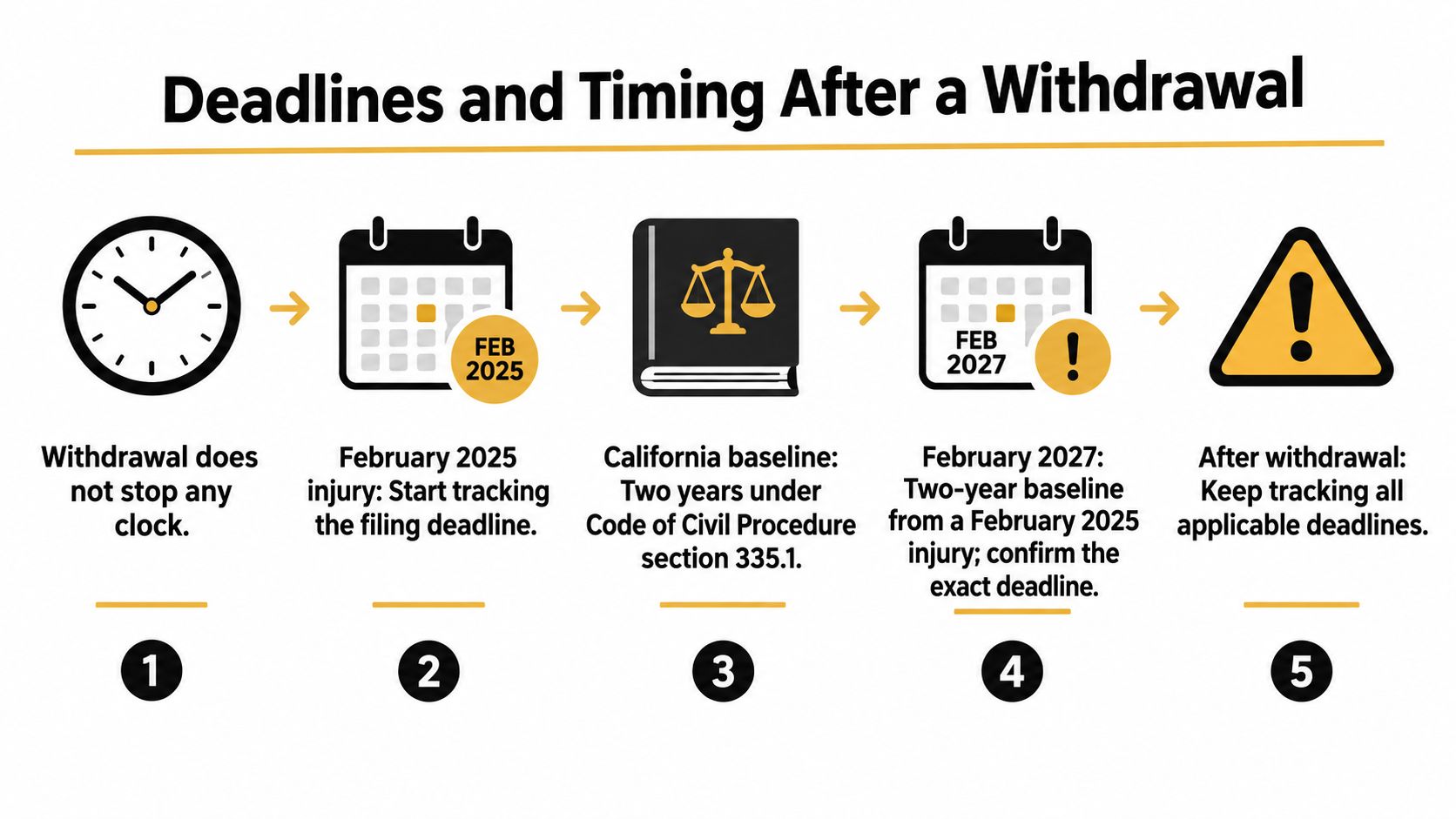
A Worked Example Shows the Squeeze
Suppose you were hurt in March 2022, and the two-year baseline put your filing deadline around March 2024. Your lawyer then sent a termination letter in February 2024, roughly six weeks before that date.
A replacement in that window has to review liability, order medical records and reports, calculate damages, locate witnesses, and prepare and file suit. Many firms decline a matter that needs urgent filing work, and the new lawyer may redo preparation the first one already billed for. Miss the date, and the claim can be barred.
The clock does not care why the seat went empty.
That squeeze is the practical version of the harm test. A late exit can significantly impede progress, raise your cost, or impair the agreed objective, which is why timing often decides whether an attempted withdrawal becomes a problem a court will scrutinize.
Deadlines to Verify After a Withdrawal
| Deadline | Typical rule | Why withdrawal raises the risk | Action now |
|---|---|---|---|
| General personal injury lawsuit | Two years under California Code of Civil Procedure section 335.1 | The clock runs regardless of the lawyer’s exit | Write the date on your calendar today |
| Claim against a California public entity | Written claim generally required before suit, on a shorter schedule | The claim must come before any lawsuit | Confirm whether the claim was filed and when |
| Minor injured client | Timing may differ or be tolled under other rules | Replacement counsel may not know the exception | Ask new counsel to confirm in writing |
| Court dates in a pending case | Set by the court and shown on the docket | A missed hearing or discovery date can cost rights | Pull the docket and list every upcoming date |
| Signed substitution or withdrawal order | Effective when entered on the court record | Until entered, notices may still go to the prior lawyer | Confirm the docket reflects the change |
| Medical records and insurance responses | Varies by provider and insurer | Records can take weeks and delay filing | Request copies in writing now |
Not Every Claim Uses the Same Clock
Some deadlines differ by claim type, defendant, government claim rules, minors, and other exceptions. A claim against a California public entity generally requires a written claim well before the two-year baseline, on a schedule measured in months rather than years. Minors may follow different timing, so do not assume a child’s case tracks the adult schedule.
A pending case adds court-set dates that live on the docket: discovery cutoffs, hearings, mediation, trial. Those dates do not move because counsel changes, and until the record shows a substitution or an entered order, notices may still flow to the prior lawyer.
Build the paper trail while the dates are fresh. Keep the termination letter, your written response or objection, and every confirmation you send, then match each upcoming deadline against the docket and your own calendar. If the exit is disputed later, that file is your record of what was said and when.
Records requests carry their own lead times, and a new lawyer cannot value or file your case without treatment records, bills, and insurer communications. Ask for written confirmation of the withdrawal date, the complete file, and every pending deadline now.
Make your first action a calendar entry for every date. Don’t rely on memory or on a single sentence in a termination letter.
Court Permission and Substitution in California
A pending case usually changes hands by one of two routes. You consent by signing a substitution of attorney with new counsel, or the court grants withdrawal after notice. California Courts identify Form MC-050 as the mechanism for substituting counsel in a pending case.
The image below maps those two routes so you can see where your case sits.
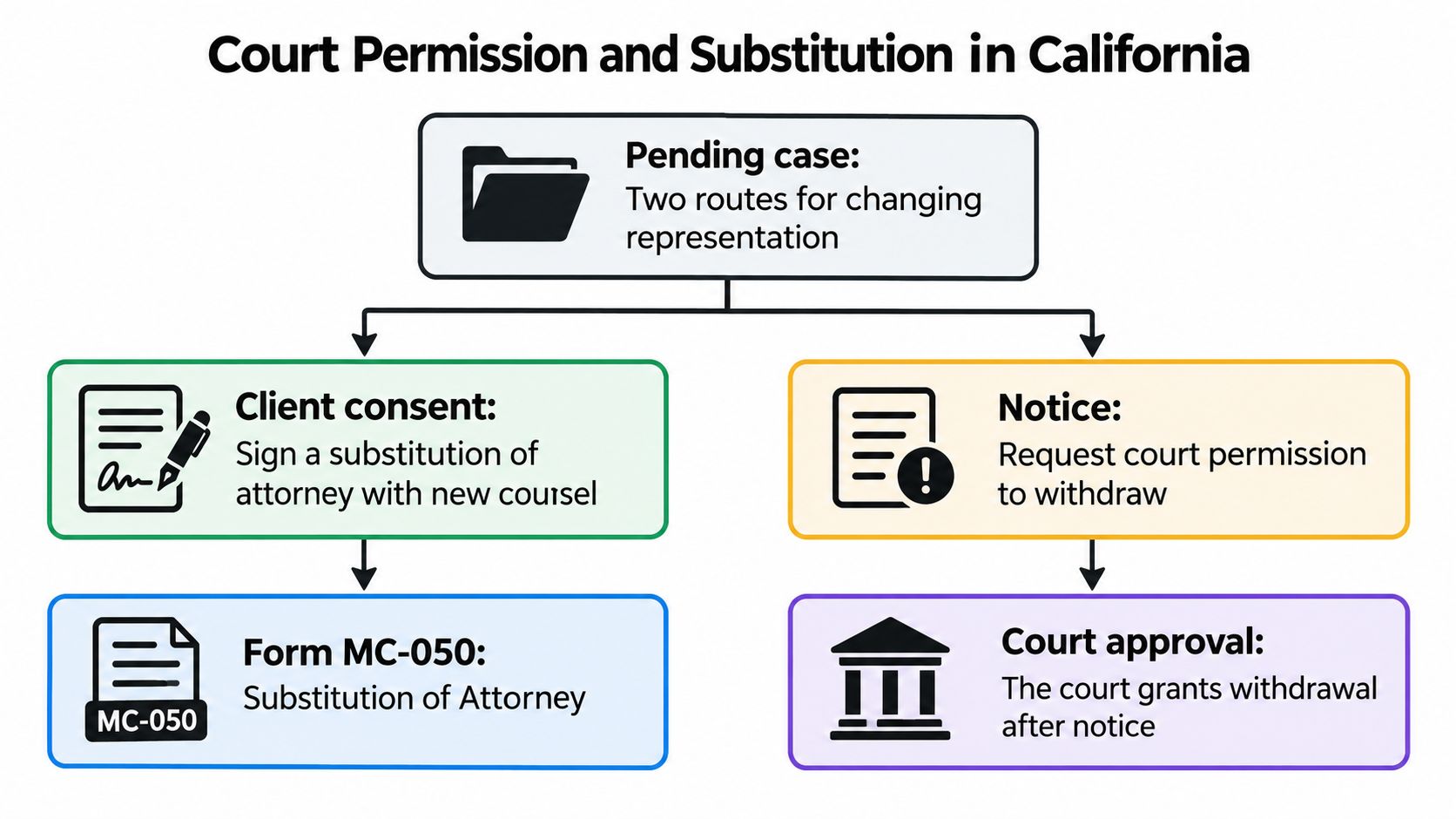
There’s often a gap between a letter saying the lawyer is leaving and a court record showing a change. Until an order or substitution is entered, the old lawyer may still be counsel of record. That means the court and opposing counsel may still send that lawyer notices, and hearings may still expect that lawyer to appear.
The Six Steps of an Orderly Exit
- Written notice comes first. The lawyer gives you written notice with the reason and the proposed withdrawal date.
- You sign or the lawyer files. You sign a substitution with new counsel, or the lawyer files a request to withdraw.
- The court acts where required. The court sets or confirms a hearing if local procedure requires one.
- The change is entered. The order or signed substitution is entered on the record, which is when the exit becomes effective for the pending case.
- The file is released. The lawyer releases pleadings, discovery, medical records, expert reports, correspondence, and settlement communications, even if fees remain disputed.
- Unearned money is returned. Unearned advance fees and expenses are promptly refunded.
If you’re unsure how money issues are handled during a change, a resource on fees when switching legal counsel can help you frame questions for both lawyers. Ask for an accounting instead of guessing what you owe.
The short video below offers another walkthrough of substitution basics before you check your own docket.
California ethics guidance requires the departing lawyer to take reasonable steps to avoid foreseeable prejudice. That includes sufficient notice to obtain new counsel and releasing materials reasonably necessary for representation. Withdrawal doesn’t erase a filed claim, extend a deadline, or preserve a missed limitations period.
Check the court docket and local rules directly, since procedures vary by court. If a lawyer leaves without adequate notice or fails to protect you from foreseeable prejudice, that may raise an ethics issue, although a malpractice claim would depend on causation, damages, applicable law, and proof of a lost legal opportunity.
Client Breaches, Fee Disputes and the Paper Trail
Consider two clients. One skips two deposition preparation sessions after a written reminder that explains why attendance matters. The other stops answering calls for a month, but there’s no warning on record explaining what obligation was breached or what happens next.
Those records lead to different conversations. Under California Rule 1.16 on material breach after reasonable warning, a lawyer may rely on your material breach only after giving you a reasonable warning that the lawyer will withdraw unless you fulfill the agreement or obligation. Failure to pay or perform under a fee agreement isn’t necessarily enough for immediate withdrawal.
Disagreement Is Not the Same as Noncooperation
You decide the objective, such as whether to accept a settlement offer. Your lawyer makes professional judgments about litigation strategy to pursue that objective. Refusing one settlement recommendation isn’t the same as refusing to provide essential information, attend required proceedings, or honor a material fee obligation.
A fee dispute in a contingency case also doesn’t make your claim disappear. The lawyer still must avoid foreseeable prejudice during any transition. If you want to understand how contingency terms are usually structured before you argue about them, Nares Law Group’s client fee guide and an explainer on contingent fee agreements can help you read your own signed agreement with clearer eyes.
Build a Cooperation Dispute Protocol
- Ask for the alleged breach in writing. Get the specific obligation, not a general claim that you’re difficult.
- Request a cure deadline. Ask what you must do, and by when, to fix the problem.
- Preserve your records. Save emails, texts, letters, and appointment records that show your responses.
- Request a current case status report. Ask what’s been filed, what’s pending, and what deadlines are coming.
- Retrieve the signed contingency agreement. Don’t rely on memory about fees, costs, or liens.
- Request a written accounting. Ask for costs, liens, and any claimed fee interest before changing counsel.
- Ask about tribunal permission. Confirm whether the lawyer will seek court permission before withdrawal if suit is pending.
Whether a lawyer can drop your case may depend on the contract, the seriousness of the breach or conduct, the warning provided, the procedural posture, and whether court approval is required. The rule also recognizes withdrawal where your conduct makes it unreasonably difficult for the lawyer to carry out the representation effectively.
The better question isn’t “can the lawyer fire me,” it’s what obligation was allegedly breached, what warning was given, and how the transition will protect the claim.
That reframing puts you in a stronger position with replacement counsel. You arrive with documents and dates, not just a story about a phone call.
Confirm the Withdrawal and Protect Your Claim Now
Start today by requesting written confirmation of the withdrawal date and the stated reason, then check the court docket for any substitution form or withdrawal order. Under California Rule of Professional Conduct 1.16 on specified withdrawal grounds, grounds such as unreasonable difficulty or a material breach after warning don’t create an automatic right to abandon a pending lawsuit when tribunal permission is required.
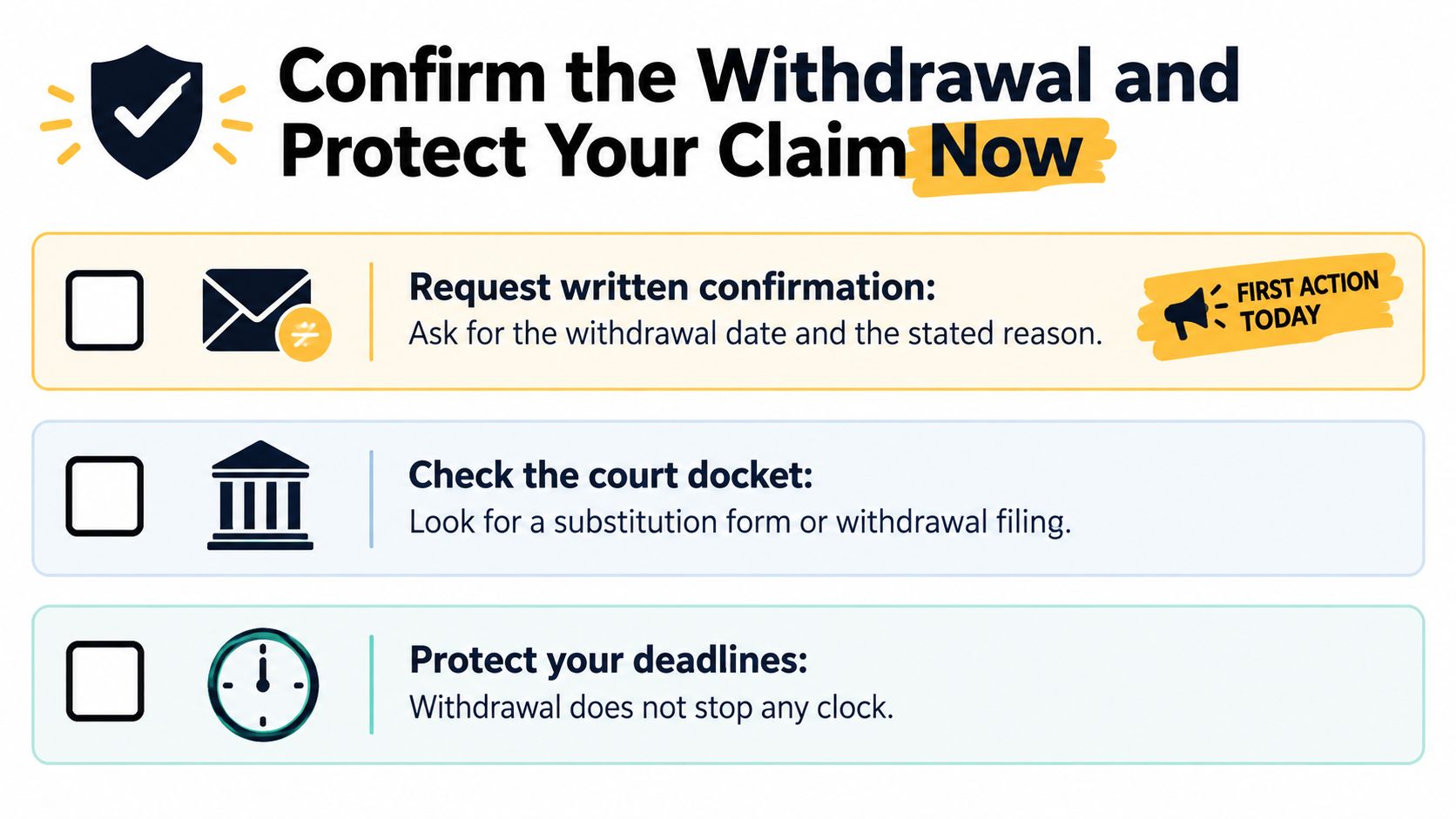
Five Steps for This Week
- Calculate every deadline yourself. Use the deadline table and the docket, not just the lawyer’s letter.
- Request the complete file. Ask for pleadings, discovery, medical records, correspondence, and settlement communications in writing.
- Pause before you sign. Don’t sign a substitution or release until you’ve reviewed it and understand its effect.
- Consult replacement counsel immediately. Share the file and your deadline list at the first meeting, and review guidance on switching personal injury lawyers so you know what to ask.
- Keep dated records. Log every contact, since any later question about lost value turns on causation, damages, and proof.
If you’re also researching how clients in other states evaluate new counsel, you can compare injury lawyers in Texas for selection criteria, then apply the California deadline and substitution rules to your own case. The selection questions travel well, but California procedure controls here.
LA Law Group, APLC handles personal injury matters across California, offers a free initial consultation and direct attorney access, and has offices in Los Angeles, Santa Monica, Chatsworth, and Fremont. A client facing a transition can request a prompt case review focused on deadlines and file transfer.
A confirmed withdrawal date and a second lawyer on the file are the fastest protection you can put in place.
This article is for informational purposes only and is not to be construed as legal advice. No attorney-client relationship exists based on review of this article, and none of the information in this article is legal advice.
If your lawyer has sent a withdrawal letter and you’re not sure whether the exit is effective or which deadlines are at risk, contact LA Law Group, APLC for a free initial consultation and prompt case review. Bring the letter, your fee agreement, and any court dates you have, and ask for direct attorney guidance on protecting your claim during the transition.
Attorney Advertising. This article is general information, not legal advice, and does not create an attorney-client relationship. Prior results do not guarantee a similar outcome.