
Can I Sue for a Slip and Fall Accident in California
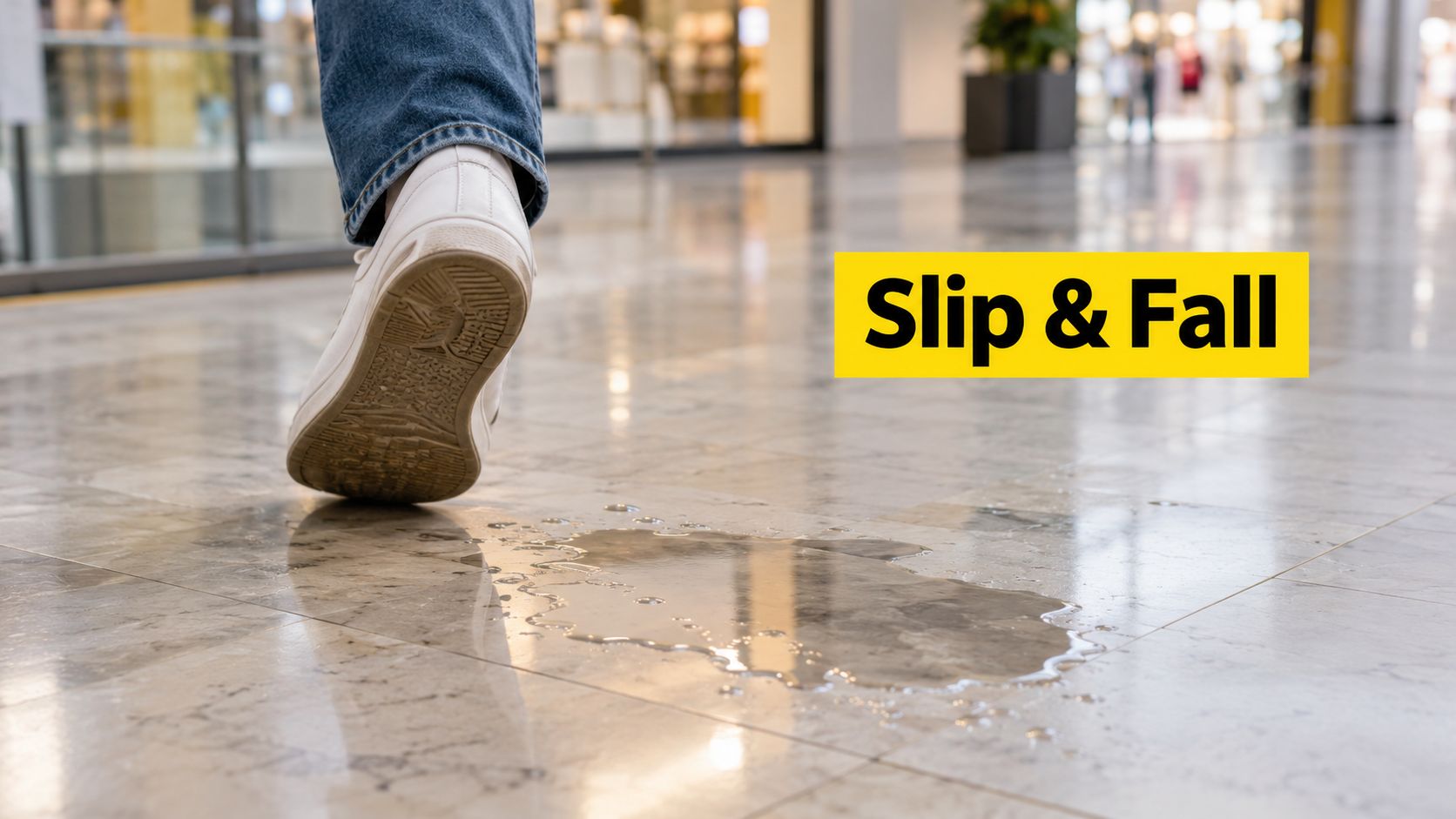
You’re leaving a California grocery store when your foot slides through a wet patch near the checkout. A sharp pain follows. The manager writes down what happened, but the floor is cleaned before you can photograph it. Days later, your back or knee still hurts, medical bills are arriving, and one question keeps coming back: can I sue for a slip and fall accident?
The answer depends on more than the fact that you fell. A viable California premises-liability claim usually requires proof that the property owner owed you a duty of care, a dangerous condition existed, the owner knew or should have known about it, and that condition caused your injury. Your own conduct, the type of property, and the filing deadline can also affect the result.
This article is for informational purposes only and isn’t legal advice. No attorney-client relationship exists based on your review of this article, and none of the information in this article is legal advice. Your specific facts may change the analysis, so consider speaking with a qualified California attorney before making decisions about a claim.
Introduction When a Simple Fall Becomes a Legal Question
A fall can happen in seconds, but the legal questions may last much longer. A restaurant customer may step onto a slick restroom floor. An apartment tenant may trip over a broken stair edge. A pedestrian may fall on a damaged walkway outside a business. In each situation, the injury may be real, yet the owner isn’t automatically responsible.
California premises liability focuses on whether someone responsible for the property failed to act reasonably. Think of the owner as a host. A host doesn’t promise that nothing will ever go wrong, but a host should address dangers they know about, or reasonably should discover, and warn people when a hazard can’t be fixed immediately.
The practical decision tree is straightforward:
- Duty: Were you lawfully on the property, and did the owner or occupier owe you reasonable care?
- Hazard and breach: Was there a dangerous condition, and did the responsible party fail to repair it, inspect for it, or warn you?
- Notice: Did the owner know about the condition, or had it existed long enough that the owner should have discovered it?
- Causation and damages: Did the hazard cause the fall and documented injuries?
The hardest question is often notice. A puddle that appeared moments before a fall may be difficult to connect to negligence. A leak reported repeatedly, or a spill visible on inspection records and surveillance footage, creates a different factual picture.
California law also imposes strict time limits. A strong claim can still fail if the injured person misses the applicable deadline, especially when a city, county, or other public entity owns the property. Acting promptly helps preserve evidence while the scene, records, and witness memories remain available.
Understanding California Premises Liability and Your Right to Sue
California premises liability becomes easier to understand when you treat a property owner like a host responsible for a shared space. A store invites customers inside, an apartment owner provides access to common areas, and a restaurant expects diners to walk through its entrance and aisles. Those relationships can create a duty of care, meaning the responsible party must take reasonable steps to maintain safe conditions.
That duty doesn’t make the owner an insurer against every accident. A person must generally identify a hazardous condition, show that the owner failed to respond reasonably, and connect the condition to the injury. The core principles are also discussed in this California premises liability law guide.
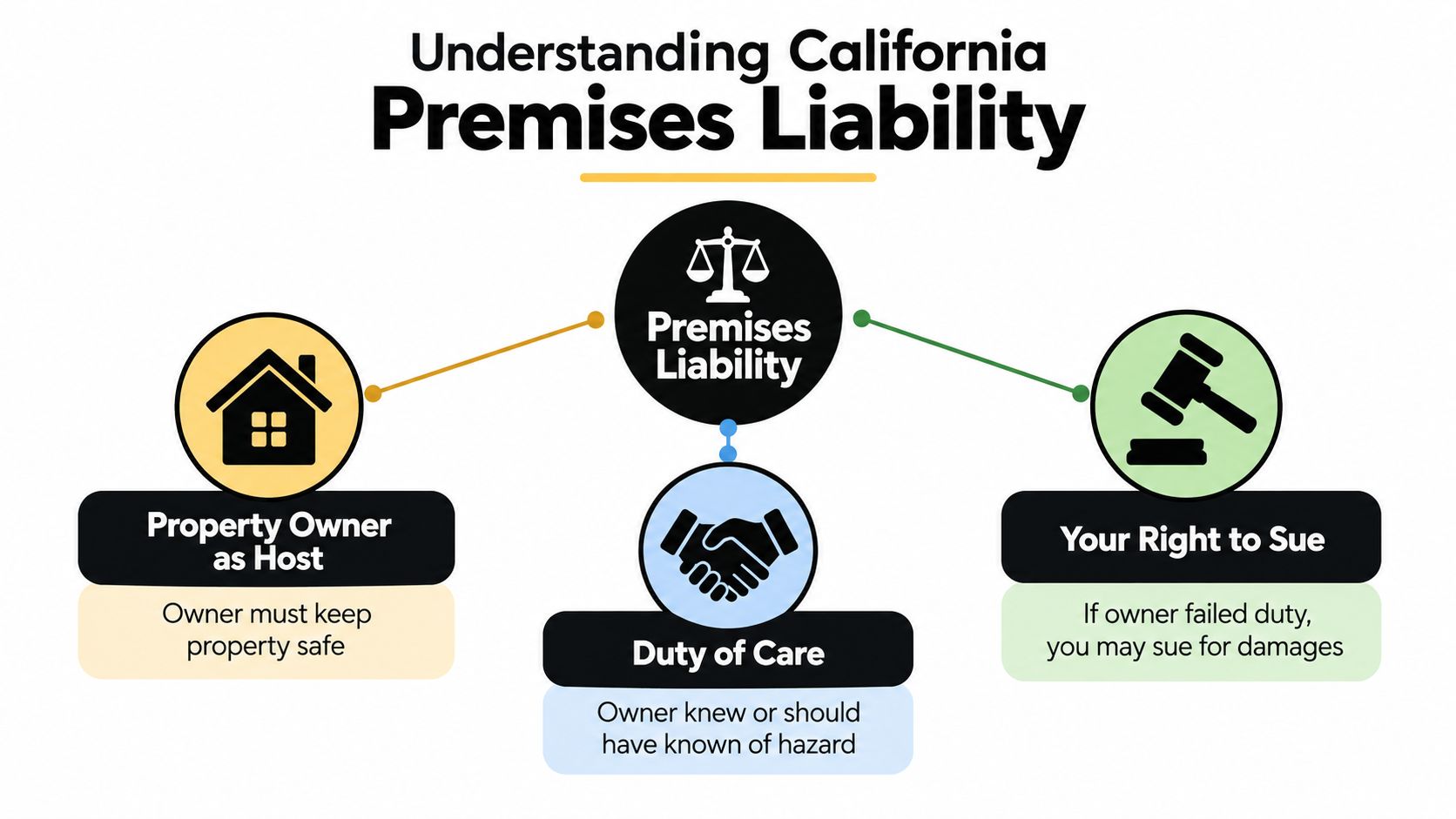
The four questions behind the claim
Start with the relationship. A paying customer, tenant, invited guest, or pedestrian using an area open to the public may have a stronger basis to argue that the property owner owed reasonable care than someone who entered without permission. The exact duty depends on the setting and facts.
Next, identify the hazard. It might be liquid on a floor, a broken step, an uneven surface, inadequate lighting, a missing handrail, or another unsafe condition. The hazard must be more than a vague feeling that the property seemed unsafe. You’ll need to explain what caused your foot to slip or your body to fall.
Then ask what the owner knew. Actual notice means someone responsible for the property knew about the danger, such as through a complaint, employee report, or prior observation. Constructive notice means the condition existed long enough, or was discoverable through reasonable inspections, that the owner should have learned about it.
Finally, causation ties the story together. If you slipped on the wet floor and immediately developed symptoms documented by a medical provider, the records may support a direct connection. If the same body part had already been causing problems, the insurer may argue that the fall didn’t cause the claimed condition or worsened it only slightly.
Practical rule: An injury proves that you were hurt. It doesn’t, by itself, prove that the property owner was negligent.
The claim generally needs evidence for each link, from duty through damages. Missing evidence doesn’t always end a case, but it can make the owner’s defenses harder to overcome.
How Fault and Common Defenses Affect Your Slip and Fall Claim
California generally follows comparative-negligence principles. That means the defense may argue that your own conduct contributed to the fall, even if a property condition also played a role. Looking at a phone, ignoring a warning sign, rushing, or wearing footwear that provided limited traction may become part of the dispute.
A fault finding can reduce recovery according to the injured person’s assigned share of responsibility. The National Law Review describes how many states reduce damages by the plaintiff’s fault percentage, while several states apply a 51% bar rule. In contributory-negligence jurisdictions including Alabama, Maryland, North Carolina, Virginia, and the District of Columbia, any plaintiff fault can defeat a claim entirely. Those rules provide useful contrast, but California’s analysis must be applied to California facts.
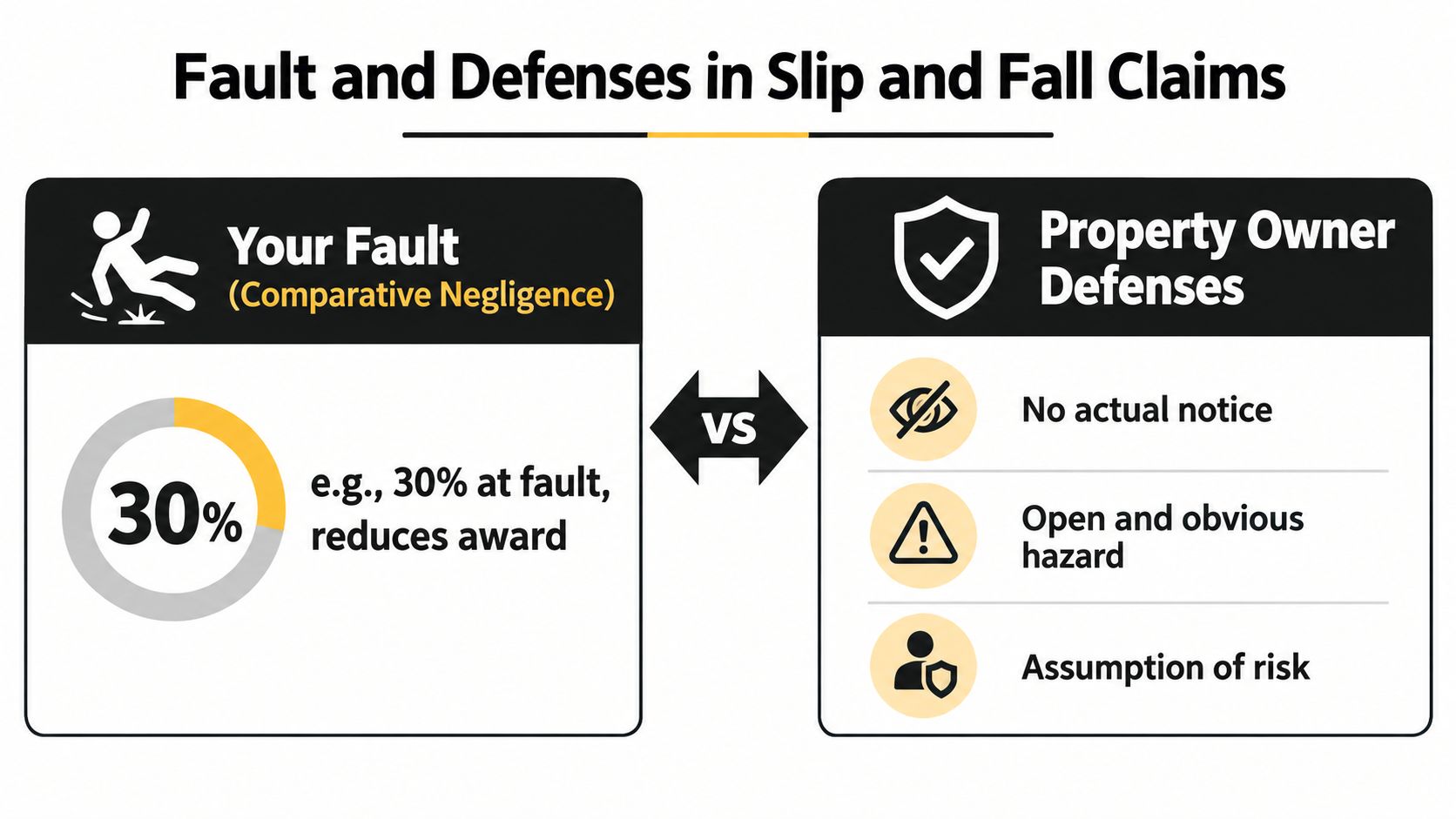
How owners challenge notice
The most common defense is often simple: “We didn’t know about the hazard.” The owner may say a customer created the spill only moments before the incident, leaving no reasonable opportunity to find and remove it. Your response depends on evidence showing duration, recurring problems, inspection practices, or prior complaints.
Consider two contrasting situations:
| Stronger factual pattern | Weaker factual pattern |
|---|---|
| A leaking refrigerator repeatedly creates water near an aisle, employees receive complaints, and inspection records show no response. | A shopper drops a drink shortly before the fall, and no one reports or sees the spill beforehand. |
| A damaged stair tread remains unrepaired after tenants report it. | The injured person can’t identify what caused the trip, and no scene evidence remains. |
| Surveillance shows the hazard and the owner’s staff passing it without taking action. | The condition is visible, clearly marked, and there’s no evidence the owner had time to respond. |
An owner may also argue that the condition was open and obvious, meaning a reasonable person should have seen and avoided it. That defense isn’t automatically decisive. A visible condition can still require precautions when the surrounding circumstances make harm foreseeable, such as poor lighting, an obstructed view, or a route that directs people toward the hazard.
How causation becomes a separate fight
Even when negligence appears plausible, the insurer may challenge the injury connection. It may point to a prior medical condition, a gap in treatment, or symptoms that weren’t reported immediately. That’s why the timing and consistency of medical records matter.
The embedded video provides another general perspective on fault and defenses:
Your goal isn’t to claim that every defense is wrong. It’s to preserve enough reliable evidence that a decision-maker can evaluate the entire sequence rather than relying on assumptions.
California Deadlines That Determine If You Can Still File
California deadlines can end a claim before a court ever considers whether the owner was negligent. For a typical private-party slip-and-fall claim, the general deadline is two years from the date of injury. The California-specific deadline information is summarized in this guide to the California negligence statute of limitations.
If the property belongs to a government entity, the process is shorter and different. A person generally must present a Government Tort Claim within six months of the injury date for a claim against a California government entity, as described in the referenced California slip-and-fall guidance. This can affect incidents involving public sidewalks, municipal buildings, public transportation facilities, or other government-controlled locations.
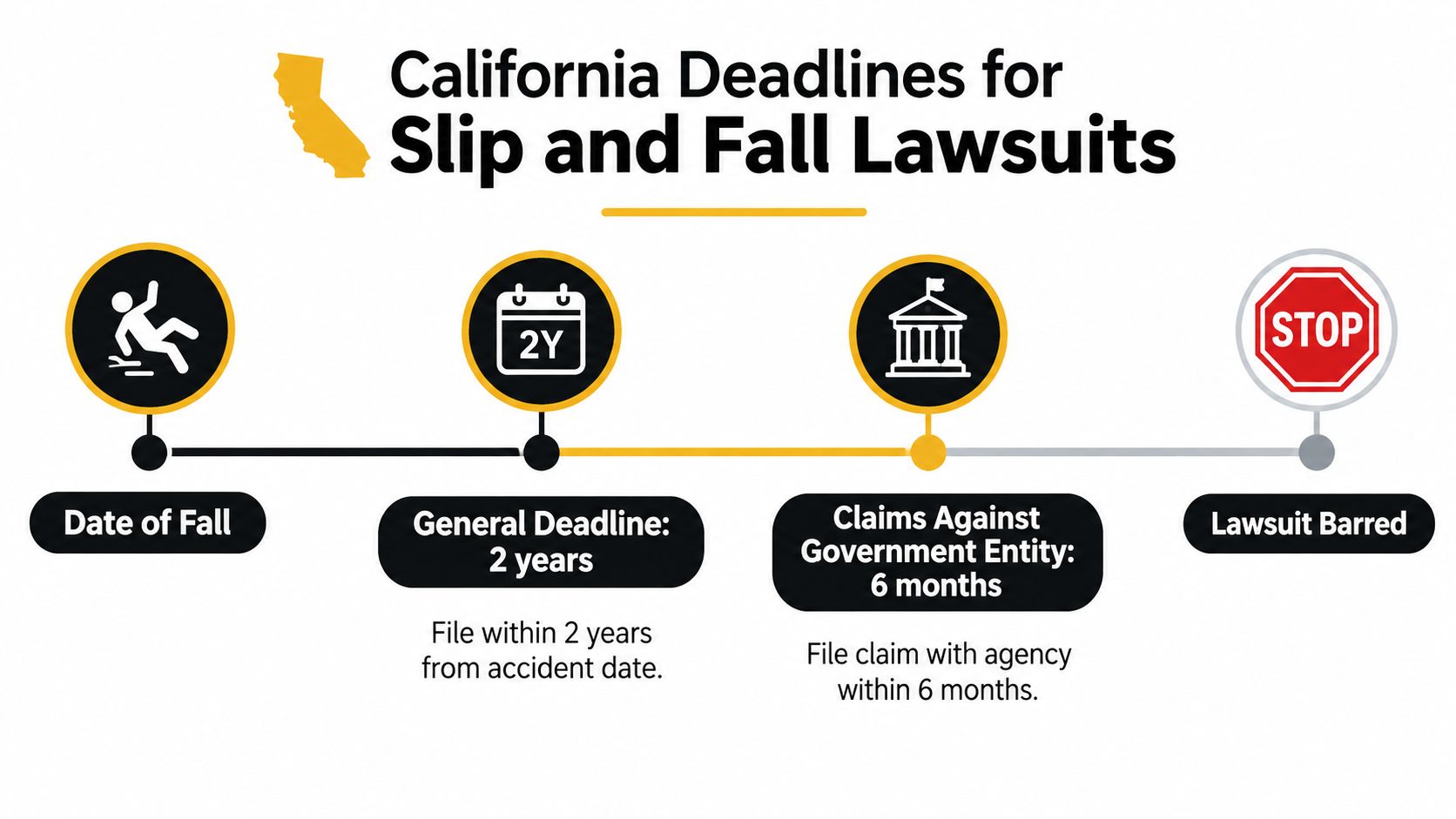
Build a deadline timeline immediately
Write down the accident date, the property owner or entity, and every communication you’ve had with the business, landlord, insurer, or public agency. Don’t assume that reporting the accident to a manager pauses the legal clock. An incident report and a lawsuit are different things.
| Property setting | General timing concern |
|---|---|
| Private business or private landlord | Lawsuit generally must be filed within two years from the injury date. |
| California government entity | Government Tort Claim generally must be presented within six months from the injury date. |
| Uncertain ownership | Investigate promptly because the shorter public-entity process may apply. |
Waiting until treatment ends can be risky. Your medical condition may continue changing, but the filing period usually continues as well. An attorney may need time to identify the correct defendant, investigate ownership, preserve records, and prepare the required filing.
Deadlines are not negotiation points. An insurer’s willingness to discuss the claim doesn’t guarantee that your right to sue remains protected.
If you’re unsure whether a city, county, transit agency, or private contractor controlled the location, treat that uncertainty as urgent. Confirm ownership and seek individualized legal guidance well before the earliest possible deadline.
Evidence That Proves Negligence and Links Your Injury to the Fall
Evidence turns a fall description into a liability case. The most useful proof often disappears first, because employees clean spills, weather changes, damaged property gets repaired, and surveillance systems may overwrite footage. Start preserving evidence as soon as you safely can.
Capture the condition and the timeline
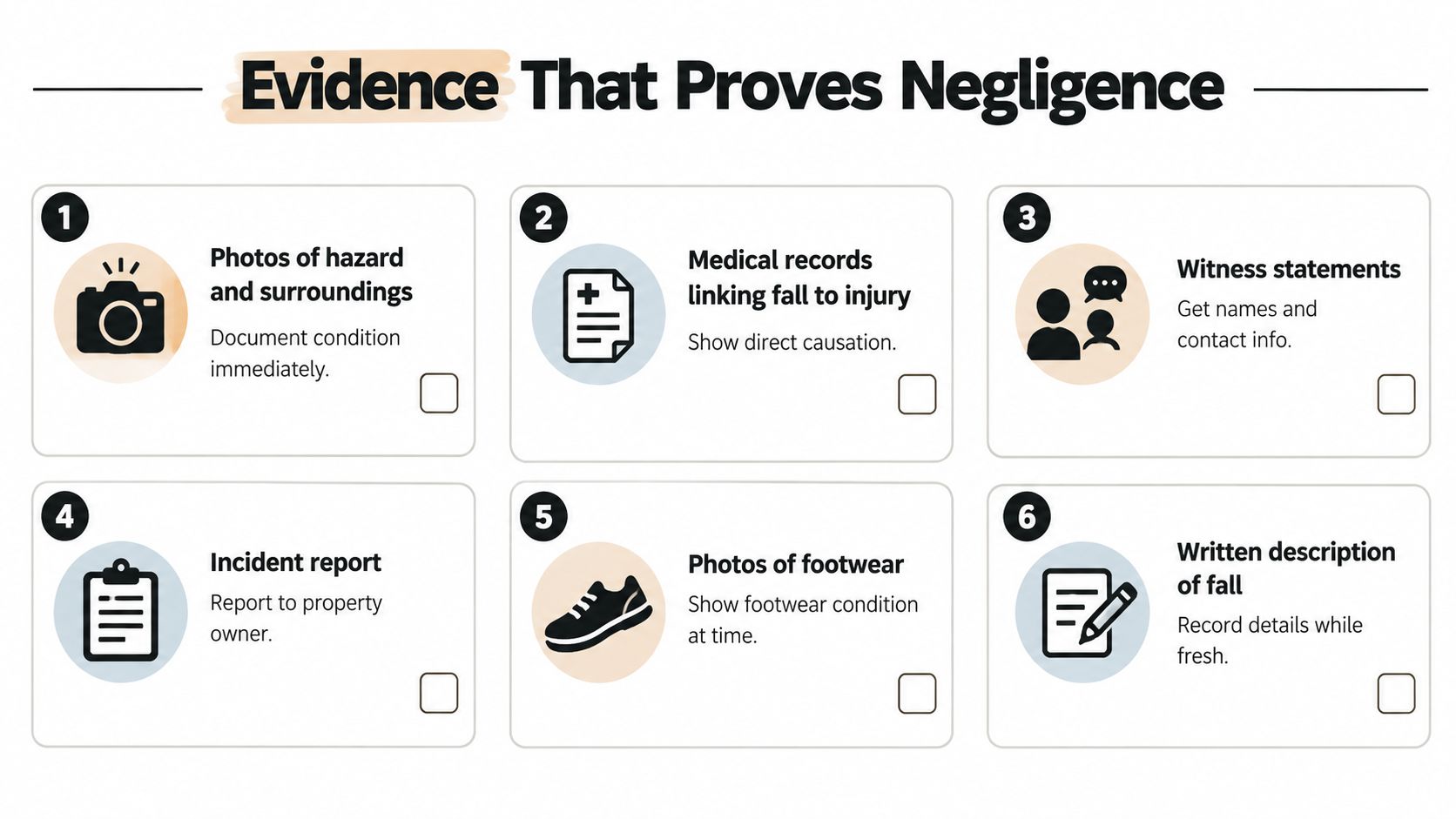
Take photographs of the hazard from close range and from the viewpoint a person would have had while walking. Include surrounding signs, lighting, aisle layout, stairs, entrances, drainage, footwear, and anything blocking visibility. If you can’t return safely, ask someone you trust to document the area, or tell an attorney where the condition was located.
Write down what happened while the details remain fresh. Record where you were walking, what you noticed, whether anyone warned you, when the pain began, and who responded afterward. Avoid guessing about facts you don’t know. A precise statement that says you felt your foot slide on liquid is more useful than a confident but unsupported estimate of how long the liquid was present.
Collect names and contact details for witnesses. A witness may have seen the fall, noticed the hazard earlier, or heard an employee acknowledge a complaint. Ask the business to document the incident, but remember that an internal report is only one piece of evidence and may not include everything you observed.
Connect the fall to the injury
Seek appropriate medical attention and describe the incident accurately. Medical records can establish when symptoms began, what body parts were affected, what treatment providers observed, and whether a prior condition existed. They can also help distinguish an injury caused by the fall from an unrelated condition.
Keep appointment records, discharge paperwork, prescriptions, bills, work absence documentation, and messages about symptoms. If your recovery involves specialized rehabilitation, an educational resource about pelvic floor therapy after a fall may help you understand one category of care, although your treating provider should determine what treatment is appropriate.
A lawyer may also send a preservation request for surveillance footage, inspection records, maintenance logs, employee schedules, complaints, and photographs. Those records can show whether the owner had actual notice, whether the condition should have been discovered, and whether staff followed the property’s safety procedures.
What Happens After You Sue Real Examples and Likely Outcomes
A California slip-and-fall claim often begins before a lawsuit is filed. After investigating the facts and collecting medical information, the injured person may send a demand to the responsible party’s insurer. The insurer may accept responsibility, dispute notice, question the injury, or make an offer that doesn’t reflect the full claim.
A supermarket spill illustrates why evidence controls outcomes. If surveillance shows an employee creating the spill, passing it repeatedly, or failing to place a warning, the notice and breach arguments become more concrete. If the store has no footage, no inspection records, and no witness who can say how long the spill was present, the insurer has more room to argue that it lacked a reasonable opportunity to respond.
The opposite situation can also weaken a claim. A clearly marked wet floor may support an owner’s argument that it gave an adequate warning. That doesn’t automatically resolve every case, but the warning becomes important evidence when evaluating whether the owner acted reasonably and whether the injured person contributed to the incident.
The litigation path
If negotiations don’t resolve the dispute, the claimant may file a complaint. The parties then exchange information through discovery, which can include written questions, document requests, depositions, and inspection of relevant records. Mediation may provide an opportunity to settle before trial, while a judge or jury may decide the matter if negotiations fail.
Potential damages can include medical expenses, future treatment needs, lost wages, reduced earning capacity, pain, emotional distress, and reduced ability to participate in ordinary activities. The available recovery depends on proof, the injury, the applicable law, insurance coverage, and any comparative-fault finding.
For additional California-specific context about valuation, review this discussion of the average slip-and-fall settlement in California. It shouldn’t be treated as a promise of a particular result. No settlement figure can be predicted responsibly without examining liability evidence, medical records, future needs, and defenses.
Most cases resolve through negotiation or mediation, but settlement isn’t guaranteed. A case may move toward trial when the parties sharply disagree about notice, causation, the seriousness of the injury, or the amount of damages.
Deciding Your Next Steps and When to Talk to an Attorney
You may have a potentially viable California claim if these statements fit your situation:
- Property relationship: You were lawfully present, and the owner or occupier likely owed you reasonable care.
- Specific hazard: You can identify the liquid, defect, obstruction, lighting problem, or other condition that caused the fall.
- Notice evidence: A complaint, witness, video, inspection record, recurring problem, or other fact suggests the owner knew or should have known.
- Medical connection: Treatment records link your symptoms to the incident.
- Deadline protection: You’re tracking the applicable private-property or government-entity deadline.
Comparative fault doesn’t necessarily mean you have no claim, but it can affect the amount recovered. The owner may also challenge whether it had time to discover the condition, whether a warning was adequate, or whether another medical issue caused the symptoms.
Talk with an attorney promptly if the injury required substantial treatment, the hazard was cleaned or repaired, surveillance may exist, the property is government-controlled, the owner denies responsibility, or the filing deadline is approaching. A law firm may also use administrative support, including Legal assistants, to help organize records and communications, but legal advice must come from a qualified attorney.
LA Law Group, APLC is one California option for discussing a premises-liability claim. A consultation can help identify the responsible party, evaluate notice evidence, protect relevant records, and determine whether the facts support a demand or lawsuit. Bring photographs, medical records, incident-report information, witness details, and your accident-date timeline to the conversation.
LA Law Group, APLC offers consultations for California premises-liability matters and can review the hazard, notice evidence, injury records, and applicable deadline. Visit LA Law Group, APLC to request an evaluation and discuss practical next steps for your slip-and-fall claim.
Attorney Advertising. This article is general information, not legal advice, and does not create an attorney-client relationship. Prior results do not guarantee a similar outcome.