
Car Accident Lawyer or Insurance: A Guide to Your Claim
You’ve just been in a collision. Your neck hurts, your car is damaged, and an insurance adjuster is already asking for a recorded statement. Then comes the fast settlement offer, presented as if accepting it today will make the problem disappear. It may do the opposite. Once you sign a release, you may lose the right to seek more money for treatment, lost income, or complications that haven’t appeared yet.
The key question usually isn’t car accident lawyer or insurance. It’s how much claim-handling resistance you can manage while you’re recovering, paying bills, documenting losses, and trying to understand what the insurer is offering. A minor crash with clear liability may be manageable on your own. A claim involving disputed fault, serious injury, or a quick low offer usually calls for legal representation.
| Your situation | Direct insurance handling may fit | A lawyer is usually worth considering |
|---|---|---|
| Vehicle damage | The damage is limited and easy to document | Repairs, valuation, or fault are disputed |
| Injuries | No injury or only minor symptoms that fully resolve | Treatment continues, symptoms worsen, or future care is possible |
| Liability | The other driver clearly caused the collision | The insurer is blaming you or another person |
| Financial impact | No meaningful wage loss or medical expenses | Bills, lost income, or long-term limitations are substantial |
| Insurance response | The adjuster communicates and makes a reasonable offer | The claim is delayed, denied, underpaid, or pressured toward a release |
The Reality Behind Every Car Accident Claim
A driver accepts an early offer after a crash because the money sounds helpful. Weeks later, the driver learns that physical therapy will continue, work restrictions may last, and the settlement release prevents any additional recovery. The mistake wasn’t accepting money. The mistake was accepting it before understanding the full injury and the full value of the claim.
This article is for informational purposes and not to be construed as legal advice. No attorney client relationship exists based on the review of this this article and none of the information in this article is legal advice.
Road traffic injuries are a leading cause of death globally. The World Health Organization’s road traffic injury fact sheet estimates that 1.19 million people died in road traffic crashes in 2021, which helps explain why motor vehicle injury claims remain foundational in personal injury practice. The harm is frequent, persistent, and often more complicated than the visible damage to a bumper.
The first decisions matter
The first few days create the record that an insurer will use later. Your statements, photographs, medical notes, vehicle positions, witness information, and reports can either support your account or give the adjuster material to challenge it.
Start with health and evidence:
- Get medical attention: Some injuries become more apparent after the initial shock fades. Tell the provider what happened and describe symptoms accurately.
- Preserve the scene: Keep photographs of vehicle damage, traffic controls, road conditions, visible injuries, and the surrounding area.
- Protect your communications: Give basic accident information when required, but don’t speculate about fault or minimize pain to make the conversation easier.
- Keep a loss file: Save medical records, bills, repair documents, wage information, prescriptions, and messages with insurers.
- Read before signing: A settlement agreement may release claims that you haven’t yet evaluated.
A practical post-accident guide from MedAmerica Rehab Center can help you organize immediate steps after a collision, especially when the crash initially appears minor.
Practical rule: Don’t let the insurer’s timetable become your medical timetable.
An adjuster may call while you’re still confused, sore, or worried about paying for a rental car. That call can feel cooperative, but the insurer is gathering information to evaluate exposure. A casual answer about how you feel, how fast you were driving, or whether you saw the other car can later be compared with medical records and damage evidence.
The right response isn’t panic or silence. It’s controlled communication. Report the collision as required under your policy, obtain treatment when appropriate, preserve evidence, and avoid agreeing that a claim is resolved until you understand what the release covers and whether the available insurance can address your losses.
Hiring a Car Accident Lawyer vs. Handling It Yourself
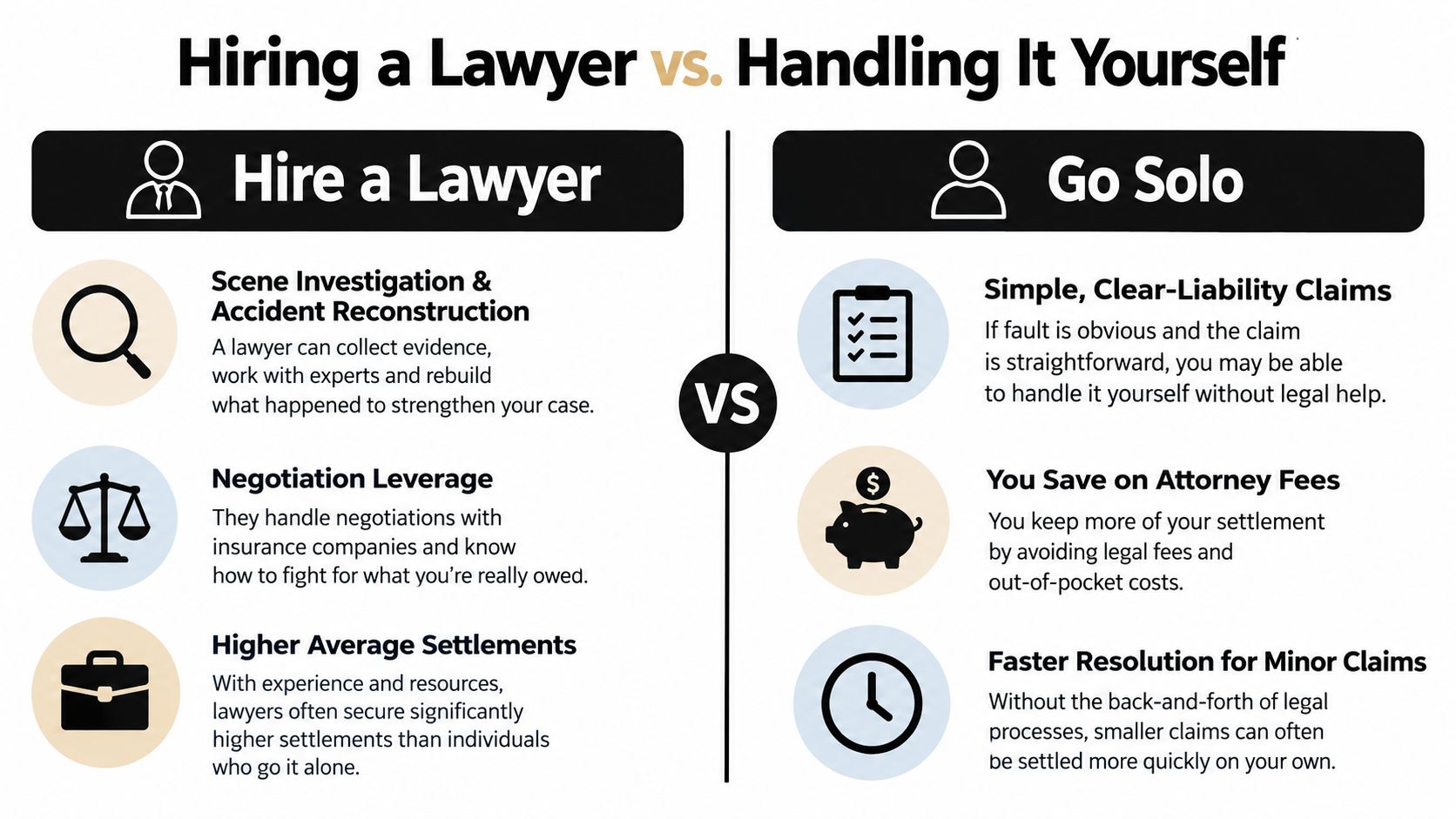
Handling a claim yourself can be reasonable when the facts are simple. The other driver accepts responsibility, the property damage is straightforward, no one has a significant injury, and the insurer responds with a sensible process. In that narrow situation, paying attorney fees may add cost without solving a difficult dispute.
The calculation changes when the claim becomes evidence-heavy or financially important. A lawyer can investigate the scene, identify witnesses, examine photographs and vehicle damage, review traffic evidence, and determine whether accident reconstruction is necessary. The lawyer can also document losses beyond the immediate bill, including continuing treatment, reduced ability to work, and other consequences supported by the evidence.
| Issue | Handling the claim yourself | Working with a lawyer |
|---|---|---|
| Evidence | You collect photographs, records, statements, and repair proof | Counsel organizes evidence and identifies gaps or disputed facts |
| Adjuster contact | You answer questions and respond to requests directly | Counsel controls claim communications and negotiations |
| Valuation | You estimate damages while the insurer supplies its own position | Counsel evaluates medical, income, liability, and future-loss evidence |
| Fault dispute | You must challenge the insurer’s version on your own | Counsel builds a documented response to disputed liability |
| Settlement | You decide whether an offer is adequate | Counsel explains the release, risks, negotiation range, and next steps |
The power difference is practical, not theatrical. The insurer handles claims routinely. You are handling one claim while trying to recover, work, arrange transportation, and keep up with household obligations. When a lawyer enters the process, the insurer knows that unanswered questions can become evidence requests, negotiation issues, or litigation decisions rather than disappearing into a phone call.
What professional leverage actually changes
A lawyer doesn’t create damages that never existed. The lawyer makes it harder for the insurer to ignore, mischaracterize, or prematurely close damages that the evidence supports. That may involve requesting records, consulting qualified specialists, preserving vehicle or video evidence, and presenting a coherent liability and damages analysis.
The lawyer also creates distance between you and pressure tactics. You don’t have to decide whether a recorded statement is appropriate while an adjuster is waiting on the phone. You don’t have to explain a complicated treatment course in a way that accidentally suggests you’re fully recovered.
For a plain-language overview of the work involved, see what a car accident lawyer does. The important point is that representation is not merely form-filling. It changes who is responsible for developing the claim and responding to the insurer’s valuation.
A self-managed claim still requires discipline. You must meet communication deadlines, understand policy terms, document every loss, and avoid trading a quick payment for a broad release. If the insurer has already disputed fault, questioned treatment, delayed decisions, or made an offer that doesn’t match the evidence, the claim has moved beyond the easy category.
What the Data Says About Settlement Outcomes
The strongest reason to take the lawyer-versus-insurance decision seriously is the difference between being paid and being paid according to the claim’s documented value. A large closed-claim dataset summarized by data on represented and unrepresented injury claims found that represented auto bodily-injury claimants recovered roughly 3.5 times more than unrepresented claimants.
The same source reported average payouts of $77,600 with counsel compared with $17,600 without counsel. Those figures don’t promise a result for any individual. Claims differ by liability, injury severity, available coverage, treatment, evidence, and the claimant’s losses. They do show that representation and self-representation have not produced equivalent outcomes in the dataset.
That gap should change how you evaluate an insurer’s first offer. An early number isn’t automatically unfair, but it is not automatically reliable either. The insurer knows its own evaluation process. The claimant often sees only a single figure with little explanation.
Why unrepresented claims can lose value
A self-represented claimant may focus on the most visible losses, such as the repair estimate and the first hospital bill. The insurer may focus on other questions, including whether treatment is related to the collision, whether prior conditions contributed to symptoms, whether the claimant missed work, and whether the evidence supports future losses.
Those questions require documentation, not frustration. Medical records should connect treatment to symptoms. Income evidence should show what work was missed and why. Photographs, witness accounts, vehicle data, and traffic evidence should support the liability position. A claimant who can’t assemble that record may accept the insurer’s assumptions as if they were established facts.
A settlement offer is a proposal, not a verdict on what your claim is worth.
A separate aggregated records dataset reported a median settlement distribution with the 25th percentile at $8,000, the 75th percentile at $58,000, and the 95th percentile at $185,000, as summarized in settlement distribution data for car-accident cases. The same source reported that adjusters’ opening offers are often 30% to 50% of the eventual settlement after negotiation. That doesn’t mean every offer should be rejected. It means an opening offer should be analyzed against the evidence, not treated as a neutral prediction.
The practical lesson is direct. If you have substantial injuries, ongoing treatment, disputed responsibility, or losses that extend beyond vehicle damage, don’t let an insurer define the claim before you understand it. A lawyer can help determine whether the offer reflects the available evidence and whether accepting it would end the claim permanently.
For a broader discussion of the factors that affect value, review car accident settlement amounts. Use that information as context, not as a substitute for evaluating your own medical records, policy coverage, liability evidence, and losses.
Understanding How Insurance Companies Actually Operate
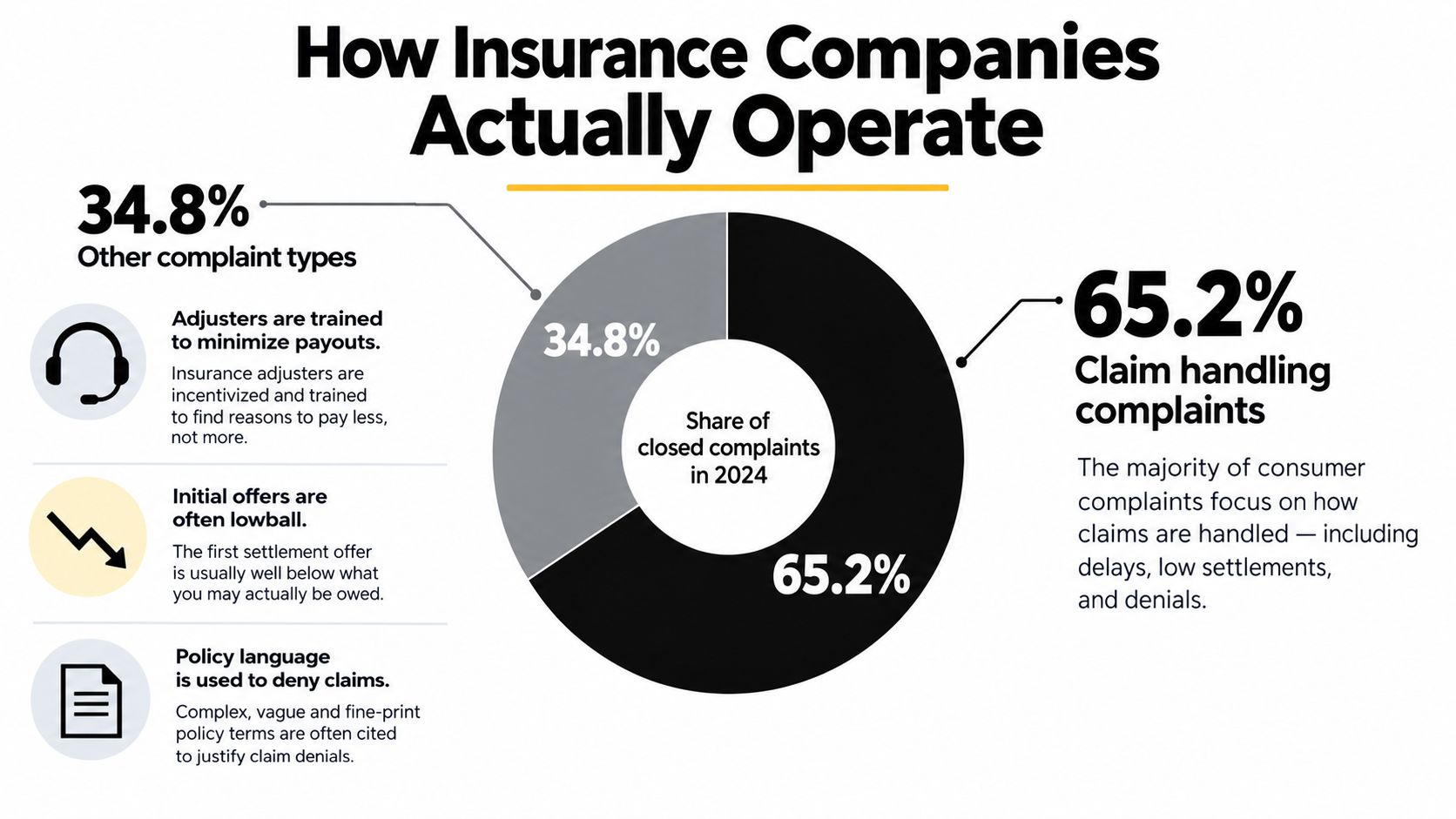
Many people assume that having insurance means the claim will be paid promptly. That assumption is unsafe. An insurance company is a business evaluating its financial exposure, and the adjuster’s role is to investigate, classify, negotiate, and close claims under the policy and the company’s procedures.
The complaint data reflects that claim handling creates substantial consumer friction. In 2024, claim handling made up 65.2% of closed insurance complaints, according to claims-handling complaint data from CCC Intelligent Solutions. Delays and unsatisfactory offers were identified as leading complaint subtypes in the provided reporting.
The friction appears in familiar forms
Claim friction doesn’t always look like an outright denial. It may appear as a request for another document, a delay while liability is reviewed, a dispute over treatment, a suggestion that your injuries are unrelated, or an offer that covers only the easiest part of the loss.
The same CCC reporting found that 45% of auto bodily-injury and medical-expense claims settled were closed without payment. That figure doesn’t prove that every unpaid claim was improperly handled. It does show why the phrase “the other driver has insurance” doesn’t answer the recovery question.
The insurer may also rely on policy language, exclusions, coverage limits, and competing claims. If several people are injured, the available liability coverage may not be enough to satisfy every loss. If the other driver has little or no coverage, you may need to examine your own uninsured or underinsured motorist protection.
Why the first offer deserves scrutiny
An adjuster’s initial offer often arrives before the medical picture is complete. A fast check can be attractive when rent, treatment, repairs, and transportation costs are pressing. But signing a release usually trades the right to pursue more for certainty now.
Evaluate the offer against concrete questions:
- Medical outlook: Has a qualified provider explained whether treatment is complete or continuing?
- Income loss: Have you documented missed work, reduced duties, or limits on your ability to earn?
- Liability evidence: Does the offer reflect the photographs, report, witnesses, and available video?
- Coverage: Do you know the relevant liability, collision, medical payments, and UM/UIM provisions?
- Release language: Does the proposed agreement end claims for injuries that may not yet be fully understood?
A consumer can handle a transparent, limited claim without assuming the adjuster is an enemy. A consumer shouldn’t mistake politeness for advocacy. The insurer’s obligation is defined by the policy and applicable law, not by the friendliness of the person assigned to the file.
Read how to deal with insurance adjusters before giving detailed statements or negotiating a serious injury claim. If the insurer delays, denies, or undervalues the claim, that resistance is the signal to assess representation, not a reason to keep negotiating indefinitely on your own.
California Specifics on Policy Limits and Timelines
California policy limits can determine how much money is available before anyone debates the severity of an injury. For standard policies beginning January 1, 2025, California’s minimum liability limits changed to 30/60/15, meaning $30,000 for bodily injury or death to one person, $60,000 for bodily injury or death per accident, and $15,000 for property damage per accident, as explained by the California Department of Insurance notice on updated auto limits.
The first number is the most the liability insurer generally pays for one injured person under that minimum policy. The second is the total bodily-injury limit for the accident. The third addresses property damage to someone else’s property. These are coverage ceilings, not valuations of your injury.
Why limits change the strategy
Suppose several people are injured in one collision. The total bodily-injury limit may have to be shared, so the existence of a valid claim doesn’t guarantee that every claimant can recover the full amount of their losses from that policy. The insurer also won’t pay costs above the applicable limits under the policy.
That makes an early coverage investigation important. Ask what policy applies, whether other vehicles or people may be responsible, whether there are multiple injured claimants, and whether your own policy includes uninsured or underinsured motorist coverage. California consumer guidance identifies $30,000/$60,000 bodily-injury limits and $3,500 uninsured motorist property-damage coverage in certain standard coverage comparisons, as shown in the California auto insurance limits comparison.
A policy-limits settlement can involve more than asking the insurer to pay the largest number printed on the declarations page. It may require documenting damages, identifying all available coverage, and considering how competing claims affect the funds. An accessible policy-limits settlement guide for personal injury attorneys provides useful background on that issue.
The payment deadline after acceptance
California also provides a concrete timing rule once a claim has been accepted and settlement has been reached. The Department of Insurance states that the insurer must pay immediately, but no later than 30 days from the date the settlement was reached, as explained in its consumer guidance after an auto accident.
That deadline applies after the relevant conditions are met. It doesn’t mean every unresolved claim must be paid within that period, and it doesn’t eliminate disputes about liability, damages, or coverage. If the insurer has accepted the claim, the parties have reached settlement, and payment still hasn’t arrived, preserve the agreement and communications and consider obtaining legal guidance.
California law also uses pure comparative fault, but fault analysis remains important because a finding that you contributed to the collision can reduce recovery. Don’t assume the policy limit is the only issue. Liability evidence, medical proof, coverage language, competing claims, and payment timing can all affect the result.
When to Call a Lawyer and How to Decide
You don’t need a lawyer for every dent. If the collision is minor, liability is clear, nobody has meaningful injuries, and the insurer is handling property damage transparently, direct negotiation may be sensible. Keep the claim organized, communicate in writing when possible, and don’t sign a release until you understand what it resolves.
Call a car accident lawyer when the claim carries consequences you can’t comfortably measure or challenge yourself. That includes significant medical bills, ongoing treatment, disputed liability, permanent or potentially permanent injury, substantial wage loss, a low initial offer, a denial, or a delay that leaves bills and transportation costs on your shoulders.
The decision is about claim friction, not pride. If the insurer asks questions you can’t answer, demands records you don’t know how to interpret, or blames you for a collision you didn’t cause, the cost of continuing alone may be more than the cost of getting advice.

Use this decision test
Ask yourself these questions before accepting an offer or continuing without counsel:
- Is the injury fully understood? If treatment is continuing or symptoms are changing, the claim may be premature.
- Can you prove every major loss? Medical bills, wage loss, future care, and limitations require records and a coherent explanation.
- Does the insurer agree about fault? A dispute over the collision usually becomes a dispute over value.
- Has the insurer made a low offer? Compare it with documented losses and the proposed release, not with your immediate financial pressure.
- Are there multiple insurance policies? Your own UM/UIM coverage may matter when the other driver lacks adequate insurance.
- Can you negotiate without minimizing yourself? Don’t say you’re fine if you’re still in pain, and don’t guess when you don’t know.
- Can you meet the process demands? A claim may require records, authorizations, evidence preservation, written responses, and careful timing.
Decision point: If one serious injury question remains unanswered, don’t trade away the claim just to end the phone calls.
A lawyer should also explain the financial arrangement before taking the case. Ask how fees work, which costs may be advanced, what happens if there is no recovery, who will communicate with the insurer, and whether the lawyer handles litigation if negotiation fails. You should understand the agreement before signing it.
Handling a small property-damage claim yourself can preserve control and avoid unnecessary expense. Handling a serious bodily-injury claim yourself can expose you to pressure at exactly the time you have the least capacity to evaluate it. The right choice depends on the evidence, the coverage, the injury, and the insurer’s conduct.
Don’t wait for the insurer to announce that your claim has become difficult. Difficulty is often visible in the first request for a recorded statement, the first disputed medical bill, the first delay, or the first offer that doesn’t account for your documented losses. Gather your records, avoid signing a release before review, and arrange a consultation when the claim crosses that line.
LA Law Group, APLC helps injured Californians assess car accident claims, handle insurance negotiations, and pursue representation in denied, delayed, underpaid, or disputed matters. Visit LA Law Group, APLC to request a consultation and discuss the evidence, coverage, and claim resistance affecting your case.
Attorney Advertising. This article is general information, not legal advice, and does not create an attorney-client relationship. Prior results do not guarantee a similar outcome.