
Car Hits a Person: Immediate Steps and Legal Actions
You’re standing at an intersection, trying to understand what just happened. One moment, you were walking. The next, a car hit you, your body is injured, and people are asking questions you can’t yet process. Shock can mask pain, while the driver, witnesses, insurance company, and nearby cameras begin creating the record that may determine what happens next.
Pedestrian crashes are not rare or minor events. The World Health Organization reports that pedestrians accounted for 23% of all road traffic fatalities, with an estimated 274,000 pedestrian deaths in 2021. If you’ve been hit, treat the first hours as both a medical emergency and an evidence-preservation emergency.
This article is for informational purposes only and is not to be construed as legal advice. No attorney client relationship exists based on the review of this this article and none of the information in this article is legal advice.
Immediate Medical and Safety Priorities
Your first decision after a pedestrian collision should be medical, not legal. A person may stand, speak, and insist they’re fine while suffering a concussion, internal bleeding, spinal trauma, or other injury that becomes more serious as adrenaline fades. If a car hits you, call 911 or have someone call for you, even if the pain seems manageable.
A young man struck while crossing a busy road may initially feel only numbness in his leg and a headache. That numbness can make him believe he escaped serious harm. The safer choice is to remain still unless the roadway creates an immediate danger, let emergency responders assess him, and follow their direction about moving to a protected location.
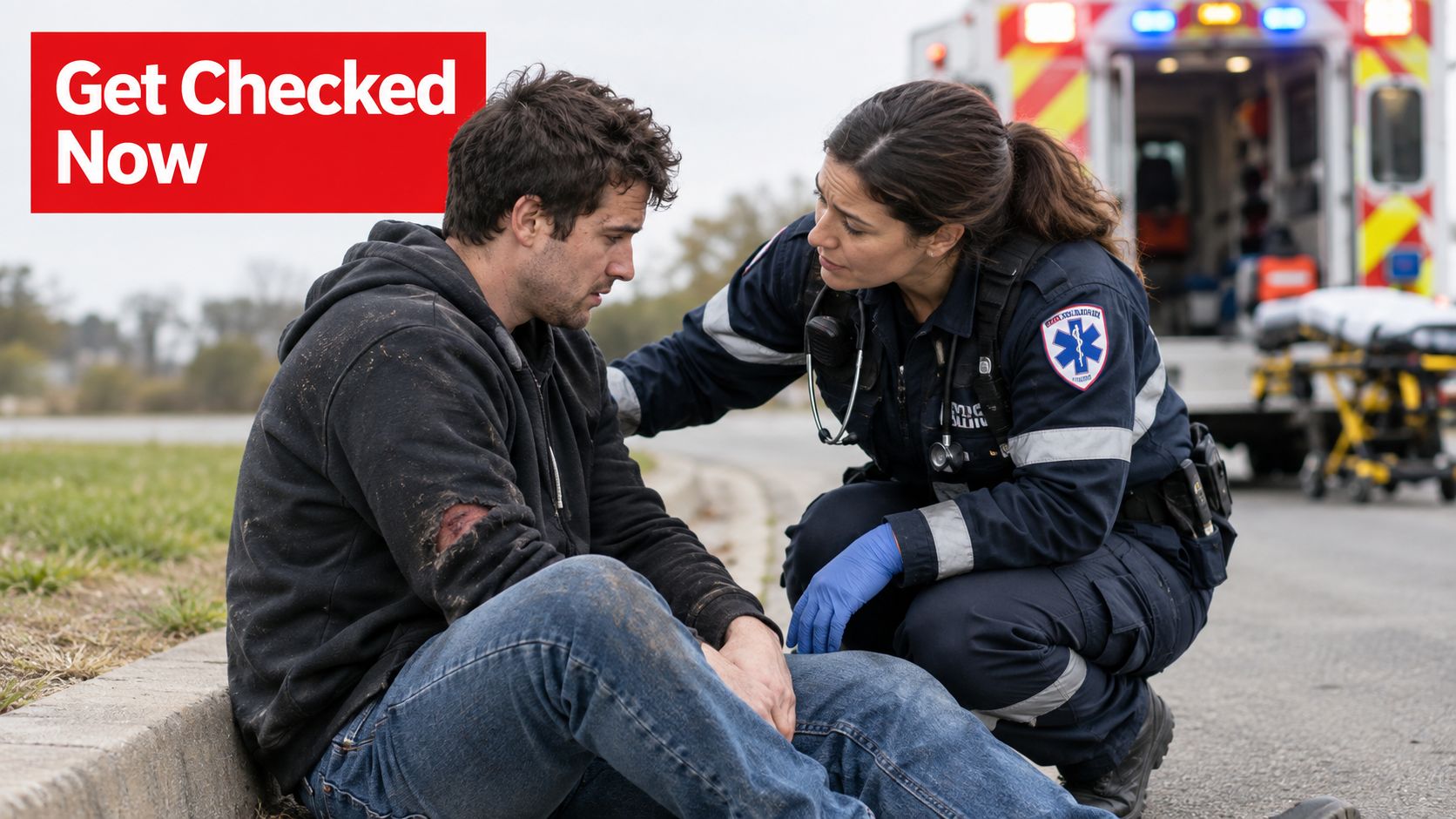
Protect your body before protecting your claim
If you can move safely, get away from live traffic without walking farther than necessary. Don’t chase the driver, argue with anyone, or attempt to recreate the collision while you’re injured. Ask someone nearby to keep vehicles and pedestrians from disturbing visible debris, clothing, or blood evidence until police arrive.
Tell the paramedics exactly what you feel, including symptoms that seem unrelated to the obvious injury. Report pain, dizziness, confusion, weakness, numbness, nausea, vision changes, difficulty breathing, or trouble remembering the impact. If symptoms appear later, seek medical care promptly and explain that they began after the collision.
Your health record matters: Prompt medical evaluation creates a documented connection between the collision and your condition. Delaying care gives an insurer an opportunity to argue that an injury came from something else.
Don’t dismiss a head impact or a period of confusion. A practical resource on recognizing possible head trauma is this guide to brain injury types, symptoms, and legal options. It isn’t a substitute for emergency care, but it can help you recognize why a seemingly modest impact deserves attention.
Let responders build the first record
Ask emergency personnel to document your complaints, visible injuries, and the location of the collision. Tell the responding officer if you’re in too much pain to give a complete account. If you’re taken away before you can identify witnesses or photograph the scene, that’s acceptable. Medical care comes first, and other people can preserve evidence for you.
For context about the vehicle involved, you may later consult a neutral resource such as the 2021 Toyota Camry safety information. A vehicle’s safety features don’t eliminate pedestrian injury risk, and a safety rating doesn’t decide fault. The important questions remain what the driver did, where the impact occurred, how fast the vehicle was traveling, and whether the driver could have avoided the collision.
Documenting the Scene and Preserving Evidence
Once your immediate medical needs are addressed, preserve the scene before weather, traffic, repairs, and memory erase useful details. You don’t need professional equipment. A smartphone, careful notes, and a calm witness can preserve evidence that later becomes difficult or impossible to obtain.
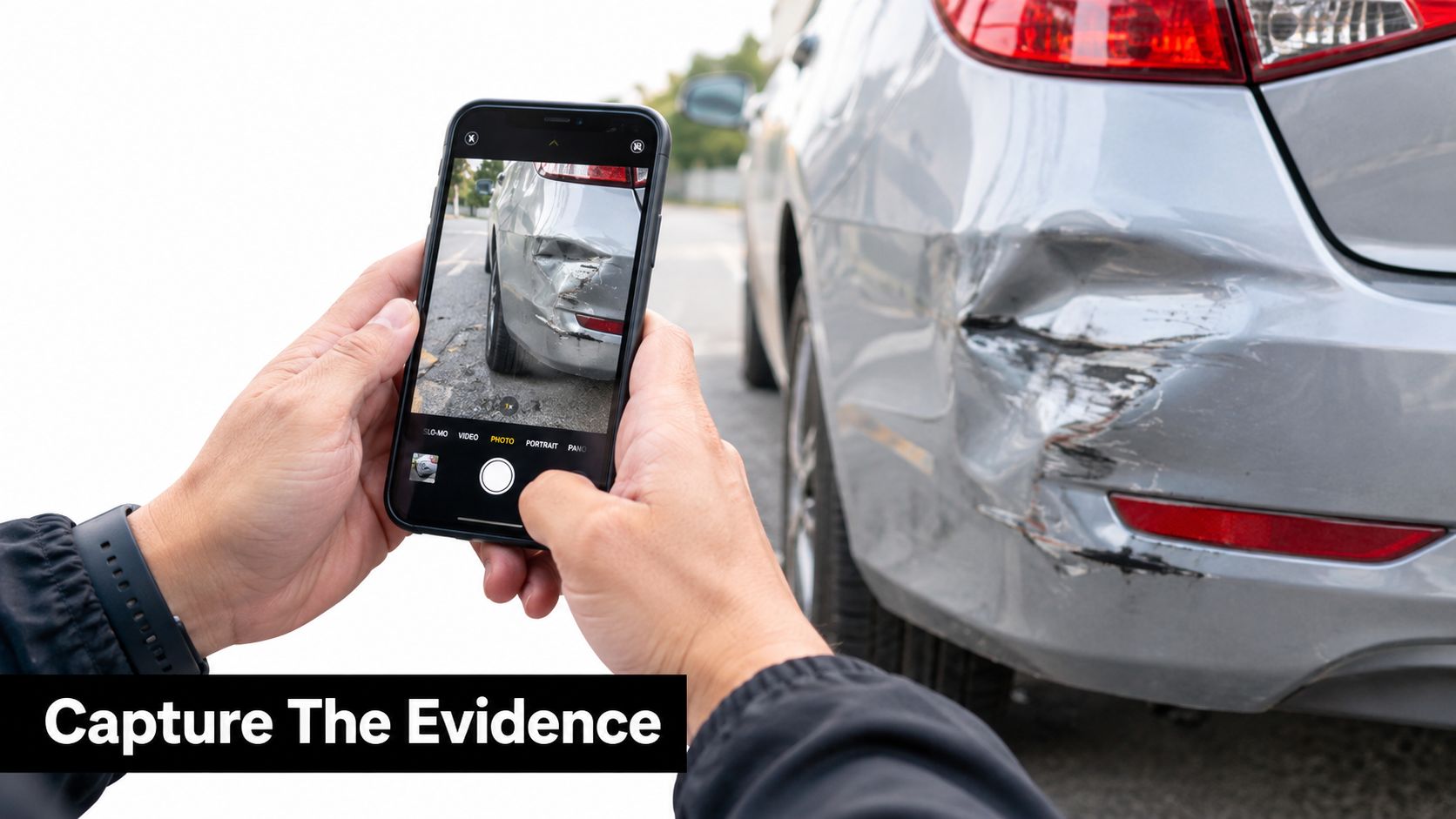
Follow a disciplined scene protocol
If you can safely participate, or if a friend can do it for you, work through these steps:
-
Photograph the full setting. Capture the intersection, lanes, crosswalk, traffic signals, signs, lighting, nearby businesses, parked vehicles, and the direction each person or vehicle was traveling. Take wide images first, then closer images that show the details.
-
Photograph the vehicle before repairs. Take pictures of the hood, bumper, windshield, mirrors, lights, license plate, dents, paint transfer, broken parts, and any visible debris. Photograph the vehicle from each side and preserve the original files rather than editing them.
-
Photograph your injuries over time. Capture swelling, bruising, scrapes, cuts, casts, bandages, and mobility limitations in clear light. Keep the original photographs with their creation dates. A single photograph rarely shows how an injury developed.
-
Record the roadway. Photograph skid marks, gouges, broken glass, vehicle resting positions, debris, potholes, poor lighting, obstructed signs, and the exact place where you were walking. Don’t step into traffic to obtain a better angle.
-
Preserve clothing and personal property. Place torn or bloodstained clothing in a clean paper bag. Keep damaged glasses, phones, bags, bicycles, headphones, and shoes. Don’t wash, repair, discard, or alter these items until they’ve been evaluated.
-
Identify witnesses carefully. Ask for each witness’s full name, telephone number, email address, and a short description of what they saw. Ask, “Where were you standing?” “What direction was the vehicle traveling?” “What did you see immediately before impact?” and “Did you see the traffic signal or hear braking?” Don’t coach the answer.
Capture the evidence other people control
Ask nearby businesses, residences, transit operators, and drivers whether a security camera or dashcam may have recorded the collision. Note the business name, address, camera direction, and the person who controls the footage. Request preservation rather than demanding that someone hand over a copy immediately.
A witness may remember the impact clearly at the roadside but forget details later. Write down their words as soon as possible, without embellishment. Save text messages, social-media posts, ride receipts, location history, emergency alerts, and photographs showing the weather or lighting. Information from a smartwatch or other wearable may also help establish movement and timing, so review this resource on wearable technology evidence before changing or deleting device data.
Don’t discuss fault at the scene. Avoid saying “I didn’t see the car,” “I was probably distracted,” or “I’m sorry.” Those statements may reflect shock rather than a reliable account, but an insurer can still use them against you. Give emergency responders the facts you know, then stop speculating.
Here’s a short visual reminder of why orderly documentation matters:
Reporting the Incident to Authorities
Report the collision to law enforcement, even if the driver apologizes, offers to pay privately, or says the damage looks minor. A police report doesn’t decide liability by itself, but it creates an official record of the location, people involved, vehicle information, observed conditions, witness accounts, and apparent injuries.
Police reporting and insurance reporting serve different purposes. The police document the incident for public safety and potential enforcement. The insurer investigates a claim to decide whether it will pay and how much. An insurance adjuster may focus on facts that reduce the value of the claim, while the responding officer is expected to record the circumstances of the incident.
Give officers facts, not conclusions
Tell the officer where you were walking, what you remember seeing and hearing, whether the signal or crosswalk applied, where the vehicle came from, and what happened immediately before impact. Explain your symptoms accurately, including confusion or memory gaps. If you don’t know the vehicle’s speed, don’t guess.
Ask how to obtain the report number and where to request a copy. Write down the officer’s name, agency, badge information if available, and the names of witnesses listed in the report. If you’re transported before speaking with police, contact the investigating agency as soon as your condition permits and ask how to provide a supplemental statement.
A focused guide to reporting an accident to police can help you organize the information you need. It doesn’t replace the report itself. You should also preserve your own photographs, medical records, witness details, and timeline because an official report may not include every fact that later becomes important.
Don’t confuse a report with a final ruling
Police may not determine fault at the scene. They may record competing accounts, cite a driver, refer the matter for further investigation, or leave questions unresolved. That doesn’t mean you have no claim. Liability may depend on surveillance footage, vehicle data, roadway design, expert reconstruction, medical evidence, and witness testimony that becomes available later.
If officers don’t arrive, report the collision through the appropriate local process and document that you attempted to obtain assistance. Get medical care, exchange identifying and insurance information if possible, and preserve photographs and witness contacts. Never follow a driver who flees. Give police the vehicle description, plate information, direction of travel, and any available camera leads.
The police report should support your account, not replace it. Read it when available and identify material errors quickly. If it omits a major injury, misstates your location, or leaves out a witness, ask how to submit a correction or supplemental information.
Understanding Insurance Claims and Communications
Insurance companies move quickly after a pedestrian collision because early statements can shape the claim before your injuries are fully understood. The adjuster may sound helpful, but the adjuster works for the insurer. Your job is to protect your recovery, document treatment, and avoid giving opinions that can be taken out of context.
Notify the relevant insurer of the collision without volunteering a long narrative. Provide basic identifying information, the date and location, the responding agency, and the fact that you’re receiving medical evaluation. Don’t guess about the extent of your injuries, say you’re fully recovered, or agree that the collision was your fault.
Medical treatment and the claim are connected
A claim usually depends on more than the first emergency-room bill. Treatment records can show what symptoms you reported, what diagnoses providers made, which restrictions they ordered, and how the injury affects work and daily life. Follow reasonable medical instructions, attend recommended appointments, and tell providers when symptoms change.
Untreated injuries create a dangerous gap. An insurer may argue that the injury wasn’t serious, that later treatment came from another cause, or that you failed to mitigate the problem. You don’t need to exaggerate pain, but you do need to report it consistently and keep records of appointments, prescriptions, referrals, transportation, missed work, and out-of-pocket expenses.
Don’t sign under pressure: A release can end your claim before you understand future treatment, lasting limitations, or the full effect on your work and daily activities.
Never provide a recorded statement about fault, symptoms, or medical history without first considering legal advice. Answer necessary factual questions truthfully, but don’t speculate about speed, distance, signal timing, or what another person saw. Keep a claim diary that records calls, names, dates, requests, and documents exchanged.
Impact speed changes the stakes
Speed reconstruction can help explain why an apparently brief contact caused severe harm. The World Health Organization’s road-safety guidance states that a pedestrian struck at 65 km/h is 4.5 times more likely to die than someone struck at 50 km/h. It also reports that an adult pedestrian’s risk of dying is less than 20% at 50 km/h and almost 60% at 80 km/h.
| Impact Speed | Risk of Death | Severity of Injury |
|---|---|---|
| 50 km/h | Less than 20% adult pedestrian death risk in the cited WHO comparison | Serious injury remains possible, and prompt medical evaluation is essential |
| 65 km/h | 4.5 times the fatality likelihood associated with a 50 km/h impact in the WHO comparison | Fatal consequences become substantially more likely |
| 80 km/h | Almost 60% adult pedestrian death risk in the cited WHO regional data | Very severe or fatal injury risk is pronounced |
| 16 to 46 mph | Not specified in the cited risk model | Severe-injury risk rises from 10% at 16 mph, to 25% at 23 mph, 50% at 31 mph, 75% at 39 mph, and 90% at 46 mph, according to the AAA Foundation pedestrian risk model |
For a practical explanation of insurance paperwork, including how to file a car insurance declaration, use a reliable declarations-page guide. That document can help identify policyholders, coverage types, and policy information, but it doesn’t prove that the insurer owes payment or establish the value of your injuries.
Seeking Legal Representation and Next Steps
Speak with a personal injury attorney before giving a recorded statement or accepting a settlement. This is especially important when the driver says you crossed outside a crosswalk, when the impact happened at night, when the vehicle was a light truck or SUV, or when the insurance company disputes the seriousness of your injuries.
Pedestrian liability is rarely decided by one fact. A driver may argue that the pedestrian shared fault. The pedestrian may have been outside a crosswalk, yet the driver may still have had time to see, slow, or stop. A lawyer should examine the entire sequence, not accept the insurer’s preferred version.
Shared fault requires a real investigation
Don’t assume a crosswalk issue ends the case, and don’t assume it has no effect. The governing law depends on the location, the roadway rules, the evidence, and the specific conduct of everyone involved. A lawyer may need to obtain traffic-camera footage, inspect signal timing, interview witnesses, analyze vehicle damage, reconstruct speed, and evaluate whether roadway design contributed to the collision.
Vehicle size also matters in case analysis. The Governors Highway Safety Association reports that U.S. pedestrian deaths were projected at 6,732 in 2025, a 7% year-over-year decline that remained 5% above 2019, and that 84% of pedestrian crashes occurred in urban areas. The same source reports that light trucks were the striking vehicle in 50.4% of pedestrian fatalities where body type was known. Those figures don’t decide an individual claim, but they show why vehicle geometry, urban roadway conditions, and visibility deserve careful attention.

Act before deadlines and evidence loss
Every jurisdiction imposes deadlines for personal injury claims. California has a statute of limitations for these cases, but the applicable deadline can depend on the claim, the defendant, the injury, and facts that affect when the period begins. Don’t rely on a general internet deadline. Have a California attorney evaluate the date and circumstances immediately.
Waiting also allows evidence to disappear. Cameras overwrite footage, vehicles get repaired, roadway conditions change, witnesses become difficult to locate, and medical records become harder to interpret when care is interrupted. An attorney can send preservation requests, identify responsible parties, communicate with insurers, and develop a damages record covering medical expenses, lost wages, reduced earning capacity, pain, emotional distress, and lasting impairment.
Don’t sign a settlement just because the insurer offers money quickly. A release may prevent you from seeking additional compensation for treatment that hasn’t yet been completed or a condition that hasn’t stabilized. You deserve a clear assessment of the claim before giving up your rights.
Important Disclaimers and Resources
A car hits a person, and the injured pedestrian often faces two separate pressures at once. The body needs treatment, while the evidence needs protection. Call emergency services, obtain medical evaluation, preserve photographs and witness information, report the incident, keep every medical and expense record, and avoid recorded statements or releases until you understand their consequences.
The CDC’s analysis of pedestrian deaths found that from 2013 to 2022, U.S. pedestrian death rates increased by a relative 50.0%, while the median rate in the other included high-income countries declined by 24.7%. The U.S. rate in 2022 was higher than all 27 included countries. These figures reinforce the need to take a pedestrian collision seriously, but they don’t determine the facts or value of your individual case.
This article is for informational purposes only and isn’t legal advice. No attorney-client relationship is created by reviewing it, and no information here substitutes for advice from a qualified attorney licensed in the jurisdiction where the collision occurred. Contact a state or local bar referral service, legal-aid organization, victim-support group, or personal injury attorney if you need help assessing your options. Bring your medical records, police report, photographs, witness information, insurance correspondence, and a written timeline to the consultation.
LA Law Group, APLC offers pedestrian accident representation and can help injured people evaluate claims, preserve evidence, and deal with insurance companies after a vehicle strikes them. Visit LA Law Group, APLC to request a case assessment and discuss the next step with the firm.
Attorney Advertising. This article is general information, not legal advice, and does not create an attorney-client relationship. Prior results do not guarantee a similar outcome.