
Consumer Rights California Law: A Practical 2026 Guide
A subscription renews after you cancelled it. A refrigerator stops cooling months after delivery. A debt collector keeps calling about a medical bill you already paid. In California, the hardest part usually isn’t discovering that something went wrong. It’s identifying which law applies, who can act, and what to do before evidence disappears.
This guide treats consumer rights under California law as a routing problem. The Consumers Legal Remedies Act (CLRA), California Consumer Privacy Act and California Privacy Rights Act (CCPA/CPRA), Song-Beverly Consumer Warranty Act, Lemon Law, Rosenthal Fair Debt Collection Practices Act, and Unfair Competition Law can overlap, but each points toward different demands, agencies, and courts. A demand letter often produces a faster, cheaper result than filing immediately, but only when it identifies the violation, preserves the right remedy, and gives the business the notice California law requires.
This article is for informational purposes only and should not be construed as legal advice. No attorney-client relationship exists based on the review of this article, and none of the information in this article is legal advice.
When California Consumers Run Into a Problem
A Sacramento resident buys a refrigerator, pays for delivery, and expects an ordinary appliance to do one job. Four months later, the refrigerator stops cooling. The retailer sends the consumer to the manufacturer. The manufacturer points back to the retailer. Customer service offers another repair appointment, but nobody explains what happens if the repair fails again.
That consumer shouldn’t begin by threatening a lawsuit in all caps. They should preserve the receipt, delivery record, warranty, repair tickets, photographs of spoiled food, and every message with the seller or manufacturer. The legal question may involve a deceptive sales statement under the CLRA, an implied warranty claim, or the Song-Beverly Consumer Warranty Act, depending on what was promised, what failed, and how the business responded.
The same routing problem appears in other settings:
- A Los Angeles tenant receives repeated collection calls about a medical bill that was paid. The Rosenthal Act, the federal Fair Debt Collection Practices Act, credit-reporting rules, and a complaint to the appropriate financial regulator may all matter.
- A San Diego shopper sees a $200 subscription renewal after attempting to cancel. The evidence may include the sign-up screen, cancellation confirmation, account terms, bank statement, and the company’s response.
- A consumer sees targeted advertising based on website activity or discovers that a business refuses a privacy request. The CCPA/CPRA may provide rights to know, correct, delete, and opt out, while enforcement may belong with the California Privacy Protection Agency (CPPA) or the Attorney General.
Practical rule: Don’t send a vague complaint to every agency you can find. Send the right evidence to the regulator with jurisdiction, and send the business a precise written demand.
California’s consumer framework has developed over decades. The Consumers Legal Remedies Act was enacted in 1970, while the CCPA was signed on June 28, 2018, took effect on January 1, 2020, and began enforcement on July 1, 2020. California’s privacy system later expanded through Proposition 24, the CPPA, and broader rights that began January 1, 2023, with enforcement beginning July 1, 2023. The California Attorney General’s CCPA overview records those milestones.
The Core Statutes That Shape Consumer Rights in California
Most California consumer disputes become easier once you stop treating every unfair transaction as the same kind of case. Start with the conduct, then match it to the statute.
The laws in plain English
The CLRA, California Civil Code section 1750, targets deceptive practices in consumer transactions. A seller that misrepresents characteristics, quality, benefits, or legal rights may face a private lawsuit. The statute can support actual damages, restitution, injunctive relief, punitive damages, and attorneys’ fees and costs for a prevailing consumer. Certain demands require pre-suit notice and an opportunity to cure, so timing and wording matter. The California consumer protection laws overview provides additional business-facing context.
The CCPA/CPRA, California Civil Code section 1798.100 and related provisions, governs personal-information practices. California consumers can ask what information a business collects, sells, or shares, request correction, seek deletion, obtain information in a readily usable format, and opt out of sale or sharing, including targeted advertising and profiling in some contexts. A consumer can generally make certain disclosure requests no more than twice in a 12-month period. These rights are different from a refund claim, even when the same online transaction creates both problems. A useful state-law summary appears in this California consumer data privacy guide.
The Song-Beverly Consumer Warranty Act supplies California’s Lemon Law framework for qualifying vehicles and other consumer goods. A manufacturer may have to repair, replace, or buy back a defective product after a reasonable number of repair attempts, when the warranty and impairment requirements are met. For vehicles, the California Attorney General explains the relevant Lemon Law protections.
The Rosenthal Fair Debt Collection Practices Act, California Civil Code section 1788, addresses improper conduct by many third-party debt collectors. Calls, threats, misleading statements, and inaccurate credit reporting can create state and federal issues. The Unfair Competition Law, Business and Professions Code section 17200, acts as a broad tool for unlawful, unfair, or fraudulent business acts, although its remedies differ from the CLRA.
| Statute | Code Citation | What It Covers |
|---|---|---|
| Consumers Legal Remedies Act | Civ. Code §1750 | Deceptive consumer transactions and misleading sales practices |
| CCPA/CPRA | Civ. Code §1798.100 and related provisions | Collection, sale, sharing, correction, deletion, and privacy choices |
| Song-Beverly Consumer Warranty Act | California warranty provisions | Defective consumer goods, vehicles, and warranty remedies |
| Rosenthal Act | Civ. Code §1788 | Improper third-party debt collection conduct |
| Unfair Competition Law | Bus. & Prof. Code §17200 | Unlawful, unfair, or fraudulent business practices |
Five Common Scenarios and the Law That Covers Them
The fastest way to identify a remedy is to describe what the business did, not what emotion the dispute caused. A broken product, a misleading advertisement, and an unwanted collection call may all feel unfair, but they require different proof.
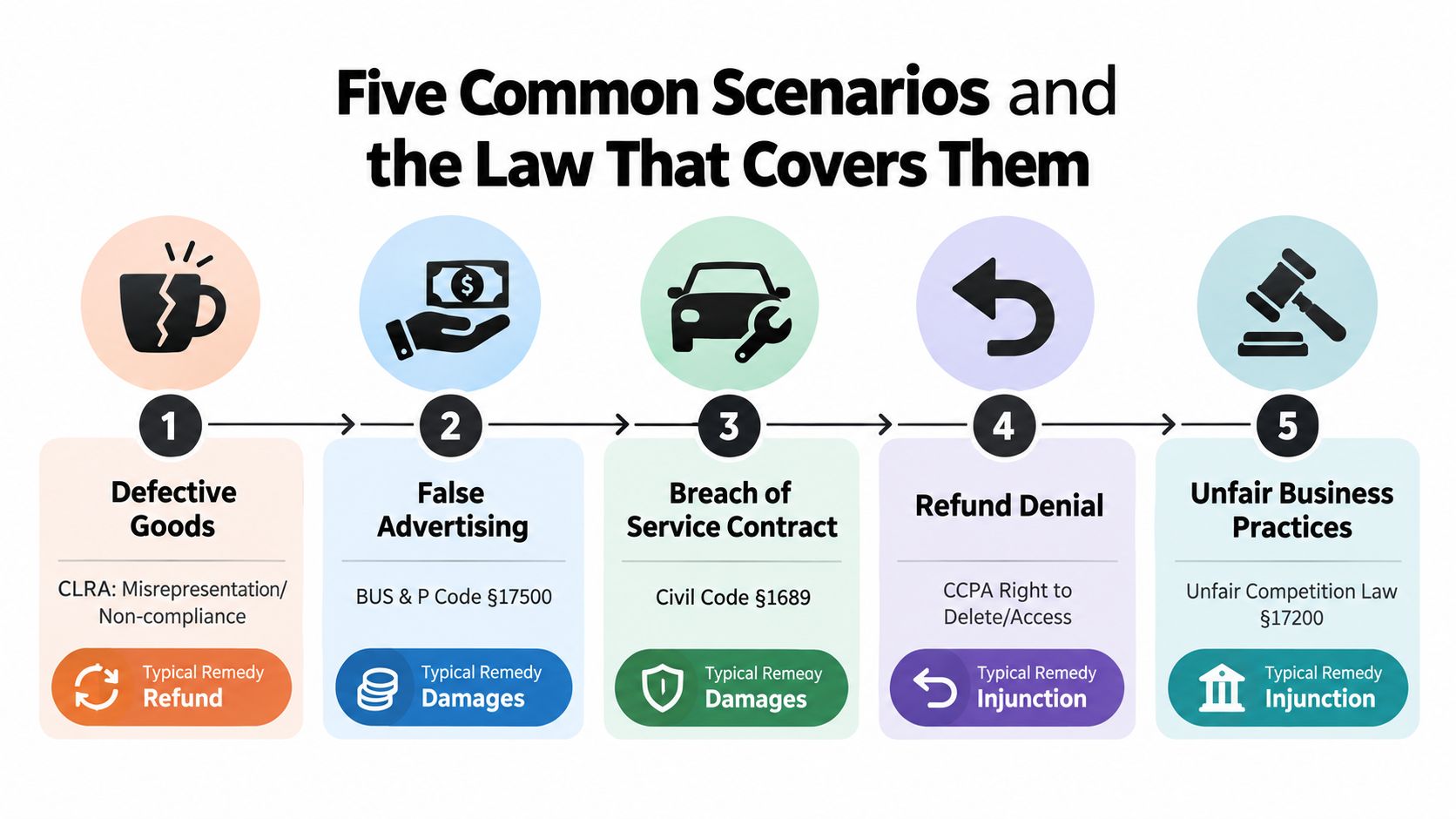
Defective goods or services
If a seller falsely described a product or service, the CLRA may apply. A consumer may also have a claim for breach of the implied warranty of merchantability under California Commercial Code section 2314, meaning goods should be fit for their ordinary purpose. The practical demand usually starts with repair, replacement, refund, or reimbursement for documented loss. Don’t throw away the product or authorize an undocumented repair before photographing the defect and preserving the purchase records.
False or misleading advertising
A product advertised as “new,” “cancel anytime,” or “guaranteed” creates a problem when the actual terms contradict the representation. The CLRA and California False Advertising Law, Business and Professions Code section 17500, may support a demand for restitution, actual damages, or injunctive relief under the applicable claim. Save the full page, not just a cropped screenshot. Capture the URL, checkout flow, disclaimers, and the terms displayed when you paid.
Warranty refusal involving a vehicle or appliance
Song-Beverly claims focus on warranty coverage, repair opportunities, and the seriousness of the defect. For a qualifying vehicle, a consumer may seek a buyback or replacement when the manufacturer can’t repair a warranty-covered defect after a reasonable number of attempts and the defect substantially impairs use, value, or safety. Keep towing invoices, rental-car charges, repair orders, and missed-work documentation because incidental and consequential losses may matter.
Aggressive debt collection
A collector who continues calling after receiving a dispute, uses threats, or reports inaccurate information may implicate the Rosenthal Act and the federal FDCPA. The consumer should save call logs, voicemails, letters, payment confirmations, and credit reports. Federal law can provide statutory damages up to $1,000 per lawsuit, but the claim depends on the collector’s status, the communication, and the evidence.
Privacy violations and data breaches
The CCPA/CPRA gives consumers tools to request access, correction, deletion, and opt-out rights. A private data-breach claim is narrower and depends on the type of personal information and the business’s security practices. The statutory range identified in the CCPA framework is $100 to $750 per consumer per incident, or actual damages when greater, subject to the statute’s requirements and adjustments. Send the required written notice when the claim calls for it, and don’t assume every unwanted cookie or privacy-policy defect creates a private damages action.
Many disputes combine claims. A misleading online sale may involve the CLRA, UCL, contract theories, payment disputes, and privacy requests. That overlap can change the economics because some statutes permit attorneys’ fees or other remedies, but it also makes early legal classification more important.
Your Step-by-Step Playbook for Resolving a Dispute
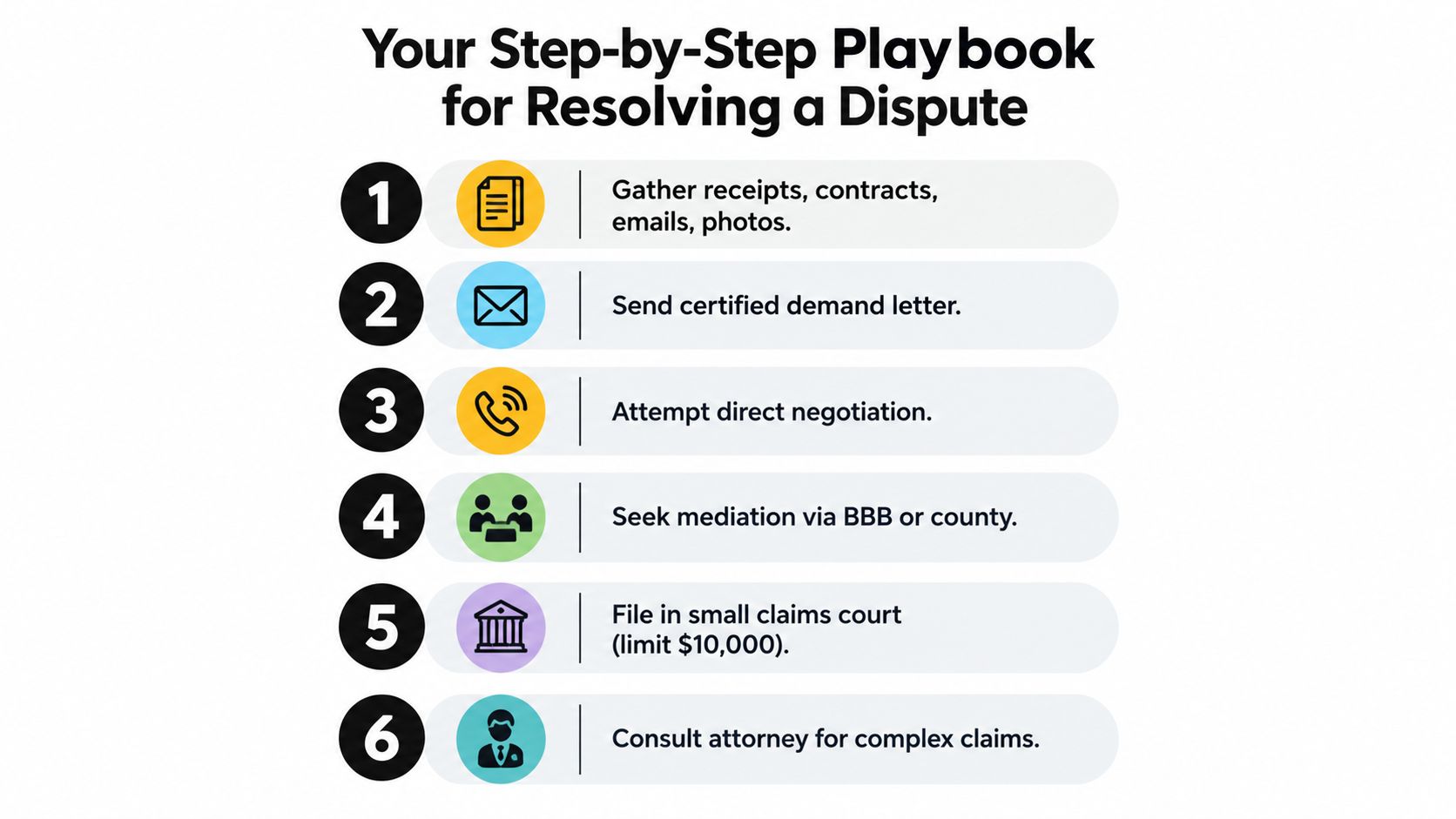
Start with a file, not a phone argument. Businesses respond more seriously when the consumer can show a clean timeline and a specific requested remedy.
Build the record first
Collect the receipt, contract, warranty, invoices, delivery records, repair orders, emails, text messages, photographs, screenshots of advertisements, account notices, and bank or credit-card statements. Export digital records where possible. Keep the original files and create a separate copy for sending.
Calculate the loss without exaggeration. Include the purchase price, payments, repair charges, towing, rental transportation, replacement costs, and other incidental expenses that the documents support. Separate what you paid from what you hope a court might award.
Send a focused demand
A demand letter should identify the transaction, date the problem began, the conduct that violates the law, the evidence attached, and the exact remedy requested. For a CLRA goods or services claim, the notice should describe the demanded correction and provide the applicable 30-day cure opportunity before filing a claim seeking remedies for which notice is required. For a warranty dispute, identify the warranty, repair history, defect, and requested buyback, replacement, or repair.
Send the letter through a trackable method and retain proof of delivery. Avoid unsupported threats, inflated damages, and legal conclusions you can’t explain. If you need help comparing negotiation, mediation, and litigation options, this California alternative dispute resolution resource is a useful starting point. Consumers who want a structured way to reduce future transaction misunderstandings can also prevent disputes with Resolve.
Use agencies strategically
File with the agency that handles the business category, and attach the invoice, contract, screenshots, complaint correspondence, and proof of payment. An agency complaint creates a record and can pressure a business, but it isn’t a substitute for a lawsuit and won’t necessarily recover your full loss.
If negotiation fails, choose the venue based on the amount, complexity, and need for discovery. Preserve every document, avoid deleting posts or messages, and calendar the limitations deadline before you begin negotiating.
Small Claims Court or Civil Suit
Small claims court is often sensible for a straightforward refund, unpaid deposit, or documented repair expense. Superior court becomes more attractive when the dispute involves layered statutory claims, extensive records, expert evidence, a corporation represented by counsel, or remedies that require formal discovery.
California small claims procedures let individuals represent themselves. The individual filing limit is $12,500, while the former lower limit for businesses no longer applies after AB 2629. Verify current filing and procedural requirements with the court before filing because rules and forms can change.
| Factor | Small Claims Court | Superior Court |
|---|---|---|
| Typical fit | Clear, smaller monetary dispute | Complex claims or broader remedies |
| Representation | Consumers generally appear without an attorney | A consumer can retain counsel |
| Procedure | Informal presentation and limited discovery | Discovery, motions, pleadings, and evidentiary procedures |
| Damages | Primarily the amount the claimant proves | Broader claim theories, including possible punitive damages under the CLRA |
| Fees | Lower-cost process, but filing and service costs still apply | Higher litigation expense and longer management burden |
| Appeal and collection | Different appeal and collection rules apply | Formal judgment, enforcement, and appellate procedures |
The statutes of limitations don’t change merely because you choose small claims instead of superior court. A consumer who files too late loses bargaining power in either venue. Conversely, filing quickly without organizing proof can produce a weak presentation.
Attorneys’ fees can affect the decision. The CLRA, CCPA-related claims, and other consumer statutes may include fee-shifting provisions, but fee recovery isn’t automatic and depends on the claim, outcome, and procedural requirements. A simple purchase dispute may belong in small claims. A defective vehicle, repeated deceptive conduct, or data-breach matter deserves a venue analysis before filing.
Where to File Your Complaint in California
The agency that receives a complaint matters. California directs consumers to different offices based on the business and the type of harm, and the Attorney General warns that some complaints belong with another regulator first.
| Problem Category | Best Agency to File With |
|---|---|
| Privacy rights, tracking, sale or sharing of personal information | California Privacy Protection Agency or California Attorney General |
| Financial scams, false advertising, charity fraud | California Attorney General complaint portal |
| Debt collectors and financial-service conduct | Consumer Financial Protection Bureau and California Department of Financial Protection and Innovation |
| Licensed contractors, automotive dealers, and repair shops | Department of Consumer Affairs and Bureau of Automotive Repair |
| Licensed real estate professionals | California Department of Real Estate |
| Local code violations and price-gouging | County District Attorney or appropriate local office |
For privacy complaints, use the CPPA privacy complaint and reporting page or the Attorney General’s privacy channel. Attach the privacy notice, screenshots of opt-out or deletion requests, confirmation emails, the business response, and the relevant account details. The CPPA reported more than 10,000 privacy complaints since its portal launched in 2023 and approximately 120% year-over-year complaint growth, so a complete submission helps the agency understand the issue efficiently. That information appears in the California Department of Consumer Affairs complaint guidance.
Financial complaints should include statements, payment records, account notices, collector letters, and call documentation. For contractors, dealers, and repair shops, include the signed estimate, license information, photographs, inspection reports, and proof of payment. A regulator may investigate, refer the matter, or communicate with the business, but consumers should not assume an agency will award every private remedy or resolve the dispute on a particular schedule.
Statute of Limitations for California Consumer Claims
Deadlines are claim-specific. A demand letter doesn’t automatically stop the clock, and an agency complaint usually isn’t a substitute for timely filing in court.
| Cause of Action | Statute | Deadline | When Clock Starts | Accrual Rule |
|---|---|---|---|---|
| Personal injury consumer claim | Applicable California limitation law | One year | Injury or discovery, depending on claim | Discovery may matter for hidden harm |
| CLRA personal injury | CLRA and related limitation rules | One year | Injury or discovery | Latent injury can affect accrual |
| Most CLRA actions | Applicable CLRA limitation rule | Two years | Discovery of the claim | Preserve facts showing when you learned of the violation |
| Song-Beverly warranty action | Warranty limitation rules | Two years | Discovery of the breach | Defect and repair history are critical |
| Consumer fraud | Fraud limitation rules | Three years | Discovery of fraud | Concealment and discovery can affect accrual |
| UCL claim | Bus. & Prof. Code §17208 | Three years | Accrual of the unlawful act | Ongoing conduct requires careful analysis |
| Written contract | Code of Civil Procedure contract rules | Four years | Breach | Contract language and breach date control |
| Magnuson-Moss warranty claim | Federal warranty law | Applicable federal deadline | Breach and notice | A short notice trigger may affect strategy |
The specific facts can change the result. Minors, bankruptcy stays, ongoing concealment, and contractual provisions may affect tolling or accrual. A consumer dealing with medical debt should separate the limitations period for the underlying debt from claims involving collection conduct. This California medical-debt credit-reporting resource can help frame that distinction, but it isn’t a substitute for reviewing the account and communication history.
When to Call a Consumer Rights Attorney
Self-help works best when the facts are simple, the loss is documented, the business is local or responsive, and the remedy is easy to state. A written refund demand for a clearly undisclosed retail policy is different from a vehicle buyback dispute involving repeated repairs, a data-breach investigation, or a collector’s conduct across multiple accounts.
Call a consumer-rights attorney early when:
- The damages are substantial: Claims above $10,000 may justify a formal strategy, particularly when repair costs, lost use, and statutory remedies overlap.
- A fee-shifting statute may apply: The CLRA, CCPA-related claims, Song-Beverly, FDCPA, and TCPA can change whether counsel can evaluate the matter without hourly billing.
- The defendant is organized and represented: A national retailer, manufacturer, lender, platform, or collector may have in-house counsel and standardized litigation procedures.
- The facts suggest a pattern: Similar complaints, hidden fees, recurring billing, tracking pixels, or a common advertising statement may raise broader enforcement or class-action questions.
- A vulnerable person is involved: Claims involving minors, older adults, or people with limited capacity require careful handling of evidence and authority.
A lawyer can draft a compliant cure notice, calculate a Song-Beverly buyback, identify incidental damages, assess small claims strategy, and spot federal claims under Magnuson-Moss, the FDCPA, or TCPA. Bring the complete file, including the purchase record, terms, repair history, payment statements, screenshots, call logs, and every demand already sent. Don’t send a partial folder that omits an unfavorable message. Counsel needs the full timeline.
For background research, an AI case law search tool may help you locate potentially relevant authorities, but search results aren’t legal analysis and shouldn’t replace a lawyer’s review. Consumers comparing firms can also review this guide to California consumer protection attorneys. LA Law Group, APLC handles consumer disputes and evaluates whether a matter belongs in small claims court, civil court, regulatory enforcement, or a broader claim.
If a defective product, deceptive advertisement, warranty refusal, privacy violation, or collection problem hasn’t been resolved, LA Law Group, APLC can assess the documents, identify the strongest California and federal claims, and recommend a practical path forward. Visit LA Law Group, APLC to request an initial consultation and discuss your consumer dispute.
Attorney Advertising. This article is general information, not legal advice, and does not create an attorney-client relationship. Prior results do not guarantee a similar outcome.