
Derechos Del Trabajador En California: A Practical Guide

You open your final pay envelope and the numbers don’t add up. Hours are missing, overtime disappeared, and your manager says it’s a mistake you’ll have to wait on. If that sounds familiar, you’re not alone, and you don’t need to learn legal Spanish or legal English perfectly to protect yourself.
Understanding Derechos del Trabajador en California means knowing what you’re owed, what evidence to keep, and which office can help. Small steps taken early often decide whether a claim is easy to prove later.
What Every California Worker Should Know Before Trouble Starts
María cleans hotel rooms in Los Angeles. She’s told to arrive early to stock her cart, clock in after, and skip her break when rooms pile up. When she quits, her final wages are short and nobody returns her calls.
That situation touches several rights at once. Wages, breaks, leave, safety, discrimination, and retaliation aren’t separate worlds for most workers. One problem often reveals another, which is why saving screenshots, schedules, and pay stubs from your first week matters more than memorizing statutes.
You hold these rights because you work in California. You don’t earn them by asking nicely, and a manager can’t take them away with a verbal policy.
What this guide can and can’t do
This article is provided for informational purposes only and is not to be construed as legal advice. No attorney-client relationship exists based on review of this article, and none of the information in this article constitutes legal advice. In plain terms, reading this doesn’t make any firm your lawyer, nobody has reviewed your personal facts, and nobody is representing you in a claim.
General information helps you spot issues and ask better questions. It can’t tell you whether your classification, deadline, or documents make your specific case strong or weak.
Classification is a good example. Whether you’re called an employee, a temporary worker, or an independent contractor changes which protections apply, and a label on a form isn’t always the final answer. Workers who are unsure about that boundary can review how independent contractor liability affects California businesses and workers to understand why the distinction matters before assuming a right does or doesn’t cover them.
Start with a simple mental map. Pay rules cover minimum wage, overtime, and final wages. Time rules cover meals, rest periods, sick leave, and family leave. Fair treatment rules cover safety, discrimination, and punishment for speaking up. When trouble starts, place your problem on that map first, then gather proof.
Minimum Wage and Overtime Rules in 2026
Think of wage rules as layers, not a single number. The state sets a floor, your city or county may set a higher floor, and overtime rules sit on top of whichever rate applies to you.
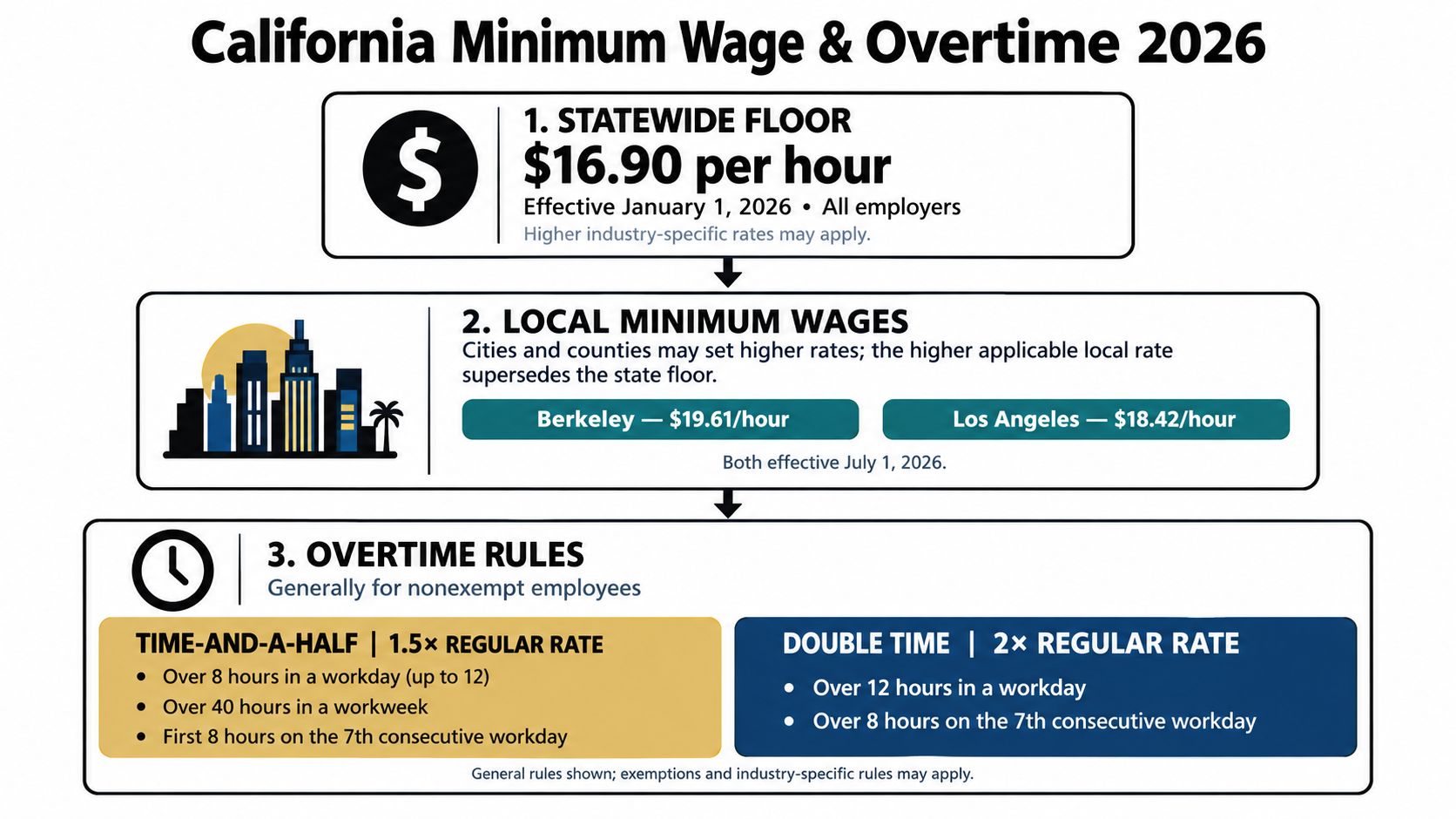
The statewide floor and local rates
For 2026, California’s statewide minimum wage for all employers, regardless of size, is $16.90 per hour effective January 1, 2026, and employers generally may not count employee tips as a credit toward that wage. The same state notice lists $16.00 beginning January 1, 2024 and $16.50 beginning January 1, 2025, showing a steady statutory climb rather than a single sudden reform.
That history matters when you check old pay stubs. The correct rate is the one in effect when you worked the hours, not today’s rate applied backward. If your city or county requires more than the state rate, the higher local rate is the one your employer must meet for work performed there.
Tips don’t lower that obligation. A server, bartender, or delivery worker still must receive the applicable minimum wage directly from the employer, with tips on top.
Daily overtime catches people off guard
California doesn’t only count weekly hours. For most nonexempt employees, hours above 8 and through 12 in a workday generally require 1.5 times the regular rate, hours above 12 require double time, and hours over 40 in a week also require 1.5 times pay. The first 8 hours on the seventh consecutive day in a workweek generally get 1.5 times pay, and hours beyond 8 that day get double time.
If you’re unsure whether you’re exempt or nonexempt, this nonexempt employee definition for HR explains the distinction in practical terms. Job titles and salary labels don’t decide it alone, and salaried workers can still be nonexempt.
Here’s the trap door. You work four 10-hour days, Monday through Thursday, for 40 total hours. A manager who only looks at the weekly total sees no overtime, but California’s daily rule makes 2 hours each day overtime, so 8 of those 40 hours should be paid at 1.5 times your regular rate.
- Track by day: Save records showing start, stop, and meal times for each workday, not just weekly totals.
- Watch the regular rate: Commissions and bonuses may affect the rate used to calculate overtime, so keep those records too.
- Check special days: Review resources on how holiday overtime pay is calculated before assuming a holiday automatically pays a premium.
Practical rule: If your schedule is long on single days, check daily overtime first. Weekly math alone will miss money.
Meal Breaks, Rest Breaks, and How Missed Breaks Are Paid
Break rules protect your time, and they also show up on your pay stub in different ways. A meal period is usually unpaid, while a rest period is paid, so confusing the two makes violations hard to spot.
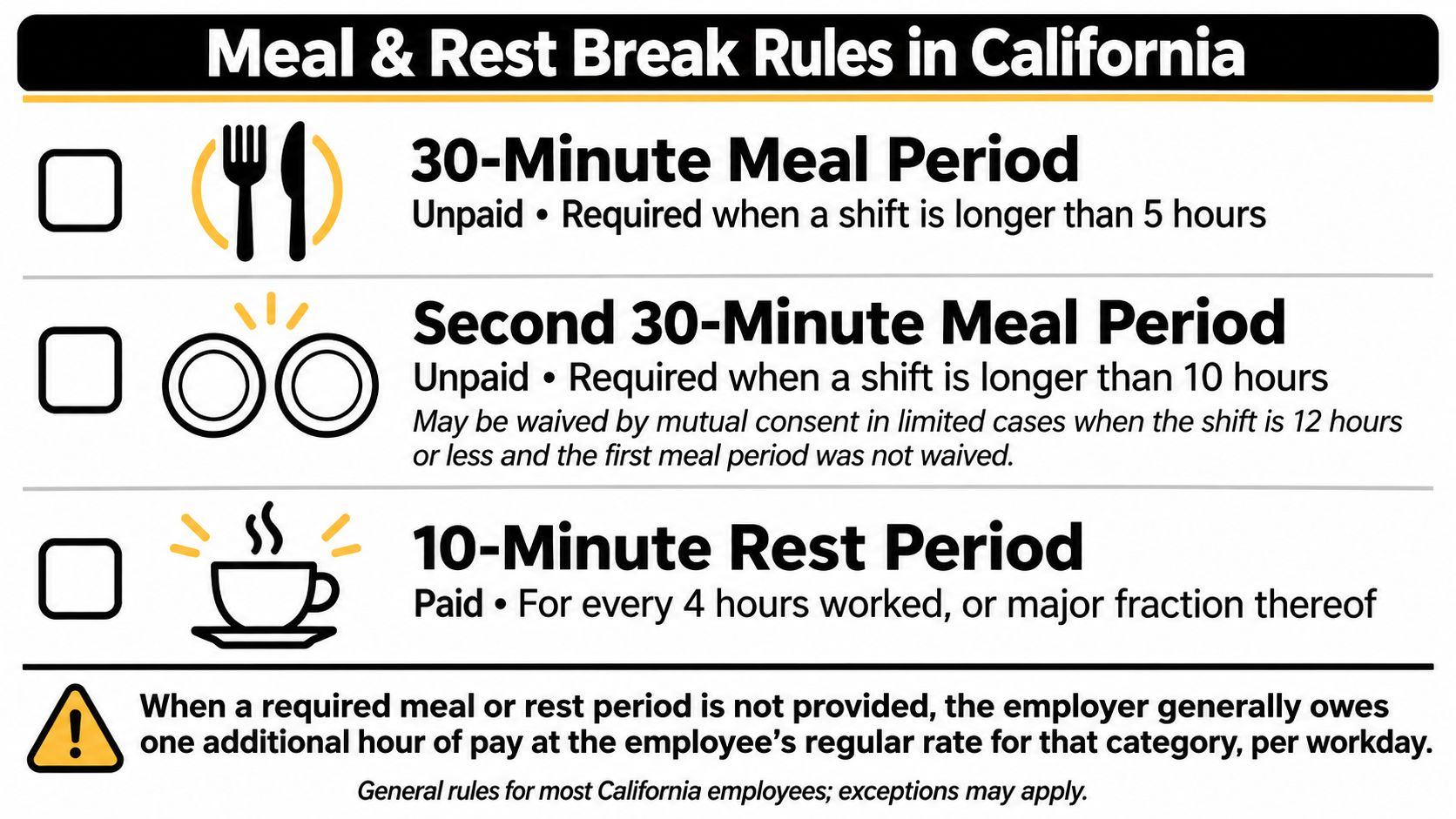
The basic timing rules
Under state guidance, most California workers must receive an uninterrupted, unpaid 30-minute meal period when working more than 5 hours in a day, a second 30-minute meal period generally applies when the workday exceeds 12 hours, and a paid 10-minute rest period is required for every 4 hours worked or a major fraction of 4 hours. That’s the compliant baseline for most warehouse, restaurant, retail, and hotel shifts.
Compare two shifts. A compliant 8-hour shift includes an unpaid 30-minute meal where you’re relieved of duty, plus paid rest time. A non-compliant shift keeps you answering the radio during lunch, asks you to clock out but stay at your station, or treats rest as something you take only if the line slows down.
If an employer fails to provide a required rest period, California’s official wage order states the employer may have to compensate the missed 10 minutes at your regular rate during the same pay period. Small amounts add up when a break is missed every shift, and a pattern is easier to prove than a memory.
Multi-location employers sometimes apply another state’s break policy by habit. HR teams comparing requirements can use California break laws for multi-state HR as a starting point for checking whether a handbook matches California rules.
What to document when a break is skipped
- Date and shift length: Note when you started, when you stopped, and whether a meal was offered.
- Who directed the work: Save texts or messages telling you to stay, return early, or work through a break.
- What you did: Write down tasks performed during the supposed break while details are fresh.
- Pay stub result: Keep the stub for that pay period to see whether any missed rest time was paid.
Don’t assume you waived a break just because you kept working. Waivers are narrow, and pressure, understaffing, or a supervisor’s instruction tells a different story than a free choice.
Sick Leave, Family Leave, and Job-Protected Time Off
Two programs cause constant confusion because their names sound similar. California Paid Sick Leave and California Paid Family Leave solve different problems, and only one of them is mainly about replacing wages for a longer family event.
Paid sick leave is the shorter, day-to-day benefit workers use for their own health needs or to care for a family member. Paid Family Leave is a state benefit program for bigger life events, and eligibility depends on wages covered by State Disability Insurance.
What Paid Family Leave actually provides
The Employment Development Department explains that California Paid Family Leave provides eligible workers with up to 8 weeks of partial wage-replacement benefits within a 12-month period, eligibility generally requires at least $300 in wages subject to State Disability Insurance during the relevant 18-month period, and benefits are approximately 70% to 90% of qualifying wages depending on income. You can use it to bond with a new child, care for a seriously ill family member, or assist with a qualifying military event, and claims may be taken continuously or split into separate periods.
Read that carefully. Paid Family Leave replaces part of your pay. It does not itself protect your job. Job protection, when it applies, comes from separate laws such as CFRA, FMLA, or pregnancy disability leave, each with its own eligibility rules.
That distinction changes planning. A worker may qualify for wage-replacement benefits but still need to confirm whether a job-protected leave also applies before taking time away. Another worker may have job protection but need to file separately for benefits. Treating one approval as automatic approval for both is a common and costly mistake.
Workers comparing systems sometimes look at general resources like sick pay eligibility explained to understand how eligibility concepts differ by place. For a California claim, always come back to the California program’s own wage and timing requirements.
Coverage also changes over time. Agricultural employees became covered by the state’s sick-leave protections in 2025, a reminder to check the rule for your industry and leave date rather than relying on what a coworker was told years ago. Seasonal, temporary, and contractor labels deserve the same careful check before you assume you’re excluded.
Workplace Safety, Discrimination, and Retaliation Protections
Some protections don’t fit neatly on a pay stub. You have the right to a safe workplace, to be free from discrimination based on protected characteristics, and to raise concerns without being punished for speaking up.

Cal/OSHA handles workplace safety hazards, from missing protective equipment to dangerous heat or machinery conditions. The Civil Rights Department handles employment discrimination and related retaliation. Workers hurt on the job also need to understand their rights after an injury at work, because medical care, wage loss, and reporting duties can overlap with safety complaints.
The three-year discrimination deadline
Timing matters, and different claims run on different clocks. The Civil Rights Department states that an employment-discrimination complaint must generally be submitted within three years of the alleged discriminatory act, measured from the date the worker was last harmed. Don’t wait for an internal HR process to finish before checking that deadline, because an internal review doesn’t pause the filing period for you.
Three years sounds long. Evidence still disappears quickly, witnesses change jobs, and messages get deleted. Early documentation protects a claim even if you file later.
Build a simple timeline
Use a chronological model that any investigator can follow.
- Protected characteristic or activity: Identify what applies, such as a disability accommodation request, a safety report, a wage complaint, or a protected characteristic.
- Adverse action: Document what changed afterward, including a schedule cut, sudden write-ups, demotion, transfer, or termination.
- Comparator treatment: Note how similarly situated coworkers were treated under the same policy or supervisor.
- Timing: Record exact dates, because a close sequence between speaking up and being disciplined can support an inference of retaliation.
Keep emails, performance reviews, attendance records, termination notices, accommodation requests, witness names, and policy documents. Save copies lawfully and don’t rely on a work phone or inbox you could lose access to without warning.
Employers may point to documented performance standards applied consistently over time. That’s exactly why your timeline should include reviews from before and after you spoke up, not just the final write-up. A clean record that suddenly changes after a complaint tells a different story than a long, consistent record.
Write dates down the same day. A timeline built from memory months later is weaker than a few saved messages with timestamps.
How to Report Violations and Choose the Right Agency
Knowing a right exists isn’t the same as enforcing it. The hardest question for many workers is simple: which door do I walk through first, and what do I bring with me?
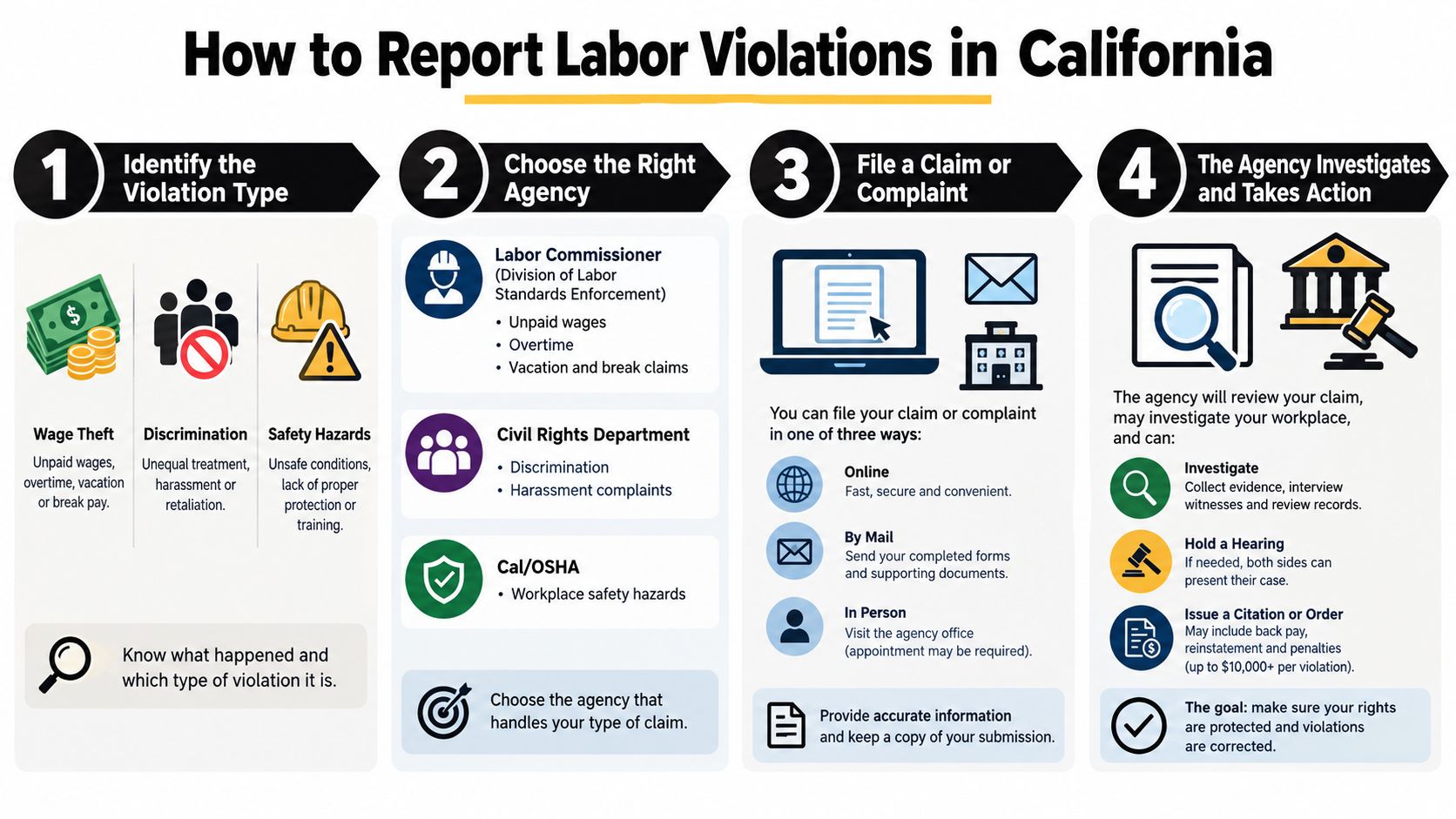
Start by naming the violation type. Unpaid wages point one direction, discrimination another, and an unsafe machine another. Filing with the wrong agency wastes time you may not have.
Matching the problem to the agency
The Labor Commissioner, through the Division of Labor Standards Enforcement, handles individual claims for unpaid wages and related labor standards issues. State guidance confirms that California’s Labor Commissioner adjudicates claims for unpaid wages, overtime, and vacation pay, and provides a dedicated phone line covering wages, breaks, retaliation, and labor laws.
The Civil Rights Department is the route for discrimination and related complaints. Cal/OSHA is the route for safety hazards. The Employment Development Department handles unemployment and Paid Family Leave benefit claims.
Sometimes more than one route fits. A worker fired after reporting unpaid overtime may have a wage issue and a retaliation issue at the same time. Parallel proceedings can make sense, but deadlines and agency roles still need to be tracked separately.
The short video below walks through the reporting sequence visually, which helps if agency names blur together on the page.
A realistic filing example
Suppose your final wages are missing. Identify the correct legal employer first, including whether a subcontractor, staffing agency, or parent business paid you. Then calculate what’s owed by day using pay stubs, schedules, time-clock screenshots, and messages directing work before or after shifts.
Bring witness names if coworkers saw the off-the-clock work. Expect conferences or hearings, not instant payment, and respond to notices promptly. Broad legal coverage doesn’t automatically create access to justice when language barriers, missing records, or fear of retaliation get in the way. Preparation closes part of that gap, and private counsel may make sense when the amount, retaliation risk, or employer structure is complex.
Your Quick-Action Checklist for a Wage or Rights Dispute
California protections have deep roots. The Legislature’s Labor Code history shows that California’s modern statutory framework for employee protections is rooted in the state Labor Code, whose employment-regulation division was enacted through Chapter 90 of the Statutes of 1937. You don’t need that history memorized. You need a same-day playbook.
If wages or overtime are missing
- Save the paper trail: Keep pay stubs, schedules, time records, offer letters, and messages about hours.
- Do the daily math: List hours by workday and mark anything over 8, over 12, or on a seventh consecutive day.
- Identify the employer: Write down the business name on checks and stubs, plus any staffing agency or subcontractor involved.
- Route the claim: Take unpaid wages, overtime, and vacation pay issues to the Labor Commissioner process.
If retaliation or discrimination followed
- Build the timeline: Record the complaint or request, the employer’s response, and every change to your schedule, duties, or discipline.
- Name witnesses: Save names and contact details before coworkers scatter.
- Watch the clock: Route discrimination complaints to the Civil Rights Department within the three-year window discussed above.
- Ask for help early: Use bilingual agency resources or a consultation when deadlines, classification, or parallel claims feel unclear.
Screenshot this checklist and start a folder on your phone today. This article remains general information only, not legal advice for your situation, and reading it doesn’t create an attorney-client relationship.
If you’re facing missing wages, a workplace injury, or retaliation after speaking up, LA Law Group, APLC can review your documents, explain your options in plain language, and help you choose the right next step for your California claim. Visit LA Law Group, APLC to request a free initial consultation and talk through your situation with a real person.
Attorney Advertising. This article is general information, not legal advice, and does not create an attorney-client relationship. Prior results do not guarantee a similar outcome.