
DHCS Personal Injury Claims: Liens, Notice and Immunity
Your emergency room bill after the crash never arrived at your house. Medi-Cal covered it. Months later an adjuster offers a number for your injuries, and someone mentions that the state can take a piece of it. That’s usually the moment people start hunting for a straight answer about DHCS personal injury claims.
The short version first. Being enrolled in Medi-Cal when you’re hurt doesn’t cancel your claim or cap what it’s worth. It creates a repayment obligation to the state for the care Medi-Cal paid, and that obligation gets resolved out of the recovery before you see the balance. Everything below is informational only and isn’t legal advice.
Most of the confusion comes from three clocks running at the same time: a notice clock, a lien clock, and, when a public agency caused the harm, a government claim clock. They don’t sync up, and missing one makes a settlement slower and smaller.
When DHCS Enters an Injury Claim
DHCS enters an injury claim for one reason. Medi-Cal paid for treatment that a liable third party caused, and the state wants that money back once the injured member recovers. The liable party is usually a driver, a property owner, or an insurer standing behind one of them. Enrollment doesn’t block the claim. It adds a repayment step that has to clear before money is split.
The sorting question is narrow. Was the person a Medi-Cal member on the date of the injury, and did Medi-Cal pay for any treatment that followed? Two yeses means DHCS will likely appear. The table below shows how that plays out across the case types that come up most.
| Case | DHCS involvement | First action |
|---|---|---|
| Medi-Cal member injured in a car crash | DHCS may assert a lien for Medi-Cal-paid injury care | Give DHCS written notice within 30 days of filing |
| Medi-Cal member hurt in a slip-and-fall or premises incident | DHCS may assert a lien for injury-related services | Confirm which services are tied to the injury |
| Medi-Cal member injured as a rideshare passenger or pedestrian | Same lien rules if a liable third party pays | Notify DHCS and keep treatment and provider dates |
| Injury caused by a state-run facility or public entity | A government claim comes first, and a lien may still follow | Present a written claim within six months |
A Medi-Cal lien isn’t a fine, and it isn’t punishment for using public coverage. Medi-Cal pays a bill up front, then asks the responsible party’s money to carry that cost instead of absorbing a bill someone else should cover. The lien is how the ask gets enforced, which is why it shows up in ordinary car crash and trip-and-fall files and not just in unusual ones.
Injury claims also sit inside more than one system, and the seam between them matters. Readers who want to see how a single accident gets sorted between a no-fault style file and a civil claim can compare Georgia work injury claims, which lays out how one injury can generate two separate reimbursement conversations.
Quick self-check: if you were covered by Medi-Cal on the day of the injury, assume DHCS may hold a claim until its own payment records show otherwise. Waiting for the state to find you is not a plan.
This article is for informational purposes only and is not to be construed as legal advice. No attorney-client relationship exists based on reading it, and nothing in it is legal advice for your situation.
How the Medi-Cal Lien Reduces Your Settlement
Numbers land harder than warnings, so here’s a hypothetical. A Medi-Cal member settles a car-collision claim for $100,000. Every figure in this section is illustrative. None of it predicts any real case.
Step one, the gross isn’t yours to keep. Attorney fees and case costs come off the top. Assume $30,000 for both, leaving $70,000.
Step two, the lien. DHCS asserts a claim for the $22,000 that Medi-Cal paid for injury-related care. Treatment with nothing to do with the crash stays out of that figure, and that exclusion does more work than any other part of the process.
Step three, subtraction. $70,000 minus $22,000 leaves about $48,000 before any reduction of the lien itself.
Where the money goes, illustratively: $100,000 gross, $70,000 after fees and costs, roughly $48,000 after a $22,000 lien.
One point trips people up. A negotiated reduction comes off the lien amount, not off the headline settlement. Cutting that $22,000 lien to $16,000 puts $6,000 back in the claimant’s pocket. It doesn’t move the $100,000 by a cent.
California’s Department of Health Care Services treats Medi-Cal payments connected to a personal-injury claim as recoverable third-party costs, and it may assert a lien for injury-related services, under both federal law and Welfare and Institutions Code sections 14124.71, 14124.785 and 14124.79, as the DHCS personal injury lien process page explains. Recovery can run through the settlement date or the full resolution of the injury actions, so the date treatment stops is part of the math.
That’s the shape of it: the gross settlement is not the money available to the injured person. The rest of the repayment universe looks similar, and this breakdown of medical liens in California personal injury cases shows where hospitals, surgeons and ambulance services fit alongside the state’s claim.
The lien figure isn’t fixed when treatment ends, and it isn’t fixed when the release is signed. It’s fixed when DHCS finishes reviewing payment records.
Notice Duties and the 30-Day Filing Deadline
The rule comes first. A Medi-Cal claimant or a representative must give DHCS written notice within 30 days after filing a personal injury claim or lawsuit, under Welfare and Institutions Code section 14124.73, as the DHCS personal injury frequently asked questions page sets out. Thirty days from filing. Not from the crash.
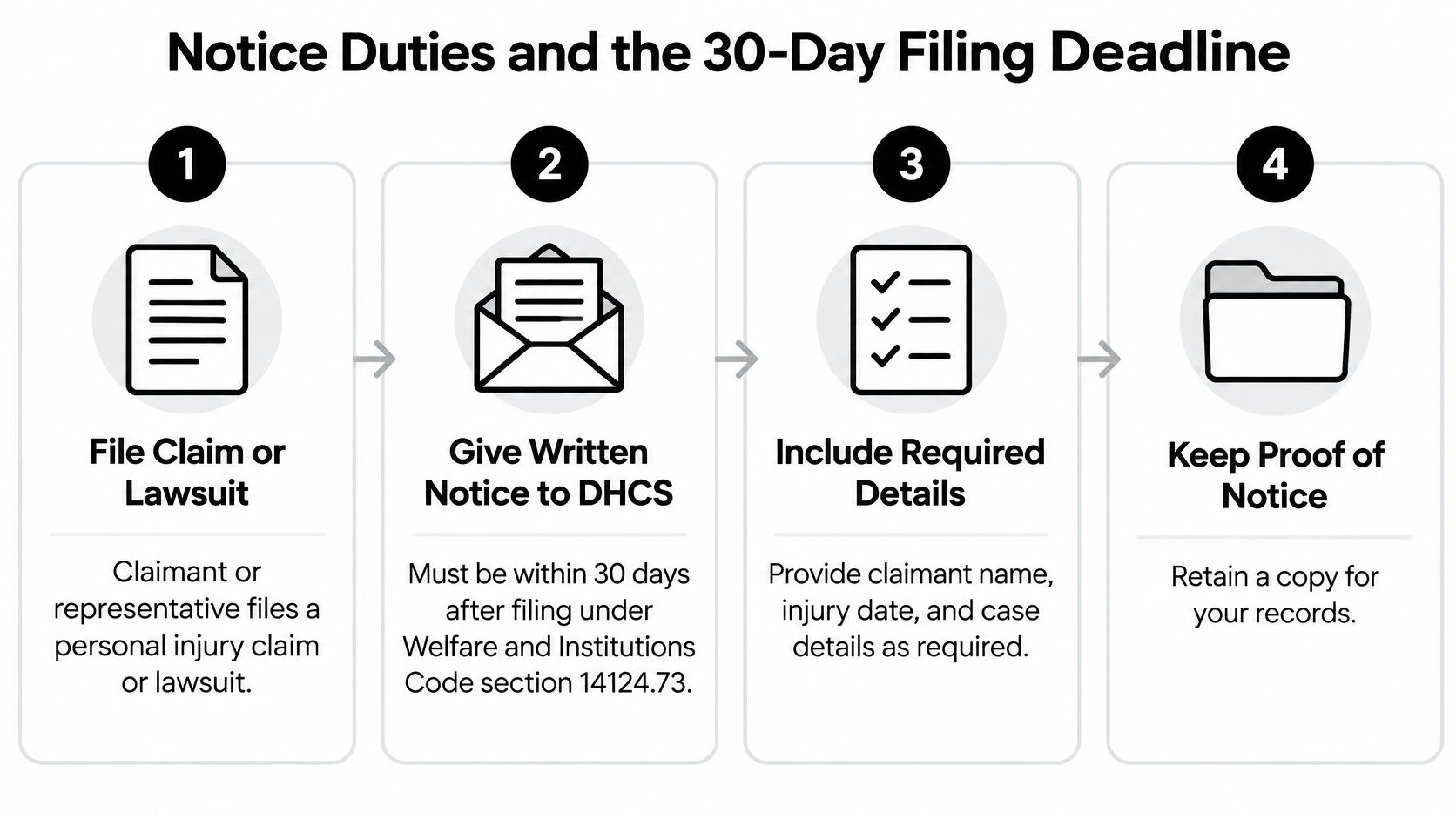
That gap is where files get into trouble. A crash in January, six weeks of treatment, a demand letter in March, a lawsuit in August, and suddenly the deadline lands in September on a matter everyone was treating as a January event.
Here’s the sequence that keeps the notice clean.
- Pull the Medi-Cal identification number. The state can’t match a notice to a member without it, and a benefits card in a drawer is faster than a records request later.
- Record the injury date and the responsible third party or insurer. These two data points drive the lien calculation, not just the paperwork.
- Add the claims administrator and claim number. This is how DHCS and the carrier find each other without going through you.
- Add defense counsel details if a suit has been filed. Liability counsel belongs on the notice from the day they appear.
- Prepare a separate notice for each Medi-Cal member involved. A three-passenger crash is three notices. A single generic filing leaves two members unreported.
- Calendar the deadline from the filing date. Diarize it the day the claim or complaint goes out, not the day someone remembers.
- Send a case update when treatment ends or a settlement is signed. This is the trigger that gets payment records ordered.
The separate-member rule earns its own paragraph because it’s counterintuitive. Two people in the same car, same crash, same insurer, and the state still wants a distinct notification for each one’s coverage.
What a missed notice actually costs: a delayed closing and a recovery demand that nobody can verify line by line, because the record trail starts late and stays thin.
The Post-Settlement Lien Timeline and Records Review
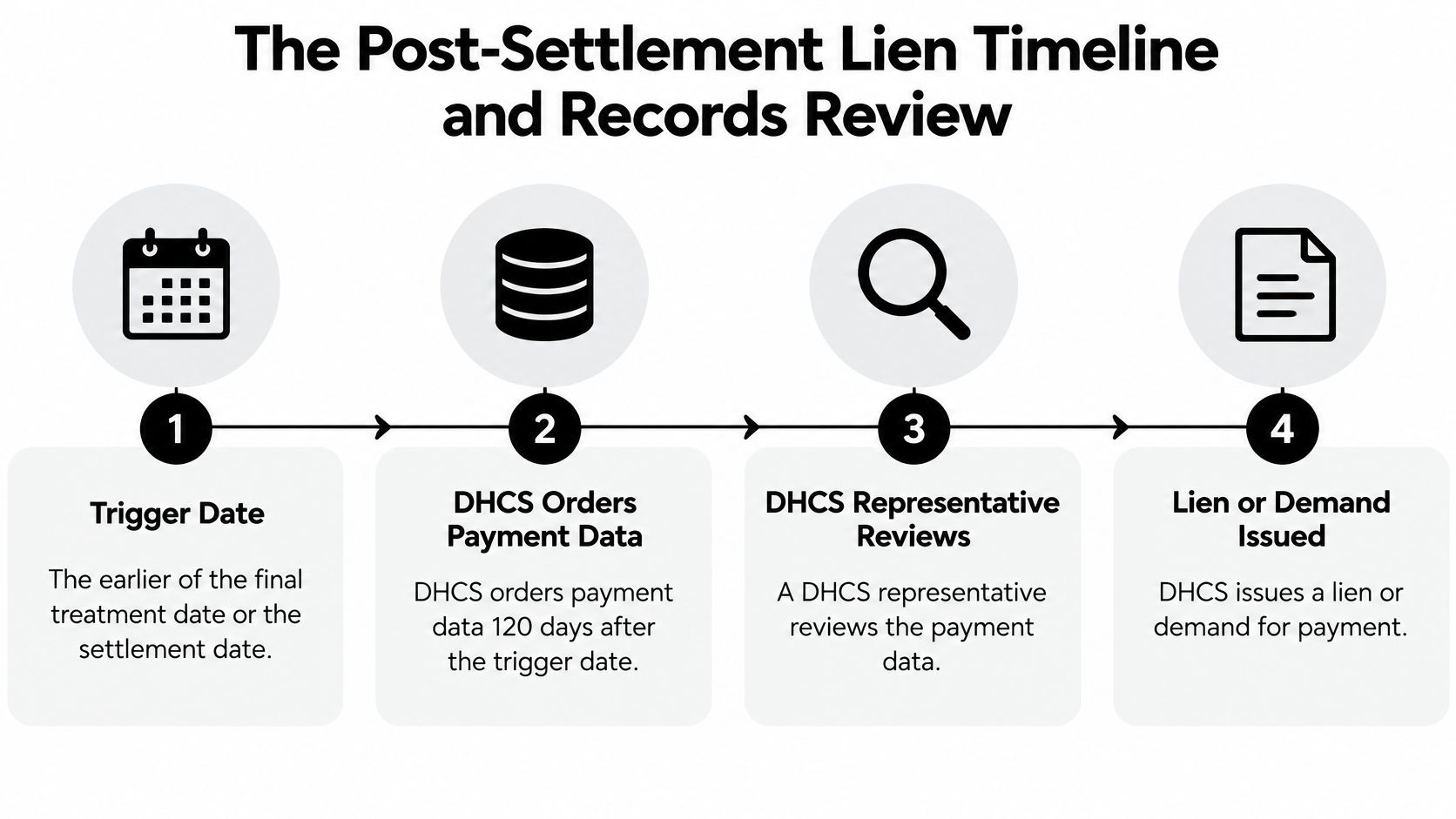
The trigger for the whole timeline is the earlier of two dates. Either the final treatment date, or the settlement date. Whichever arrives first starts the clock, not whichever is more convenient.
Then comes a fixed administrative milestone. DHCS’s recovery guidance states that the agency orders payment data 120 days from the settlement date or the final date of treatment, whichever occurs first, and that a DHCS representative reviews the data and creates a lien if one applies, as described in the DHCS guidance on potential third-party liability. The published personal-injury flowchart uses the same 120-day interval before payment data is reviewed and a lien or no-lien letter goes out.
| Milestone | Trigger | What happens |
|---|---|---|
| Treatment ends or settlement signed | Earlier of final treatment date or settlement date | Case update goes to DHCS |
| Day 120 after the trigger | 120 days from the trigger date | DHCS orders payment data |
| Records review | Payment data received | DHCS representative reviews and decides whether a lien applies |
| Lien or no-lien letter | Review complete | Lien amount is known before money is disbursed |
Four months of waiting sounds administrative until you see what it does to a file. Treatment often runs past the point where a carrier makes an offer, and settlements get signed before every billing record has been processed. That’s why a closing gets held: counsel, the insurer, the providers and DHCS all have to be looking at the same set of paid claims before anyone can divide the money.
The review itself is a records exercise. Request the itemized list of what Medi-Cal paid, check each charge against the accident, and flag entries that belong to an earlier injury or duplicate a service already counted. What you keep on file decides how that argument goes: accident date, treatment chronology, provider identity, insurance information, and how the settlement was allocated. Those are the data points that place a paid service inside or outside the recoverable injury episode.
Billing entries are the raw material here, and they’re rarely tidy. Anyone who has tried to reconcile a hospital statement knows the mess, and a virtual medical coder can explain how procedure and diagnosis codes map back to a specific billed service.
Reporting is separate from review, and it isn’t optional. Medi-Cal members, their legal representatives and insurance carriers all have a duty under federal and state rules to report injury claims that could produce compensation. Failure to report can reduce recoveries for California and for the federal government, which is the state’s problem until it becomes the claimant’s delay.
A no-lien letter is the document that clears the file, the written answer to what a letter of subrogation does in other settings. Until that letter or a fixed lien amount lands, distributing settlement money is premature.
Suing a State Facility Under the Government Claims Act
The six-month deadline is where public-entity claims fail, and it arrives sooner than many expect. A bus operated by a public transit agency, a state hospital, a county building, a city sidewalk, a public university campus: each of these starts with a written claim presented to the entity under the California Government Claims Act, and the claim comes before any lawsuit.
| Requirement | Rule |
|---|---|
| Claim against a public entity for personal injury | Presented within six months of the injury (Government Code 911.2) |
| Lawsuit after a written rejection | Filed within six months after the rejection notice (Government Code 945.6) |
| No rejection notice issued | Suit filed within two years of the injury (Government Code 945.6) |
| Dangerous condition of public property | Claimant must show the condition and the entity’s knowledge or notice (Government Code 835) |
Notice the structure. Six months to present, six months to sue after a rejection, two years if the entity never sends a rejection at all. Those aren’t interchangeable dates, and they don’t run from the same event.
Then come the immunities, and they’re the part claimants underestimate. Under Government Code 815, a public entity is generally immune from liability unless a statute specifically creates it. Discretionary decisions carry their own protection under Government Code 820.2. A dangerous condition claim under Government Code 835 requires proof of the condition itself plus the entity’s knowledge or notice of it. Concretely, a fall on a cracked walkway at a state hospital is a property condition question. A complaint about how the hospital scheduled its staff that day runs into a discretionary decision, and the second claim is much harder to carry. Same building, same injury, very different cases.
The parallel track nobody warns you about: a Medi-Cal member hurt at a state-run facility may owe a lien notice on one clock and a government claim on another. Each runs on its own schedule, and neither one pauses for the other.
A written rejection starts a fresh six-month window to file suit. Calendar the date the rejection arrives, not the date someone plans to open the envelope. And note that a settlement with a public entity doesn’t erase the state’s interest: a Medi-Cal lien can still attach to money paid by a government defendant.
Public-entity files generate a lot of paper, from claim forms to proof of presentation to the rejection itself, and a Hire Virtual Legal Assistants in California service can keep that packet indexed so no deadline depends on memory. If the claim has already been presented, this walkthrough of government claims for personal injury in California covers what happens next.
Mistakes to Avoid and the Pre-Settlement Checklist
California’s Department of Health Care Services runs its Personal Injury Program under federal and state third-party liability rules. When Medi-Cal pays for care connected to a crash, a fall or a premises incident and the member later recovers from a responsible party, the department must seek reimbursement for the related Medi-Cal spending, as the DHCS Personal Injury Program page describes. That means the claim has to be identified and resolved before proceeds are handed out.
The costliest errors come in five shapes.
- Settling before the lien status is known. The cause is pressure to close while the number is on the table. The fix is to wait for the lien or no-lien letter, because once funds are released there’s nothing left to hold back.
- Treating the total medical bill as the lien. The provider’s charges and the amount Medi-Cal paid for injury care are different numbers. Work from the state’s itemized paid-claims list, not the hospital’s sticker price.
- Letting unrelated or duplicated charges stand. A charge from a 2021 back injury sitting inside a 2024 crash demand is a line item to dispute, not to absorb. Challenge it against the record.
- Assuming a government settlement escapes the lien. A public entity’s money is still third-party money. Check lien exposure after any recovery from a state or municipal defendant.
- Losing the treatment trail. DHCS obtains and reviews payment records before it issues a lien, so the final treatment date and the settlement documents are what fix the number. Keep the accident date, the provider list and the settlement allocation together.
Why the last one matters most: you can’t dispute a charge you can’t date to the accident, and a thin record turns a negotiable demand into a take-it-or-leave-it one.
Before any money moves, answer these with a yes or no.
- Was the injury care paid by Medi-Cal? If yes, the lien conversation is live.
- Was written notice sent to DHCS for each Medi-Cal member within 30 days of filing? Each member, not each accident.
- Are the final treatment date and the settlement documents in hand? These are the two triggers that start the review.
- Were DHCS payment records requested and checked line by line? Not the bills. The paid claims.
- Has a lien or no-lien letter been issued? One of the two should exist before disbursement.
- Is the net figure calculated after any lien reduction? Reductions hit the lien amount, not the gross.
- For a public entity, was the claim presented within six months? If not, the rest of the checklist may not matter.
Two or more no answers means the file isn’t ready to close, regardless of what the adjuster says about the offer expiring.
The next step isn’t signing anything. It’s having the file reviewed against the list above. LA Law Group, APLC offers a free consultation in which an attorney reviews the injured person’s options and explains them in plain language, and the number for calls and free consultations is (866) 625-2529.
LA Law Group, APLC works with injured Californians who are untangling a Medi-Cal lien, a government claim, or both at once, and can take over the insurer calls while the notice and reimbursement steps get handled in order. A free consultation gives you a clear read on where your claim stands and what the state’s repayment demand covers, explained in plain language rather than statute numbers. Visit LA Law Group, APLC to request yours.
Attorney Advertising. This article is general information, not legal advice, and does not create an attorney-client relationship. Prior results do not guarantee a similar outcome.