
Your Guide to Diminished Value Claims
So, what exactly is a diminished value claim? Think of it as compensation for the simple fact that a car with an accident history is worth less than an identical one without it. Even if your car was perfectly repaired, its market value takes a hit. This claim is your way of recovering that financial difference from the at-fault driver’s insurance company.
Disclaimer: This article is for informational purposes and not to be construed as legal advice. No attorney-client relationship exists based on the review of this article, and none of the information in this article is legal advice.
What a Diminished Value Claim Actually Is
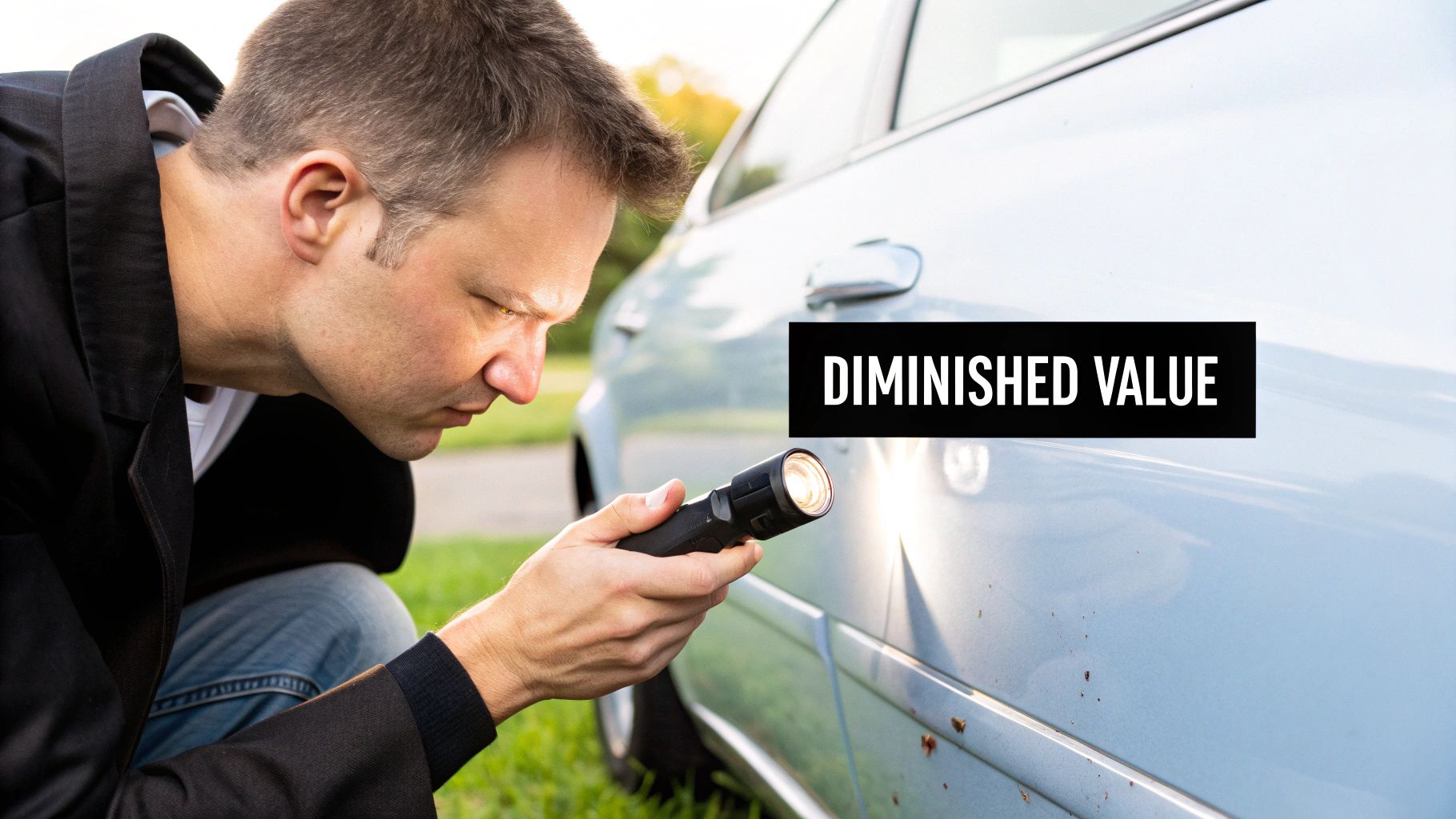
Let’s imagine you’re trying to sell your car. Now picture an identical one for sale right next to it—same make, model, year, and mileage. The only difference? Yours has a collision on its vehicle history report. A smart buyer will almost always offer you less money for your car, and that gap in price is its diminished value.
A diminished value claim specifically targets this loss in your car’s market value after it has undergone necessary auto repairs from an accident someone else caused. It’s a completely separate financial loss from the repair bill itself. While the insurance company pays the body shop to fix the dents and scratches, that payment does nothing to restore your car’s pre-accident market worth.
The Three Types of Diminished Value
To build a strong claim, you first need to understand where the loss is coming from. Diminished value isn’t just one broad idea; it actually breaks down into three distinct categories.
To make it clearer, here’s a quick breakdown of the three types of diminished value you might encounter.
Types of Diminished Value Explained
| Type of Diminished Value | When It Occurs | Key Characteristic |
|---|---|---|
| Inherent Diminished Value | After repairs are completed | The automatic loss of value just because the car now has an accident history. |
| Immediate Diminished Value | Right after the accident, before repairs | The difference between the car’s pre-accident value and its value while damaged. |
| Repair-Related Diminished Value | After repairs are completed | An additional loss in value due to poor-quality repair work (e.g., mismatched paint). |
Most claims focus on inherent diminished value. It’s the unavoidable drop in resale price that happens the moment an accident is recorded on the vehicle’s history, no matter how perfect the repairs are.
Ultimately, filing a diminished value claim is about your right to be made financially whole again. The driver who caused the accident is responsible for all the damages, and that includes this often-overlooked depreciation. While amounts vary depending on the car and the accident, the average claim is around $1,500.
Knowing Your Right to File a Claim
Before you can even think about getting paid for your car’s lost value, you have to understand your legal right to ask for it. This is the foundation of your entire claim.
The core principle is actually quite simple: the person who caused the accident is responsible for all the damages that resulted. That doesn’t just mean fixing the dent in your door. It also covers the invisible damage—the loss of market value your car now carries because it has an accident history.
This leads us to a crucial distinction you absolutely must grasp: the difference between a first-party and a third-party claim. Who you file against makes all the difference.
First Party vs. Third Party Claims
When you file a claim against the at-fault driver’s insurance, that’s a third-party claim. In nearly every state, this is the correct—and accepted—way to go after diminished value compensation. The other driver’s liability policy is specifically designed to cover the damages their client caused to others, including you.
A first-party claim, on the other hand, is when you try to file against your own insurance policy. Don’t waste your time. Most standard auto insurance contracts have language that explicitly excludes covering your own car’s diminished value. Unless you live in a state with a specific law that allows it (like Georgia), this is a dead end.
Disclaimer: This article is for informational purposes and not to be construed as legal advice. No attorney-client relationship exists based on the review of this article, and none of the information in this article is legal advice.
Why State Laws Are So Important
Your ability to file a claim, and the specific hoops you have to jump through, are all dictated by your state’s laws. Each state has its own statute of limitations for property damage, which is basically a countdown timer for filing your claim. This window is typically between two and four years, but it can vary quite a bit.
Knowing the rules in your state isn’t just a good idea; it’s non-negotiable. These laws determine:
- Who you can file against: This almost always confirms the third-party rule.
- How long you have to file: Missing the statute of limitations deadline means you get nothing.
- What proof you need: Different states may have different standards for the evidence required.
If you ignore these local rules, your claim can be shut down before it even gets off the ground. By figuring out the right person to file against and respecting your state’s timeline, you’re building your case on a solid legal foundation from day one.
How Diminished Value Is Calculated
There isn’t some magic calculator that spits out a single, definitive number for diminished value. Honestly, this ambiguity is where things get messy, because the insurance company and an independent appraiser can come up with wildly different figures.
Insurance adjusters often rely on their own internal formulas, which are almost always designed to pay out as little as possible. One of the most infamous is the “Rule 17c,” a formula that came out of a Georgia lawsuit. It’s widely criticized for its arbitrary caps and multipliers that stack the deck in the insurer’s favor, usually leading to a lowball offer.
Disclaimer: This article is for informational purposes and not to be construed as legal advice. No attorney-client relationship exists based on the review of this article, and none of the information in this article is legal advice.
You are under no obligation to accept a number based on a flawed formula like 17c. A real, credible calculation of your car’s diminished value hinges on several specific, real-world factors that only a professional appraiser will properly analyze.
Key Factors Influencing Your Claim
The true loss in your car’s market value isn’t found in a simple spreadsheet. It’s determined by a combination of critical variables—the kind of details that actual car buyers care about.
A professional appraiser will dig into factors like these:
- Vehicle Specifics: The make, model, age, mileage, and condition of your car before the accident set the baseline. High-end, luxury, or in-demand vehicles tend to take a much bigger financial hit after a collision.
- Severity of Damage: A minor parking lot scuff won’t have the same impact as a crash that caused structural damage. If you’re worried about major damage, you should understand when frame damage equals a total loss in California.
- Quality of Repairs: Were original manufacturer (OEM) parts used, or cheaper aftermarket ones? Does the paint match perfectly? Any hint of a shoddy repair job will scare off potential buyers and tank the resale price.
From a legal and actuarial standpoint, research has shown that a vehicle’s diminished value loss often lands somewhere between 10% to 20% of the direct repair costs. So, if your car needed $10,000 in repairs, a fair compensation range for its lost market value would likely be between $1,000 and $2,000. You can see some of the data behind this in these actuarial findings from the National Association of Insurance Commissioners.
Remember, the first number the insurance company gives you is just their opening offer. It’s not the final word. Your best weapon in this fight is a detailed, independent appraisal from a professional. That document gives you a credible, evidence-based valuation to stand on, allowing you to counter their lowball number with a figure that’s actually grounded in market reality.
A Step-By-Step Guide to Filing Your Claim
Knowing what a diminished value claim is and actually getting a check from the insurance company are two different things. Turning theory into a payout requires a smart, methodical approach. It might seem like a lot, but if you break it down into simple, manageable steps, you can build a strong case right from the start.
The whole process boils down to this: get your car professionally appraised, submit a formal claim to the insurer, and negotiate a fair settlement.
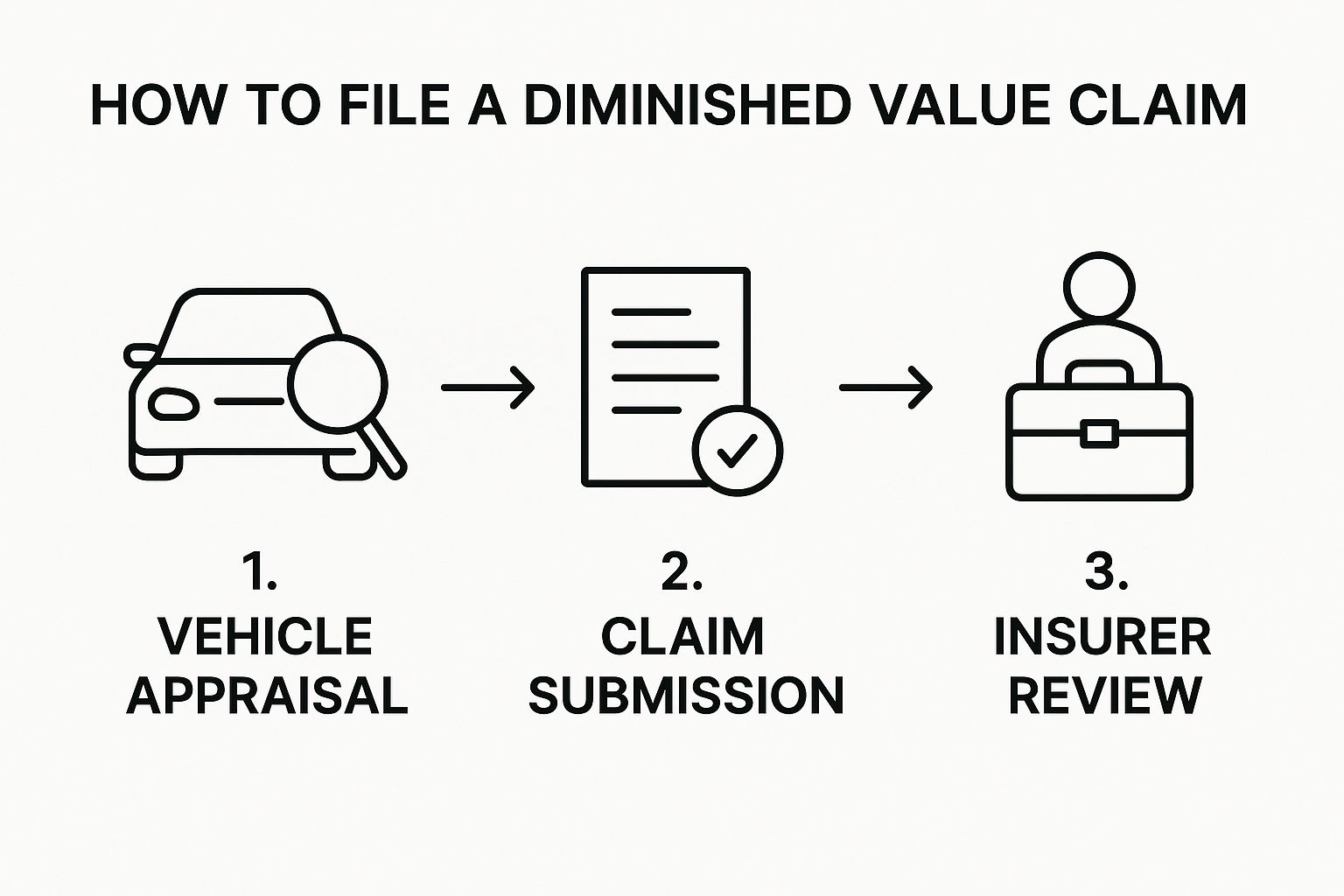
As you can see, a successful claim is built on a logical foundation, starting with solid evidence and ending with a firm negotiation.
Disclaimer: This article is for informational purposes and not to be construed as legal advice. No attorney-client relationship exists based on the review of this article, and none of the information in this article is legal advice.
Step 1: Confirm You Are Not at Fault
First thing’s first. You absolutely must confirm the other driver was at fault for the accident. A diminished value claim is filed against the at-fault party’s liability insurance. If you caused the wreck, you generally can’t file this type of claim against your own policy.
The police report is your golden ticket here. It’s the most critical document for establishing fault. Get a copy and triple-check that it accurately describes what happened. This single piece of paper is the bedrock of your entire claim.
Step 2: Gather All Essential Documents
Next, it’s time to become a document collector. You need every single piece of paperwork related to the accident and the repairs. Staying organized is key—a well-documented file signals to the insurance adjuster that you’re serious and prepared. If you need a refresher on the basics, this guide on how to file a general car insurance claim is a great place to start.
Here’s your document checklist:
- The Police Report: This is your official proof of who was at fault.
- Repair Estimates and Invoices: The itemized bills show the extent of the damage and exactly what was fixed.
- Photographs: Collect pictures of the damage before the repairs, and if you can, after they’re done.
- Vehicle Title and Registration: These prove you actually own the car.
Step 3: Obtain a Credible Independent Appraisal
This is, without a doubt, the most important step. You can’t just pull a number out of thin air for your car’s lost value. You need a certified, independent appraisal from a professional who specializes in diminished value. Don’t skip this.
An expert appraisal gives you an unbiased, evidence-based calculation of your loss. A true professional will look at your car’s pre-accident value, the severity of the damage, the quality of the repairs, and local market trends. This report is your primary weapon and your strongest negotiating tool against the inevitable lowball offer from the insurer.
Step 4: Write and Send a Powerful Demand Letter
With your appraisal and documents in hand, it’s time to formally ask for your money. You’ll do this with a demand letter. This is a professional document you send to the at-fault driver’s insurance adjuster that clearly lays out your case and states the specific amount you’re seeking.
Your letter should be clear, concise, and professional. Make sure it includes:
- The basic facts of the accident (date, location, at-fault driver).
- The insurance claim number.
- A clear statement that you are making a diminished value claim.
- The exact dollar amount of diminished value, supported by your appraisal.
- Copies of all your supporting documents, especially the appraisal report.
Sending a formal demand letter creates a paper trail and shows the insurer you’re handling this professionally, much like a lawyer would. This simple act often gets you a much more serious and timely response from the adjuster.
Building an Unbeatable Case with Strong Evidence
Think of it this way: a diminished value claim without solid proof is just an opinion. And in the world of insurance, opinions don’t get you very far. To get the insurance company to take you seriously, you need to build a case that’s so well-documented it becomes undeniable. Your job is to transform a simple request into a compelling, evidence-backed demand.
You have to put on your detective hat. Every piece of paper, every photograph, and every professional report adds another layer of credibility to your story. The insurance adjuster you’re up against reviews claims all day, every day. A disorganized or unsupported claim is the easiest thing in the world for them to dismiss. But a file packed with organized, convincing evidence? That forces them to stop and pay attention.
Disclaimer: This article is for informational purposes and not to be construed as legal advice. No attorney-client relationship exists based on the review of this article, and none of the information in this article is legal advice.
Your Essential Evidence Checklist
Gathering the right documents is, without a doubt, the most critical part of preparing your claim. Some of these items are completely non-negotiable, while others just add extra weight to your argument. The key is to be thorough.
Here’s a breakdown of the evidence you absolutely need to collect:
- The Police Report: This is your foundation. It officially establishes who was at fault for the accident, which is a must-have for filing a third-party diminished value claim in the first place.
- Itemized Repair Bills: These detailed invoices do more than just show the total cost. They prove the true extent of the damage, listing every single part that was replaced and every hour of labor. This detail helps justify a significant loss in value. The quality of the work matters, too, so understanding how to work with the best body shops in Chatsworth when navigating collision repairs can be a huge advantage.
- Photos of the Damage: This is crucial. Take pictures of your vehicle from every possible angle before any repairs are done. A visual of a crumpled bumper or bent frame is infinitely more powerful than just words on a page.
- Independent Diminished Value Appraisal: This is your secret weapon. A professional report from a certified, independent appraiser gives you an expert, unbiased valuation of your financial loss. It lends your claim immediate, undeniable credibility.
To make this easier, here’s a quick-glance table to help you organize your evidence-gathering process. Think of it as your case file checklist.
Essential Evidence Checklist for Your Claim
| Evidence Type | Why It’s Important | Where to Get It |
|---|---|---|
| Police Report | Establishes fault and officially documents the accident. | The police department that responded to the scene. |
| Itemized Repair Invoices | Details the full extent of the damage and repairs performed. | The auto body shop that repaired your vehicle. |
| Pre-Repair Photos | Provides clear, visual proof of the severity of the damage. | Your own smartphone or camera at the accident scene. |
| Independent Appraisal | Offers an expert, third-party valuation of your lost value. | A certified, independent auto appraiser specializing in DV. |
| Dealership Trade-In Offers | Shows real-world market proof of the value reduction. | Used car managers at several local car dealerships. |
Having these documents neatly organized and ready to go will show the adjuster that you are serious and have done your homework, making them far more likely to offer a fair settlement.
Proving Market Value Loss
The final piece of the puzzle—and often the most persuasive—is getting real-world proof of your car’s lost value. The most effective way to do this is by taking a trip to a few local car dealerships.
Go to the used car manager and ask for two written offers for your vehicle:
- One quote based on its current, post-repair condition with its known accident history.
- A second quote for what they would have offered for the exact same car if it had a clean record with no accident.
The difference between those two numbers is your diminished value, demonstrated in plain, undeniable market terms. When you can hand an insurance adjuster written offers from people in their own industry showing a clear financial loss, it makes your claim incredibly difficult to lowball or ignore.
Navigating Common Insurance Company Tactics
Once you’ve submitted your diminished value claim, brace yourself. The insurance adjuster on the other end isn’t just a paper-pusher; they’re a trained negotiator whose primary goal is to pay out as little as possible. They have a well-worn playbook of tactics designed to poke holes in your claim, chip away at its value, or simply frustrate you into giving up.
Knowing what’s coming is the best way to prepare.
One of the first things you’ll probably hear is that the repairs made your car “good as new.” They’ll argue that since they paid to fix the dents and replace the bumper, your car’s value is completely restored. This argument conveniently ignores the entire concept of inherent diminished value—the simple fact that a car with an accident on its record is worth less than one without.
Another favorite move is to pull out a flawed, internal formula to calculate your loss. Many insurers lean on something like the controversial “Rule 17c,” which is notorious for using arbitrary caps and multipliers that always seem to work out in their favor. They’ll present this lowball number to you as if it’s the final, undeniable truth, hoping you’ll just take it.
Standing Your Ground with Facts
The secret to pushing back against these tactics isn’t to get angry—it’s to get organized. Keep your cool, be firm, and let your evidence do the talking for you.
When the adjuster hits you with the “good as new” line, your response should be direct and factual. This is where you pull out your independent appraisal report and the written trade-in quotes from dealerships. You can say something like, “I understand the physical repairs were completed, but these documents from market experts show a clear and measurable loss in resale value because of the accident history.”
And what about that lowball offer based on their secret formula? Don’t even bother arguing about it.
Your best move is to refuse to debate the merits of their flawed calculation. Instead, pivot the conversation right back to your professional appraisal, which is grounded in real-world market data, not some self-serving formula.
Delay tactics are another classic. Adjusters know that dragging out a claim for weeks or months can wear you down. The more frustrated you get, the more likely you are to accept a bad offer just to be done with it all. To counter this, document every single interaction. Follow up on phone calls with a summary email, and set clear deadlines for when you expect a response.
The goal here is to level the playing field. You do that by replacing their opinions and stall tactics with your undeniable proof. For a deeper dive into these strategies, our guide on how to negotiate an insurance settlement offers even more valuable insights.
Frequently Asked Questions About Diminished Value
When you’re trying to get a handle on diminished value, a few key questions always come up. Let’s tackle some of the most common ones right now.
Disclaimer: This article is for informational purposes and not to be construed as legal advice. No attorney-client relationship exists based on the review of this article, and none of the information in this article is legal advice.
How Long Do I Have to File a Claim?
Time is definitely a factor. Every state has a deadline for filing property damage claims, which is known as the statute of limitations.
This window varies pretty widely, but you can generally expect it to be somewhere between two and four years from the date the accident happened. It’s critical to check the specific laws in your state, because if you miss that deadline, you lose your right to file a claim for good.
Can I File a Claim If the Accident Was My Fault?
This is a common point of confusion, but the answer is almost always no. A diminished value claim is something you file against the at-fault driver’s insurance policy.
Your own insurance policy is a “first-party” contract, and it typically doesn’t cover the diminished value of your vehicle after an accident you caused. The idea is to hold the responsible party accountable for all the damage they caused, including the drop in your car’s market value.
Should I Get a Lawyer Involved?
It really depends on your specific situation. If you’re dealing with a relatively small claim on a standard vehicle, the cost of hiring an attorney might eat up a significant portion of your potential settlement, making it less practical.
However, if your car is a high-value, luxury, or classic model, or if the damage was extensive, bringing in a lawyer can be a very smart move. An attorney becomes especially valuable if the insurance company is giving you the runaround or has outright denied a claim you believe is fair.
Navigating a diminished value claim can feel complicated and frustrating, especially when dealing with insurance companies. But you don’t have to go through it alone. The experienced team at LA Law Group, APLC is here to help you get the full compensation you’re entitled to. Contact us today for a free consultation and let’s discuss your case.
Attorney Advertising. This article is general information, not legal advice, and does not create an attorney-client relationship. Prior results do not guarantee a similar outcome.