
Dog Bite Settlement Guide for California Victims
You’re in a California emergency room after a dog bite. Your clothing is torn, your hand or face is swollen, and an insurance adjuster has already asked for a recorded statement. You may be wondering whether you should accept the first offer, how much your injuries are worth, or whether the dog owner’s homeowners insurance will pay anything at all.
A dog bite settlement is a negotiated payment that resolves a claim without a trial verdict. Most compensation commonly comes through the dog owner’s homeowners or renters insurance, although coverage, exclusions, policy limits, and liability evidence can change the result. Insurance claim data is useful for context, but an average claim cost isn’t a promise about your individual recovery. The Insurance Information Institute’s dog bite liability overview explains why industry claim payouts are often used as settlement benchmarks, since there’s no single national database of court settlements.
This article focuses on California’s strict-liability framework and the practical effect of insurance limits. It’s designed to help you understand the legal foundation, categories of damages, evidence, negotiation, and next steps.
This article is for informational purposes only and isn’t to be construed as legal advice. No attorney-client relationship exists based on your review of this article, and none of the information in this article is legal advice.
Introduction to Dog Bite Settlements in California
California gives injured people an important starting point. Under the state’s dog-bite statute, an owner can generally be held responsible when the dog bites someone who was lawfully in a public place or lawfully on private property, even if the owner didn’t know the dog was dangerous. That rule can make liability clearer than in states that require proof of a prior aggressive act or owner negligence.
Clarity about responsibility doesn’t automatically determine the settlement amount. The insurer still examines medical records, photographs, wage loss, future treatment, scarring, emotional effects, available coverage, and any argument that the injured person provoked or contributed to the incident. A settlement is a business negotiation built around legal risk and provable damages, not a fixed price tag attached to the bite.
Settlement versus trial verdict
A settlement is an agreement. You release the claim in exchange for payment, and the dispute ends without a judge or jury deciding the amount. A verdict is different. It follows a trial, and the court may later address legal challenges, collection issues, or other limits.
Insurance companies often prefer negotiated resolutions because trials create uncertainty for everyone. That doesn’t mean an adjuster’s first offer reflects the claim’s full value. It may instead reflect incomplete records, disputed liability, a coverage concern, or an early effort to resolve the matter before the long-term effects are known.
Why California law changes the analysis
California’s liability rule can help an injured person establish the owner’s responsibility, but the claim still needs evidence. Medical treatment should be prompt, the incident should be reported where appropriate, and the injury’s effect on work and daily life should be recorded. A strong claim connects the legal rule to facts that an insurer can verify.
Practical rule: Don’t measure your case by the bite alone. Measure it by liability evidence, documented losses, lasting effects, and available insurance.
How California Dog Bite Liability Shapes Your Settlement
Think of liability as the rulebook for the claim. Before an insurer debates how much an injury is worth, it asks whether the owner is legally responsible and whether the evidence supports that conclusion. California’s framework can provide a strong foundation, but several separate concepts still matter.
Strict liability as the starting rule
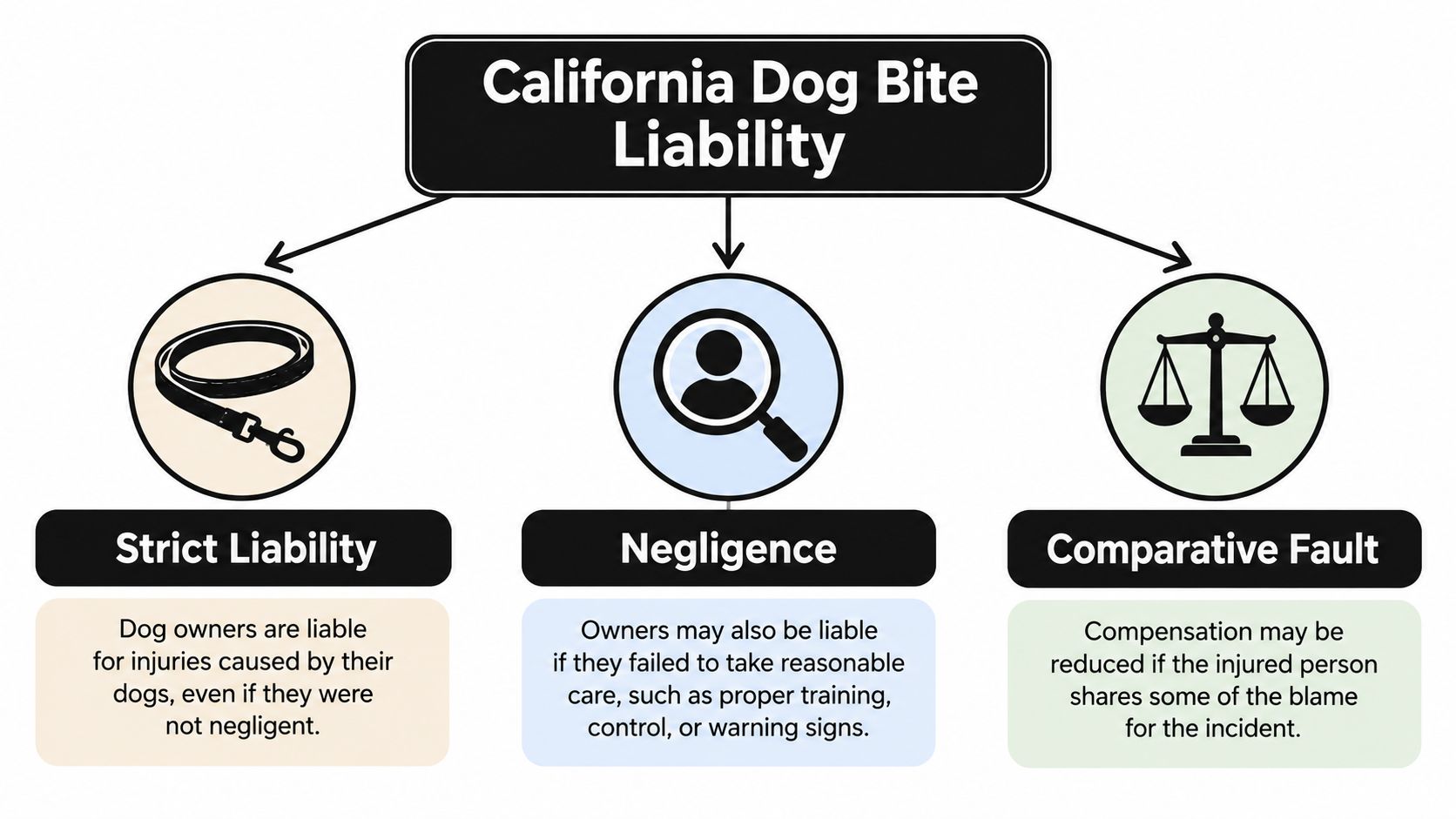
California generally applies strict liability to qualifying dog bites. In practical terms, the injured person usually doesn’t need to prove that the owner knew the dog had dangerous tendencies. The key questions include whether a bite occurred, whether the victim was lawfully present, and whether the statutory requirements apply to the facts.
That’s different from a negligence-only approach. Negligence asks whether the owner acted unreasonably, such as by ignoring a leash requirement, failing to secure the animal, or allowing a known risk to continue. Negligence may still provide an alternative or additional theory, especially when the incident involved a fall, a chase, or another injury that didn’t involve a bite.
For a plain-language discussion of California rules, review this California dog bite law resource. The specific facts still need legal analysis because location, conduct, injury mechanism, and available evidence can affect the claim.
Comparative fault can reduce recovery
Strict liability doesn’t mean every dispute disappears. The owner or insurer may argue that the injured person provoked the dog, ignored a warning, entered an area without permission, or otherwise contributed to the event. California follows a comparative-fault approach, so a fact finder can assign responsibility among the parties and reduce damages by the injured person’s share of fault.
For example, a person who lawfully enters a property and gets bitten while standing still faces a different liability dispute from someone who intentionally teased an animal. The evidence might include witness accounts, surveillance footage, messages, animal-control records, and the parties’ statements.
Filing deadlines create urgency
A valid claim can still fail if it’s filed too late. California personal-injury deadlines can depend on the circumstances, including the identity of the responsible party and whether a public entity is involved. Don’t assume that a settlement conversation pauses every legal deadline. Preserve your rights promptly and obtain advice about the deadline that applies to your facts.
What a Dog Bite Settlement Covers and How It Is Calculated
A settlement usually starts with damages, not with a headline average. The practical calculation asks what the injury cost, what it may cost later, and how the bite changed the person’s physical, financial, and emotional life.
The main damage categories
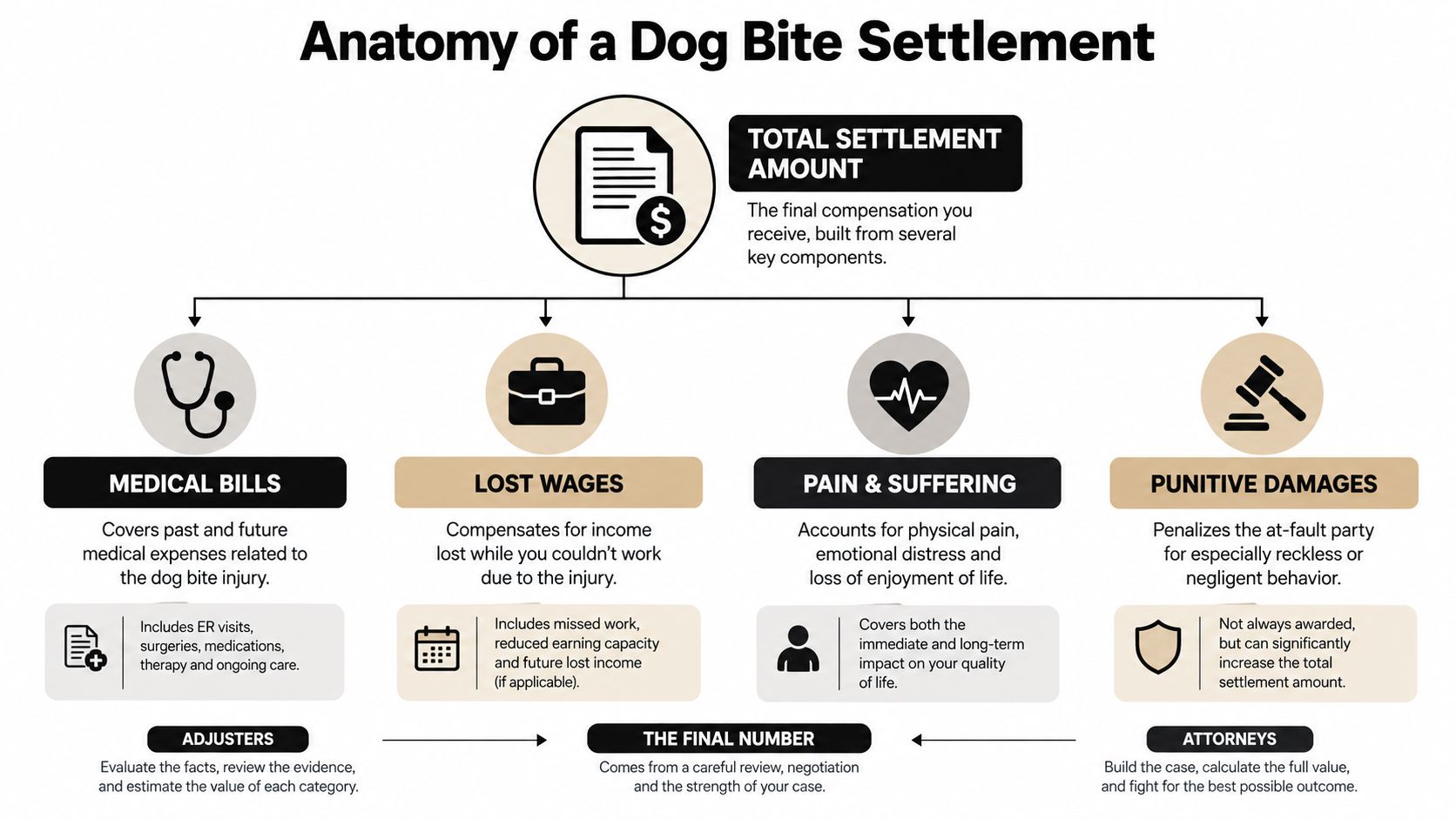
Medical damages can include emergency treatment, follow-up appointments, medication, surgery, reconstruction, therapy, and reasonably supported future care. Keep itemized bills, insurance explanations of benefits, prescriptions, mileage records, and provider recommendations.
Income-related damages may include wages lost during recovery and reduced earning capacity when the injury affects future work. A pay stub can show missed earnings, but an earning-capacity claim may require employer records, vocational evidence, or medical opinions linking the impairment to work limitations.
Pain, suffering, and emotional distress address harm that doesn’t appear on a bill. Facial scarring, nerve damage, fear, sleep disruption, anxiety, and reduced enjoyment of daily activities can matter. A pain journal, counseling records where appropriate, photographs, and testimony from people who observe the changes can make these effects more concrete.
Loss of consortium may apply to qualifying effects on a spouse’s relationship, companionship, or household life. Punitive damages are different. They aren’t automatic compensation for a serious injury and generally require evidence of particularly wrongful conduct under the applicable law.
A working evidence map
| Damage Category | What It Includes | Documentation Needed |
|---|---|---|
| Medical bills | Treatment already received and supported future care | Bills, records, prescriptions, provider opinions |
| Lost wages | Missed work, reduced earning capacity, related benefits | Payroll records, employer verification, work restrictions |
| Pain and suffering | Physical pain, scarring, emotional distress, daily limitations | Photos, journal entries, treatment records, witness accounts |
| Loss of consortium | Qualifying effects on a marital relationship | Testimony and records describing relationship changes |
| Punitive damages | Potential additional damages for legally qualifying misconduct | Evidence of the defendant’s conduct and surrounding facts |
Adjusters and attorneys often use a multiplier-style discussion for pain and suffering, but no single formula controls every California claim. A common practical method is to document economic losses first, then evaluate non-economic harm in light of injury severity, treatment, prognosis, credibility, and litigation risk. This personal injury settlement calculation guide provides additional general context, but an online formula can’t account for your policy, medical outlook, or liability dispute.
Policy limits may set the maximum ceiling. Insurance guidance reports that dog-bite losses reached $882 million across 17,989 claims in 2021, with an average paid loss of $49,025, and attributes the long-term rise in claim costs to medical expenses and larger settlements, judgments, and jury awards. Industry insurance guidance also explains why a severe injury may settle below its apparent value when available liability coverage is limited.
Typical Dog Bite Settlement Amounts and What Data Really Shows
Settlement value often turns on two practical questions: what coverage applies, and how well the claim is documented. California’s strict-liability rule may make responsibility easier to establish, but it does not guarantee payment beyond the available policy limits. The national figures below show insurer payouts and claim patterns, not a price tag for every injury.
In 2024, U.S. insurers paid $1.57 billion across 22,658 dog-related injury claims, with an average cost of $69,272 per claim. The figures reflect overall claim severity and insurer payout pressure. They do not predict what a particular scar, surgery, or permanent impairment is worth.
The 2025 figures point to the same coverage question. The industry tracker reported 28,450 claims and $1.862 billion in payouts, while the average cost per claim was $65,450. Claim frequency rose 25.6% from 2024, even though the average individual claim cost declined.
Why two similar injuries can produce different results
Consider two people with comparable hand injuries. One has prompt treatment, complete medical records, reliable wage documentation, and an applicable policy with sufficient limits. The other has delayed care, gaps in treatment, or an exclusion and low limit. Their injuries may appear similar, yet the available settlement could differ substantially.
Documentation works like a bridge between the injury and the requested payment. Treatment records show medical harm, employment records support lost income, and photographs or witness accounts can clarify what happened. Coverage determines how far that bridge can extend.
Available insurance coverage can shape what a dog-bite claim realistically resolves for.
Step by Step California Dog Bite Claim Process
A claim becomes easier to manage when you treat it as a sequence of evidence decisions. Each step protects information that may be difficult to recreate later.
Start with health and incident records
-
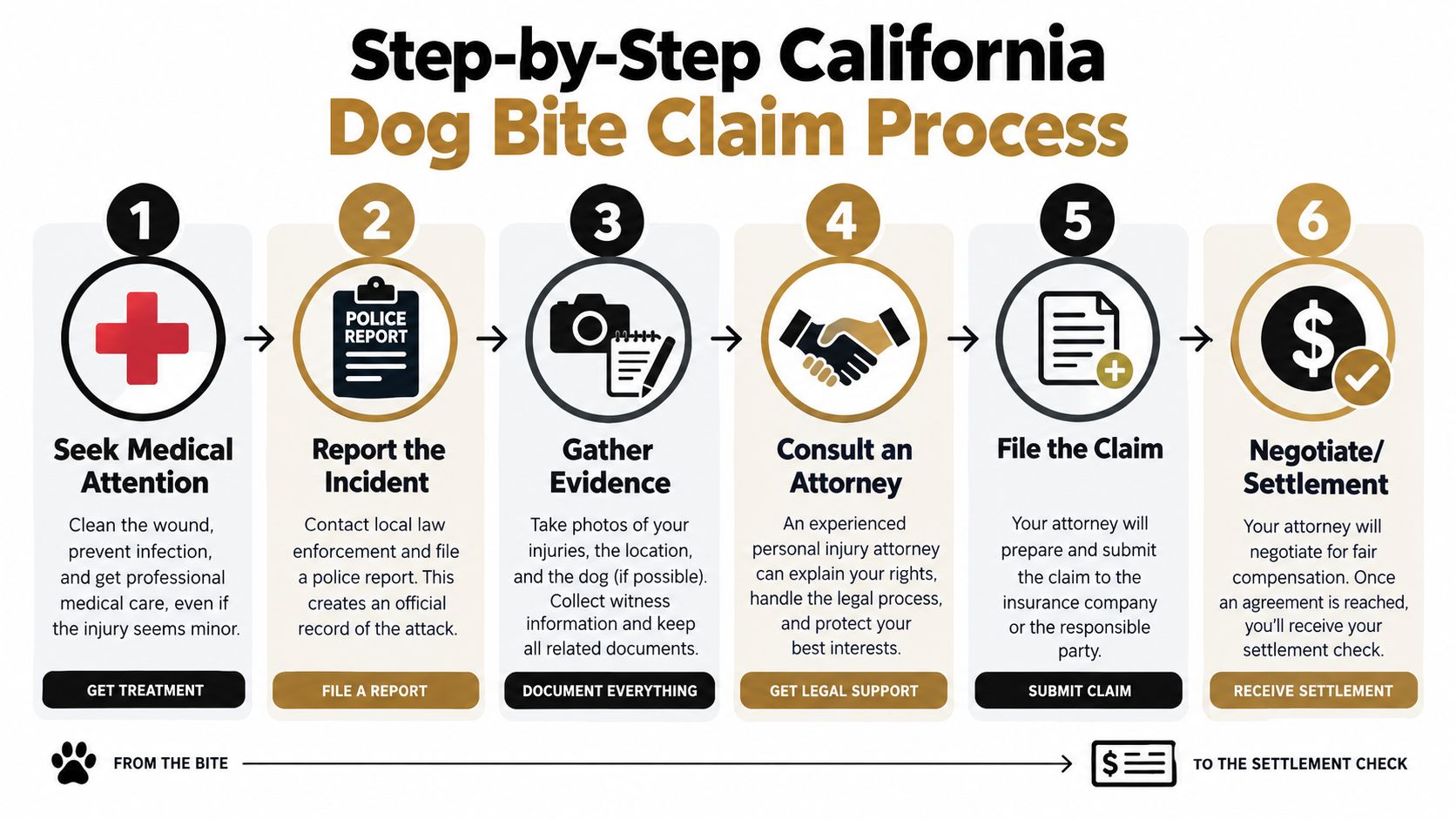
Obtain medical care promptly. Tell the provider exactly what happened, where the dog bit you, and how the injury affects movement, sleep, work, or ordinary activities. Follow-up care matters because an early record may not show the final scar, infection, nerve issue, or emotional effect.
-
Report the incident. Contact the appropriate animal-control or public-safety agency and keep the report number if one is issued. Ask how to obtain the completed report, and preserve communications with the dog owner, witnesses, property manager, and insurers.
-
Preserve physical evidence. Photograph the wounds as they heal, the location, visible warnings, torn clothing, and anything that shows how the incident occurred. Don’t wash or discard torn clothing before photographing and preserving it.
Build a damages file
Create one folder, physical or digital, for medical bills, records, receipts, wage documents, insurance correspondence, and photographs. Keep a simple pain journal that records symptoms, sleep disruption, medication effects, missed activities, and work restrictions. Consistent entries can help explain daily consequences that a medical bill can’t show.
Identify witnesses and write down their contact details while memories are fresh. Ask the property owner or business to preserve surveillance footage, but don’t alter or edit recordings you receive.
Make the demand specific
After the medical picture is sufficiently developed, a demand package can present liability, treatment, damages, and settlement terms. A dog-bite demand letter should generally identify a specific settlement amount, include proof such as medical records and photographs, and provide a response deadline. FindLaw’s settlement guidance states that a 30-day response window is standard in most states and recommends sending the letter to the opposing attorney or adjuster when the other side has representation.
Don’t sign a release until you understand which claims it ends and whether future treatment has been addressed. The settlement check usually comes only after the agreement and release are completed, followed by resolution of any applicable liens or case expenses.
Negotiation Strategies and When to Hire an Attorney
Negotiating directly can work for a straightforward injury with clear responsibility, complete treatment, and adequate coverage. It becomes riskier when the insurer disputes the facts, requests a recorded statement, blames you for provoking the dog, questions future care, or makes an offer before your medical condition is stable.
Compare the leverage on each side
| Direct negotiation | Attorney-supported negotiation |
|---|---|
| You communicate with the adjuster yourself | Counsel handles insurer communications and formal demands |
| You organize medical and wage records | Counsel can investigate coverage, liability, and future damages |
| You evaluate whether an offer is adequate | Counsel can compare the offer with litigation risk and provable losses |
| You may avoid immediate legal fees | Representation can help protect against premature releases and admissions |
An insurer may begin with a low offer because the file is incomplete or because it believes you’ll accept quickly. Your response should be evidence-based, not emotional. Explain each medical charge, work loss, scar photograph, restriction, and future-care recommendation, then tie the requested amount to the record.
Policy limits deserve early attention. A severe injury can plateau around available homeowners or renters liability coverage, while a well-documented claim may justify pursuing the full applicable limit. The California dog bite lawyer resource discusses why legal representation can help with investigation, negotiation, and the settlement process.
When legal help adds practical value
Consider consulting counsel before signing anything if the injury involves facial scarring, reconstructive surgery, nerve damage, lasting impairment, substantial work loss, a child, disputed facts, multiple potentially responsible parties, or uncertain insurance coverage. An attorney may also help identify additional policies, assess comparative-fault allegations, preserve evidence, and prepare the claim as though trial could become necessary.
LA Law Group, APLC is one California option for a free initial consultation and direct attorney access. A consultation can help you understand whether the policy, evidence, deadline, and expected damages justify formal representation.
Moving Forward With Your California Dog Bite Settlement
A strong California dog bite claim rests on three connected pillars. First, establish liability through the facts supporting California’s strict-liability rule and any applicable negligence theory. Second, document every damage, including treatment, future care, wages, scarring, pain, emotional effects, and relationship consequences. Third, negotiate with the policy limits and litigation risks in view, rather than relying on a national average.
Use this short action list:
- Get treatment: Follow medical instructions and keep every record.
- Preserve proof: Save photographs, clothing, messages, reports, witness details, and surveillance information.
- Track losses: Record bills, receipts, missed work, restrictions, symptoms, and daily limitations.
- Protect deadlines: Ask promptly which filing deadline applies to your circumstances.
- Review coverage: Determine whether homeowners, renters, umbrella, or another policy may respond.
- Evaluate offers carefully: Don’t sign a release before understanding future treatment and the full scope of the claim.
- Seek case-specific guidance: Arrange an assessment if the insurer disputes responsibility or the injury has lasting effects.
The right next step may be a prompt case assessment and evidence review. LA Law Group, APLC offers free initial consultations for people evaluating California injury claims.
If a dog bite has left you with medical bills, lost income, scarring, or lasting emotional harm, LA Law Group, APLC can review the facts, available coverage, and supporting evidence with you. Contact the firm for a free initial consultation and personalized guidance before you respond to an insurer or accept a settlement.
Attorney Advertising. This article is general information, not legal advice, and does not create an attorney-client relationship. Prior results do not guarantee a similar outcome.