
Herniated Disc Car Accident Settlement in California
Short answer: A herniated disc after a California car accident is not valued from a published average. A claim is shaped by factors: fault, the medical record that ties the disc injury to the crash, imaging and exam findings, treatment, prior history, insurance, and deadlines. This guide walks through those factors using official California and federal sources.
Attorney Advertising. This guide explains how herniated-disc car-accident claims are framed under California law and official sources, not a promise of any outcome or of any amount. Prior results do not guarantee a similar outcome. This page is general information, not legal advice.
What is a herniated disc?
An official definition comes from MedlinePlus, the consumer health service of the U.S. National Library of Medicine. Its Medical Encyclopedia article on herniated disk, read on November 11, 2026 (America/Los_Angeles), states:
“A herniated (slipped) disk occurs when all or part of a disk is forced through a weakened part of the disk. This may place pressure on nearby nerves or the spinal cord.”
The same article explains how that pressure can matter:
“The disk may move out of place (herniate) or break open (rupture) from injury or strain. When this happens, there may be pressure on one or more spinal nerves. This can lead to pain, numbness, or weakness.”
It also describes where herniations usually happen:
“The lower back (lumbar area) of the spine is the most common area affected by a herniated disk. The neck (cervical) disks are the second most commonly affected area. The upper-to-mid-back (thoracic) disks are rarely involved.”
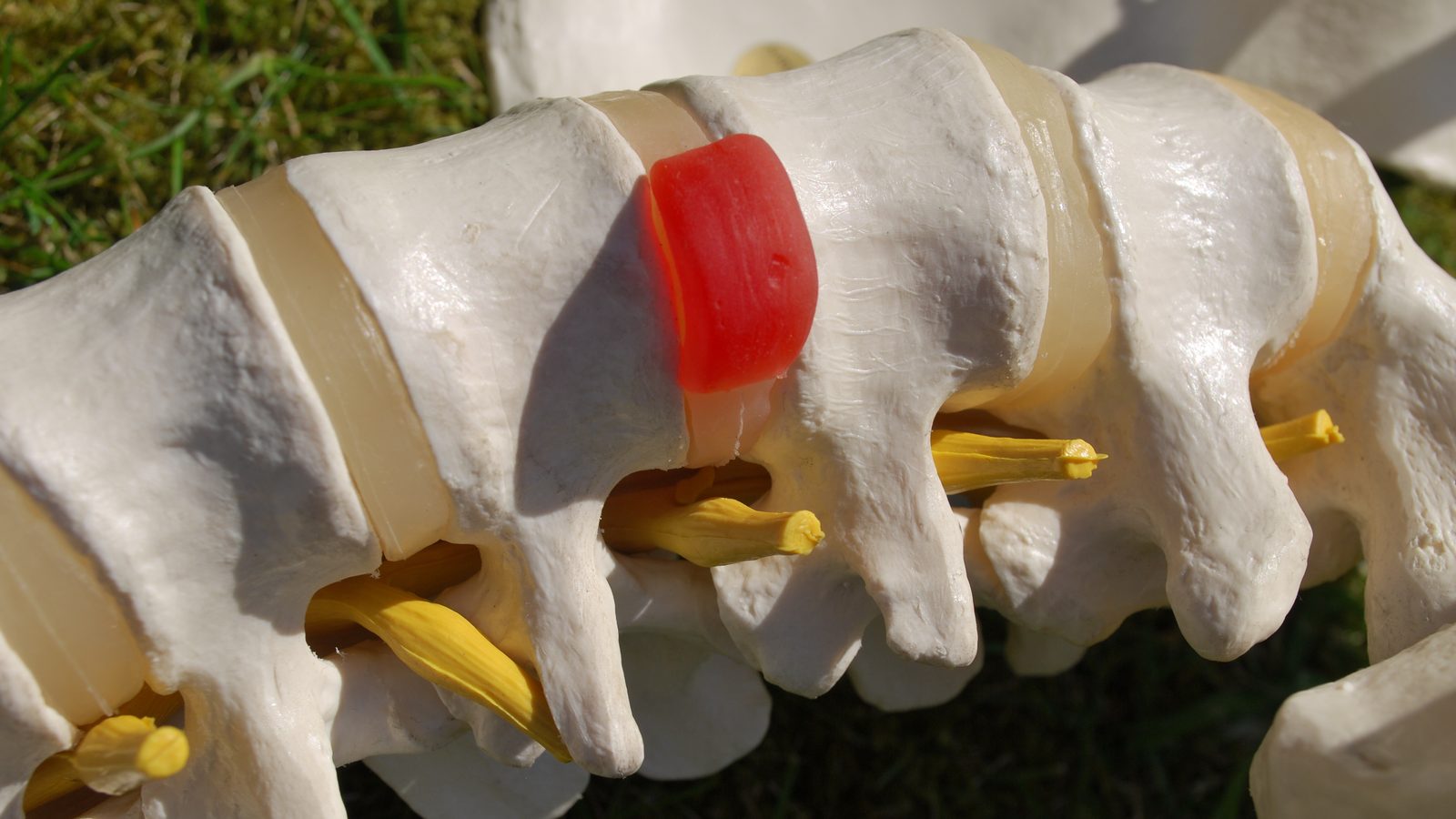
MedlinePlus spells the word “disk.” Many medical and legal writers use “disc.” They mean the same structure. The photo at the top of this page is an anatomical teaching model, used to show what a disc and nearby nerve roots look like. It does not show any client or patient.
How is a herniated disc diagnosed after a crash?
Diagnosis is a medical question, and this page does not give medical advice. The official MedlinePlus pages describe the process in general terms. The topic page on herniated disk, read the same day, says:
“Your doctor will diagnose a herniated disk with a physical exam and, sometimes, imaging tests. With treatment, most people recover. Treatments include rest, pain and anti-inflammatory medicines, physical therapy, and sometimes surgery.”
On imaging, the Medical Encyclopedia article lists:
“Spine MRI or spine CT to show where the herniated disk is pressing on the spinal canal.”
And it adds a limit that often matters later:
“However, it is not possible to diagnose a herniated disk by a spine x-ray alone.”
That last point explains why an early x-ray that looked normal does not, by itself, settle whether a disc was injured. It also explains why imaging reports tend to become central documents in these claims.
Does an MRI prove the crash caused the herniation?
No single test proves a legal claim. An MRI or CT can show where a disc is and whether it is pressing on the spinal canal or a nerve. It does not show who was at fault for the collision, and it does not, on its own, show when the disc changed.
Causation is usually addressed through the whole record, read together:
- Timing and symptoms. What the person reported to providers after the crash, and whether those reports are consistent from visit to visit.
- The exam. What the treating provider found on physical examination, including any nerve-related findings.
- Imaging. What the MRI or CT report describes, and where.
- Treating opinions. What the person’s own providers wrote about the cause of the symptoms.
- Comparison. Earlier records or imaging, if any exist, that show the condition before the crash.
A practical point: In a herniated-disc claim, the imaging shows what is there; the consistent medical record over time is what usually connects it to the crash.
What if the insurer says the disc problem was degenerative or already there?
This can become a point of dispute in disc claims. An insurer may point to wording on an imaging report that it reads as wear or degeneration, and argue that the disc finding pre-dates the collision.
A prior history does not end a claim. It changes the questions. The record usually has to address what the person’s back or neck was like before the crash, what changed after it, and what the treating providers say about that change. Earlier records, if they exist, can cut both ways: they may show a quiet history before the crash, or they may show ongoing complaints. Either way, they may be requested.
California’s general measure of damages for a non-contract wrong is in Civil Code section 3333. The official text, read on California Legislative Information on November 11, 2026 (America/Los_Angeles), states:
“For the breach of an obligation not arising from contract, the measure of damages, except where otherwise expressly provided by this Code, is the amount which will compensate for all the detriment proximately caused thereby, whether it could have been anticipated or not.”
The phrase “proximately caused” is one reason causation sits at the center of a disc claim. The statute does not set a figure, and this page does not invent one. For how the human side of an injury is treated as a category of damages, see our guide to pain and suffering damages in California.
How do conservative care, injections, or surgery factor into a claim?
Treatment is a factor, not a price list. The MedlinePlus Medical Encyclopedia describes a typical progression:
“The first treatment for a slipped disk is a short period of rest and taking medicines for the pain. This is usually followed by physical therapy. Most people who follow these treatments recover and return to normal activities. Some people will need to have more treatment. This may include steroid injections or surgery.”
In a claim, what matters is the path the person’s own providers recommended, the reasons they gave, and how the person responded. A claim where conservative care resolved the symptoms is a different factual picture from one where symptoms persisted and more treatment followed. Neither picture comes with a set number. An insurer may raise gaps in treatment, or stopping care early, so the reasons for any gap can matter as well.
Medical bills and records, documented time missed from work, and changes in daily life are the usual building blocks. For a broader look at how these pieces fit together, see our guide on how much a personal injury case is worth in California, which explains factor-based valuation without a formula.
How does fault affect a herniated-disc claim?
California’s official civil jury instructions address comparative fault. If a defendant argues that the injured person’s own negligence contributed to the harm, the official jury instruction is CACI No. 405, Comparative Fault of Plaintiff, in the Judicial Council of California Civil Jury Instructions, 2026 edition. The official edition was downloaded from the Judicial Council on November 11, 2026 (America/Los_Angeles), and the Judicial Council’s July 2026 supplement, downloaded the same day, does not list 405 among the revised instructions. The instruction states:
“[Name of defendant] claims that [name of plaintiff]’s own negligence contributed to [his/her/nonbinary pronoun] harm. To succeed on this claim, [name of defendant] must prove both of the following:
- That [name of plaintiff] was negligent; and
- That [name of plaintiff]’s negligence was a substantial factor in causing [his/her/nonbinary pronoun] harm.
If [name of defendant] proves the above, [name of plaintiff]’s damages are reduced by your determination of the percentage of [name of plaintiff]’s responsibility. I will calculate the actual reduction.”
When more than one person may share fault, a separate instruction, CACI No. 406, Apportionment of Responsibility, applies. This page does not assign percentages or work a sample reduction. Fault is a fact question in each crash.
What does the insurance claim process look like?
A herniated-disc claim often begins as an insurance claim, not a lawsuit. Coverage concepts that can come up include the at-fault driver’s liability coverage, uninsured or underinsured motorist coverage, and medical payments coverage if a policy includes it. Which coverages exist, and their limits, depend on the policies involved.
The California Department of Insurance publishes consumer guidance titled “So You’ve Had an Accident, What’s Next?” Under a heading on the Fair Claims Settlement Practices Regulations, the page, read on November 11, 2026 (America/Los_Angeles), says: “In general, insurance companies are required to do the following:” and its first item is:
“Advise you of all benefits, coverage, time limits or other provisions of your insurance policy.”
The Department labels that list as consumer guidance, stating: “The above represents a paraphrased brief overview of some of the Fair Claims Settlement Practices Regulations.” It is quoted here as the Department’s guidance, not as the text of the regulations themselves.
What filing deadlines may apply?
Many private injury lawsuits in California are subject to Code of Civil Procedure section 335.1. The official text, read on California Legislative Information on November 11, 2026 (America/Los_Angeles), states:
“Within two years: An action for assault, battery, or injury to, or for the death of, an individual caused by the wrongful act or neglect of another.”
If a public entity may be involved, such as a city vehicle or a road-condition claim against a government agency, a written government claim usually comes first. Government Code section 911.2(a), read on the same official site the same day, states:
“A claim relating to a cause of action for death or for injury to person or to personal property or growing crops shall be presented as provided in Article 2 (commencing with Section 915) not later than six months after the accrual of the cause of action. A claim relating to any other cause of action shall be presented as provided in Article 2 (commencing with Section 915) not later than one year after the accrual of the cause of action.”
Exceptions and tolling rules can move these dates, and waiting for a report generally does not pause them. This page does not compute a deadline for any particular crash. For a broader map of which clock may apply, see our California personal injury statute of limitations guide.
What can this look like in practice?
Illustrative hypothetical, not a case result: This example is fictional. It does not describe a real client and does not predict any outcome. A driver is rear-ended at a California stoplight. An urgent-care x-ray that evening is read as normal. Lower-back pain with numbness down one leg continues, and a later MRI report describes a lumbar disc herniation pressing toward a nerve root. The insurer points to a chiropractic visit from before the crash and calls the finding degenerative. The questions that shape the claim are the ones in this guide: what the earlier record actually says, whether symptoms were reported consistently after the crash, what the treating providers wrote about cause, how physical therapy and any further care went, and whether fault is disputed. The details are made up to show how the factors fit together. They are not a case result, and they do not convert into a dollar figure.
How do attorney fees work at LA Law Group?
No attorney fee unless we win your case. You are responsible for case costs regardless of the outcome.
The written fee agreement explains how fees and costs are handled before work begins.
How can LA Law Group help from Chatsworth?
LA Law Group serves California personal injury clients from our Chatsworth office at 21540 Prairie St Unit A, Chatsworth, CA 91311. We can review the medical records, the imaging reports, the insurance picture, and the deadlines, and explain the next steps in a written agreement before any work starts.
To learn more, visit our personal injury practice page.
Your initial consultation is free.
Call (866) 625-2529.
Sources checked
Official sources checked on November 11, 2026 (America/Los_Angeles):
- Code of Civil Procedure section 335.1
- Government Code section 911.2 (subdivision (a) quoted)
- Civil Code section 3333
- Judicial Council of California, Civil Jury Instructions, including the official 2026 edition PDF (CACI No. 405 and No. 406) and the July 2026 supplement PDF (405 and 406 are not listed as revised)
- MedlinePlus Medical Encyclopedia: Herniated disk
- MedlinePlus: Herniated Disk
- California Department of Insurance: So You’ve Had an Accident, What’s Next?
Statute, instruction, and agency text can be amended. Re-check the official page or edition before you rely on it.
Key takeaways
- MedlinePlus defines a herniated disk as one where all or part of the disk is forced through a weakened part of the disk, which may press on nearby nerves or the spinal cord.
- MedlinePlus says a herniated disk cannot be diagnosed by a spine x-ray alone; MRI or CT can show where it presses on the spinal canal.
- Imaging shows what is there. The consistent medical record and treating opinions are what usually connect it to a crash.
- A prior back history changes the questions in a claim; it does not end the claim.
- Treatment is a factor, not a price tier, and there is no official average for these claims.
- CACI No. 405 reduces a plaintiff’s damages only if the defendant proves the plaintiff’s own negligence was a substantial factor.
- Code of Civil Procedure section 335.1 and, for public entities, Government Code section 911.2(a) set official clocks. Exceptions and tolling rules can move these dates, and waiting for a report generally does not pause them.
Short checklist
- The crash report or report number, photos, and the other driver’s insurance details.
- Medical records from the first visit onward, including what symptoms were reported.
- Imaging reports (MRI, CT, and any x-ray), with dates.
- Earlier back or neck records, if any exist.
- Treatment records, referrals, and the reasons given for each step or any gap.
- Documented time missed from work and changes in daily activities.
- The relevant insurance policies, including the person’s own auto policy.
- Whether a city, county, or state agency may be involved, and the deadline in the official statute that applies.
This article is for general information only. It is not legal advice and does not create an attorney-client relationship. Reading it does not make LA Law Group your lawyers. Results depend on the facts and California law. Prior results do not guarantee a similar outcome. Attorney Advertising.
Photo: “Spine model 9” by John Campbell via Wikimedia Commons, licensed CC BY 2.0 (cropped).

Frequently asked
Is a herniated disc a serious injury after a car accident?
It can be. The MedlinePlus Medical Encyclopedia, from the U.S. National Library of Medicine, says a herniated disk "may place pressure on nearby nerves or the spinal cord" and that pressure on spinal nerves "can lead to pain, numbness, or weakness." How serious a particular injury is depends on the medical findings for that person, not on a label. This page does not assign a value to any injury.
What factors shape a California herniated-disc car-accident claim?
Common factors include who was at fault, how the medical record connects the disc finding to the crash, the imaging and exam findings, the treatment path and how the person responded to it, any prior back or neck history, documented time away from work, how daily life changed, the insurance coverage available, and whether the claim was brought on time. There is no official statewide average for these claims, and this page does not publish one.
How should a bulging-disc claim be approached alongside a herniated-disc claim in California?
The official MedlinePlus topic page lists "Bulging disk" among the terms it groups under herniated disk, and the official pages read for this guide do not draw a clinical line between the two. This guide does not invent one. In a claim, the treating providers' own words in the records, and the imaging reports, describe what was found. The same factors, including causation, treatment, and fault, apply either way.
What insurance coverages may apply to a herniated-disc injury after a California car accident?
Coverage concepts that can come up include the at-fault driver's liability coverage, uninsured or underinsured motorist coverage on the injured person's own policy, and medical payments coverage if the policy includes it. Which coverages exist, and their limits, depend on the policies involved. The California Department of Insurance consumer guide says insurers are generally required to "Advise you of all benefits, coverage, time limits or other provisions of your insurance policy."
Can a car accident cause a herniated disc, and how is that usually shown?
MedlinePlus says a disk "may move out of place (herniate) or break open (rupture) from injury or strain." Whether a crash caused a particular disc injury is a medical and factual question. It is usually addressed through the physical exam, imaging such as MRI or CT, and a consistent treatment record. An imaging study can show where a disc is; it does not, on its own, decide who caused the crash.
What if there was a prior back problem before the crash?
A prior back or neck history does not end a claim, but it can become part of the dispute. An insurer may argue that a disc finding is degenerative or existed before the crash. The questions then tend to be what changed after the collision, what earlier records and imaging show, and what the treating providers say about the before-and-after picture. This page does not cite case law on the point.
What filing deadlines may apply to a California herniated-disc injury claim?
Code of Civil Procedure section 335.1 states: "Within two years: An action for assault, battery, or injury to, or for the death of, an individual caused by the wrongful act or neglect of another." If a public entity may be involved, Government Code section 911.2(a) sets a separate claim-presentation rule that begins: "A claim relating to a cause of action for death or for injury to person or to personal property or growing crops shall be presented as provided in Article 2 (commencing with Section 915) not later than six months after the accrual of the cause of action." Exceptions and tolling rules can move these dates, and waiting for a report generally does not pause them.
How do conservative care, injections, or surgery factor into a California herniated-disc claim?
Treatment is a factor, not a price tier. MedlinePlus describes a first course of rest and pain medicine, usually followed by physical therapy, and says some people need more treatment, which "may include steroid injections or surgery." In a claim, the path a person's own providers recommended, why, and how the person responded are what the records document. A case without surgery, or with more than one affected disc, is still assessed on its own facts.
Attorney Advertising. This article is general information, not legal advice, and does not create an attorney-client relationship. Prior results do not guarantee a similar outcome.