
What to Do After Hit and Run Car Accidents

Disclaimer: This article is for informational purposes only and is not to be construed as legal advice. No attorney-client relationship exists based on the review of this article, and none of the information provided constitutes legal advice.
It’s one of the most jarring things that can happen on the road: the sudden crunch of metal, the jolt, and then watching the other car speed away. A hit-and-run isn’t just an accident; it’s a criminal act. The driver intentionally flees the scene, leaving you shocked, vulnerable, and often facing a mountain of car repairs and potential injuries with no obvious person to hold accountable.
Your First Steps After a Hit and Run Accident
The moments right after a hit-and-run are pure chaos. Your adrenaline is pumping, and it’s completely natural to feel overwhelmed and angry. But the choices you make in these first few minutes are absolutely critical, both for your immediate safety and for building a case later on. Knowing what to do can make all the difference.
First things first: safety. If your car is still driveable, carefully pull it over to the side of the road, away from the flow of of traffic. The last thing you need is a second collision. If the car won’t move, flip on your hazard lights immediately to warn other drivers.
Prioritize Safety and Call for Help
Once you’re in a safe spot, your very next move is to call 911. This one call is a two-for-one powerhouse: it gets law enforcement on their way to report the crime, and it summons paramedics if you or anyone else is hurt.
Don’t just brush off potential injuries. Adrenaline is a powerful painkiller, and you might not realize you’re hurt until hours later. It’s always smart to get checked out by a medical professional. When you talk to the dispatcher, be clear: “I’ve been the victim of a hit-and-run.” Give them the most precise location you can and let them know if anyone needs medical attention. That official police report is non-negotiable—it’s the cornerstone of your entire insurance claim. For a deeper dive, our guide on what to do in https://www.bizlawpro.com/the-first-72-hours-after-an-automobile-accident/ has more detail on handling the immediate aftermath.
Document Everything You Can Remember
While you wait for the police to arrive, your memory is your best weapon. The driver who took off is banking on disappearing without a trace, but even the smallest detail can help the police track them down.
Grab your phone and start a note. Jot down anything and everything you can recall about the car and driver:
- License Plate: Even a partial plate number is a huge help for investigators. “I think it started with an 8 and had a W…” can be enough to narrow it down.
- Vehicle Details: What was the make, model, and color? Was it a sedan, an SUV, a beat-up truck?
- Distinctive Features: Did you notice any bumper stickers, a roof rack, a loud muffler, or any pre-existing damage before it hit you?
- Direction of Travel: Which street did they turn on? Did they speed off down the freeway?
This simple infographic breaks down the three most critical actions to lock in right away.
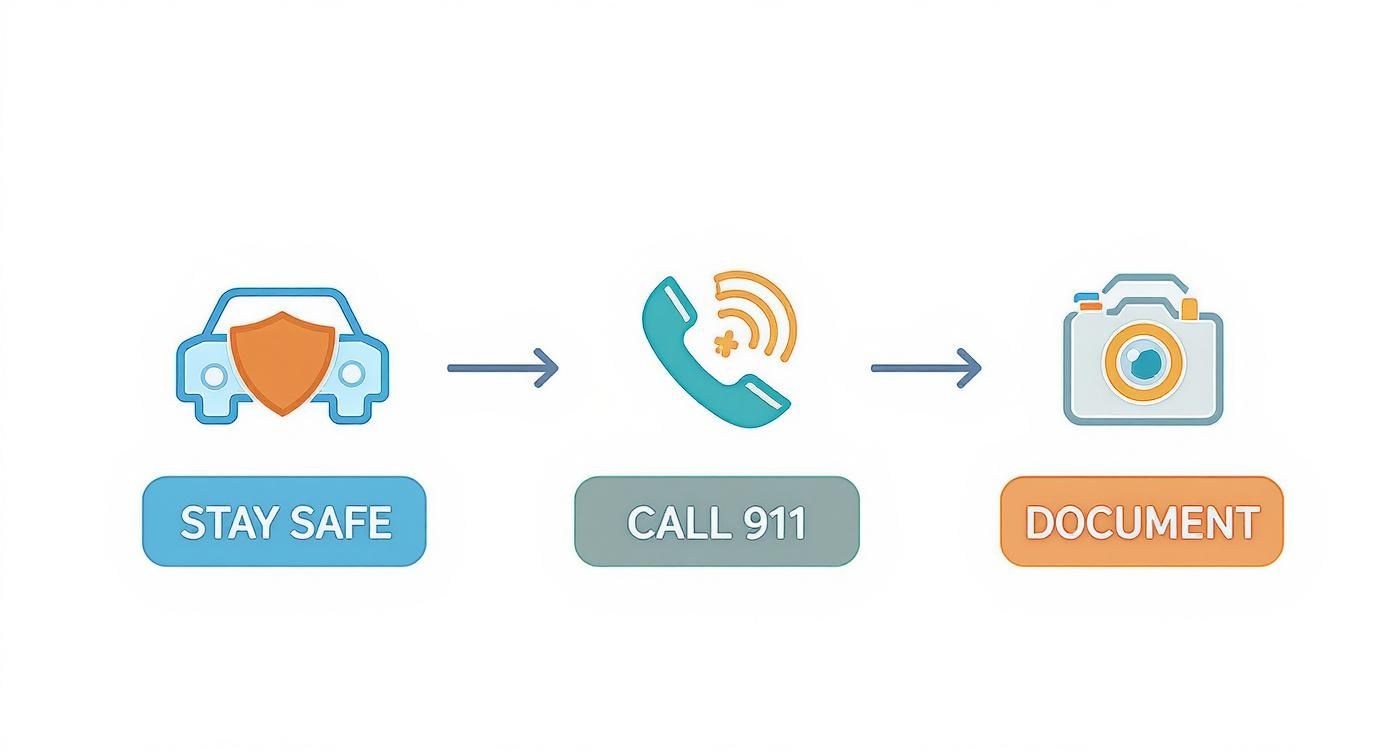
As you can see, a calm, methodical approach—focusing on safety, official reporting, and gathering evidence—gives you the strongest possible foundation to move forward.
To help you stay focused during a stressful moment, we’ve put together a quick checklist.
Immediate Hit and Run Action Checklist
Use this quick reference table to ensure you take the most critical actions immediately after a hit and run to protect your safety and your rights.
| Action Item | Why It’s Critical | Key Details to Capture |
|---|---|---|
| Ensure Safety | Prevents further accidents and injuries. Your well-being is the top priority. | Move vehicle if possible, turn on hazard lights, check on passengers. |
| Call 911 | Creates an official police report and summons medical aid if needed. | Your exact location, state it was a hit-and-run, report any injuries. |
| Document Vehicle Info | Provides crucial leads for law enforcement to identify the fleeing driver. | Partial license plate, make, model, color, unique features (dents, stickers). |
| Take Photos/Videos | Visual evidence is powerful for insurance claims and legal proceedings. | Damage to your car, your injuries, skid marks, debris, surrounding area. |
| Find Witnesses | Third-party accounts can verify your story and provide missing details. | Get names and phone numbers from other drivers, pedestrians, or nearby residents. |
Having this mental or physical checklist can bring a sense of order to a chaotic situation, ensuring you don’t miss a step that could be vital later.
Gather Evidence at the Scene
Think of your smartphone as your personal investigation tool. Start taking photos and videos of everything. Get multiple angles of the damage to your car, any visible injuries you have, the road and weather conditions, and the general scene. Look for skid marks or pieces of the other car left behind.
And don’t forget to look around for people. Other drivers who pulled over, pedestrians on the sidewalk, or even someone looking out of a window in a nearby building might have seen the whole thing. If you see anyone, politely ask if they saw what happened and if they’d be willing to give you their name and phone number. A witness’s statement can be the key piece of evidence that breaks the case open. For more advice on handling collisions, you can also review these steps on what to do after a truck accident.
Disclaimer: This article is for informational purposes only and is not to be construed as legal advice. No attorney-client relationship exists based on the review of this article, and none of the information provided constitutes legal advice.
Understanding California’s Hit and Run Laws
To really get a handle on your rights as a hit-and-run victim, you first need to understand just how seriously California law treats this offense. When a driver hits you and takes off, they aren’t just being irresponsible—they’re committing a crime with very real consequences. This is why the police and your insurance company will take your report so seriously.
Think of it as a fundamental rule of the road. We all agree to a certain code of conduct when we get behind the wheel. The absolute bare minimum is taking responsibility when a crash happens. By fleeing, a driver doesn’t just leave behind a damaged car or an injured person; they completely shatter that basic trust.
The Legal Duties of Every Driver in California
After any collision, whether it’s a minor fender-bender or something more serious, every single driver involved has a clear list of things they must do by law. These aren’t just suggestions. Knowing what they are helps frame just how badly the other driver acted by leaving.
Every driver is required to:
- Stop Immediately: You have to stop your car at the scene, or as close as you can possibly get without creating more danger for other drivers.
- Exchange Information: Drivers have to provide their name, address, driver’s license number, and vehicle registration to everyone else involved.
- Render Reasonable Assistance: If someone is hurt, you have a duty to help them. Most of the time, this means calling 911 for medical help right away.
When a driver flees the scene, they are deliberately ignoring all of these legal duties. It’s this intentional act of evasion that turns a simple car accident into a criminal hit-and-run.
Misdemeanor vs. Felony: A Crucial Distinction
California law doesn’t treat all hit-and-runs the same. They are split into two categories, and the difference comes down to one critical question: Was anyone hurt? This distinction is what determines if the driver is facing a relatively minor charge or serious prison time.
A misdemeanor hit-and-run is what happens when the crash only involves property damage. This is the classic scenario of someone sideswiping your parked car and speeding off, or bumping your car in a parking lot and leaving without a note. It’s still a crime, but the legal system views it less severely than an incident where a person is injured.
On the other hand, a felony hit-and-run occurs when the accident causes any injury or death to another person. It’s important to know that the injury doesn’t have to be catastrophic. Even something that seems minor at the time, like whiplash, can elevate the crime to a felony. The law takes a very dim view of leaving an injured person behind without help.
A hit and run is fundamentally an act of evasion. The driver is not just fleeing the accident; they are fleeing legal and financial responsibility for the damage and harm they caused.
This legal framework is incredibly important for you as the victim. Understanding whether you’re dealing with a misdemeanor or a felony gives you clarity when you speak with the police. It helps you understand why investigators might put more resources into finding a driver who caused an injury, and it gives you important context for your insurance claim.
Why This Matters for Your Case
Knowing these laws gives you power. When you call the police, you’re not just reporting a crash; you’re reporting a specific crime. Being able to tell them whether it was just property damage or if you were injured helps them categorize the offense correctly from the start.
This knowledge also provides the backbone for your insurance claim, especially if you need to use your Uninsured Motorist coverage. The driver who fled made a conscious decision to break the law, leaving you to pick up the pieces. This legal reality validates your position and is the first step in holding them accountable—whether they are ever found or not.
Navigating Your Insurance Claim After a Hit and Run
After a hit and run, the first question on everyone’s mind is usually, “Who’s going to pay for this?” The driver who caused the mess is gone, so you can’t exactly file a claim against their insurance. This is the moment your own policy steps up to become your most critical financial tool. It’s when you find out the real value of the coverage you’ve been paying for all this time.
The whole process can feel overwhelming, especially when you’re already stressed out from the accident itself. But if you understand which parts of your policy apply and how they work, you can map out a clear path forward. Your best friend in this situation is a specific type of coverage designed for this exact nightmare scenario.
Your Financial Safety Net: Uninsured Motorist Coverage
Think of Uninsured Motorist (UM/UIM) coverage as your personal safety net. In California, it’s an optional add-on, but it’s one we highly recommend. When a driver hits you and flees the scene, your insurance company treats them as an “uninsured motorist” because, well, they’re unidentified.
Your UM coverage steps in to do the job the other driver’s insurance should have done. It can cover your medical bills, lost income if you’re unable to work, and even the pain and suffering that comes with the crash. This is the coverage that shields you from shouldering the financial fallout from someone else’s crime. You can get a deeper dive into this vital protection in our guide on what is uninsured motorist coverage.
Other Key Insurance Coverages That May Apply
While UM coverage is the star of the show, other parts of your policy might also kick in, depending on the options you chose. It’s smart to know how all the pieces of your insurance puzzle fit together after a hit and run.
- Collision Coverage: This is what pays to repair or replace your car, no matter who was at fault. If you don’t have UM property damage coverage, you’ll likely file a claim under your collision policy to get your car fixed. You’ll have to pay your deductible, but your insurer handles the rest.
- Medical Payments Coverage (MedPay): This is another optional coverage that helps with medical costs for you and your passengers, regardless of fault. MedPay can be a real lifesaver for immediate expenses like ambulance rides, ER visits, and co-pays while your larger UM claim is still being processed.
Knowing these options empowers you to have a much more effective conversation with your insurance agent. You can confidently ask about what’s available to you and how to best use it.
A Step-by-Step Guide to Filing Your Claim
The secret to a smooth insurance claim is acting fast and being thorough. The moment you start the process, you’re building the foundation for your financial recovery.
- Notify Your Insurer Immediately: Don’t put this off. Most policies require you to report an accident “promptly.” For a hit and run, that often means within 24 hours. Waiting too long can give your insurer a reason to second-guess or even deny your claim.
- Provide the Police Report Number: When you call your insurance company, have that police report number handy. This report is the official proof that the incident was a hit and run, which is crucial for activating your UM coverage and often protects you from a rate hike.
- Submit All Your Documentation: Your insurance adjuster will need every piece of evidence you collected. That means photos of the scene and the damage, contact info for any witnesses, and the notes you scribbled down about the car that fled.
- Keep Detailed Medical Records: If you were hurt, create a file for every single medical bill, doctor’s note, prescription receipt, and report. This paper trail is vital for proving the extent of your injuries and getting the full compensation you’re owed under your UM or MedPay coverage.
By tackling these steps one by one, you create a clear, documented history that backs up your claim. It shows your insurer that you’re a responsible policyholder who is simply seeking the benefits you’re entitled to.
What If You Don’t Have UM or Collision Coverage?
Unfortunately, some people find themselves without these specific coverages. If you’re in this tough spot, don’t lose hope—there may still be other avenues for help. California’s Victims of Crime Compensation Program (CalVCB) can sometimes provide financial assistance for medical bills and lost wages if you were physically injured in a hit and run.
The problem itself is massive. Globally, road traffic injuries are a leading cause of death, with hit-and-runs making the situation worse. These incidents add legal complexity and greater medical needs to an issue that already costs most countries about 3% of their GDP. This context helps explain why programs like CalVCB exist—to offer a lifeline when all other options are off the table.
Disclaimer: This article is for informational purposes only and is not to be construed as legal advice. No attorney client relationship exists based on the review of this this article and none of the information in this article is legal advice
How Police Investigate Hit and Run Car Accidents
After you’ve filed a police report for a hit-and-run, it can feel like your case just vanished into a bureaucratic black hole. You’re stuck waiting, wondering if anything is actually being done. But that report is far more than just paperwork; it’s the spark that ignites the entire investigation.
Every detail you manage to recall—a partial license plate, the car’s color, the direction it sped off in—becomes an actionable lead. The police don’t just file it away; they use it as a blueprint to start piecing together the puzzle of who hit you.
Starting With the Evidence You Gathered
The first thing investigators do is focus on the physical world. Detectives will often head back to the accident scene, looking for tiny clues that were missed in the initial chaos. Their trained eyes can spot things most of us would walk right past.
This on-site investigation often includes:
- Debris Analysis: Even small pieces of a broken headlight or bumper can be matched to specific makes and models. It’s like a car’s unique fingerprint left behind.
- Paint Transfer: Microscopic flecks of paint left on your car can be analyzed to determine the color, and sometimes even the year and make, of the other vehicle.
- Tire Marks: Skid marks tell a story about the car’s speed, direction, and even the type of tires it had.
Every bit of physical evidence helps build a more detailed profile of the phantom vehicle. This is exactly why it’s so critical not to touch or move anything at the scene.
Expanding the Search with Technology and Witnesses
With the initial clues in hand, the search broadens. Investigators then pivot to technology and good old-fashioned detective work, hunting for the digital and human witnesses who can fill in the gaps. When police investigate hit and run car accidents, they heavily rely on any available video, like footage from nearby apartment building security cameras or traffic cameras.
Officers will canvass the area, knocking on doors and asking local businesses if their surveillance systems caught the incident or the fleeing car. A single clear image can be the breakthrough a case needs. They’ll also re-interview any witnesses you found, hoping to jog a memory or clarify a small but vital detail. We cover more of this in our guide on hit-and-run driver identification strategies.
Investigators combine physical evidence from the scene with witness statements and video footage to create a composite picture of the suspect and their vehicle, systematically closing the net.
This methodical process of blending physical clues with a digital trail is at the heart of modern police work.
Using Databases to Identify a Suspect
The final stage usually involves running all of this compiled information through powerful law enforcement databases. A partial license plate number can be cross-referenced with DMV records against the vehicle description, generating a list of potential matches for officers to investigate.
If a strong lead emerges, police might issue a public bulletin or a “Be On the Look-Out” (BOLO) alert to other officers in the area. They may also check with local auto body shops to see if anyone brought in a car with damage matching the accident. While it’s true that not every hit-and-run is solved, this diligent process gives you the best possible shot at finding the person responsible.
Disclaimer: This article is for informational purposes only and is not to be construed as legal advice. No attorney client relationship exists based on the review of this this article and none of the information in this article is legal advice
Your Legal Rights to Compensation

When the police manage to track down the driver who fled the scene, it completely changes the game for your case. Suddenly, you’re no longer just a victim of an anonymous crime—you have a specific person you can hold accountable.
This breakthrough opens the door to filing a civil claim, which is a legal action entirely separate from any criminal charges the driver will face. This is your chance to pursue financial recovery for everything you’ve lost. It’s about making you whole again. The goal is to secure compensation, known in the legal world as “damages,” that covers the full scope of the harm you’ve suffered.
Economic Damages: The Tangible Costs
The most straightforward part of your claim is what we call economic damages. Think of these as the concrete, calculable losses—the things that have a clear price tag. They are the bills and financial hits that have piled up since the moment of impact.
Your claim can seek full reimbursement for:
- Medical Expenses: This covers everything. The ambulance ride, the ER visit, any surgeries, ongoing physical therapy, and even the prescriptions you need to manage your recovery.
- Lost Wages: If your injuries kept you out of work, you have the right to be paid back for every dollar of income you lost while you were healing.
- Loss of Earning Capacity: Sometimes, an injury is so severe it permanently impacts your ability to work or advance in your career. You can seek damages for the income you would have earned in the future.
- Property Damage: This is for the cost to repair or replace your car and any personal belongings that were damaged in the wreck, like a laptop or phone.
These damages are the financial bedrock of your claim, making sure the accident doesn’t push you into a financial crisis.
Non-Economic Damages: The Human Toll
Beyond the numbers and receipts, a hit and run car accident takes a huge personal toll. Non-economic damages are meant to compensate for these intangible, but deeply felt, human losses. You can’t put a price tag on pain, but our legal system recognizes that this suffering deserves to be acknowledged and compensated.
These damages account for:
- Pain and Suffering: This is for the physical pain, ongoing discomfort, and mental anguish your injuries have caused.
- Emotional Distress: We’re talking about the very real anxiety, fear, depression, and psychological trauma that follows such a violent and violating event.
- Loss of Enjoyment of Life: If the injuries stop you from enjoying hobbies, activities, or simple life experiences you once loved, this is meant to compensate for that profound loss.
Calculating a fair value for these losses is incredibly complex and is one of the key areas where having an experienced advocate on your side makes all the difference.
The Statute of Limitations: A Critical Deadline
Here’s a crucial point: in California, you don’t have forever to take action. The statute of limitations is a strict legal clock that starts ticking the moment you’re injured. For most car accident cases, you have two years from the date of the injury to file a lawsuit.
If you miss this deadline, you will almost certainly lose your right to seek compensation forever. It doesn’t matter how strong your case is. This makes it absolutely critical to move quickly once the at-fault driver is identified.
This is especially concerning as these incidents increasingly involve pedestrians and cyclists, who are the most vulnerable people on our roads. You can find more data on this alarming trend and other traffic safety issues in recent NHTSA reports.
The Role of a Personal Injury Attorney
Trying to navigate a civil claim—especially one as complicated as a hit and run car accident—is not something you should ever do alone. A personal injury attorney acts as your champion, fighting for your best interests from start to finish. They handle the complex negotiations with the other driver’s insurance company, which will almost always try to pay you as little as possible.
Your lawyer’s job is to build a powerful case by gathering evidence, calculating the full extent of all your damages (both economic and non-economic), and fighting for a settlement that is truly fair. And if the insurance company won’t play ball, your attorney will be fully prepared to take your case to court to get you the justice you deserve.
Disclaimer: This article is for informational purposes and is not to be construed as legal advice. No attorney client relationship exists based on the review of this this article and none of the information in this article is legal advice
Common Questions About Hit and Run Accidents
When you’re the victim of a hit and run, the immediate aftermath can feel like a whirlwind of confusion and stress. You’re left dealing with the damage, and the person responsible is nowhere to be found. It’s only natural to have a ton of questions. Here, we’ll tackle some of the most common concerns that come up.
While every accident is different, many people run into the same worries and roadblocks. Getting a handle on the answers now can give you a sense of control in a chaotic situation. We’ve put together this quick-reference guide to help you navigate what comes next.
What If I Only Got a Partial License Plate Number?
Don’t dismiss it! A partial license plate is a surprisingly powerful piece of evidence. Even just a few numbers or letters can be the key that breaks the case wide open.
Get that partial number to the police right away. Give them every other detail you can recall, no matter how small—the car’s make, model, color, or any dings, dents, or stickers you noticed. Police investigators have access to powerful databases that can filter through millions of registered vehicles, cross-referencing your partial plate with other details to narrow down the list of suspects.
What might seem like a useless tidbit to you could be the exact clue an investigator needs to track down the driver who fled the scene.
Will My Insurance Rates Go Up for a Hit and Run Claim?
This is a huge worry for most victims, but here’s the good news: in California, the law is on your side. Insurers are legally blocked from raising your premiums for an accident that wasn’t your fault.
By definition, a hit and run is 100% not your fault. So, when you file a claim under your Uninsured Motorist (UM) or collision coverage, your rates shouldn’t budge. The critical piece here is to have an official police report that clearly documents the incident as a hit and run. This report is your proof.
You shouldn’t be penalized for being the victim of a crime. Your insurance policy is there for exactly these kinds of situations, and California law backs that up.
What Should I Do If My Parked Car Was Hit?
There are few things more frustrating than walking back to your parked car and finding a fresh dent or scrape. When this happens, you need to treat it with the same urgency as any other hit and run.
- Look for Clues: First, do a quick scan of the area. Did the other driver leave a note? Did anyone see what happened?
- Check for Cameras: Look around at nearby storefronts, homes, or apartment buildings. Many have security cameras that might have caught the whole thing on video. It never hurts to politely ask if they’d be willing to check the footage.
- Document Everything: Pull out your phone and take pictures. Get shots of the damage from every angle, the position of your car, and the surrounding scene.
- File a Police Report: Call the non-emergency police line and get a report filed. This is non-negotiable for your insurance claim.
- Contact Your Insurer: Report the damage to your insurance company. Your collision coverage should take care of the repairs, though you will likely have to pay your deductible.
How Long Do I Have to Report a Hit and Run?
Time is critical. You need to report a hit and run car accident to the police as soon as you possibly can—ideally, right from the scene while everything is fresh in your mind.
For insurance purposes, the clock is ticking even faster. Most policies demand that you report the accident “promptly.” For Uninsured Motorist claims, this often means within 24 hours. If you wait too long, you could put your entire claim in jeopardy.
While you technically have two years in California to file a personal injury lawsuit, dragging your feet on reporting the incident to the police and your insurer will seriously weaken your case and could even lead to your claim being denied.
Disclaimer: This article is for informational purposes and not to be construed as legal advice. No attorney client relationship exists based on the review of this this article and none of the information in this article is legal advice
If you have been the victim of a hit and run, you don’t have to face the legal and financial challenges alone. The team at LA Law Group, APLC is here to provide the experienced advocacy you need to fight for the compensation you deserve. Contact us today for a free, no-obligation consultation to understand your rights and options. Visit us at https://www.bizlawpro.com to learn more.
Attorney Advertising. This article is general information, not legal advice, and does not create an attorney-client relationship. Prior results do not guarantee a similar outcome.