
How Much Compensation for Whiplash Is Realistically Awarded

Disclaimer: This article is for informational purposes and not to be construed as legal advice. No attorney-client relationship exists based on the review of this article and none of the information in this article is legal advice.
So, how much compensation for whiplash can you actually expect? While there’s no magic number, minor whiplash claims often settle in the $10,000 to $20,000 range. For severe cases with long-term complications, that figure can easily jump over $100,000. The final amount really boils down to the specific details of your injury, your medical bills, and the overall impact the accident has had on your day-to-day life.
What Is a Realistic Whiplash Compensation Amount
Disclaimer: This article is for informational purposes and not to be construed as legal advice. No attorney-client relationship exists based on the review of this article and none of the information in this article is legal advice.
When you’re trying to figure out a realistic compensation amount, don’t think of it like a lottery ticket with a set prize. A better analogy is a custom repair job for a classic car. The total cost depends on the extent of the damage (your medical bills), how long the repairs will take (your recovery time), and how the car will perform in the future (your quality of life).
Because every single accident and injury is different, the settlement amounts can vary wildly. A minor neck strain that gets better in a few weeks is going to have a much different value than an injury that demands months of physical therapy or, in some cases, even surgery.
Understanding the Tiers of Whiplash Claims
To help set some clear expectations, we can group potential compensation into three general tiers based on how severe the injury is. This is a good way to see how different situations lead to very different outcomes.
- Minor Whiplash: These are cases involving muscle strains that heal up within a few weeks. Medical treatment is usually minimal—maybe a few trips to the chiropractor—and you miss little to no work.
- Moderate Whiplash: This is a step up, involving more persistent pain that might require ongoing physical therapy or visits to a specialist. You might miss several weeks or even months of work, and the injury limits your daily activities in a documented way.
- Severe Whiplash: These are the most serious cases, hands down. They often come with complications like nerve damage, chronic pain, herniated discs, or the need for surgery. The impact on a person’s ability to work and just enjoy life is significant and often permanent.
This chart helps visualize how the potential compensation lines up with these different injury levels.
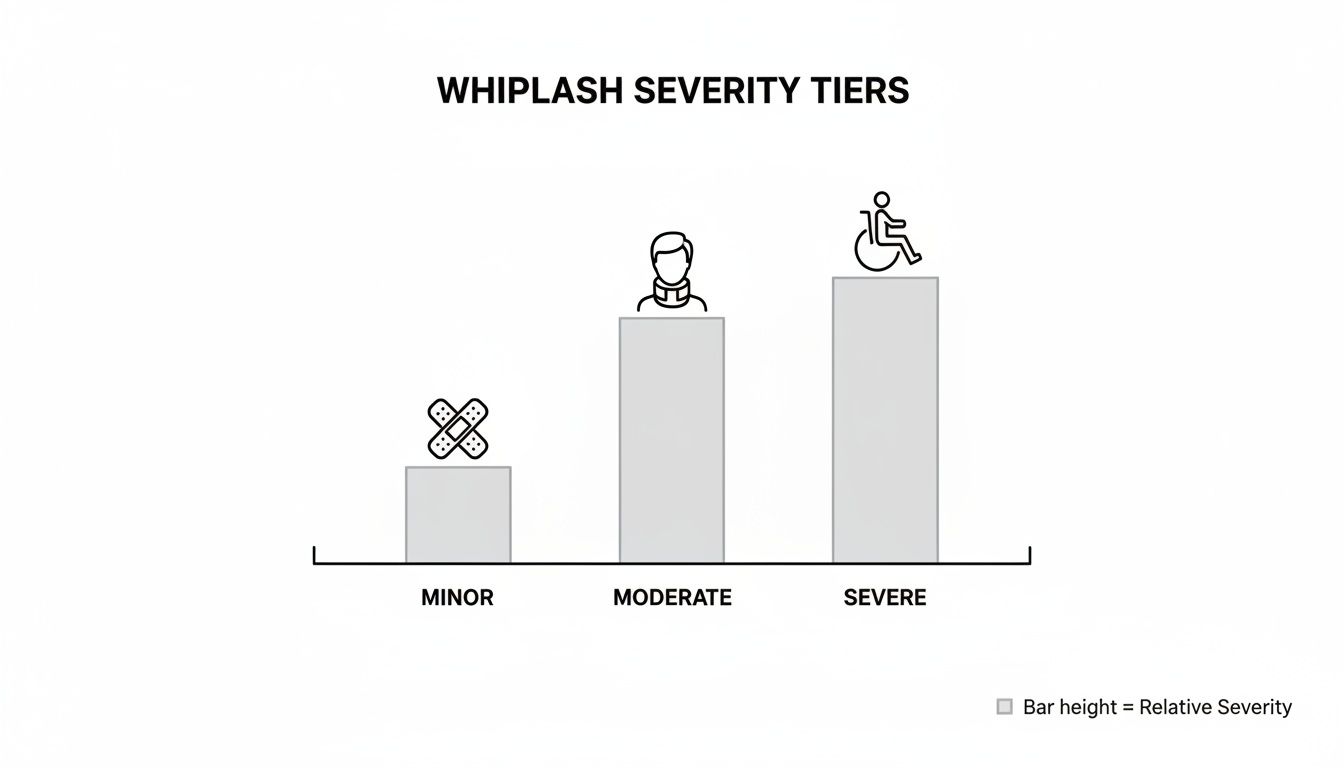
As you can see, the value of a claim grows substantially as the injury’s impact deepens. This reflects the reality of higher medical costs and greater life disruption. In the sections ahead, we’ll break down exactly what factors go into calculating these values.
Understanding Economic and Non-Economic Damages
Disclaimer: This article is for informational purposes and not to be construed as legal advice. No attorney-client relationship exists based on the review of this article and none of the information in this article is legal advice.

A whiplash settlement isn’t a random number pulled out of a hat. It’s a sum built from two very different kinds of losses: economic damages and non-economic damages. Getting a handle on how these two pieces fit together is the key to figuring out what kind of compensation might be on the table for your specific case.
Think of economic damages as everything you have a receipt for. These are all the tangible, black-and-white costs that come with a clear price tag attached. They’re the most straightforward part of any personal injury claim because you can prove them with bills, invoices, and pay stubs.
These damages build the financial foundation of your claim, painting a clear picture of the money you’re out because of the accident.
Calculating Your Economic Damages
Economic damages are simply the sum of every direct financial hit you’ve taken because of your whiplash injury. There’s no guesswork involved; it’s all about meticulous record-keeping.
The biggest pieces of the economic damages puzzle usually include:
- Medical Bills: This covers everything from the first ambulance ride and ER visit to follow-up appointments with specialists, physical therapists, and chiropractors. It also includes the cost of imaging like MRIs or X-rays.
- Lost Wages: If your whiplash kept you from working, you can claim the income you missed out on. We calculate this based on your normal pay rate and the exact amount of time you were unable to work.
- Future Medical Expenses: A serious whiplash injury can mean long-term problems. Your claim can include the projected costs for future physical therapy, pain management, or even surgery if a doctor says it’s necessary down the road.
- Loss of Earning Capacity: In the worst-case scenarios, whiplash can permanently impact your ability to do your job or force you into a lower-paying role. This part of the claim compensates you for the hit to your future earning potential.
By carefully tracking every single expense, you build an undeniable record of your financial losses. This isn’t just helpful documentation—it’s the hard evidence that forces the insurance company to take your compensation request seriously.
The Human Cost: Non-Economic Damages
While economic damages add up the bills, non-economic damages are all about the profound, personal toll the injury has taken on you. This is the “human cost” that doesn’t come with a receipt. These damages are more subjective and harder to put a number on, but they are just as real and just as important.
Non-economic damages are meant to compensate you for the physical pain and emotional fallout from the whiplash.
- Pain and Suffering: This is compensation for the actual physical pain you’ve had to live with since the accident. It acknowledges the daily aches, the stiffness in your neck, and the headaches that won’t go away.
- Emotional Distress: An accident is traumatic. This category covers the anxiety, stress, sleepless nights, and other psychological impacts that often come after a violent collision.
- Loss of Enjoyment of Life: If your injury stops you from playing with your kids, hitting the gym, or enjoying your hobbies, you can be compensated for that loss. It’s about the drop in your overall quality of life.
Because you can’t get an invoice for suffering, these damages are often calculated using a “multiplier.” The total economic damages are multiplied by a number (usually between 1.5 and 5) based on how severe the injury is. A more painful, long-lasting injury justifies a higher multiplier, leading to a larger award for non-economic damages. For a closer look, you can learn more about the different types of damages in a personal injury claim in our detailed guide.
Key Factors That Drive Your Settlement Value
Disclaimer: This article is for informational purposes and not to be construed as legal advice. No attorney-client relationship exists based on the review of this article and none of the information in this article is legal advice.
Ever wonder why one whiplash case settles for a few thousand dollars while another hits six figures? It’s not random. The final number comes down to the specific, provable details of your accident and your injuries. Insurance adjusters, and juries if it comes to that, look at several key factors to figure out what a claim is actually worth. Think of them as ingredients in a recipe—each one changes the final result.
The single biggest driver of value is the severity of your injury. A minor neck strain that clears up in a few weeks is worlds away from a whiplash injury causing herniated discs, chronic nerve pain, and long-term disability. The more serious the injury, the higher the compensation potential. Simple as that.
And this is exactly where your medical records become the bedrock of your entire claim.
The Power of Medical Evidence
Solid, objective medical proof is your best friend in a whiplash claim. It takes your case from “my neck hurts” to a documented, verifiable injury that an insurance company can’t just brush aside. Vague complaints are easy to ignore; a specific diagnosis backed by a specialist is powerful.
Your medical file needs to tell a clear, detailed story of your injury and treatment from day one. The most compelling pieces of evidence include:
- Diagnostic Imaging: MRIs, CT scans, and X-rays are the gold standard. They provide visual proof of damage to discs, ligaments, or vertebrae that an adjuster can’t argue with.
- Specialist Reports: An evaluation from a neurologist, orthopedic surgeon, or pain management doctor adds a massive layer of credibility to your claim.
- Treatment Records: A consistent paper trail of physical therapy, chiropractic care, prescriptions, and follow-up appointments demonstrates a genuine effort to recover.
To really nail down the long-term impact of whiplash, especially on your ability to work, doctors often use a functional capacity evaluation. This assessment gives you hard data on your physical limitations, which is crucial for proving you’ve lost earning capacity.
The Role of Total Medical Expenses
While how badly you were hurt is the main factor, the total cost of your medical care is a close second. Insurance adjusters often use the total amount of your medical bills as a starting point to calculate pain and suffering damages.
Generally, higher medical bills signal a more serious injury that needed more extensive treatment. This direct link makes it absolutely vital to track every single expense, from the ambulance ride to your very last physical therapy co-pay. Keeping detailed records gives you a much stronger hand to play during negotiations.
Here’s a key takeaway: what you do—or don’t do—after the accident matters. Big gaps in your treatment or a failure to follow your doctor’s advice will be used against you. An insurance company will argue your injuries couldn’t have been that bad. Consistency is everything.
Impact on Your Daily Life and Income
Beyond the medical bills, your compensation is also heavily tied to how the injury has turned your life upside down. This covers everything from your ability to earn a living to simply enjoying your day-to-day activities.
- Lost Income: This one is pretty straightforward. Documenting the time you missed from work is critical. If the injury stops you from returning to your old job or hurts your future earning potential, this becomes a major part of your claim.
- Loss of Enjoyment: Were you an avid golfer who can no longer swing a club without pain? A parent who can’t pick up their toddler? These are real, compensable losses. Keeping a journal and getting statements from friends and family can help paint a clear picture of this impact.
The strength of your evidence also matters a great deal. A clear police report that puts the other driver 100% at fault, backed by witness statements and traffic camera video, is infinitely stronger than a disputed “he said, she said” crash.
The Practical Cap of Insurance Policy Limits
Finally, there’s a practical reality that can put a ceiling on your settlement: the at-fault driver’s insurance policy limits. No matter how devastating your injuries are or how rock-solid your case is, you typically can’t get more money than the maximum amount of the other driver’s insurance coverage.
If your damages blow past these limits, your options get a lot more complicated. This is why it’s so important to have your own Underinsured Motorist (UIM) coverage. Insurance companies will fight tooth and nail to pay out as little as possible; learning how insurance companies undervalue personal injury accident claims is a real eye-opener. Their job is to protect their profits, not to make sure you get a fair shake.
Research from Consumer Shield’s November 2025 analysis provides a grounded perspective. Their study found whiplash settlements typically land somewhere between $7,500 to $50,000, with the average hovering around $18,950. This research confirms that the final number is driven primarily by how severe the injury is and how much medical care was needed.
How California Law Shapes Your Whiplash Claim
Disclaimer: This article is for informational purposes and not to be construed as legal advice. No attorney-client relationship exists based on the review of this article and none of the information in this article is legal advice.

Figuring out what a whiplash claim is worth goes beyond just adding up your medical bills. Here in California, a few specific state laws have a massive impact on the outcome. These rules can either be your best friend, protecting your right to a fair payout, or they can sink your claim if you aren’t paying attention.
It’s crucial to get a handle on this legal landscape. California has its own way of dealing with fault, strict deadlines for filing a claim, and minimum insurance requirements that directly affect what you can actually recover after a crash.
The Clock Is Ticking: The Statute of Limitations
In California, you don’t have an unlimited amount of time to take action. The state has a hard deadline, called the statute of limitations, for filing a personal injury lawsuit. For the vast majority of whiplash claims, you have just two years from the date of the accident to file your case.
This isn’t just a friendly suggestion—it’s a non-negotiable rule. If you miss that two-year window, the court will almost certainly throw out your case. You’ll lose any right to seek compensation for your injuries, no matter how legitimate your claim is.
This is why it’s so important to talk to a lawyer sooner rather than later. Evidence gets lost, witnesses forget details, and the legal gears take time to start turning. Acting fast is the best way to protect yourself.
California’s Pure Comparative Negligence Rule
What happens if you were partly to blame for the accident? In some states, that would mean you get nothing. California, however, follows a much fairer rule called “pure comparative negligence.”
This system lets you recover money for your injuries even if you share some of the fault for what happened. The catch is that your final compensation will be reduced by your percentage of blame.
Example: Let’s say your total damages from the whiplash injury add up to $50,000. If a court decides you were 20% at fault—maybe you were driving a few miles over the speed limit—your payout gets reduced by that 20%. In this case, you’d be able to recover $40,000.
This rule is designed to divide responsibility fairly, but it also gives insurance companies an incentive. You can bet they will try to pin as much blame on you as possible to drive down the value of your claim. It’s also worth noting that the legal landscape is always shifting; keeping up with evolving California personal injury laws in 2025 can give you an edge.
Navigating Insurance Minimums and UIM Coverage
Finally, your ability to actually collect your settlement money is tied directly to how much insurance coverage is available. California law requires all drivers to carry liability insurance, but honestly, the minimum amounts are shockingly low.
Here are the state-mandated minimums:
- $15,000 for injury or death to one person.
- $30,000 for injury or death to more than one person.
- $5,000 for property damage.
If a serious whiplash injury leaves you with medical bills and lost wages that climb past $15,000, the at-fault driver’s basic policy simply won’t be enough. This is where your own insurance policy becomes your most important safety net.
This is exactly why Uninsured/Underinsured Motorist (UIM) coverage is so vital. This optional add-on to your policy kicks in when the other driver has no insurance at all or not enough to cover your damages. It can be the one thing that makes the difference between getting pennies on the dollar and receiving the full compensation you truly need.
Illustrating Whiplash Settlement Payouts
Disclaimer: This article is for informational purposes and not to be construed as legal advice. No attorney-client relationship exists based on the review of this article and none of the information in this article is legal advice.
Theory is one thing, but seeing how these factors play out in real-world scenarios makes it all click. Let’s walk through a few detailed examples to connect the dots between the type of accident, the severity of the injury, and the final settlement amount.
These stories show just how different the outcomes can be, helping you put your own situation into better context.
Scenario 1: Minor Whiplash Claim
Picture Sarah, stopped at a red light when another car lightly bumps her from behind. The damage to her car is barely noticeable, but she feels that tell-tale neck stiffness almost immediately. She heads to an urgent care center and gets a diagnosis for what it is: a minor cervical strain, the classic whiplash injury.
Her recovery is pretty straightforward:
- The doctor prescribes over-the-counter pain relievers and recommends ice packs.
- She sees a chiropractor for six weeks to get her full range of motion back.
- She only misses two days of work, and she has a doctor’s note to prove it.
Calculating Sarah’s direct losses, or economic damages, is simple. She has $3,500 in medical bills and $400 in lost wages. Because her injury was minor and healed quickly without much disruption to her life, an insurance adjuster might use a 3x multiplier for her pain and suffering. This brings the total settlement offer to around $15,700, which covers her expenses and fairly compensates her for the discomfort she went through.
Scenario 2: Moderate Whiplash with Complications
Now let’s look at David’s case. He’s in a much more serious T-bone collision. The impact is jarring, and he immediately feels sharp neck pain, blinding headaches, and a weird tingling down his arms. His family doctor sends him to a neurologist right away.
An MRI tells the real story: a bulging disc in his neck. David’s road to recovery is a lot longer and more involved:
- He’s in intensive physical therapy for four months just to manage the pain and try to move normally again.
- He needs a series of corticosteroid injections to calm the inflammation around the nerve.
- His construction job is physically demanding, so he’s out of work for a full month.
- Smartly, he keeps a journal detailing his chronic headaches and sleepless nights, which serves as powerful evidence of his emotional distress.
David’s economic damages are significant: $15,000 for medical care and $6,000 in lost income. Because of the persistent pain, the need for specialists, and the well-documented emotional toll, his settlement lands in the $60,000 range to reflect the much greater impact this injury had on his life.
Scenario 3: Severe Whiplash Requiring Surgery
Finally, there’s Maria. She’s rear-ended at high speed on the freeway, and her head is whipped back and forth violently. The pain is excruciating and immediate. She’s taken to the hospital by ambulance, where an MRI reveals a herniated disc that’s actively compressing a spinal nerve.
Her journey is long and grueling:
- She tries everything first—physical therapy, injections—but nothing provides relief.
- After months of living with debilitating pain, her orthopedic surgeon says the only option left is a cervical fusion surgery.
- The surgery helps with the pain, but it leaves her with a permanent loss of some mobility in her neck.
- She can’t return to her job as a graphic designer for six months.
Maria’s case is in a completely different league. Her medical bills, surgery included, top $100,000, and her lost income is over $30,000. Because her injury is permanent and has fundamentally changed her quality of life, her case results in a six-figure settlement, potentially pushing past $250,000.
Whiplash compensation settlements vary dramatically, with data from major law firms showing average payouts ranging from $72,500 to $1,008,258. This wide spectrum highlights how severe cases, like those requiring surgery, command significantly higher values. For instance, one case involving a 61-year-old man who needed cervical fusion surgery resulted in a $550,000 settlement. You can explore more about these whiplash compensation case results to see how different factors influence outcomes.
How to Navigate the Claims Process Effectively
Disclaimer: This article is for informational purposes and not to be construed as legal advice. No attorney-client relationship exists based on the review of this article and none of the information in this article is legal advice.
The moments after a car accident are chaotic and confusing. When you’re dealing with pain and shock, figuring out what to do next can feel impossible. But the first few steps you take are critical for protecting your health and your right to fair compensation.
Your absolute first priority is to get a medical evaluation. Do this even if you think you’re fine. Whiplash symptoms are notorious for showing up hours or even days later. A doctor’s visit creates an official, time-stamped record connecting your injuries to the crash, which is a cornerstone of any injury claim. Next, report the accident to the police and your own insurance company. Stick to the basic facts and don’t admit fault.

Dealing With Insurance Adjusters
It won’t be long before you get a call from the other driver’s insurance adjuster. It’s vital to remember who they work for. Their job is to protect their company’s bottom line by paying out as little as possible, not to make sure you’re taken care of.
They have a playbook of tactics to accomplish this. The adjuster will likely sound friendly and concerned, but every question is designed to find information they can use to devalue your claim.
A classic move is to offer you a quick, low settlement before you even know the full extent of your injuries. It can be tempting to take the cash, but once you accept, you sign away your right to any future compensation—even if your condition gets much worse down the line.
Another common tactic is to subtly question how badly you were hurt or suggest your injuries came from something else. They might dig into your past medical records or claim that a gap in your treatment proves you weren’t really in pain. This is exactly why sticking to your treatment plan is so important.
When to Hire a Personal Injury Attorney
While you might be able to handle a tiny fender-bender claim yourself, there are clear signals that it’s time to bring in a professional. If your injuries are anything more than minor, require ongoing treatment, or if the insurance company starts giving you the runaround, you need an attorney. An experienced lawyer immediately takes over all communication, shielding you from the adjuster’s tactics.
You should seriously consider hiring an attorney if:
- Your injuries are significant: If your recovery involves more than a couple of check-ups—like physical therapy, chiropractic care, specialist visits, or surgery—the financial stakes are simply too high to handle alone.
- Fault is being disputed: If the other driver is trying to pin the blame on you, an attorney can build a strong case with evidence to prove their negligence.
- The settlement offer is a joke: A good lawyer knows what a whiplash case is actually worth and will fight for a number that truly covers all of your losses.
A personal injury attorney manages all the legal heavy lifting, freeing you up to focus on what matters most: your recovery. They level the playing field against massive insurance companies and have the expertise to secure the maximum compensation you’re entitled to. This also means identifying all sources of recovery, including things like understanding post-accident counselling benefits like those offered by ICBC, which can be essential for your emotional well-being.
Frequently Asked Questions About Whiplash Claims
Disclaimer: This article is for informational purposes and not to be construed as legal advice. No attorney-client relationship exists based on the review of this article and none of the information in this article is legal advice.
When you’re dealing with a whiplash claim, a lot of questions pop up, especially when it comes to California law and what it all means for your wallet. Here are some straightforward answers to the most common concerns we hear from accident victims.
Can I Get Compensation If I Was Partially At Fault in California?
Yes, absolutely. California operates under a “pure comparative negligence” rule. All that means is you can still recover money for your injuries even if you were partly to blame for the crash.
Your final compensation is simply reduced by whatever percentage of fault is assigned to you. For instance, if you’re found to be 20% at fault for an accident and your total damages are $100,000, you would still be able to collect $80,000. This system ensures you aren’t completely shut out of a recovery just because you shared a small piece of the responsibility.
How Long Do I Have to File a Whiplash Lawsuit in California?
This one is critical. In California, you generally have two years from the date of the accident to file a personal injury lawsuit. This is called the statute of limitations, and it’s a hard deadline.
If you miss this two-year window, you will almost certainly lose your right to seek any compensation at all. The courthouse doors will be closed to your claim, permanently.
It’s crucial to get the ball rolling quickly after an accident. Waiting too long can seriously jeopardize your ability to get the financial help you need for your injuries and other losses.
Is My Whiplash Settlement Money Taxable?
For the most part, no. The IRS generally does not consider compensation for physical injuries, medical bills, or pain and suffering to be taxable income. The idea is that this money is meant to make you “whole” again after an injury, not to act as a source of income.
However, there’s a key exception: any portion of your settlement that is specifically for lost wages is usually taxable. This makes sense because it’s replacing income that you would have earned and paid taxes on anyway. It’s always a good idea to chat with a tax professional for advice tailored to your specific financial picture.
Disclaimer: This article is for informational purposes and not to be construed as legal advice. No attorney client relationship exists based on the review of this this article and none of the information in this article is legal advice.
Navigating the complexities of a personal injury claim requires experience and dedicated advocacy. The team at LA Law Group, APLC is here to help you understand your rights and fight for the full compensation you deserve. Schedule your free, no-obligation consultation today by visiting us at https://www.bizlawpro.com.
Attorney Advertising. This article is general information, not legal advice, and does not create an attorney-client relationship. Prior results do not guarantee a similar outcome.