
How Much Is a Wrongful Death Lawsuit Worth in California

A wrongful death case may anchor around the $961,000 median jury award reported in federal civil-trial data, or the about $973,054 average and $294,728 median reported in a 2019–2024 analysis, but those figures don’t predict a California family’s recovery. California rules, the non-economic damages cap, the decedent’s earnings, available insurance, and the difference between survivor and survival-action claims can reshape the result substantially.
You may be reading this after a phone call from an insurer, while funeral bills arrive and your family tries to understand how the mortgage, childcare, and everyday expenses will be covered. The honest answer to how much is a wrongful death lawsuit worth in California is that no calculator can produce a reliable number without examining liability, financial records, family relationships, and the claims California law permits.
This article is for informational purposes only and isn’t legal advice. No attorney-client relationship exists based on your review of this article, and none of the information in it is legal advice.
What Counts as a Wrongful Death Case in California
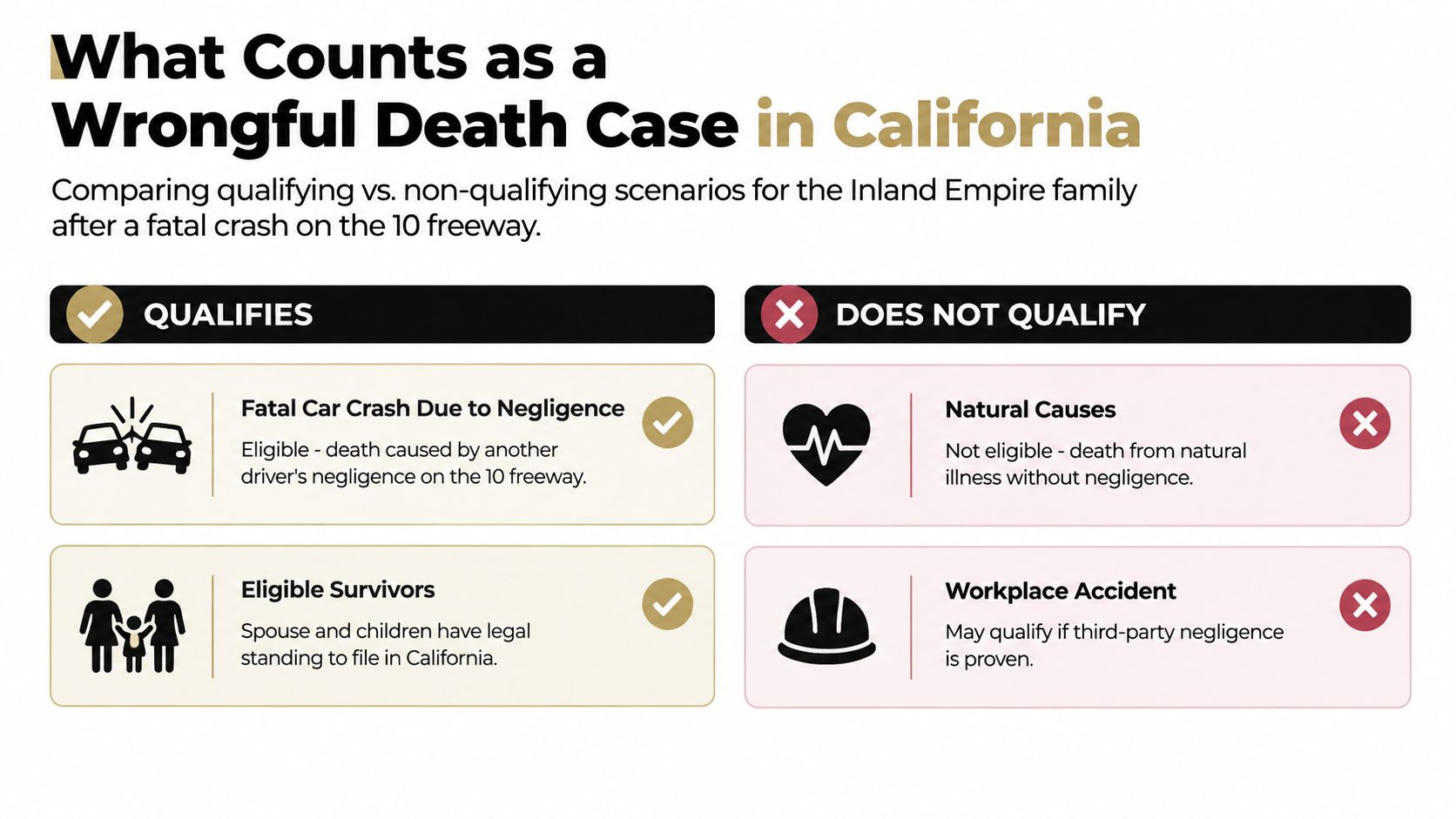
A surviving spouse in the Inland Empire and two children are trying to make sense of their loss after a fatal crash on the 10 freeway. The other driver may have been speeding, distracted, or failed to yield. The family wants to know whether they have a civil claim, whether a criminal case matters, and what compensation could cover the financial damage left behind.
A California wrongful death claim is a civil action brought when someone dies because of another party’s negligence or intentional conduct. It isn’t the same as a criminal prosecution. The state may bring criminal charges, but eligible family members bring a wrongful death lawsuit to seek compensation for losses caused by the death.
California also recognizes a separate survival action under California Code of Civil Procedure section 377.30. That claim belongs to the decedent’s estate, not directly to the surviving family members. It can address losses the deceased experienced between the injury and death, such as medical expenses, pre-death pain, and wages lost before death. A wrongful death action and survival action may proceed together because they measure different injuries.
Who may bring the California claim
Under CCP 377.60, eligible claimants can include a surviving spouse, domestic partner, children, and certain other heirs or people who depended financially on the deceased. Standing depends on the family structure and the evidence of financial dependence.
Practical rule: Don’t assume the person who handled the funeral is automatically the only person who may file. California law can give several survivors rights in the same case.
Families often confuse the survivor claim with the estate claim. A plain-language explanation of that distinction appears in the Mattiacci Law survival action explanation. The distinction matters because combining both claims may capture losses that one claim alone would miss.
The Damages California Law Actually Lets You Recover
California wrongful death damages generally fall into economic and non-economic categories. Economic damages are losses that can be supported with records, calculations, or expert analysis. Non-economic damages address the human relationship and support the family lost.
The California Civil Jury Instructions on wrongful death damages provide the framework jurors use. Economic losses can include funeral and burial expenses, financial support the decedent would have provided, employment benefits, household services, and expected gifts or benefits. Non-economic losses can include love, companionship, comfort, care, assistance, protection, affection, society, and moral support.
A worked example
Suppose a 42-year-old parent earned $85,000, supported two children, and had a non-working spouse. An attorney might organize the claim this way:
| Damage Category | Example Amount | Notes |
|---|---|---|
| Funeral and burial expenses | Documented cost | Supported by invoices and receipts |
| Lost financial support | Expert calculation | Based on earnings, benefits, taxes, and household contribution |
| Household services | Expert or market analysis | May include childcare, home maintenance, and daily assistance |
| Lost companionship and guidance | Subject to applicable California limits | Evaluated from the family relationship and evidence |
| Survival-action losses | Documented and calculated separately | May include pre-death medical expenses, pain, and lost wages |
| Total claim | Case-specific | Not a guaranteed settlement figure |
This illustration doesn’t establish a dollar value. The $85,000 salary, age, and family structure help show why attorneys build a model rather than apply a flat average. The family may have substantial support losses, but the final amount depends on work-life assumptions, benefits, taxes, household services, liability, insurance, and statutory limits.
The categories can also overlap if they’re not carefully separated. Financial support belongs to the survivor claim, while medical treatment and losses experienced before death may belong to the estate’s survival action. A guide to broader damage categories appears in this overview of types of damages.
A wrongful death claim isn’t priced like a fixed-fee service. The value comes from proving each loss and matching it to the claim California law permits.
How Attorneys Calculate Future Lost Income and Support
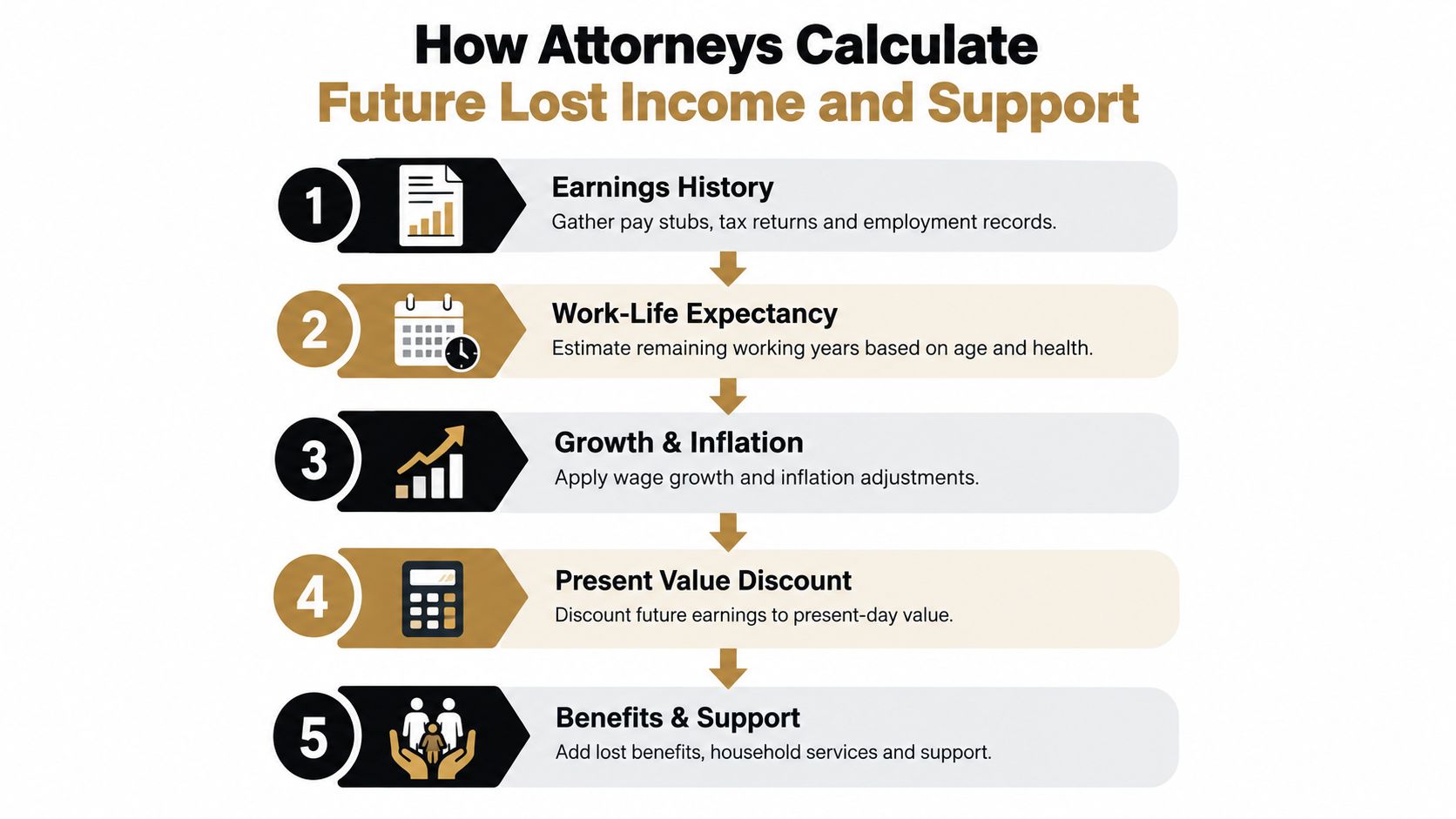
Future income is often the largest economic component when the deceased supported a household. Attorneys typically begin with employment records, tax returns, pay statements, promotion history, education, occupation, and employer-provided benefits. They then ask what the decedent likely would have earned and contributed over the remaining work-life period.
The calculation in practice
An economist may use work-life expectancy information and testimony about the person’s career path. The analysis can account for wages, employer benefits, pension contributions, Social Security-related contributions, and anticipated raises. The 2019–2024 dataset described earlier identifies lost future income, medical bills, funeral expenses, and family support as core valuation components, but each projection remains dependent on case evidence (settlement valuation methodology).
An illustration helps. A person earning $75,000 per year over 23 remaining years produces a substantial gross stream before taxes, benefits, raises, household contributions, or discounting are considered. After an economist applies case-supported growth assumptions and converts future payments into present value, the result can fall in a six- to seven-figure range, but the precise figure cannot be stated responsibly without a complete financial model.
The discounting step recognizes that money received now can be invested, while future income arrives over time. Attorneys also value household services separately. Childcare, cooking, cleaning, transportation, and home maintenance may have replacement value even when the decedent didn’t receive a paycheck for those tasks.
Why the projection remains disputed
The defense may challenge career advancement, retirement timing, health, labor-force participation, or the share of income the decedent would have spent personally. A jury can accept, reject, or modify expert testimony. These calculations support negotiation, but they don’t bind the jury to one result.
The following video provides another visual explanation of the income-support calculation process:
California’s Legal Limits on What You Can Collect
California wrongful death value depends on two separate legal paths. A surviving spouse, domestic partner, child, or other qualifying heir may bring a survivor claim under CCP 377.60. The estate may bring a separate survival action under CCP 377.30 for losses the decedent suffered before death. These claims can overlap in subject matter, but they are not the same account.
The filing deadline also matters. A wrongful death claim is generally subject to a two-year statute of limitations measured from the date of death, although particular facts can change the deadline. Families should seek legal advice promptly. California-specific deadline information is available in this wrongful death statute of limitations guide.
The 2026 non-economic damages limit
For claims covered by the applicable California rule, CCP 377.34 limits non-economic damages in the wrongful death action. The 2026 inflation-adjusted figure is $475,000, compared with the $500,000 statutory baseline described in that framework. The limit applies to the wrongful death action, not automatically to the separate survival action.
The distinction can change the final value. For example, a family’s survivor claim may include a capped non-economic component, while the estate separately seeks allowable losses from the period before death. Attorneys must examine both claims together, then determine which losses belong to each one.
California also follows pure comparative negligence. If the claimant or decedent bears part of the fault, the recoverable amount may be reduced by that share. A case can therefore have substantial documented losses and still produce a smaller recovery after fault is assigned.
Punitive damages have no statutory ceiling, but they require evidence supporting that remedy and remain subject to constitutional and procedural limits. The MICRA-style framework does not generally extend to wrongful death claims.
| Legal Rule | What It Limits | Current Figure or Limit | Applies To |
|---|---|---|---|
| CCP 377.60 | Who may bring a wrongful death action | Spouse, domestic partner, children, and qualifying others | Survivor claim |
| CCP 377.30 | Estate’s separate recovery | Losses suffered before death | Survival action |
| CCP 377.34 | Certain non-economic wrongful death damages | $475,000 inflation-adjusted figure for 2026, against a $500,000 baseline | Covered wrongful death action |
| Comparative negligence | Recovery affected by fault | Pure comparative approach | Claims where fault is disputed |
| Punitive damages | Conduct-based additional damages | No statutory ceiling | When legally supported |
These rules explain why a headline settlement figure cannot be evaluated without knowing which claim produced each part of the recovery. This information is general education, not legal advice.
What Makes a California Case Worth More or Less
Two families can experience similar deaths and receive very different settlement evaluations. The difference often comes from proof, collectability, and how convincingly the evidence connects the defendant’s conduct to the loss.
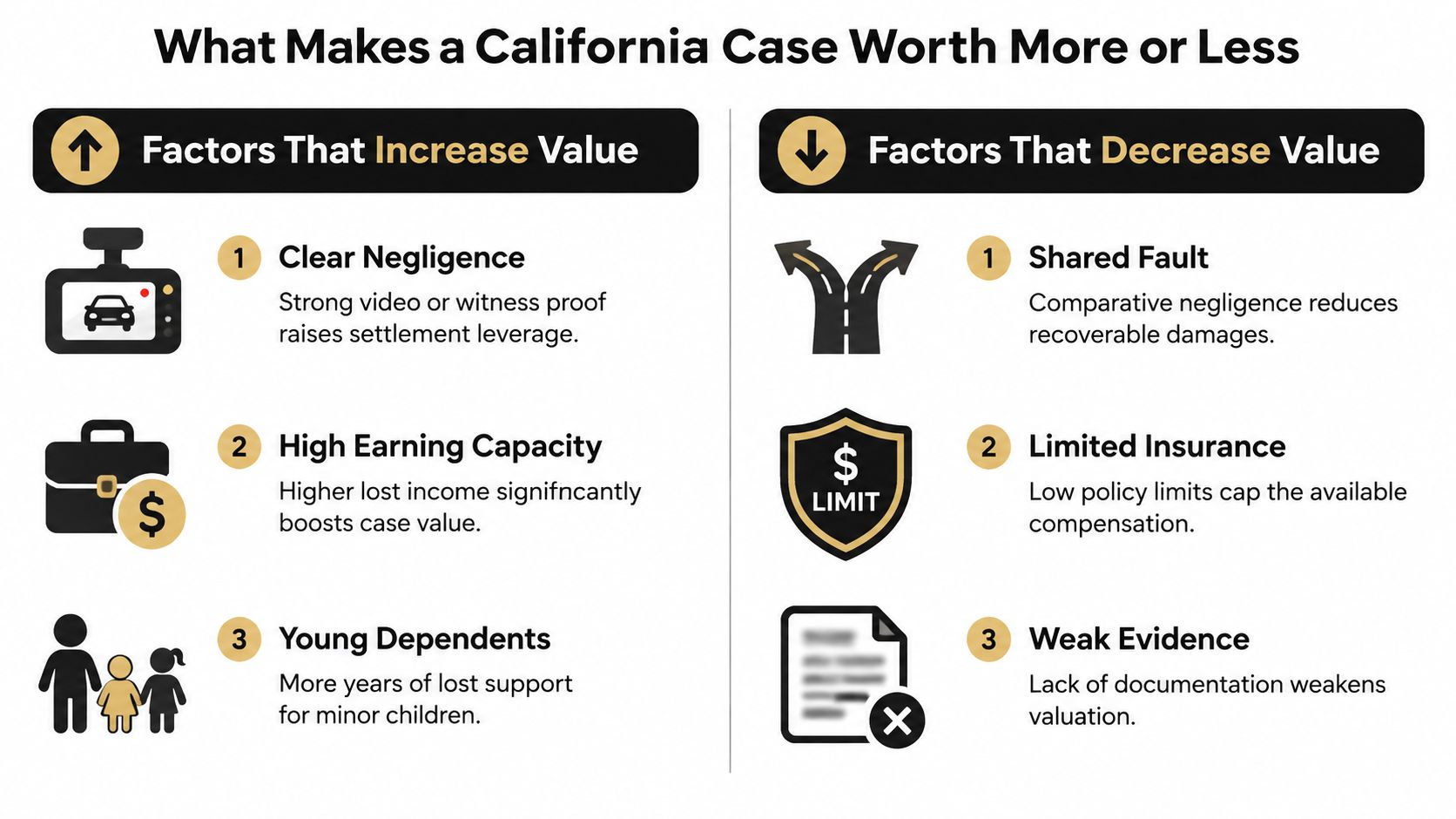
Liability strength comes first. A dashcam recording, surveillance footage, vehicle data, or independent eyewitness can make negligence easier to prove. An insurer may evaluate a claim more seriously when the evidence leaves little room for a competing account. By contrast, disputed speed, a contested traffic signal, or evidence that the decedent contributed to the collision can reduce practical value under California’s comparative-fault rule.
Collectability and the people involved
Insurance coverage can set the practical boundary of a settlement. A claim may have serious damages, but a policy with $30,000 in limits offers a different recovery path from a large commercial policy or multiple available policies. The defendant’s assets, additional insureds, umbrella coverage, and employer responsibility may affect what can be collected.
The decedent’s age, earnings trajectory, education, health, expected work life, and role in the household also shape the economic analysis. The number and age of dependents matter because support may have continued for different periods. Documentation of immigration status and the legal status of survivors can affect how experts and courts analyze expected earnings and eligibility, but status alone doesn’t answer the valuation question.
Venue may influence negotiations and trial strategy. Los Angeles, San Francisco, and Orange County cases can present different jury dynamics from cases in rural counties, but no venue guarantees a particular award. Family testimony also matters. Clear, credible descriptions of daily care, parenting, companionship, and financial dependence help the fact finder understand losses that records can’t fully capture.
Pre-existing health conditions don’t automatically defeat a claim. Under the eggshell-skull rule, a defendant generally takes a victim as found, though the defense may still contest causation, life expectancy, or the amount of claimed loss.
Settlement Versus Verdict in California Cases
A settlement exchanges trial risk for negotiated certainty. A verdict gives the jury the final say, but it can produce more or less than either side expected. Families should compare not just the headline amount, but also timing, costs, collectability, appeal risk, and the evidence available at the time of negotiation.
Federal Bureau of Justice Statistics data from 452 plaintiff-winning wrongful death trials reported a median jury award of $961,000 (federal civil jury benchmark). That historical figure describes trial outcomes, not a guaranteed California settlement. A separate 2019–2024 analysis of 956 cases reported an average of about $973,054 and a median of $294,728, with outcomes ranging from roughly $100,000 to more than $10 million (case-value analysis).
California outcomes can therefore run from a low-five-figure policy-limits settlement to a seven- or eight-figure verdict in an unusually strong, high-damage case. Those are qualitative California outcome categories, not a promise or a standard range. Insurance limits, liability, damages, available defendants, and statutory rules control the practical result.
| Factor | Settlement | Trial Verdict |
|---|---|---|
| Decision-maker | Parties and counsel | Judge or jury under applicable rules |
| Certainty | Known amount once finalized | Uncertain until verdict and post-trial process ends |
| Timing | Often faster than trial | Can extend through motions and appeal |
| Risk | Reduced litigation uncertainty | Either side may win or lose on disputed issues |
| Potential recovery | May be below a strong verdict | May exceed negotiation offers, or fall below them |
| Privacy and control | Terms can be negotiated | Court proceedings are generally public |
Trial may make sense where a corporate defendant refuses a reasonable offer, evidence of liability is compelling, or punitive damages are a serious possibility. It can also be unwise if insurance is limited, evidence is uncertain, or the family needs a prompt resolution. Families evaluating a hospital claim may also find guidance on maximizing a hospital wrongful death claim useful when considering records, expert review, and institutional responsibility.
Attorney Fees and Case Costs That Change Your Net Recovery
The settlement number isn’t the amount the family takes home. A contingency agreement usually explains the attorney’s percentage, when that percentage changes, and which case expenses come out of the recovery. In California practice, a fee may be 33⅓% before suit and rise to 40% after filing or near trial, but the written agreement controls and families should ask for every step in plain language.
Expenses can include filing fees, deposition transcripts, expert witnesses, accident reconstruction, medical-record retrieval, investigators, and exhibits. The agreement should state whether expenses are deducted before or after the attorney fee. Families should review this point before signing, not after a settlement arrives.
A $500,000 illustration
Assume a $500,000 settlement, a 33⅓% fee, and $20,000 in case expenses deducted after the fee:
| Line Item | Amount | Notes |
|---|---|---|
| Gross settlement | $500,000 | Negotiated recovery before deductions |
| Attorney fee at 33⅓% | About $166,667 | Based on the assumed pre-suit rate |
| Case expenses | $20,000 | Illustrative litigation and investigation costs |
| Estimated net recovery | About $313,333 | Before liens, medical reimbursement, or other obligations |
This is only a mathematical illustration. If the case reaches litigation and the agreement uses a 40% rate, the net changes. Medical liens, public-benefit reimbursement claims, estate administration, taxes, and allocation between survivor and survival claims may also affect distribution.
California’s CCP 377.34 reasonableness review can become important when the recovery is limited, particularly for fees connected to a survival claim. The court may examine whether the fee is reasonable in relation to the work and recovery. Families can compare fee provisions with this contingent fee agreement guide and ask counsel how the agreement handles unsuccessful litigation and advanced expenses.
Ask for a written distribution sheet before accepting a settlement. Gross recovery, fees, expenses, liens, and net payment are separate figures.
Practical Next Steps and a Plain-English Disclaimer
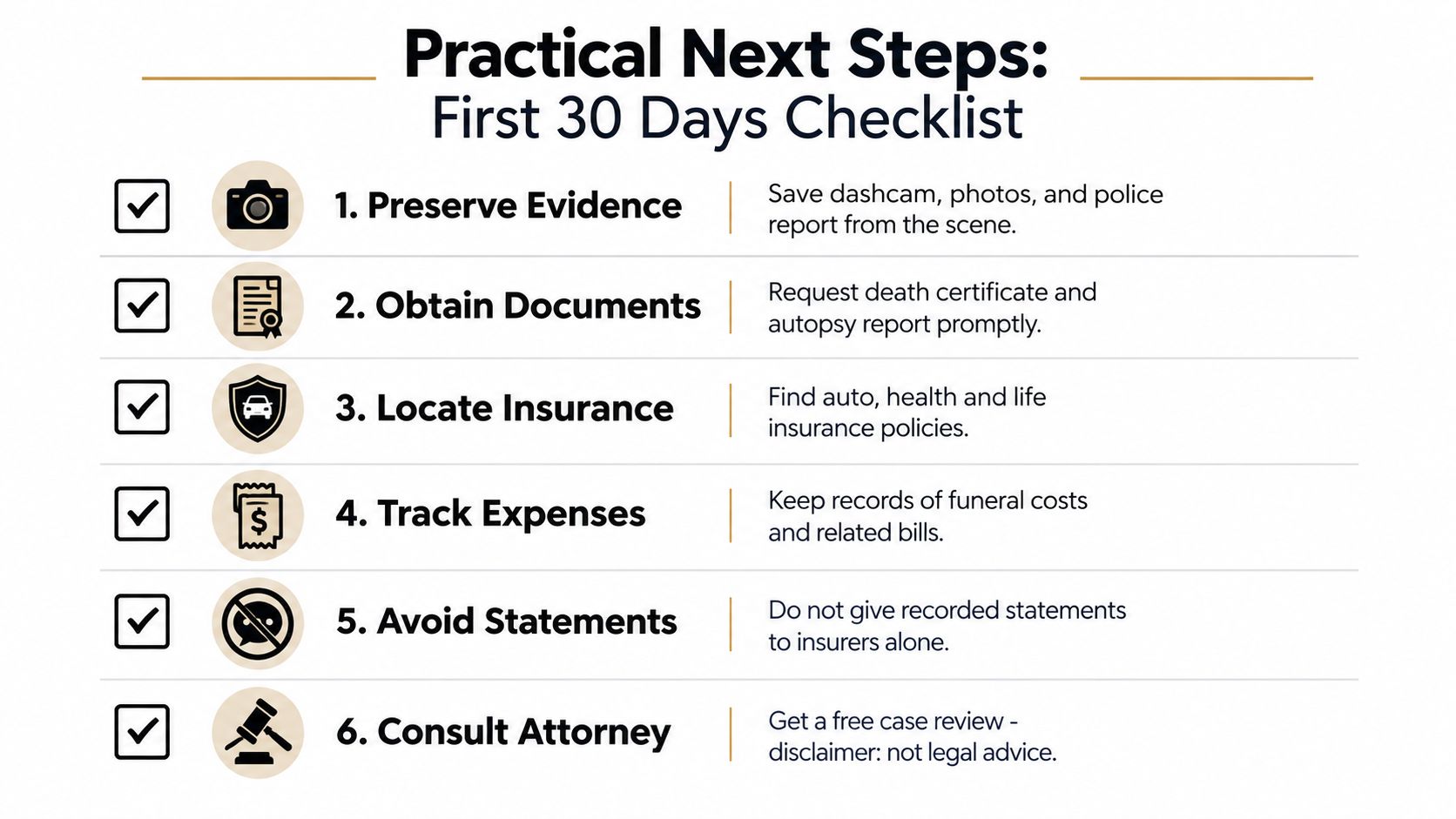
The first month after a death can affect what evidence remains and how clearly the family’s losses can be shown. Use it to preserve records, document household finances, and identify the people who relied on the decedent. The goal is not to decide the case value immediately. It is to keep the facts from becoming harder to prove.
A first-30-days checklist
- Preserve evidence: Save dashcam footage, photographs, text messages, vehicle information, incident reports, and witness contact details.
- Request records: Obtain the death certificate, autopsy materials, medical records, and available police or agency reports.
- Locate insurance: Gather auto, health, life, homeowners, employer, and commercial insurance information.
- Track expenses: Keep funeral invoices, travel costs, medical bills, household bills, childcare costs, and other death-related payments.
- Identify eligible heirs: List the surviving spouse, domestic partner, children, and anyone claiming financial dependence under CCP 377.60.
- Limit recorded statements: Do not give an insurer a recorded statement or sign a release before understanding the claim and requested documents.
Before hiring counsel, ask how the fee changes after filing suit, who advances case expenses, how experts are chosen, and whether the attorney has handled California wrongful death trials. Ask the lawyer to explain how the survivor claim and survival action may fit together, how insurance coverage affects collection, and whether liens or reimbursement claims may reduce the payment.
Confirm the filing deadline early. This California wrongful death deadline resource explains the applicable statute of limitations, but a general resource cannot determine the deadline for a particular family or claim. Delay can affect rights, so discuss the dates with a licensed California attorney.
This article is for informational purposes only and isn’t to be construed as legal advice. No attorney-client relationship exists based on the review of this article, and none of the information in this article is legal advice. California statutes, damage limits, and inflation adjustments can change. Only a licensed California attorney who reviews the evidence, family structure, financial records, insurance, and filing deadlines can evaluate a specific case.
LA Law Group, APLC offers California families an initial case assessment focused on liability, survivor and survival-action damages, insurance, deadlines, and likely net recovery. Visit LA Law Group, APLC to discuss the circumstances with a California legal team and determine which records to gather next.
Attorney Advertising. This article is general information, not legal advice, and does not create an attorney-client relationship. Prior results do not guarantee a similar outcome.