
How to Get Police Report: Easy Steps to Obtain Yours
So, you need a copy of a police report. It sounds simple enough, but knowing the right steps can make a world of difference. The process usually involves figuring out which police department handled the incident, pulling together some key details, and then formally asking for the report.
Most agencies let you request a copy in a few different ways: online, in person, or by mail. Your first move is to figure out which method is best for your situation.
Why Do You Even Need a Police Report?
A police report is the official story of what happened, as documented by a law enforcement officer. It’s packed with details you’ll need for insurance claims, a civil lawsuit, or sometimes just for your own records. After a car accident, for instance, your insurance company is almost guaranteed to ask for it before they’ll process your claim.
This guide will walk you through the most common ways to get that report, so you know exactly what to expect.
- For Insurance Claims: The report gives an unbiased account of the incident, which is crucial for proving the facts and getting your claim handled quickly.
- For Legal Proceedings: In a personal injury case or another type of lawsuit, the police report is often a foundational piece of evidence.
- For Personal Records: If you were a victim of theft or vandalism, having an official police report creates a paper trail that can be surprisingly useful down the road.
Disclaimer: This article is for informational purposes only and is not to be construed as legal advice. No attorney-client relationship exists based on the review of this article, and none of the information provided constitutes legal advice. You should consult with a qualified attorney for advice regarding your individual situation.
Why a Police Report Is a Critical Document

Before you even start the process of getting a police report, it’s important to understand why you’re doing it. This isn’t just another piece of paper to file away. A police report is the official, objective account of what happened—whether it was a fender bender, a theft, or any other incident that brought law enforcement to the scene.
For most people, it’s the single most important document for protecting their rights and their wallet.
Think about it from an insurance company’s perspective. After a car accident, they need a clear, unbiased story to process your claim. The police report provides exactly that, laying out the evidence and narrative needed to determine fault and get you paid for damages. Without one, you could be looking at serious delays or even an outright denial.
What’s Actually Inside a Police Report?
A well-written police report is a detailed record that breaks down the entire incident. Knowing what to look for helps you make sure it’s accurate and will be useful for your claim or case.
Here’s a quick rundown of what you’ll find:
- The Officer’s Narrative: This is the heart of the report. It’s the responding officer’s written summary of their observations and the sequence of events as they understood them.
- Party Information: You’ll find names, addresses, phone numbers, and insurance details for everyone directly involved.
- Witness Statements: Any accounts from bystanders or third-party witnesses are recorded here, offering perspectives that aren’t tied to either side.
- Incident Diagrams: Especially in traffic accidents, officers often include a simple drawing to show where the vehicles were and the points of impact.
This report often becomes the foundation for everything that follows, including how legal teams approach their legal case preparation.
This official documentation is the cornerstone for both insurance claims and legal action. Double-checking its details ensures you have a solid foundation, whether you’re dealing with an adjuster or an attorney down the road.
The way these reports are managed is influenced by data from over 16,000 law enforcement agencies across the U.S. In fact, statistics show that up to 20% of reported incidents end up needing an official police report for victim compensation or litigation. You can learn more about why filing a police report after an auto accident is crucial for your claim in our detailed guide on the subject.
Getting Your Ducks in a Row Before You Ask
One of the biggest hang-ups I see when people try to get a police report is showing up at the records department totally unprepared. A few minutes of prep work can turn a frustrating, back-and-forth process into a quick in-and-out task. Think of it like making a cheat sheet for the records clerk.
The absolute best thing you can have is the case or report number. If the officer on the scene gave you one, you’re golden. Your request will be a breeze. But don’t sweat it if you don’t have it—you can still get the report.
Key Details to Have on Hand
Without a case number, the clerk has to dig through their system to find the right file. You need to give them something to work with. Be ready to provide:
- Date and Time of the Incident: Get as specific as you can. “Last Tuesday” won’t cut it. You need the exact date and a rough time of day.
- Location of the Incident: This means a street address, the nearest intersection, or a major landmark. The more precise, the better.
- Names of Involved Parties: This is crucial. Provide the full names of any drivers, passengers, witnesses, or victims you know.
- Type of Incident: Just be clear about what happened—a car accident, a theft, a break-in, etc.
You will absolutely need to show a government-issued photo ID, like a driver’s license or passport. They have to confirm you are who you say you are and were actually involved in the incident. It’s a non-negotiable step to verify you have a legal right to access the report.
Most law enforcement agencies will require you to submit a formal request and prove you were involved. Access is typically governed by state public records laws, and while police reports are technically public records, they’re filled with sensitive information that needs to be protected. For a deeper dive, check out these insights on public records laws and crime data on jasher.substack.com.
Disclaimer: This article is for informational purposes only and is not to be construed as legal advice. No attorney-client relationship exists based on the review of this article, and none of the information provided constitutes legal advice.
Choosing the Right Way to Request Your Report
So you need a police report. The first thing you’ll discover is that there’s no single, universal method for getting one. The best approach really boils down to your local police department’s specific procedures, how quickly you need the document, and honestly, your own comfort level with technology.
Each path—online, in-person, and by mail—has its own quirks. Knowing the ins and outs of each one helps you pick the most efficient route for your situation.
It’s worth noting how much things have changed over the past couple of decades. The shift from old-school paper files to computerized databases has slashed processing times. What used to take weeks can now often be done in just a few days. This digital leap is precisely why online portals have become so common. You can get a deeper dive into the evolution of crime reporting systems from this CBS News piece.
No matter how you kick off the process, the basic flow is the same: figure out which agency has the report, submit your request, and then get the document. It’s a straightforward path, as you can see below.
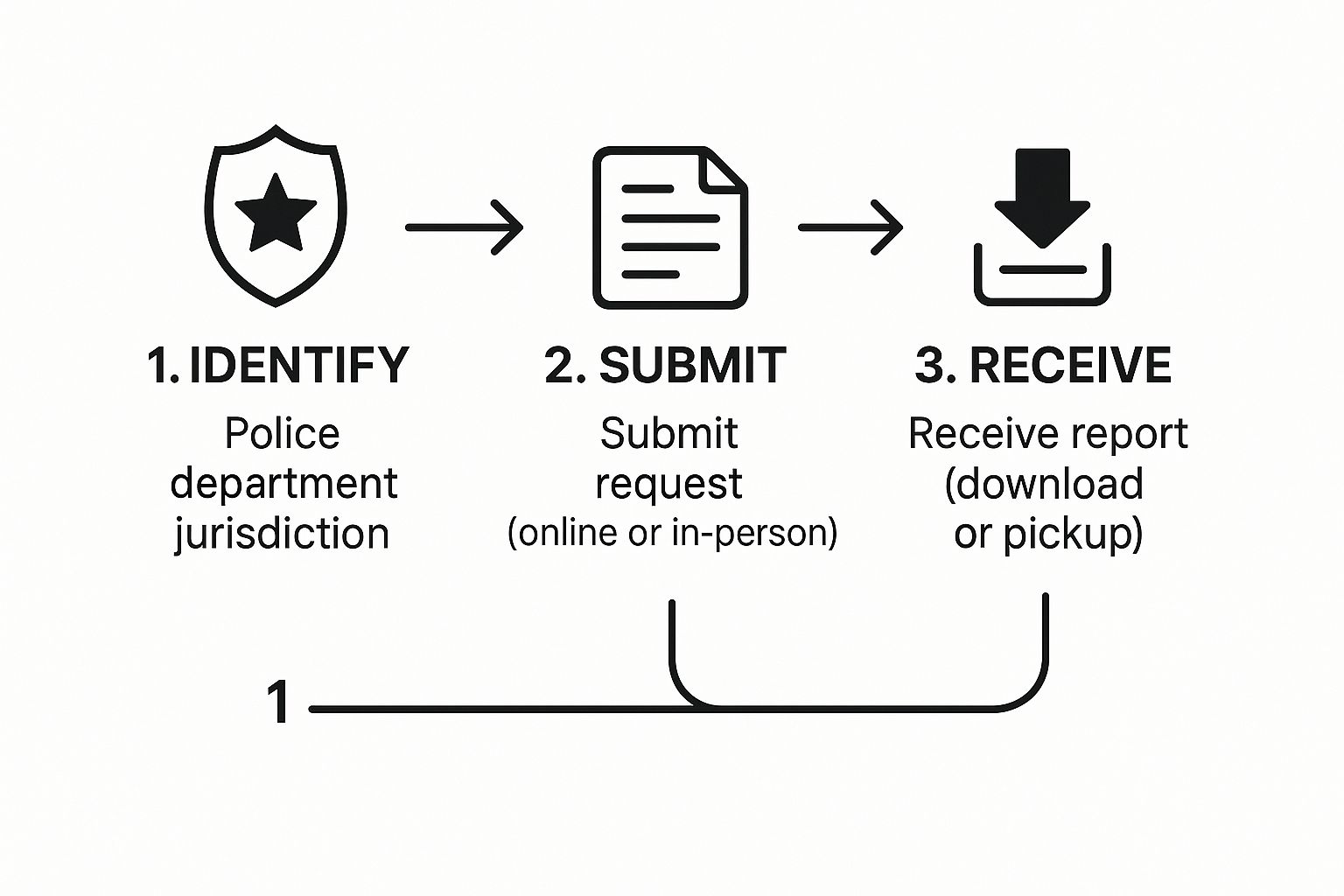
Let’s break down your options.
Going Digital: The Online Request Portal
For most people, the quickest way to get a police report is through the department’s online records portal. The majority of major cities and counties now offer this service. You’ll want to head to the police department’s official website and look for a link labeled “Records,” “Public Records,” or something similar like “Report Requests.”
The online process is usually pretty standard:
- You’ll fill out a digital form with all the incident details.
- Next, you’ll need to upload a clear copy of your government-issued photo ID.
- Finally, you’ll pay the fee online with a credit or debit card.
After you submit everything, you should get an email confirmation, often with a link to download the report as a PDF within a few business days. Just a heads-up, though: some municipal websites can be a bit clunky and frustrating to navigate.
My best tip for online requests: Be patient and meticulous. Double-check every single piece of information before you hit “submit.” A simple typo in a case number or a date can trigger an automatic rejection, forcing you to start the whole process over again.
The Old-Fashioned Way: An In-Person Visit
If you’d rather deal with a real person—or if the website is giving you a headache—visiting the police department’s records division is a perfectly solid choice. This way, you can ask questions on the spot and get immediate confirmation that your request was received correctly.
Just make sure you bring all your information and a valid photo ID. A clerk will hand you a request form to fill out and will take your payment for the fee. If they aren’t too busy and the report is ready, you might even walk out with a copy that very day.
Tried and True: The Mail-In Request
Finally, there’s the mail. This is the most traditional method and, in some smaller towns or jurisdictions, it might be your only option. You’ll typically need to find the correct form on the department’s website, print it, and fill it out by hand.
From there, you’ll mail the completed form, a photocopy of your ID, and a check or money order for the fee. Be warned, this is by far the slowest method. Only go this route if the online and in-person options are off the table. And whatever you do, triple-check that you’ve included every single required item to avoid your request getting sent right back to you.
Comparing Police Report Request Methods
To make it easier to decide, I’ve put together a quick comparison of the three methods. This table lays out the pros and cons of each, helping you see at a glance which one is the best fit for your needs.
| Method | Typical Speed | Convenience Level | Common Requirements |
|---|---|---|---|
| Online | 1-5 business days | High (24/7 access) | Case number, date, photo ID, credit/debit card |
| In-Person | Same day to a few days | Medium (business hours only) | Case number, date, photo ID, various payment forms |
| By Mail | 1-3 weeks or more | Low (slowest process) | Printed form, photo ID copy, check/money order |
Ultimately, your choice depends on balancing speed and convenience. If you need the report quickly, online is almost always your best bet. But if you have questions or prefer a more direct approach, nothing beats an in-person visit.
Navigating Fees, Timelines, and Common Delays
Knowing how to get your hands on a police report is only half the battle. You also need a realistic grasp of the costs and, just as importantly, the potential wait times involved.
Requesting a report is rarely free, though thankfully, the fees are usually quite modest. Most police departments will charge a small administrative fee to cover the costs of processing and copying. This typically runs anywhere from $5 to over $25, depending on the department and how complex the report is.
If you’re using an online portal, you’ll almost always need a credit or debit card. For in-person requests, you might have the option to pay with cash or a check.
Understanding the Wait
So, how long will it take? The timeline for getting your report can vary wildly. A simple traffic accident report might be ready for you in just a few business days. But if the report is tied to a more serious incident, you’ll need to prepare for a much longer wait.
If your request involves an active criminal investigation, you can definitely expect delays.
The police department might hold off on releasing the report for weeks, or even months, to protect the integrity of their ongoing investigation. In these situations, the document won’t be made public until the case is closed or charges have officially been filed.
Another common holdup is redaction. Before releasing a report, law enforcement is legally required to black out sensitive information. This could include Social Security numbers, the names of juveniles, or details about confidential informants. This review process takes time and can easily add several days to your wait.
If you were involved in a car crash, you can learn more about navigating the aftermath and your legal roadmap while you’re waiting for the official report. The key is to be patient, but don’t be afraid to follow up politely if the expected timeline comes and goes.
Disclaimer: This article is for informational purposes only and is not to be construed as legal advice. No attorney-client relationship exists based on the review of this article, and none of the information provided constitutes legal advice.
What to Do When Your Request Is Denied
It’s incredibly frustrating to get a denial letter after you’ve gone through the process of requesting a police report. But don’t assume you’ve hit a dead end. More often than not, there’s a straightforward, legitimate reason behind it.
The most common culprits are an ongoing investigation or the need to protect sensitive information, like the identities of juveniles. Law enforcement has to be careful. Releasing a report prematurely could seriously compromise an active case, so they often hold off until the investigation is closed.
Sometimes, the reason is much simpler—it could just be a minor administrative error on your application.
Understanding the Denial and Taking Action
Your first move is to figure out exactly why your request was turned down. Don’t just accept the denial at face value.
- Request the Reason in Writing: Politely reach out to the records division and ask for the specific legal statute or reason they’re citing for the denial. Getting it in writing is key.
- Correct Any Errors: If the rejection was due to a simple mistake like missing information or a typo on your form, you can usually just fix the application and resubmit it. Easy fix.
- Consider an Appeal: Most jurisdictions have a formal appeals process. This might mean submitting a written appeal to a supervisor or a designated city records officer.
If you hit a wall and feel the denial is improper, you might start thinking about your legal options. It’s helpful to have a basic grasp of how legal professionals manage these kinds of official processes. For instance, understanding law firm phone answering services offers a small peek into how legal teams handle critical client communications, which is a big part of dealing with official documents and tight deadlines.
Disclaimer: This article is for informational purposes only and is not to be construed as legal advice. No attorney-client relationship exists based on the review of this article, and none of the information provided constitutes legal advice.
Common Questions About Getting Police Reports

Even once you have the basic steps down, a few specific questions always seem to pop up. Let’s walk through some of the most common ones I hear from clients to make sure you’re completely clear on the process.
How Long Do Police Departments Keep Reports?
This is a big one. Generally, police departments are required to keep reports for a certain number of years, but that timeline can vary wildly depending on the state and the seriousness of the incident.
For example, a minor traffic accident report might only be kept for a few years. On the other hand, records for serious felonies could be held onto indefinitely. It all comes down to local and state record retention laws.
Can Someone Else Request the Report for Me?
Absolutely. In fact, it’s often a smart move to have your lawyer or insurance agent request the police report on your behalf. This is standard procedure for them, and they know exactly how to handle the paperwork and any necessary follow-up.
Having a professional handle this can be a huge relief, especially when you’re already trying to figure out what to do after a car accident and protect yourself legally.
Is the Police Report Always Correct?
It’s critical to remember that a police report, while an official document, isn’t infallible. It represents the responding officer’s summary and perspective of what happened, often gathered under chaotic circumstances.
The information in a police report is not always 100% accurate. It can absolutely be disputed with evidence during an insurance claim or in court.
Disclaimer: This article is for informational purposes only and is not to be construed as legal advice. No attorney-client relationship exists based on the review of this article, and none of the information provided constitutes legal advice.
If you’re dealing with the aftermath of an accident and need help obtaining documents or protecting your rights, the team at LA Law Group, APLC is here to assist. Contact us for a free consultation to discuss your case by visiting https://www.bizlawpro.com.
Attorney Advertising. This article is general information, not legal advice, and does not create an attorney-client relationship. Prior results do not guarantee a similar outcome.