
How to Negotiate Contracts Without Losing Leverage

The contract is sitting in your inbox, the other side wants a signature by Friday, and your team has already spent more time debating the document than discussing whether the deal truly works. You’re tempted to accept the supplier’s form, make a few redlines, and hope the important points sort themselves out later. That approach usually gives away bargaining power before the negotiation has properly started.
Learning how to negotiate contracts means managing more than wording. You need to control the starting template, separate essential protections from preferences, understand your alternative if the deal fails, and create a review process that keeps decisions accountable. That matters whether you run a small business, sell through Amazon, or provide recurring professional services.
What Successful Contract Negotiation Really Looks Like
A local retailer needed a fulfillment partner before its seasonal demand increased. The supplier sent a familiar agreement with fixed payment terms, broad rights to use customer data, an automatic renewal provision, and liability language that placed most delivery risk on the retailer. The owner initially focused on the monthly fee. After reviewing the operational terms, the more important questions became clear: Who would absorb losses from damaged inventory? How quickly would the provider respond to service failures? Could the retailer exit if performance deteriorated?
The negotiation improved when the owner stopped treating every sentence as a separate battle. The parties agreed on measurable delivery responsibilities, a defined process for resolving inventory discrepancies, a practical termination right, and a renewal discussion tied to performance. The supplier kept protections it needed, while the retailer avoided accepting open-ended operational risk. That’s a durable negotiation outcome, not just a lower price.
A successful agreement should do four things:
- Serve the business purpose: The contract must support the transaction the parties intend to perform.
- Define performance clearly: Each side should know what it must deliver, when it must deliver it, and what happens when it doesn’t.
- Allocate risk deliberately: Liability, indemnification, insurance, confidentiality, and intellectual property terms should reflect the actual operation.
- Preserve useful flexibility: A durable agreement leaves room for future changes instead of forcing every later adjustment into a dispute.
Historical bargaining data illustrates why patience and deadline management matter. A 1998 Bureau of Labor Statistics review found that 92.6% of union respondents and 90.3% of management respondents said they reached agreement, while about 53% of both groups reported settlements within 1 month of the contract expiration date. The review also described more than 100,000 collective bargaining contracts covering roughly 9 million private-sector workers at that time, demonstrating how structured negotiation can operate at scale. The Bureau of Labor Statistics review also found that airline labor negotiations averaged 1.3 years and about half entered federal mediation, a reminder that complex agreements can require formal processes and extended timelines.
Practical rule: A deadline should focus decisions, not force you to accept risk you haven’t evaluated.
For a broader operating framework, review these contract management best practices 2026 after the negotiation, especially if your business manages recurring vendor, customer, or eCommerce agreements. The signed document is only useful when your team can find it, understand it, and follow it.
How to Prepare So You Negotiate From Strength
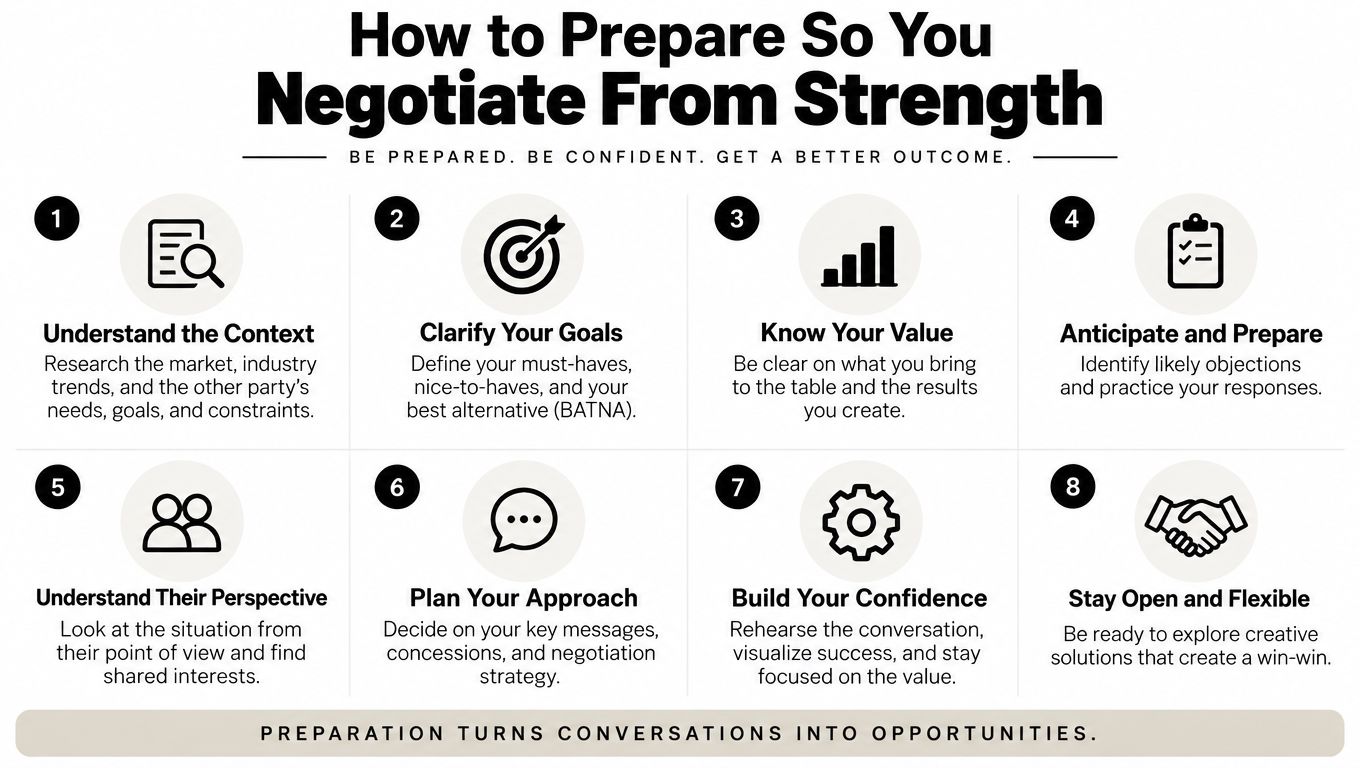
A supplier sends its standard agreement with a short deadline. If you start by redlining line by line, the other side controls the sequence and may frame every change as a concession. Preparation gives you a decision system before that pressure arrives. Create a one-page sheet listing your objectives, limits, alternatives, approval requirements, and the language you will use if discussions stall.
Start with the deal you need
State the business outcome in plain language. A service provider may need predictable payment timing and permission to reuse general know-how. An eCommerce seller may need clear responsibility for chargebacks, inventory loss, marketplace compliance, and customer support. A small business buying software may value reliable data access at termination more than a minor price reduction.
Sort terms into three groups:
- Must-haves: Requirements you cannot accept without, such as ownership of your work product or a liability cap.
- Tradeable points: Items you can exchange for value, including invoice timing, reporting frequency, or implementation flexibility.
- Nice-to-haves: Useful improvements that should not consume negotiation capital.
Identify your BATNA, or best alternative to a negotiated agreement. If the supplier fails, can you use another vendor? If the client rejects your terms, can you take different work? If an Amazon-related service provider refuses reasonable responsibility for account or inventory issues, what practical alternative can you activate?
Set a walk-away point that guides action. “I want a fair deal” is not a limit. “I will not accept uncapped liability for losses outside my control” is.
Control the first draft
The opening template establishes defaults for risk allocation, notices, payment mechanics, warranties, and remedies. A 2025 procurement benchmark reported that 60% of enterprise contracts originated on the supplier’s template rather than the buyer’s standard form, according to Procurement Tactics’ negotiation statistics. Template control does not guarantee better terms, but it reduces the work required to replace unfavorable fallback language.
Use your own form when possible. If the counterparty insists on its template, build a clause map showing what each provision does compared with your preferred position. Teams creating a reusable starting document can review this guide on how to draft contracts, then tailor the form to the transaction instead of copying provisions blindly. For recurring agreements, store approved alternatives and require human review before AI-generated edits enter the negotiation workflow.
Limit the room and research the counterparty
Find out who controls price, risk, implementation, and legal language on the other side. Review the counterparty’s operating model, customer concentration, delivery dependencies, public terms, and likely pressure points. The person sending a redline may lack authority to approve the change.
Keep your internal team small. The research described in peer-reviewed contract negotiation analysis examined typical sessions involving about 5 people per side, lasting 1 hour, followed by 3 hours of internal discussion with 5–7 participants. More voices can improve issue spotting, but inviting every stakeholder to every call raises cost and slows decisions. Assign one commercial lead, one operational owner, and legal support when the risk warrants it. One person should own the issue list, fallback language, and final approval path.
Key Clauses and Red Flags Every Business Should Review
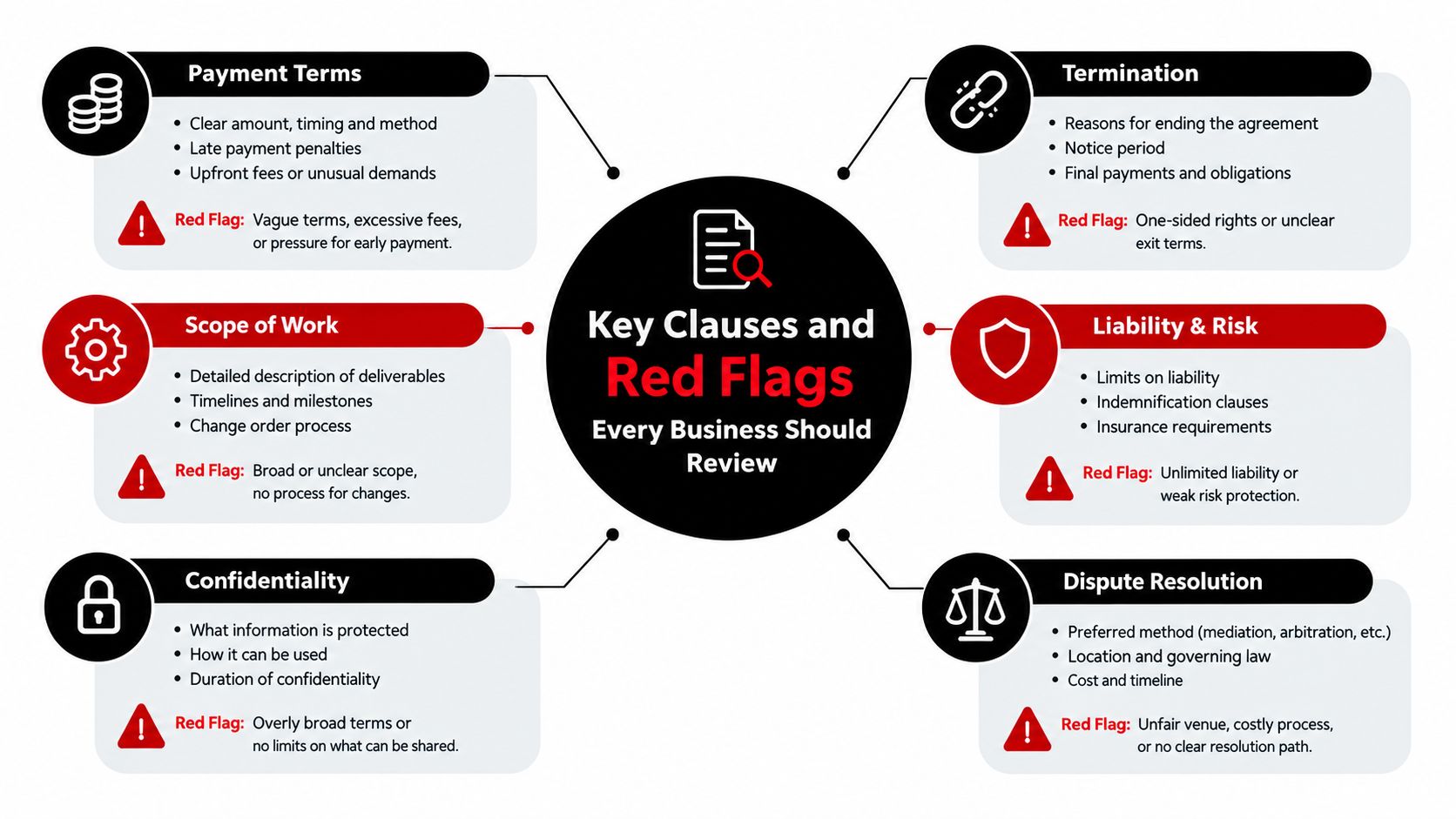
A contract can look polished and still leave the business exposed. Review clauses by operational risk, not by their order on the page. Start with scope, money, exit rights, liability, intellectual property, and dispute mechanics. Then test whether each provision gives the team a workable process when performance, payment, or ownership becomes contested.
Translate the language into operating consequences
Scope and deliverables should state what the provider will do, what the customer must supply, how acceptance works, which milestones apply, and how changes are approved and priced. “Industry-standard service” sounds acceptable but gives neither side a reliable test if a dispute arises. A cleaning company, marketing agency, or software developer needs deliverables that someone can verify.
Payment terms should cover invoicing, disputed charges, taxes, late fees, refunds, credits, and the effect of nonpayment. An eCommerce seller also needs the agreement to distinguish ordinary payment disputes from marketplace holds, chargebacks, returns, and inventory claims. Those events can interrupt cash flow even when the seller has performed its own obligations.
Termination and renewal can determine whether a manageable problem becomes a costly lock-in. Automatic renewal is risky when the notice window is easy to miss. Request clear renewal notice, a practical nonrenewal process, termination for an uncured material breach, and an orderly handoff of data, inventory, or customer work.
Liability and indemnification decide who pays when something goes wrong. Check for uncapped exposure, consequential-loss exclusions that protect only one side, broad indemnities, and duties triggered by allegations rather than established responsibility. A service provider should not accept responsibility for every claim connected to a customer’s instructions, systems, or decisions.
Intellectual property and confidentiality should separate preexisting materials, customer data, commissioned work, tools, templates, feedback, and general skills. A client may own a final website design while the developer retains reusable code libraries and general methods. State those boundaries directly, including any license the customer needs to use the deliverables.
Dispute resolution and governing law affect the cost and location of a disagreement. Review notice requirements, venue, arbitration language, attorneys’ fees, emergency relief, and escalation steps. A process that appears efficient on paper may be impractical for a small business located far from the chosen forum.
Use fallback language instead of rejecting everything
Review time is limited, so prioritize provisions that can affect cash, continuity, ownership, or the company’s ability to keep operating. A practical clause map gives the negotiator a preferred position, an acceptable fallback, and a point requiring approval. That structure also gives an AI-assisted workflow clear boundaries. AI can compare language and flag deviations, but a person should approve risk acceptance and any edit outside the approved alternatives.
| Clause Area | Red Flag Language | Balanced Fallback to Propose |
|---|---|---|
| Liability | “All losses arising from or related to the services” | Limit liability to a defined amount, with tailored exceptions for specific serious misconduct or confidentiality and IP violations |
| Indemnification | One party indemnifies every claim connected to the relationship | Limit indemnity to third-party claims caused by the indemnifying party’s breach, negligence, or misconduct |
| Termination | Termination only at the counterparty’s discretion | Permit termination for material uncured breach, insolvency, and defined convenience rights with reasonable notice |
| Auto-renewal | Renewal occurs automatically with an easy-to-miss notice deadline | Require clear renewal notice and allow nonrenewal through a practical written process |
| Intellectual property | “All work product and related materials belong exclusively to the customer” | Assign specifically paid-for deliverables while preserving preexisting tools, methods, and reusable materials |
| Performance | “Prompt,” “high quality,” or “satisfactory” without standards | Add objective deliverables, acceptance criteria, service levels, cure periods, and change-order rules |
For small businesses, the fallback should match actual capacity. A service provider may accept a defined cure period instead of immediate termination. An eCommerce seller may need specific treatment for platform suspensions and inventory disputes. If several owners share revenue or decision rights, review business partnership agreements for governance issues that a basic vendor form will not address. The goal is a contract the team can administer, not a document that wins every sentence and fails during the first operational problem.
Negotiation Tactics and Language That Move Deals Forward
Strong negotiators don’t merely demand changes. They explain the business reason, ask questions that reveal priorities, and trade issues instead of arguing over every sentence.

Replace positional language with usable phrasing
Weak language sounds absolute but often produces resistance:
“We never accept your indemnity clause. Delete it.”
A more productive version identifies the concern and proposes a path:
“The current indemnity makes us responsible for claims we may not control. We can accept responsibility for claims caused by our breach, negligence, or misconduct, with the usual notice and defense procedures.”
Use diagnostic questions before offering concessions:
- Ask about priority: “Which part of this provision is most important to your team?”
- Test the risk: “What loss are you trying to protect against?”
- Clarify the operation: “How would this work if the marketplace suspends the account without either party being at fault?”
- Expose ambiguity: “What event would cause you to say the service failed?”
If you make the first proposal, anchor it in a reason. A service provider might say, “Our fee reflects the defined response time, reporting obligations, and dedicated support included in the scope.” A buyer might say, “We can commit to this volume if the supplier accepts the delivery schedule and remedy structure.”
When the other side reacts strongly, don’t immediately retreat. Say, “It sounds like that term creates a problem. Which element is difficult, the amount, the timing, or the principle?” That response converts a reaction into information.
Trade, don’t donate
“Can you lower the price?” should not receive an isolated yes or no. Tie the answer to another variable:
“If you can commit to a longer initial term, we can discuss the rate. If the term stays flexible, we’d need the current pricing to remain.”
For practical examples of presenting scope, timing, and value in a small service business, these tips for solo cleaning business proposals offer useful commercial context.
AI changes the review dynamic, but it doesn’t remove accountability. A 2026 industry report says 44% of organizations already use AI in contracting, while 53% of executives expect AI agents to autonomously negotiate customer and supplier deals within 12 months, as reported in coverage of the World Commerce and Contracting report. If the other side sends machine-generated redlines, ask what business objective each change serves. If your own system proposes language, record who reviewed it, what source clause informed it, and whether the final wording matches the approved risk position.
Watch this practical negotiation discussion after reviewing the written terms, not instead of doing so:
How to Trade Concessions and Close Without Regret
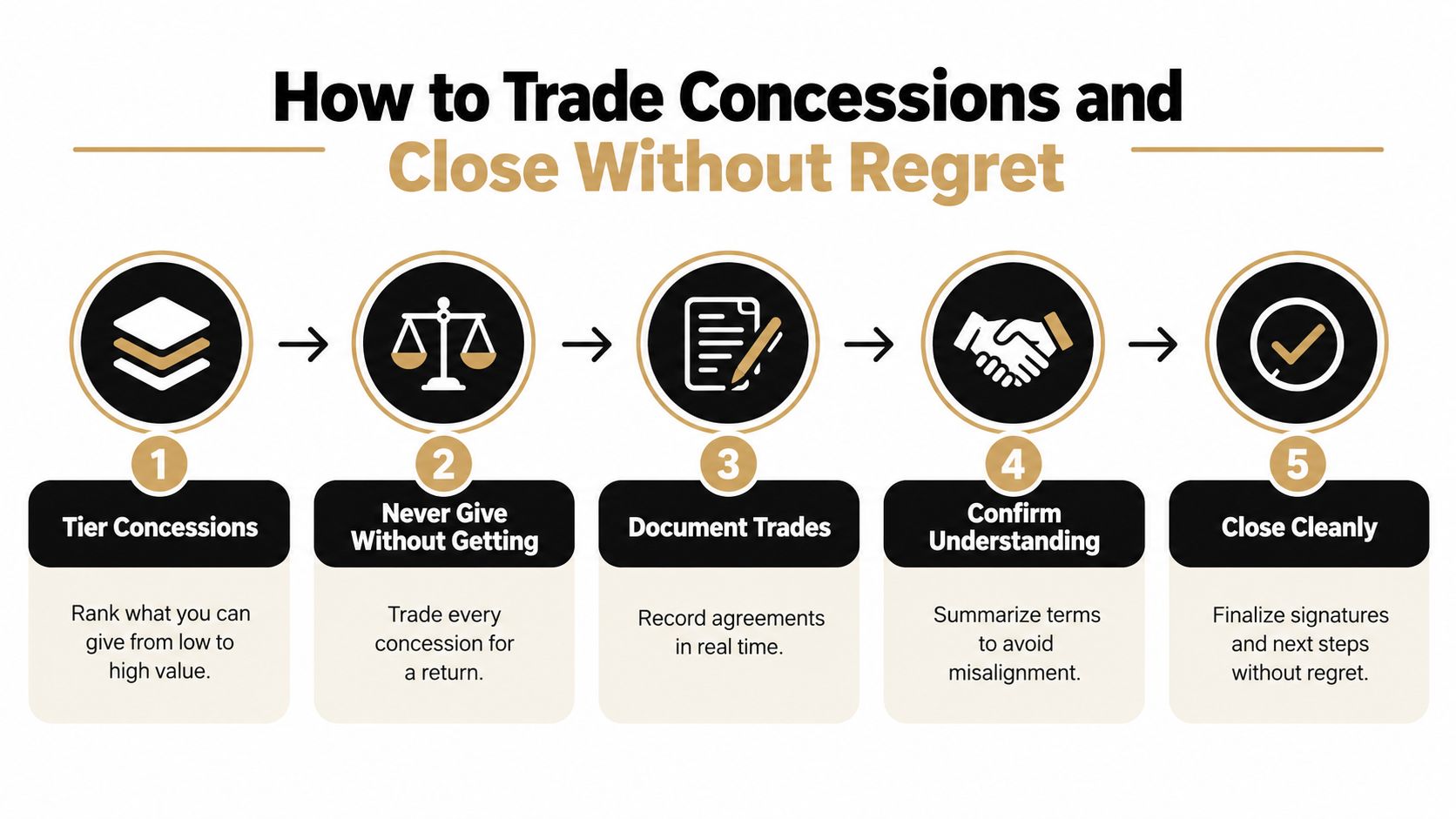
A concession has value even when it costs you little to perform. Faster approval, flexible delivery, a reference, a longer term, or a broader license may matter greatly to the counterparty. Plan those points before the call so pressure doesn’t turn them into free gifts.
Build a concession ladder
Rank possible concessions from low value to high value. For a vendor, you might offer a flexible implementation date before agreeing to a longer commitment. For a customer, you might offer additional reporting before accepting a broader warranty.
Use conditional language every time:
“If you can accept the liability cap, we can move on the invoice timing.”
“If you need the termination right, we’ll need the minimum volume commitment.”
Avoid exchanging two changes without recording what each party received. Keep a live issue list with four columns: the requested change, your response, the return obligation, and the person authorized to approve it. That record prevents a late-stage misunderstanding where one party treats a discussion as a final agreement.
Set approval and escalation rules
Decide in advance which terms require owner, finance, operational, or attorney approval. Escalate when the counterparty requests uncapped liability, transfers core intellectual property, demands a personal guarantee, expands data rights, or changes dispute procedures in a way your business can’t practically use.
Technology can support this discipline. A 2025 state-of-contracting report found AI adoption for contract review rose 75% year over year, from 8.1% to 14%, according to LegalOn Technologies’ report. Use automated review to identify deviations, summarize changes, and maintain an issue register. Don’t let a tool approve a risk allocation that your business owner or counsel hasn’t accepted.
Close the complete deal
Before signing, confirm:
- Commercial terms: Price, taxes, payment timing, credits, volume commitments, and expenses.
- Operational terms: Scope, milestones, acceptance, service levels, reporting, support, and dependencies.
- Risk terms: Liability, indemnity, insurance, confidentiality, data use, and intellectual property.
- Exit terms: Term, renewal, termination, transition duties, and post-termination access.
- Execution terms: Final exhibits, signature authority, effective date, notice addresses, and storage of the executed copy.
A clean close includes a short written summary of what changed and what each team must do first. If the contract says one thing and the implementation email says another, resolve the conflict before signature.
When to Involve an Attorney and Final Takeaways
You can often handle a straightforward, low-risk agreement when the scope is clear, the value is manageable, the other side uses balanced terms, and your business understands the obligations. A short vendor order with defined deliverables is different from a long-term distribution agreement, an intellectual property transfer, or a contract that exposes your personal assets.
Bring in counsel when the agreement includes uncapped liability, broad indemnification, personal guarantees, transfer of core intellectual property, sensitive personal data, regulated activity, exclusivity, non-compete restrictions, complex revenue sharing, or meaningful termination costs. Counsel can also help when the counterparty refuses to explain a material clause, when several documents conflict, or when a missed deadline could lock your business into an unwanted renewal.
The cost question should be practical, not emotional. If professional review costs less than the risk created by one ambiguous ownership clause, an uncapped obligation, or an unusable dispute process, review may be the more economical choice. It is worth asking whether the attorney offers a defined consultation, flat-fee review, redline support, or a staged process that begins with the highest-risk provisions. California businesses can explore California contract lawyer services when the agreement requires jurisdiction-specific analysis.
Use this closing checklist:
- Confirm your must-haves and walk-away points.
- Check whether the starting template shifts defaults against you.
- Tie every concession to a return.
- Verify that scope and remedies match actual operations.
- Escalate material risk instead of approving it under deadline pressure.
- Make sure the final signed version includes every agreed exhibit and change.
- Store the executed contract where the people performing it can find it.
This article is for informational purposes only and isn’t to be construed as legal advice. No attorney-client relationship exists based on your review of this article, and none of the information in this article is legal advice. This material isn’t a substitute for obtaining advice from a qualified attorney, and reading or using it doesn’t create an attorney-client relationship.
LA Law Group, APLC offers contract formation, review, and negotiation support for California businesses and eCommerce operators, including help identifying risk, marking up agreements, and developing practical revisions. Visit LA Law Group, APLC to discuss your contract and determine the right next step.
Attorney Advertising. This article is general information, not legal advice, and does not create an attorney-client relationship. Prior results do not guarantee a similar outcome.