
How to Prove Pain and Suffering in a California Injury Claim

When you’re trying to prove pain and suffering, you need to show the real, human side of your injuries—the story that goes way beyond medical bills. This means collecting evidence that paints a clear picture of your daily struggles, like your medical records, a personal journal, and even statements from friends or family who have seen how the accident changed your life.
Disclaimer: This article is for informational purposes only and is not to be construed as legal advice. No attorney-client relationship is created by reviewing this article, and none of the information herein constitutes legal advice.
What Does Pain and Suffering Mean in a California Claim?
Before you can prove pain and suffering, you first have to get a handle on what the term actually means in a California personal injury case. It’s not just a vague idea; it’s a specific legal concept covering non-economic damages. Think of these as the personal, human costs of an injury that don’t come with a receipt or an invoice.
This is the compensation for all the physical discomfort and emotional turmoil you endure after an accident. It’s the chronic pain that keeps you from picking up your kids, the spike of anxiety you feel every time you have to drive, or the simple loss of joy because you can’t go hiking or play your favorite sport anymore.
The Two Sides of Your Claim
Every personal injury case really boils down to two types of damages. Getting this distinction is crucial for building a solid claim.
- Economic Damages: These are the straightforward, calculable financial losses. We’re talking about things like hospital bills, prescription costs, lost paychecks from being out of work, and repair costs for your car.
- Non-Economic Damages: This is where pain and suffering lives. These damages are subjective, designed to compensate you for the ways the injury has impacted your quality of life.
Because there’s no price tag on emotional distress or chronic pain, non-economic damages are almost always the most fought-over part of any claim. Insurance companies will often try to minimize what you’re going through, arguing you’re exaggerating or that your suffering isn’t directly tied to the accident. That’s exactly why your evidence needs to be so detailed and compelling. You can learn more in our detailed guide on what qualifies as pain and suffering in California personal injury claims.
A strong pain and suffering claim tells the whole story. It’s not just about the moment of injury, but about every part of your life that’s been disrupted since—from how you sleep at night to your ability to simply enjoy a day with your family.
Real-World Examples of Pain and Suffering
Let’s put this into perspective with a couple of real-world scenarios. Imagine someone who suffers a bad leg fracture after a slip-and-fall. Their pain and suffering isn’t just the initial break. It’s the ongoing ache, the multiple surgeries, and the new fear of walking on slick surfaces.
Or consider someone in a serious car crash. Even after their broken bones and bruises heal, they might be left with PTSD, constant nightmares, and a deep depression that wasn’t there before.
These examples show that “pain and suffering” is a wide-ranging term covering all sorts of human experiences. Your job—and your attorney’s—is to translate these very real, personal struggles into concrete evidence that an insurance adjuster or a jury can truly understand and assign a value to.
Disclaimer: This article is for informational purposes only and is not to be construed as legal advice. No attorney-client relationship is created by reviewing this article, and none of the information herein constitutes legal advice.
Using Medical Records to Document Your Injuries
After an accident, your medical records are hands-down the most powerful tool you have for proving pain and suffering. They provide the objective, professional proof that insurance companies and juries need to see. This isn’t just a stack of papers; it’s the official story of your injury and your path toward recovery.
Think of each record as a chapter in that story. The initial ER report, notes from your physical therapist, prescription receipts—they all work together to build a clear, undeniable timeline. This paper trail directly links your injuries to the accident and illustrates just how much treatment you’ve needed to get better.
This is exactly why you must see a doctor right after an accident, even if you think you’re “fine.” Any delay or gap in treatment is an open invitation for an insurance adjuster to argue that your injuries weren’t that serious or, worse, that they were caused by something else entirely.
What Your Medical File Should Contain
A meticulously organized medical file is your best asset. You need a complete collection of every single document related to your care. Don’t dismiss anything as unimportant, because a seemingly minor detail can often become a critical piece of evidence.
Your file should include, at a minimum:
- Emergency Room Reports: This is ground zero. These documents establish what happened immediately after the crash, detailing your initial injuries and the care you received.
- Physician and Specialist Notes: Records from your family doctor, orthopedist, neurologist, or any other specialist provide a running commentary on your condition and prognosis.
- Diagnostic Test Results: We’re talking about the hard proof—X-rays, MRIs, and CT scans that visually confirm the physical damage you’ve suffered.
- Physical Therapy and Rehabilitation Logs: These are gold. They document your progress, your setbacks, and the sheer effort it takes to regain function, offering concrete evidence of your daily struggles.
- Prescription Receipts: A list of medications prescribed for pain, anxiety, or insomnia directly backs up your claims of both physical pain and emotional distress.
It’s also crucial to include records from any specialized providers. For instance, if you suffered complex wounds that required ongoing attention from a clinic offering specialty wound care services, that documentation powerfully demonstrates the severity of your injuries and the intensive treatment involved.
The infographic below breaks down the key elements you’re trying to prove, all of which are supported by strong medical documentation.
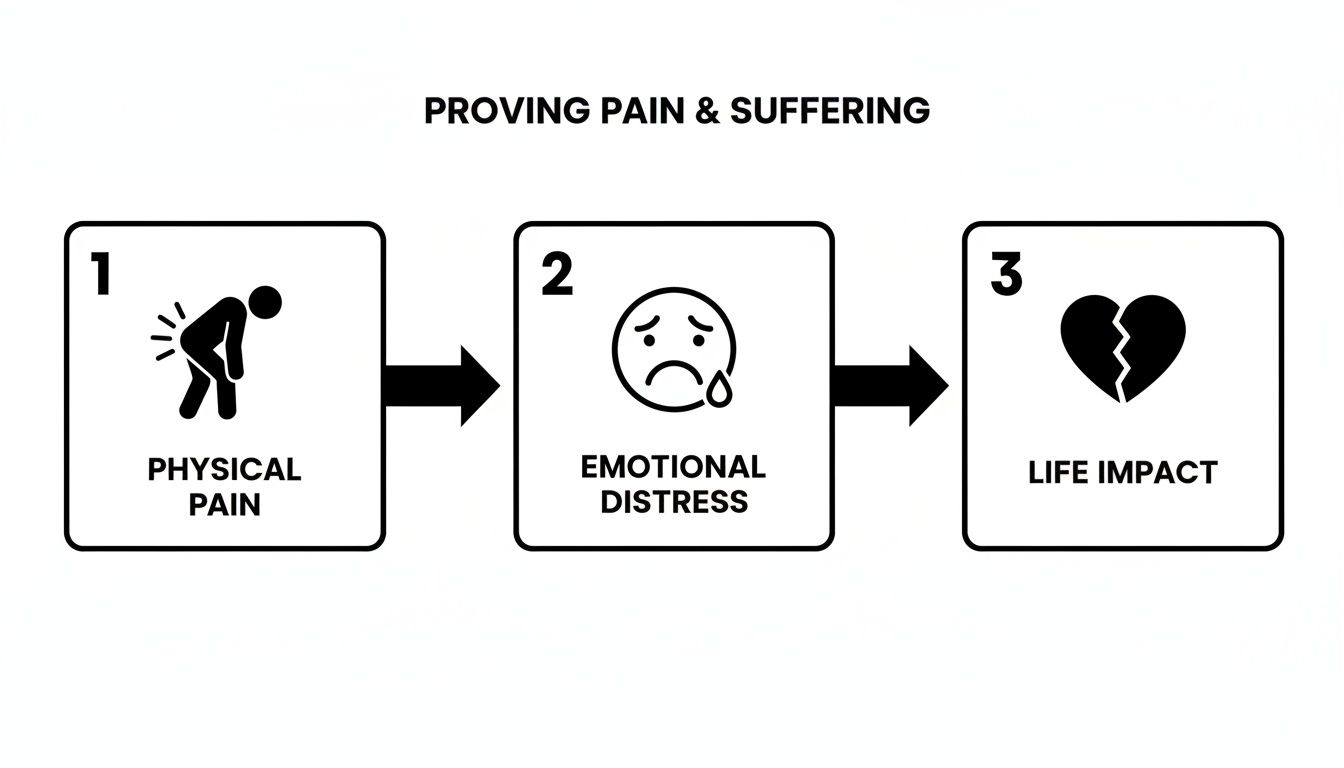
As you can see, a solid claim is built on documenting your physical pain, your emotional distress, and the real-world impact the accident has had on your life—all things your medical history helps substantiate.
Communicating Effectively with Your Doctor
What you say to your doctor is just as important as the treatment they provide. Why? Because their notes are based almost entirely on your words. Being clear, specific, and brutally honest is the only way to create an accurate record of what you’re going through.
Vague statements like “I’m okay” or “it’s a little better” are killers for your claim. You have to give them details they can write down. This specificity is what makes your suffering real to an insurance adjuster reading the file later.
For example, don’t just say “my back hurts.” Describe it. Is it a “sharp, stabbing pain when I try to stand up”? Or is it a “dull, constant ache that keeps me from getting a full night’s sleep”? That level of detail is impossible for an insurance company to ignore.
Key Takeaway: Be your own best advocate in the exam room. Your doctor is on your side, but they can only document the symptoms and struggles you tell them about. A detailed medical record starts with your detailed account.
Linking Pain to Your Daily Life
To truly capture the extent of your pain and suffering, your medical records need to connect the dots between your physical injuries and your everyday life. It’s not just about the pain; it’s about what the pain has taken from you.
Be specific with your doctor about the new limitations you’re facing. For example:
- “The shooting pain in my shoulder means I can’t lift my granddaughter anymore.”
- “I’ve had to give up my daily walks because my knee gives out after about ten minutes.”
- “I’m having panic attacks whenever I get in a car, and it’s making it hard to get to work on time.”
When these real-world consequences are written into your medical file, your claim transforms from a simple injury report into a powerful story of personal loss. This connection shows the insurance company that your suffering isn’t just a score on a pain chart—it has fundamentally changed your quality of life. The stronger you make that link, the stronger your case for fair compensation will be.
Creating a Powerful Personal Injury Journal
Medical records are the cold, hard facts of your claim—they prove what injuries you sustained. But to really show the true depth of your pain and suffering, you need to paint a picture of how those injuries disrupt your daily life. This is where a personal injury journal becomes one of the most persuasive tools in your arsenal.
A journal turns your personal experience from vague complaints into a consistent, detailed story of your day-to-day struggles. It provides the human element that sterile medical charts just can’t capture, creating a vivid picture for an insurance adjuster or a jury. Think of it this way: honest, regular entries are the key to transforming your reality into compelling proof.
What to Include in Your Journal Entries
The real power of a journal is in the details. An entry that just says “had a bad day” isn’t going to help your case. You need to create a clear, structured record of your physical and emotional state each day. Every entry should be a snapshot of your life after the accident.
To get the most impact, try to build each entry around these core elements:
- Pain Level: Use a simple 1-10 scale to rate your pain. Note how it changes throughout the day. For example, “Woke up at a 4, but it shot up to a 7 after trying to sit at my desk for an hour.”
- Type of Pain: Get specific with your descriptions. Is it a sharp, stabbing pain? A dull, throbbing ache? Is there burning or tingling? Adjectives make the pain real to someone who can’t feel it.
- Emotional State: Your feelings are a huge part of your suffering. Are you frustrated, anxious, depressed, or just plain irritable? It’s important to connect these emotions directly to your physical limits.
- Daily Activities: This is where you connect the injury to your life. Detail the simple tasks you struggled with or had to skip entirely. Could you tie your shoes? Did you have to ask for help carrying groceries?
Following a consistent framework helps you build a powerful log over time. You can get more great tips on this process by reading our guide on how keeping a diary after a car accident can strengthen your claim.
Turning Daily Life into Evidence
The most effective journal entries are grounded in real-world examples. Think about the small, everyday moments your injury has complicated or stolen from you. These concrete details are far more persuasive than just saying you’re in pain.
Let’s look at how to translate your daily experiences into powerful entries:
Example Journal Entry 1 (Post Car Accident with Whiplash)
“Neck pain is a solid 7/10 today. It’s a sharp, grinding feeling every time I turn my head. I felt a wave of anxiety just driving to my physical therapy appointment; I actually had to pull over to calm down. Couldn’t lift the grocery bags out of the car—had to ask my neighbor for help, which was embarrassing.”
Example Journal Entry 2 (Post Slip-and-Fall with Knee Injury)
“Woke up three times last night from the throbbing in my knee. Pain is a steady 6/10. Had to skip walking the dog this morning, which really bummed me out. Tried to do some chores but couldn’t kneel to clean the bathtub. Feeling so frustrated and useless.”
See the difference? These examples show instead of just tell. They connect a pain score to a specific feeling and a tangible, real-life limitation, painting a complete picture of that day’s challenges.
Key Insight: Your journal should capture the good days and the bad. Honesty is crucial. Documenting a day where your pain is a 3/10 is just as important as a day when it’s an 8/10. It shows you’re giving a credible, balanced account of your recovery, which makes your entire claim more believable.
Practical Tips for Keeping Your Journal
Consistency beats length every time. A short, daily entry is far more valuable than a long one you only write once a week. The goal is to create an unbroken record of your experience.
Here are a few tips to make journaling manageable and effective:
- Choose Your Format: This could be a simple notebook, a private blog, or even a notes app on your phone. The best tool is the one you’ll actually use every single day.
- Set a Daily Reminder: Make journaling part of your routine, like brushing your teeth. An alarm on your phone can be a huge help in staying on track.
- Be Honest and Authentic: Don’t exaggerate. Your genuine voice and honest reflections are your most powerful asset. Write about your setbacks and even the small victories.
- Include Photos or Videos: If you have visible injuries like bruises or swelling, snap a picture. If you’re struggling with a task, a short video can be incredibly powerful supplementary evidence.
By diligently documenting your journey, you are creating an undeniable record of your suffering. This personal account breathes life into your medical records and gives your claim the human element it needs to succeed.
Disclaimer: This article is for informational purposes only and is not to be construed as legal advice. No attorney-client relationship is created by reviewing this article, and none of the information herein constitutes legal advice.
How Visuals and Witness Statements Strengthen Your Case
Your medical records establish the clinical facts, and a personal journal brings your internal struggle to life. But to make your pain and suffering claim truly undeniable, you need to bring in outside perspectives. Think of visual proof and witness statements as powerful backup; they show an insurance adjuster or jury what your life looks like now, validating everything you and your doctors have said.
It’s an old cliché because it’s true: a picture is worth a thousand words. An adjuster might skim over the term “severe contusion” in a medical report, but a high-resolution photo of a deep, dark purple bruise makes the injury impossible to ignore. Words can only do so much; visuals deliver an immediate, visceral impact.

Capturing Compelling Visual Evidence
The time to start documenting is right now. You should begin taking photos and videos as soon as possible after the accident and keep it up throughout your recovery. This builds a clear timeline that illustrates both the initial shock of the trauma and the long, often frustrating, healing process.
Your visual evidence portfolio should include a mix of the following:
- The Initial Injuries: Take clear, well-lit photos of every cut, scrape, bruise, and stitch right after the accident. Don’t hold back.
- The Healing Process: This tells a powerful story. Take pictures weekly to show how a wound is healing—or, just as importantly, if a nasty scar is becoming permanent. This progression shows the journey you’ve been forced to take.
- Medical Devices: Get photos of you using crutches, wearing a neck brace, in a sling, or using any other piece of medical equipment. These images are instant proof of your physical limitations.
- Short Videos: A quick video clip can be incredibly persuasive. Film yourself trying to do something that used to be simple, like climbing a flight of stairs, getting out of a chair, or even trying to lift a gallon of milk. This is how you show a “loss of enjoyment of life.”
For more complex injuries, we can take this a step further. Advanced imaging can transform a flat MRI or CT scan into a dynamic visual. For example, knowing how to create 3D models from medical scans allows us to show a jury the true extent of an internal injury in a way they can immediately understand.
The Power of Third-Party Perspectives
What others have seen is just as important as what you’ve experienced. Statements from friends, family, and colleagues add a massive layer of credibility to your claim. They can speak to the “before and after”—the person you were versus the person the accident has forced you to become.
The best people to ask for witness statements include:
- Family Members: They see your day-to-day reality up close—the sleepless nights, the irritability from pain, and the inability to pick up your kids.
- Close Friends: Maybe you’ve stopped going to your weekly trivia night or had to give up a hobby you once loved. Friends can speak directly to these changes in your social life.
- Coworkers or a Supervisor: They can describe how the injury has affected your ability to do your job, your need for special accommodations, or even just changes in your energy and mood at work.
A heartfelt statement from a spouse describing how you’ve gone from an active, outgoing person to someone who is withdrawn and always in pain can be one of the single most powerful pieces of evidence in your entire case.
When you ask someone for a statement, give them a little guidance. Ask them to be specific and use concrete examples. A generic line like “he’s been in a lot of pain” doesn’t hit hard. But a detailed account like, “Before the crash, he coached our son’s soccer team every Saturday. Now, he can’t even stand on the sidelines for more than ten minutes without needing to sit down,” paints a complete and humanizing picture of your suffering. It’s that kind of external validation that insurance companies find very difficult to dispute.
Disclaimer: This article is for informational purposes only and is not to be construed as legal advice. No attorney-client relationship is created by reviewing this article, and none of the information herein constitutes legal advice.
How Lawyers Calculate Pain and Suffering Value
Putting a dollar amount on something as personal as pain and suffering feels strange, almost impossible. How can you quantify the frustration of not being able to pick up your child? Or the spike of anxiety you feel every time you get behind the wheel?
While no check can ever erase what you’ve been through, the legal system has developed methods to assign a monetary value to these non-economic damages. It’s a necessary step for any settlement or verdict.
Understanding how lawyers and insurance companies approach this calculation is critical. It gives you realistic expectations and shows exactly how the evidence you’ve gathered—from your medical bills to that symptom diary—fits into the bigger picture. In California, there are two primary models that usually kick off this complex conversation.
The Multiplier Method
By far, the most common approach used in California is the Multiplier Method. The calculation starts with a hard, tangible number: the total of your economic damages. This includes all your concrete costs, like medical bills, physical therapy sessions, and lost wages from being out of work.
Once that total is tallied up, it’s multiplied by a number, typically between 1.5 and 5.
This multiplier isn’t just pulled out of thin air. It’s carefully chosen based on the specifics of your case, reflecting the severity, permanence, and overall impact of your injuries on your life.
Factors that influence the multiplier include:
- Severity of Injuries: A minor sprain that heals quickly might land a 1.5x multiplier, while a catastrophic injury causing permanent disability could easily command a 5x.
- Recovery Time: The longer and more difficult your recovery, the higher the multiplier.
- Impact on Daily Life: This is where your journal entries and witness statements become invaluable. The more your life has been disrupted, the stronger the argument for a higher multiplier.
- Clarity of Fault: When the other party is 100% at fault, it significantly strengthens your position for a higher number.
Let’s say you were in a serious car crash in Los Angeles that left you with permanent scarring and $50,000 in medical expenses. Using the multiplier method, an attorney might argue for a 3.5x multiplier given the severity. That would bring your pain and suffering damages to $175,000, for a total settlement value of $225,000.
The Per Diem Method
Another model, though less common for severe or long-term injuries, is the Per Diem Method. “Per diem” is just Latin for “per day.” This method assigns a daily dollar value to your suffering, which is then multiplied by the number of days you were in pain and actively recovering.
What’s a fair daily rate? It’s often pegged to your actual daily earnings. The logic is simple: enduring the pain and limitations from an injury is at least as demanding as going to work every day.
For example, if you earn $200 per day and your recovery takes 150 days, the per diem calculation for pain and suffering would be $30,000 ($200 x 150).
This method works best for shorter-term injuries with a clear beginning and end to the recovery period. It’s far less practical for chronic conditions or permanent injuries, which is why the multiplier method is used much more frequently in those situations.
Pain and Suffering Calculation Methods Compared
It’s important to remember that these methods aren’t rigid legal formulas. They’re starting points for negotiation. A savvy personal injury attorney will often analyze a case using both models to arrive at a reasonable settlement range. They might use the multiplier method as the primary approach and the per diem method as a secondary check to add support during negotiations.
Here’s a quick breakdown of how these two methods stack up.
| Method | How It Works | Best For | Potential Drawback |
|---|---|---|---|
| Multiplier Method | Total economic damages (medical bills, lost wages) are multiplied by a factor (e.g., 1.5-5) based on injury severity. | Serious, long-term, or permanent injuries where the impact on life is significant and ongoing. | Can feel arbitrary if an insurance company lowballs the multiplier and refuses to acknowledge the reality of your suffering. |
| Per Diem Method | A daily dollar amount is assigned to your suffering and multiplied by the number of recovery days. | Shorter-term injuries with a clear and definable recovery period. | Ineffective for permanent conditions and can be harder to justify for individuals who are not employed. |
Ultimately, the strength of your evidence is what drives the final value. A high multiplier is only justifiable if you have the medical records, journal entries, and witness statements to back it up.
To get a better sense of what your potential settlement could look like, check out our guide that includes a helpful pain and suffering settlement calculator.
Common Questions About California Injury Claims
After an injury, your head is probably swimming with questions about what comes next. It’s completely normal to feel overwhelmed. Proving something as personal as pain and suffering is often the trickiest part of a claim, so knowing the rules here in California is critical. Let’s clear up some of the most common concerns we hear from clients.
Keep in mind, this is for your information only and isn’t a substitute for legal advice. Every situation is different, and the best first step is always to talk to a qualified attorney about your specific case.
Is There a Cap on Pain and Suffering Damages in California?
This is a big one, and the answer depends on the type of case. For most personal injury claims in California—think car accidents, a slip-and-fall, or a dog bite—the good news is that there is no cap on pain and suffering damages. A jury has the power to award what they feel is fair and just based on the evidence of what you’ve been through.
The major exception here is medical malpractice. California law does limit non-economic damages in these specific cases. As of 2023, that cap is $350,000, and it’s scheduled to increase over the next few years. But for almost everything else, your compensation is tied to the strength of your case, not a predetermined legal limit.
Do I Need a Lawyer to Prove Pain and Suffering?
Legally, no, you don’t have to hire an attorney. But trying to prove something as subjective as pain and suffering on your own is an uphill battle. Insurance adjusters are trained negotiators whose entire job is to minimize what the company pays out. They have a playbook of tactics designed to devalue your experience, especially the parts of your claim that don’t have a clear price tag.
An experienced personal injury attorney knows exactly how to build a compelling story. They understand how to package the evidence, bring in the right medical experts, and stand up to insurance companies that are determined to lowball you.
Time and again, studies show that people who have a lawyer on their side walk away with significantly higher settlements than those who go it alone. An attorney doesn’t just level the playing field—they make sure your voice is heard and your suffering is properly valued.
How Long Do I Have to File an Injury Claim in California?
This deadline is known as the statute of limitations, and it’s non-negotiable. For the majority of personal injury claims in California, you have two years from the date you were injured to file a lawsuit. If you miss that window, the court will almost certainly refuse to hear your case, and you’ll lose your right to any compensation.
While a few rare exceptions exist (like for injuries to a minor or those not discovered right away), you should never count on them. This deadline is ironclad, which is why it is so important to speak with an attorney as soon as you can after an accident to protect your rights.
How Is the Per Diem Method Used in California?
The “per diem” (Latin for “per day”) method is a straightforward way to put a number on your daily suffering. It’s especially useful in cases like premises liability claims from a slip-and-fall. We assign a daily dollar amount—maybe between $100 and $300—to your pain and inconvenience.
We then multiply that daily rate by the number of days you were in active recovery. For instance, if your recovery took 200 days and we used a rate of $200 per day, that would come out to $40,000 in pain and suffering damages. This amount is then added to your concrete costs like medical bills and lost wages. It’s a powerful tool for showing an adjuster or jury exactly what you endured.
According to national data, the average personal injury plaintiff receives $52,900, with the vast majority of cases settling before they ever see a courtroom. You can find more personal injury law statistics on runsensible.com.
At LA Law Group, APLC, we know that behind every case file is a real person with a real story. If you’re trying to heal from an injury caused by someone else’s carelessness, you shouldn’t have to fight the legal battle by yourself.
Contact us for a free, no-obligation consultation to see how we can help you get the full and fair compensation you are owed. Visit us at https://www.bizlawpro.com to get started today.
Attorney Advertising. This article is general information, not legal advice, and does not create an attorney-client relationship. Prior results do not guarantee a similar outcome.