
How to Respond to Lawsuit Summons: A Practical Guide
Disclaimer: This article is for informational purposes only and is not to be construed as legal advice. No attorney-client relationship exists based on the review of this article, and none of the information contained within constitutes legal advice. You should consult with a qualified attorney for advice regarding your individual situation.
That official-looking envelope sitting on your counter is enough to make anyone’s stomach drop. But panicking is the last thing you should do. The moves you make in the first few hours and days after being served will set the stage for your entire case.
The golden rule is simple: do not ignore a summons.
What to Do Immediately After Receiving a Lawsuit Summons
Ignoring the paperwork won’t make the lawsuit disappear. In fact, it’s the fastest way to lose. It almost guarantees a default judgment, which means the court automatically rules in favor of the person or company suing you (the plaintiff) simply because you never showed up to defend yourself.

This happens more often than you’d think. In consumer debt collection lawsuits, for example, the numbers are staggering. Research covering 2010 to 2019 found that over 70% of these cases in several major U.S. jurisdictions ended in a default judgment. You can read more about these court notification findings and see just how real the risk of inaction is.
Court deadlines are unforgiving. In California, you generally have 30 days to respond, but in other states, it could be as short as 20. Miss that window, and you’ve likely lost your right to fight back.
Your Initial Action Plan
Instead of letting that packet of papers intimidate you, it’s time to get organized. Your first goal is to understand exactly what you’re holding and pull out the most critical pieces of information. This proactive step helps you take back a little control.
Here’s what you need to do right away:
- Stay Calm and Read Everything. I know it’s tempting to put it aside, but you have to fight that urge. Read every single page you were given, including all the fine print. You’re looking for two key documents: the Summons and the Complaint.
- Identify the Key Players. Find the name of the plaintiff (the one suing you) and the defendant (you). Double-check that all your information is correct.
- Locate the Court Information. The documents will name the specific court handling the case, like the “Superior Court of California, County of Los Angeles.” Jot down the court’s address and, most importantly, the case number.
- Find Your Deadline. This is it—the most critical piece of information in the whole packet. The Summons will tell you exactly how many days you have to file a formal response. Circle it, highlight it, and put it on every calendar you own.
Taking these initial steps transforms you from a state of shock into a position of strength. You’re no longer just reacting; you’re gathering the intelligence you need to build your defense.
Creating Order from Chaos
Once you have the basics down, it’s time to get organized. Don’t rely on your memory. Grab a folder and start a dedicated file for everything related to this lawsuit. Keeping meticulous records from day one is a habit that will pay off, whether you decide to handle this yourself or bring in an attorney.
To help you get started, here’s a quick checklist to guide your first 48 hours.
First 48 Hours Checklist After Receiving a Summons
This table breaks down the essential first steps. Think of it as your immediate game plan to get organized and protect your rights from the very beginning.
| Action Item | Why It’s Important | Key Information to Find |
|---|---|---|
| Do Not Ignore It | Failing to respond almost guarantees an automatic loss via default judgment. | The exact date you were officially served with the papers. |
| Read the Documents | You can’t defend yourself if you don’t know who is suing you and why. | Plaintiff’s name, the court’s name and address, and the case number. |
| Pinpoint the Deadline | Missing your deadline means forfeiting your right to present your side of the story. | The number of days you have to respond (e.g., 30 days in California). |
| Gather All Paperwork | A strong, timely defense is built on organized facts and documents. | The Summons, the Complaint, and any other attached pages or exhibits. |
| Avoid Contacting the Plaintiff | Anything you say can be used against you. All communication should be formal. | The name and contact information for the plaintiff’s attorney. |
| Consult an Attorney | Legal procedures are incredibly complex. An expert can protect your rights. | A list of your top questions to ask during a consultation. |
Following these structured steps right after being served will help you move past the initial shock and start preparing for what comes next. You’ll be in a much better position to understand the claims against you and make an informed decision on how to respond.
Decoding the Summons and Complaint
Disclaimer: This article is for informational purposes only and is not to be construed as legal advice. No attorney-client relationship exists based on the review of this article, and none of the information contained within constitutes legal advice. You should consult with a qualified attorney for advice regarding your individual situation.
That stack of legal papers that just landed in your hands tells a story, but it’s written in a language most of us don’t speak: legalese. The first thing you need to do is translate these documents to figure out exactly what you’re up against.
The two most critical documents in that pile are the Summons and the Complaint. A simple way to think about it is that the Summons is the official invitation to court, and the Complaint explains why you’ve been invited.
The Summons is more than just a notice; it’s a formal command from the court to respond. Critically, it’s the document that establishes the court’s authority over you, which lawyers call personal jurisdiction. This is where the concept of “proper service” becomes so important.
Understanding Proper Service
For a lawsuit to even be valid, the plaintiff has to deliver the documents to you following a strict set of legal rules. This process is called service of process. If they messed this up—maybe they left the papers with your neighbor or used the wrong mailing procedure—you might have a powerful defense based on improper service right out of the gate.
These rules can get complicated and are different from state to state. It’s vital to figure out exactly how you received the documents and whether that method met the legal standard. For example, procedures like Service by Notice and Acknowledgement in California show just how detailed and specific these rules can be.
Things get even more complex when the lawsuit crosses international borders. U.S. courts have had to adapt, sometimes approving service via international courier or even by email when traditional methods aren’t feasible. So, even if you get served through an unconventional channel from another country, you’re almost always held to the same tight U.S. deadlines for responding.
Dissecting the Complaint
If the Summons is the “what,” the Complaint is the “why.” This document, drafted by the plaintiff’s lawyer, lays out their entire argument against you. You’ll see it’s broken down into numbered paragraphs that tell their version of events.
Your job is to read it carefully, piece by piece. It will generally be structured into a few key sections:
- Parties: This part simply identifies everyone involved in the lawsuit—who is suing whom.
- Factual Allegations: Here, the plaintiff lays out their side of the story, presenting the “facts” that they believe led to the dispute.
- Causes of Action: These are the specific legal claims the plaintiff is making against you, like “Breach of Contract,” “Negligence,” or “Fraud.” Each one is a distinct legal theory for why you should be found liable.
- Prayer for Relief: This is arguably the most important section to find. It spells out exactly what the plaintiff wants the court to give them. This could be a specific amount of money (damages), a court order forcing you to do something (or stop doing something), which is called injunctive relief, or other legal remedies.
By breaking down the Complaint, you shift from the vague panic of “I’m being sued” to a crystal-clear understanding of “I am being accused of X, and they want Y from me.” This clarity is the foundation of your entire defense strategy.
Let’s walk through a quick, real-world scenario. Imagine you’re a small business owner and a supplier serves you with a lawsuit. The Complaint might break down like this:
- Cause of Action 1 - Breach of Contract: The supplier claims you never paid an invoice for $50,000.
- Cause of Action 2 - Fraud: They also allege that you intentionally lied about your ability to pay just to get them to ship the goods.
- Prayer for Relief: Here’s the kicker. The supplier is asking the court for the $50,000 they claim you owe, plus another $100,000 in punitive damages for the fraud claim, and for you to cover all their attorney’s fees.
Analyzing the document this way shows you the stakes are much, much higher than just a disputed invoice. Getting a handle on these details is the first and most crucial step in building a smart response.
Choosing Your Strategy: Answer, Settle, or Challenge
Disclaimer: This article is for informational purposes only and is not to be construed as legal advice. No attorney-client relationship exists based on the review of this article, and none of the information contained within constitutes legal advice. You should consult with a qualified attorney for advice regarding your individual situation.
Once you’ve read through the summons and complaint, you’re standing at a critical fork in the road. The move you make next will set the tone for the entire lawsuit. This isn’t just a simple choice between fighting or giving in; it’s a strategic decision that depends on the specific facts of your case, your available resources, and what you ultimately hope to achieve.
You essentially have three primary paths you can take. You can file a formal Answer, challenge the lawsuit on technical grounds with a motion, or try to negotiate a settlement. Each option has its own pros and cons, and the right one for you depends entirely on your situation.
To help you visualize these initial choices, here’s a simplified decision tree that breaks down the process after you’ve been served with court papers.
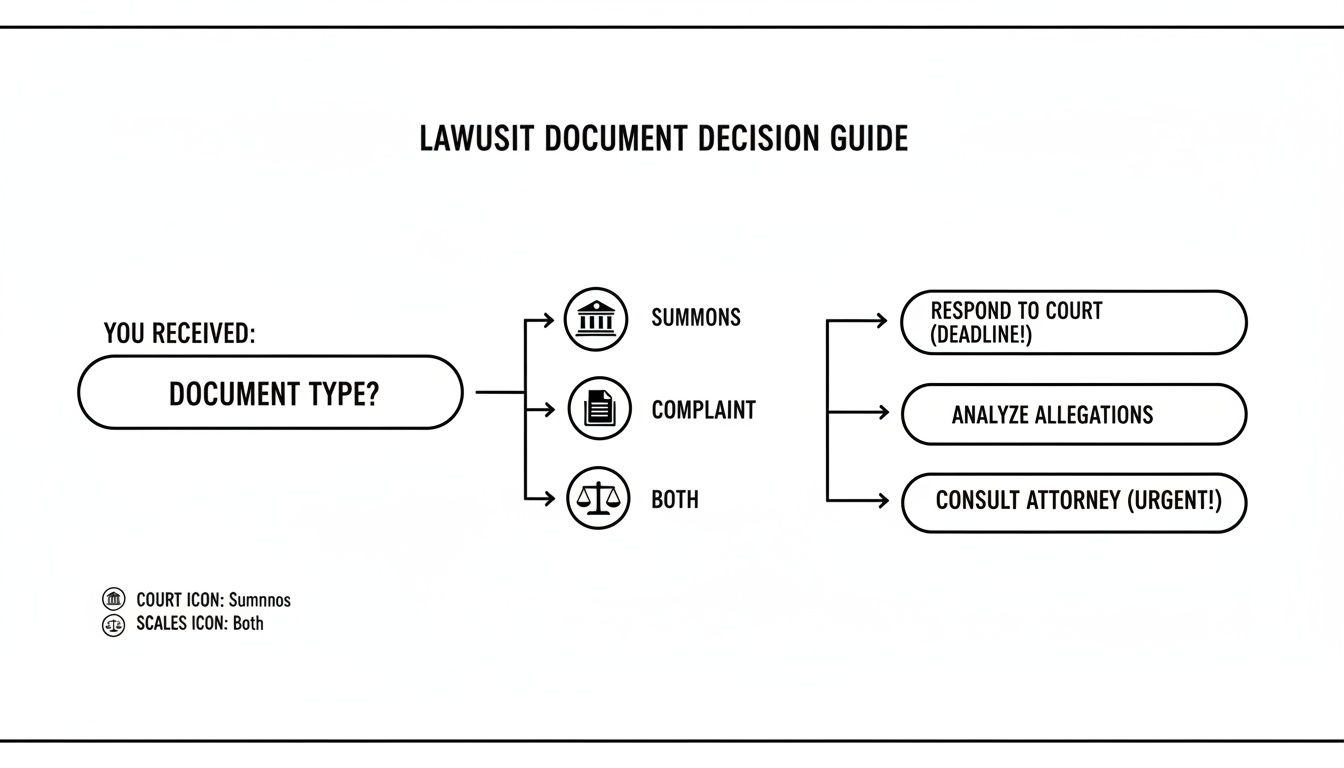
As you can see, no matter what documents you’ve received, the next steps always come back to two key actions: responding to the court on time and, ideally, speaking with an attorney.
The Standard Response: Filing an Answer
The most common and direct path is to file an Answer. Think of this as your formal, point-by-point response to every allegation the plaintiff made in their complaint. You’ll go through their document, paragraph by paragraph, and for each one, you must “Admit” it’s true, “Deny” it’s false, or state that you “Lack Knowledge” to do either.
Filing an Answer officially puts you in the game. It tells the court and the other side that you plan to defend yourself, and it’s the standard move that pushes the case into the next phase, known as discovery, where both sides start exchanging information and evidence.
Filing an Answer is your official entry into the legal fight. It preserves your right to contest the claims and forces the plaintiff to prove their case, preventing them from winning by default.
This is the right move when you genuinely believe the plaintiff’s claims are wrong or when you have affirmative defenses that could excuse you from liability. For instance, if a supplier sues you over an unpaid invoice but you have the canceled check to prove you paid it, your Answer would deny their claim and set you up to present that proof later on.
The Technical Challenge: Filing a Motion to Dismiss
Sometimes, you can attack the lawsuit without ever getting into the “he said, she said” of the facts. A Motion to Dismiss is a formal request asking the court to throw the case out completely because of a procedural mistake or a fatal legal flaw in the plaintiff’s argument.
This is a powerful tool, but it’s very specific. It’s not about whether you actually did what they’re accusing you of; it’s about whether they even have the legal right to sue you in the first place.
You might file a Motion to Dismiss for several reasons:
- Improper Service: They didn’t follow the strict legal rules for delivering the summons and complaint to you.
- Lack of Jurisdiction: The court they sued you in doesn’t have the power to hear the case, maybe because the incident happened in a different state or county.
- Failure to State a Claim: Even if every single thing the plaintiff says is true, it still doesn’t add up to a valid legal case.
- Statute of Limitations: The plaintiff simply waited too long to file their lawsuit, and the legal deadline has passed.
If you win, a motion to dismiss can end the lawsuit right then and there, saving you a massive amount of time, stress, and money. But be warned: if the motion fails, the court will still require you to file an Answer.
The Practical Route: Exploring an Early Settlement
Your third option is to try and settle the case. This means negotiating directly with the plaintiff to resolve the dispute outside of court, often for a lower amount or on different terms than what they demanded in their complaint.
Settlement can be a very practical choice. It makes sense if the plaintiff has a strong case against you, if the amount they’re asking for is relatively small, or if the cost of hiring a lawyer to fight would be more than the lawsuit is even worth. It provides certainty and helps you avoid the risk and anxiety of a trial.
But here’s a critical point that many people miss: starting settlement talks does not stop the clock on your deadline to respond to the court. You absolutely must keep working on your formal court response—whether that’s an Answer or a motion—while negotiations are ongoing. If you miss that filing deadline, you could lose by default, even if you were just a day away from reaching a deal.
How to Draft and File Your Formal Response
Disclaimer: This article is for informational purposes only and is not to be construed as legal advice. No attorney-client relationship exists based on the review of this article, and none of the information contained within constitutes legal advice. You should consult with a qualified attorney for advice regarding your individual situation.
Once you’ve decided on a strategy, it’s time to put it on paper in a way the court will recognize. If you’re planning to fight the lawsuit based on its merits, your next step is drafting an Answer. This isn’t just a simple letter explaining your side of the story; it’s a formal legal document that has to follow a very specific set of rules.
It’s easy to feel ready for a fight, but that feeling can be deceiving. A recent litigation trends survey showed that only 29% of organizations felt “very prepared” for litigation, a significant drop from 43% just the year before. This gap in preparedness is where simple procedural mistakes happen—like filing an incomplete Answer or, even worse, missing a deadline. These early fumbles can cause serious damage to your case right out of the gate.

Formatting Your Answer Correctly
Your Answer needs to look official. Every formal court document starts with a caption at the top. This section contains the court’s name, the names of the plaintiff and defendant, and the case number. You have to copy this information exactly as it appears on the Complaint you received. No typos, no abbreviations—precision is key.
The core of the Answer is your paragraph-by-paragraph response to every single allegation the plaintiff made in their Complaint. For each numbered paragraph, you have three ways to respond:
- Admit: You agree the statement is true.
- Deny: You state the statement is false.
- Lack Knowledge or Information Sufficient to Form a Belief as to the Truth of an Allegation: This is the formal, legal way of saying, “I don’t know.”
How you respond matters immensely. Anything you admit is taken as a proven fact for the rest of the lawsuit, so choose your words carefully. To get a much deeper understanding of this crucial document, take a look at our guide on what an Answer to a Complaint in a California lawsuit really involves.
Introducing Affirmative Defenses
Answering the complaint isn’t just about admitting or denying facts. This is also your chance to introduce affirmative defenses. Think of these as powerful legal arguments that could potentially get the entire case thrown out, even if everything the plaintiff said about the facts is true.
It’s like this: The plaintiff claims you breached a contract. An affirmative defense doesn’t just say, “No, I didn’t.” Instead, it introduces a new piece of the puzzle, like, “Even if I did, the statute of limitations has expired, so they waited too long to sue me.”
An affirmative defense shifts the focus. You’re no longer just defending against the plaintiff’s story; you are presenting your own legal reasons for why you should win, regardless of their claims.
Here are a few common affirmative defenses you might raise:
- Statute of Limitations: The plaintiff missed the legal deadline for filing the lawsuit.
- Failure to State a Claim: The complaint, even if every word is true, doesn’t actually add up to a valid legal case.
- Payment: You’ve already paid the debt or fulfilled the obligation they’re suing you over.
- Waiver: The plaintiff’s own actions or words showed they were giving up their right to sue you.
It’s critical to include every possible affirmative defense in your initial Answer. If you don’t raise them now, you’ll most likely lose the right to use them later on.
The Final Steps: Filing and Service
Drafting the document is just the first part. To make it official, you have to file it with the court and serve it on the plaintiff.
Filing is the act of delivering your original, signed Answer to the court clerk before your deadline hits. Many courts have moved to e-filing systems, but some still require you to file in person or by mail. Always, always check the local rules for your specific court.
Once it’s filed, you have to arrange for a copy of your Answer to be formally delivered to the plaintiff’s lawyer (or the plaintiff if they don’t have one). This is called service of process. The most important rule here is that you cannot be the one to serve the documents. It has to be done by a neutral third party who is over 18 and not involved in the case. This is usually done by mail.
Finally, the person who served the paperwork must fill out and sign a Proof of Service form. This form is your official proof that you followed the rules and notified the other side. You then file that form with the court. People often forget this last step, and it’s a huge mistake—without a filed Proof of Service, it’s as if you never responded at all.
When preparing your documents for filing, you might find yourself needing to use a fax service for submissions. It’s crucial that any transmission is professional and legally recognized. You can find excellent fax cover letter templates for legal documents to ensure your filings are presented correctly.
Navigating California Specific Rules and Procedures
Disclaimer: This article is for informational purposes only and is not to be construed as legal advice. No attorney-client relationship exists based on the review of this article, and none of the information contained within constitutes legal advice. You should consult with a qualified attorney for advice regarding your individual situation.
Legal procedures aren’t one-size-fits-all; they change dramatically from state to state. If you’ve been sued in California, you’ve stepped into a unique legal landscape. Understanding the local rules isn’t just a good idea—it’s absolutely essential for mounting an effective response.
The rules here have specific nuances that can easily trip you up if you’re not prepared.
The most critical number to burn into your memory is 30. In most California Superior Court civil cases, you have 30 calendar days to file a formal response after being personally served with the summons and complaint. This deadline is unforgiving. Missing it gives the plaintiff a direct path to asking the court for a default judgment against you.
Understanding California Court Tiers
Not all lawsuits are created equal in California, and where your case is filed dictates everything—the rules, potential damages, and overall complexity. Cases are generally sorted into three tiers:
- Small Claims Court: This is for disputes involving $12,500 or less for an individual. The rules are simplified, and lawyers generally cannot represent parties in court. It’s designed to be more accessible.
- Limited Civil Court: Here, the amount in dispute is $35,000 or less. The discovery process (how parties exchange information) is more restricted, which usually makes these cases faster and less expensive than their unlimited counterparts.
- Unlimited Civil Court: This is for all cases involving more than $35,000. These are the most complex cases with full discovery rules and formal procedures, often requiring significant legal strategy.
Knowing which court you’re in helps you grasp the scope of the fight ahead and the specific procedural rules that will govern every move you make.
Using Mandatory Judicial Council Forms
California’s court system tries to standardize certain legal documents by requiring the use of official forms created by the Judicial Council. This is especially common in bread-and-butter lawsuits like contract disputes and personal injury claims.
For instance, if you’re responding to a breach of contract claim, you’ll almost certainly need to use Form PLD-C-010, the Answer—Contract.
Don’t think of these forms as suggestions; they are often mandatory. They provide a structured, fill-in-the-blank format to ensure your response includes all the required information, from the case caption to your specific admissions, denials, and affirmative defenses. You can usually find the latest versions on the California Courts’ official website.
Using the correct Judicial Council form is a non-negotiable first step. It ensures your response is procedurally correct and will be accepted by the court clerk for filing, preventing a rejection that could cause you to miss your deadline.
Filing and Serving in the Golden State
Once your response is prepared, you have to file it with the correct court and serve a copy on the plaintiff. It’s no longer just about walking into the courthouse. Many California courts now mandate e-filing, which means you have to submit documents through an approved online portal. For a more detailed breakdown of the entire litigation journey, you can explore the 7 steps in a civil case in our complete guide to California courts.
Finally, always double-check the rules with the specific county court handling your case. Local court rules can add another layer of requirements on top of the statewide procedures. A quick visit to your local court’s website can save you from a critical—and costly—procedural mistake.
Common Questions About Responding to a Summons
Disclaimer: This article is for informational purposes only and is not to be construed as legal advice. No attorney-client relationship exists based on the review of this article, and none of the information contained within constitutes legal advice. You should consult with a qualified attorney for advice regarding your individual situation.
Even with a roadmap, the legal world is full of confusing turns. It’s completely normal to have questions pop up as you figure out how to handle a lawsuit summons. Let’s tackle some of the most common points of confusion we see every day.
What Happens if I Miss the Deadline to Respond?
This is probably the most critical mistake you can make. If you don’t file a formal response (like an Answer or a Motion to Dismiss) before the deadline, the plaintiff can immediately ask the court for a “Request for Default.”
Once a default is entered, you’ve essentially given up your right to defend yourself. From there, the court will almost certainly enter a default judgment against you. That means the plaintiff wins, period. They can get the money or relief they asked for in the Complaint without the court ever hearing a single word from your side.
A missed deadline isn’t just a small stumble; it’s a direct path to losing your case. The court interprets your silence as you admitting to everything, which results in a legally binding judgment that can be used to garnish your wages, seize funds from your bank accounts, and put liens on your property.
Can I Just Call the Court or the Plaintiff’s Lawyer?
Absolutely not. A phone call gives you zero legal protection and does not count as a response. Sure, calling the court clerk is fine for asking about procedural stuff like filing fees or e-filing instructions, but they cannot take a verbal response or offer any legal advice.
Calling the plaintiff’s lawyer is even riskier. Remember, their job is to win for their client, not to help you. Anything you say can and will be used against you. More importantly, a conversation doesn’t pause the clock on your deadline to file a written response. Only a formal, written response filed with the court will officially protect your rights.
Do I Still Need to Respond if the Lawsuit is Full of Errors?
Yes, you must respond. It’s common to read a Complaint and spot glaring mistakes—wrong dates, incorrect dollar amounts, or mixed-up facts. It’s tempting to think this makes the whole lawsuit invalid, but it doesn’t work that way.
You are still legally required to file a formal response. Your Answer is actually the perfect place to address these errors by denying the incorrect statements. If the mistakes are so huge that they kill the plaintiff’s entire legal claim, your lawyer might be able to file a Motion to Dismiss. But you can never just ignore a lawsuit because it has flaws.
How Much Does It Cost to Hire an Attorney to Respond?
The cost really depends on how complex your case is, where you’re located, and the lawyer’s fee structure. Some attorneys might charge a flat fee to prepare and file a standard Answer, while others work on an hourly basis and will ask for an upfront retainer.
Many people hesitate to call a lawyer because they’re worried about the cost. But think about the alternative: the cost of losing by default. That could mean paying the full amount demanded in the lawsuit, plus interest and the other side’s attorney fees. That number is almost always far higher than the cost of getting professional help to defend your rights from the beginning.
Is It Possible to Settle After I’ve Filed a Response?
Of course. Filing an Answer doesn’t mean you’re headed straight for a trial. In reality, the vast majority of civil lawsuits—over 90%—are settled long before they ever see the inside of a courtroom. Filing a response is a necessary step that protects your right to fight while leaving the door wide open for negotiations.
In fact, filing a strong, professionally drafted Answer with solid affirmative defenses can give you more leverage in settlement talks. It sends a clear message to the plaintiff that you’re serious about defending yourself, which often makes them much more willing to negotiate a reasonable deal.
Disclaimer: This article is for informational purposes only and is not to be construed as legal advice. No attorney-client relationship exists based on the review of this article, and none of the information contained within constitutes legal advice. You should consult with a qualified attorney for advice regarding your individual situation.
Navigating a lawsuit is a high-stakes process where one wrong move can have severe, long-lasting effects. The expert team at LA Law Group, APLC blends deep legal knowledge with sharp business instincts to protect what you’ve built. If you’ve been served with a summons, don’t wait for the deadline to get closer. Contact us today for a consultation to understand your options and start building a powerful defense. Visit https://www.bizlawpro.com to get the help you need.
Attorney Advertising. This article is general information, not legal advice, and does not create an attorney-client relationship. Prior results do not guarantee a similar outcome.