
Independent Contractor Agreement Lawyer: A California Guide

The most popular advice on contractor paperwork is also the most expensive one to follow. Download a template, add a sentence that says the worker is not an employee, and treat the signature as the end of the classification question. California does not work that way. A written label is evidence of what the parties intended. It is not proof of what they do. An independent contractor agreement lawyer is worth hiring when the working relationship and the paper do not match, because agencies and courts read both together.
This article is for informational purposes only. Nothing here is legal advice, and reading it does not create an attorney-client relationship.
When a California Business Needs a Contractor Agreement Lawyer
Call when the cost of getting classification wrong is larger than the cost of a review. Wage claims, payroll taxes, unemployment, and workers’ compensation can all follow a single bad engagement. Waiting until someone complains turns a drafting problem into a defense problem.
Five triggers should prompt the call:
- The role is new. Before anyone starts, the deliverables are still fuzzy and nobody has written what “done” looks like.
- The schedule looks like a job. The worker will keep set hours, report to a manager, or sit in required meetings.
- The work is the business. A bakery that hires a baker to run daily production is not buying an outside service. It is staffing its own product.
- The engagement is not local. Work that crosses state lines, sits with a remote worker, or runs through a platform can pull in more than one set of rules at the same time. Companies that staff through remote staffing agencies still need to know who directs the work and where it is performed.
- An agency is already asking. A wage claim, an unemployment audit, or a request for an IRS Form SS-8 determination means the facts are already in play.
A short, one-off project with an established contractor who has other clients and their own insurance can sometimes live on a standard template. Anything that looks like ongoing staff does not.
Practical rule: The earlier the call, the cheaper the fix. Rewriting a scope before day one costs less than rebuilding payroll history after a claim.
Bring the preparation checklist in the next section to that first conversation so the review starts from facts, not from a blank form.
Why California’s ABC Test Decides Worker Status
The contract’s title does not decide worker status. California starts from the opposite assumption. The worker is presumed to be an employee unless the hiring business proves every part of the ABC test.
That presumption became the statewide rule when Governor Gavin Newsom signed Assembly Bill 5 on September 18, 2019. As the California Department of Industrial Relations explains, AB 5 codified and expanded the test under the Labor Code, the Unemployment Insurance Code, and Industrial Welfare Commission wage orders. Miss one prong and the presumption stands. A signature page cannot carry the other two.
Prong A, freedom from control
The worker must be free from the company’s control over how the work is done, both in the contract and in daily practice. A freelance designer who sets her own hours, chooses her tools, and turns in a finished file can satisfy this prong. The same designer fails it if a manager assigns a desk, sets a 9-to-5, and requires a check-in every morning. A clean “independent contractor” recital does not erase those habits.
Prong B, outside the usual course
The work has to sit outside the company’s usual business. A photographer hired to shoot a one-time office portrait is easier to place outside a software company’s core service. A graphic designer building the company’s own product line is doing the business itself. That second arrangement fails prong B even if the invoice says “consulting.”
Prong C, an established trade
The worker must already run a trade or business of the same kind. Registration, other clients, separate marketing, and the worker’s own insurance are the usual proof. A person who has never sold this service to anyone else is hard to describe as an established business.
A careful review looks at the business profile, invoices, insurance certificates, and who pays for tools and expenses. For a deeper look at what liability follows a failed classification, see our note on independent contractor liability.
| ABC prong | What the business must show | Evidence to gather |
|---|---|---|
| A. Freedom from control | Worker controls how and when the work is done, both in the contract and in practice | Deliverable-based scope, no fixed hours, no required supervision or check-ins |
| B. Work outside the usual course | The work falls outside the core business the company runs | Written scope that differs from the company’s core service line and org chart |
| C. Independently established business | The worker runs an established trade or business of the same nature | Business registration, other clients, own insurance, separate marketing and invoices |
Run this check today. For each prong, name one document and one daily practice that proves it. If you can name the document but not the practice, the agreement is ahead of the relationship.
This discussion is for informational purposes only. It is not legal advice, and it creates no attorney-client relationship.
Federal Tests and When to File Form SS-8
A California business can fail one test and still face another. Federal wage-and-hour rules and federal tax rules do not step aside because AB 5 also applies.
On January 10, 2024, the U.S. Department of Labor issued a final rule that replaced a narrower approach with a six-factor economic reality analysis under the Fair Labor Standards Act. The Department of Labor’s misclassification FAQs state that no single factor automatically determines status. The question is whether the worker is economically dependent on the business or is running an independent enterprise.
| Factor | Question to answer | Points toward contractor status when |
|---|---|---|
| Opportunity for profit or loss | Can the worker earn more or lose money through how they manage the work? | Worker sets prices and bears the risk of loss |
| Investments | Does the worker invest in tools, space, equipment or staff? | Worker supplies significant equipment or capacity of their own |
| Permanence | Is the relationship indefinite or tied to a defined project? | Engagement is project-based with a defined end |
| Control | Who directs the nature and degree of the work? | Worker controls methods, sequencing and schedule |
| Integral work | Is the work central to the potential employer’s business? | Work is peripheral or separable from core operations |
| Skill and initiative | Does the worker use specialized skill and business initiative? | Worker brings specialized skill and runs an independent business |
A useful scoring pass is simple. Write one sentence of facts under each factor, then mark whether that sentence points toward dependence or toward an independent business. Clauses about project work, nonexclusive service, separate marketing, and control over methods can reflect the intended deal. They lose when the facts show dependence or employer-style direction.
The IRS looks at control, not the pay label
Federal tax classification turns on whether the business has the right to control what is done and how it is done. The IRS groups the facts into behavioral control, financial control, and the relationship of the parties. Paying by the project instead of by the hour does not settle it, and neither does full-time versus part-time work. The IRS guidance on Form 1099-NEC makes that limit explicit. Significant investment can support contractor status, but there is no dollar cutoff that wins the question by itself.
When Form SS-8 is the right tool
Businesses and workers may file Form SS-8 when they cannot tell whether common-law rules make the worker an employee or a contractor. The form asks the IRS for an official determination on federal employment tax and income-tax withholding. Per the Form SS-8 instructions, every question in Parts I through IV must be answered. Part V is also required when the worker serves customers directly or works as a salesperson. Copies of Forms W-2, 1099-MISC, and/or 1099-NEC must go in for each year under review.
A formal determination takes time and puts the relationship in front of the agency. Save it for a real stalemate, not for a routine project you can classify from the facts you already have.
Preparation Checklist Before the First Lawyer Call
You can do most of the useful work before you pay anyone. A first meeting goes faster when the file already shows the law that might apply, who the worker is, and how the work runs. During that consultation, LA Law Group discusses the specifics of the case and what to expect from the review.
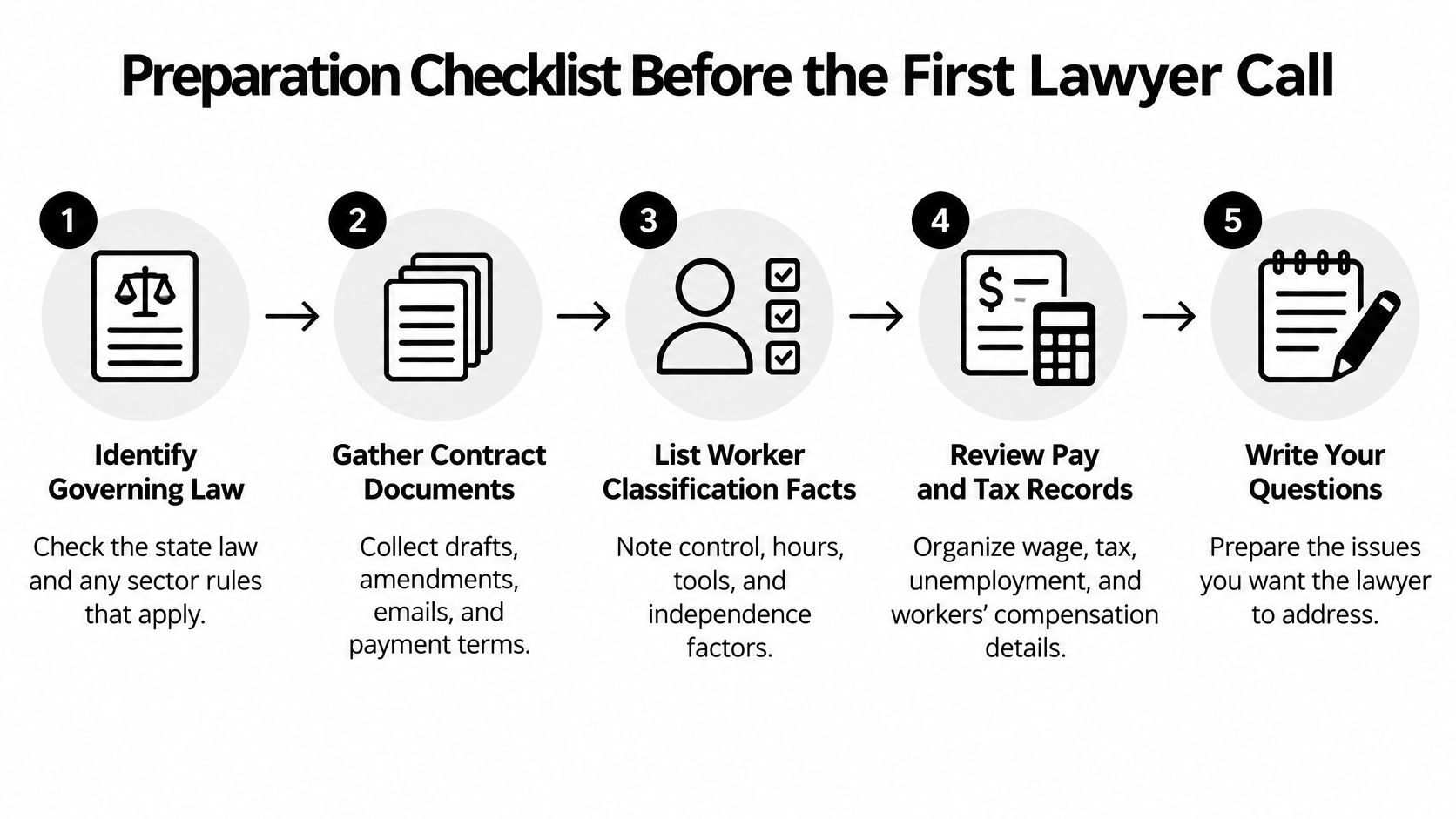
Work through this sequence. Each step has a reason, and each has a slip that shows up constantly.
- Identify the governing law. Note California plus any wage, tax, unemployment, workers’ compensation, or industry rule that might apply because of where the work is done. The slip is assuming the company’s home state is the only law in the room.
- Write the worker’s business profile. Entity type, advertising, other clients, commercial insurance, equipment, and who sets the price. The slip is treating a personal email address and a single invoice as a business.
- List deliverables and acceptance criteria. Say what will be delivered and how you will accept it. Do not describe a schedule or a supervision method. The slip is drafting the contract after the person has already started, with no scope on file.
- Gather the records. Past invoices, emails, timesheets, project trackers, and any org chart that shows where the role sits. The slip is bringing only the draft agreement and leaving the contradictory email thread at the office.
- Flag every habit that looks like employment. Fixed hours, mandatory training, required meetings, and reimbursement of ordinary operating costs belong on this list. The slip is editing those facts out because they make the story less tidy.
- Decide the payment structure. State the fee, the invoice cycle, and whether the pattern resembles payroll. The slip is a weekly draw that never ties to a milestone.
If pulling those records is the bottleneck, some companies hire legal virtual assistants to assemble drafts, invoices, and correspondence before counsel reviews them. The assistant does not classify the worker. Counsel does.
Take this to the call:
- Governing law notes, including any second state or platform terms.
- Business profile for the worker, with insurance and other clients.
- Deliverable list with acceptance criteria, not hours.
- Record set of invoices, emails, and time or project logs.
- Habit list of anything that looks like direction or exclusivity.
- Payment sketch showing fee, timing, and expenses.
Must-Have Clauses and the Red Flags That Override Them
Clauses allocate commercial risk. They do not prove that someone is a contractor. A lawyer still maps each deliverable to an objective milestone, states who supplies tools and materials, and keeps the right to control manner and means with the worker.

| Clause | What it protects | Gap if missing |
|---|---|---|
| Scope and deliverables | Defines outcomes and milestones without employee-style schedules | Open-ended duties that read like a job |
| Payment terms | Sets fee, invoice schedule and late payment rules | Pay that resembles payroll weakens the contractor position |
| IP assignment | Transfers work product and ownership to the company | Contractor keeps rights to code, designs or content |
| Confidentiality | Protects client lists, pricing and internal data | Trade secrets leave with the contractor |
| Indemnity | Allocates liability for third-party claims and errors | Company absorbs losses caused by contractor work |
| Insurance | Requires the contractor’s liability or other coverage where it applies | Uninsured losses fall on the company |
| Termination | Sets notice periods and exit rights for both sides | Disputes over early exit and final payment |
| Other clients | States that the contractor may serve other clients | Exclusivity signals employment |
| Governing law and forum | Names the state law and venue for disputes | Litigation in an unexpected jurisdiction |
What each clause is actually for
Scope and deliverables should name outcomes and milestones, not a weekly hour target. Open-ended duties read like a job description. Payment terms should tie money to invoices and milestones. A standing weekly amount with no deliverable behind it starts to look like payroll. IP assignment should transfer work product created for this engagement, and it should be paired with a license for any background materials the contractor embeds. Without that, the contractor can keep the code, the design, or the copy. Confidentiality is what stops client lists and pricing from walking out. Indemnity is how third-party claims and errors get allocated instead of landing entirely on the company.
Insurance should match the work and should be the contractor’s own coverage, not a promise that the company will reimburse ordinary operating costs. Termination needs notice and a rule for unfinished work and final invoices. Other clients should say the contractor may serve them. A noncompete dressed up as a loyalty clause is exclusivity, and exclusivity points toward employment. Governing law and forum name the state and the venue you want. For a fuller drafting sequence, see how to draft contracts. Companies that add people through vendors rather than direct contracts can compare these terms with key clauses in staff augmentation contracts, then still test the facts of who directs the work.
Practices that outweigh the clause
California judges control under the contract and in fact. A manager who sets the daily hours undoes a freedom-from-control clause. The same is true of mandatory training, performance reviews copied from the employee handbook, exclusive service, reimbursed rent and software, open-ended renewals, and a contractor who performs the company’s core service. When the clause and the habit conflict, the habit carries more weight.
Platform and remote work create their own record. Ratings, delivery logs, algorithmic instructions, and payment histories can contradict a paragraph that says the worker controls the manner and means. A choice-of-law clause does not erase mandatory protections in the place where the services are performed. Cross-border work also raises withholding, data-transfer, chain-of-title, and payment-route questions that a California form will not answer by itself.
The audit is a comparison, not a clause count. Set the agreement next to the invoices, the emails, the payment pattern, and the way the work is managed this week. Reassess at renewal and after any real change in duties, pricing, or how much of the worker’s income comes from you.
For a short walkthrough of how these agreements get marked up in practice, this overview is a useful companion before you sit down with the draft.
Pricing Models and Timeline for Agreement Review
The billing model should match the job. A light markup of a standard form is a different piece of work from a negotiated deal with custom IP and a second jurisdiction. Ask which model applies before anyone opens the file. Our note on finding a contract lawyer in California covers how that first scope conversation usually runs.
| Billing model | Best for | What drives the cost |
|---|---|---|
| Flat fee for template review | Standard agreements with few changes | Number of edits and the calls needed |
| Flat fee for custom drafting | New relationships with unique deliverables | Complexity of IP, payment and risk terms |
| Hourly rate for negotiation | Contested or heavily customized agreements | Attorney time spent on research and back-and-forth |
| Retainer for ongoing counsel | Businesses that engage contractors repeatedly | Volume of agreements and classification reviews |
| Hourly rate for disputes | Misclassification claims and agency inquiries | Litigation stage and discovery needs |
What actually moves the number
Four things move cost more than the hourly rate on a website. The number of edits, the complexity of IP and payment terms, the number of counterparties, and the stage of any dispute. A one-page scope with a single milestone is a flat-fee review. A software build with background IP, a license-back, and a payment holdback is custom drafting. Once the other side is marking up every paragraph, hourly time is the honest model, because nobody can price an open negotiation in advance.
A retainer fits a company that signs contractors every month and wants the same classification screen each time. Dispute work is hourly because discovery and agency responses expand in ways a flat fee cannot absorb.
A realistic clock
A template review often moves in about a week once the documents are in hand. A custom agreement that needs negotiation commonly takes two to four weeks. The clock slips when records were never gathered, when the contractor is slow to respond, or when more than one jurisdiction is in the deal.
Ask for a written fee estimate before work starts. It should name the documents covered, how many revision rounds are included, and whether a classification review is part of the fee or a separate task. If classification is carved out, you are buying proofreading, not a status opinion.
Book a Contract Review Before You Sign
Send the file before the contractor starts, not after a wage claim arrives. Four items are enough to open a real review:
- The preparation checklist, filled in rather than sketched.
- The draft independent contractor agreement, including any template terms you did not write.
- The deliverables list with milestones and acceptance criteria.
- A short description of how the work is managed, including who sets hours and who approves output.
LA Law Group, APLC can review that agreement against the record. Contract and business law services at the firm include entity formation, contracts, and the everyday legal questions of running a company. The first consultation is free and confidential, and it is held with the attorney who will handle the matter. Clients deal directly with the firm’s attorneys, not with secretaries or paralegals. The firm serves clients throughout California in English, Spanish, and Farsi from its office in Chatsworth.
Book the review before work starts. A classification problem is cheapest while the scope is still a draft.
This article is for informational purposes only. It is not legal advice, and none of the information in it should be construed as legal advice. No attorney-client relationship exists based on your review of this article. Talk with a licensed attorney about your own facts before you sign or before you start the work.
LA Law Group, APLC reviews California independent contractor agreements against how the work is managed, including scope, classification risk, and the clauses that allocate IP, payment, and liability. If you are about to sign, or you already have a contractor whose day-to-day role looks like a job, bring the draft and the checklist to a first conversation. Visit LA Law Group, APLC to arrange that review with the attorney who would handle the matter.
Attorney Advertising. This article is general information, not legal advice, and does not create an attorney-client relationship. Prior results do not guarantee a similar outcome.