
What to Do if You Are Injured in an Accident in California

You’re sitting in your car after a collision, hands still tight on the steering wheel, trying to decide whether the pain in your neck is serious or just adrenaline. The other driver is asking what happened, your phone is filling with notifications, and an insurance adjuster may soon want your version of events. If you’re injured in an accident, the first week matters, but you don’t need to solve the entire claim at the scene.
Your priorities are straightforward: protect people from further harm, obtain medical care, preserve evidence, report the accident correctly, and avoid statements or deadlines that can damage your rights. The worldwide scale of accidental injury shows why this isn’t a rare legal problem. The World Health Organization’s injury data estimates 4.4 million injury-related deaths each year, including 3.16 million unintentional injury deaths and 1.25 million violence-related deaths. Road crashes alone remain a major source of fatal and nonfatal harm.
This article is for informational purposes only and is not to be construed as legal advice. No attorney client relationship exists based on the review of this article, and none of the information in this article is legal advice.
The First Hour After the Accident
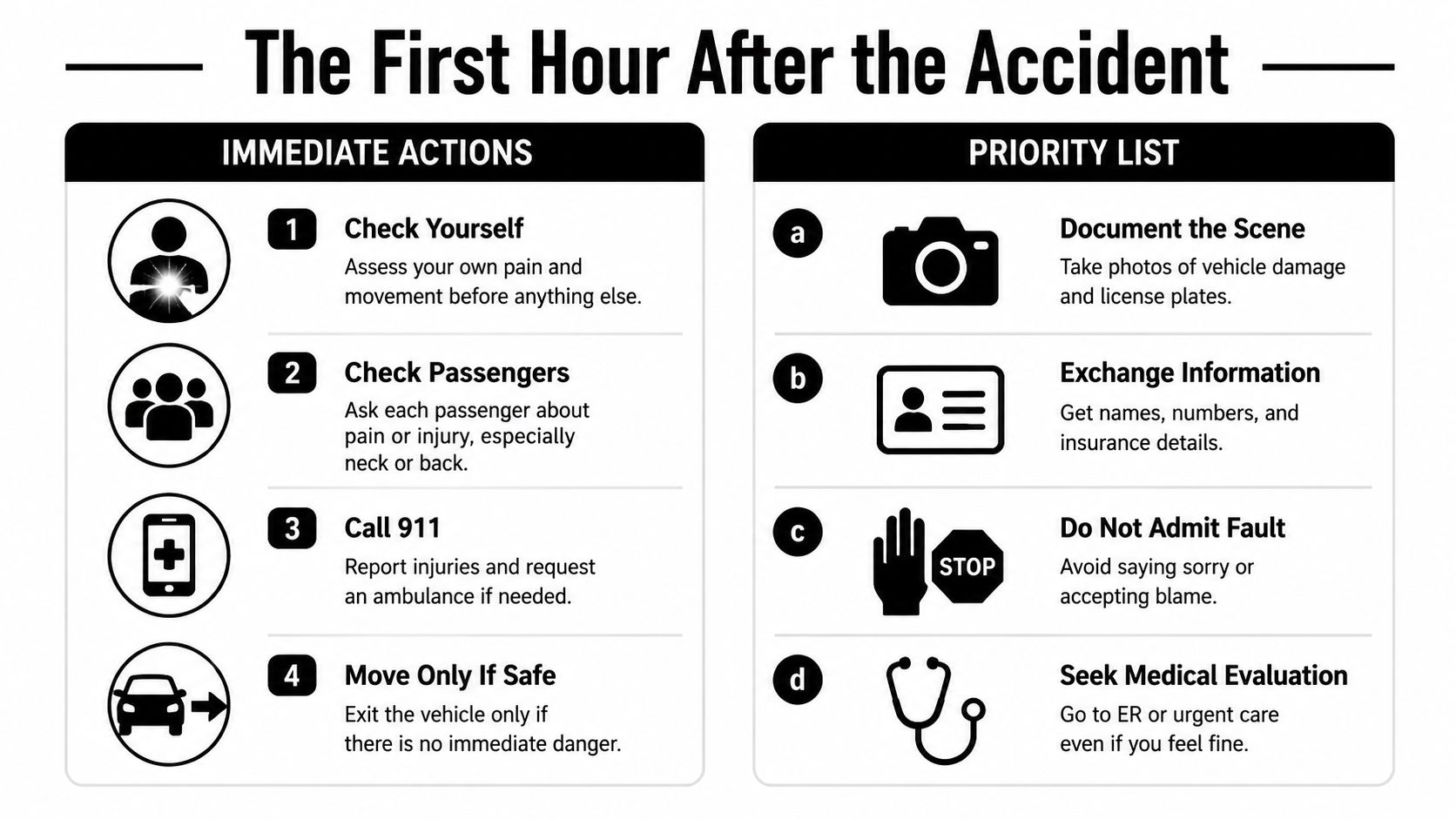
The first sound may be the airbag deflating, followed by ringing ears, broken glass, and someone asking whether you’re okay. Before you move, check yourself for severe pain, bleeding, weakness, numbness, trouble breathing, or confusion. Then ask each passenger about pain, especially in the neck, back, chest, or head.
If the vehicles can be moved safely, pull to a secure location and turn on the hazard lights. Don’t step into traffic to inspect damage. If moving would create another danger, stay inside with your seat belt fastened unless the vehicle itself presents an immediate threat.
Call 911 when anyone appears injured, when the drivers disagree about what happened, or when there’s visible vehicle damage. Request medical help when needed, and let police document the scene. Don’t apologize, argue, speculate about speed, or say that you caused the collision. A polite “I’m glad you’re safe” is different from “I’m sorry, I wasn’t paying attention.”
What to collect before leaving
Exchange the other driver’s name, phone number, insurer, policy number, license plate, and vehicle make and model. Photograph the vehicles from several angles, the road layout, traffic controls, skid marks, debris, weather or lighting conditions, and visible injuries. Ask witnesses for contact details if they’re willing to provide them.
If the other driver tries to leave, don’t chase the vehicle or put yourself in danger. Tell the dispatcher the direction of travel, vehicle description, plate information, and what you observed. Stay factual. The first 72 hours after an automobile accident require organized follow-through, but the scene itself has only one immediate job: safety and accurate preservation of facts.
Practical rule: Give police and medical providers facts, not conclusions. Fault should be evaluated from the evidence, not decided by the most frightened person at the roadside.
Getting Medical Care and Protecting the Health Record
Pain after a crash can be delayed. Neck stiffness, headaches, back pain, dizziness, concentration problems, and soreness may become more noticeable after the immediate shock fades. Same-day evaluation is the safest choice for new symptoms, even when the vehicle damage looks modest.
Go to an emergency room for severe or worsening headache, repeated vomiting, loss of consciousness, confusion, weakness, numbness, trouble walking, serious bleeding, chest pain, abdominal pain, or breathing difficulty. Urgent care or your primary physician may be appropriate for less urgent symptoms, but don’t choose convenience over safety.
Tell every provider plainly that the accident caused the symptoms. Don’t say, “My neck hurts.” Say, “My neck pain began after the collision,” and explain when it started, what movements worsen it, and whether you had similar symptoms before. That history helps the clinician assess causation and creates a clearer record.
Build a record that follows the injury
Keep copies of triage notes, imaging orders, test results, diagnoses, referrals, prescriptions, work restrictions, and discharge instructions. Request records promptly and use a symptom journal to note pain location, sleep disruption, medication effects, missed work, and activities you can no longer perform.
Follow referrals and attend recommended therapy. A gap in care can become a central defense argument. Research available through the National Library of Medicine found that workers who reported an injury within the first two weeks had a predicted disability duration more than 14 days shorter than those who reported it 30 days or later. The lesson for a crash claim is practical: prompt reporting and uninterrupted care make the timeline easier to understand.
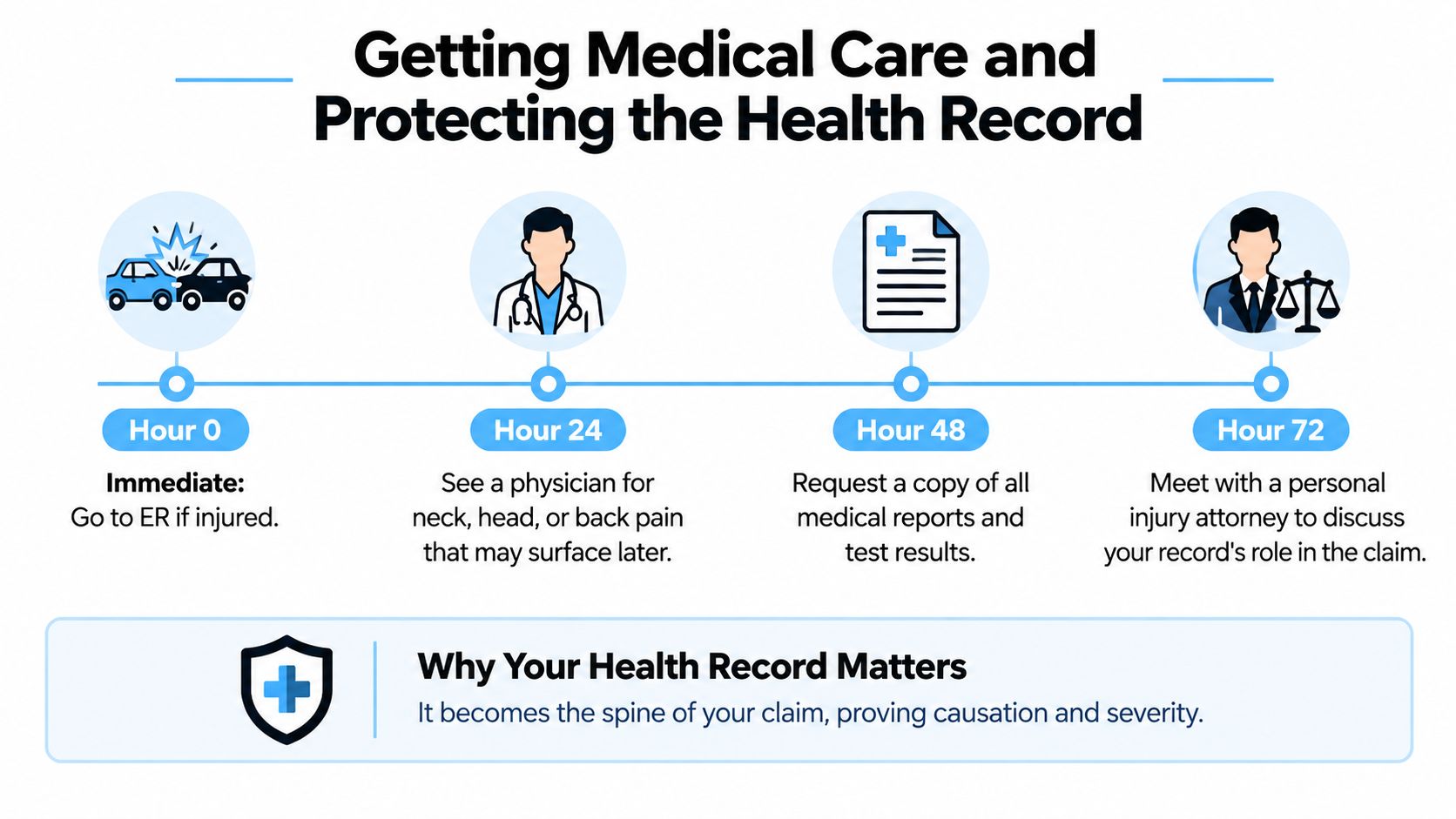
When you need help obtaining records, the Attorney Assistant guide to records retrieval offers a useful overview of the request process. A treatment interruption doesn’t automatically defeat a claim, but you should document why it happened, whether transportation, cost, childcare, work, relocation, or scheduling caused it, and what you did to resume care.
Reporting the Accident the Right Way
Report the collision in the right order. Start with emergency services when injuries, disagreement, danger, or substantial damage requires police involvement. California law also requires a traffic accident report when property damage exceeds $1,000, a threshold described in the California Department of Motor Vehicles reporting guidance.
Use simple language:
- To 911 or police: “There was a collision at this location. People may be injured, and these vehicles are involved.”
- To your own insurer: “I’m reporting a collision on this date and opening any applicable medical-payments or uninsured-motorist claim. I’m still receiving medical evaluation.”
- To the other driver’s insurer: “The collision occurred on this date and location. These vehicles were involved, and I’m receiving treatment at this facility. I’m not prepared to give a recorded statement or discuss fault.”
California requires an SR-1 report to the DMV within 10 days when the collision involves injury or death. Don’t assume the police report satisfies your separate DMV obligation. Preserve the confirmation and a copy of anything submitted.
Keep communications narrow
Tell the other driver’s liability insurer only established facts. Don’t estimate your speed, guess about the other driver’s speed, speculate about fault, describe prior injuries casually, or agree to a recorded statement while your diagnosis is still developing. Don’t post accident photographs, jokes, activity videos, or recovery updates on social media. Adjusters and defense counsel can compare those posts with your medical reports.
California follows comparative fault principles. If evidence assigns you some responsibility, recovery can be reduced by your percentage of fault, but that doesn’t mean you should volunteer a roadside conclusion. For a practical discussion of filing issues involving work-related driving, review this claim process for self-employed drivers. You can also review how to report an accident to the police before an emergency occurs, so you know what information to provide.
Quick settlement calls deserve caution. An insurer may offer money before your doctor knows whether you need extended treatment, specialist care, or restrictions at work. Don’t sign a release until you understand what rights it gives up and whether the payment accounts for future losses.
How California Auto Insurance Limits Actually Work
Insurance limits often determine the practical ceiling of a claim. California’s older minimum bodily injury limits were $15,000 for injury or death to one person and $30,000 for injury or death to more than one person in a single accident, as explained by the California Department of Insurance automobile insurance guide. A recent California policy explainer states that the required minimum bodily injury limits increased to $30,000 per person and $60,000 per accident, effective January 1, 2025, with the change applying to existing policies upon renewal.
Those figures work in two directions. The per-person limit is the maximum the policy may pay for one injured claimant. The per-accident limit is the total available for all injured people in the same collision. If several people are hurt, they may have to share the overall occurrence limit.
The same policy guide identifies a $5,000 property-damage minimum under the older coverage structure. Property damage and bodily injury are separate categories. A vehicle repair bill doesn’t automatically increase the amount available for medical losses.
California auto insurance minimum coverage at a glance
| Coverage Type | California Minimum | What It Covers | Common Gap |
|---|---|---|---|
| Bodily injury, one person | $15,000 under older minimum policies, with newer policies changing upon renewal | Injury or death claims by one person | Serious treatment and wage losses can exceed the individual limit |
| Bodily injury, one accident | $30,000 under older minimum policies, with newer policies changing upon renewal | Combined bodily injury claims from one collision | Multiple injured passengers share the total |
| Property damage | $5,000 under the older minimum structure | Damage to another person’s vehicle or property | Repair or replacement costs may exceed the limit |
Consider four injured occupants pursuing a policy with a $30,000 per-accident bodily injury limit. Even if each person has substantial medical expenses and lost income, the insurer cannot pay more than the policy’s total occurrence limit. The four claimants may need to negotiate how that limited fund is divided, and the limit won’t measure the full value of anyone’s pain, disability, or future care.
That’s why the insurance number on the other driver’s card rarely equals what you personally recover. The policy may have changed at renewal, several claimants may compete for the same fund, or your losses may exceed the available coverage. Counsel may investigate your own underinsured-motorist coverage, additional policies such as an umbrella policy, and whether the at-fault driver has reachable assets. Those options depend on the policy language, the facts, and the person’s financial circumstances.
How delay becomes a money problem
Take a realistic example. You wait three weeks to see a specialist, miss physical therapy sessions, and answer an adjuster’s call while treatment is still underway. Each event gives the insurer a separate argument, even if the underlying injury is genuine.
The specialist delay lets the defense argue that the injury wasn’t urgent or may have developed from another cause. Missed appointments can be framed as noncompliance with medical advice. A recorded statement can preserve an early description such as “just sore,” which the insurer may later compare against reports of severe or radiating pain.
The settlement impact isn’t theoretical, but it also can’t be reduced to a reliable dollar range without your records, diagnosis, coverage, liability evidence, and prognosis. A gap may lead to disputed treatment bills, rejected future-care claims, a lower valuation of pain and suffering, or pressure to accept less than the claim would support with a consistent record. If you’re paying transportation, medication, therapy, or household expenses while work is interrupted, the delay can also create immediate cash-flow pressure.
Insurers document the calendar. You should, too.
A settlement research study published by Cornell estimated an aggregate civil settlement rate of 66.9% across case categories and concluded that roughly two-thirds of federal civil cases settle rather than proceed to judgment. The Cornell Law Faculty study supports a practical conclusion: prepare the claim for negotiation early, because a strong settlement position comes from objective records, not from waiting for a courtroom to fix missing evidence.
Your direct levers are documentation and treatment continuity. Keep appointments when medically appropriate, explain unavoidable interruptions in writing, save receipts, and avoid giving the insurer a premature narrative that your later medical record must fight.
California Deadlines You Cannot Afford to Miss
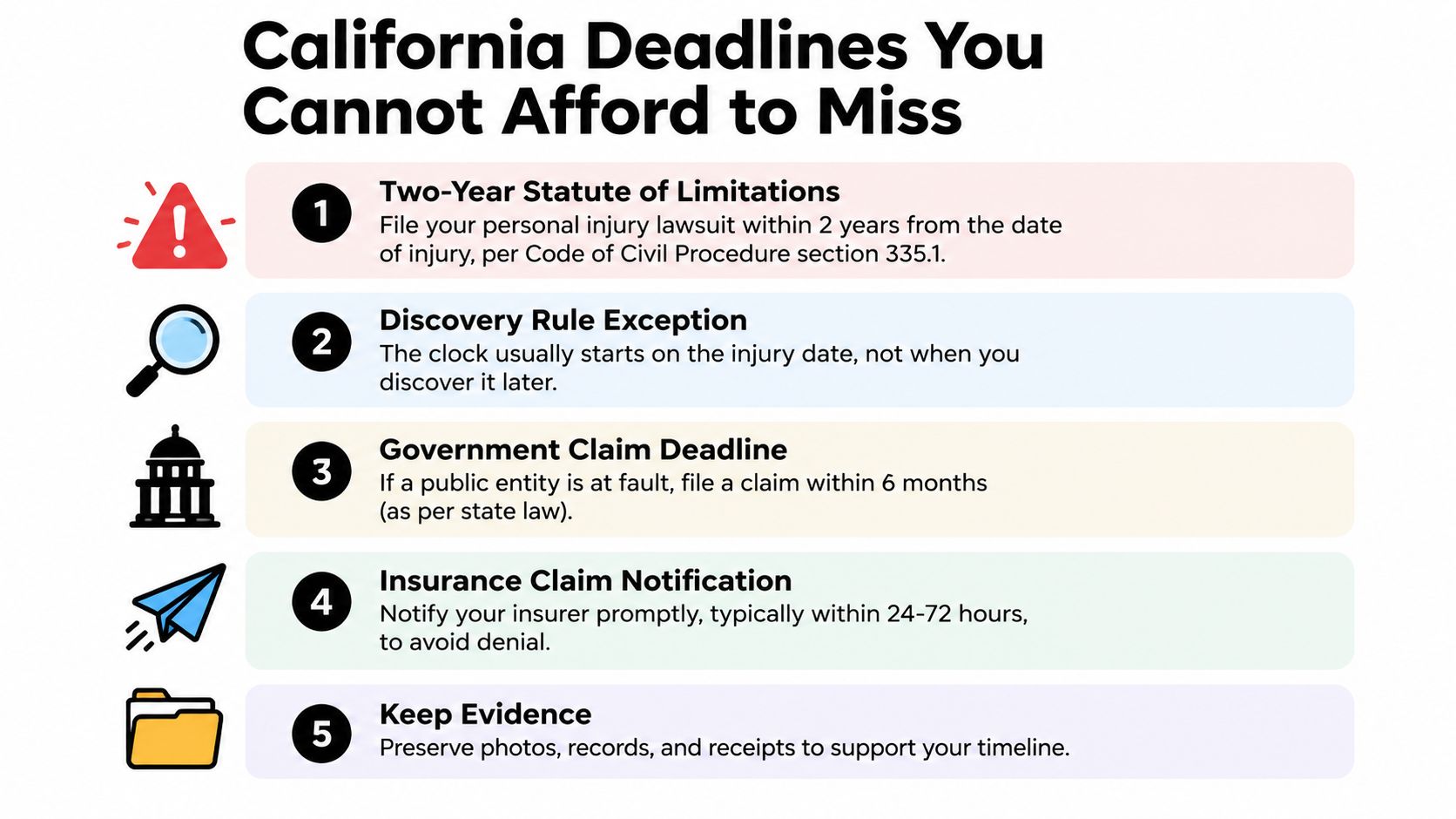
The calendar starts on the day of the injury. For most California personal injury claims, Code of Civil Procedure section 335.1 sets a two-year filing deadline. The California courts’ statute of limitations guidance explains that this rule covers personal injury accidents, wrongful death, assault, battery, and negligent or wrongful acts. Review this California auto accident statute of limitations guide before assuming a claim can wait.
A government defendant creates a separate deadline problem. A claim involving a public entity or government employee may require a government claim within six months, and some situations may also involve a 30-day intent-to-sue notice. A city bus, county vehicle, public roadway, or government facility must be investigated under rules different from those for a private defendant. Identify the responsible entity immediately and get advice on the required claim procedure.
Put every clock on one calendar
Create a case calendar on the accident date:
- Accident date: Record the collision date, location, agencies contacted, witnesses, and every medical visit.
- Early reporting: Complete the SR-1 requirement when applicable and retain proof of submission.
- Government involvement: Flag the claim immediately if a public vehicle, employee, roadway, or facility may be involved.
- Insurance deadlines: Read your policy for notice and uninsured-motorist requirements. Policy deadlines can differ from lawsuit deadlines.
- Litigation date: Calculate the two-year injury deadline from the accident date, then speak with counsel well before it arrives.
Other rules may impose their own reporting windows, including workers’ compensation procedures and policy-specific uninsured-motorist notice requirements. A delayed diagnosis does not automatically extend every deadline. Ongoing treatment, difficulty locating the other driver, or a late lowball offer should prompt legal advice now.
Legal proceedings can take substantial time, so missing records or waiting until a deadline is close can create serious pressure. The England and Wales and Ireland figures cited in other systems illustrate that claims may remain unresolved for months, but California deadlines control your case.
Use a calendar, not memory. If a government entity or employer may be involved, treat the issue as urgent until a California attorney evaluates it.
When to Bring in a Personal Injury Attorney
A do-it-yourself insurance claim may be manageable when fault is undisputed, injuries resolve quickly, and the insurer is paying reasonable covered losses. It becomes a poor strategy when the adjuster disputes liability, requests a recorded statement, minimizes ongoing symptoms, denies the claim, or pushes a release before your treatment is complete.
Bring in counsel promptly when you have a fracture, concussion symptoms, nerve complaints, surgery discussions, extended therapy, lost income, permanent limitations, or a treatment gap that needs explanation. The same is true when a passenger, rideshare company, commercial vehicle, public entity, or multiple drivers may be involved. Coverage analysis becomes more important as damages rise.
California-specific rules can change the evaluation. Comparative fault can reduce recovery when evidence assigns responsibility to more than one person. Medical damages and other restrictions under California’s changing personal injury law, including MICRA-related issues in qualifying cases, can require careful analysis rather than a generic online calculator.
What the first consultation should answer
A productive consultation usually begins with the collision narrative, police report, photographs, witness information, medical records, insurance correspondence, and your work-loss documentation. The attorney should discuss liability, available policies, unresolved medical questions, deadlines, likely stages of the claim, and whether an early settlement would be premature.
Bring:
- Accident materials: Police report information, photographs, videos, witness contacts, vehicle damage records, and the other driver’s insurance details.
- Medical materials: Discharge papers, diagnoses, imaging, referrals, prescriptions, therapy records, and a list of future appointments.
- Financial materials: Pay records, work restrictions, missed shifts, receipts, transportation expenses, and health insurance correspondence.
- Communication materials: Adjuster letters, emails, texts, recorded-statement requests, and settlement offers.
Ask who will handle the case, how often you’ll receive updates, how contingency fees are calculated, which litigation costs you may be responsible for, what happens if the case doesn’t resolve, and how liens or medical balances are addressed. Many personal injury firms work on contingency, so an upfront fee shouldn’t stop you from seeking an evaluation.
LA Law Group, APLC is one California option for accident-related personal injury matters, including car accidents, pedestrian accidents, premises incidents, truck accidents, rideshare injuries, and wrongful death claims. The firm describes a process involving case assessment, strategy, negotiation, and resolution, with direct attorney access and free initial consultations.
A Clear Path Forward After an Accident
The first week is not about proving your entire case. It’s about creating a reliable record while protecting your health.
Get emergency care for dangerous symptoms and follow the treatment plan for everything else. Photograph the scene and your injuries, preserve vehicle and medical evidence, and write down what happened while your memory is fresh. Report the collision through the appropriate channels, including police, the DMV, your insurer, and any applicable liability carrier. Keep communications factual, and don’t let an adjuster rush you into a recorded statement or release while your prognosis remains unclear.
Watch the calendar. Most California injury claims carry a two-year deadline from the injury date under Code of Civil Procedure section 335.1, while claims involving a government entity can require action within six months. Those deadlines are not interchangeable, and a strong liability case can still be lost if the wrong procedure or filing date controls.
The value of an injury claim usually turns less on the drama of the impact than on what happened afterward. Consistent medical care, documented symptoms, preserved evidence, accurate reporting, and coverage analysis give the claim a foundation. A gap, unexplained delay, casual admission, or premature settlement can give the insurer a competing story.
This article provides general information about California personal injury law for informational purposes only. It isn’t legal advice for your specific circumstances, no attorney client relationship exists based on reading this article or contacting a firm through it, and none of the information here is legal advice. If your injuries are significant, consult a licensed California attorney who can evaluate your facts, records, insurance coverage, and deadlines.
Protect your health first, your evidence second, and your legal rights on the same day.
LA Law Group, APLC offers California personal injury consultations for people dealing with crash injuries, disputed liability, treatment gaps, insurer pressure, and coverage questions. Visit LA Law Group, APLC to request a consultation and discuss the next step for your accident claim.
Attorney Advertising. This article is general information, not legal advice, and does not create an attorney-client relationship. Prior results do not guarantee a similar outcome.