
Is Lane Splitting Legal A Complete State-by-State Guide for Riders
Disclaimer: This article is for informational purposes only and is not to be construed as legal advice. No attorney-client relationship exists based on the review of this article, and none of the information provided constitutes legal advice.
Riding on two wheels offers a kind of freedom you just can’t get in a car. But with that freedom comes a big question for riders nationwide: is lane splitting legal? The answer is surprisingly complex and changes drastically the moment you cross a state line. Right now, California is the only state that has officially given motorcyclists the green light to practice it.
Your Quick Guide to Lane Splitting Laws by State
For any motorcyclist stuck in gridlock, that sliver of space between lanes of stopped or slow-moving traffic looks mighty tempting. Riding through it is called lane splitting, which is formally defined as riding a motorcycle between rows of vehicles moving in the same direction. It’s a way to cut through congestion, save time, and, some argue, even avoid getting rear-ended.
But the legality of this move is one of the most tangled topics in traffic law. While it’s a daily sight on California freeways, trying it just about anywhere else can land you a ticket. A few other states, like Arizona and Utah, have dipped their toes in the water with a limited version called lane filtering. This usually just allows riders to move between stopped cars, like at a red light, not while traffic is flowing.
To make sense of this legal patchwork, here’s a quick overview of where things stand across the United States.
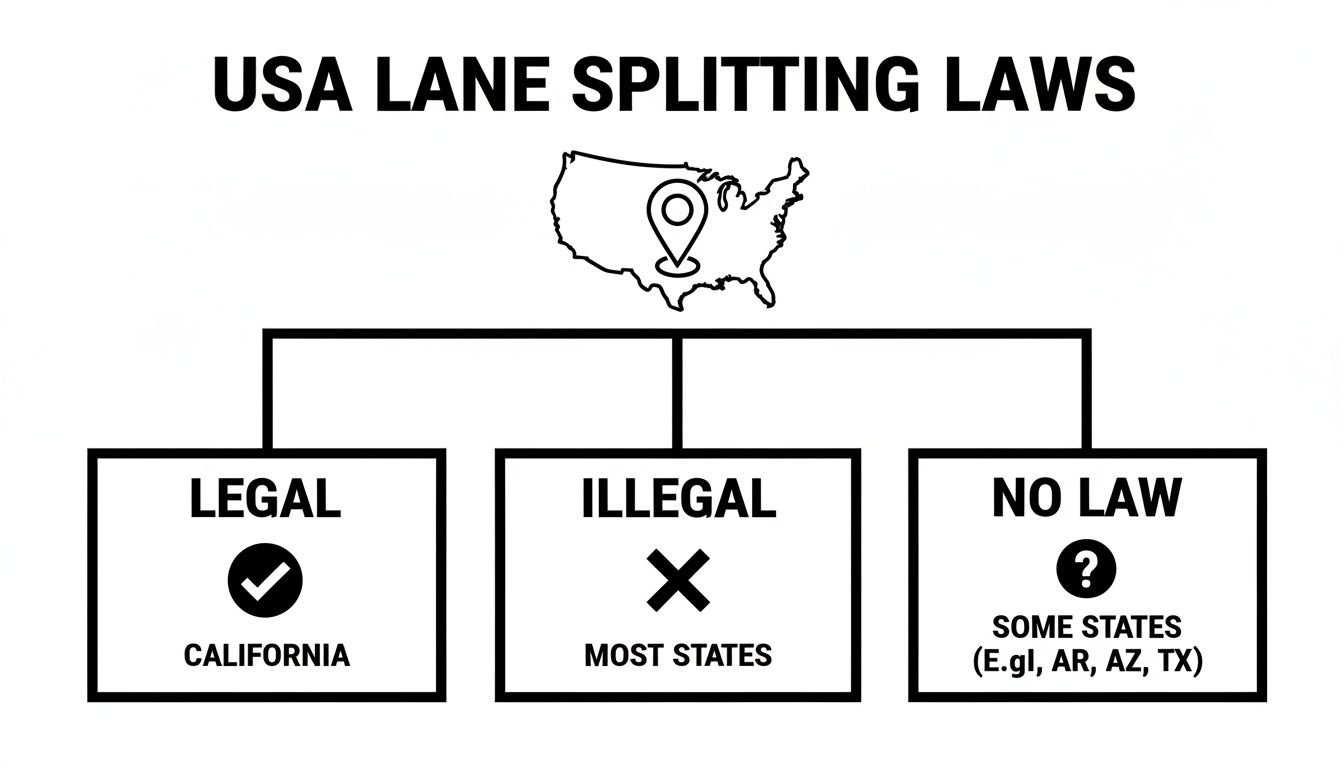
As you can see, California is in a league of its own. Most states have outlawed the practice entirely, while a few others haven’t passed any specific laws, leaving riders in a legal gray area.
U.S. Lane Splitting and Filtering Laws at a Glance
For a more detailed breakdown, this table offers a quick reference guide to the current laws across the country.
| Legal Status | States | Key Details |
|---|---|---|
| Legal | California | Lane splitting is fully legal. The California Highway Patrol (CHP) provides safety guidelines for riders. |
| Legal (Filtering Only) | Arizona, Montana, Utah, Hawaii | Lane filtering (moving between stopped vehicles) is permitted under specific conditions, like low speeds. |
| Illegal | Most States | Explicitly prohibited by traffic laws. Riders can be ticketed for “improper lane change” or similar violations. |
| No Specific Law | Arkansas, Texas, Oklahoma, etc. | No statute directly addresses lane splitting, creating a legal gray area. It’s often treated as illegal. |
Knowing these rules is about more than just avoiding a ticket—it’s about your safety and protecting your rights if an accident happens. The legality of what you were doing on the road will be a huge factor in any personal injury claim. For riders in California, it’s especially critical to understand the official guidelines from the California Highway Patrol (CHP) to ensure you’re riding safely and within the bounds of the law.
Understanding California’s Lane Splitting Law
Disclaimer: This article is for informational purposes only and is not to be construed as legal advice. No attorney-client relationship exists based on the review of this article, and none of the information provided constitutes legal advice.
Ask a rider if lane splitting is legal, and you’ll get a different answer depending on where you are in the country. It’s a complicated patchwork of rules, but here in California, the answer is a clear and simple “yes.”
The Golden State is the only one to formally legalize and define the practice, setting a precedent that riders and lawmakers nationwide are watching. This took lane splitting out of a legal gray area and made it an accepted way to navigate our state’s notoriously congested roads.
This official shift from a tolerated practice to a legal maneuver happened back in 2016. Before then, riders did it, and law enforcement mostly looked the other way, but there were no official rules. That changed when Assembly Bill 51 added Section 21658.1 to the California Vehicle Code. For the first time anywhere in the U.S., lane splitting was officially on the books.
But the law itself was just the beginning. It gave the California Highway Patrol (CHP) the job of creating educational guidelines to make sure riders were doing it safely. These guidelines, issued in 2018, are incredibly important.
The CHP Guidelines: What Every Rider Must Know
Think of the CHP guidelines as the unwritten “rules of the road” for lane splitting. They aren’t laws with specific fines attached, but they are the standard that police, insurance adjusters, and courts use to decide if a rider was being safe and reasonable.
Following them is your best defense in an accident—and your best strategy for avoiding one in the first place.
The CHP boils it down to a few key safety tips:
- Consider the Total Environment: This is the big one. It means you have to constantly be scanning everything—traffic speed, how wide the lanes are, weather conditions, and the amount of space you have. Safe lane splitting is all about the situation you’re in.
- Manage Your Speed Differential: Your motorcycle should be going no more than 10 mph faster than the traffic around you. Anything more than that dramatically increases your risk.
- Avoid Splitting at High Speeds: The CHP advises against lane splitting when traffic is moving faster than 30 mph. When cars are moving that fast, drivers simply don’t have enough time to see you and react.
These three points are the core of riding responsibly. If you’re zipping along at 45 mph through traffic that’s moving at 40 mph, you’re riding outside of these safety recommendations and could easily be seen as reckless.
The whole point of lane splitting is to safely move through slow or stopped traffic—not to weave through cars on the open freeway. The CHP guidelines make it clear: this is a tool for gridlock, not a pass for aggressive riding.
Putting the Safety Rules into Practice
Beyond those core speed rules, the CHP gets more specific about real-world situations. Paying attention to these details is what separates a safe rider from a liability.
First, not all lanes are created equal. The CHP recommends splitting between the far-left lanes (the #1 and #2 lanes). Why? Because drivers in those lanes generally expect to be passed on the left and are less likely to make a sudden move into your path. Splitting between other lanes, especially near on-ramps and exits where cars are merging, is far more dangerous.
There are also times when you should just avoid splitting altogether:
- Bad Weather: Rain, fog, or slick roads are a hard no. Your visibility is lower, your tires have less grip, and it’s just not worth the risk.
- Wide Vehicles: Never try to squeeze past big rigs, buses, or trucks with wide trailers. Their blind spots are huge, and they might not see you at all.
- When in Doubt, Don’t: If you feel unsafe for any reason—maybe drivers are being erratic or the lanes seem too narrow—the smartest move is always to merge back into a lane and wait it out.
Ultimately, lane splitting is legal in California, but that legality comes with a heavy dose of personal responsibility. Part of that responsibility is wearing the right gear; you can learn more by reading our guide on motorcycle helmet laws in California. By following the CHP’s common-sense guidelines, you protect yourself not just physically, but legally. If an accident does happen, the fact that you were following these safety practices will be a critical factor in determining who was at fault.
Why Lane Splitting Can Be a Safer Way to Ride
Disclaimer: This article is for informational purposes only and is not to be construed as legal advice. No attorney-client relationship exists based on the review of this article, and none of the information provided constitutes legal advice.
To anyone in a car, watching a motorcycle glide between lanes can look like a daredevil stunt. The gut reaction is that it’s reckless, but a solid body of evidence actually points in the opposite direction, especially in the soul-crushing, stop-and-go traffic that’s a daily reality for commuters. The real argument for lane splitting isn’t about shaving a few minutes off a commute—it’s about preventing one of the most dangerous and common types of motorcycle accidents.
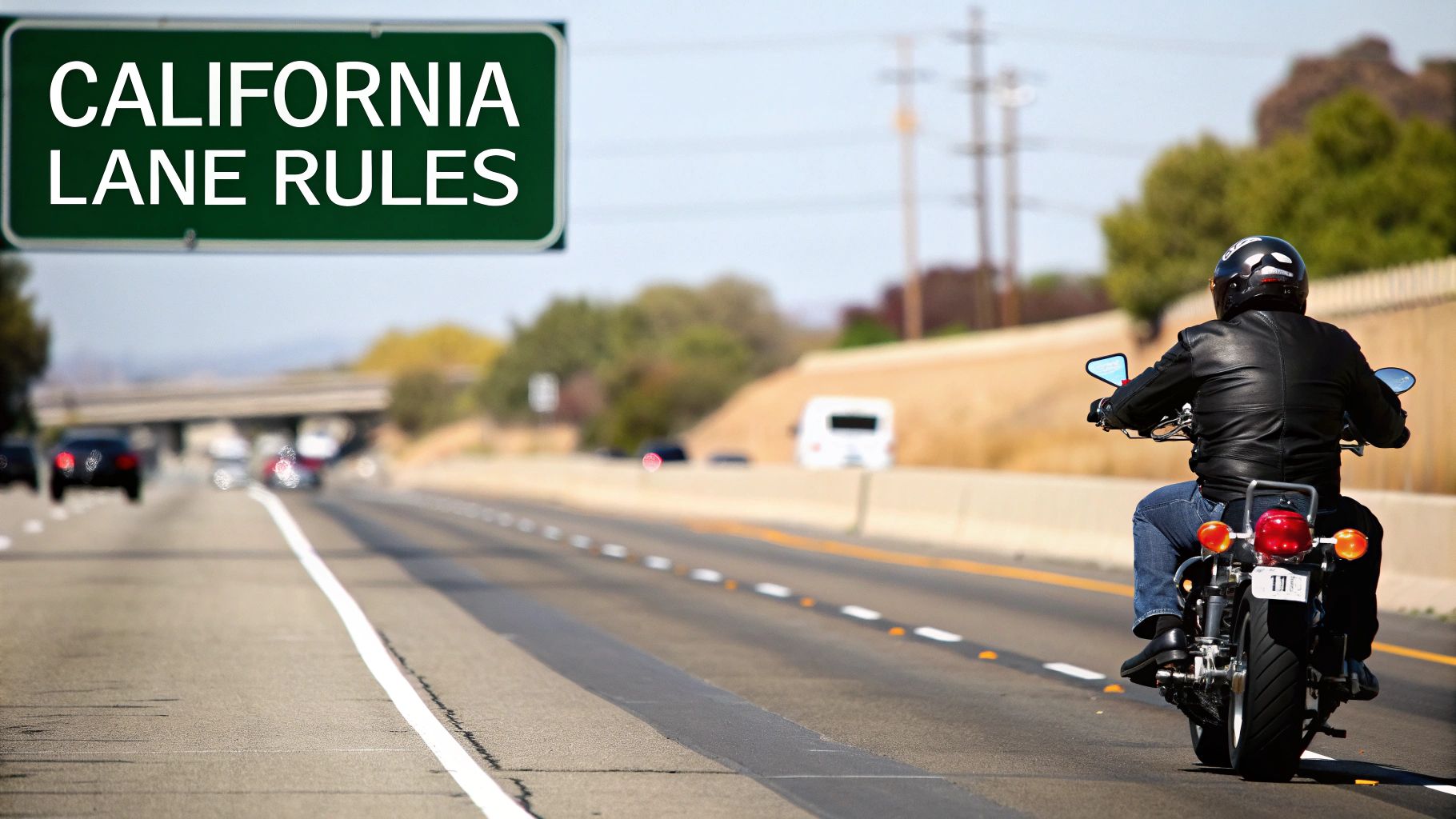
At its core, lane splitting is about drastically reducing the risk of rear-end collisions. When a bike is stopped in traffic, it’s a completely exposed target for a distracted driver. One second of looking down at a text is all it takes for a two-ton car to become a battering ram, and the consequences for the rider are almost always devastating.
The Physics of Rider Safety
Picture this: a rider is stuck in bumper-to-bumper traffic, boxed in with no escape route. The driver behind them doesn’t stop in time. The motorcycle and rider absorb the full force of that impact, often getting crushed between two much larger vehicles. This is a tragically common and often fatal scenario for bikers in congested traffic.
Lane splitting completely changes that equation. By moving slowly between the lanes, a rider is no longer a sitting duck. They’re occupying a space where a direct, forceful rear-end collision is virtually impossible. In essence, they’ve removed themselves from the single most vulnerable position on the road during a traffic jam.
When done safely and correctly, lane splitting isn’t a risk—it’s a defensive riding strategy. It’s about proactively getting out of the way of inattentive drivers.
Data Backs Up the Safety Claims
This isn’t just a theory; the numbers tell a compelling story. Research consistently shows that riders who practice safe lane splitting are often better off than those who don’t. Studies that dig into motorcycle accident data find that lane-splitting riders are less likely to suffer from severe head injuries, torso trauma, or fatalities when a crash does occur.
The safety data coming out of California is a big reason why the practice has gained legal ground, especially in gridlocked areas like the freeways of Los Angeles. One pivotal study found that the rate of rear-end accidents involving motorcycles dropped from 4.6% to 2.6%—that’s a 43% reduction—for riders who were lane splitting. This makes perfect sense, as getting rear-ended in stop-and-go traffic accounts for a shocking number of rider fatalities. You can learn more about these findings on RevZilla’s Common Tread.
Lane Splitting as a Defensive Technique
Ultimately, responsible lane splitting is just another tool in a defensive rider’s toolkit. It demands a high level of awareness, fine-tuned control, and sticking to safety guidelines, like keeping the speed difference low. Riders who split lanes properly are often more tuned in to their surroundings, constantly scanning for hazards instead of just passively waiting for traffic to move.
Think about how proper lane splitting incorporates key defensive riding principles:
- Increased Visibility: A bike moving slowly between lanes is often more noticeable than one tucked away in a car’s blind spot.
- Proactive Positioning: The rider is actively managing their space and maintaining an escape path, not just trapped in one spot.
- Hazard Anticipation: To split lanes safely, a rider has to constantly predict what drivers will do next, like an unexpected lane change, which makes them a more alert rider overall.
While the question “is lane splitting legal” is still a patchwork of laws across the country, the safety argument makes a powerful case for why states like California have embraced it. When it’s done right, it’s not about speed or recklessness; it’s about smart, strategic positioning to avoid the biggest dangers riders face every day.
How the Rest of the World Handles Lane Splitting
Disclaimer: This article is for informational purposes only and is not to be construed as legal advice. No attorney-client relationship exists based on the review of this article, and none of the information provided constitutes legal advice.
Here in the United States, just mentioning “lane splitting” can kick off a heated debate. But for most of the world, it’s not a question at all—it’s just how you get through the daily commute. The controversy we have here stands in stark contrast to its widespread acceptance across Europe and Asia, where it’s seen as a common-sense solution to traffic jams.

Looking at it from a global perspective really changes the conversation. What might seem reckless to an American driver is simply an efficient—and often safer—way to manage traffic in packed cities from Amsterdam to Taipei. In these places, lane splitting isn’t merely tolerated; it’s an expected part of driving that both riders and car drivers know how to navigate.
A Look at European Norms
In Europe, the approach to lane splitting is far more unified and permissive. It’s a daily reality in most of the 27 EU countries, where it’s either explicitly legal or just an accepted, standard riding technique. This international consensus is starting to influence U.S. policy discussions, with more states looking at California’s success as a potential model. To get a broader view, you can explore the global variations of lane splitting laws and see how different countries handle the practice.
For example, in the Netherlands, lane splitting is not only legal but actually encouraged in certain conditions to help ease traffic flow. Dutch riders are taught to filter through stopped or slow traffic as a matter of course. Other nations have their own slight variations:
- Germany: Generally permits filtering, but only when traffic is at a complete standstill.
- Spain: Technically, the practice is banned, but it’s often tolerated by police in congested city centers.
- Poland: The law is ambiguous, neither banning nor endorsing it, so it’s left up to the rider’s discretion.
This widespread acceptance shows that with proper rider training and driver awareness, lane splitting can be integrated safely into traffic systems, even on a massive scale.
The global view shows that California isn’t an outlier; it’s actually aligning with a proven international consensus on motorcycle safety and traffic efficiency. The U.S. is the exception, not the rule.
Lessons from International Practice
The success of lane splitting overseas offers some valuable lessons. In countries where it’s common, there’s a shared understanding between drivers and riders. Drivers learn to anticipate motorcycles moving between lanes, and riders are trained to do so predictably and safely—keeping speeds low and staying alert.
This cultural acceptance is the key takeaway. It suggests the biggest hurdle to safe lane splitting isn’t the act itself, but rather the lack of awareness and education for everyone on the road. When we look at how other nations have made it work for decades, it’s clear that lane splitting is a viable strategy for improving road safety and cutting down on congestion, not just some controversial maneuver.
Determining Fault in a Lane Splitting Accident
Disclaimer: This article is for informational purposes only and is not to be construed as legal advice. No attorney-client relationship exists based on the review of this article, and none of the information provided constitutes legal advice.
After any crash, the first question is always the same: Who’s at fault? This question gets a lot more complicated when a lane-splitting motorcyclist is involved. The answer almost always boils down to a legal concept called negligence.
Simply put, negligence means someone failed to act with reasonable care, and that failure caused harm. For a car driver, that could be anything from changing lanes without signaling to texting behind the wheel. For a rider, it could mean weaving recklessly through traffic.
The Role of CHP Guidelines in Proving Negligence
In California, you can’t just point a finger and say, “He was lane splitting, so it’s his fault.” Since the practice is legal, a rider isn’t automatically to blame. Instead, investigators and insurance companies will look at the specific details of the accident, using the CHP’s safety guidelines as an unofficial rulebook.
Think of it this way: if you were splitting lanes by the book—moving no more than 10 mph faster than traffic that was already going under 30 mph—and a driver suddenly cuts you off, their negligence is clear. They had a duty to check their mirrors and blind spots.
But if you were flying between cars at 50 mph, you were riding outside those safety recommendations. In that scenario, even if the driver also made a mistake, you could be found partially or even entirely responsible for the collision.
Understanding Comparative Negligence
California follows a legal rule called “pure comparative negligence.” This is actually good news for riders. It means you can still recover money for your injuries even if you were partially to blame for the accident. Your final compensation is just reduced by whatever percentage of fault is assigned to you.
For a deeper look at this principle, check out our detailed guide on what is pure comparative negligence.
Here’s how it works in the real world:
- A driver makes an unsafe lane change, hitting a motorcyclist who is lane splitting.
- A court finds the driver was 80% at fault because they didn’t signal or check their mirrors.
- However, the court also determines the rider was going 15 mph faster than traffic, making them 20% at fault.
- If the total damages (medical bills, lost wages, bike repairs) add up to $100,000, the rider can recover $80,000 ($100,000 minus their 20% share of fault).
This system is exactly why sticking to the CHP guidelines is so important. Following them helps prove the other driver carries the lion’s share of the blame.
Insurance companies love to use a rider’s decision to lane split as a catch-all excuse. They often try to deny the claim or pin most of the blame on the motorcyclist, hoping the rider doesn’t know the nuances of comparative negligence.
Why Insurance Companies Push Back
At the end of the day, an insurance adjuster’s job is to save their company money. They will often argue that lane splitting is inherently dangerous—regardless of its legality—to scare you into accepting a tiny settlement or just giving up.
They’ll try to twist your actions against you, even if you were riding responsibly. Without an experienced advocate in your corner, you could easily be blamed for a crash that a careless driver caused. This is where a skilled personal injury attorney is crucial. They can fight back against these biased arguments, use evidence to show you were riding safely, and make sure fault is assigned where it truly belongs so you get the compensation you deserve.
Your Action Plan After a Lane Splitting Crash
Disclaimer: This article is for informational purposes only and is not to be construed as legal advice. No attorney-client relationship exists based on the review of this article, and none of the information provided constitutes legal advice.
The moments right after a crash are a blur of adrenaline and confusion. It’s chaotic and disorienting, but what you do next can make a world of difference for your health and your ability to get fair compensation.
Knowing the right steps is crucial, especially when an insurance adjuster or the other driver is itching to blame you just for lane splitting. Following a plan protects your rights and lays the groundwork for your recovery.
Your absolute first priority is safety. If you’re able, move yourself and your bike out of traffic to avoid a second collision. Next, get medical attention immediately. Adrenaline is a powerful painkiller and can easily hide serious injuries that will show up hours or days later.
Document Everything at the Scene
Once you’re safe, it’s time to shift gears and become an evidence collector. The details you can gather right after the crash are the most powerful pieces of your potential claim. A strong case is built on solid proof, not just a fuzzy memory of what happened.
Here’s what you need to start documenting with your phone:
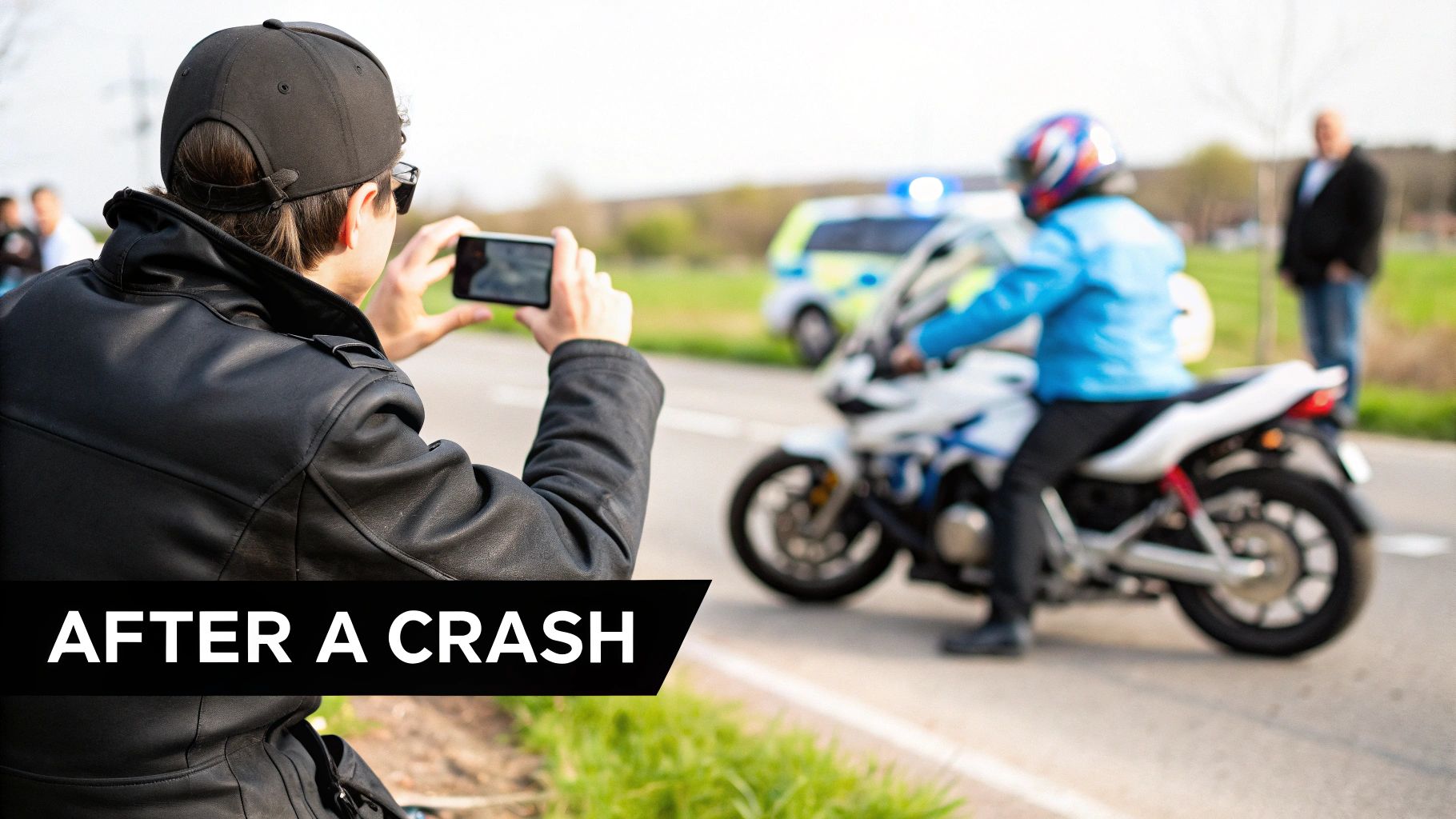
- Photos and Videos: Take pictures of everything. Get wide shots of the entire scene, close-ups of the damage to all vehicles from every angle, the final resting spots of the cars and your bike, skid marks, and any relevant traffic signs or signals.
- Contact Info: Swap insurance and contact details with the other driver. Just as importantly, get the names and phone numbers of anyone who saw what happened. Eyewitness accounts can be incredibly powerful.
- Police Report: Always call the police to get an official report filed. When the officer shows up, calmly and clearly state the facts. Stick to what you know for sure, and don’t guess or speculate about speed or fault.
CRITICAL TIP: Never, ever admit fault at the scene. Don’t say “I’m sorry” or anything that sounds like you’re taking the blame. Let the evidence and the official investigation figure out who was negligent.
Protect Your Legal and Financial Interests
After you’ve left the scene and seen a doctor, the next phase is all about protecting your legal rights and starting down the path to financial recovery. This is where a lot of riders make missteps that seriously weaken their case.
Your post-accident game plan should include these moves:
- Notify Your Insurance: Report the accident to your own insurance company as soon as you can, but only give them the basic facts. Do not agree to a recorded statement or sign anything from the other driver’s insurance company until you’ve spoken with an attorney.
- Preserve the Evidence: Don’t throw away your damaged riding gear. Your helmet, jacket, pants, and gloves are powerful evidence that can show the forces involved in the collision. Also, keep a detailed file of all your medical treatments, bills, and related expenses.
- Understand the Process: After a lane splitting accident, knowing what kind of compensation you might be entitled to is a huge part of your action plan. You can consult a comprehensive motorcycle accident injury settlement guide to get a clearer picture of what to expect.
Navigating the aftermath of any accident is complicated, and there are many small but critical steps to take. For a more general rundown, our guide on what to do after a car accident can be a helpful resource. Following a clear plan from the start is the best way to ensure you don’t miss anything that could impact your claim.
How an Attorney Fortifies Your Accident Claim
Disclaimer: This article is for informational purposes only and is not to be construed as legal advice. No attorney-client relationship exists based on the review of this article, and none of the information provided constitutes legal advice.
After a lane-splitting accident, you’re not just hurt—you’re immediately on the defensive. Insurance companies often carry a bias, assuming the rider must be at fault. This is where an experienced personal injury attorney steps in, acting as your advocate and strategist to level the playing field.
Right away, they get to work preserving the evidence that can vanish in a heartbeat. Think about it: dashcam footage from other cars gets overwritten, and traffic camera recordings are often deleted after a short period. Your lawyer knows how to secure this crucial evidence before it’s gone for good.
While you’re focused on healing, your attorney is busy building your case. They dive deep into the details, applying California’s Vehicle Code and the CHP’s own safety guidelines to prove the other driver was negligent. This is absolutely critical because insurance adjusters are trained to use any excuse—including the simple fact that you were lane splitting—to reduce your claim or deny it outright.
Calculating Your Claim’s Full Value
One of the most important things an attorney does is figure out what your claim is really worth. It’s so much more than just your initial emergency room bill and the cost to fix your bike. A truly comprehensive claim has to account for everything the accident will cost you, now and in the future.
This includes things like:
- Future Medical Costs: What about the ongoing physical therapy, potential future surgeries, or long-term care you might need?
- Lost Income: It’s not just about the paychecks you’ve already missed. What if your injuries affect your ability to earn a living down the line? That’s your diminished earning capacity.
- Pain and Suffering: This is compensation for the physical pain, the emotional trauma, and the simple loss of being able to enjoy your life the way you used to.
Calculating the full value ensures you don’t get stuck with unexpected bills years from now. It’s the difference between accepting a quick, lowball offer from an insurer and securing the resources you actually need to fully recover.
Navigating Complex Legal Scenarios
An attorney is also your guide through the legal maze that often follows a crash. Things can get especially tricky if a hit and run is involved; understanding the value of hiring a hit and run defense attorney provides a glimpse into the complexities of the legal process. They take over all communication with the insurance companies, shielding you from their pressure tactics and building a case that’s strong enough for court if a fair settlement isn’t on the table.
Having skilled legal representation sends a clear message to the insurance company: you will not be intimidated or short-changed. It forces them to evaluate your claim based on the facts and the law, not on unfair biases against motorcyclists.
Ultimately, having an attorney on your side means every detail is handled correctly. It frees you up to focus on the one thing that truly matters—your health and getting back on the road.
Disclaimer: This article is for informational purposes only and is not to be construed as legal advice. No attorney-client relationship exists based on the review of this article, and none of the information provided constitutes legal advice.
If you’ve been injured in a motorcycle accident while lane splitting, you don’t have to face the legal battle alone. The dedicated team at LA Law Group, APLC is here to fight for your rights and secure the compensation you deserve. Contact us today for a free, no-obligation consultation to discuss your case by visiting bizlawpro.com.
Attorney Advertising. This article is general information, not legal advice, and does not create an attorney-client relationship. Prior results do not guarantee a similar outcome.