
Los Angeles Drunk Driving Lawyers and Your Options

It’s still dark when you get home from a Los Angeles crash. Your phone has photos of damaged cars, someone has gone to the hospital, and the paperwork mentions an arrest, a driver’s license, or an insurance claim. Searching for Los Angeles drunk driving lawyers can make those problems look like one legal matter. They aren’t, and choosing the right help starts with knowing whose interests need protection.
One Crash and Three Different Legal Problems
Say a driver on Sunset Boulevard collides with another car. Police arrest the driver on suspicion of driving under the influence, while a passenger leaves by ambulance. Before sunrise, the people involved may be facing a criminal prosecution, an administrative license action, and a civil injury claim.
The prosecutor controls the criminal case. The California DMV handles the administrative license process, which doesn’t have to wait for a guilty verdict. The injured passenger’s claim concerns compensation for harm, including treatment expenses and lost income, rather than the punishment a court might impose.
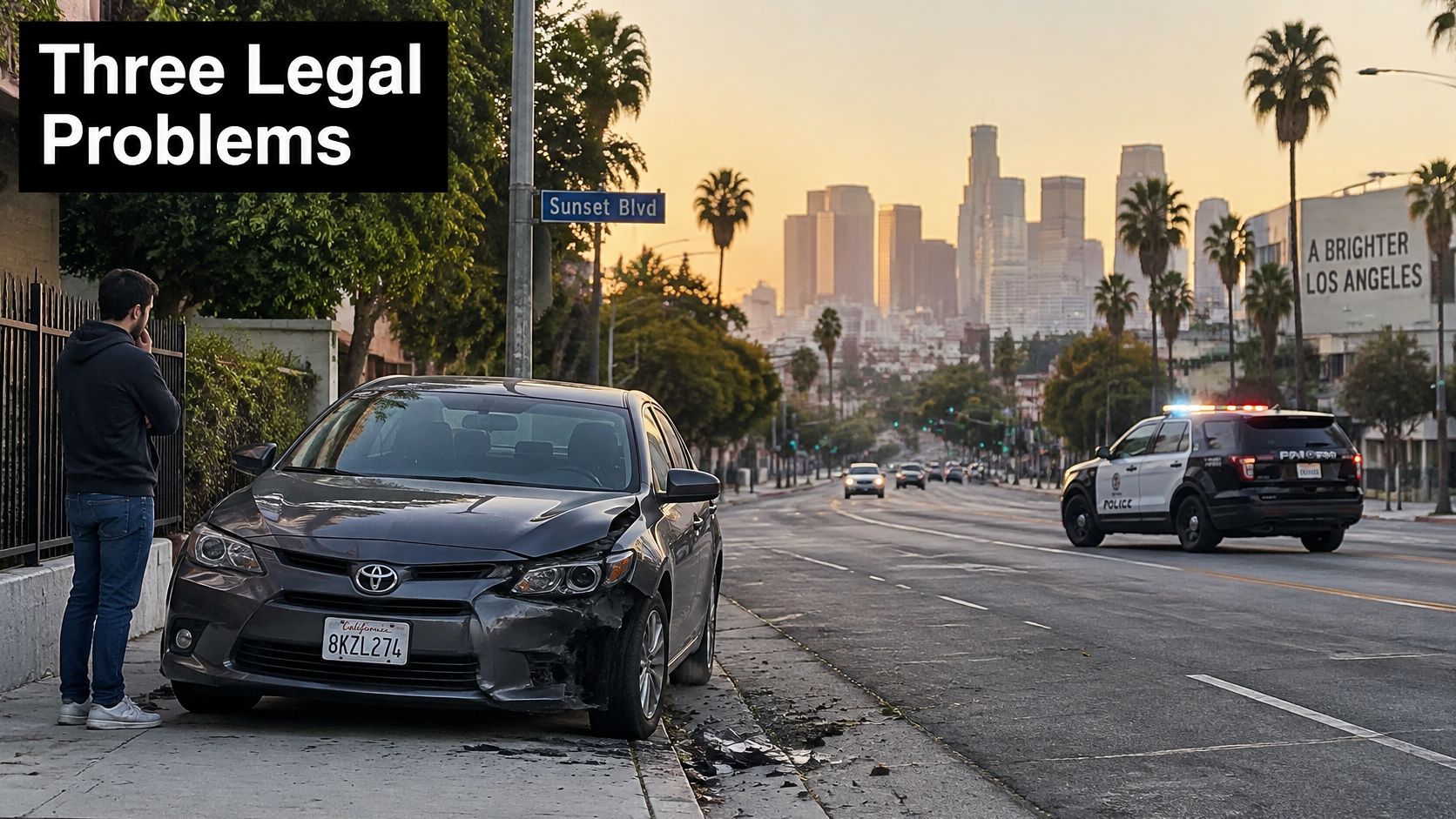
The same crash creates different interests
The driver wants to understand the accusation and protect their rights. The passenger wants medical care and a way to address the financial consequences. A family member may be trying to organize both situations, but that doesn’t make their legal interests interchangeable.
A California legislative background report identifying 2024 roadway harm figures reported 4,445 alcohol-involved fatalities and serious injuries, compared with 713 drug-involved fatalities and serious injuries. Those statewide categories describe serious public-safety harm, not the merits of any individual accusation or insurance claim.
Start with your role: Were you arrested, injured, or both? That answer matters more than the broad label “drunk-driving lawyer.”
Information is not representation
This article is for informational purposes only and is not to be construed as legal advice. Reviewing this article does not create an attorney-client relationship, and none of the information in this article is legal advice.
An arrest doesn’t establish guilt, and an injury doesn’t establish the value of a claim. Each matter requires its own evidence, decision-maker, and assessment. Keeping those distinctions clear helps people avoid asking a defense lawyer to pursue compensation or assuming the prosecutor represents the injured person’s financial interests.
Criminal Court the DMV and the Injury Claim
One crash can create three separate legal matters
After a Los Angeles drunk-driving crash, the criminal case, the DMV process, and an injury claim may proceed on separate tracks. Each asks different questions and can reach a different outcome. The California DMV’s DUI guide describes administrative action at 0.08% BAC or higher for noncommercial drivers age 21 or older, generally a four-month suspension after a first qualifying arrest and a one-year suspension for a second or subsequent qualifying offense within 10 years.
| Matter | Who starts it | Common trigger | Separate outcome |
|---|---|---|---|
| Criminal DUI case | City attorney or district attorney | Arrest for driving under the influence | Program, fines, possible jail, and probation if convicted |
| DMV administrative per se | California DMV | Chemical test meeting the ordinary adult threshold stated above; qualifying priors affect the suspension period | First-arrest or repeat-offense suspension periods described above |
| Civil injury claim | Injured person, often through insurance | Crash harm such as medical bills and lost wages | Settlement or lawsuit compensation, independent of the criminal verdict |
The criminal file concerns the accusation
A criminal defense lawyer assesses whether the prosecution can prove the charged offense. That review can include the reason for the stop, witness observations, driving evidence, chemical testing, and whether the evidence connects the accused person to the alleged driving.
A conviction can bring obligations beyond the sentence people first notice. These may include completing a DUI program, showing proof of financial responsibility, possible ignition-interlock requirements, fines, and potential incarceration. Defense counsel can explain which consequences are proposed, which apply under the circumstances, and which remain unresolved.
Bail concerns release while a criminal case is pending. It is separate from whether the prosecution can prove the charge. For general questions about understanding DUI bail bond premiums, readers should keep the bail arrangement distinct from the evidence and issues in the case.
The DMV file concerns driving privileges
The court date and DMV deadline are not the same thing. Read the administrative notice, find its hearing-request instructions, and confirm the applicable deadline promptly. Missing that deadline can forfeit an opportunity to challenge the suspension.
For the DMV matter, counsel will need details such as the arrest and notice dates, test type and timing, and prior-offense history. Confirm whether DMV representation is part of the engagement. Hiring counsel for the criminal charge does not necessarily mean the lawyer has agreed to handle the administrative proceeding.
A dismissal or reduced charge in court does not automatically end the DMV matter. The proceedings have different functions, so the driver should know who is handling each one and what action is required.
The injury file concerns compensation
An injured person’s claim focuses on what caused the collision, which injuries followed, what treatment was necessary, and what insurance may cover. The claim belongs to the injured person, not to the criminal prosecutor.
An insurer may investigate while the criminal case is pending. The injured person should not assume the prosecutor will submit medical bills, negotiate a settlement, or protect a civil filing deadline. The accused driver, in turn, should send civil claim papers to the appropriate insurer and counsel rather than treating them as ordinary criminal discovery. These tracks can affect people involved in the same crash, but each has its own decision-maker, evidence, and next steps.
Blood Alcohol Numbers and Refusal Clocks
California per se BAC benchmarks by driver situation
The California Department of Alcoholic Beverage Control’s intoxication guidance identifies different BAC benchmarks for different driver situations: 0.08% for noncommercial drivers, 0.04% for commercial drivers, and 0.01% for drivers on DUI probation. The California alcohol limit for driving also depends on the driver’s circumstances. Passenger-for-hire drivers may be subject to a lower threshold than ordinary noncommercial drivers, so check the applicable rule rather than assuming one number fits everyone.
| Driver situation | Per se BAC benchmark |
|---|---|
| Noncommercial driver age 21 or older | 0.08% or higher |
| Commercial vehicle driver | 0.04% or higher |
| Passenger-for-hire driver | 0.04% or higher |
| Driver on DUI probation | 0.01% or higher |
The probation entry concerns an administrative-action benchmark. It does not mean every row describes the same offense. Check the driver’s age, vehicle use, and licensing status before applying a threshold.
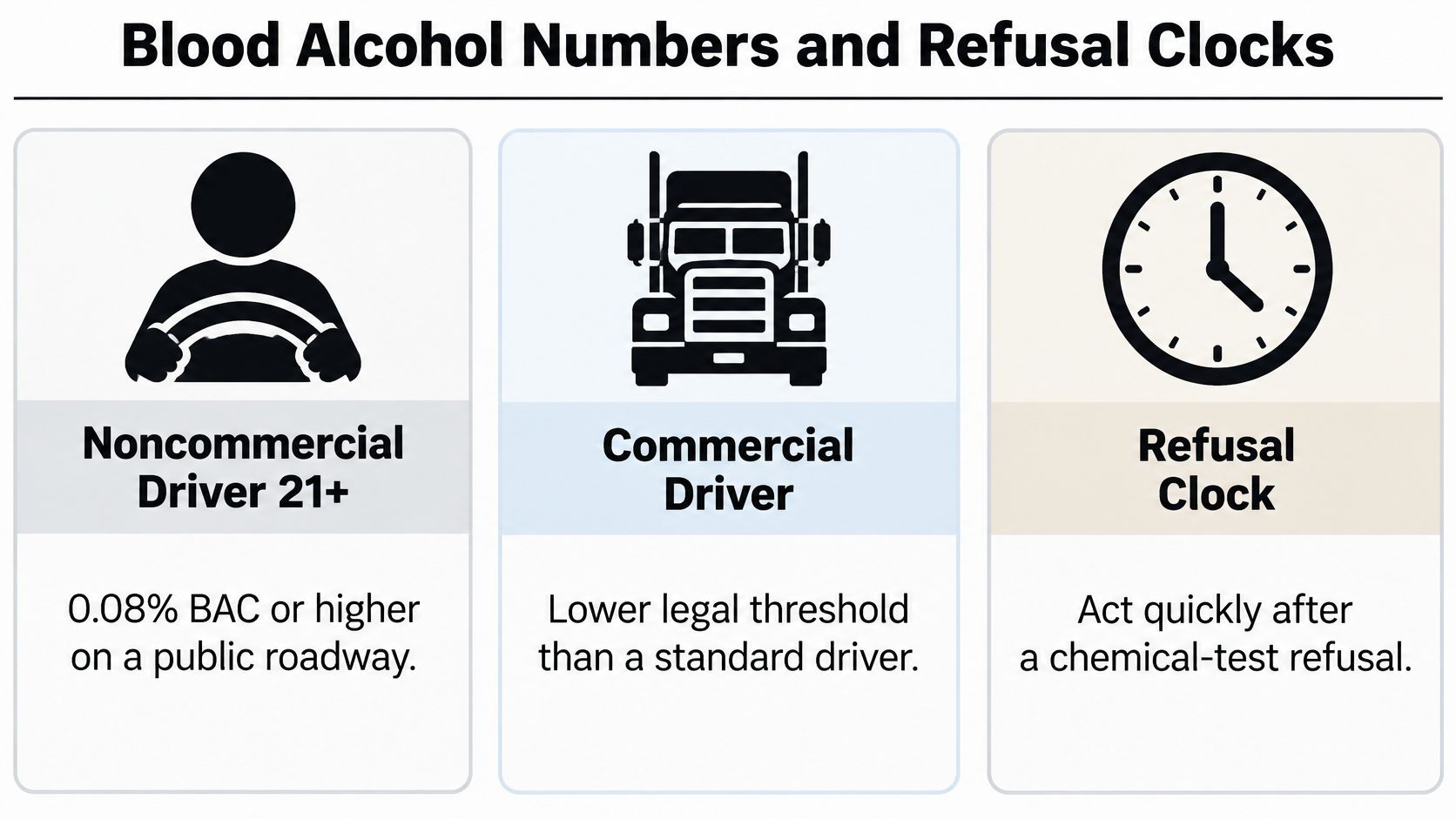
A result below the benchmark isn’t an all-clear
NHTSA’s discussion of BAC legislation describes research finding that driving impairment can begin below 0.08 g/dL BAC. A result below a stated threshold does not, by itself, establish that driving was safe or lawful.
A per se rule makes a specified alcohol concentration legally significant without separate proof of impairment for that particular theory. An impairment allegation asks whether the person’s ability to drive was affected. These are different questions, and a low test result may still matter when the evidence is considered as a whole.
Refusal creates a separate administrative problem
The DMV’s refusal and restriction materials identify refusal-related suspension periods of one year for a first offense, two years for a second, and three years for a third or subsequent offense within the applicable lookback period. Refusing or failing to complete a qualifying chemical test can trigger administrative consequences apart from any court punishment.
The sequence matters. Relevant details include which test was requested, when it was requested, what warnings were given, what the driver said, and whether a medical or practical issue affected completion. Record those specifics rather than relying on a general memory of refusing a breath test.
For someone comparing information from different states, Georgia-oriented steps after a Georgia DUI arrest should not be treated as instructions for responding to a California notice.
Test timing needs a documented sequence
A technical review connects the sample to the time of driving instead of considering the reported result alone. Alcohol absorption or elimination may affect that connection. Questions about collection or instruments call for records, not speculation.
- Preserve timestamps: Record the reported driving time, stop, arrest, and sample collection.
- Request instrument records: Seek calibration, maintenance, operator training, and observation-period documentation.
- Trace blood handling: Identify collection, labeling, storage, transfers, and laboratory analysis.
- Compare observations: Put officer notes, field observations, and chemical-test results in chronological order.
Technical review asks whether the evidence reliably supports the allegation. It cannot promise that a testing issue will defeat a case.
How an Injury Claim Sits Beside the Charge
Think of separate files on separate desks. The criminal file concerns the state’s accusation against the driver. The civil file concerns the injured person’s effort to obtain payment for harm caused by the crash.
Those files may contain overlapping evidence, including photographs, witness accounts, police reports, and chemical-test results. But they don’t share an automatic outcome: a reduced charge or acquittal doesn’t necessarily end a civil claim, and a conviction doesn’t calculate the injured person’s losses.
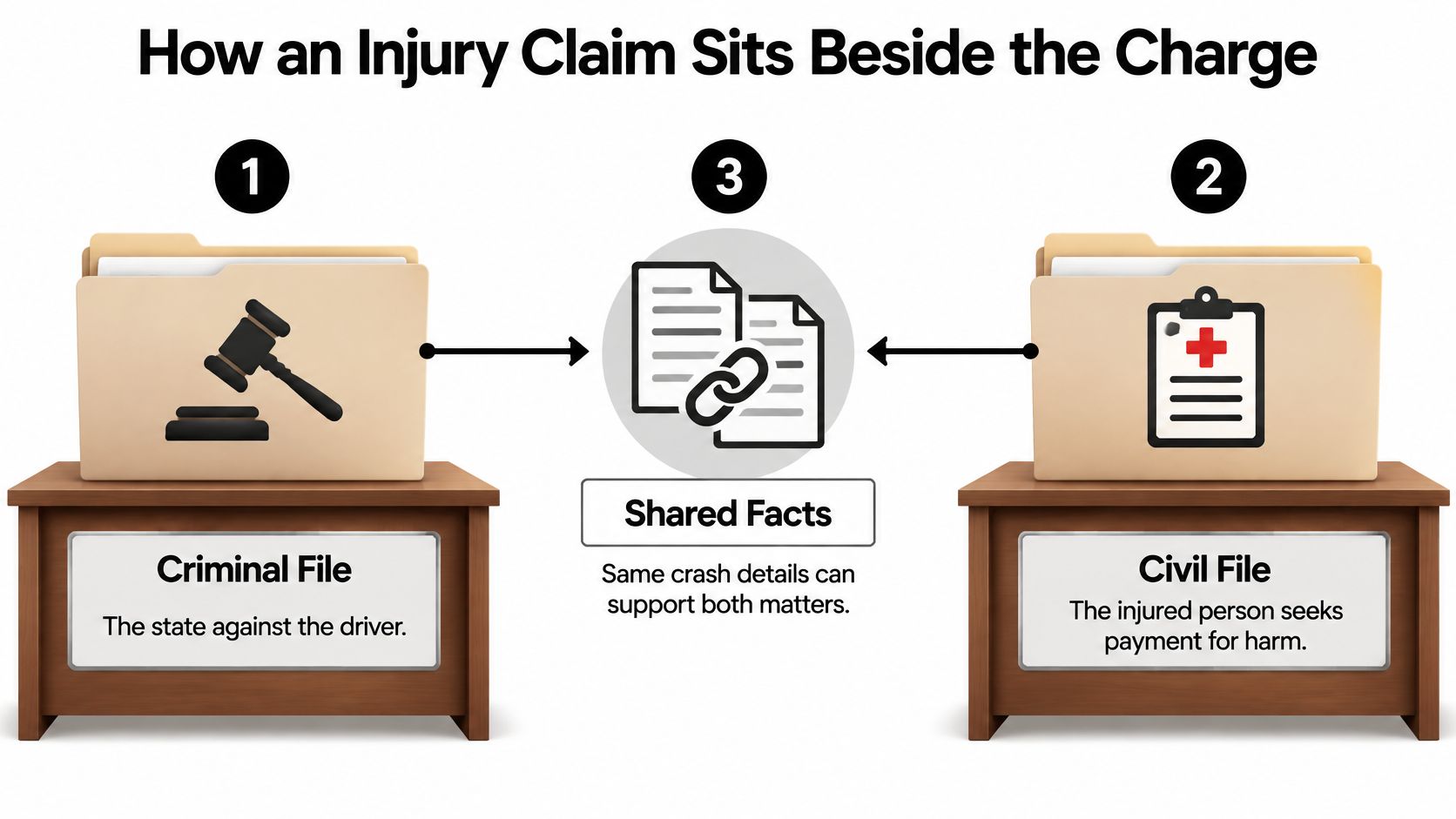
Build the injury file around care and documentation
Civil liability uses a lower burden of proof than the criminal requirement of proof beyond a reasonable doubt. Even so, suspected intoxication doesn’t remove the need to establish causation and document damages. The claim must connect the collision to actual injuries and losses.
- Get medical care and retain discharge papers. Explain symptoms accurately and follow treatment instructions. Keep referrals, prescriptions, appointment records, and work restrictions together.
- Save the crash evidence. Preserve original photographs, witness contact information, the report number, and relevant messages. Don’t edit the originals or discard material because it seems unhelpful.
- Notify the relevant auto insurer. Give accurate basic facts without guessing about speed, fault, or another person’s condition. Keep a record of the claim number and communications.
- Understand a recorded-statement request before responding. Ask which insurer is requesting it and why. Obtain advice about cooperation obligations rather than assuming every request is mandatory or every refusal is harmless.
- Retain counsel for the injury matter if that’s the help needed. Bring treatment records, insurance correspondence, and evidence of missed work to the consultation.
The person’s position changes the investigation
A passenger injured in the arrested driver’s car may need to identify available coverage without relying on that driver’s account. A pedestrian struck at an intersection may need evidence about signal timing and visibility. A rideshare rider should preserve the trip receipt and app information because the trip’s circumstances matter to the insurance investigation.
Economic losses commonly pursued include medical and surgical bills, recovery costs, and lost wages. Records should show what was charged, what treatment occurred, and how the injury affected work. A description of pain alone won’t answer an insurer’s questions about those financial losses.
The discussion of a drunk-driving accident attorney’s role in protecting victims’ rights provides context for the civil side.
The accused driver’s defense lawyer protects the driver’s interests. The injured person needs independent advice, not the assumption that the same lawyer can serve both sides.
Mixing those adverse roles creates a conflict, not a convenient combined service.
Why Los Angeles Penalties Are Not Uniform
The California DMV’s Los Angeles County participation report reports first-offense program and interlock participation of 83.6% and 5.1%, second-offense participation of 76.3% and 1.7%, and fourth-or-later participation of 19.0% and 10.0%, respectively.
Los Angeles County DUI program and interlock participation by offense level
| Offense level | DUI program participation | Ignition interlock participation |
|---|---|---|
| First offense | 83.6% | 5.1% |
| Second offense | 76.3% | 1.7% |
| Fourth or later | 19.0% | 10.0% |
These are participation rates among tracked county cases, not predicted sentences. They don’t establish why a person participated, whether an interlock was required in a particular case, or what a newly arrested driver will face. They show why a generic penalty chart can’t describe every person’s practical obligations.
Case facts matter more than a county average
Prior convictions, probation status, injury allegations, refusal allegations, vehicle ownership, and court-specific practices can affect the analysis. A lawyer should distinguish legal requirements from available compliance options and negotiated proposals. Describing every possible consequence as automatic can be just as misleading as minimizing the charge.
Record accuracy deserves particular attention. A person may remember an old case by the arrest date, while court and DMV records describe different events and dispositions. Counsel should obtain the underlying records rather than rely solely on memory or an incomplete background summary.
Arrests, convictions, DMV entries, and program enrollment measure different things. An arrest total isn’t a count of proven offenses, and program participation isn’t a conviction rate. Treating those categories as interchangeable produces unreliable expectations.
Build a compliance budget, not just a fine estimate
The useful question isn’t what the court might order someone to pay. It’s what the person must do, what each requirement costs, and how they can complete it while maintaining work and family responsibilities.
- Verify the prior record: Compare court dispositions with the DMV history and flag mismatches for counsel.
- Separate the obligations: List court requirements and administrative requirements under different headings, with supporting paperwork.
- Identify the interlock rule: Ask whether installation is required in the particular case or represents an available driving option.
- Account for practical costs: Include program fees, financial-responsibility insurance requirements, installation and monitoring expenses, transportation, and time away from work.
- Keep completion evidence: Save enrollment confirmations, payment receipts, installation records, and certificates.
An SR-22 or SR-1P filing is proof of financial responsibility, not a substitute for understanding the underlying insurance coverage. Likewise, paying a fine doesn’t necessarily complete a program or resolve a license restriction. Written instructions and organized proof are more useful than an estimate based on someone else’s case.
Choose Counsel for the Track You Are On
Choose a lawyer by the work that needs doing, not by a broad advertising label. Los Angeles drunk driving lawyers may concentrate on criminal defense, administrative license issues, or injury claims. A useful consultation makes the scope clear before discussing likely outcomes.
For the arrested driver, the relevant fit is a criminal defense lawyer who will identify the courthouse, examine the evidence, and address the administrative notice. For the injured person, the relevant fit is a personal injury lawyer who can investigate liability, coverage, treatment, and losses.
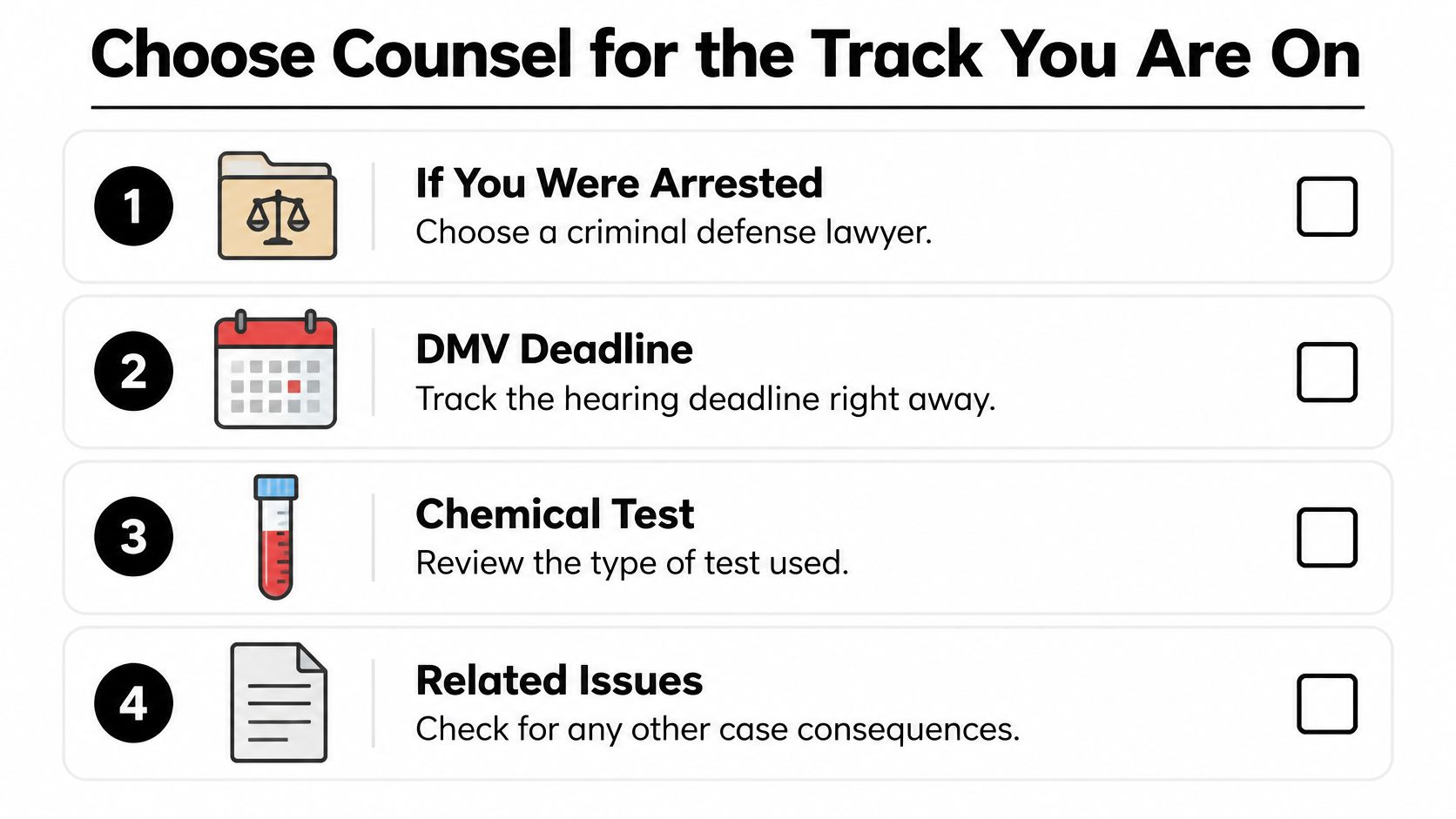
Ask for a defined assignment
A useful lawyer should identify what remains unknown and what records are needed to answer it. A guaranteed dismissal, guaranteed license result, or guaranteed settlement is a reason to slow down. Careful evaluation doesn’t require certainty before the evidence is available.
- For a defense engagement: Confirm whether the agreement includes the DMV hearing, who requests it, and who monitors notices.
- For an injury engagement: Confirm who investigates coverage, communicates with insurers, and evaluates whether litigation is appropriate.
- For either matter: Get the scope, fees, expenses, communication arrangements, and exclusions in writing.
AskLegally’s guide to car accident lawyers offers a broader introduction to the compensation process. Our explanation of how to choose a car accident lawyer can also help injured readers prepare focused consultation questions.
An injury consultation is not criminal defense
For someone injured by an impaired driver, we at LA Law Group, APLC are an option for the civil injury matter, not the driver’s criminal defense. Our first consultation is free and confidential, and it’s held with the attorney who will handle the matter. We serve clients throughout California in English, Spanish, and Farsi from our Chatsworth office.
Bring the crash report information, photographs, insurance letters, treatment records, and work-loss documentation you have. We can discuss the specifics and what to expect without treating an arrest as proof of a particular settlement value.
Many personal injury cases we handle take six months to reach a settlement, and some lawsuits could take up to three years. Those are not deadlines or promises for an individual claim. Treatment needs, disputed facts, insurance negotiations, and litigation can affect the path.
Before retaining anyone, make sure the written agreement identifies the matter the lawyer will handle and that opposing interests aren’t combined under the same representation. This article is informational only and is not legal advice. Reading it or contacting a firm through it does not, by itself, create an attorney-client relationship.
If you were injured in a crash involving a suspected impaired driver, LA Law Group, APLC can review what happened, explain your civil claim options, and communicate with insurers on your behalf. Visit LA Law Group, APLC to arrange a free, confidential consultation with the attorney who will handle the matter, and bring your crash paperwork and treatment information.
Attorney Advertising. This article is general information, not legal advice, and does not create an attorney-client relationship. Prior results do not guarantee a similar outcome.