
Loss of Consortium Settlement Amounts Explained

The most popular advice about loss of consortium settlement amounts is also the least reliable: find a percentage, enter the injured spouse’s recovery, and treat the result as a prediction. California courts don’t use a calculator. They evaluate the actual relationship, the underlying injury, the evidence of change, and any fault assigned to the injured spouse.
A consortium claim can be financially meaningful, especially when a permanent injury changes intimacy, companionship, caregiving, household responsibilities, and everyday life. But severe medical harm alone doesn’t guarantee a large award. The case must show what the relationship looked like before the injury, what changed afterward, and why the defendant caused that change.
Understanding Loss of Consortium Claims in California
Loss of consortium is a separate claim belonging to the uninjured spouse or qualifying registered domestic partner. It addresses relationship losses caused by the other spouse’s injury, including companionship, affection, intimacy, moral support, advice, and household assistance. The claim is derivative, meaning it depends on the injured spouse having a viable underlying personal injury claim.
That derivative status matters. The uninjured spouse doesn’t bring a second version of the injured person’s medical claim. They seek compensation for their own relationship-based losses. California jury guidance recognizes that consortium damages may involve the loss of companionship, comfort, affection, sexual relations, moral support, training and advice, and physical assistance in the home. See the California jury instruction on loss of consortium damages.
This article is for informational purposes only and is not to be construed as legal advice. No attorney client relationship exists based on the review of this this article and none of the information in this article is legal advice.
The relationship must qualify before the injury
A qualifying marriage or registered domestic partnership generally must exist when the injury occurs. A later marriage usually can’t retroactively create a consortium claim for an accident that happened before the marriage or partnership. A published California legal source explains that the claim is recognized for a relationship arising from marriage or registered domestic partnership and requires an injury that incapacitates that relationship for a definite or indeterminable period. Review the California damages discussion of consortium claims.
That rule prevents a common mistake. A long-term dating relationship may be emotionally significant, but emotional significance alone doesn’t establish the legal relationship required for this California claim. Eligibility should be checked before anyone spends time trying to calculate value.
Why online calculators fail
A calculator can’t measure whether an injured spouse’s personality changed after a traumatic brain injury, whether the couple previously shared household work, or whether intimacy disappeared because of pain and disability. It also can’t evaluate whether friends, relatives, medical providers, photographs, messages, calendars, and employment records support the claimed before-and-after difference.
The practical sequence is straightforward:
- Confirm the qualifying relationship existed at the time of injury.
- Establish that the defendant caused the underlying injury.
- Identify concrete changes in the relationship.
- Document those changes with testimony and records.
- Account for comparative fault and other defenses.
A settlement demand that skips those steps usually invites the insurer to treat consortium as an emotional add-on instead of a distinct claim supported by evidence.
How Juries Calculate Non-Economic Relationship Damages
Medical expenses come with invoices. Lost earnings can be supported by payroll records, tax documents, and employer testimony. Consortium damages have no comparable receipt, because the jury must value personal and relational losses that cannot be purchased at a standard rate.
California jury instructions provide no fixed mathematical formula for this valuation. Jurors use their judgment after considering the nature, extent, and expected duration of the loss. The guide to non-economic damages provides broader context for how relationship-based losses differ from economic damages.
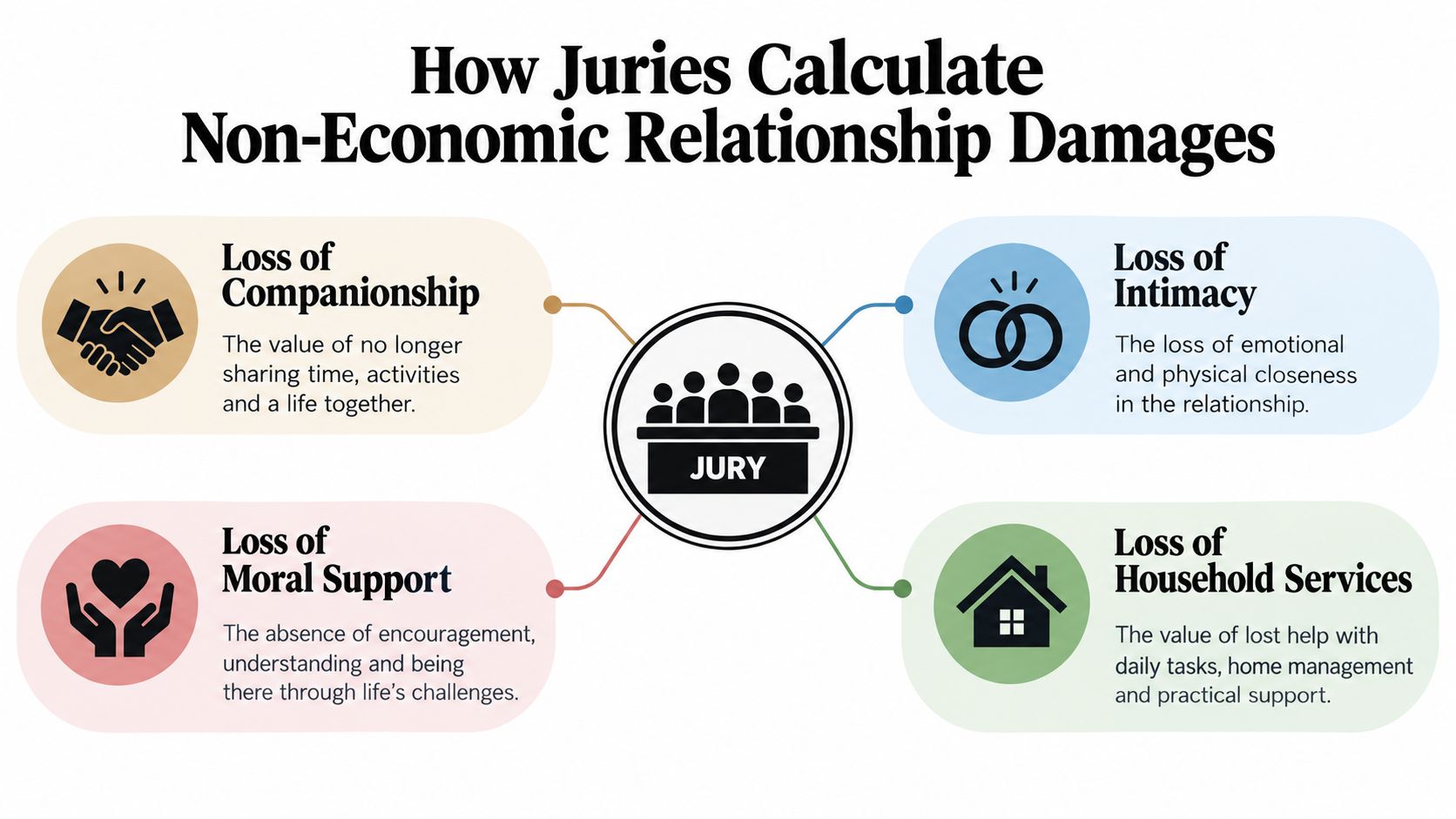
What the jury is actually measuring
The strongest presentation translates abstract pain into ordinary life. Jurors may consider:
- Companionship: The loss of shared time, recreation, conversation, travel, and participation in family life.
- Affection and intimacy: Reduced physical affection and sexual relations caused by pain, disability, cognitive changes, or emotional withdrawal.
- Moral support: The loss of encouragement, comfort, emotional availability, and mutual reliance.
- Advice and guidance: The injured spouse’s reduced ability to provide training, advice, decision-making, or practical support.
- Household assistance: The loss of cooking, childcare, transportation, home maintenance, financial management, or other physical contributions.
The point isn’t to present a list mechanically. A jury needs to understand how these categories interacted. A spouse who once handled finances may now be unable to make decisions. A partner who once provided emotional stability may become withdrawn after a brain injury. Someone who once shared household work may require assistance instead.
Duration changes the valuation
The expected duration of the marital loss also matters. A temporary limitation presents a different valuation problem from a permanent change in mobility, cognition, personality, or sexual function. Jurors can consider the spouses’ ages, life expectancy, relationship stability, and the anticipated duration of the lost benefits.
Practical rule: Don’t describe the relationship only as “close.” Show what each spouse did, shared, planned, and contributed before the injury, then identify what disappeared afterward.
Two couples can experience similar medical diagnoses but present very different consortium claims. One may have extensive proof of shared responsibilities and a dramatic change in daily life. The other may offer only general testimony. The legal label matters, but the human evidence usually determines how the jury understands the loss.
Key Factors That Drive Settlement Amounts
Insurance adjusters don’t value consortium claims by sympathy. They examine the underlying bodily injury, liability, policy limits, anticipated trial risk, and the quality of proof showing relationship harm. The more permanent and observable the change, the harder it becomes to dismiss the claim as minor.
A commonly cited settlement pattern places moderate-to-serious consortium claims at roughly 10% to 30% of the injured spouse’s overall recovery, as summarized by a neutral legal resource on loss of consortium valuation factors. That range is a negotiation reference, not a California formula. It can be misleading when an injury is catastrophic or when the evidence is weak.
Moderate injury and catastrophic injury are different negotiations
In a moderate case, the relationship may be affected by a period of pain, reduced activity, limited intimacy, or temporary household disruption. The claim may remain meaningful, but the defense can argue that the loss is limited or improving.
Catastrophic injury changes the negotiation. Paralysis, severe traumatic brain injury, permanent disability, or lasting personality change can eliminate longstanding forms of companionship, care, intimacy, and shared responsibility. In those cases, a consortium award can move well beyond a routine fraction of the bodily injury recovery.
The underlying injury still anchors the negotiation. A large medical recovery doesn’t automatically produce a large consortium payment, but a permanent injury with strong relationship evidence can raise the practical ceiling substantially. See the discussion of personal injury settlement amounts for the broader role of injury severity and proof in personal injury valuation.
The variables adjust the offer
Adjusters and defense counsel will focus on:
- Permanence: Whether doctors expect the impairment to continue indefinitely.
- Functional impact: Whether the injured spouse can walk, communicate, work, participate in intimacy, or manage household tasks.
- Cognitive and personality changes: Whether a brain injury altered judgment, mood, communication, or emotional connection.
- Pre-injury relationship quality: Whether testimony shows a stable and active relationship before the accident.
- Corroboration: Whether people outside the marriage can confirm the changes.
- Liability strength: Whether the defendant faces a clear and persuasive case at trial.
- Fault allocation: Whether the injured spouse may bear part of the responsibility.
A demand package should connect each claimed loss to a concrete change. “Our marriage suffered” is not enough. “My spouse previously managed school transportation, prepared meals, and planned family activities, but now requires assistance and no longer participates” gives the adjuster a specific loss to evaluate.
Real-World Verdicts and Settlement Ranges
Reported verdicts show why broad internet ranges rarely answer the client’s real question. The outcomes span from substantial five-figure awards to multimillion-dollar verdicts, depending on the injury, relationship, proof, liability, and jurisdiction.
In California, a jury awarded $500,000 for loss of consortium in Rodriguez v. McDonnell Douglas Corp. The injured spouse became triplegic at age 22 after 16 months of marriage, and the award survived appellate review as not excessive. The example demonstrates that a relatively short marriage doesn’t automatically prevent a significant award when the injury permanently changes the relationship. The case is discussed in legal scholarship concerning consortium damages.
More recent reported examples show a wider upper range. A downtown Los Angeles jury awarded $4 million for past and future loss of consortium to a spouse whose husband of more than 50 years suffered an injury that drastically changed his active lifestyle, as reported in Plaintiff Magazine’s discussion of loss of consortium. An Alameda County jury awarded $1 million in future loss-of-consortium damages in a traumatic brain injury case.
Lower reported awards can look very different:
| Injury Profile | Primary Injury Award | Consortium Award | Key Takeaway |
|---|---|---|---|
| Shattered elbow | $1.4 million | $85,000 | The consortium award represented a smaller portion of the primary recovery. |
| Lower-leg compartment syndrome, foot drop, and related injuries | $1.05 million | $100,000 | A serious injury can still produce a comparatively modest consortium award. |
| Traumatic brain injury | Not specified in the reported data | $1 million future consortium damages | Cognitive and relationship changes can support a substantial award. |
| Permanent lifestyle change in a marriage lasting more than 50 years | Not specified in the reported data | $4 million past and future consortium damages | Long-duration relationship evidence and major disruption can drive an exceptional result. |
The lower-end examples, including $85,000 and $100,000, are reported in a legal publication discussing consortium awards. They shouldn’t be treated as averages. They illustrate the distribution problem: many claims may resolve below headline verdicts, while a smaller group involving permanent paralysis, traumatic brain injury, or profound disability can reach six or seven figures.
Other reported benchmarks include a Michigan matter with a $2,475,000 total verdict, including $600,000 for loss of consortium, and catastrophic cases reporting $750,000 after appellate reduction or $3,000,000 for loss of services in a paralysis case. Those examples appear in reported consortium verdict materials. They show why the bodily injury award often provides the practical ceiling, while the relationship evidence determines how much of that value the consortium claim can capture.
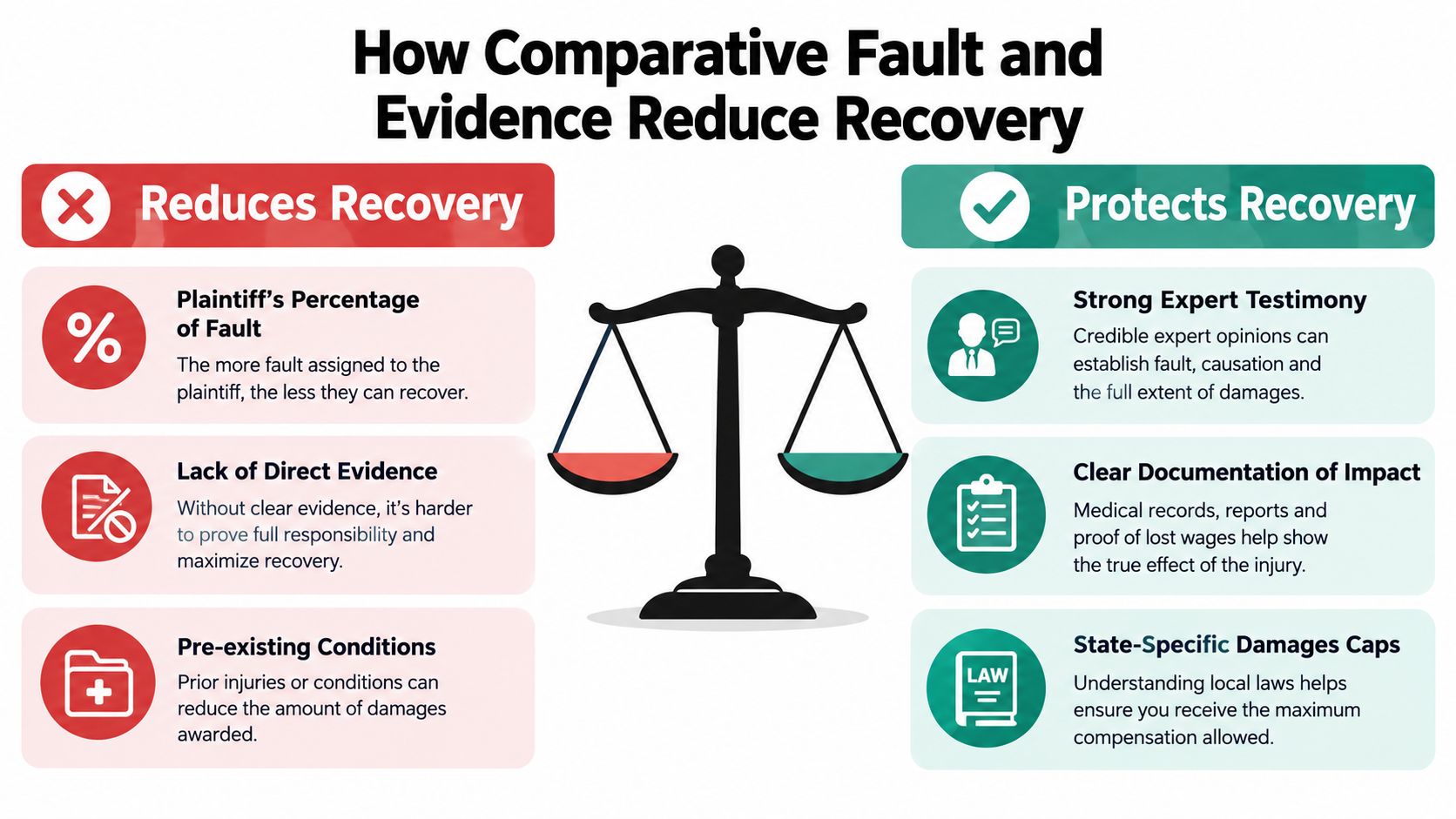
How Comparative Fault and Evidence Reduce Recovery
A severe injury doesn’t guarantee a severe consortium recovery. California’s comparative fault rules can reduce the derivative claim, and weak proof can persuade a jury that the relationship loss is less extensive than claimed.
The clearest illustration is Campos v. Coleman. The surviving spouse received a $1 million jury award for loss of spousal consortium, but the award was reduced to $580,000 after the decedent was found 42% contributorily negligent. The case is discussed in the Connecticut Supreme Court opinion addressing consortium and fault allocation.
Fault follows the underlying claim
Because consortium is derivative, the claim is tied to the injured spouse’s personal injury case. If the defense proves that the injured spouse contributed to the accident, the consortium recovery can be reduced according to the assigned share of fault. That reduction can occur even when the uninjured spouse did nothing wrong.
The defense may also challenge causation. It can argue that the claimed relationship problems arose from pre-existing medical conditions, prior marital difficulties, unrelated stress, or ordinary changes rather than the accident. That’s why a permanent diagnosis alone doesn’t establish the value of the derivative claim.
Evidence establishes the baseline
The most important proof often compares the relationship before and after the injury:
- Historical records: Photos, travel records, calendars, messages, social events, and family activities can show how the couple spent time together.
- Third-party testimony: Friends, relatives, neighbors, coworkers, and caregivers can describe changes they personally observed.
- Medical evidence: Treatment records can connect pain, cognitive impairment, mobility loss, or personality changes to the underlying injury.
- Household evidence: Prior division of chores, transportation, childcare, and financial responsibilities should be identified specifically.
- Relationship testimony: Both spouses should explain concrete changes without exaggeration or rehearsed language.
A strong liability case can still produce a modest consortium amount when the claimant cannot prove what the relationship was before the injury.
The defense doesn’t need to prove that the marriage was unhappy. It may only need to create uncertainty about whether the accident caused the claimed loss or whether the loss is as extensive as presented. Documentation closes that gap.
Strategies for Maximizing Your Consortium Claim
The strongest consortium claims are built during the case, not invented when settlement negotiations begin. Start with a detailed baseline of the relationship and update it as the injury continues to affect daily life.
Build a before-and-after record
Ask each spouse to identify specific activities, responsibilities, and routines that changed. Don’t stop at “we lost our normal life.” Identify the trips you no longer take, the rooms or activities the injured spouse can no longer use, the household duties transferred to the other spouse, and the forms of affection or communication that stopped.
A private journal can help preserve dates, examples, and observations. It should be accurate and contemporaneous, not dramatic. Medical records, calendars, photographs, messages, travel reservations, school records, and employment materials can provide independent support for the couple’s former routine.
Use witnesses who saw the relationship
Friends and family members can explain how the couple interacted before the injury and what they noticed afterward. Coworkers may describe changes in the injured spouse’s personality, communication, reliability, or participation in social life. Their testimony works best when it is based on personal observation rather than conclusions about the legal claim.
A medical expert may explain how a brain injury, spinal injury, chronic pain condition, or physical limitation affects intimacy, communication, independence, and household function. The expert’s role is to connect the impairment to the claimed relationship losses without overstating what the records support.
Coordinate the derivative claim with the primary demand
The consortium claim should be developed alongside the injured spouse’s bodily injury demand. Separating the claims too aggressively can make the insurer treat consortium as an afterthought. The demand should identify the spouse’s distinct damages while explaining how they flow from the documented injury.
Include a clear damages narrative, supporting records, witness summaries, and medical opinions where appropriate. Avoid using a percentage as the only justification. A number becomes more credible when it follows a detailed explanation of permanence, lost functions, relationship history, and future impact.
Preserve credibility
Both spouses should tell the truth consistently. Don’t minimize the injury, but don’t claim that every part of the relationship disappeared if some activities remain possible. Credibility matters because the defense will compare testimony with medical records, social media, photographs, employment records, and witness accounts.
The goal isn’t to make the marriage sound perfect. The goal is to prove exactly what the injury changed.
Evaluating Your Case and Next Steps
Loss of consortium settlement amounts can’t be predicted from a diagnosis or a calculator. The value depends on the underlying injury, whether the impairment is permanent, the relationship’s documented quality, the specific losses in daily life, the strength of liability, and any comparative fault assigned to the injured spouse.
Moderate injuries may support meaningful but comparatively limited relationship damages. Catastrophic injuries can support much larger awards when the evidence shows permanent loss of companionship, intimacy, household support, caregiving, communication, or personality. The reported verdicts demonstrate a wide spectrum, not a dependable average.
Prepare before requesting a valuation
Gather the documents that establish the relationship baseline and the post-injury change. Identify witnesses who observed the couple before and after the accident. Make a written list of household responsibilities, shared activities, intimacy-related changes, communication problems, caregiving duties, and future limitations.
Then obtain a formal case assessment from a qualified California personal injury attorney. A lawyer can evaluate the derivative claim with the underlying liability and damages evidence, review comparative fault risks, and determine how to present the claim in negotiation or litigation. Learn more about when to hire a personal injury attorney.
This article is for informational purposes only and is not to be construed as legal advice. No attorney client relationship exists based on the review of this this article and none of the information in this article is legal advice.
LA Law Group, APLC offers California personal injury consultations and can evaluate how an accident has affected both the injured person and the marital relationship. Visit LA Law Group, APLC to discuss the underlying claim, relationship evidence, comparative fault issues, and practical next steps with a legal team.
Attorney Advertising. This article is general information, not legal advice, and does not create an attorney-client relationship. Prior results do not guarantee a similar outcome.