
Recovering Legal Expenses With a Memorandum of Costs
When you win a lawsuit, that’s a huge victory. But the final judgment from the court doesn’t automatically cover all the money you spent to get there. This is where a memorandum of costs comes into play.
Think of it as the official, legally binding expense report you submit to the court after you’ve won. It’s the key document that helps turn your legal win into a true financial recovery by getting you reimbursed for specific, allowable costs from the litigation.
Your Guide to Recovering Litigation Expenses
All those expenses—from court filing fees to the cost of depositions—can really add up, often reaching thousands of dollars. The memorandum of costs is your formal request to have the losing party pay you back for those necessary expenses.
This guide will break down what this crucial document is, which costs you can legally claim in California, and the strict rules you have to follow. Whether you’re a business owner who just won a contract dispute or an individual who won a personal injury case, understanding this process is essential.
What Is the Purpose of This Document?
The main job of a memorandum of costs is to formally ask the court to add your litigation expenses onto the final judgment amount. It’s an itemized list of what are known as “taxable costs” that you provide to both the judge and the other side.
This gives the losing party a chance to review what you’re claiming and object if they believe an expense isn’t valid. You can think of your lawsuit as a big project; the judgment is the successful outcome, but the memorandum of costs is how you settle up the project’s accounts and get paid back for your operational spending.
Disclaimer: This article is for informational purposes only and is not to be construed as legal advice. No attorney-client relationship exists based on the review of this article and none of the information in this article is legal advice.
Key Concepts to Understand
Before we get into the nitty-gritty, there are a few core ideas you need to grasp. These principles are the foundation of the entire cost recovery process in California.
- Prevailing Party: In most situations, only the “winner” of the case can recover their costs. Figuring out who the prevailing party is can sometimes be tricky, but it’s generally the side that accomplished its main goals in the lawsuit.
- Taxable Costs: You can’t just claim every single expense you had. California law is very specific about which costs are “taxable,” meaning they are legally allowed to be passed on to the losing party.
- Strict Deadlines: The court system runs on a tight schedule. You typically only have 15 days after the notice of entry of judgment is served to file your memorandum of costs. If you miss that deadline, you could lose your right to recover anything at all.
Getting this document filed correctly is just as critical as any other major step in your lawsuit. The procedural rules are strict, much like those discussed in our article on how to file an answer to a complaint in a California lawsuit.
Understanding Which Expenses You Can Claim
After winning a judgment, the next big question is: which of your litigation expenses can you actually get back? It’s a common misconception that you can recover every single dollar you spent. The reality is that California law is very specific about which costs the losing party has to pay.
Think of it like getting reimbursed for a work trip. Your company will cover your flight and hotel because they were necessary for the job. But they probably won’t pay for the souvenirs you bought. In the legal world, these reimbursable expenses are called “taxable costs.” You can only claim costs that were both reasonable and absolutely necessary to move your case forward.
The Legal Blueprint for Allowable Costs
So, what’s the official rulebook for this? It’s all laid out in the California Code of Civil Procedure, section 1033.5. This statute is the definitive checklist that separates legitimate, recoverable litigation expenses from everything else.
The core principle is simple but powerful: a cost must be both allowable by law and reasonably necessary to the litigation. This two-part test stops parties from running up the bill with extravagant or unrelated expenses. You have to be able to justify that you truly needed to spend that money to effectively argue your case.
What Expenses Are Generally Recoverable?
When you win a case in California, the memorandum of costs is your tool for getting back the money you spent on essential litigation activities. The law recognizes a whole range of standard expenses that are almost always approved. Getting a handle on these categories is your first step to getting the maximum amount you’re owed. If you want a deeper dive, you can explore the details of judgment collection in California.
Here are some of the most common “taxable costs” you can claim:
- Court Filing Fees: This is the most straightforward one. It includes the initial fee you paid to file the complaint and other essential documents with the court.
- Service of Process Fees: You can recover the money you paid to have legal documents formally delivered to the other side. This covers costs for professional process servers or the local sheriff’s department.
- Deposition Costs: The fees for the court reporter who transcribed depositions are usually recoverable, along with the cost of one copy of each transcript.
- Ordinary Witness Fees: If you subpoenaed a non-expert witness to testify, you can claim their small, daily statutory fee plus mileage.
- Jury Fees: Any fees you paid directly to the court to have a jury trial are also on the approved list.
Important Note: This article is for informational purposes only and is not to be construed as legal advice. No attorney-client relationship exists based on the review of this article, and none of the information provided constitutes legal counsel.
Common Expenses That Are Not Recoverable
Knowing what not to include on your cost memo is just as critical as knowing what to include. Trying to claim non-allowable costs is a surefire way to draw an objection from the other side (called a motion to tax costs) and can even damage your credibility.
Be sure to leave these common expenses off your list:
- Attorney’s Fees: This is the big one that surprises many people. Under the “American Rule,” both sides are generally expected to pay for their own lawyers. There are exceptions, of course, like when a contract or a specific law allows for fee recovery, but that requires a separate, more involved motion—not a simple cost memo.
- Expert Witness Fees (Beyond the Basics): While you can claim the small statutory appearance fee for an expert, you can’t recover the hefty fees you paid them for their research, reports, and prep time. Recovering those larger expert costs is possible only in specific situations, like after the other side rejects a formal settlement offer.
- General Office Expenses: Everyday costs like postage, photocopies, and phone calls are seen as the normal cost of doing business for a law firm, not direct litigation expenses you can pass on.
- Private Investigator Fees: Even if an investigator uncovered the key evidence that won your case, their fees are not considered a recoverable “taxable cost.”
To help clarify, here’s a quick comparison of what you can and can’t typically claim.
Recoverable vs Non-Recoverable Litigation Costs in California
This table provides a clear, at-a-glance comparison of typical expenses that can be claimed on a memorandum of costs versus those that are generally disallowed, helping litigants understand what to track and expect.
| Expense Category | Generally Recoverable (Taxable) | Generally Not Recoverable |
|---|---|---|
| Court & Filing Fees | Initial filing fees, motion fees, jury fees | Fines or sanctions imposed by the court |
| Service of Process | Fees paid to a professional process server or sheriff | Costs for informal document delivery (e.g., mail, courier) |
| Witness Fees | Statutory fees for ordinary witnesses; statutory fees for expert witness court appearance | Fees paid to expert witnesses for preparation, reports, or consultation |
| Discovery & Evidence | Court reporter fees for depositions, one copy of deposition transcripts, models, and blowups | General investigation costs, private investigator fees, surveillance |
| Attorney & Staff Fees | Generally none, unless allowed by contract or statute (requires a separate motion) | Attorney’s fees, paralegal time, law clerk salaries |
| Office Overhead | Not applicable | Postage, photocopies, telephone calls, general office supplies |
| Travel & Miscellaneous | Not applicable | Attorney travel expenses, meals, lodging (unless specifically ordered by the court) |
As you can see, the lines are pretty clearly drawn.
This is why tracking your expenses meticulously from day one is so important. Many modern law firms use powerful legal practice management software to tag and categorize every single cost as it comes in. When it’s time to prepare your memorandum of costs, having those clean, accurate records will be your single greatest asset in getting back what you’re owed and defending your claims if they’re challenged.
Filing and Serving Your Memorandum of Costs Step-by-Step
Winning your case in court is a huge relief, but it’s not the final step. To actually get paid back for your litigation expenses, you need to file a memorandum of costs. This is a formal process with tight deadlines and specific rules, and getting it right is crucial.
Think of it like this: after finishing a huge project for a client, you don’t just say, “You owe me money.” You send a detailed, itemized invoice by a specific date. A memorandum of costs is the court’s version of that invoice. If you miss the deadline or fill it out incorrectly, you could lose your right to recover thousands of dollars you spent to win your case.
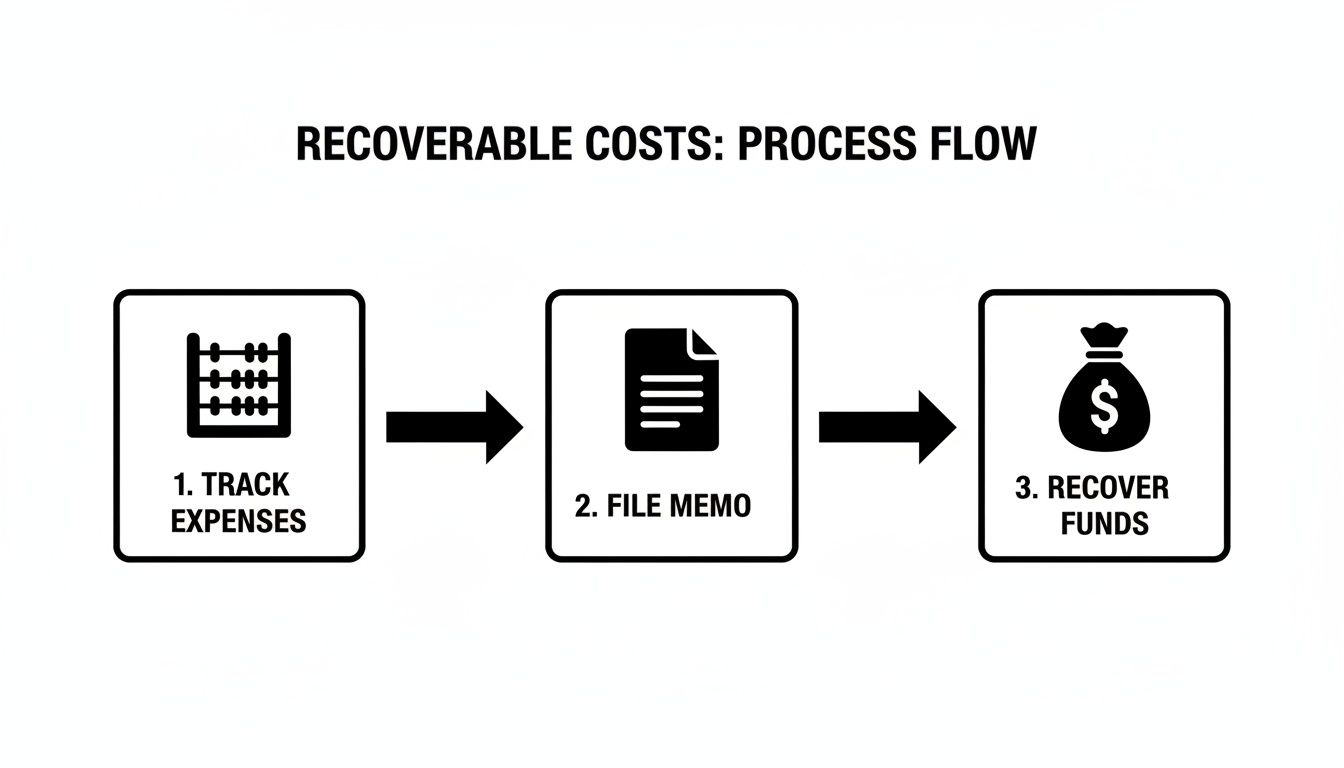
This whole journey—from keeping track of expenses to getting your money back—is a deliberate process, not an automatic reward for winning.
Understanding the Critical Deadline
In California, the timeline for filing your memorandum of costs is incredibly strict. You have just 15 days from the date the court clerk or the other party serves the “notice of entry of judgment.”
This isn’t a guideline—it’s a hard deadline. Miss it, and you’ve almost certainly forfeited your right to recover any of your costs. This short window means you have to be ready to move the moment you get that notice.
Using the Correct Judicial Council Forms
To keep things uniform, California courts require you to use standardized forms. For claiming your costs, the main one you’ll need is the MC-010, Memorandum of Costs (Summary).
This simple, two-page form has a checklist of common expenses, making it easy to categorize everything. You’ll find specific lines for things like:
- Filing and motion fees
- Deposition costs
- Service of process fees
- Witness fees
- Jury fees
Using the official MC-010 isn’t optional. It ensures your claim is presented in the exact format the court expects, which minimizes the risk of it being rejected on a technicality.
The Verification Requirement: A Critical Step
At the end of the MC-010 form, there’s a verification section. This is more than just a place to sign your name. When you sign it, you are swearing under penalty of perjury that every cost listed is accurate and was a reasonable and necessary part of the lawsuit.
This sworn statement is legally binding. It means you are personally guaranteeing that every expense is legitimate. While you don’t need to attach all your receipts with the initial filing, you absolutely must have them ready to back up your claims if the other side challenges them.
Itemizing Your Expenses with Precision
Accuracy is everything when you fill out the MC-010. You need to total up your expenses for each category. For instance, if you paid five separate court filing fees over the course of the case, you’ll add them all up and enter the grand total on the “Filing and motion fees” line.
What if you have costs that don’t fit the pre-listed categories? That’s what the “Other” line is for. If you use it, you must attach another form—usually the MC-011, Memorandum of Costs (Worksheet)—to provide a detailed breakdown of those expenses. Being clear and specific here can help you avoid objections from the opposing party.
Proper Service on the Opposing Party
Filing the memorandum with the court is only half the job. On the very same day, you also have to “serve” a copy on the opposing party or their attorney.
This gives them formal notice of what you’re claiming and the opportunity to object. Proper service is absolutely required. If you’re unfamiliar with the formal rules, our guide on service by notice and acknowledgement in California is a helpful resource.
A well-executed memorandum of costs can make a huge difference. California data shows that strategically filing for post-judgment costs can increase total collections by 22-35% on average. Governed by Code Civ. Proc. §§ 685.040 and 685.070, this is a tool we at LA Law Group frequently use for our clients in premises liability and eCommerce IP cases. While debtors can file a motion to tax costs within 10 days, court statistics show only about 19% succeed, usually when the claimed costs are not “reasonable and necessary.”
Responding to a Motion to Tax Costs
Just because you’ve filed your memorandum of costs doesn’t mean the fight is over. After you serve your detailed expense list, the losing party gets a chance to push back. Their official challenge is a legal document called a motion to tax costs.
This motion is the other side’s formal request for a judge to scrutinize your claimed expenses. The term “tax” in this legal context simply means to reduce or even completely strike certain costs from the list. It’s a very common tactic to try and shrink the final bill they have to pay. Your job is to be ready to defend every single dollar.
Think of it like an audit of your expense report. You’ve submitted the bill, and now the other party is flagging specific line items they don’t think should be approved. Knowing how to respond effectively is absolutely critical to protecting the money you’re owed.
Common Grounds for a Motion to Tax Costs
The losing party can’t just say, “I don’t feel like paying.” They need solid legal arguments to back up their objections. Their motion will almost always argue that certain costs were either not legally allowed or were not reasonable.
Here are the most common arguments you’ll likely run into:
- The Cost Is Not Legally Allowable: They might argue an expense isn’t recoverable under California Code of Civil Procedure § 1033.5. Common targets here include things like private investigator fees or general office photocopies.
- The Cost Was Not Reasonably Necessary: This one is more subjective. For instance, they might agree deposition costs are allowed but claim you paid for an unnecessarily rushed transcript or conducted far too many depositions.
- The Amount Is Unreasonable: They could also attack the price tag on a service, arguing you paid way over the going market rate for a court reporter or process server without a good reason.
To succeed, the other side needs more than a vague complaint. They have to provide evidence or a compelling legal argument explaining exactly why a specific cost should be thrown out.
Building Your Defense with Meticulous Records
Your single most powerful weapon against a motion to tax costs is your documentation. This is where all that diligent record-keeping you did from day one really pays off.
Once the other side files their motion, the burden of proof is now on you. You have to convince the court that every challenged expense was both reasonable in amount and necessary for the litigation. Your success hinges entirely on the quality of your evidence.
Disclaimer: This article is for informational purposes and is not to be construed as legal advice. No attorney-client relationship exists based on the review of this article and none of the information in this article is legal advice.
Your defense will take the form of a formal opposition to their motion. This legal response absolutely must include a sworn declaration from you or your attorney, with copies of every relevant receipt, invoice, and any other proof that justifies the cost attached as exhibits.
Crafting a Compelling Declaration
Your declaration is where you tell your side of the story to the judge. It needs to explain why each challenged expense was essential to winning the case. Don’t just attach a receipt—give it the context that makes the cost logical and necessary.
For example, if they object to the cost of blowing up trial exhibits, your declaration should spell it out clearly:
- What the exhibits were: “These were enlargements of photographs showing the cracked and uneven steps.”
- Why they were necessary: “It was critical for the jury to see the defects up close, as these photos were the primary evidence of the dangerous condition that caused my client’s fall.”
- Why the cost was reasonable: “We got quotes from three different local print shops and selected the most affordable option that could meet the court’s deadline.”
This kind of detail transforms a simple line item into a justified and indispensable litigation expense. In California, these details matter. Disallowed items like photocopies, unless they were “reasonably helpful,” can slash claims by 12% on average. On the flip side, for our business law clients like suspended Amazon sellers, successfully defending costs for surety bond premiums (averaging $750) and attachment fees ($500+) can significantly boost their recovery.
As one legal forum points out, a strong filing is especially crucial for our Spanish-speaking auto accident clients, as an estimated 91% of unchallenged cost memos in Los Angeles are approved. You can find more insights on this topic by exploring discussions about recovering litigation costs on Avvo.com.
By putting together a strong, evidence-backed defense from the start, you can shut down these challenges and protect your right to full reimbursement.
Why You Need an Experienced California Litigator
Winning your case is a huge relief, but it’s really only half the battle. Now comes the critical part: getting back the money you spent to win. This is where the process can get tricky, and having a seasoned legal pro in your corner isn’t just a good idea—it’s essential.
Trying to navigate the rules for a memorandum of costs on your own is a real gamble. One small mistake could wipe out your entire cost recovery, turning a hard-fought legal victory into a major financial loss.

Common Pitfalls That Jeopardize Recovery
Without the right guidance, it’s easy to fall into common traps that could cost you everything you’re entitled to. These aren’t just minor technicalities; they are mistakes that can completely derail your reimbursement.
Here are some of the most damaging missteps we see:
- Missed Deadlines: That 15-day deadline to file is non-negotiable. If you miss it, you will almost certainly recover nothing. It’s a harsh but firm rule.
- Poor Documentation: If the other side files a motion to tax costs, you have to prove every penny. Without meticulous records, defending your claims becomes nearly impossible.
- Incorrectly Claimed Costs: Including expenses that aren’t allowed, like your attorney’s fees, is a red flag. It can trigger an objection from the other side and bog down the whole process.
- Weak Defense: When you’re challenged on your costs, you need a strong, legally sound response. A weak one can lead to a judge striking out legitimate expenses you should have recovered.
These challenges show why going it alone can be a costly error. For a better sense of how this fits into the bigger picture, take a look at our guide on the 7 steps in a civil case in California.
The LA Law Group Advantage
At LA Law Group, our team, led by Mr. Aryan Amid, knows that a win isn’t truly a win until your financial recovery is complete. We’ve spent years deep in the trenches of California civil litigation, mastering every detail from tracking expenses on day one to fighting off objections after the verdict. We handle the paperwork and procedures so you don’t have to sweat the small stuff that could cost you big money.
We believe in a client-first approach. That means you get direct access to your attorney for clear communication and a strategy built around your specific needs. We’re here to protect the financial interests of people and businesses all over California, and we proudly serve our Spanish-speaking clients.
We have a proven history of helping clients successfully file their memorandum of costs and defend their claims, getting them the reimbursement they deserve. It doesn’t matter if you’ve won a personal injury case, a complex business dispute, or an intellectual property lawsuit—our team has the know-how to secure your financial win.
Don’t leave your money on the table. Schedule a free consultation with LA Law Group today, and let’s make sure you get every dollar you’re owed.
Common Questions About Recovering Your Costs
Working through the rules for a memorandum of costs can feel like navigating a maze. The process is incredibly precise, and one small mistake can cost you thousands. Let’s tackle some of the most common questions people have when they’re trying to turn a court victory into a real financial win.
These answers should clear things up and build on what we’ve already covered, giving you the practical know-how to get this done right.
What Happens If I Miss the Filing Deadline?
This is the big one, and the answer is unforgiving: missing the deadline is a critical, and almost always irreversible, mistake. In California, you typically have just 15 days after the notice of entry of judgment is served to get your memorandum of costs filed with the court.
If you let that deadline slip by, your right to recover any of your litigation costs is almost certainly gone for good. While there’s a slim chance a court might grant relief for “excusable neglect,” the bar for proving it is incredibly high and rarely met.
This is why you have to move fast as soon as the judgment is official. Partnering with an attorney who lives and breathes these deadlines is the best way to make sure your claim is protected.
Disclaimer: This article is for informational purposes and is not to be construed as legal advice. No attorney-client relationship exists based on the review of this article and none of the information in this article is legal advice.
Do I Need to Attach All My Receipts When I File?
No, you don’t have to bury the court clerk in paperwork right away. When you first file the memorandum of costs, you aren’t required to attach your receipts, invoices, or any other proof. The form is signed under penalty of perjury, so your signature is your sworn statement that the costs are real and were necessary.
But don’t get too comfortable. You absolutely must have a perfect, organized file of every single expense. The real test comes if the other side files a “Motion to Tax Costs” to challenge your claims.
That’s when the burden flips to you. You’ll have to produce every receipt and invoice for the contested items and prove to the judge they were reasonable and essential to the case. Think of your initial filing as the claim, and your organized records as the evidence you’ll need to defend it.
Can I Get My Attorney’s Fees Back on the Memorandum of Costs?
In most cases, attorney’s fees are off the table. California follows the “American Rule,” which means each party pays for their own lawyer, win or lose. Attorney’s fees aren’t considered a standard “cost” you can just list on the memorandum of costs.
However, there are two major exceptions where you can recover them:
- A Contract Says So: The contract at the heart of the lawsuit had an “attorney’s fees clause” that awards fees to the winner.
- A Law Allows It: A specific California statute that applies to your case type explicitly says the prevailing party can recover their legal fees.
If your case fits one of these exceptions, you can’t use the simple memorandum of costs form for your fees. You have to file a separate, more detailed “Motion for Attorney’s Fees” to make that request.
What’s the Difference Between Form MC-010 and Form MC-012?
They might look alike, but these two forms serve completely different purposes at different times. Using the wrong one is a surefire way to get your request rejected.
Form MC-010, the Memorandum of Costs (Summary), is what you use right after you win your case. It’s for claiming all the costs you racked up during the lawsuit itself—the initial filing fees, deposition costs, expert witness fees, and everything else that got you to the judgment.
Form MC-012, the Memorandum of Costs After Judgment, comes into play later. You use this form to recover the costs of enforcing the judgment. Think of expenses like fees for levying a bank account, serving a writ of execution on property, or forcing the debtor to show up for an examination. You can file a new MC-012 every time you incur more collection costs.
Navigating the complexities of cost recovery requires precision and legal experience. One missed deadline or poorly documented expense can jeopardize your entire claim. Don’t risk leaving money on the table after a hard-fought legal battle. The team at LA Law Group, APLC is dedicated to ensuring your legal victory translates into a full financial recovery. We manage the critical deadlines and procedural requirements, allowing you to focus on what matters most. Schedule your free consultation today by visiting https://www.bizlawpro.com.
Attorney Advertising. This article is general information, not legal advice, and does not create an attorney-client relationship. Prior results do not guarantee a similar outcome.