
Minimum Insurance Requirements in California: A Quick Guide
Disclaimer: This article is for informational purposes only and is not to be construed as legal advice. No attorney-client relationship exists based on the review of this article, and none of the information in this article is legal advice.
For the first time in more than fifty years, the game has changed for California drivers. The state’s minimum insurance requirements have been officially updated, raising the mandatory liability limits for every single person on the road.
Starting January 1, 2025, the old “15/30/5” standard is out. It’s being replaced by a much more robust “30/60/15” requirement. This move doubles the coverage for bodily injuries and triples the protection for property damage.
Understanding the New Car Insurance Minimums in California
Disclaimer: This article is for informational purposes only and is not to be construed as legal advice. No attorney-client relationship exists based on the review of this article, and none of the information in this article is legal advice.
For decades, California’s minimum auto insurance requirements were stuck in the past. As the costs of medical care and vehicle repairs skyrocketed, the old limits became dangerously inadequate, leaving many drivers exposed to massive out-of-pocket expenses after an accident.
Recognizing this critical gap, state lawmakers finally took action, passing Senate Bill 1107. This was the first major overhaul of these laws since 1967, and it’s designed to create a more realistic financial safety net for everyone involved in a collision. Now, every driver must carry these higher liability amounts to operate a vehicle legally in California. You can explore the full details in our guide to the California car insurance minimums changes for 2025.
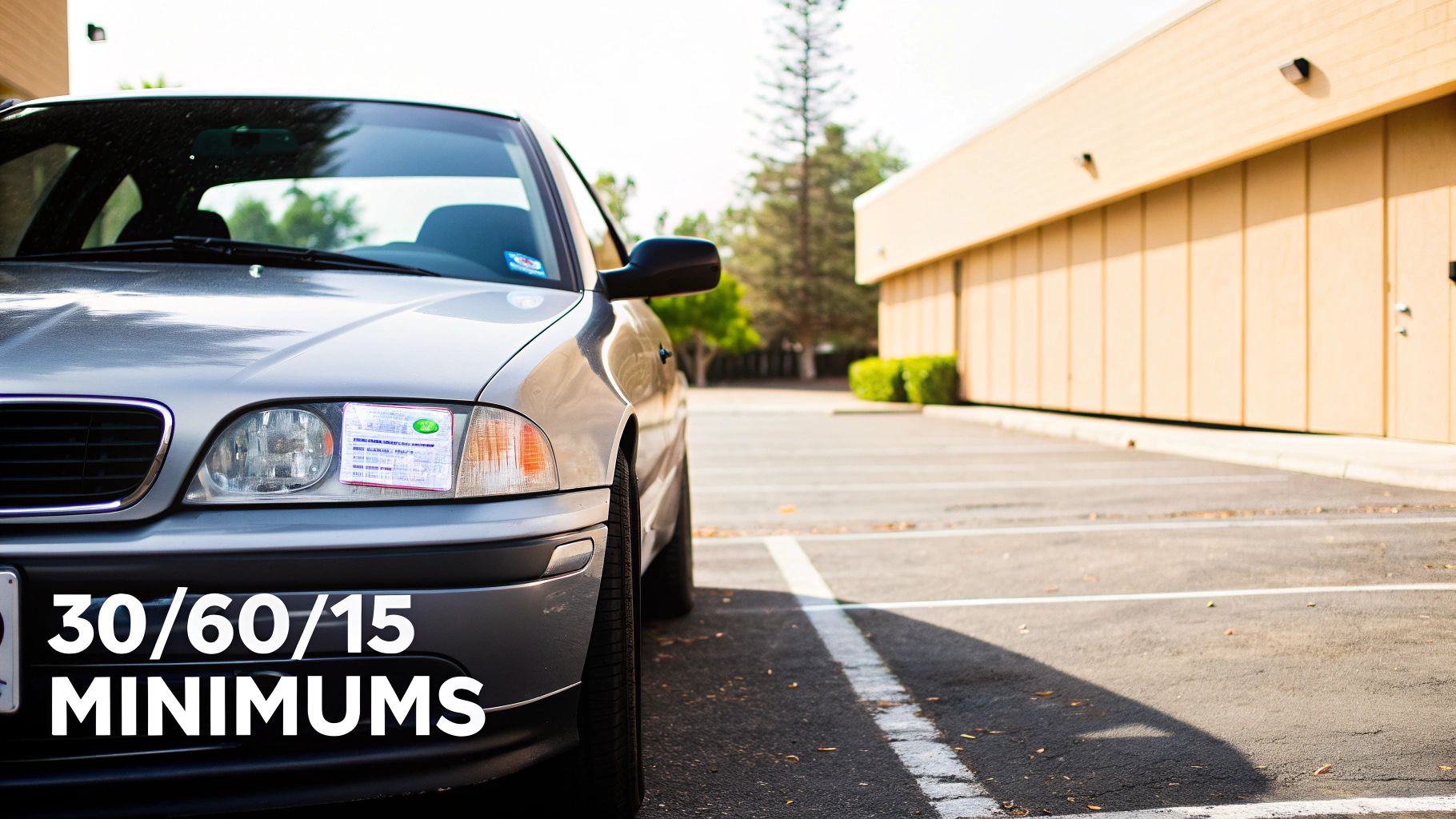
This is a big deal. Any insurance policy that renews on or after January 1, 2025, has to meet these new, higher thresholds. Think about it—the old $5,000 property damage limit often wasn’t even enough to cover a fender bender on a modern car, let alone a serious crash. At-fault drivers were often left holding a very large bill.
The Old vs. New Requirements
So, what does the switch from “15/30/5” to “30/60/15” actually mean for you? In short, it dramatically increases the amount of financial protection your policy provides to others if you’re at fault in an accident. The new limits are built to better handle today’s economic realities.
Here’s a quick breakdown to see just how much things have changed:
California Minimum Liability Insurance At a Glance
| Coverage Type | Limits Before The Change (‘15/30/5’) | Current Limits (‘30/60/15’) |
|---|---|---|
| Bodily Injury Liability | $15,000 per person | $30,000 per person |
| Bodily Injury Liability | $30,000 per accident | $60,000 per accident |
| Property Damage Liability | $5,000 per accident | $15,000 per accident |
As you can see, the bodily injury limits have doubled across the board, and the property damage limit has tripled. This legislative update is a critical step toward ensuring that California’s minimum insurance offers real, meaningful protection when an accident happens.
Why Did California Overhaul Its Insurance Laws?
Disclaimer: This article is for informational purposes only and is not to be construed as legal advice. No attorney-client relationship exists based on the review of this article, and none of the information in this article is legal advice.
For more than 50 years, California’s minimum auto insurance requirements were stuck in the past. Think of it like a photograph from the 1960s—while the world outside the frame changed dramatically, the laws stayed frozen in time. The problem was, the cost of everything from a hospital visit to a simple bumper repair skyrocketed, leaving the old “15/30/5” minimums dangerously obsolete.
This growing divide between outdated coverage and modern expenses meant that even a minor accident could leave drivers financially exposed. It became clear that the old system wasn’t working anymore, which prompted lawmakers to pass Senate Bill 1107 and pull the state’s requirements into the 21st century.
At its core, the issue was simple: the old limits were no match for inflation. What $15,000 covered in medical bills back in 1967 is a drop in the bucket today. A single trip to the emergency room, followed by a few diagnostic scans and follow-up appointments, can easily blow past that amount.
The Danger of Outdated Financial Protection
Imagine trying to pay for a new car using a budget from five decades ago—it just doesn’t add up. That’s the exact corner California drivers were backed into. The old $5,000 property damage limit was a particularly glaring example of this problem.
In today’s world, $5,000 might not even cover the repair costs for a fender-bender on a newer vehicle loaded with sensors and advanced tech. Hitting a moderately priced sedan could easily lead to a repair bill of $10,000 or more, leaving the at-fault driver on the hook for the rest.
This gap created a high-risk situation for everyone. At-fault drivers faced potential financial ruin, while injured parties were often left with nowhere near enough money to cover their medical bills and vehicle repairs, forcing them to bear the financial burden themselves.
It was a domino effect of financial hardship. Drivers who followed the law and thought they were protected were suddenly staring down lawsuits and crippling debt, all because the legal minimum was no longer a practical safety net.
Aligning the Law with Modern Economic Reality
The disconnect between the old laws and real-world costs was undeniable. California’s previous minimums were among the lowest in the nation, with only a handful of states having similar or lower requirements. Studies from industry authorities like the National Association of Insurance Commissioners (NAIC) have shown that medical and vehicle repair costs have far outpaced general inflation, making the old limits completely inadequate.
The new “30/60/15” limits are a direct response to this imbalance. Here’s a quick look at how the increased limits offer a more realistic financial cushion:
- Doubled Bodily Injury Protection: Raising the limits to $30,000 per person and $60,000 per accident provides much better protection against the steep cost of modern medical care.
- Tripled Property Damage Coverage: The new $15,000 limit is far better suited to handle the high price of repairing or replacing today’s technologically complex vehicles.
By updating these laws, California is working to ensure that when an accident happens, the financial backstop is more aligned with the actual costs involved. This change provides a stronger shield for everyone on the road, reducing the odds that a single crash will spiral into devastating, long-term financial consequences.
Understanding Your Basic Liability Coverage
Disclaimer: This article is for informational purposes only and is not to be construed as legal advice. No attorney-client relationship exists based on the review of this article, and none of the information in this article is legal advice.
Let’s be honest, diving into an auto insurance policy can feel like trying to read another language. You see terms like “liability,” “bodily injury,” and “property damage” thrown around, but what do they actually mean when you’re out on the road?
At its heart, the law behind minimum insurance requirements in California is built on one simple idea: financial responsibility.
Liability insurance isn’t really for you—it’s for the other people you might harm in an accident where you’re at fault. Think of it as a financial shield. It protects others from the consequences of a mistake you make behind the wheel, covering their costs so they aren’t left with a mountain of bills. This is exactly why the state mandates it; it’s a system designed to make sure victims of an accident get the help they need.
What Bodily Injury Liability Covers
Bodily Injury (BI) liability is the first major piece of your coverage puzzle. This is the part of your policy that steps in to pay for the medical expenses of anyone injured in an accident you cause. It’s designed to handle costs that can get overwhelming, fast.
Imagine you accidentally run a red light and hit another car. The other driver ends up with a broken arm and a concussion. Your Bodily Injury liability coverage would kick in to help pay for their:
- Hospital Bills: This covers everything from the initial emergency room visit to any necessary surgeries or a hospital stay.
- Medical Treatments: Follow-up doctor’s appointments, physical therapy, and required medications all fall under this umbrella.
- Lost Wages: If the injuries keep them from working, this coverage can help compensate for the income they lose while recovering.
Under California’s updated “30/60” rules, your policy will pay up to $30,000 for one person’s injuries and a total of $60,000 for everyone hurt in a single accident. This is a critical safety net that protects both the injured person and your own personal assets. If you want to dig deeper into this topic, you can learn more about what bodily injury coverage includes in our detailed article.
The infographic below shows exactly why California decided it was time for this significant update to its insurance laws.
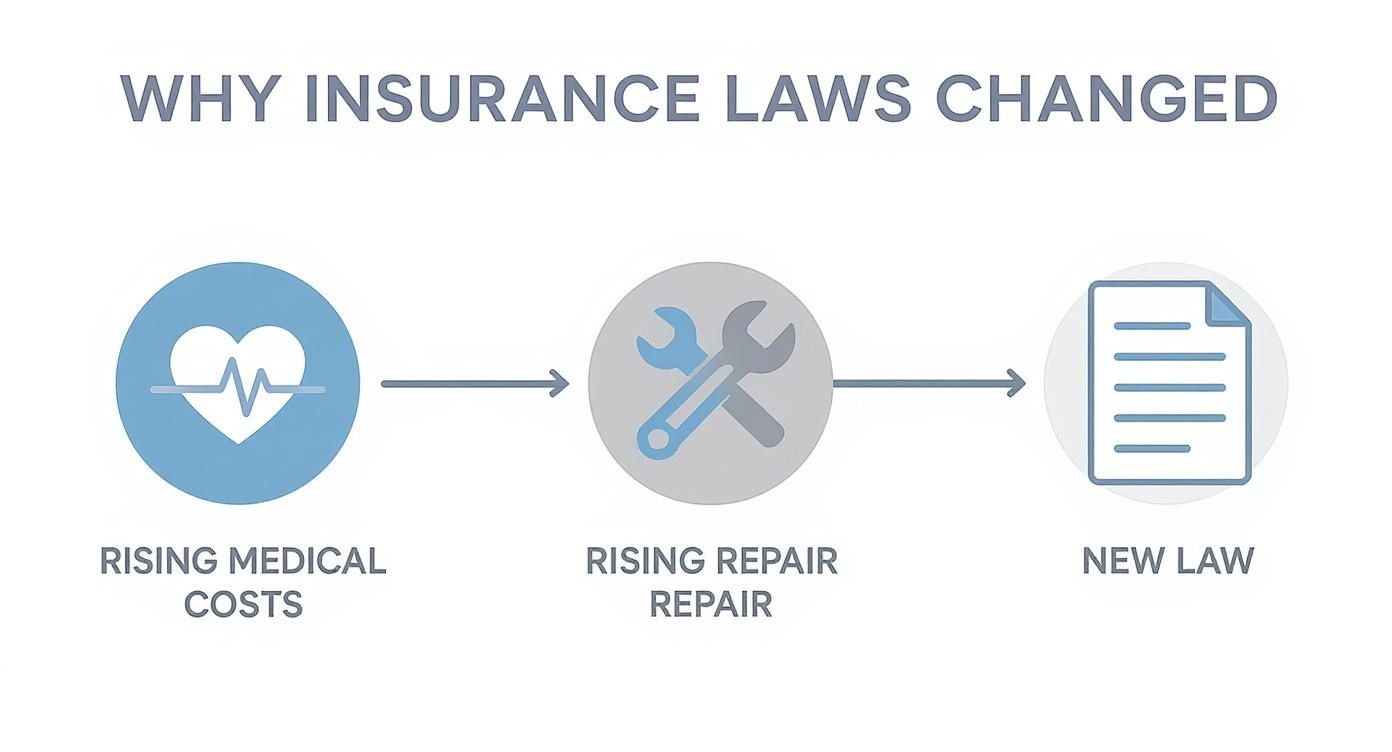
The connection is clear. As the costs for both medical care and vehicle repairs kept climbing over the years, the old insurance minimums just couldn’t keep up, forcing the state to create a new, more realistic law.
How Property Damage Liability Works
While Bodily Injury coverage deals with the human cost of an accident, Property Damage (PD) liability takes care of the material side of things. This coverage pays to repair or replace another person’s property that you damage in a collision you cause.
Most of the time, this means paying to fix the other driver’s vehicle. But it’s not just limited to cars. Let’s say you swerve to avoid an animal and end up taking out a neighbor’s fence and mailbox. Your Property Damage liability would cover the costs to repair or replace both.
Under the new minimum insurance requirements in California, drivers must carry at least $15,000 in Property Damage liability coverage per accident. This tripling of the previous $5,000 limit is a direct response to the skyrocketing expense of modern vehicle repairs.
With all the advanced safety sensors, complex electronics, and specialized materials in today’s cars, even a “minor” fender bender can lead to a shockingly high repair bill. The increased $15,000 limit provides a much more practical buffer, making it far less likely that you’ll have to pay thousands out of your own pocket to fix someone else’s property after a crash.
The Financial Dangers of Minimum Coverage
Disclaimer: This article is for informational purposes only and is not to be construed as legal advice. No attorney-client relationship exists based on the review of this article, and none of the information in this article is legal advice.
Meeting California’s minimum insurance requirements is something you have to do, but it’s critical to understand that “legal” doesn’t always mean “safe.” While the new “30/60/15” limits are a step up from the old standard, they represent a financial floor—not a ceiling of protection.
Think of it this way: your minimum liability policy is like a small umbrella in a torrential downpour. Sure, it offers some basic protection and keeps you compliant with the law. But in a serious storm—a major accident—it can be overwhelmed in an instant, leaving your personal finances completely exposed.

When Bodily Injury Limits Are Not Enough
Let’s walk through a realistic scenario. You’re in heavy traffic, you get distracted for just a moment, and you cause a multi-car pileup involving three other vehicles. Your $60,000 per-accident bodily injury limit might sound like a lot of money, but it can vanish in the blink of an eye.
Here’s how quickly those costs could stack up:
- Driver 1: Suffers a broken leg and whiplash. Their hospital bills, surgery, and physical therapy total $35,000.
- Driver 2: Experiences a concussion and serious back injuries. Their medical costs hit $28,000.
- Passenger: A passenger in the third car sustains what seem like minor injuries but still requires an ER visit and follow-up care, costing $5,000.
Just like that, the total medical bills for this single accident have reached $68,000. Your insurance policy will pay its maximum of $60,000, which means you are now personally on the hook for the remaining $8,000. And that’s before anyone even brings up lost wages or pain and suffering claims, which can send the total amount you owe soaring.
The Modern Reality of Property Damage Costs
You’re just as vulnerable when it comes to property damage. The new $15,000 limit is a welcome change, but it’s often not enough in a world filled with expensive cars. Think about all the luxury vehicles, electric cars with complex battery systems, and even standard SUVs loaded with advanced safety sensors on the road. Repair bills can easily blow past that limit.
Imagine a collision with a newer electric vehicle. Even a minor-looking impact can damage the battery pack, a single component that can cost anywhere from $15,000 to $25,000 (or more) to replace. If you cause an accident resulting in $25,000 of damage, your policy pays its $15,000 limit, and you are legally responsible for the $10,000 difference.
This exact issue is what drove lawmakers to push for higher minimums in the first place.
Once your insurance limits are exhausted, the other party’s attorneys can come after your personal assets to cover the remaining debt. This isn’t just a possibility; it’s a common legal outcome.
When you’re held personally liable, your entire financial world is at risk. Creditors can get court judgments to seize your assets and pay off the debt.
- Savings and Investments: Your bank accounts, stocks, and even retirement funds could be targeted.
- Property: Any equity you have in your home or other real estate could be on the line.
- Wage Garnishment: A court could order a portion of your future paychecks to be taken until the debt is fully paid off.
This is why looking at insurance as just another monthly bill is a huge mistake. It’s a critical tool for preserving everything you’ve worked for. Opting for higher limits—like 100/300/50 or more—often costs only a bit more each month but provides a massively stronger financial shield. After an accident, you’ll likely face claims for different kinds of losses, so it’s important to understand what economic damages are to truly grasp what you could be liable for.
Penalties for Driving Uninsured in California
Disclaimer: This article is for informational purposes only and is not to be construed as legal advice. No attorney-client relationship exists based on the review of this article, and none of the information in this article is legal advice.
https://www.youtube.com/embed/8c2uBouPB4A
Getting behind the wheel in California without the required insurance isn’t just a minor slip-up. It’s a serious violation with consequences that get worse with every offense. The state’s financial responsibility laws aren’t suggestions; they’re strict rules designed to make sure every driver on the road can cover the damage they might cause.
If you’re caught driving uninsured, you’re looking at immediate legal and financial trouble. These aren’t just slaps on the wrist. The penalties can drain your bank account, suspend your license, and even lead to your car being taken away.
Having the right coverage is only half the battle. To stay out of trouble, understanding the importance of carrying proof of insurance is absolutely critical.
Fines and Immediate Consequences
The first thing you’ll face for driving uninsured is a significant fine. A first-time offender can expect a base fine between $100 and $200. But don’t be fooled by that number—once court costs and other penalty assessments get tacked on, the total amount you owe can swell dramatically.
Get caught a second time within three years, and things get much worse. The fines for a subsequent offense jump to between $200 and $500, and that’s before all the extra fees get added.
But the financial hit doesn’t stop there.
Beyond the fines, police have the right to impound your vehicle right there on the spot. To get it back, you’ll have to pay off the fines, cover the towing bill, and pay daily storage fees. Those costs can pile up fast, easily running into hundreds or even thousands of dollars.
To put it simply, getting caught without insurance is expensive. Here’s a quick look at what you can expect.
Penalties for Driving Uninsured in California
| Offense | Potential Fines | Other Penalties |
|---|---|---|
| First Offense | $100 - $200 (plus assessments) | Vehicle impoundment, court-ordered proof of insurance (SR-22) |
| Subsequent Offenses | $200 - $500 (plus assessments) | Vehicle impoundment, potential driver’s license suspension |
Remember, these penalties can be triggered during a simple traffic stop for something like a broken taillight. You don’t have to be in an accident to face this entire chain of expensive consequences.
The Financial Ruin of an At-Fault Accident
As bad as those fines and fees are, they are nothing compared to the financial nightmare you’ll face if you cause an accident while uninsured. This is where the real danger of driving without insurance lies.
If you’re at fault, you are personally on the hook for every single dollar of damage you cause. Without liability coverage to protect you, you’ll have to pay for it all out of your own pocket. This includes:
- Medical Bills: You are responsible for the hospital stays, surgeries, physical therapy, and ongoing care for anyone you injure.
- Lost Wages: If the people you injured can’t work while they recover, you have to cover their lost paychecks.
- Property Damage: You are liable for the full cost of repairing or replacing any cars or other property you damaged in the crash.
These costs can spiral into tens or even hundreds of thousands of dollars in the blink of an eye. The injured party can sue you, and if they win a judgment against you, your financial future is at risk. A court can seize your bank accounts and garnish your wages for years until the debt is paid off.
Driving uninsured isn’t just breaking a rule—it’s a massive gamble with your entire financial life.
Common Questions About California Car Insurance
Disclaimer: This article is for informational purposes only and is not to be construed as legal advice. No attorney-client relationship exists based on the review of this article, and none of the information in this article is legal advice.
Trying to make sense of auto insurance can feel like a chore, but getting a handle on a few key ideas can make all the difference. Most drivers have practical questions about how California’s minimum insurance laws hit their daily lives and, of course, their wallets. Let’s clear up some of the most common worries with simple, direct answers.
With the new, higher minimums now in effect, it’s completely normal to be concerned about your premium costs going up.
What If I Cannot Afford My Insurance Premiums?
If you’re finding it tough to afford coverage, don’t panic. California has a program specifically designed to help people in your situation. It’s called California’s Low Cost Auto Insurance (CLCA) program, and it provides affordable liability insurance to income-eligible drivers with a good driving record. Think of it as a state-sponsored safety net to make sure everyone can legally get behind the wheel without breaking the bank.
To qualify, you’ll need to meet certain income guidelines, own a vehicle valued at $25,000 or less, and be at least 16 with a valid California driver’s license. This program is a vital resource that keeps legal driving within reach for thousands of residents.
Another common point of confusion is what your basic policy actually pays for after a crash. It’s a widespread myth that your own liability insurance will cover your car’s repair bills.
It’s critical to understand this: minimum liability insurance does not cover damage to your own car. Its sole purpose is to pay for the injuries and property damage you cause to other people.
If you want to protect your own vehicle, you’ll need to add separate coverages to your policy:
- Collision Coverage: This is what pays to fix or replace your car if it gets damaged in an accident with another vehicle or an object (like a pole or fence), no matter whose fault it was.
- Comprehensive Coverage: This handles damage from just about everything else—think theft, vandalism, fire, or even hitting a deer.
It’s also worth looking into other specialized protections that might be available. For instance, some policies offer add-ons like car key replacement insurance, which can be a real lifesaver if you lose your modern, expensive keys.
Are There Alternatives to Traditional Insurance?
While buying a standard auto insurance policy is how nearly everyone meets the requirement, California law does allow for a few other ways to prove you can pay for damages. These options are pretty uncommon and come with strict requirements, so they really only work for a very small number of people or companies.
One alternative is to get a surety bond of $35,000 and file it with the Department of Motor Vehicles (DMV). This bond acts as a guarantee that you can cover the costs if you’re at fault in an accident. Another route is to make a cash deposit of $35,000 directly with the DMV.
Lastly, if you own a large fleet of more than 25 vehicles, you can apply for a certificate of self-insurance from the DMV. This requires proving you have enough money set aside to pay out any judgments that might come from an auto accident involving one of your vehicles.
Disclaimer: This article is for informational purposes only and is not to be construed as legal advice. No attorney-client relationship exists based on the review of this article, and none of the information in this article is legal advice.
If you have been injured in an accident, navigating the complexities of insurance claims and legal rights can be challenging. At LA Law Group, APLC, our experienced attorneys are here to provide the guidance and advocacy you need. We are committed to protecting your interests and securing the compensation you deserve. For a free, no-obligation consultation to discuss your case, please visit us at https://www.bizlawpro.com.
Attorney Advertising. This article is general information, not legal advice, and does not create an attorney-client relationship. Prior results do not guarantee a similar outcome.