
Motorcycle Accident Lawyer Fremont: Claims and Deadlines
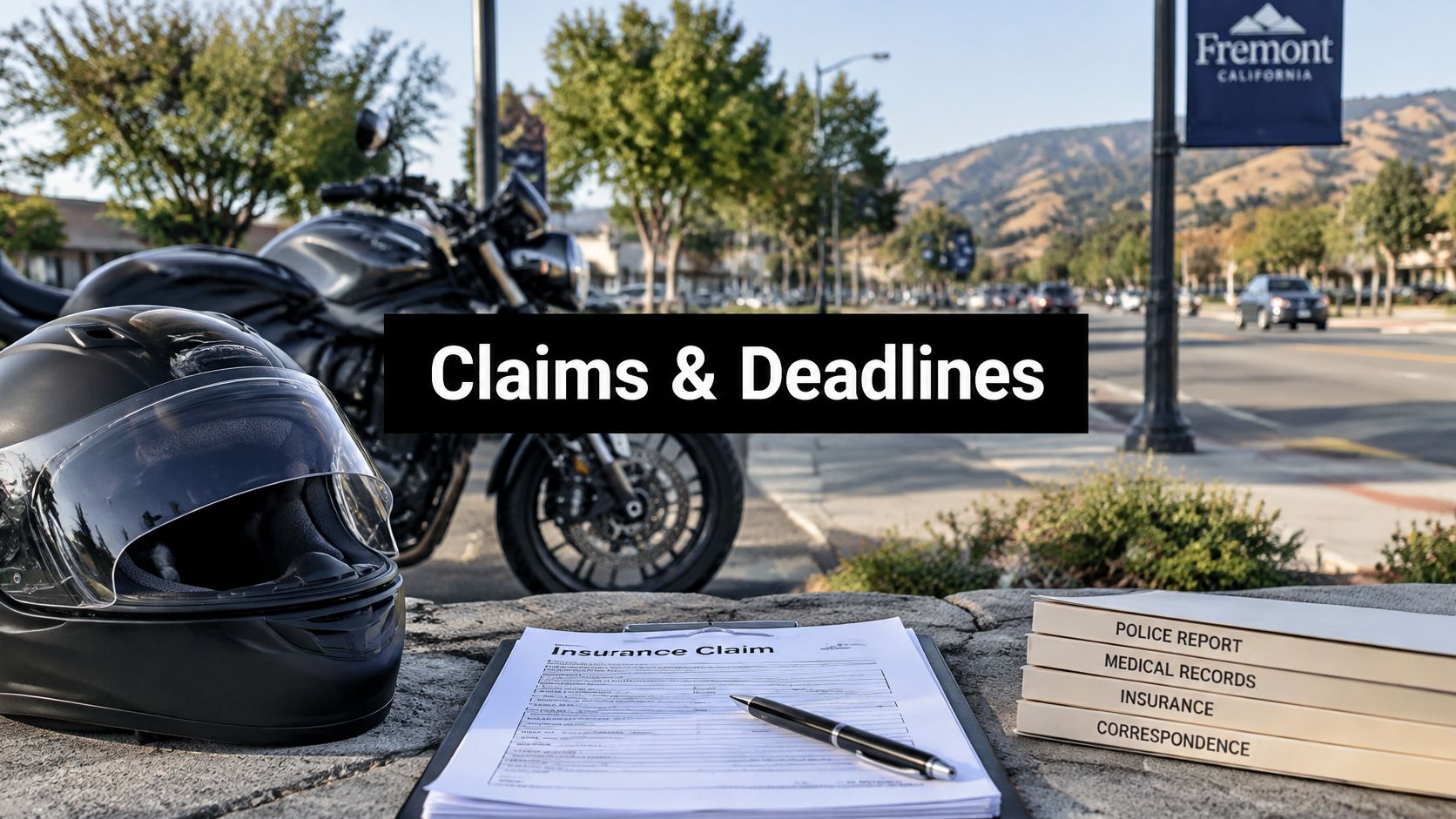
Motorcyclists died at a rate of 31.39 per 100 million vehicle miles traveled in 2023, nearly 28 times the passenger-car occupant rate of 1.13, according to NHTSA crash statistics. That comparison reframes what happens after a bike crash. A rider who goes down at an intersection isn’t holding a bent fender and a sore neck. The rider is holding a trauma bill, weeks away from work, and an insurer that already has a theory about speed.
This guide explains how an injury claim moves in Fremont, California. It covers the filing windows that can end a case before it starts, how fault gets sorted out when the rider’s own conduct is on the table, which evidence disappears fastest, how compensation is documented category by category, and what to ask before hiring a motorcycle accident lawyer in Fremont.
What a Fremont Motorcycle Accident Claim Involves
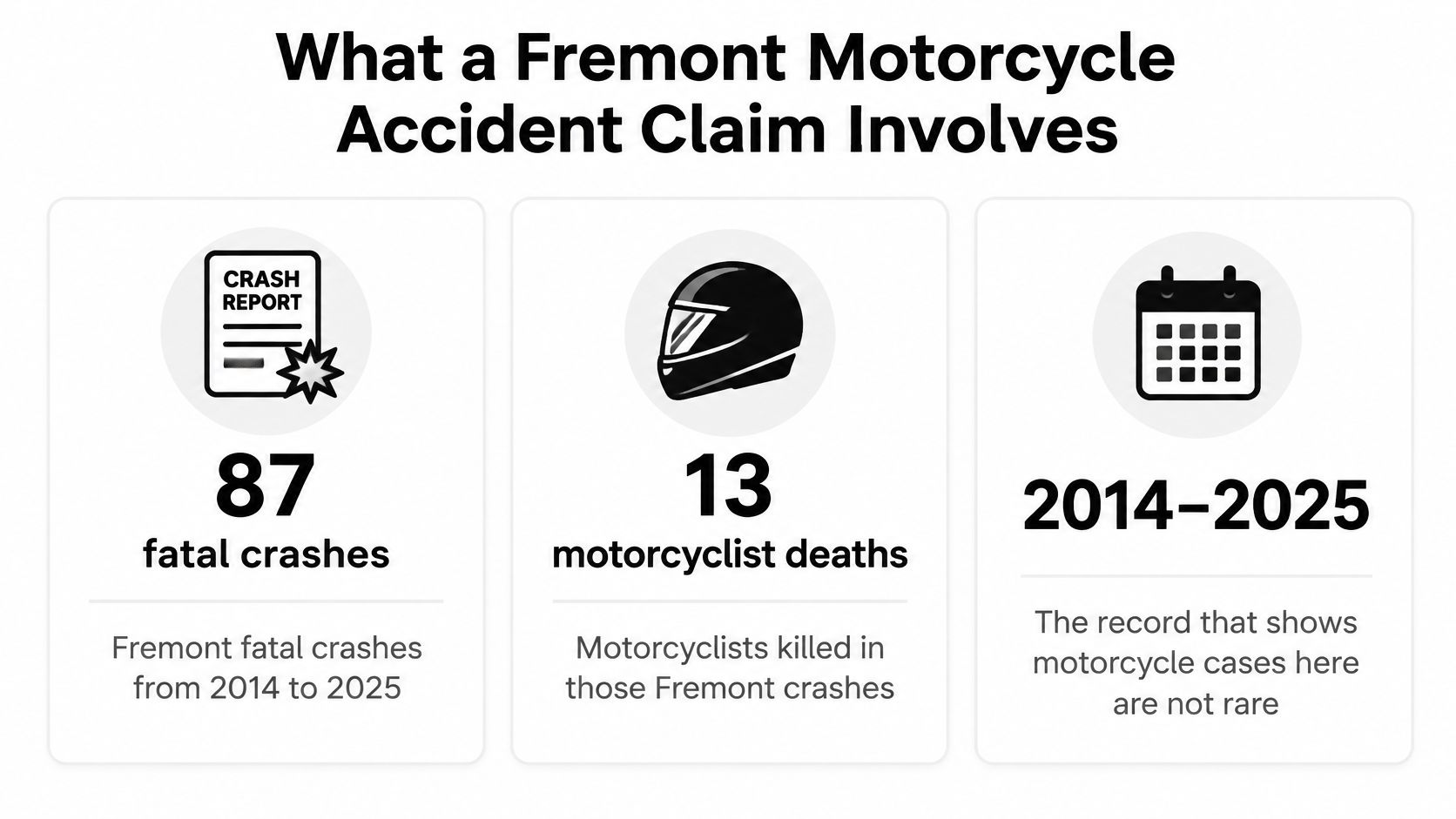
Fremont’s fatal-crash record shows that motorcycle collisions can have devastating consequences. A claim begins by identifying who may be responsible and connecting that person’s conduct to the rider’s injuries and losses. The infographic below provides local crash information; the first step is understanding how an injury claim is built.
A motorcycle injury claim is a personal-injury claim based on negligence. In plain terms, the injured rider must show that another party had a duty to act with care, failed to meet that duty, and caused injuries or losses that can be supported by records. Each part matters: a collision alone does not establish who was legally responsible.
What a breach looks like: A driver turns left across a rider’s lane without yielding, drifts into the rider’s path while texting, or pulls out of a driveway without looking. Each example may show a failure to use reasonable care, but the facts of the crash determine whether that failure caused the injury.
Motorcycle claims often involve serious injuries and substantial medical bills. Insurers may examine speed, lane position, lane splitting, and helmet use, along with the other driver’s actions. These are different questions: evidence about who caused the collision concerns fault, while helmet use may affect the severity of an injury and the damages claimed. An adjuster may form an early view from the police report, so keep your account factual and avoid guessing about details you do not know.
LA Law Group’s personal injury practice includes motorcycle accidents, truck accident cases, wrongful death, and catastrophic injuries. The firm handles the claim process and deals with insurance companies on a client’s behalf. That does not change the basic task of a claim: establishing responsibility and documenting the harm.
The claim process has several stages, and the order matters. Filing deadlines can affect whether a claim may proceed. Fault analysis then considers each party’s conduct; after that, the claim may move through insurance negotiations and, if needed, a lawsuit. Evidence preservation and documenting compensation are separate parts of building the case. Each stage relies on information gathered earlier, much like links in a chain.
Your first task today: record the crash date, location, names of the other parties, and any insurer names or policy numbers you have. Keep the information together. A clear record gives an attorney details to review and compare with the police report.
This article provides general information, not legal advice, and reading it does not create an attorney-client relationship. The State Bar of California explains that legal information is not a substitute for advice from an attorney authorized to practice in the relevant jurisdiction.
Filing Deadlines You Cannot Afford to Miss
| Claim type | General deadline | Note |
|---|---|---|
| Personal injury from a motorcycle crash | 2 years from the date of injury | Code of Civil Procedure 335.1; exceptions can apply |
| Property damage to the motorcycle | 3 years from the date of damage | Separate from the injury claim |
| Wrongful death after a fatal crash | 2 years from the date of death | Confirm the exact start date with counsel |
| Claim against a public entity | 6 months to present an administrative claim | Government Claims Act; short window, so check it early |
The California Courts self-help guide on statutes of limitations puts the ordinary injury claim at two years from the date of the injury under Code of Civil Procedure section 335.1, and treats property damage separately, generally three years from the date the property was damaged.
The row that catches riders is the last one. If a dangerous road surface, a city vehicle, a county truck or a transit bus played a part, the claim runs through the Government Claims Act, and the same court guidance identifies a six-month deadline for presenting an administrative claim. That window is shorter than many assume, and it runs while you’re still in a cast.
The trap in practice: a rider who spends five months in surgery and rehab before calling anyone may still have 19 months left on the injury claim and zero days left on the government claim.
Exceptions, discovery rules and the injured person’s age can all move the calculation, so treat the table as a starting point rather than an answer. Three steps keep you ahead of it.
- Fix the starting date. Note the crash date and every public agency that could be involved: the City of Fremont, Alameda County, a transit district, a utility.
- Calendar the earliest deadline that could apply. Work backward from the shortest window, never the longest.
- Get it confirmed in writing. Ask a lawyer to state in writing which deadline applies and when it runs.
Deadlines only make sense once you know what you’d have to prove, and the California negligence statute of limitations explainer connects the two. Which row matches your case, and which deadline arrives first? Where more than one applies, the shortest one sets the calendar.
How Fault Is Decided in Fremont Motorcycle Crashes
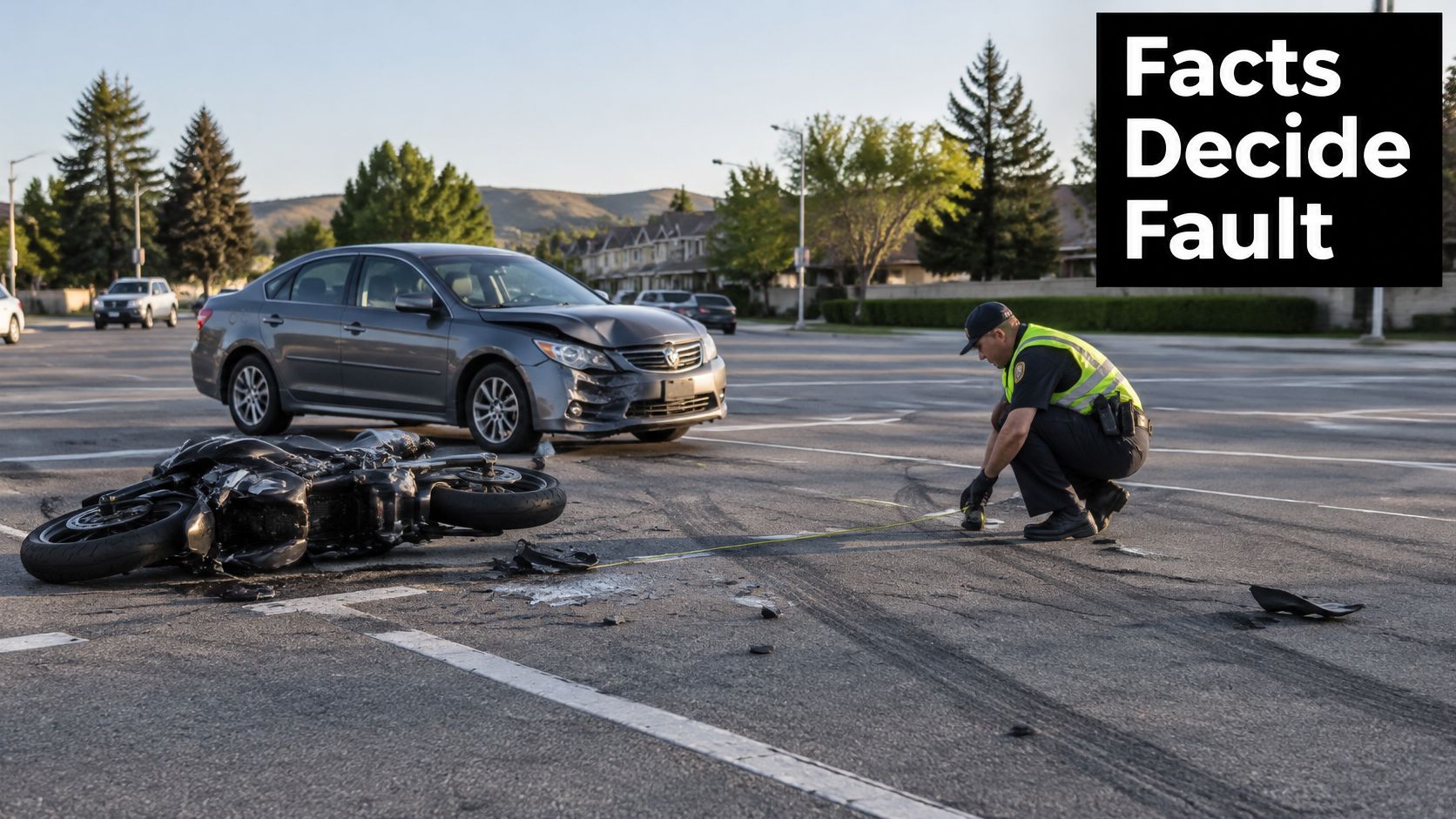
Fault in a motorcycle crash turns on facts, not on the type of vehicle involved. Assume nobody is at fault because they ride, and nobody is blameless because they drive a car.
Fremont recorded 87 fatal traffic crashes between 2014 and 2025. Of those deaths, 39 involved pedestrians (45%), 27 involved motor-vehicle drivers or occupants (31%), 13 involved motorcyclists (15%), and 8 involved bicyclists (9%), according to Fremont’s traffic safety data and trends. The city also reports that all 13 motorcyclist fatalities were associated with reckless driving: 3 riders were killed by a reckless motor-vehicle driver, while 10 were killed while driving recklessly themselves.
That split cuts both ways. It defeats the assumption that the rider is always the victim, and it defeats the assumption that the rider is always the problem. Each case has to be reconstructed.
Lane splitting is legal, but it is not a free pass
California Vehicle Code section 21658.1 defines lane splitting as operating a two-wheeled motorcycle between rows of stopped or moving vehicles traveling in the same lane, and it applies on divided and undivided streets, roads and highways. California Highway Patrol motorcyclist safety guidance confirms it’s legal while warning that safety depends on traffic conditions, speed differences, lane width and roadway factors. Deliberately blocking a rider in a way that could cause harm is illegal, and so is opening a car door to impede one. Our lane splitting laws guide covers how those rules surface in a fault dispute.
A worked example of shared fault
Say a driver turns left across the path of a rider who was splitting lanes at about 35 mph, then tells the officer the motorcycle wasn’t visible. Visibility is a real issue, but it doesn’t cancel the driver’s duty to yield before turning. California follows pure comparative negligence, so a rider found 20% at fault still recovers 80% of the damages. The share reduces the award rather than barring the claim, and the actual split depends on the facts of that case.
For a look at how an initial review of a crash claim is handled, the short segment below is a useful starting point.
Every reader ends up at the same two questions. Who had the right of way, and what did each party do in the seconds before impact?
How a Claim Moves From Insurer to Settlement or Lawsuit
Most riders picture a courtroom. The first months of a claim look nothing like one.
- Report and notify. You or a lawyer tells the at-fault driver’s insurer that a claim exists and gets a claim number. Do it early, because a claim number is what makes every later request traceable.
- Investigation. The insurer reads the police report and asks for a recorded statement. This is the stage where a casual phone call does the most damage.
- Treatment and documentation. Care continues until your doctors say you’ve reached maximum improvement, and records are gathered afterward. A demand built on unfinished treatment undercounts the case.
- Demand and negotiation. A demand package goes out with medical records, bills, wage proof and a damages figure. First negotiations happen here.
- Litigation. If no agreement is reached, a lawsuit is filed and the case moves into discovery and possibly trial.
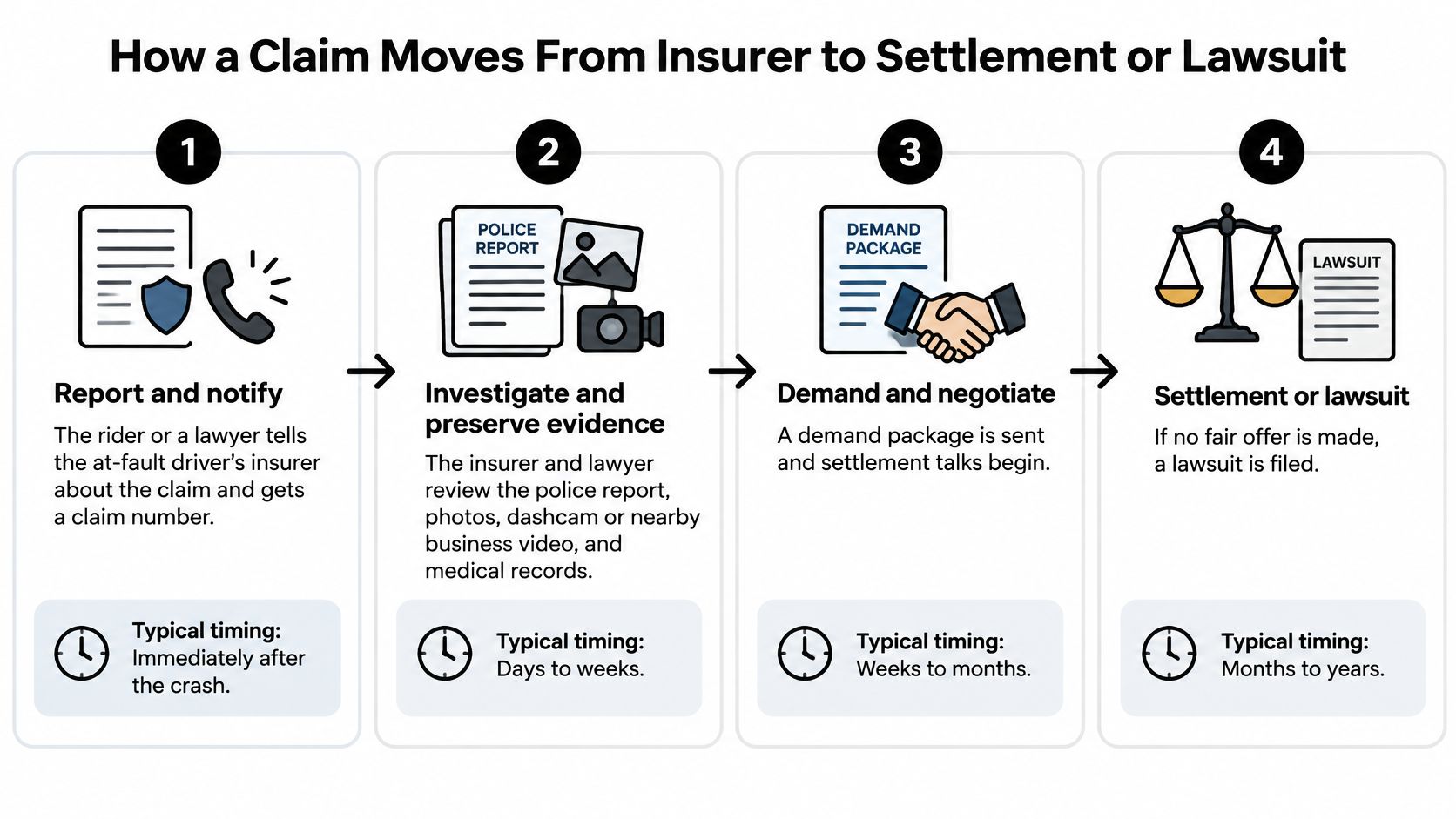
Two timelines are worth keeping in view. Many personal injury cases we handle take six months to reach a settlement, and some lawsuits could take up to three years. Neither number is a promise about your file; treatment length and disputed fault are what move a case along.
In personal injury cases we handle the claim process and deal with insurance companies on the client’s behalf, and we review what happened and explain the options in plain language. If no agreement can be reached, the matter may proceed to litigation.
Don’t sign early: a recorded statement or a release signed before treatment finishes usually locks in the lowest number an insurer will ever offer, at the exact moment your injuries are least understood.
Evidence to Preserve Before the Insurer Builds Its Case
Evidence in a motorcycle case has a shelf life measured in days, not months. The insurer will reconstruct the crash with or without your help, and the only question is whose version of the scene survives.
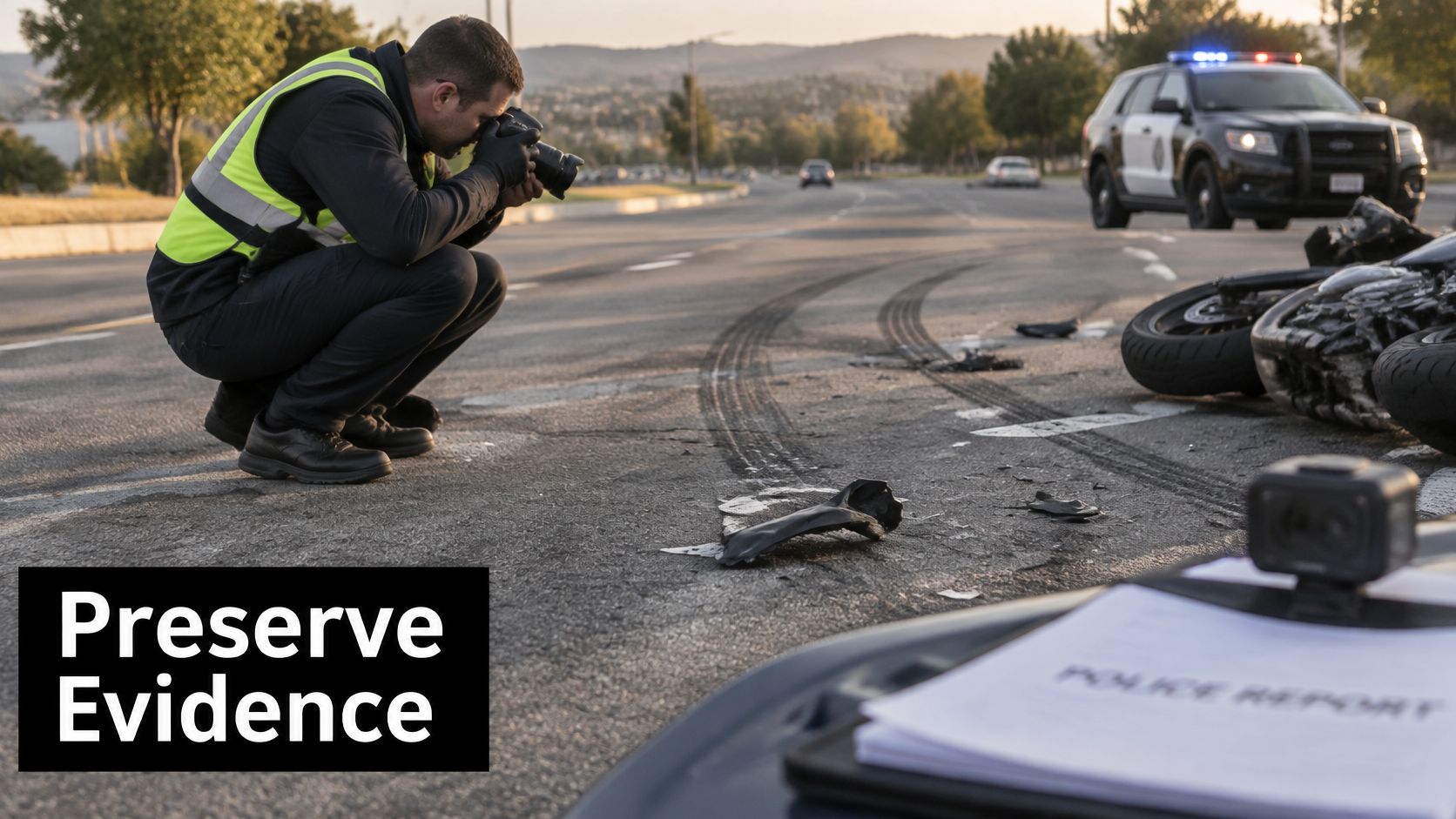
- Photograph the scene and the bike. Lane markings, skid marks, the debris field, the motorcycle’s damage from several angles, and your gear before anything is cleaned or moved.
- Get the police report and any video. Dashcam, nearby business cameras and doorbell footage get overwritten fast. Send a written preservation request to every business within sight of the intersection.
- Collect witness names and phone numbers. A willing witness who moves next month is worth nothing, so get a written or recorded statement now.
- Keep the helmet and riding gear. Photograph shell and liner damage before anything is altered, and note the certification markings inside the helmet.
- Request emergency and trauma records. The first records are what tie a specific injury to a specific impact.
- Save bills, pay stubs and a log. Dates of missed work, trips to appointments and every out-of-pocket expense, each with a receipt.
Why the helmet is evidence about damages, not fault
NHTSA reports that compliant helmets reduce rider fatalities by approximately 37% and brain injuries by about 67%, according to NHTSA’s Countermeasures That Work motorcycle chapter. For a claim, that finding speaks to injury severity and damages. It says nothing about who caused the collision. The mechanism is biomechanical: a helmet’s energy-absorbing liner extends impact duration and spreads load, lowering the peak acceleration that reaches the skull and brain. Medical records should separate traumatic brain injury from orthopedic and soft-tissue injury so an insurer can’t argue them as one lump.
Helmet use doesn’t erase liability for an unsafe lane change, a failure to yield, speeding or an improper lookout. A defensible damages analysis compares the injuries that occurred with medically supported evidence rather than assuming a helmet would have prevented all harm, since NHTSA notes that helmets mainly protect against head and brain trauma and can’t prevent most bodily injuries.
Reconstruction analysts then test competing mechanisms: left-turn encroachment, rear-end impact, lane-change conflict, single-vehicle loss of control. They work from vehicle event data, sight lines, lane geometry, lighting and final rest positions, and every one of those inputs is perishable.
Don’t repair, sell or scrap the motorcycle until an expert has inspected it. A repaired bike is a destroyed exhibit, and an offer made before inspection reflects the damage an adjuster can see, not the damage the frame absorbed.
What Compensation a Motorcycle Claim Can Include
A rider with a fractured femur and a concussion may have several distinct losses, each needing its own support. Economic damages cover documented expenses and lost income. Non-economic damages may include pain, emotional distress, and losing the ability to enjoy activities such as riding.
| Damage type | Typical examples | How it is documented |
|---|---|---|
| Economic: medical and surgical bills | Emergency care, surgery, imaging, rehabilitation | Itemized bills and treatment records |
| Economic: recovery costs | Equipment, home help, transportation to appointments | Receipts and a mileage or care log |
| Economic: lost wages | Missed shifts, reduced hours, lost commissions | Pay stubs and an employer letter |
| Non-economic: pain and suffering | Ongoing pain, limited movement, sleep loss | Medical records and provider testimony |
| Non-economic: emotional distress and lost enjoyment | Anxiety after the crash, loss of riding or daily activities | Treatment notes, a personal journal and witness accounts |
These categories are assessed separately because a receipt proves a bill, while treatment records and other evidence help explain less tangible harm. For some cases, non-economic damages are estimated by applying a multiplier to economic damages. This is one approach, not a fixed rule, and complete, itemized financial records can make the underlying losses clearer.
California’s reported helmet-use rate in the cited crash tables was approximately 92%, according to NHTSA’s motorcycle crash statistics. That figure describes a state-level pattern, not an individual rider’s injuries. Helmet use may be relevant to injury severity and damages, but it does not establish who caused the collision.
Compensation questions get answered in categories, not in one lump sum. Each category either has paper behind it or it doesn’t.
In the example above, surgery creates itemized hospital and surgeon bills. Six weeks away from work can be supported by pay stubs and an employer letter. Physical therapy notes document recovery, while concussion symptoms should also appear in the medical record. Keeping the head injury distinct from the leg injury helps show how each affected the rider.
Future losses require additional support. Ongoing treatment, reduced earning capacity, and long-term impairment may need input from medical or economic experts. Emotional harm also needs documentation, such as treatment notes, personal records, and accounts from people who observed changes in the rider’s daily life.
Start a running log early. Record each expense, missed workday, and symptom with its date, along with the relevant receipt or note. This creates an organized record of how the collision affected both finances and everyday life. Further information about treating crash-related PTSD in Florida concerns Florida, so it should not be treated as guidance on what a California claim requires.
Choose a Motorcycle Accident Lawyer in Fremont
Hiring a motorcycle accident lawyer in Fremont comes down to the answers, not the advertising. These questions separate a specific, accountable answer from a pitch.
| Question to ask | Clear answer looks like | Red flag |
|---|---|---|
| How many motorcycle crash cases have you handled? | Specific recent examples and outcomes described in general terms | Vague answers or only general injury experience |
| Who will work on my case day to day? | A named attorney with direct contact | Work handed off without a clear lawyer contact |
| How are fees and costs calculated? | Written terms explained before signing | Unclear percentages or unexplained costs |
| Will you handle insurer communications? | Yes, with plain-language updates | Pressure to accept an early offer |
| How will the case be updated? | A stated schedule for updates and contact | No clear plan for communication |
Ask one more question that people forget: what happens to costs if there’s no recovery? Get the fee agreement in writing before you sign anything, and confirm consultation terms, office location and language availability directly with the firm, because those details change.
Our offices in Santa Monica, Los Angeles and Fremont are available by appointment only, at 1400 Broadway in Santa Monica, 3380 Livonia Ave in Los Angeles, and 3105 Capitol Ave in Fremont. The first consultation is free and confidential, and it’s held with the attorney who will handle the matter. Injury consultations are confidential.
Where a crash was fatal, families face a different evidentiary problem, and autopsy evidence for wrongful death claims explains how post-mortem findings can support causation. The questions to ask an injury lawyer checklist goes deeper on fee structures and case handling.
Before the first meeting, gather the police report, your medical records, the insurance declarations page and your expense list. Book the consultation in the first weeks after the crash, while every filing window is still open. Use the attorney’s answers as the test, not the advertising.
This article is for informational purposes only and is not to be construed as legal advice. No attorney-client relationship exists based on review of this article, and none of the information here is legal advice.
If you were hurt on a bike in Alameda County, LA Law Group, APLC reviews what happened, explains your options in plain language, and handles the insurance company on your behalf while you focus on treatment. The first consultation is free, confidential, and held with the attorney who would handle your case, with a Fremont office available by appointment. Visit LA Law Group, APLC to schedule a time to talk through your crash.
Attorney Advertising. This article is general information, not legal advice, and does not create an attorney-client relationship. Prior results do not guarantee a similar outcome.