
Motorcyclist Road Rage: What to Do Right After It Happens
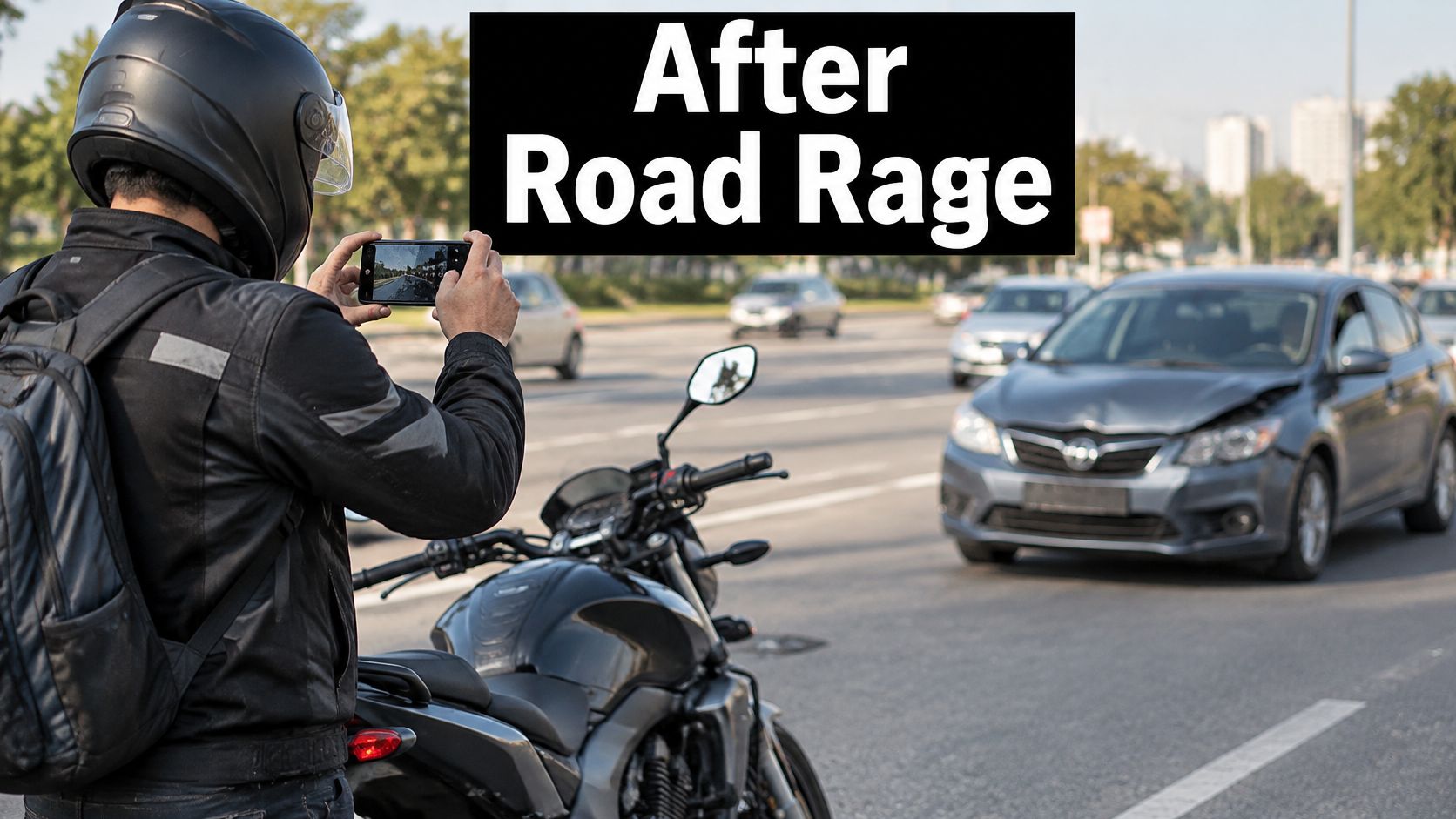
You’re stopped at a light with the engine idling, and a sedan pulls up beside you with the window down. The driver is shouting something your helmet swallows whole. You’ve got a camera on the chin bar, a phone in your pocket, and about three seconds to decide whether this ends at the intersection or follows you for the next two miles.
Most advice about motorcyclist road rage stops right there, at the moment of the confrontation. The part that determines what happens to your injuries, your bike and your insurance premium comes later, in the report an officer writes, the file an adjuster opens, and the evidence you either saved or lost. This article is for informational purposes only and must not be construed as legal advice. No attorney-client relationship exists based on review of this article, and none of the information in this article is legal advice.
Stay Safe When a Driver Turns Hostile
Annoyance and escalation look different from the saddle. A driver who honks once and turns off is venting. A driver who matches your speed for six blocks, then swings across two lanes to get in front of you at the next light, has moved into something else.
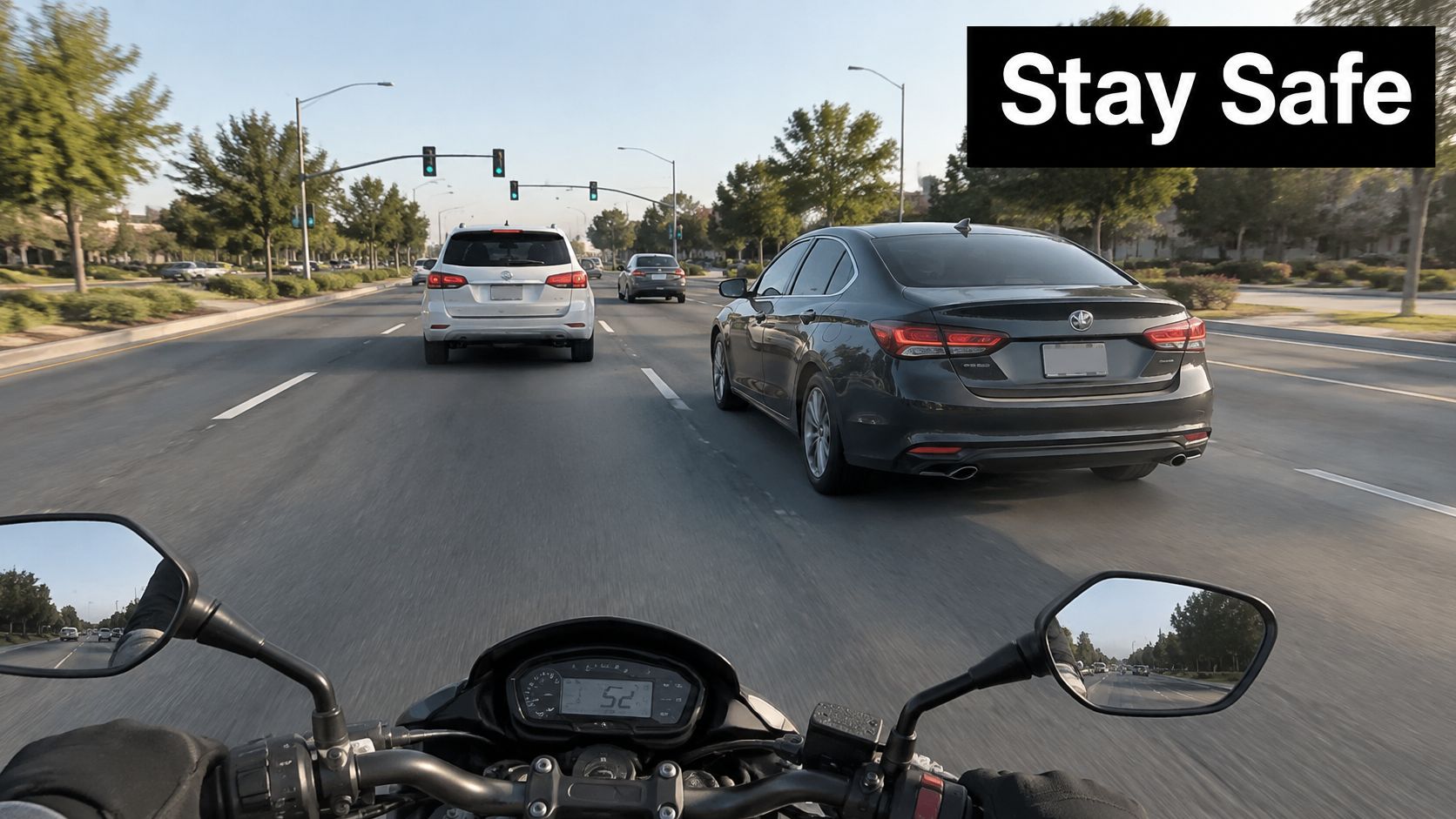
Watch for these signs, in roughly this order of seriousness:
- Sustained tailgating: the car stays inside your following gap through speed changes, not just one stretch of road.
- Pursuit through several blocks: the driver takes turns they don’t need, matching your route.
- Repeated horn use and gestures: contact attempts, not a single frustrated beep.
- Blocking in traffic: the vehicle slows to pace you or crowds you toward the shoulder.
- A driver stepping out of the car: the encounter has left the roadway and become a physical confrontation.
Retaliation costs you more than it costs them. Research involving 960 Vietnamese motorcyclists found that aggressive emotional expression was associated with 1.54 times as many minor crashes and 1.93 times as many traffic violations for each unit increase in the relevant aggression factor, while adaptive expressions were associated with 40% fewer major crashes and 19% fewer offenses, according to the motorcyclist aggression study archived by the University of Liège. “Stay calm” is too vague to act on. Creating distance is a specific behavior with a measurable payoff.
The six moves that end the encounter
- Don’t match speed, gesture back or argue at the window.
- Create distance with a legal lane change once traffic allows it.
- Skip the sudden braking, weaving and racing away. That’s how a dispute becomes a crash report with your name in the speed box.
- Ride toward a populated, well-lit place or somewhere police can reach quickly, such as a fuel station with cameras or a fire station.
- Call 911 if the driver follows, threatens you or makes contact.
- Keep the helmet camera recording the entire time, including the parts where you’re doing nothing interesting.
The win isn’t proving your point at the light. It’s ending the ride with the other driver behind you and a continuous file on your card.
A safe outcome has three markers: the car is no longer with you, other people can see you, and your recording never stopped. If contact or injury did happen, the next hours matter as much as the next seconds, and understanding filing a motorcycle crash claim before you talk to an adjuster helps you avoid handing over a version of events you’ll later have to correct.
Evidence to Collect Right After an Incident
The evidence has to show the sequence of events, not just that you were angry or scared. Fear is real and it’s also unprovable on its own. What persuades an officer, an adjuster or a jury is a chain: this car did this, at this location, at this time, and here’s the file that shows it.
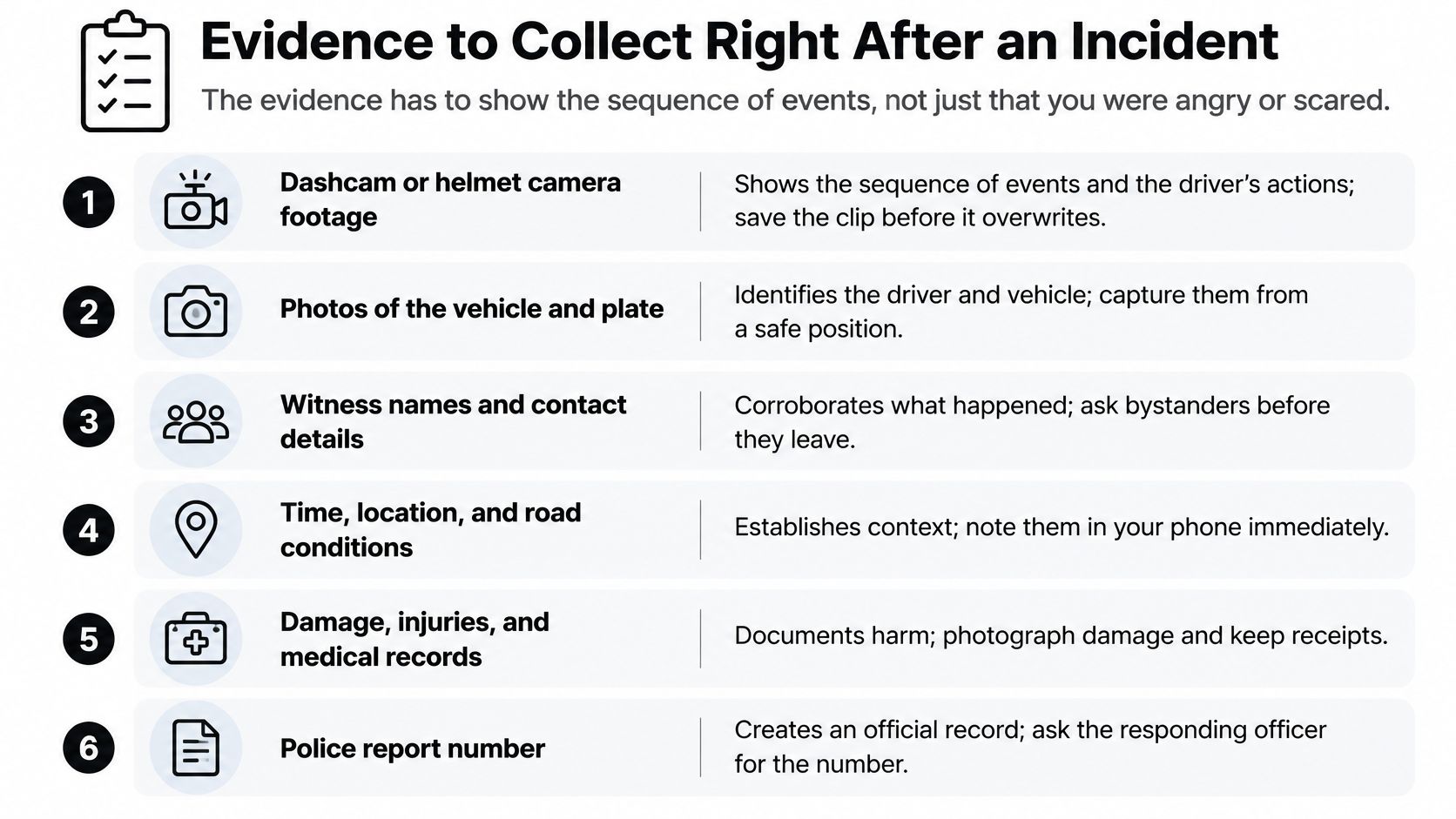
What each piece of evidence proves
Treat each behavior as a separate entry rather than one blur of “he was aggressive.” Investigators who study riding risk define observable indicators first (speeding, passing on the right, abrupt acceleration or braking, close following, lane violations, retaliatory maneuvers) and then compare a rider’s event rate against that rider’s own baseline. The Motorcycle Safety Foundation’s analysis of the MSF 100 naturalistic study found that when aggressive riding such as speeding or passing on the right occurred as the only recorded behavior, the risk of a crash or near-crash was approximately 18 times the risk when none of the analyzed behaviors occurred. Behavior, not mood, is what carries weight.
| Evidence | What it shows | How to capture it |
|---|---|---|
| Helmet or dashcam footage | Sequence of pursuit, blocking or contact | Save the original file, don’t edit it, back it up the same day |
| Independent witness details | Who started the confrontation | Get name and phone number before they leave |
| Location, direction, lane and time | Traffic signals and positions | Note street, lane, direction and the time stamp on your phone |
| Speed estimate and traffic conditions | Whether speeding or unsafe following occurred | Write it down within an hour with traffic and weather notes |
| Threatening texts, voicemails or posts | Intent and threats | Screenshot with timestamp and sender name visible |
| Other vehicle plate, make and damage | Identity of the driver | Photograph plate, vehicle and visible damage from several angles |
| Medical records from first visit | Link between the incident and the injury | Seek care promptly and keep discharge notes and bills |
| Written sequence of events | Provocation, response and outcome | Create a timeline the same day while details are fresh |
Pull the card or connect the camera to your phone before you ride again. Most action cameras loop-record, and the next commute can overwrite the only footage of the incident. Copy the original file to cloud storage and a second device, and don’t trim, stabilize or add music to the version you send anyone.
Photograph the other vehicle before repairs change it. A car whose belts locked in a collision can be back on the road quickly, and guides such as Safety Restore’s locked belt fix show what that repair involves, which is exactly why your same-day photos of the plate, bumper and damage matter more than the car’s condition a week later.
Where riders lose the thread
The common failure isn’t a missing photo. It’s a statement built entirely on how the encounter felt. Self-reported hostility without behavioral corroboration is weak, and thresholds for what counts as aggressive riding shift with the environment, so a claim that “anyone would call that road rage” proves nothing about causation. Anger alone doesn’t establish who caused a crash.
Write it while it’s fresh: an hour after the incident, open a notes app and log the sequence in order, with times, lane positions, your speed estimate and each maneuver by the other vehicle. Date the note. That timeline becomes the spine of every report you file afterward.
Reporting Routes by Situation
The right report depends on what happened. An ongoing threat, an injury, a message that arrives after you’ve parked, a property-only collision and a driver who fled all travel different paths.
| Situation | Report to | When | What to bring |
|---|---|---|---|
| Ongoing pursuit, blocking or threat | 911 | Right away, while it’s happening | Phone on, location shared, helmet camera running |
| Injury or death at the scene | 911 and the responding officer | Immediately | Officer name, badge number and collision report number |
| Threats or harassment after the ride, no injury | Local police non-emergency line | As soon as you’re safe, ideally within 24 hours | Screenshots, timeline, plate number |
| Collision with property damage in California | California DMV SR 1 report | Within 10 days when the case is reportable | Photos, damage estimate, police report number |
| Crash with a driver who left the scene | Police and your own insurer | Immediately | Witness details, damage photos, medical records |
California’s Report of Traffic Accident Occurring in California (SR 1) applies in certain injury or damage cases, and the dollar threshold that triggers it gets updated. Check the current figure on the DMV’s own form before you decide your crash was too minor to report.
The sequence that creates an official record
Call 911 first when anyone is hurt or a driver is still threatening you, and stay on the line until dispatch tells you it’s fine to hang up. Ask the responding officer for their name, badge number and the collision report number before they clear the scene, because “an officer came” isn’t something you can request a copy of later.
If no officer responded, file at the local police department as soon as you’re safe rather than waiting to see whether your shoulder still hurts next week. Bring the video file on a drive or a shareable link, the printed timeline and your screenshots. Our guide to reporting unsafe driving walks through how to describe a driver’s conduct in terms a report can capture.
The report matters because it’s the document insurers and attorneys build on. A threat you mention for the first time ten days later is much harder to tie to a specific ride, a specific plate and a specific intersection.
Off-road threats still count. Messages, voicemails and social posts that arrive after the confrontation are evidence of intent, and they belong in a police report even though nothing happened in traffic. Save them with the sender and timestamp visible, and don’t reply.
How Insurers and Police Record Road Rage Crashes
Road rage rarely gets coded as road rage. The report uses categories that already exist in the database: speeding, racing, unsafe following, improper lane change. Your conduct can end up in one of those boxes even when nobody was charged with anything resembling an anger offense.
The National Highway Traffic Safety Administration’s 2024 motorcycle traffic safety facts define a crash as speeding-related when the driver was charged with a speeding offense or when an investigating officer identified racing, driving too fast for conditions, or exceeding the posted speed limit as a contributing factor. In 2024, 37% of motorcycle riders involved in fatal crashes were speeding, compared with 22% of passenger-car drivers, 15% of light-truck drivers and 8% of large-truck drivers.
That definition is the trap. If you accelerated hard to escape a pursuing driver, an officer may record excessive speed as a contributing factor without recording anything about the pursuit that prompted it. The paperwork can end up describing your reaction and omitting the provocation.
What to send your insurer, and in what order
- Notify your insurer promptly and describe the incident in facts, not opinions. “The vehicle followed me for four blocks and braked in front of me” beats “the guy went insane.”
- Send the timeline and an itemized evidence list, including the unedited video file.
- Ask about medical payments coverage for immediate bills, since treatment often can’t wait for a fault determination.
- If the other driver fled or carried no insurance, ask specifically about uninsured motorist coverage.
- Before giving a recorded statement, review what you’re being asked and don’t guess about speed or intent.
Recorded statements: “I don’t recall my exact speed” is an accurate answer. A number you invent to sound cooperative becomes the number in the file.
A speeding entry in the police report can be used against you, so consistency across your 911 call, your officer statement and your insurer statement matters more than a dramatic account. If the report contains a factual error, our walkthrough on fixing a flawed police accident report explains the correction process and what documentation supports a request.
If the insurer disputes fault, don’t argue by phone. Ask for the denial or the fault allocation in writing, request the documents they relied on, and put your video and timeline in front of them again. A written position is something you can answer; a adjuster’s tone on a call isn’t.
Legal Remedies and When to Call a Lawyer
Three separate questions get tangled together in almost every road rage case. Was the conduct careless? Was it intentional? And what can you prove? A rider can be certain of the first two and still lose on the third.
Road rage is a behavioral description, not a legal conclusion. Liability depends on provable acts, causation and damages. A driver who screamed at you and then drove away may have committed something reportable without giving you a compensable injury claim, while a driver who never said a word but deliberately crowded you into a guardrail may have handed you both a negligence claim and an intentional-conduct claim.
The routes available and who brings them
| Remedy | Brought by | What must be shown | Typical deadline |
|---|---|---|---|
| Civil negligence claim | Injured rider, usually through counsel | Duty, breach, causation and damages | Generally two years from injury in California |
| Civil claim for intentional conduct | Injured rider, usually through counsel | Intentional act that caused harm, such as battery or intentional infliction of emotional distress | Generally two years from injury in California |
| Criminal report for assault or threats | Prosecutor after a police report | Unlawful force or threat with the required intent | Depends on the offense and must be checked |
| Civil harassment restraining order | Person threatened or harassed | Course of conduct causing fear for safety | Can be filed promptly; temporary orders may issue quickly |
| Uninsured motorist claim | Rider’s own insurer | Injury from an uninsured or unidentified driver | Governed by the policy’s notice rules |
One incident can support several of these at once. A criminal case and a civil claim aren’t alternatives, and a prosecutor declining to charge doesn’t decide whether you can recover for your injuries. The standards differ, the decision-makers differ, and the outcomes don’t have to match.
What decides the outcome
Evidence carries the case, not the emotional story. The sequence of maneuvers, independent witnesses who aren’t your riding buddies, and medical records that connect the crash date to the diagnosis do the work. A rider who can show pursuit through three intersections on video is in a different position from one describing the same events from memory.
California applies comparative fault, so your own conduct can reduce what you recover. That’s the practical reason to be precise about your speed and your evasive maneuver from the first statement rather than adjusting the account later when the video surfaces. Timing matters too: the general personal injury limitation period in California is two years from the injury, with exceptions that can shorten or extend it, so confirm the deadline that applies to your facts early rather than at month twenty-two.
Riders injured outside California face different rules entirely. Resources like Nares Law Group rider injury claims show how motorcycle injury cases are built under Colorado law, which is a useful reminder that a crash during an out-of-state trip needs advice specific to that state.
The video below covers how motorcycle injury claims are evaluated after a collision.
When the call to a lawyer is worth making
Some situations justify a consultation immediately, before you speak to any adjuster:
- Serious injury: fractures, road rash requiring grafting, head injuries or surgery mean the claim value turns on medical documentation you shouldn’t assemble alone.
- An unidentified or uninsured driver: your own policy becomes the source of recovery, and the notice rules and arbitration provisions in that policy are unforgiving.
- A weapon in the threat: the criminal side moves fast and your civil strategy should account for it.
- A continuing threat: someone who knows your route or workplace needs a restraining order analysis, not just a police report.
- An insurer disputing fault: a written denial citing your speed is the point where representation typically pays for itself.
Our comparison of when to hire a personal injury attorney sets out the decision points in more detail, including the cases where handling a claim yourself is reasonable. Our personal injury practice covers automobile accidents, motorcycle accidents, truck accident cases, wrongful death, product and premises liability, and catastrophic injuries, so a road rage collision gets assessed alongside the vehicle, roadway and insurance questions that come with it.
Bring your own facts to qualified counsel: the video, the timeline, the report number and your medical records. This article is for informational purposes only and is not to be construed as legal advice. No attorney-client relationship exists based on reviewing it, and none of its content is legal advice.
If a hostile driver left you injured, off work or fighting a fault finding, LA Law Group, APLC can review your helmet-camera footage, police report and medical records, assess liability and insurance coverage, and handle the insurer communications while you recover. We offer free initial consultations and direct attorney access from offices in Los Angeles, Santa Monica, Chatsworth and Fremont. Visit LA Law Group, APLC to request a case evaluation and find out which claim routes your evidence supports.
Attorney Advertising. This article is general information, not legal advice, and does not create an attorney-client relationship. Prior results do not guarantee a similar outcome.