
California's Non Delegable Duty Explained

Disclaimer: This article is for informational purposes only and is not to be construed as legal advice. No attorney-client relationship exists based on the review of this article, and none of the information in this article is legal advice.
In legal terms, a non-delegable duty is a specific kind of responsibility—one so important that you can’t just hand it off to someone else and wash your hands of it. Even if you hire an outside expert or an independent contractor to handle a task, you’re still the one on the hook for making sure it gets done safely. This powerful legal concept is a major exception to the general rule that you aren’t liable for a contractor’s mistakes.
Understanding the Core Responsibility

Think of yourself as the captain of a massive ship. You can absolutely assign a crew member to navigate a tricky channel, but the ultimate responsibility for the ship’s safety—and everyone on it—still rests squarely on your shoulders. If that crew member messes up and the ship runs aground, you, the captain, are the one who has to answer for it.
A non-delegable duty works on the very same logic. The law recognizes that certain obligations are just too critical to public safety to be outsourced away. These duties mean you can’t fulfill your responsibility simply by hiring a competent contractor; the law demands that the original party, whether it’s a property owner or a general contractor, keeps the ultimate liability.
Why This Doctrine Exists
At its heart, the non-delegable duty doctrine is all about protecting the public. It makes sure the party with the most control and the deepest pockets—the one best equipped to manage the risks—remains responsible.
This prevents big companies from sidestepping their safety obligations by hiring smaller, potentially underinsured contractors to do dangerous work. The doctrine forces a higher standard of care in situations where a little negligence could lead to serious injury or even death.
You’ll see this principle pop up most often in a few key areas of law:
- Premises Liability: Landlords and business owners have a duty to keep their properties reasonably safe for anyone who comes on site.
- Inherently Dangerous Activities: Jobs that carry a high risk of harm, like fumigation or demolition, almost always come with non-delegable duties.
- Workplace Safety: General contractors and employers have specific obligations to provide a safe environment for every worker on a job site.
In essence, the law created these exceptions to stop the “pass the buck” game. It ensures accountability for safety stays right where it belongs: with the party who initiated the work and stands to benefit from it.
The Impact on Safety Standards
This legal concept has been a game-changer for safety standards, especially in high-risk fields like construction. Just look at the scaffolding statistics. The Bureau of Labor Statistics reports that scaffolding mishaps cause roughly 4,500 injuries and 60 fatalities every single year in the U.S.
In response, some states have taken a hard line. New York’s famous Scaffold Law, for example, slaps a non-delegable duty onto property owners and general contractors for worker safety. They are held strictly liable if a worker is injured in a fall, even if a subcontractor was the one who was actually at fault. This tough standard, born directly from the need to slash construction accidents, shows you just how powerful this doctrine can be.
You can learn more about how a property owner’s duties are defined in our guide on what premises liability law is. These principles ensure that those in charge can’t just look the other way when it comes to inherently dangerous work.
The Legal Roots of This Duty in California
The whole idea of a “non-delegable duty” isn’t just some abstract legal theory. It’s a powerful tool with deep roots in California’s commitment to public safety. Think of it as a crucial exception to a general rule. Normally, if you hire an independent contractor, you’re not on the hook for their mistakes. But this doctrine says, “Not so fast.”
At its core, the principle is built on a simple belief: some responsibilities are just too important to pass off to someone else.
In California, these duties don’t just appear out of thin air. They grow from three very specific legal sources, each designed to make sure the buck stops where it should. Understanding these sources is the key to figuring out why a property owner or a company might end up being held responsible for a contractor’s screw-up.
Where Does a Non-Delegable Duty Come From?
The legal system creates these duties to protect all of us, especially when there’s a special relationship between the parties or when the work itself involves inherent risks. When someone gets hurt, the courts will look to see if the responsibility falls into one of these specific buckets.
Here are the three primary sources:
- Statutes and Ordinances: Sometimes, the law itself says a duty can’t be handed off. This is common with laws tied to public safety, like state building codes or local workplace safety regulations. The government has essentially decided that the responsibility is fixed.
- Contracts: A simple contract can also create a non-delegable duty. If one party signs an agreement promising to be responsible for a specific safety outcome, they can’t just hire a subcontractor to escape that promise. The contract holds them to their word.
- Common Law (Court Decisions): Over many years, California courts have carved out situations where a duty is non-delegable simply as a matter of public policy, even if no specific law is on the books. This often applies to activities that are considered “inherently dangerous.”
This legal framework makes sure that the person or company with the main control over—and financial interest in—a project ultimately holds the bag for safety.
Key Statutes and Landmark Court Cases
California’s legal landscape is dotted with laws and court rulings that cement the non-delegable duty doctrine. For example, various sections of the California Civil Code place a duty on landowners to keep their property in a reasonably safe condition. Courts have said time and time again that this is a classic non-delegable duty.
When it comes to court cases, the most influential decisions have often revolved around workplace safety. For decades, the landmark case of Privette v. Superior Court has been the heavyweight champion, shaping how these duties apply to contractors on a job site.
While the Privette doctrine generally protects a property owner from being sued for a contractor’s negligence, it comes with some huge exceptions. Those exceptions often kick in when the owner keeps control over how the work is done or when the work itself is inherently dangerous.
Public policy is the real engine here. The law wants to stop a property owner from reaping the rewards of risky work while dodging responsibility for injuries that were a predictable result of that very risk.
Imagine a general contractor hires a roofing company. An employee of that roofing company gets hurt because of an unsafe condition the general contractor personally created. In that situation, the non-delegable duty doctrine might very well come into play. Courts will dig into the details to see if the hiring party’s own actions “affirmatively contributed” to the injury.
These legal precedents show a clear trend: California courts are serious about protecting people. They ensure the party in the best position to prevent harm has every reason to do so. The non-delegable duty is a vital legal backstop, preventing responsibility from being watered down through endless layers of subcontracting. It’s a stark reminder that with great control comes great responsibility.
Real-World Scenarios Where This Duty Applies
To really get a handle on the non delegable duty doctrine, you have to see it in action. Legal definitions are one thing, but how does this play out in the real world? This isn’t just some abstract theory lawyers argue about; it pops up in everyday situations where public safety is on the line. From apartment buildings to busy construction sites, California law is very clear that certain responsibilities stick to the person or entity in charge—no matter what.
Let’s walk through some of the most common scenarios where this powerful duty comes into play. These examples will show you exactly how it impacts property owners, general contractors, and business operators across the state, and why you can’t just hire someone else to escape your ultimate responsibility for safety.
Premises Liability: A Landlord’s Core Duty
One of the absolute classic examples of a non-delegable duty lies in premises liability. In California, landlords and commercial property owners have a basic, unshakable duty to keep their properties reasonably safe for tenants, customers, and visitors. This isn’t just about the private spaces; it absolutely covers all common areas like hallways, stairwells, parking lots, and lobbies.
Think about the owner of a large apartment complex. He hires an independent maintenance company to fix a wobbly handrail on a main staircase. The maintenance guy does a sloppy job. A few days later, a tenant leans on that rail, it gives way, and she suffers a serious fall.
The property owner can’t just point a finger at the maintenance company and wash his hands of the situation. The duty to maintain safe common areas is non-delegable. Because the owner holds the ultimate responsibility for the property’s safety, they can be held liable for the tenant’s injuries, even though the contractor’s direct negligence caused the fall.
This rule is firmly rooted in public policy. The law recognizes that the property owner is in the best position to control safety and has the financial means to manage that risk. These duties can come from statutes, contracts, or established common law, all creating a clear line of accountability that leads right back to the owner.
This simple decision tree shows how the law determines if a duty can be passed on by looking at its source.
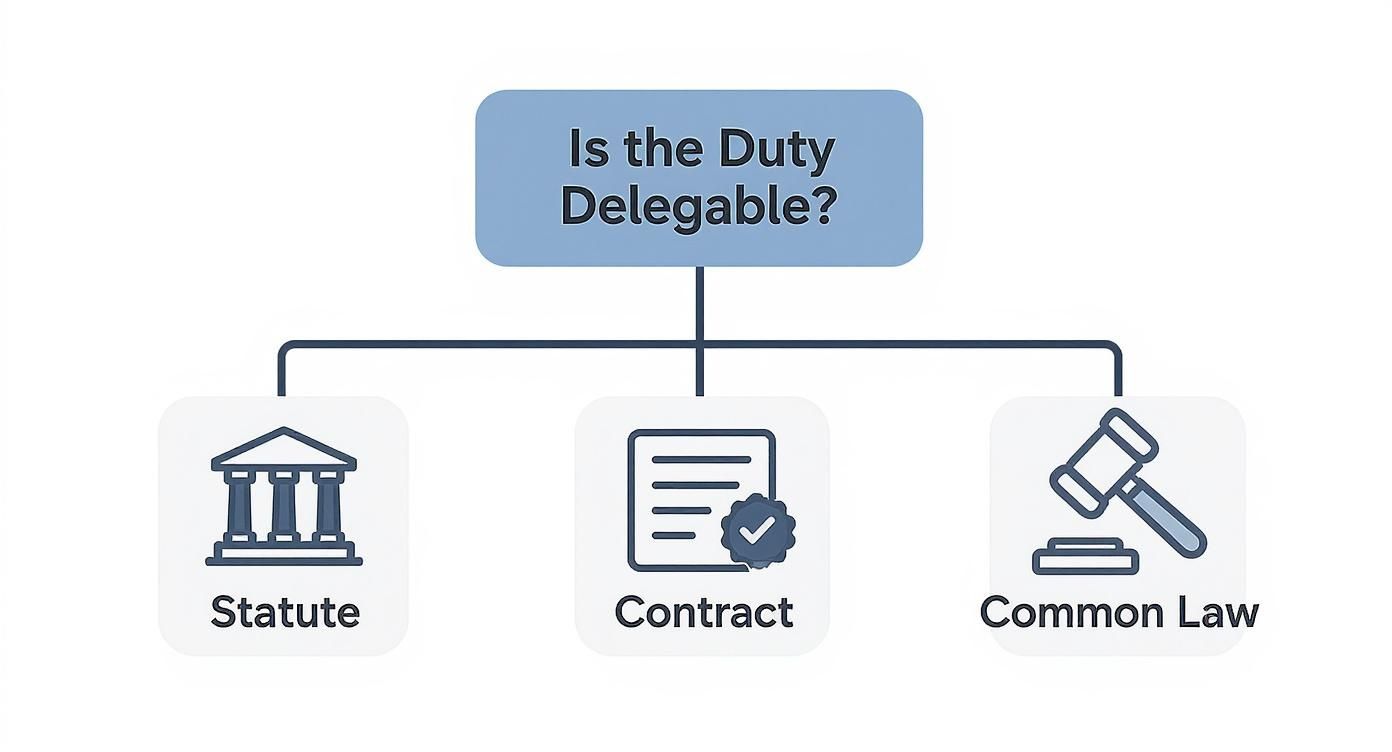
As the flowchart shows, whether a duty comes from a specific law, a private contract, or a long-standing court decision, any of these sources can create a responsibility that simply cannot be legally handed off to someone else.
To make this clearer, let’s look at a few side-by-side examples.
Examples of Non Delegable Duty Scenarios
| Scenario | Delegable Duty (General Rule) | Non Delegable Duty (Exception) | Ultimately Liable Party (in Non Delegable cases) |
|---|---|---|---|
| Routine Landscaping | A homeowner hires a gardener to mow the lawn. If the gardener negligently damages a neighbor’s fence, the gardener is typically liable. | A hotel hires a company to trim large, heavy palm fronds over a public walkway. If a frond falls and injures a guest, the hotel may be liable. | The Hotel |
| Building Repair | A small office hires a painter for an interior room. If the painter spills paint on an employee’s computer, the painter is liable for the damage. | A mall owner hires a roofer to fix a leak. If the roofer’s poor work causes a ceiling collapse injuring a shopper, the mall owner is liable. | The Mall Owner |
| Construction Work | A general contractor hires a caterer for the work crew. The caterer would be liable for any food-related issues. | A general contractor hires a demolition crew for a project next to a busy street. The duty to ensure public safety during demolition is non-delegable. | The General Contractor |
This table highlights the crucial difference: routine, low-risk tasks are one thing, but when public safety or inherent danger is involved, the responsibility sticks with the person in charge.
Inherently Dangerous Activities
Another major area where non-delegable duties appear is work that’s considered “inherently dangerous.” This doesn’t just mean “risky”; it refers to activities that carry a significant, unavoidable risk of harm to others, even when someone is being as careful as possible. The law places a non-delegable duty on the person who commissions this kind of work to make sure every necessary precaution is taken.
Common examples of inherently dangerous activities include:
- Fumigation: Using toxic chemicals for pest control is a clear risk to anyone in or near the building.
- Demolition: Tearing down a building creates obvious hazards from falling debris, dust, and unstable structures.
- Large-Scale Construction: Big projects, especially those with heavy machinery or work at great heights, are inherently risky.
- Excavation: Digging deep trenches creates a serious risk of collapse that can harm workers or the public.
Imagine a general contractor overseeing the construction of a new office building. The contractor hires a specialized subcontractor for the excavation work. If that subcontractor fails to properly shore up the trench walls and a collapse injures a worker, the general contractor can be held liable. The duty to ensure overall site safety during such a dangerous operation is non-delegable.
Workplace Safety on Multi-Employer Sites
On job sites where you have multiple employers working side-by-side—like a general contractor and several different subcontractors—the party with overall control of the site often has a non-delegable duty to ensure the safety of all workers. This is frequently called the “non-delegable duty of a hirer.”
Let’s circle back to a property owner scenario. Say a commercial landlord hires an independent electrician to repair some faulty wiring in a public hallway. The electrician’s shoddy work sparks an electrical fire, and a customer in a nearby store is injured. Here again, the property owner’s duty to ensure the safety of public areas was non-delegable.
Even though the electrician was an independent contractor, the owner can’t just escape liability by blaming them. The core responsibility to keep the premises safe for visitors ultimately stays with the owner, making them a prime defendant in a personal injury lawsuit. This is a critical protection for the public, ensuring that injured people have a clear path to seek compensation from a financially responsible party.
How This Doctrine Shapes Legal Claims
When a non-delegable duty is in play, it completely redraws the map for a personal injury lawsuit. For the person who’s been hurt, this legal principle can be the key that unlocks a path to fair compensation that might otherwise be completely blocked off.
For a business or property owner, it’s a huge potential liability. The go-to defense of “we hired a contractor, it’s their fault” can fall apart when a non-delegable duty is proven, leaving them on the hook for the contractor’s mistakes.
A Lifeline for Plaintiffs
Picture this: you slip on a shoddily repaired floor in a big-box retail store and end up with a serious injury. When you approach the store, the manager tells you they hired an outside flooring company and that you’ll have to go after them for your damages. The problem? That flooring company is a small operation with minimal insurance.
This is exactly where the non-delegable duty doctrine steps in as your most powerful tool. It gives your lawyer the legal leverage to hold the major, well-funded retail corporation responsible. Instead of chasing a small contractor who can’t possibly cover your medical bills and lost income, you can bring a claim against the party that had the ultimate, unshakable responsibility for keeping the public safe—the store owner.
This doctrine ensures that victims aren’t left holding the bag just because a company tried to outsource its core safety obligations.
Strategic Impact on Filing a Lawsuit
The possibility of a non-delegable duty changes the legal game plan from day one. An experienced personal injury lawyer will immediately start digging to see if such a duty applies to your situation.
This investigation focuses on figuring out if the duty was established by:
- A California statute that mandates a certain level of safety.
- The fine print in a contract where a party agreed to take on that responsibility.
- Established common law related to activities that are inherently dangerous or affect public safety.
If a non-delegable duty exists, the entire strategy pivots. The lawsuit will name the property owner or general contractor right alongside the subcontractor, arguing they are directly liable for your injuries. Why? Because they failed to make sure their fundamental, non-transferable responsibility was met. This is a much more solid legal footing than just trying to prove the contractor was sloppy.
The heart of the argument shifts. It’s no longer just about the contractor’s error; it’s about the property owner’s failure to uphold a core duty that the law says they could never hand off to someone else.
Reshaping Settlement Negotiations and Trial Evidence
This doctrine also brings a new dynamic to settlement talks. When a defendant realizes they can’t just point the finger at their independent contractor, their bargaining power shrinks. Facing the real possibility of being found liable in court, they’re often far more motivated to offer a reasonable settlement.
If the case does go to trial, the evidence presented will zero in on the defendant’s duty, not just the contractor’s actions. Your legal team will focus on proving four key things:
- The defendant owed you a fundamental duty of care.
- This duty was non-delegable due to public safety rules or the nature of the work.
- That duty was breached, which directly caused your injuries.
- You suffered real damages because of that breach.
This legal approach is different from vicarious liability, where an employer is held responsible for what an employee does on the job. With a non-delegable duty, the liability is direct—it’s for the defendant’s own failure to ensure the job was done safely. You can get a deeper understanding of the differences in our guide on vicarious liability in California.
This isn’t just a California-specific quirk; it’s a globally recognized principle. In the United Kingdom, for instance, major court rulings have affirmed that non-delegable duties are especially crucial in situations where someone is vulnerable—like a student at a school or a patient in a hospital. These institutions can’t escape liability by hiring third-party contractors for essential services. This global consensus underscores just how fundamental this legal protection is.
Strategies for Managing Liability and Risk

Hearing the term “non-delegable duty” can sound intimidating, almost like there’s nothing you can do. But while it’s true you can’t just hand off this responsibility, that doesn’t mean you’re left defenseless. You can’t transfer the duty itself, but you can absolutely manage the financial risk that comes along with it.
Good property management strategies mean knowing what tasks you can delegate versus which duties you ultimately remain responsible for. The key is building a strong financial and legal shield around your business. This starts with smart planning long before any work begins and continues with a solid legal defense if something goes wrong.
Proactive Risk Management Through Contracts
Your best defense starts before a contractor even steps onto your property. It all comes down to the contract. A well-written, ironclad agreement is your number one tool for managing liability.
Even though the law says the ultimate responsibility is yours, a strong contract can legally shift the financial consequences back to the independent contractor. This is done with a few critical, legally binding clauses.
Here’s what your contracts must include:
- Indemnification Clauses: Think of this as a promise from the contractor to cover your losses if their work causes an issue. They are essentially agreeing to “hold you harmless,” picking up the tab for any legal costs or damages you might face.
- Insurance Requirements: The contract must force the contractor to carry a significant amount of liability insurance. Crucially, it must also require them to name you as an “additional insured” on their policy. This makes their insurance company the first one to call, not yours.
- Proof of Coverage: Never, ever take a contractor’s word that they’re insured. You need to demand a certificate of insurance sent directly from their insurance provider before they are allowed to start any work.
These clauses don’t make your non-delegable duty vanish, but they create a vital financial firewall. If you get sued and are found liable for a contractor’s mistake, these terms ensure their insurance is the one paying the settlement, not you.
The Importance of Diligent Vetting
Beyond the paperwork, you have to be incredibly careful about who you hire. A cheap bid from a corner-cutting contractor can quickly turn into a financial nightmare.
Your due diligence isn’t just a box to check—it’s a core part of your defense. If you end up in court, being able to show you took every reasonable step to hire a competent and safe professional is a powerful argument in your favor.
Before you hire anyone, you need to:
- Verify Licensing and Credentials: Check that the contractor has all the right California state licenses and certifications for the job they’re doing. No exceptions.
- Conduct Thorough Background Checks: What’s their track record? Look into their safety history, check out past projects, and actually call their references. You want to see a pattern of professionalism.
- Review Their Safety Protocols: Ask to see their safety manual. Do they have clear, established procedures for managing risks on a job site? If they don’t have a plan, that’s a huge red flag.
Taking these steps is non-negotiable. You can learn more about why this is so critical in our article on the pros and cons of hiring licensed vs unlicensed contractors in California.
Legal Defenses When a Claim Arises
Even with perfect planning, accidents happen. If you get hit with a lawsuit that brings up a non-delegable duty, you still have options for a legal defense. The most common and effective defense is comparative fault.
California law allows blame to be shared. If the injured person’s own carelessness contributed to the accident—maybe they ignored clear warning signs or used equipment the wrong way—their compensation can be reduced by their percentage of fault.
This isn’t just a California concept. In Australia, for instance, where courts are very strict about non-delegable duty in high-risk industries, property owners are still held responsible for worker safety. This intense focus has actually led to a 25% reduction in construction deaths over ten years because everyone is more focused on compliance.
By combining smart contracts, careful vetting, and an aggressive legal defense, business and property owners can successfully navigate the risks that come with non-delegable duties.
Answering Your Questions About Non-Delegable Duty
Even after breaking down the legal ins and outs of non-delegable duties, it’s completely normal to have a few questions. This is a tricky corner of the law, and the stakes are always high for both the injured person and the property owner. To help clear things up, we’ve put together answers to some of the most common questions we hear.
What Is the Difference Between Non Delegable Duty and Vicarious Liability
This is probably the most frequent point of confusion, and for good reason—both concepts can make one party legally responsible for someone else’s mistake. But they get there in completely different ways. The real difference is whether the liability is considered direct or indirect.
- Non-Delegable Duty: Think of this as a form of direct liability. The law is holding you accountable for your own failure to see a critical safety duty through to the end. It’s a responsibility so important, you can’t just hand it off. The failure isn’t just that your contractor messed up; it’s that you didn’t ensure the safe outcome you were ultimately responsible for.
- Vicarious Liability: This is a classic form of indirect liability. Here, you are responsible for the negligent actions of someone else (usually an employee) simply because of your special relationship with them. The mistake was theirs, but because they were acting on your behalf, the responsibility jumps to you.
Here’s a simpler way to think about it: a non-delegable duty is your own unbreakable promise to keep people safe. Vicarious liability is being on the hook for what your agent does while on your clock.
The core distinction is simple: with a non-delegable duty, the law views the failure as your own. With vicarious liability, the law is transferring someone else’s failure to you.
Can a Contract Make a Non Delegable Duty Disappear
No. A contract, no matter how ironclad it seems, cannot make a true non-delegable duty vanish. This is a huge point of misunderstanding for many property and business owners. A duty is labeled “non-delegable” by the courts or by a specific law for a reason—it’s considered too vital to public safety to be signed away in a private agreement.
However, a contract is still an incredibly powerful tool for managing the financial risk that comes with that duty.
Here’s how that works in the real world:
- Indemnification Clauses: A good contract will include a clause requiring your independent contractor to “indemnify” you. This is a legal way of saying they agree to cover all your legal fees, costs, and any damages if their mistake leads to a lawsuit against you.
- Insurance Requirements: Your contract should also force the contractor to carry a hefty liability insurance policy and, crucially, to name your company as an “additional insured.” This makes their insurance policy the first line of defense if a claim arises.
So while you can’t contract away the legal duty itself, you can build a strong financial fortress around it. If you get sued and are found liable because of your non-delegable duty, the contract ensures the contractor (or their insurance company) is the one who ultimately pays the bill.
Does Hiring a Fully Insured Contractor Protect Me From a Claim
Hiring a fully insured contractor is an absolutely essential business practice, but it does not make you lawsuit-proof. An insurance policy is a financial tool, not a legal shield.
If someone is injured on your property because of something your contractor did (or failed to do), the injured party can—and almost certainly will—name you, the property owner, as a defendant in the lawsuit. This is especially true if a non-delegable duty is in play.
Having proof of your contractor’s insurance is your financial backstop. It ensures there’s a pot of money available to pay for the damages if you are found liable. But it won’t stop the lawsuit from being filed against you in the first place, nor does it erase your underlying legal responsibility. The law’s main concern in these situations is protecting the public and making sure the injured victim has a path to recovery from a financially stable party—and that’s usually the property owner.
This isn’t just a theory; it’s reinforced across different areas of law. For instance, both Title II of the Americans with Disabilities Act (ADA) and Section 504 of the Rehabilitation Act impose non-delegable duties on public agencies. Courts have consistently ruled that a state can’t dodge its responsibility to provide accessible prison healthcare just by hiring a private company to run it. The duty to comply stays with the state, proving that some responsibilities just can’t be passed off.
Navigating the complexities of a personal injury claim, especially one involving a non delegable duty, requires skill and legal insight. If you or someone you know has been injured due to the negligence of a property owner or their contractor, you don’t have to face it alone. The experienced team at LA Law Group, APLC is here to help you understand your rights and fight for the compensation you deserve. Contact us today for a free, no-obligation consultation to discuss your case by visiting https://www.bizlawpro.com.
Attorney Advertising. This article is general information, not legal advice, and does not create an attorney-client relationship. Prior results do not guarantee a similar outcome.