
Pedestrian vs Vehicle: California Laws in 2026
In 2023, pedestrians represented 18% of all U.S. traffic fatalities, despite being only one category of road user. In California, right-of-way is a shared legal duty shaped by Vehicle Code sections 21950 and 21954, not a question answered solely by who was crossing.
That distinction controls many pedestrian-versus-vehicle claims. A person may have been outside a marked crosswalk, but that fact alone doesn’t establish that the driver acted carefully. A driver may have had a green light, but that doesn’t automatically excuse speeding, distraction, poor visibility, or a failure to yield to someone lawfully in a crosswalk. The practical question is what each person could see, where each person was, how fast the vehicle was traveling, what the traffic signals showed, and whether the collision could have been avoided.
California cases also increasingly involve cameras, automated emergency braking, vehicle sensors, roadway lighting, and software logs. Those systems may create evidence that helps or hurts either side. They don’t replace careful reconstruction of the event.
Why Pedestrian Safety Demands Legal Awareness
In 2023, pedestrian-versus-vehicle crashes killed 7,314 pedestrians on U.S. public roads, a 3.7% decrease from 7,593 deaths in 2022. Pedestrians still represented 18% of all U.S. traffic fatalities, while an estimated 68,244 pedestrians suffered traffic-crash injuries, up from 67,341 in 2022, according to NHTSA’s 2023 pedestrian traffic safety data.
Those figures describe the scale of the danger, not the outcome of an individual claim. Consider a California intersection at night. A pedestrian begins crossing near an intersection, a driver turns through the crossing, and the police report records a brief phrase such as “pedestrian action.” That label doesn’t answer whether the driver was watching the roadway, obeying the signal, traveling at a safe speed, or had enough time to stop.
This article is for informational purposes only and is not to be construed as legal advice. No attorney-client relationship exists based on the review of this article, and none of the information in this article is legal advice. Every collision requires a fact-specific evaluation, and the legal rules discussed here can’t predict the result of a particular claim.
National danger is not individual liability
Global data reinforces why pedestrians need protection. The World Health Organization’s road-safety guidance reports approximately 1.19 million road-traffic deaths worldwide each year, with 20–50 million non-fatal injuries. More than half of global road deaths involve vulnerable road users, including pedestrians, cyclists, and motorcyclists.
A statistic can establish that pedestrian crashes are a serious public-safety problem. It can’t prove that a particular driver caused a particular injury. Liability depends on evidence, California statutes, negligence principles, medical records, and the conduct of everyone involved.
Practical rule: Treat the crash as an evidence problem from the beginning. Don’t assume the police report, an insurance decision, or a crosswalk label will settle civil responsibility.
Understanding California Right-of-Way Laws
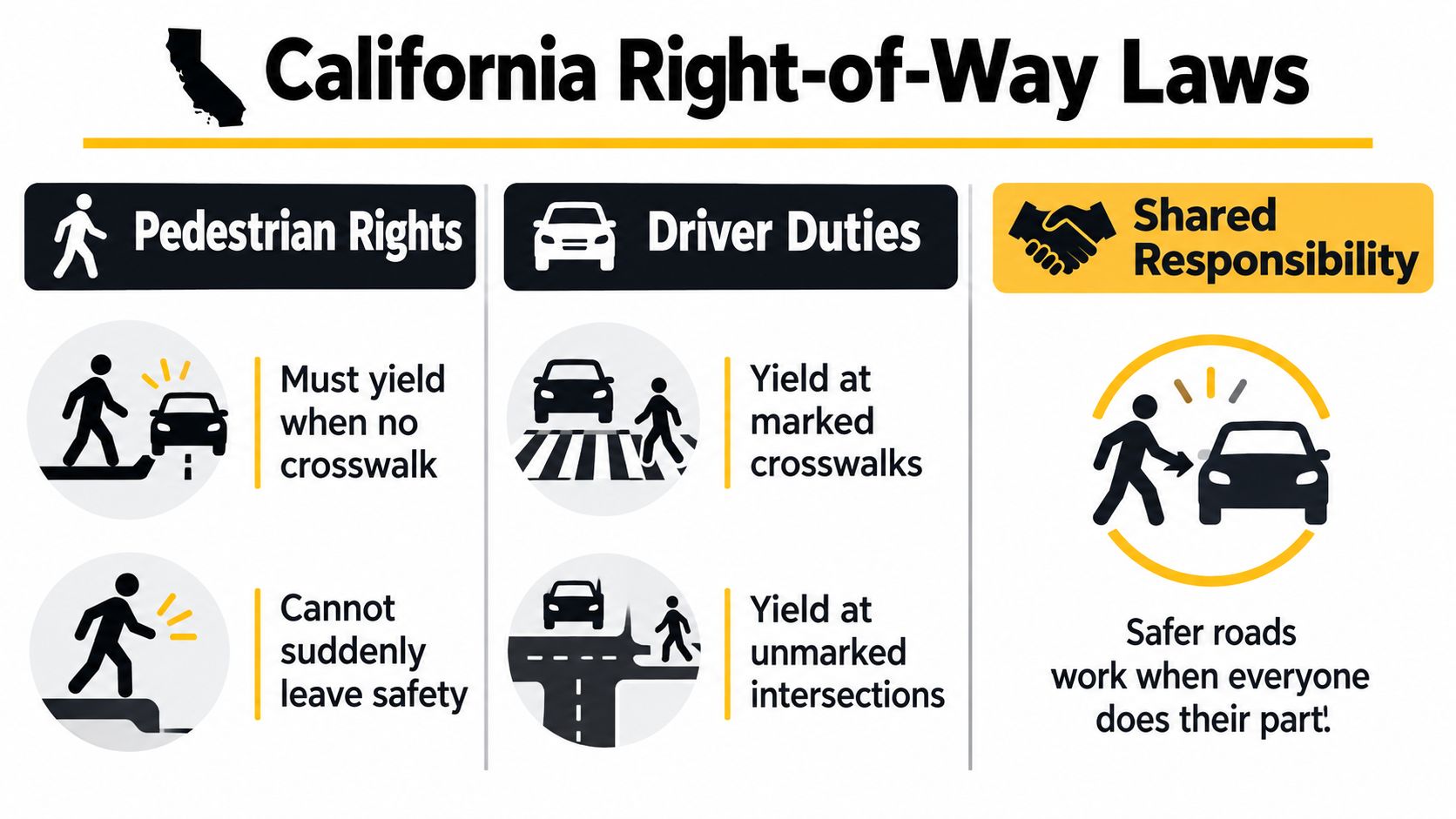
California Vehicle Code section 21950 requires a driver to yield to a pedestrian crossing within a marked crosswalk or an unmarked crosswalk at an intersection. The driver must also exercise all due care and reduce speed or take another necessary action to protect the pedestrian, as stated in the California Vehicle Code section 21950.
That rule doesn’t make every crossing collision an automatic driver-liability case. The same statute addresses pedestrian conduct. A pedestrian can’t suddenly leave a curb or another place of safety and enter the path of a vehicle so close that an immediate hazard exists, and a pedestrian can’t unnecessarily stop or delay traffic in a crosswalk.
Marked, unmarked, and outside-crosswalk crossings
Vehicle Code section 21954 applies when a pedestrian crosses outside a marked crosswalk or an unmarked intersection crosswalk. In that situation, the pedestrian must yield to a vehicle that is close enough to create an immediate hazard. California defines a crosswalk under Vehicle Code section 275 as the roadway area formed by extending sidewalk boundaries across an intersection, subject to the statutory alley exception, or a roadway portion distinctly marked for crossing. Local authorities may also prohibit crossing at a location with signs.
The legal analysis therefore turns on more than the word “jaywalking.” Investigators should identify the precise crossing location, the nearest intersection, signage, lane positions, sight distance, lighting, and the vehicle’s speed. Readers using electric scooters or similar devices may also benefit from avoid fines with Punk Ride’s guide, particularly when evaluating rules that affect roadway and crossing behavior.
Traffic signals add another layer. Under Vehicle Code section 21453, a driver facing a steady circular red signal must stop at the limit line, before the near-side crosswalk if no limit line exists, or otherwise before entering the intersection. A permitted turn on red still requires the driver to yield to pedestrians lawfully in the adjacent crosswalk and continue yielding until proceeding is reasonably safe. A pedestrian facing a steady circular red or red-arrow signal generally may not enter the roadway unless a pedestrian-control signal permits it. A detailed discussion of these rules is available in California pedestrian crosswalk laws.
The Critical Role of Impact Speed on Injury Severity
A pedestrian has no passenger compartment, seat belt, or airbag to absorb the crash energy. The vehicle’s impact speed, rather than only its posted speed limit or speed before braking, can become central to both injury evaluation and liability analysis.
The Insurance Institute for Highway Safety reports the following probability of a serious injury or worse at specified impact speeds:
| Impact Speed | Serious Injury/Fatality Risk |
|---|---|
| 20 mph | 18% |
| 25 mph | 32% |
| 35 mph | 67% |
| 45 mph | 90% |
| 55 mph | 97% |
These figures come from IIHS research on pedestrians and bicyclists. The pattern is nonlinear. A five-mile-per-hour change from 20 mph to 25 mph nearly doubles the stated risk, while speeds above 35 mph are associated with very high injury probabilities.
What speed evidence can show
The posted limit doesn’t prove the vehicle’s impact speed. A driver may have braked before impact, accelerated through a turn, or traveled below the limit but still too quickly for darkness, congestion, a curve, or a visible pedestrian hazard. Reconstruction may require event-data-recorder information, vehicle telemetry, surveillance footage, vehicle crush evidence, tire marks, and pedestrian throw-distance evidence.
The evidence also matters medically. A claim should connect the mechanism of impact to the diagnosed injuries, treatment course, rehabilitation needs, and functional limitations. An accident reconstruction expert cost guide can help readers understand why reconstruction may involve specialized work rather than a simple estimate based on the posted sign.
Immediate Steps After a Pedestrian Accident
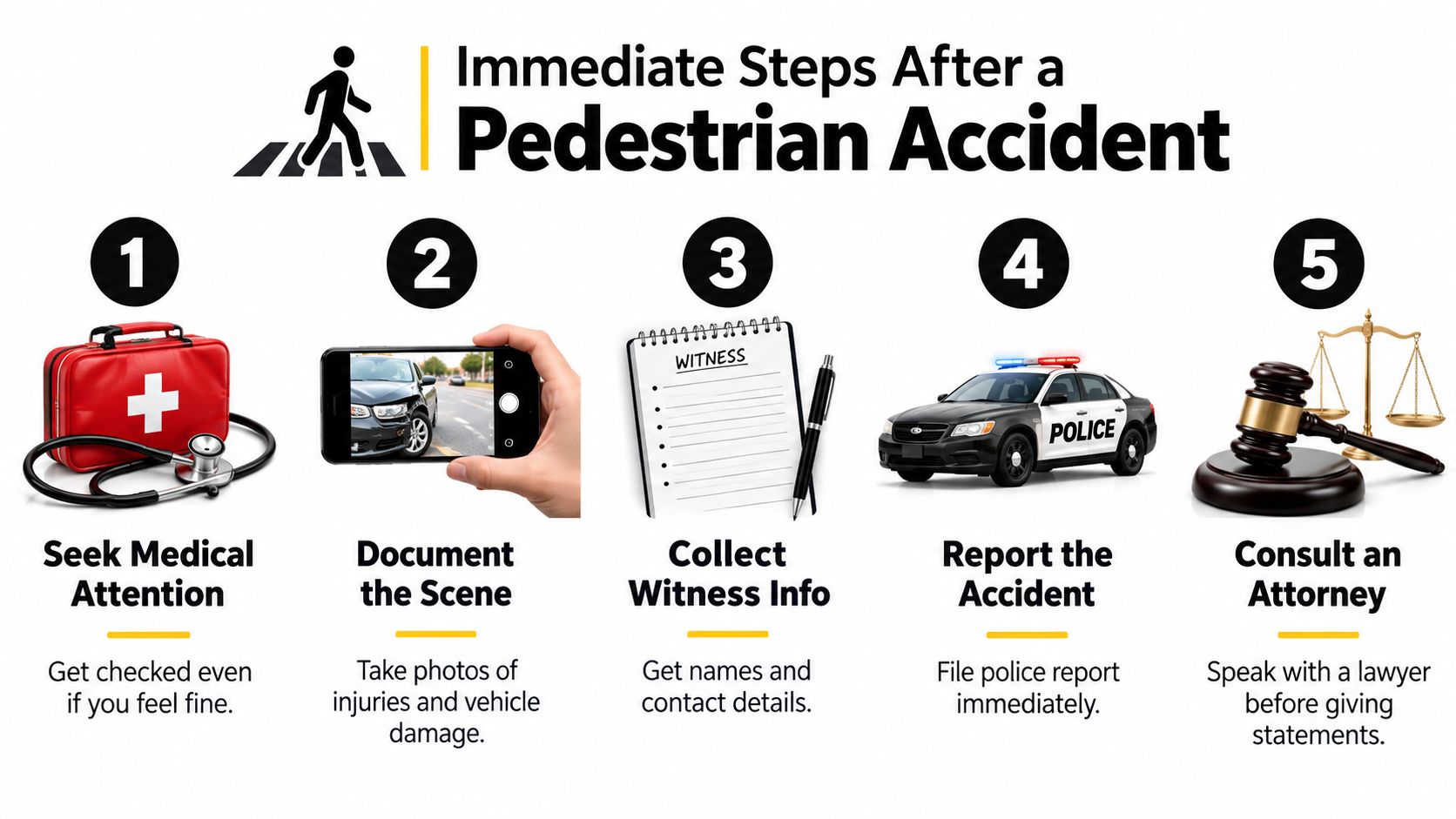
The first priority is medical care. Call emergency services when appropriate, accept an evaluation, and follow discharge instructions even if pain seems manageable. Some injuries aren’t obvious immediately, and a gap between the collision and treatment can give an insurer an argument that the injury came from something else.
Preserve the scene and the timeline
If your condition permits, document what still exists before vehicles move, weather changes, or footage disappears. Ask a trusted person to help if you can’t do this yourself.
- Photograph the location: Capture the vehicle, damage, roadway, crosswalk, signals, lighting, debris, skid marks, nearby signs, and visible injuries.
- Record witness details: Obtain names and reliable contact information. A witness may remember the signal phase, vehicle speed, driver’s behavior, or the pedestrian’s location.
- Request the report number: Keep the police agency, report number, responding officer’s name if available, and the date of the incident.
- Preserve recordings: Identify nearby homes, businesses, buses, traffic cameras, dashcams, and vehicle systems. Surveillance footage may be overwritten quickly.
- Avoid premature statements: Don’t guess about speed, distance, or fault. Tell the truth, but distinguish what you personally saw from what someone else told you.
Spanish-speaking residents shouldn’t hesitate to request language assistance. Ask for an interpreter when communicating with medical providers, police, insurers, or attorneys, and don’t sign a release or recorded statement you don’t understand. An adjuster’s early settlement offer may arrive before the full diagnosis, wage loss, or future treatment is known. Guidance on protecting evidence after a truck crash also illustrates the broader preservation principle, although pedestrian cases require their own facts and analysis.
For Spanish-speaking families, keep copies of medical records, bills, prescriptions, work restrictions, and messages in one file. You can ask for written explanations in Spanish where available and should clarify whether a communication concerns an insurance claim, a citation, or a civil lawsuit. Those processes aren’t interchangeable.
Navigating Fault and Comparative Negligence in California
A pedestrian who was hit isn’t automatically entitled to full recovery, and a pedestrian who crossed outside a crosswalk isn’t automatically barred from recovering. California evaluates the conduct of the parties under comparative negligence principles. If a fact finder assigns some responsibility to the pedestrian, the recovery may be reduced by that percentage, even when the driver also acted negligently.
That makes the difference between statistical risk and legal causation essential. National data can show that nighttime visibility and impact speed create serious risks. It can’t establish whether a driver in one California case had enough time to see, react, brake, or steer away.
Why police labels don’t finish the case
California’s official crash systems separate pedestrian injuries and fatalities from factors such as speeding, alcohol or drugs, distraction, intersections, and work zones. The Berkeley-hosted SWITRS summary tool allows searches by city or county and states that 2025 data are provisional and subject to change.
A police report may be important evidence, but it remains one part of the record. Officers may arrive after vehicles move, witnesses leave, lighting changes, or the injured person is transported. A coded pedestrian action may not capture the driver’s speed, phone use, sight distance, lane position, or opportunity to avoid the impact.
Compare the competing explanations
A careful claim tests both sides:
- The pedestrian’s conduct: Was the person crossing against a signal, entering suddenly, distracted, or outside a crosswalk?
- The driver’s conduct: Was the driver speeding, turning without looking, using a phone, impaired, or failing to reduce speed?
- The environment: Did darkness, glare, rain, poor lighting, road design, construction, or parked vehicles limit visibility?
- The evidence: Do video, vehicle data, photographs, witnesses, medical records, or reconstruction support one explanation?
A crosswalk violation may affect comparative fault. It doesn’t erase the driver’s separate duty to exercise reasonable care.
The Impact of Advanced Driver Assistance Systems
Pedestrian-detection systems and automatic emergency braking change the evidence, but they don’t create an automatic answer. A vehicle may have a camera, radar, lidar, warning system, or braking feature, yet the claim still requires proof about whether the system was installed, enabled, maintained, functioning, and capable of responding under the actual conditions.
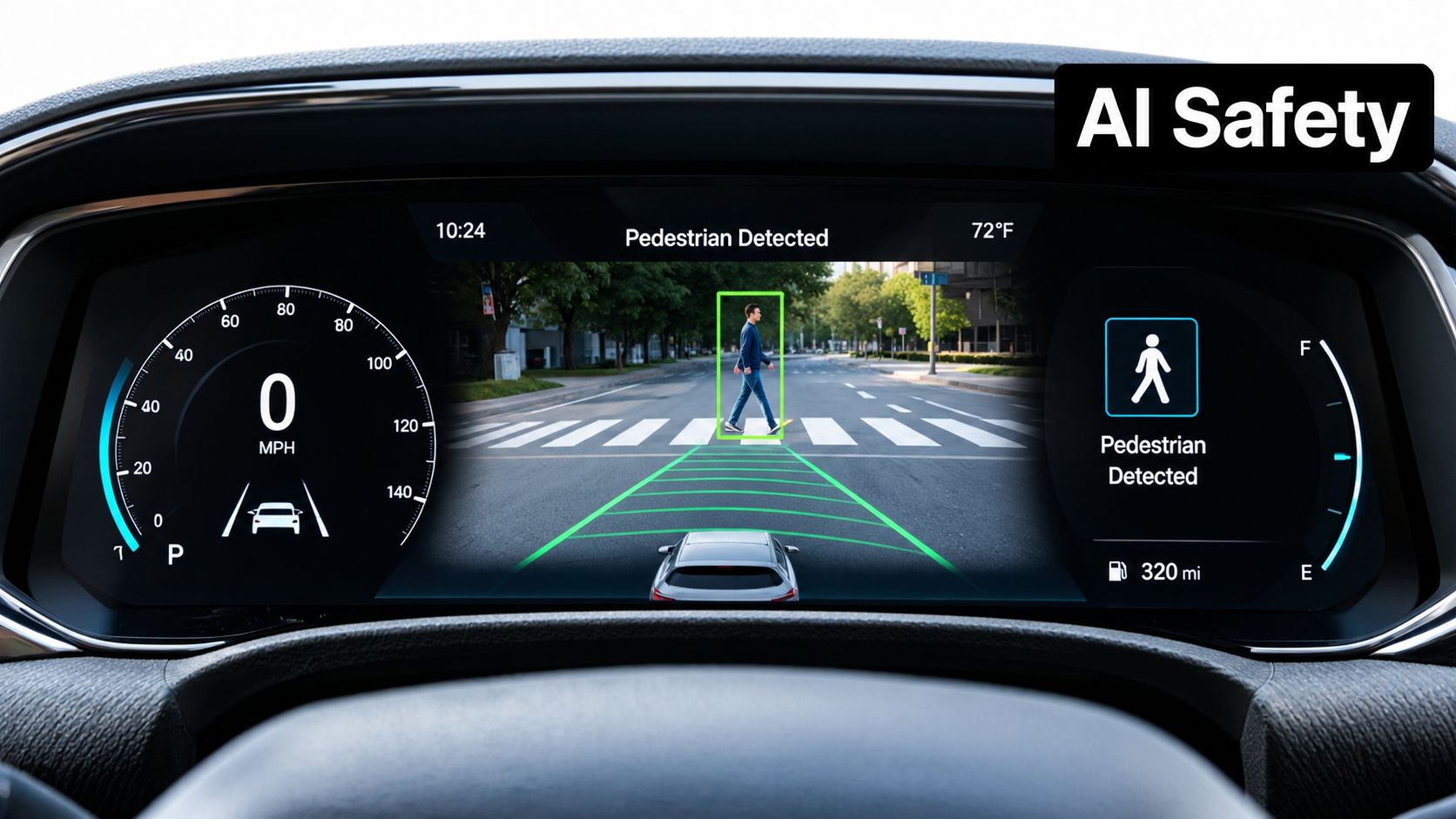
The practical questions are specific:
- Did the system detect the pedestrian?
- Did it issue a warning?
- Did the driver receive and understand that warning?
- Did automatic braking activate?
- Were the sensors obstructed, disabled, or undergoing a fault?
- Did darkness, rain, glare, unusual clothing, a mobility device, or a complex intersection affect detection?
- Were diagnostic logs, event-data records, and vehicle-camera footage preserved?
A 2025 scoping review examined 35 studies involving AI detection, smart lighting, connected vehicles, sensor fusion, behavioral prediction, and assistive technologies. It reported detection accuracies as high as 98.6% for AI systems and 99.11% for sensor-fusion systems, while identifying unresolved issues involving real-time adaptability, inclusive design, multimodal integration, and fragmented policy, as described in the PACIS 2025 research review.
Those test results don’t prove that a particular vehicle detected a particular person. Responsibility may involve the driver, automaker, software developer, roadway operator, or technology vendor, depending on the evidence. An attorney or expert may need to request diagnostic logs, maintenance records, system specifications, roadway lighting records, signal timing, and reconstruction analysis before drawing a conclusion.
Building a Strong Claim with the Right Legal Counsel
A viable pedestrian-versus-vehicle claim usually develops through several connected tasks. The legal team must preserve evidence before it disappears, evaluate the crossing and signal rules, assess comparative fault, document the medical consequences, and identify every potentially responsible party.
The strongest cases don’t rely on a single dramatic fact. They build a consistent timeline from photographs, witness accounts, vehicle data, surveillance, medical records, employment documentation, and roadway conditions. If an insurer focuses on the pedestrian’s location, the response should address that issue directly while also examining speed, visibility, driver attention, stopping distance, and the duty of due care.
What a focused evaluation should address
A lawyer should be able to explain:
- Right-of-way: Which statute applied to the crossing, signal, or turn?
- Comparative negligence: What conduct might an insurer attribute to the pedestrian, and what evidence supports or disputes that position?
- Causation: Do the collision mechanics and medical records connect the impact to the claimed injuries?
- Technology: Were ADAS features active, functional, and relevant to avoidance?
- Damages: What treatment, limitations, lost income, household effects, and future needs require documentation?
- Communication: Can the client receive explanations and updates in Spanish or another preferred language?
Spanish-speaking clients should ask who will interpret legal terms, whether documents are available in Spanish, and whether the person handling the case can communicate clearly without relying on informal translation by relatives. Understanding the process matters, particularly when a traffic citation, an insurance investigation, and a civil claim produce different conclusions.
A California auto accident lawyer resource can provide general context, but no online article can assess the evidence in a specific pedestrian collision. Seek counsel before signing a release, accepting a settlement, or making a recorded statement about fault. LA Law Group, APLC may be one option for a California resident seeking a case assessment, evidence strategy, and representation in a pedestrian injury claim. This article remains informational only, isn’t legal advice, and doesn’t create an attorney-client relationship.
LA Law Group, APLC offers consultations for California pedestrian injury claims, including help evaluating right-of-way, comparative negligence, medical documentation, and evidence involving the driver or vehicle. Visit LA Law Group, APLC to discuss the collision with a legal team and learn what next steps may fit your circumstances.
Attorney Advertising. This article is general information, not legal advice, and does not create an attorney-client relationship. Prior results do not guarantee a similar outcome.