
Your Guide to a Personal Injury Demand Letter Template

Before you dive in, a quick but important note: This guide and the sample personal injury demand letter template are for informational purposes and are not to be construed as legal advice. No attorney-client relationship exists based on the review of this article and none of the information in this article is legal advice. Reading this does not create an attorney-client relationship with our firm.
Your First Move in Seeking Fair Compensation

Think of a personal injury demand letter as your official opening statement in negotiations with an insurance company. It’s far more than just filling out a form; it’s a strategic document that lays out your case, explains why the other party is responsible for your injuries, and justifies the compensation you’re seeking.
A well-written letter can often pave the way for a fair settlement without ever stepping foot in a courtroom. That means saving you a tremendous amount of time, money, and stress. This guide will show you how to take our downloadable template and turn it into a powerful tool customized for your specific situation here in California.
The Power of a Well-Crafted Demand
Your demand letter is the foundation of your entire claim. It takes all the scattered facts, medical records, and financial losses and organizes them into a clear, logical argument. Its primary goals are to:
- Establish Liability: Clearly explain how the at-fault party’s negligence directly caused the incident and your injuries.
- Document Damages: Provide a detailed breakdown of every single loss, both economic (like medical bills) and non-economic (like pain and suffering).
- Initiate Negotiation: This is your formal request that opens the door for settlement talks with the insurance adjuster.
- Demonstrate Seriousness: It signals to the insurance company that you have a solid, well-documented case and you’re prepared to see it through.
This first communication really sets the tone for everything that follows. It’s your best opportunity to make a strong impression and guide the negotiations in your favor from the start. It’s also interesting to see how technology is changing the legal field; for instance, understanding how AI for Personal Injury Lawyers is used can offer insight into how firms manage cases today.
Why Most Cases Settle Before Trial
It might surprise you, but the vast majority of personal injury cases never see the inside of a courtroom. This is a critical point to remember as you draft your letter.
Across the United States, a staggering 95% of personal injury lawsuits are resolved through pre-trial settlements. Only a tiny fraction, about 5%, actually go to trial to be decided by a judge or jury.
This statistic really underscores the importance of your demand letter. It’s the key that unlocks the negotiation process and is often the most effective tool for securing fair compensation without the risk and expense of a long legal battle. A strong, persuasive letter forces the insurer to seriously evaluate their risk, making a settlement a much more appealing option than facing you in court.
Building Your Demand letter Section by Section
A well-crafted personal injury demand letter is more than just a list of grievances. Think of it as a strategic narrative, where each section builds on the last to guide the insurance adjuster toward one undeniable conclusion: you deserve to be compensated fairly. Let’s break down how to construct each part to make your argument clear, persuasive, and incredibly difficult to dispute.
Just a quick note: This article is for informational purposes and not to be construed as legal advice. No attorney-client relationship exists based on the review of this this article and none of the information in this article is legal advice.
Crafting a Clear Introduction
The first few sentences need to get straight to the point. This isn’t the place for a long, winding story. Your introduction is a formal notice that immediately tells the adjuster what this letter is about.
Your opening should clearly state:
- Who you are: Your full legal name.
- Who you’re writing to: The insurance company and the specific adjuster’s name, if you have it.
- Who they insure: The full name of their policyholder who caused your injuries.
- The key details: Your claim number, the date of the incident, and your date of birth for easy identification.
This section is essentially the cover sheet for your claim, giving the adjuster all the administrative details they need to pull up your file and get to work.
The Factual Account of the Incident
Here’s where you tell the story. The key is to present a concise, chronological, and purely factual account of what happened. Strip out emotional language and accusations—stick to the objective details that paint a clear picture of the event.
Think like a journalist reporting on the scene. You’ll want to include critical information like:
- The exact date, time, and location.
- Weather and road conditions, if they played a role.
- What you were doing right before it happened (e.g., “I was driving northbound on Sunset Boulevard in the right-hand lane, proceeding through a green light at the intersection with Fairfax Avenue.”).
- A step-by-step breakdown of the other party’s actions that caused the incident.
This dispassionate, detailed account is the foundation for your entire claim.
Arguing Liability and Proving Fault
After you’ve laid out the facts, you need to explicitly state why their insured is legally responsible—or liable—for your injuries. Don’t be vague. Ground your argument in their specific actions and, whenever possible, the law itself.
For instance, in a California car accident, you wouldn’t just say, “The other driver was careless.” You’d make a much stronger case by stating, “Your insured, Mr. Smith, was negligent and is directly responsible for my injuries because he violated California Vehicle Code § 21950(a) by failing to yield the right-of-way to a pedestrian in a marked crosswalk.”
Citing specific laws adds serious weight to your claim. It shows the adjuster you’ve done your homework and understand the legal basis for their policyholder’s fault. That makes it much harder for them to push back.
This approach turns a simple complaint into a well-supported legal argument. While this guide is all about personal injury letters, the core ideas—clear sections and proper formatting—are universal. You can learn more about these fundamentals from resources that detail the principles of drafting effective legal letters and templates.
Before moving on, let’s quickly recap the essential parts of a strong demand letter.
Essential Components of a Demand Letter
This table summarizes the key sections your letter must include and the purpose each one serves in building a compelling case for compensation.
| Section | Purpose | Key Information to Include |
|---|---|---|
| Introduction | To clearly identify all parties and the claim. | Your name, adjuster’s name, insured’s name, claim number, date of incident. |
| Factual Account | To provide a clear, objective narrative of the incident. | Date, time, location, step-by-step description of events. |
| Liability | To legally establish why the other party is at fault. | Citing specific actions, negligence, and relevant laws or vehicle codes. |
| Injuries & Impact | To detail the physical and emotional harm suffered. | Medical diagnoses, treatment timeline, pain and suffering, life disruptions. |
| Damages | To itemize all financial losses (medical bills, lost wages). | Detailed list of all economic costs with supporting documentation. |
| Demand | To state the total compensation amount you are seeking. | A specific dollar amount for settlement. |
Each of these components works together to tell your story in a way that an insurance company understands and must take seriously.
Detailing Your Injuries and Their Impact
This is where you connect the incident to its human cost. It’s absolutely critical to go beyond a simple list of medical diagnoses. You need to describe the real-world, day-to-day impact these injuries have had on your life.
Don’t just write “fractured wrist.” Explain what that actually meant. For example, “As a direct result of the fractured wrist, I was unable to perform my duties as a graphic designer for six weeks. The injury also made it impossible to care for my two young children, forcing me to hire help for basic tasks like cooking and cleaning.”
Organize this section into a clear timeline:
- Immediate Aftermath: Describe the pain at the scene and any emergency medical care you received.
- Ongoing Treatment: Detail all follow-up appointments, physical therapy, surgeries, and medications.
- Impact on Daily Life: Explain how the injuries have affected your job, family life, hobbies, and overall quality of life. This is where you bring in the pain, suffering, and emotional distress.
By showing the full scope of your suffering, you give the adjuster a powerful justification for the compensation you’re about to demand. You’re connecting the dots for them, proving your claim is about a profound disruption to your life, not just a stack of medical bills.
How to Calculate the Value of Your Claim
Trying to put a dollar amount on your injuries and suffering feels strange. It’s deeply personal. But when you’re filing a personal injury claim, calculating a specific, justifiable settlement figure is one of the most critical steps you’ll take. This calculation is the foundation of your demand, and it needs to be built on clear logic that an insurance adjuster can’t easily dismiss.
Let’s break down exactly how to figure out what your claim is worth, looking at both the concrete financial losses and the less tangible—but equally real—impact the injury has had on your life.
Disclaimer: This article is for informational purposes and not to be construed as legal advice. No attorney-client relationship exists based on the review of this this article and none of the information in this article is legal advice.
This flowchart maps out the process. You start with the facts of what happened, connect them to the injuries you sustained, and then use that to establish who is liable.
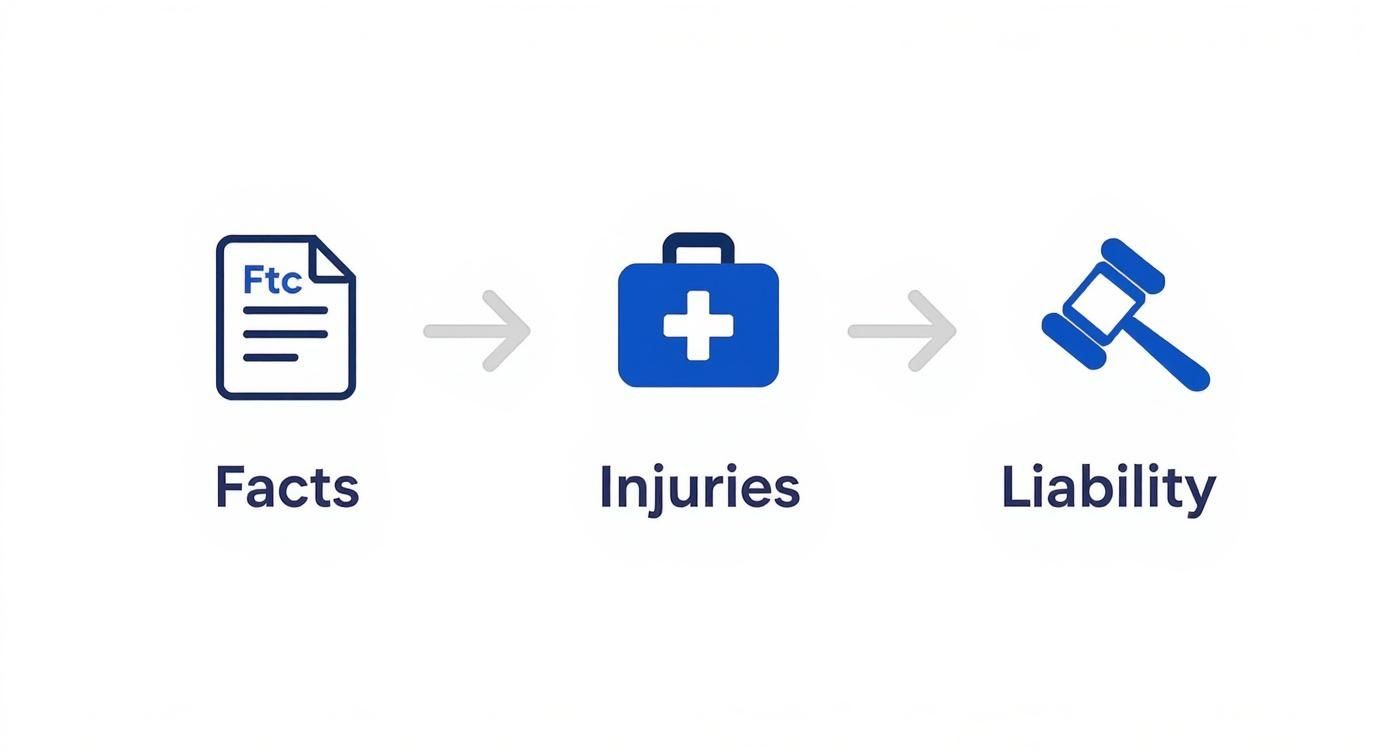
Each of these elements builds on the last, creating the sturdy framework you need to support your final compensation demand.
Understanding Special Damages: The Economic Costs
The easiest part of your claim to calculate is what lawyers call “special damages.” Think of these as any expense with a clear receipt or paper trail. These are all the tangible, out-of-pocket economic losses you’ve had—and will have in the future—because of the accident.
Gathering the paperwork for these costs is non-negotiable. You have to create a meticulous list and back it up with every invoice, pay stub, and billing statement you can find.
Your checklist for special damages should include:
- All Past and Future Medical Bills: This covers everything from the ambulance ride and ER visit to surgery, physical therapy sessions, prescriptions, and any future care your doctor says you’ll need.
- Lost Wages and Earning Capacity: Add up every dollar you lost from being unable to work. If your injuries will impact your ability to earn a living down the road, that has to be calculated, too.
- Property Damage: In a car crash, this is usually the cost to repair or replace your vehicle.
- Transportation Costs: Did you have to take Ubers or taxis to get to doctor’s appointments because you couldn’t drive? Keep those receipts.
- Out-of-Pocket Expenses: This is a catch-all for anything you had to buy because of your injury, like crutches, a wheelchair ramp, or even paying someone for household chores you could no longer do yourself.
Calculating General Damages: Pain and Suffering
This is where things get more subjective. “General damages” are meant to compensate you for the human cost of the injury—the physical pain, emotional distress, anxiety, and the loss of enjoyment of life. There’s no simple invoice for this kind of suffering, so how do you attach a number to it?
Insurance adjusters often use a common formula known as the “multiplier method” to get a starting figure.
The Multiplier Method Explained: The formula is simple. You take the total of your special (economic) damages and multiply it by a number, usually between 1.5 and 5. The more severe, painful, and permanent your injuries are, the higher the multiplier you use.
For instance, a minor sprain that heals up in a few weeks might get a 1.5 multiplier. But a permanent, life-altering condition like a spinal cord injury or a traumatic brain injury could easily justify a multiplier of 5 or even higher.
Putting It All Together: A Realistic Scenario
Let’s walk through how this works with a real-world car accident. Imagine you were rear-ended on a California freeway and ended up with a herniated disc in your lower back.
Your special damages add up like this:
- ER visit, MRI, and orthopedic consultations: $15,000
- Physical therapy (24 sessions): $6,000
- Epidural steroid injections: $4,000
- Lost wages from time off work: $5,000
- Total Special Damages: $30,000
Now, we apply the multiplier. A herniated disc is a significant and painful injury that can cause long-term problems. A reasonable multiplier here would be 3.
- Special Damages ($30,000) x Multiplier (3) = General Damages ($90,000)
Finally, you add your special and general damages together to get your total settlement demand.
- Special Damages ($30,000) + General Damages ($90,000) = Total Demand ($120,000)
This approach gives you a logical, defensible starting point for your negotiations. With motor vehicle accidents making up about 52% of all personal injury claims, this is a common scenario. These demand letters almost always focus on medical expenses and lost wages, which are getting more severe; one report noted a 6% increase in medical severity for claims in 2024.
For a more in-depth look at this crucial step, you can also check out our guide on how to calculate a personal injury settlement. Nailing this calculation is a foundational piece of your personal injury demand letter template and ensures you’re asking for what you truly deserve.
Gathering the Evidence That Backs Up Your Claim
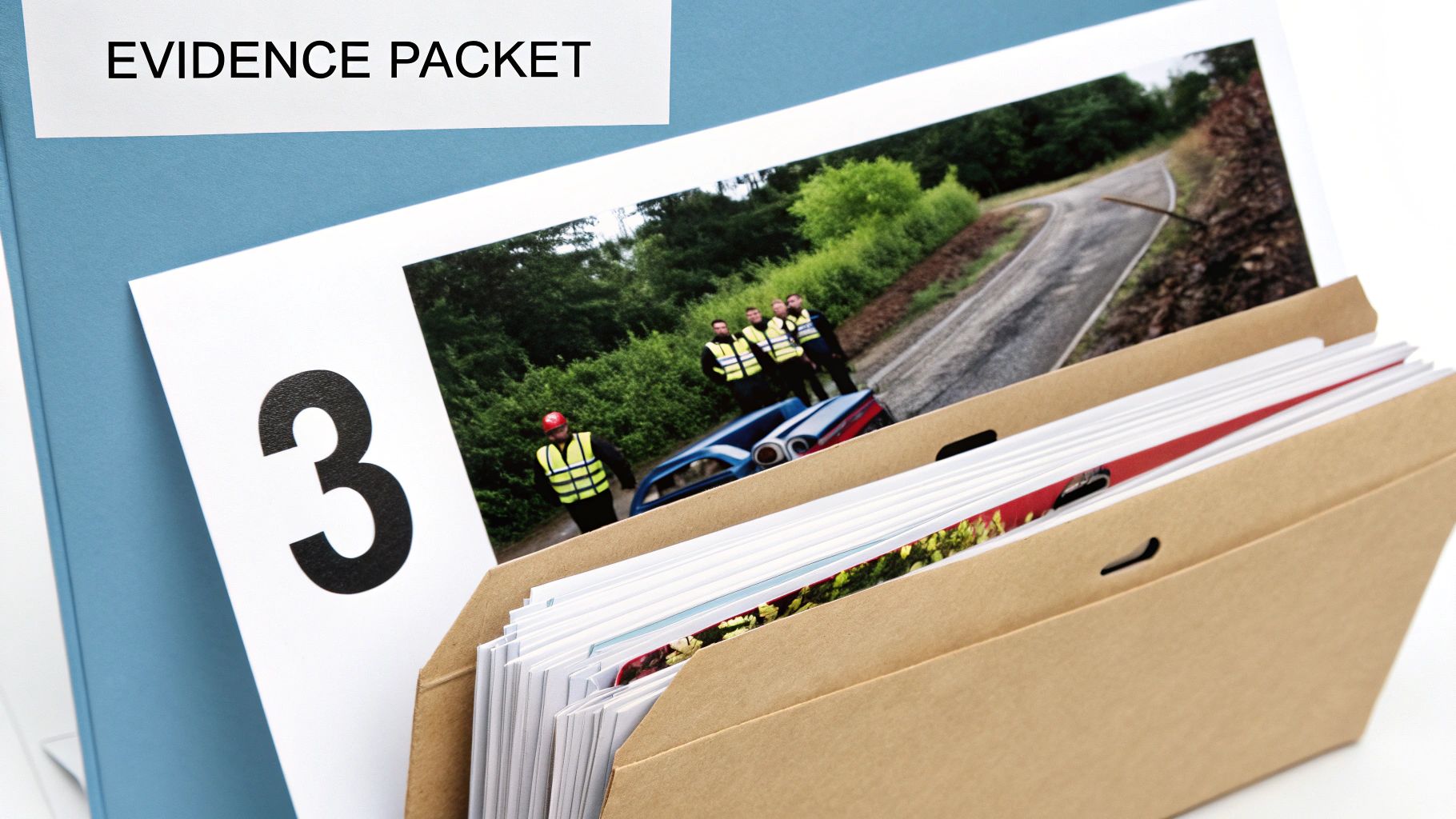
A personal injury demand letter is only as strong as the evidence you attach to it. Simply telling your story, no matter how compelling, isn’t going to cut it with an insurance adjuster. You have to prove every single point with clear, organized, and undeniable documentation.
Think of it this way: your letter makes the argument, but your evidence packet is the proof that forces the insurance company to take you seriously. Submitting a messy or incomplete set of documents signals that you’re unprepared. That’s an open invitation for them to question your claim or hit you with a lowball offer right out of the gate.
Please remember: This article is for informational purposes and not to be construed as legal advice. No attorney-client relationship exists based on the review of this this article and none of the information in this article is legal advice.
The Non-Negotiable Evidence Checklist
Your goal is to build an ironclad case that leaves no room for doubt. Each document has a specific job—establishing the facts, proving your injuries, or justifying your financial losses. This checklist covers the essentials that must go with your personal injury demand letter template.
Your evidence packet has to include:
- The Official Police or Incident Report: This is your foundation. It’s the objective, third-party account of what happened, often with diagrams, witness info, and the officer’s initial take on who was at fault.
- Photos and Videos: Visuals are incredibly powerful. You need clear photos of the accident scene itself, the damage to all vehicles involved, and your visible injuries—think bruises, cuts, or casts. Don’t forget to document any hazardous conditions that caused the incident, like a puddle on a grocery store floor or a broken handrail.
- Witness Information: Get the names and contact details for anyone who saw what happened. Their statements can be the key to backing up your side of the story.
- Proof of Lost Wages: This isn’t just a note you write yourself. You need an official letter from your employer on company letterhead that details your job title, your pay rate, and the exact dates you were out of work because of your injuries.
- All Medical Records and Bills: This will be the thickest part of your packet. It needs to include everything related to your treatment: the first ER visit, surgical reports, physical therapy notes, prescription receipts, and copies of any X-rays or MRIs.
Organizing Your Evidence for Maximum Impact
An adjuster plows through dozens of claims a day; they don’t have time to piece together a disorganized mess of papers. How you present your evidence is almost as important as the evidence itself. A professional, neatly organized submission shows you’re serious.
Pro Tip: Create a simple index or table of contents that lists every single document you’re attaching. Number each one (e.g., Exhibit 1: Police Report, Exhibit 2: Medical Bills from St. John’s Hospital). This lets the adjuster easily flip to the exact proof as they read your letter.
This small step makes the adjuster’s job easier, which is always a good thing. It frames you as a credible, prepared claimant and guides them logically through your case, making it much harder for them to ignore critical information. Your documentation is what proves not just that you were hurt, but the full extent of that harm.
For a deeper dive, learn more about how to prove your injuries are sufficient for a personal injury claim.
Your Fill-in-the-Blank Personal Injury Demand Letter Template
Alright, you’ve done the hard work of calculating your damages and pulling together all your evidence. Now it’s time to assemble everything into a clear, professional demand letter.
To make things easier, I’m providing a straightforward, fill-in-the-blank template below. It’s designed specifically for someone who isn’t a lawyer. Every bracketed part, like [Date of Incident] or [Detailed Description of Injuries], matches up with the steps we’ve already walked through.
This isn’t just a random format. It’s structured logically to make an insurance adjuster’s job simple. It lays out your story—the facts, the other party’s fault, your injuries, and what you’re demanding—in a way that’s easy to follow. The goal here is to give you a solid foundation you can adapt to the specifics of your situation.
Disclaimer: This template is for informational purposes only and is not to be construed as legal advice. No attorney-client relationship exists based on the review of this this article and none of the information in this article is legal advice.
The User-Friendly Template
You can copy and paste the template below. Just be sure to carefully replace all the bold, bracketed text with your own information. Once you’re done, attach all your supporting documents (police report, medical bills, etc.) and send the final letter via certified mail with a return receipt requested. That receipt is your proof they received it.
[Your Full Name]
[Your Street Address]
[Your City, State, ZIP Code]
[Your Phone Number]
[Your Email Address]
[Date]
[Insurance Adjuster's Full Name]
[Adjuster's Title]
[Insurance Company Name]
[Insurance Company Street Address]
[Insurance Company City, State, ZIP Code]
VIA CERTIFIED MAIL - RETURN RECEIPT REQUESTED
RE: Demand for Settlement
Claimant: [Your Full Name]
Your Insured: [At-Fault Party's Full Name]
Claim Number: [Your Claim Number]
Date of Incident: [Date of the Incident]
Dear [Mr./Ms. Adjuster's Last Name],
As you are aware, I was injured in an accident caused by your insured, [At-Fault Party's Full Name], on [Date of the Incident] around [Time of Incident] at [Location of Incident, e.g., the intersection of Main Street and Oak Avenue in Los Angeles, CA]. This letter is my formal demand to settle my personal injury claim.
Facts of the Incident
At the time of the crash, I was [Describe what you were doing, e.g., lawfully proceeding through the intersection with a green light]. Your insured, [At-Fault Party's Full Name], then [Describe the insured's negligent actions, e.g., failed to stop at the red light and collided with the driver's side of my vehicle]. The actions of your insured were the direct and sole cause of this collision and all the injuries I sustained.
My Injuries and Medical Treatment
As a direct result of this incident, I suffered significant injuries, including [List your main injuries, e.g., a concussion, a herniated disc in my C5-C6 vertebrae, and severe whiplash].
I was taken by ambulance to [Name of Hospital] immediately after the crash. My medical care has since included [Summarize your course of treatment, e.g., an initial ER visit, an MRI, three months of physical therapy, and a series of epidural steroid injections]. These injuries have not only caused me considerable pain but have also impacted my ability to [Describe impact on daily life, e.g., work, care for my family, and enjoy hobbies].
Damages
My economic damages, or “special damages,” are listed below:
- Medical Expenses:
[$ Amount] - Lost Wages:
[$ Amount] - Other Out-of-Pocket Costs:
[$ Amount] - Total Economic Damages:
[$ Amount]
Given the severity of my injuries, the pain, and the disruption to my life, I am demanding [$ Amount for Pain and Suffering].
Settlement Demand
Therefore, I demand the total amount of [$ Total Settlement Amount] to fully resolve my claim. I have attached all relevant documents to support my claim, including the police report, all medical records and bills, and documentation of my lost wages.
I look forward to your response within 30 days of receiving this letter.
Sincerely,
[Your Signature]
[Your Typed Full Name]
A Note for Spanish Speakers
We know how challenging this process can be, especially when English isn’t your first language. It’s important to understand that in California, all official legal documents, including your final demand letter, must be submitted in English.
But that doesn’t mean you have to figure it out alone. If you need help understanding what’s required or getting your documents ready, our team offers support and guidance in Spanish. We want to make sure your claim is presented clearly and correctly. Our goal is to help everyone in our community, and we’re here for you.
For more ideas on how to frame your letter, take a look at these 7 personal injury demand letter examples to see how different people have approached their own unique cases.
Common Mistakes That Can Sabotage Your Demand Letter
Crafting a solid demand letter is one thing, but sidestepping the simple mistakes that insurance companies love to pounce on is just as important. A single misstep can tank the value of your claim or give an adjuster the opening they need to deny it flat out. We’re not talking about complex legal loopholes here—these are common-sense pitfalls that trip up people all the time.
Often, the most damaging errors occur before you even sit down to write your personal injury demand letter template. Knowing what not to do from the start will help you build a much stronger case from the ground up.
Disclaimer: This article is for informational purposes and not to be construed as legal advice. No attorney-client relationship exists based on the review of this this article and none of the information in this article is legal advice.
Mistake #1: Sending Your Demand Too Soon
Jumping the gun and sending your demand letter too early is one of the most destructive mistakes you can make. It’s completely understandable to want a fast resolution and put this behind you, but firing off that letter before you’ve reached Maximum Medical Improvement (MMI) is a huge blunder.
MMI is the point where your doctor says your condition is as good as it’s going to get and they have a clear picture of your future medical needs.
If you demand a settlement before you know the full story of your injuries, you’re walking into a trap. You could end up:
- Wildly underestimating the cost of future surgeries or long-term physical therapy.
- Failing to account for chronic pain or permanent disabilities that only show up later.
- Taking a settlement that doesn’t come close to covering all your losses, leaving you to pay the rest out of pocket.
Once you cash that settlement check, the case is closed forever. You can’t go back and ask for more money. In this game, patience isn’t just a virtue; it’s a strategic weapon.
Mistake #2: Using Emotional or Aggressive Language
Think of your demand letter as a professional business document, not your personal journal. The experience was no doubt frustrating and painful, but loading your letter with anger, threats, or emotional language will only backfire. Insurance adjusters are trained professionals; they ignore emotional appeals and focus on one thing: documented facts and legal liability.
Pouring your frustration onto the page might feel good for a moment, but it won’t add a single dollar to your settlement. Stick to a formal, objective tone. It gives you credibility and shows the adjuster you mean business.
Mistake #3: Admitting Any Amount of Fault
Never, ever admit even a tiny bit of fault in your demand letter. California is a “comparative negligence” state, which means your final compensation can be slashed by whatever percentage of fault is assigned to you.
Even a seemingly harmless comment like, “I might have glanced at my phone for a second,” is a gift to the insurance company. An adjuster will grab that statement and use it to pin a huge chunk of the blame on you, drastically cutting the money you receive.
Finally, don’t let a simple procedural error undermine all your hard work. Always send your demand letter via certified mail with a return receipt requested. This gives you undeniable legal proof of when the insurance company received your claim, so they can never pull the old “it must have gotten lost in the mail” excuse.
Common Questions After Sending Your Demand
Once you’ve sent off your demand letter, it’s natural to feel a mix of anticipation and uncertainty. You’ve done the hard work, and now the ball is in the insurance company’s court. Here are the questions we hear most often at this stage of the game.
What Happens After I Send the Demand Letter?
After the insurance company gets your package, an adjuster is assigned to your claim. Their job is to review your letter, go through every piece of evidence you sent, and then launch their own investigation into the accident.
Don’t be surprised if their first response is a counteroffer that’s much lower than what you asked for—that’s just the opening move in the negotiation dance. In some situations, they might deny the claim outright. If that happens, it’s time to decide on your next step, which could mean filing a lawsuit.
How Long Should I Wait for a Response?
While there’s no law setting a strict deadline, a reasonable timeframe to expect a response is 30 to 45 days. If you’re approaching the 45-day mark and haven’t heard a peep, it’s perfectly fine to make a polite follow-up call or send a brief letter.
A good practice is to mention in your original demand that you expect to hear from them within 30 days. This sets a clear, professional expectation right from the start.
Should I Write This Myself or Hire a Lawyer?
For a straightforward fender-bender with very minor injuries, you can absolutely handle the demand letter yourself using a solid template. But when the stakes are higher, you need to think strategically.
If your case involves serious injuries, complicated questions about who was at fault, or significant financial losses, it’s time to call in a professional. An experienced personal injury lawyer knows exactly how to calculate the true value of a claim and has the negotiation skills to get you the compensation you actually deserve.
Please remember: This personal injury demand letter template and guide are for informational purposes and not to be construed as legal advice. No attorney-client relationship exists based on the review of this this article and none of the information in this article is legal advice.
Navigating a personal injury claim can feel like a full-time job when you should be focused on healing. You don’t have to do it alone.
The team at LA Law Group, APLC is here to handle the legal fight and the tough negotiations so you can focus on your recovery. For a free, no-obligation consultation to talk about your case, get in touch with us today at https://www.bizlawpro.com.
Attorney Advertising. This article is general information, not legal advice, and does not create an attorney-client relationship. Prior results do not guarantee a similar outcome.