
Personal Injury Lawyer Santa Rosa: A 2026 Guide
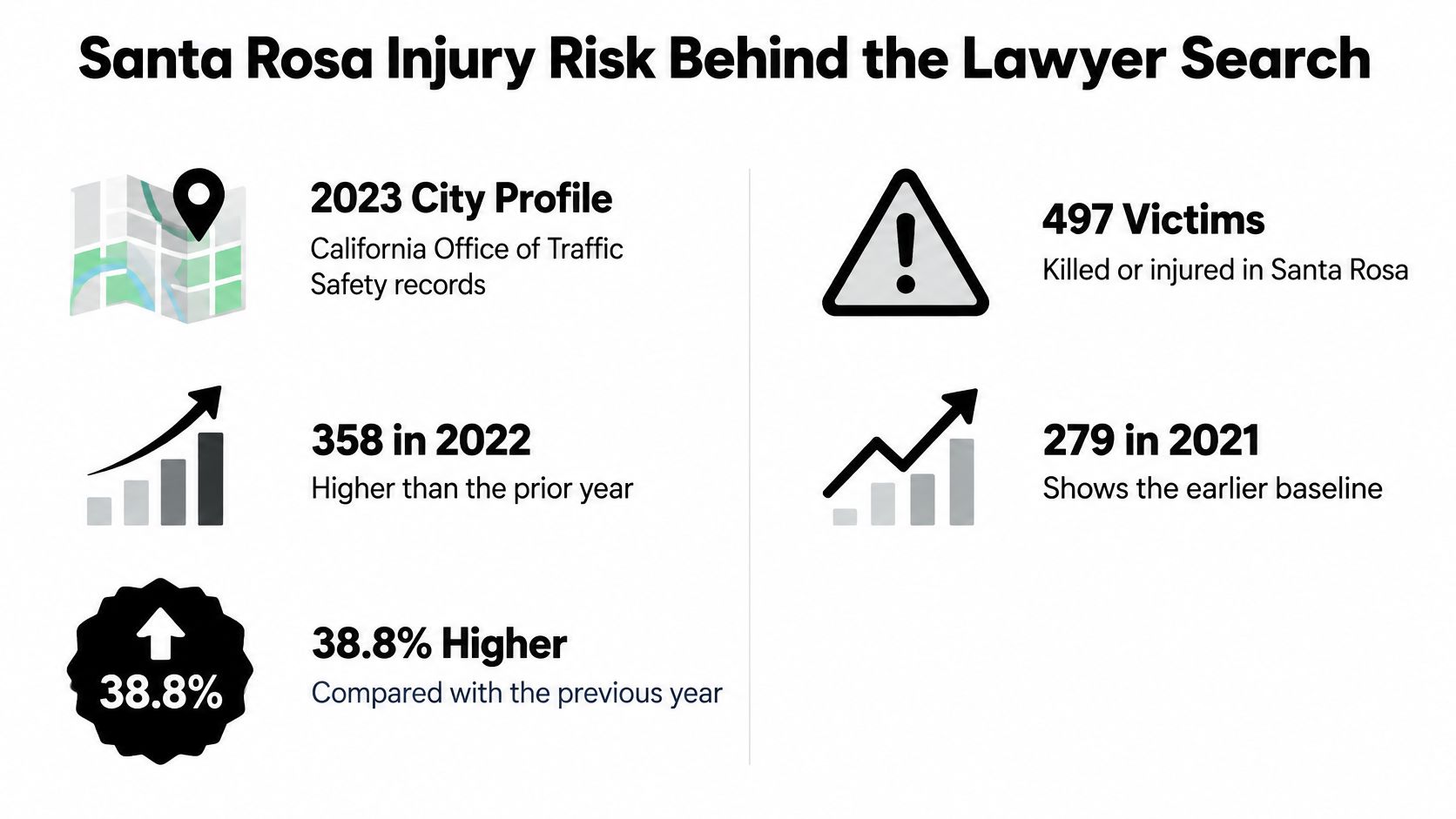
Santa Rosa recorded 497 people killed or injured in traffic collisions in 2023, according to the California Office of Traffic Safety’s city profile. For someone searching for a personal injury lawyer in Santa Rosa, that figure points to a practical question: what evidence, insurance coverage, and filing deadline apply to your particular injury?
Santa Rosa Injury Risk Behind the Lawyer Search
The Office of Traffic Safety’s city profile puts that injury toll against 358 victims in 2022 and 279 in 2021, increases of approximately 38.8% and 78.1%, respectively. Its categories describe different legal problems: 75 alcohol-involved victims, 74 victims in speed-related fatal or injury collisions, 37 pedestrians, 26 motorcyclists, and 23 bicyclists. It also records 39 hit-and-run fatal or injury collisions, an average population of 177,043, and more than 1.36 million daily vehicle miles traveled.
Those categories aren’t separate pieces that necessarily add up to the total. A pedestrian injury, for example, could also involve alcohol or speed. They’re clues about the questions an attorney needs to investigate, not a formula for predicting compensation.
The local comparison is summarized below.
Translate the collision into a claim
Say you’re a passenger injured when a speeding driver strikes your vehicle. Your immediate concerns may be treatment and missed work, but the claim also needs evidence connecting the driver’s conduct to the collision and your injuries.
A cyclist struck by a driver who leaves faces a different problem. Identifying the vehicle and locating applicable insurance may matter as much as documenting the physical impact.
- Speed or impairment: Preserve information about driving behavior, impact, and the injury mechanism.
- Vulnerable road users: Keep damaged helmets, bicycles, clothing, and photographs of the crossing or roadway.
- A missing driver: Save camera locations, witness contacts, and any identifying vehicle details.
Start with the decision, not a settlement estimate
A useful evaluation matches the claim to its filing clock, examines fault, separates legal fees from take-home proceeds, and identifies proof that could disappear. A later police update describing fewer collisions but more fatal collisions makes that last task especially important.
This article is for informational purposes and is not to be construed as legal advice. No attorney-client relationship exists based on review of this article, and none of the information in this article is legal advice.
Claim Types Deadlines and First Proof
Santa Rosa injury claims, clocks, and first proof
| Claim type | Usual window | Who often pays | First proof |
|---|---|---|---|
| Car or passenger crash | General personal-injury lawsuit window described below | At-fault driver’s liability insurer | Crash report, photos, medical records, insurance cards |
| Rideshare after driver accepts match | General lawsuit window; coverage period established by app match | Transportation network company’s applicable liability policy | Trip receipt and app match time |
| Rideshare app on, no match yet | General lawsuit window; pre-match coverage tier | Applicable pre-match policy; personal auto may exclude the activity | App login time and evidence of whether a match existed |
| Pedestrian or bicycle | General lawsuit window | Driver liability coverage; potentially uninsured motorist coverage if the driver fled | Witness contacts, roadway and lighting photos |
| Motorcycle | General lawsuit window | Applicable liability and uninsured or underinsured motorist coverage | Gear, bike damage, event data if available |
| Premises slip or fall | General lawsuit window; delayed-discovery rules may require separate analysis | Responsible property owner or premises insurer | Incident report, hazard photos, shoes, witness names |
| City, bus, or other public entity | Short administrative claim requirement described below, subject to exceptions | Responsible public entity | Written claim, submission records, roadway or vehicle photos |
| Hit-and-run | General lawsuit window; insurance notice requirements also need review | Potentially your uninsured motorist coverage | Police report and any plate, camera, or witness lead |
Identify the clock before choosing a strategy
Under Code of Civil Procedure section 335.1, California generally allows two years from the injury to file a personal-injury lawsuit; California Courts’ statute-of-limitations guidance also describes a potential one-year period from discovery when an injury wasn’t discovered immediately and a six-month administrative claim period for personal injury or personal-property damage involving a public entity, subject to exceptions.
Those aren’t interchangeable deadlines. The delayed-discovery rule isn’t an automatic extension whenever treatment continues or a diagnosis changes. A public-entity administrative claim is also a different procedural step from filing a lawsuit.
Think of the claim type as the on-ramp and the deadline as the meter already running. A passenger might identify the private driver as responsible, but evidence could also raise questions about a government vehicle or roadway condition. That possibility changes which procedures need attention.
Read the payment column cautiously
An insurer listed in the table isn’t a promise of coverage. The policy, insured person, covered activity, exclusions, and facts still need review.
For example, a hit-and-run victim shouldn’t assume that every auto policy includes uninsured motorist protection for that event. Likewise, an app being active doesn’t, by itself, establish that the highest rideshare coverage tier applies.
Deadline rule: Settlement discussions don’t safely pause a filing clock. Identify and protect the deadline independently of negotiations.
For a fuller explanation of how filing periods operate, our personal injury statute-of-limitations guide provides additional context. Don’t treat a later medical appointment as a fresh starting date for every claim.
Circle the row matching the potential defendant, write down the incident date and earliest possible deadline, and gather the proof listed beside it. If several rows fit, flag all of them for review rather than choosing the most generous clock. This is informational guidance, not legal advice about your date of injury.
How California Fault Splits Compensation
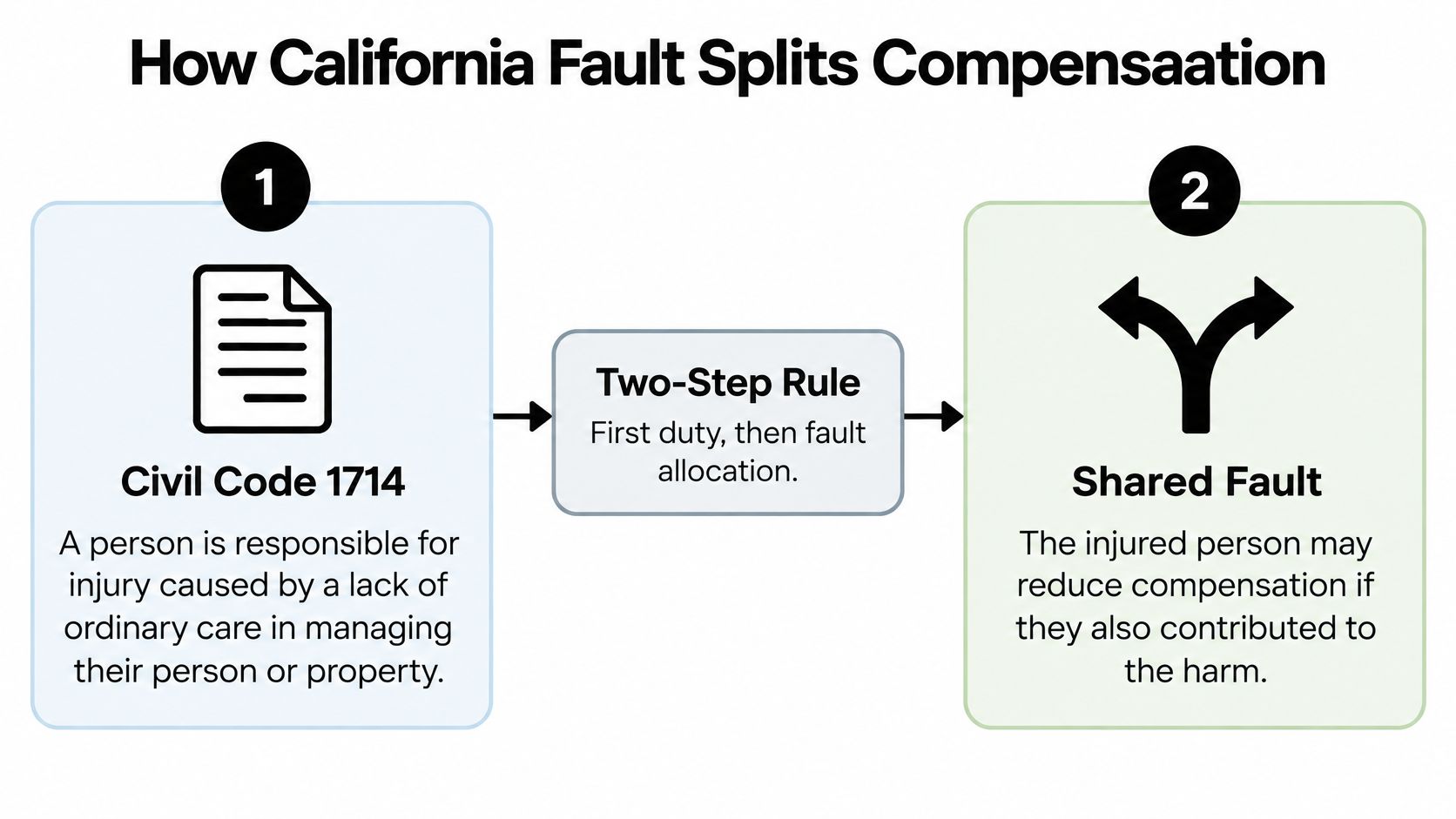
Duty and allocation are different questions. California Civil Code section 1714 establishes responsibility for injury caused by a lack of ordinary care in managing a person or property, while recognizing the injured person’s contributing conduct.
A grocery aisle illustrates property care: was a wet floor left without a reasonable warning or cleanup? A speeding driver illustrates personal conduct: did the driver operate the vehicle without ordinary care? Neither example establishes liability without evidence about what happened.
The diagram separates the duty question from shared fault.
Separate the damage categories
California Civil Code section 1431.2 defines economic damages as objectively verifiable losses, including medical expenses, lost earnings, repair costs, and lost business opportunities. Non-economic damages include pain, suffering, emotional distress, and loss of consortium.
For non-economic damages, that statute makes each defendant responsible only for the portion corresponding to that defendant’s percentage of fault, with a separate judgment against each. A defendant’s greater insurance limits don’t automatically make that defendant responsible for everyone else’s non-economic share.
A hypothetical pedestrian allocation
Suppose a jury assesses $100,000 in non-economic damages and assigns fault as follows:
- Defendant A receives 60% of fault. A’s separate non-economic judgment is $60,000.
- Defendant B receives 20% of fault. B’s corresponding judgment is $20,000.
- The pedestrian receives 20% of fault. The remaining $20,000 attributable to that share isn’t collected from either defendant.
These are illustrative figures, not a settlement prediction. If the pedestrian also has hypothetical medical bills of $40,000, those bills belong to the economic category. Don’t apply the non-economic allocation mechanically to them; have counsel explain the economic-damages rules applicable to the defendants.
This companion video can support a discussion of fault and compensation.
Partial fault isn’t automatically a bar to recovery, but it can reduce the amount recovered. A police narrative is a starting point for investigation, not the final civil allocation. This explanation is informational and isn’t legal advice.
Contingency Fees and Settlement Deductions
How personal injury fee models usually work
| Fee model | When it is used | Typical range | If there is no recovery |
|---|---|---|---|
| Contingency before suit | A common arrangement for plaintiff injury claims | Percentage established in the signed agreement | No attorney fee under a no-recovery contingency; cost responsibility follows the contract |
| Contingency after filing | When litigation or trial work triggers a contractual change | Contract may specify a higher percentage | No attorney fee under a no-recovery contingency; advanced costs may still be owed |
| Hourly | An alternative, less common arrangement for injured plaintiffs | Attorney’s agreed hourly rate multiplied by time spent | Client pays for work regardless of outcome |
| Flat fee | Uncommon for a complete injury claim | Set amount agreed in advance | Client pays according to the agreement |
A fee percentage isn’t your net recovery
A contingency fee connects the attorney’s fee to the recovery rather than billing every hour to the client. Don’t assume every firm uses the same percentage, litigation trigger, or cost policy. The written agreement controls those terms.
As an illustration, a proposed contract might charge one-third before a lawsuit and 40% after filing or specified trial preparation. Those figures are examples of terms to compare, not a quote from LA Law Group, APLC or a documented market survey.
Case costs are separate from attorney fees. Filing fees, medical-record charges, deposition expenses, and expert reconstruction may be advanced during the claim. The agreement should explain whether you reimburse them, what happens if nothing is recovered, and whether they’re deducted before or after calculating the fee.
Work backward from the settlement
Consider a hypothetical $90,000 settlement, a one-third fee, $4,000 in costs, and a $10,000 medical or health-plan lien. If the fee is calculated on the gross settlement, the attorney fee is $30,000, leaving $46,000 after those assumed costs and lien payments.
That example isn’t a forecast. It demonstrates why a headline settlement amount and the client’s final check aren’t the same thing.
Ask for a written settlement breakdown showing the gross recovery, fee calculation, itemized costs, reimbursement payments, and proposed client payment.
Medicare, Medi-Cal, and health-insurer reimbursement claims are separate from the attorney’s fee. Their applicability and amount require review; an asserted balance shouldn’t be treated as an unexplained deduction.
Use these consultation questions to compare agreements:
- Fee changes: What percentage applies before filing, and what event triggers an increase?
- Cost treatment: Are expenses deducted before or after the percentage, and who owes them if the claim fails?
- Lien responsibility: Who reviews and negotiates reimbursement claims, and how will the final amounts be documented?
Our personal injury contingency-fee guide offers additional explanation of that arrangement. This is general information, not a fee quote or legal advice.
Evidence to Save After a Serious Crash
Santa Rosa Police Department’s November 2025 reporting described declining overall traffic collisions and a 26% decrease in DUI-related crashes, but a 20% increase in fatal collisions compared with the same period the prior year. Fewer collisions don’t necessarily mean less severe outcomes or simpler claims.
That combination calls for evidence triage, meaning the prompt identification of proof most likely to disappear or change. A badly damaged vehicle, overwritten security recording, or unreachable witness can matter more to an individual claim than a citywide collision total.
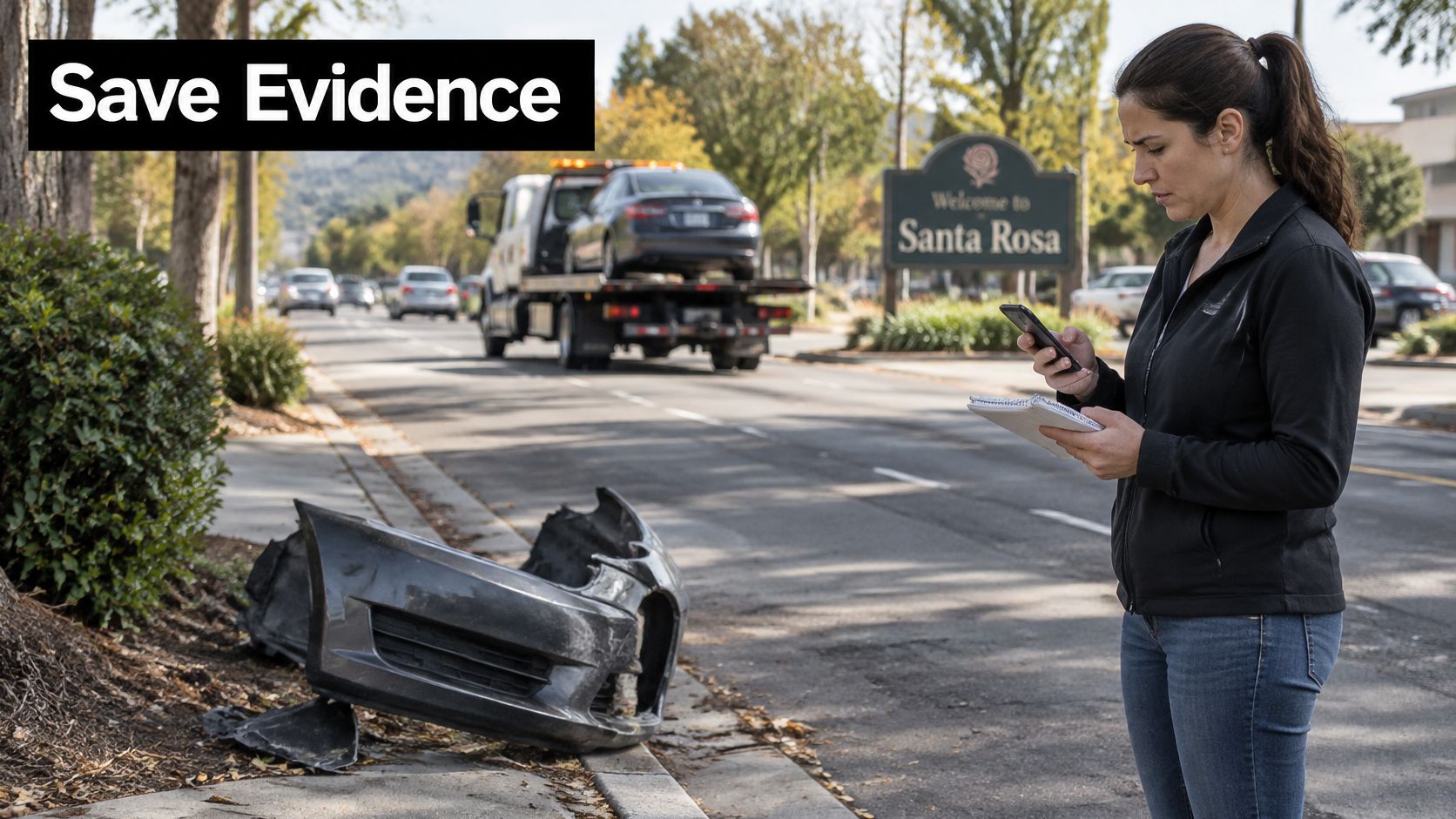
Physical evidence needs attention before repair or disposal.
Match preservation to the collision
A nighttime speed-related crash: Keep the vehicle available for inspection. Photograph crush damage, debris, tire marks, and sightlines without entering traffic or disturbing the scene. Have counsel assess available event data before repairs and identify nearby cameras and emergency-call records.
A hit-and-run pedestrian or bicycle collision: Record lighting, crossing locations, obstructions, and roadway conditions. A partial plate, vehicle description, rideshare decal, or witness who saw the vehicle turn onto another street may help identify a responsible party.
An alcohol-involved collision: Preserve the collision report and early treatment records. Tell medical providers accurately about both new symptoms and pre-existing conditions, so the record helps distinguish acute trauma from prior problems or later aggravation.
The California Highway Patrol’s official crash-data resource includes collision types, injured-person information, and contributing circumstances. Those categories help organize an investigation, but an individual claim still needs its underlying documents and physical evidence.
Build a usable preservation file
- Event identification: Keep the report number, responding agency, incident location, and insurer correspondence together.
- Original files: Save unedited photographs and videos with their original metadata, plus backup copies.
- Physical items: Retain helmets, damaged safety gear, clothing, and vehicle components.
- Witness access: Record names, phone numbers, and what each person observed.
- Inspection protection: Arrange preservation before repairs, salvage, disposal, or destructive testing.
Preservation priority: Don’t delay urgent medical care to collect evidence. Ask someone you trust to help document what you can’t safely preserve yourself.
A police report isn’t itself a finding of civil fault. Match the saved materials to the relevant claim type, and identify the missing item most likely to affect responsibility or coverage. This is informational only, not legal advice.
Fatal Crash Claims and Family Next Steps
When a collision is fatal, the family needs more than a standard injury checklist. Potential claimants may include a surviving spouse, children, or an estate representative, but who can file and which losses belong to which claim require individual review.
Wrongful-death and estate-based claims aren’t interchangeable. Medical expenses, funeral costs, lost financial support, and relationship losses need to be evaluated under the appropriate claim rather than placed into a single undifferentiated demand.
Preserve records without guessing legal authority
- Obtain identifying records. Request the collision report and case number, and record the coroner or medical examiner’s contact information.
- Protect physical and digital proof. Have counsel address preservation of vehicles, event data, and roadway or private-camera footage before salvage or repair.
- Collect financial and treatment documents. Gather hospital records and employment, income, and benefit information from before the death.
- Identify witnesses. Include people who called emergency services or saw a vehicle leave.
- Keep expense receipts. Save funeral, transport, and household replacement records.
Confirm who has authority to obtain records, act for the estate, and bring each claim. Don’t assume that a relative’s involvement automatically gives that person filing authority.
A death-claim review should resolve both who may act and which deadline applies, before anyone signs a settlement release.
A police report doesn’t independently decide civil responsibility. This section is informational only and isn’t legal advice.
Rideshare Premises and City Claim Differences
Identify the defendant and the coverage period before discussing settlement value. A letter denying coverage from the wrong policy doesn’t resolve every possible source of recovery.
Rideshare coverage follows the app clock
The California Department of Insurance’s rideshare insurance announcement describes requirements beginning July 1, 2015: $1 million in liability coverage from acceptance of a passenger match until the passenger exits, and pre-match minimums of $50,000 for injury to one person, $100,000 for injury to multiple people, and $30,000 for property damage, plus $200,000 in company-maintained excess insurance.
Those are the stated requirements in that announcement, not a guarantee that a particular claimant receives those amounts. Policy application and available limits still require investigation.
For an Uber or Lyft collision, preserve the trip receipt, acceptance time, cancellation messages, and app screenshots. The practical distinction is whether the driver had accepted a match, not whether someone remembers being on a trip.
The department also warns that a personal auto policy may exclude rideshare activity. A denial from the driver’s personal carrier therefore calls for further coverage analysis, not an automatic conclusion that no claim exists. Our rideshare accident attorney guide explains the records useful to that review.
Property and public-entity defendants require different proof
For a store or apartment fall, investigate the hazard itself: what the responsible party knew, how long the condition existed, what inspections occurred, and whether lighting or warnings were reasonable. Photograph the condition before cleanup if you can do so safely, and identify who controlled that portion of the property.
For prevention context, Overton Security’s resource on liability management for property owners offers a property-management perspective. It doesn’t establish whether a particular owner breached a legal duty.
A city bus, government vehicle, or public-sidewalk incident requires careful identification of the responsible agency and applicable claim procedure. Public ownership alone doesn’t prove liability, and an ordinary insurance demand isn’t necessarily a substitute for the required administrative submission.
- Rideshare: Establish the driver’s app status.
- Premises: Establish control, notice, and the condition.
- Public entity: Establish the agency and required procedure.
This explanation is informational and isn’t legal advice.
Schedule a Free Injury Case Review
Request a review promptly when the defendant, deadline, or evidence is uncertain. That includes a possible city or bus claim, an active rideshare app, a driver who left the scene, or medical bills and wage loss that you can’t yet calculate reliably.
An approaching filing date deserves attention even if an adjuster sounds cooperative. You also shouldn’t postpone review because you’re still receiving treatment.
Use a practical yes-or-wait test
- Seek review now: A public entity may be involved, coverage has been denied, the vehicle may be salvaged, or important footage hasn’t been preserved.
- Flag approaching dates: If your earliest potential deadline is within the coming year, bring it to the attorney’s attention rather than waiting for negotiations to finish.
- Gather documents without unnecessary delay: You can organize photographs and records while arranging the consultation, but don’t assume collecting everything is a prerequisite to getting help.
A useful consultation identifies potential defendants, flags the shortest applicable deadline, and explains fee and cost terms before you sign. It should also separate what the attorney knows from what still needs investigation.
Bring a file the attorney can use
Bring the collision or incident report, photographs, provider list, wage documentation, insurance letters, and any Uber or Lyft trip record. Write down the injury date, potential defendant’s name, treatment timeline, and your most urgent question.
Organized intake helps prevent important details from getting lost. Virtual Legal Assistants’ explanation of legal intake specialists provides context about that administrative role, but intake isn’t a substitute for an attorney’s legal evaluation.
At LA Law Group, APLC, our first consultation is free and confidential, and it’s held with the attorney who will handle the matter. We serve clients throughout California in English, Spanish, and Farsi from our Chatsworth office, and we can travel to a client’s home or hospital if needed.
You don’t need a polished account of the incident. Bring what you have, identify what’s missing, and be candid about prior injuries or uncertain details.
This article is for informational purposes only, isn’t legal advice, and creates no attorney-client relationship. None of the information in this article is legal advice.
LA Law Group, APLC offers a free, confidential attorney consultation to review a Santa Rosa injury, identify potential claim options, and discuss what needs prompt attention. Visit LA Law Group, APLC to request a review, and have your incident date, insurance correspondence, and available photographs ready for the conversation.
Attorney Advertising. This article is general information, not legal advice, and does not create an attorney-client relationship. Prior results do not guarantee a similar outcome.