
Personal Injury Lawyer What Do They Do? a California Guide

Search Personal Injury Lawyer What Do They Do and you’ll get the same list from every firm. Investigate the crash. Call the insurer. Negotiate. File suit if talks stall. That list answers a different question than the one keeping you up at night.
Here’s the gap. Almost nothing written for injured people explains what a claim is worth after the lawyer’s percentage and the case costs come out of it. A $100,000 settlement does not put $100,000 in your pocket, and for a claim with modest medical bills, that difference decides whether hiring anyone makes sense at all.
This guide follows a California claim in the order you’d live through it, defining each term as it appears. It covers the work a lawyer does at each stage, how fees and costs split the recovery, the deadlines that can end a claim early, and the rideshare insurance layers that confuse passengers most. Where representation isn’t worth the cost, it says so.
What a Personal Injury Lawyer Does at Each Stage
A personal injury lawyer turns an injury into a documented claim and deals with the insurance company on your behalf. The lawyer goes to court only when a fair settlement can’t be reached.
Before anything else, the disclaimer. This article is for informational purposes only and is not legal advice. No attorney-client relationship exists because you read it, and none of the information here should be relied on as legal advice for your own situation.
The technical core of the job is narrower than the advertising suggests. What a personal injury lawyer does, at the level of the file, is convert an injury event into a legally provable negligence claim and a defensible damages model. The California Courts guide to personal injury cases describes this as connecting duty, breach, causation and compensable harm with admissible evidence, rather than resting on your account of what happened. The same guide lists recoverable losses that can include medical expenses, lost wages, ongoing treatment, emotional harm and future consequences.
Here’s the shape of the work, stage by stage.
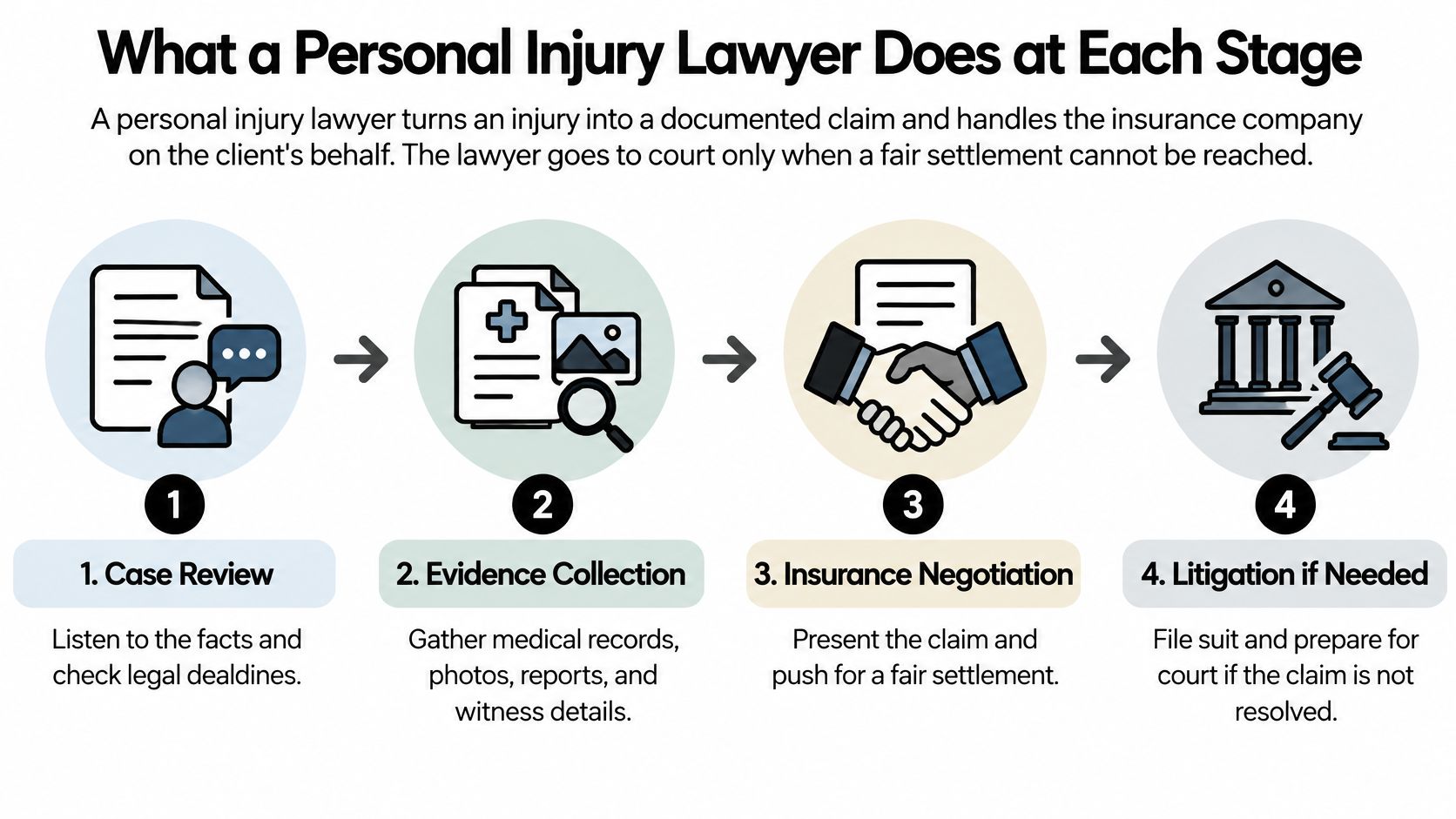
| Stage | What the Lawyer Does | What the Client Provides |
|---|---|---|
| Case review | Screens liability and identifies responsible parties | Date, location and a summary of what happened |
| Evidence preservation | Collects photos, footage, 911 records and witness accounts | Phone photos, witness names, insurance details |
| Medical and wage documentation | Organizes bills, treatment records and lost-income proof | Medical records, bills and pay stubs |
| Damages valuation | Calculates economic losses and non-economic losses | Records of out-of-pocket costs and time off work |
| Insurer negotiation | Presents a demand and negotiates the settlement | Authorization to communicate with the insurer |
| Litigation | Files and pursues a lawsuit if talks fail | Availability for depositions and testimony |
Most of that work happens before a courthouse is involved. In a personal injury case, the firm handles the claim process and deals with insurance companies on the client’s behalf, so the calls and deadlines don’t run through you while you’re still in treatment. LA Law Group can review what happened, explain injury claim options in plain language, and talk with insurers on the client’s behalf. The losses pursued include economic damages such as medical and surgical bills, recovery costs and lost wages, plus non-economic harm like pain, emotional distress and lost enjoyment of life.
Find your own case in that table. At stage one you need the date, the location, everyone involved and your insurance card. At stage three you need every bill and every pay stub from the days you missed. The later stages can only work with what the earlier ones preserved.
How Contingency Fees and Case Costs Work
Most injury claims aren’t billed by the hour. They run on a contingency fee, an arrangement where the lawyer receives an agreed percentage of the money recovered through settlement or judgment and generally receives no attorney fee at all if you recover nothing. The State Bar of California fee agreement materials set out what the written agreement has to contain.
Two lines in that agreement move your net number more than the headline percentage does. One states whether the percentage is calculated before or after case costs are deducted. The other states whether you could owe the lawyer anything for related work outside the agreement.
The same settlement, two different checks
Take a $100,000 settlement, a 33 percent fee and $5,000 in case costs.
- Fee taken before costs. The lawyer’s cut is $33,000. Subtract the $5,000 in costs and you receive $62,000.
- Fee taken after costs. Costs come off first, leaving $95,000. The fee is 33 percent of that, or $31,350, and you receive $63,650.
Same injury, same settlement, $1,650 difference, decided by one sentence most clients skim. On a smaller claim the swing matters more, because costs don’t shrink along with the recovery.
| Fee or Cost Item | How It Works |
|---|---|
| Contingency fee, calculated before costs | 33% of gross recovery, so $33,000 on the example and $62,000 net to the client |
| Contingency fee, calculated after costs | 33% of recovery minus costs, so $31,350 and $63,650 net to the client |
| Litigation-stage percentage | Higher share once trial begins, as in sample agreements |
| Case costs | Filing, expert, records and deposition expenses |
| Hourly retainer | Billed by the hour regardless of outcome |
What actually counts as case costs
Case costs are the expenses of building the file, kept separate from the lawyer’s fee. They include court filing fees, charges for medical and employment records, fees paid to treating physicians and accident-reconstruction experts, deposition transcripts and reporter fees, and process servers. Some agreements advance them and repay them out of the recovery. Ask which approach applies to yours.
Sample agreements in the State Bar materials show a higher percentage once trial begins, such as 33 percent before trial and 40 percent after. Treat that as an illustration of how staged percentages work, not a standard rate; the percentage is a matter of your agreement and applicable law.
An hourly retainer, where you’re billed for time whether or not you win, is uncommon for injury claims for a simple reason. Most injured people can’t absorb that risk while they’re out of work.
Three questions to ask in writing
- Is the fee calculated before or after costs, and what happens to costs if we lose?
- What percentage applies at each stage, and when does the trial percentage start?
- Does this agreement cover everything, or could I owe a separate fee for a related matter?
The contingent fee agreement is where all of this lives, and it’s worth reading twice before you sign.
Filing Deadlines and How Long a Claim Takes
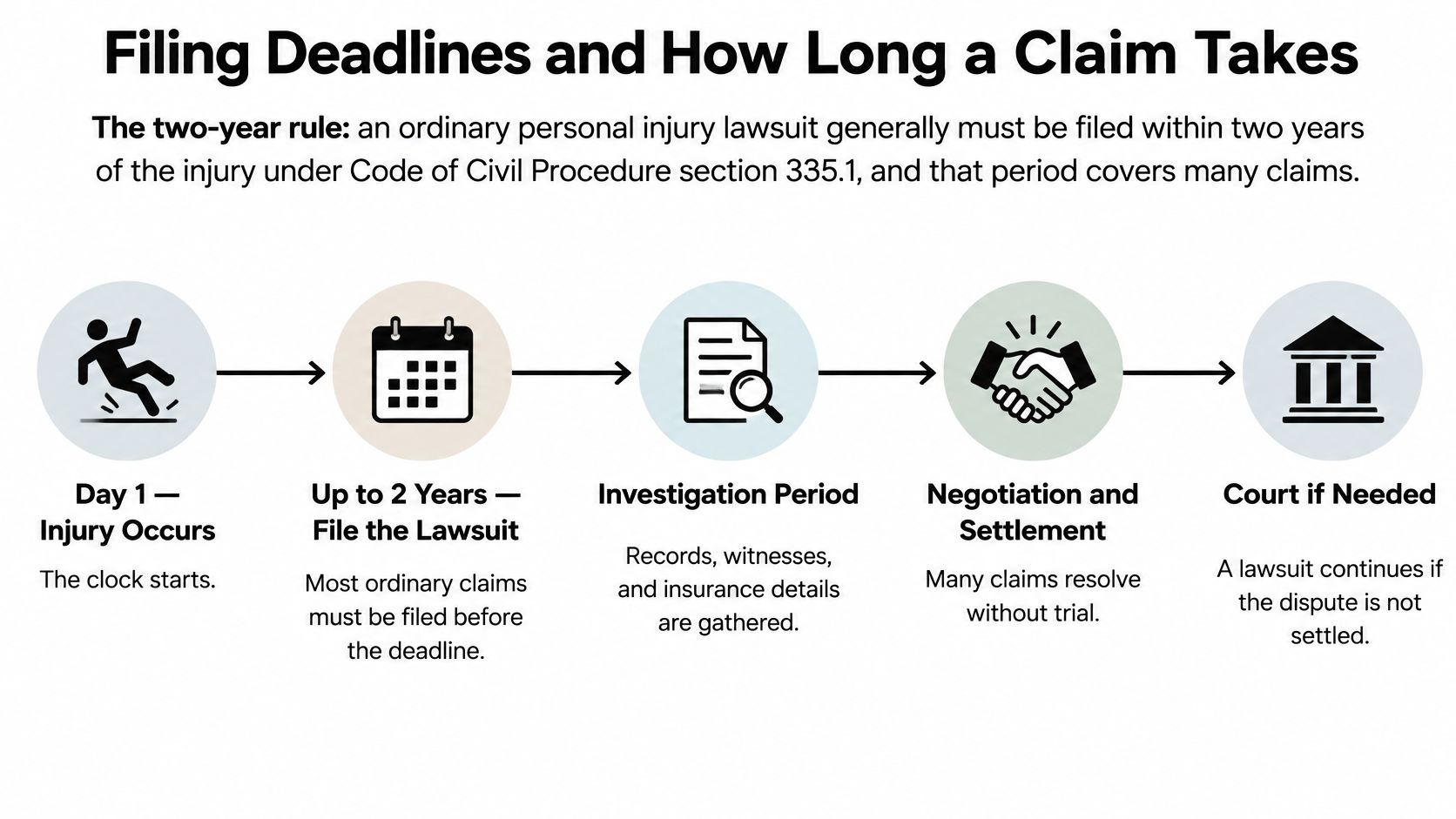
How long can you wait to file, and when might a claim pay out? In California, an ordinary personal injury lawsuit generally must be filed within two years of the injury, under Code of Civil Procedure section 335.1, according to the California Courts statute of limitations guide. Missing the deadline can bar a claim, even when the evidence is strong.
The timeline depends partly on who may be responsible. A claim involving a city, county, transit district, or state agency generally starts with an administrative claim, not a lawsuit.
When the defendant is a government agency
For many claims against a California government agency, the injured person generally must submit an administrative claim within six months of the injury. The agency has 45 days to respond. If it rejects the claim, a lawsuit generally must be filed within six months of the rejection notice being mailed or delivered in person. If no rejection arrives, the California Courts government claims information generally gives two years from the incident to file suit.
That first step can be easy to overlook. A bus collision or fall in a public building may involve a public entity, which changes the claims process and deadline.
| Claim Type | Deadline or Timeline | Notes |
|---|---|---|
| Ordinary personal injury lawsuit | File within 2 years of the injury | Code of Civil Procedure section 335.1 |
| Claim against a California government agency | Administrative claim within 6 months of the injury | Agency has 45 days to respond |
| Lawsuit after a government claim is rejected | File within 6 months of the rejection notice | Counted from mailing or personal delivery |
| Government claim with no rejection received | Generally 2 years from the incident | Per California court information |
| Typical time to settlement | Many LA Law Group cases settle in about 6 months; some lawsuits take up to 3 years | Timing varies by case |
The calendar matters from the start. Prompt attention to a claim can help preserve evidence while it is still available.
How long the money takes
A settlement timeline depends on the injuries, disagreements about fault, and whether a lawsuit is needed. A claim may take longer if the injured person’s future care costs are still unclear.
Many personal injury cases handled by LA Law Group take about six months to reach a settlement. Some lawsuits can take up to three years. These are typical timeframes, not guarantees for an individual case.
The ordinary two-year deadline is a starting point, not a rule for every situation. A lawyer can review the facts and explain which deadline may apply.
Common Case Types and Rideshare Coverage
A collision claim can involve more than the driver who caused the crash. Depending on the facts, responsibility may also involve a vehicle owner or an insurer. The evidence helps establish what happened and which parties may be responsible.

For a straightforward collision, useful records may include the police report, scene and vehicle photographs, a damage estimate, and medical records linking treatment to the crash. Together, they help show how the collision happened and how it affected the injured person.
Case types and what each one needs
LA Law Group handles automobile and motorcycle accidents, truck accident cases, wrongful death, product and premises liability, and catastrophic injuries. The evidence depends on the type of claim, so the records needed for a truck crash may differ from those needed for a fall on someone else’s property.
| Case Type | Who May Be Liable | Evidence That Matters Most |
|---|---|---|
| Auto accident | Negligent driver, and possibly the vehicle owner or insurer | Police report, photos, vehicle damage, medical records |
| Truck accident | Driver, trucking company or maintenance contractor | Driver logs, maintenance records, inspection reports |
| Motorcycle accident | Negligent driver | Gear condition, skid marks, witness statements |
| Pedestrian or bicycle injury | Driver or other road user | Scene photos, traffic reports, footage |
| Premises liability or slip and fall | Property owner or maintainer | Incident photos, maintenance records, surveillance footage |
| Dog bite | Owner or keeper of the dog | Animal control reports, medical treatment records |
| Wrongful death | Party responsible for the death | Death certificate, funeral costs, dependents’ loss records |
A truck case may involve driver logs, inspection records, or maintenance documents. These can help clarify whether driver conduct or vehicle upkeep contributed to the crash. In a motorcycle case, the parties may dispute visibility, the rider’s gear, or the path of the vehicles.
Premises claims often turn on whether a property was maintained and what records or footage show about the hazard. Dog bite claims may rely on animal control records and medical documentation. In a wrongful death case, documents can help establish funeral expenses and the losses experienced by dependents.
Rideshare claims follow the app, not the car
In a rideshare crash, the driver’s app status can affect which insurance policy may apply. A driver may be offline, waiting for a request, on the way to pick someone up, or carrying a passenger. The applicable coverage can depend on what the driver was doing at the time.
Uber’s California driver insurance information describes coverage for drivers and trips in the state. Lyft publishes its own driver coverage limits, which differ by app status. Confirm the terms that apply to the trip date directly with the platform. For more on the legal questions involved, see this guide to suing Lyft after an accident.
Why status matters: A passenger injured during a trip may have a different insurance claim than a pedestrian hit by a driver who had not accepted a request.
The records that connect a crash to a rideshare trip include app information, details about the people in the car, medical evidence, and communications with potentially responsible insurers. The driver’s status helps identify which coverage may need to be considered.
Steps to Take After an Injury
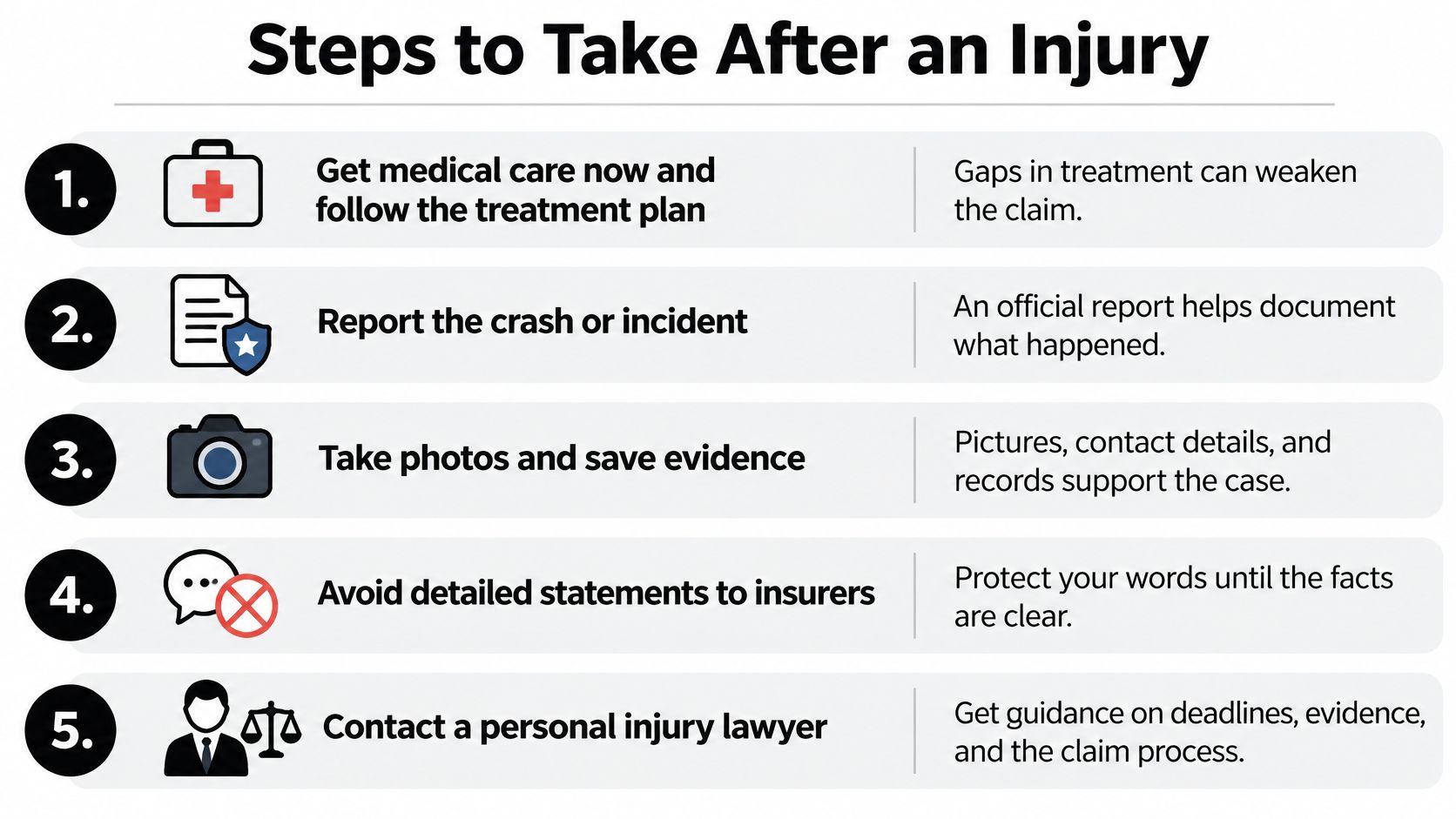
The first weeks decide how much of the claim survives. None of these steps requires a lawyer, and every one of them protects the evidence a lawyer would need later.
- Get medical care and follow the plan. Gaps in treatment are the easiest thing for an insurer to attack, because they suggest the injury wasn’t serious or came from something else.
- Report the crash or hazard. File a police report for a collision and notify the property owner for a fall. Get the report number in writing.
- Photograph everything and keep the originals. Scene, vehicles, the hazard, your visible injuries, the shoes you were wearing. Don’t edit or delete the files.
- Collect witness names and numbers on the spot. People leave, and a name you can call in three weeks beats a memory you can’t.
- Keep a daily log of symptoms, appointments, medications and missed work. A dated record of a bad month reads very differently from a summary written a year later.
- Put every bill, receipt, pay stub and insurance letter in one folder. Reimbursement is documentary, so the paper trail is the claim.
- Decline recorded statements before you get advice. An adjuster’s request sounds routine, but early words get quoted back during negotiation.
- Write down the injury date. It starts the clock that the claim must be filed within.
- Book a consultation and be candid. Once an attorney-client relationship forms, those communications are generally privileged and confidential, and reading this article creates no such relationship.
If the crash was minor and you’re unsure how much detail matters, handling a minor car accident well covers the recovery side, including when to get checked and what to document, and pairs sensibly with the legal steps above.
Practical rule: photograph the scene before you leave it. No later visit recreates the skid marks, the light or the position of the vehicles.
Everything a client shares with LA Law Group is protected by attorney-client privilege and remains confidential. The purpose of these nine steps is narrower than a legal strategy: they keep the photographs, dates, records and witnesses intact so that whatever you decide, the file is still usable.
Frequently Asked Questions About Personal Injury Lawyers
Do I need a lawyer for a minor injury with clear fault? Not always. Compare what you’d likely net after the contingency fee and case costs against the hours you’d spend gathering records and negotiating alone. On a small, clean claim with a cooperative insurer, handling it yourself can leave you more money.
Will I pay anything upfront? Contingency arrangements generally mean no attorney fee if nothing is recovered, and your own policy may cover some treatment costs as you go. Read the written agreement for the percentage and the cost terms before signing.
How long do I have to file a claim? Two years is the general California deadline for a lawsuit, and six months is the administrative deadline when a government agency caused the injury. Both run from the injury date, and a missed deadline can end an otherwise valid claim.
Does reading this article or asking a question create an attorney-client relationship? Reading it creates none, and a conversation only becomes representation on terms both sides confirm. Ask the firm to put the status in writing.
What if the at-fault driver has no insurance? Uninsured motorist coverage on your own policy may respond, depending on the policy language and limits. A lawyer reviews every policy that might apply, including ones in your household, not just the other driver’s.
These answers are general education, not legal advice for your situation.
Deciding Whether to Call a Personal Injury Lawyer
Some cases need representation and some don’t, and the honest dividing line is the size and complexity of the loss.
Call a lawyer when any of these is true:
- The injury is serious or lasting. Surgery, a fracture, a brain injury, or anything with a projected course of treatment changes the claim’s value by orders of magnitude.
- Fault is disputed. A rear-end impact is easy; an intersection crash with conflicting accounts is not.
- Several parties could share responsibility. A trucking company, a maintenance contractor, a vehicle owner and a platform can all carry fault.
- A government agency is the defendant. The shorter administrative track catches out people handling a claim alone.
- An insurer is lowballing you or has gone quiet. That’s a signal the negotiation needs real strength behind it.
- A filing deadline is close. A date that passes cannot be reopened by agreement.
Now the trade-off most guides skip. For a minor injury with clear fault and modest medical bills, the fee and case costs can consume much of the recovery, and the net after both may not justify sharing it. Run the arithmetic on your own numbers first: your likely settlement, the percentage, and the costs that won’t shrink with it.
What to bring to the first consultation
A short, complete file beats a long story. Bring the accident date, time and location; the police or incident report number; every medical record and bill you have; photographs of the scene, vehicles and injuries; the other party’s insurance details plus your own declarations page; pay records for time missed; and a one-page timeline written in date order.
The first consultation at LA Law Group is free and confidential, and it’s held with the attorney who will handle the matter. Expect the specifics of your case to be discussed, including what to expect at each stage, and expect to deal directly with that attorney afterward rather than with secretaries or paralegals. If any consultation fee applies anywhere in the process, get the answer in writing before you go.
Nothing on this page is legal advice, and reading it creates no attorney-client relationship. A consultation is where a real assessment begins.
If you were hurt in a crash, a rideshare or on someone else’s property in California, LA Law Group, APLC can review what happened, explain your claim options in plain language, and talk with insurers on your behalf, with a free and confidential first consultation held by the attorney who would handle your case. If a fair settlement can’t be reached, the matter can move to litigation. Visit LA Law Group, APLC to start that conversation and bring the checklist above.
Attorney Advertising. This article is general information, not legal advice, and does not create an attorney-client relationship. Prior results do not guarantee a similar outcome.