
Your Guide to a Fair Rear End Collision Settlement

Disclaimer: This article is for informational purposes and is not to be construed as legal advice. No attorney-client relationship exists based on the review of this article, and none of the information in this article constitutes legal advice.
When you’ve been in a rear-end collision, you’ll likely hear the term “settlement” thrown around. So, what is it? A rear end collision settlement is simply a formal agreement between you (the injured person) and the at-fault driver’s insurance company.
This agreement closes your personal injury claim without going to court. In exchange, you receive financial compensation to cover everything from your medical bills and lost paychecks to your car repairs and the pain you’ve endured. Here in California, settlements are the most common way to resolve these cases because they’re much faster than a drawn-out trial.
Understanding Your Rights After a Rear End Collision

Getting hit from behind is jarring. The moments after are often a blur of confusion, adrenaline, and stress. The legal and financial mess that follows only adds to that weight, which is exactly why it’s so important to understand the settlement process.
Think of a settlement less like a lottery ticket and more like a way to make you “whole” again. It’s about getting you back on your feet by covering the losses you were unfairly forced to suffer.
The entire foundation for a rear-end collision settlement in California rests on a key legal idea: the presumption of fault. This principle basically says that the driver who hits the car in front of them is almost always considered legally responsible. Why? The logic is simple. Every driver has a duty to keep a safe following distance, giving them plenty of room to stop if the car ahead brakes suddenly.
But—and this is a big “but”—this presumption isn’t set in stone. Certain situations can muddy the waters, shifting or even splitting the blame, which can complicate what seems like a straightforward claim.
Exceptions to the Presumption of Fault Rule
While the driver in the back is usually on the hook, there are critical exceptions that can completely change the game during settlement talks. A sharp attorney will always dig deep to see if any of these factors were at play:
- Sudden or Erratic Braking: If the front driver slammed on their brakes for no good reason (a classic “brake check”), they could be found partly or even fully at fault.
- Faulty Brake Lights: Were the lead car’s brake lights out? If so, the rear driver never got the signal they needed to stop in time, which can shift liability.
- Improper Lane Changes: A driver who cuts you off and then immediately hits the brakes can absolutely be held responsible for causing the crash that follows.
- Reversing into Traffic: This one’s a no-brainer. If the front vehicle was actually backing up when it was hit, the fault would almost certainly fall on them.
These accidents are anything but minor fender-benders. In fact, rear-end collisions are a huge problem on our roads, making up nearly 30% of all crashes in the U.S. That’s about 2.5 million incidents every single year.
Even worse, these crashes lead to roughly 950,000 serious injuries annually, including whiplash, herniated discs, and concussions. You can dive deeper into the numbers by checking out more rear-end collision statistics on mighty.com.
Important Disclaimer: This article is for informational purposes and is not to be construed as legal advice. No attorney-client relationship exists based on the review of this article, and none of the information in this article constitutes legal advice.
Calculating the Value of Your Settlement
After a rear-end collision, the most pressing question on everyone’s mind is a simple one: “So, what’s my case actually worth?” While there’s no magic calculator that can spit out an exact number, there is a clear, logical method we use to figure out the value of a rear-end collision settlement. Getting a handle on this process helps you set realistic expectations and see the true financial potential of your claim.
Think of building your settlement value like building a house. You start with a solid foundation of concrete, measurable costs, and then you build upon it with other crucial elements to complete the picture.
The Foundation: Economic Damages
The starting point for any settlement valuation is adding up your economic damages. These are the specific, provable financial losses you’ve suffered as a direct result of the accident. They are the black-and-white numbers that form the base of your entire claim.
These damages typically include:
- Medical Bills: This covers everything from the ambulance ride and initial emergency room visit to any surgeries, physical therapy sessions, prescription drugs, and chiropractor appointments.
- Future Medical Costs: If your injuries are going to require long-term treatment or ongoing care, the projected cost of that future care is a critical piece of your settlement.
- Lost Wages: This is the straightforward calculation of the income you lost because you were unable to work while recovering.
- Loss of Earning Capacity: This is a big one. If your injuries prevent you from going back to your old job or limit your ability to earn a living down the road, this calculation accounts for that long-term financial hit.
- Property Damage: This is the cost to either repair or replace your vehicle and any other personal property, like a laptop or phone, that was damaged in the crash.
These economic damages aren’t just figures on a spreadsheet; they represent real financial burdens forced upon you through no fault of your own. You can get a more detailed breakdown by reading our guide on what economic damages are in a personal injury case.
The Multiplier: Non-Economic Damages
Once that foundation of economic damages is solid, we add the next layer: non-economic damages, more commonly known as “pain and suffering.” This is where the calculation gets more nuanced. Unlike medical bills, there’s no receipt for physical pain, emotional trauma, or a lower quality of life.
Pain and suffering often acts as a multiplier. Insurance adjusters and attorneys will frequently take your total economic damages and multiply them by a number (usually between 1.5 and 5) to land on a value for your non-economic damages. The more severe and life-altering your injuries are, the higher that multiplier will be.
For instance, a minor whiplash injury that heals up in a few weeks with a little physical therapy might get a low multiplier, like 1.5. But an injury that requires surgery and leaves you with chronic pain? That would justify a much higher multiplier, significantly boosting the total value of the settlement.
How Injury Severity Drives Settlement Ranges
The single biggest factor that moves the needle on your rear-end collision settlement is the severity of your injuries. A minor fender-bender is, of course, going to result in a much lower settlement than a high-speed crash that causes catastrophic harm.
Nationally, cases involving minor whiplash or soft tissue injuries often settle in the $5,000-$10,000 range. For more moderate injuries—think herniated discs or concussions that need therapy—that range can easily climb to $25,000-$75,000 or more.
It’s crucial to remember that these are just general ballpark figures. A case involving a spinal cord injury or a traumatic brain injury could be valued in the hundreds of thousands, or even millions, of dollars. The logic is always the same: the greater the impact on your life, the higher the value of your claim.
Disclaimer: This article is for informational purposes and not to be construed as legal advice. No attorney-client relationship exists based on the review of this article, and none of the information in this article is legal advice.
Key Factors That Influence Your Settlement Amount
So, we’ve talked about the formulas used to calculate a settlement, but what are the actual ingredients that go into that calculation? Think of your rear end collision settlement as a puzzle. Each factor is a critical piece, and how they all fit together determines the final picture of your compensation.
Getting a handle on these variables is crucial because they form the very foundation of your claim. This isn’t just theory; these are the evidence-backed arguments you’ll use to justify the dollar amount you demand from the insurance company.
The Severity of Your Injuries
Without a doubt, the single biggest driver of your settlement’s value is the nature and severity of your physical injuries. A case of minor neck soreness that clears up in a few weeks will result in a much smaller settlement than an injury that requires surgery and months of physical therapy. It’s just common sense.
Insurance companies don’t take your word for it, though. They evaluate the seriousness of an injury based on one thing: objective medical documentation. This is exactly why getting checked out by a doctor right away—and consistently following their treatment plan—is the most important thing you can do after a crash. Your medical records become the primary evidence to prove how much you were harmed.
Here’s what adjusters and attorneys look at:
- Type of Injury: Common soft tissue injuries like whiplash are one thing, but severe harm like broken bones, concussions, or spinal cord damage will lead to substantially higher values.
- Permanence of Injury: Is this something you’ll fully recover from, or are you now facing chronic pain, limited mobility, or a permanent disability? The long-term impact on your life is a massive consideration.
- Visibility of Injury: Objective injuries that show up clearly on an MRI or X-ray—like a fracture or a herniated disc—tend to carry more weight with adjusters than subjective complaints of pain, which are harder to prove.
Total Cost of Medical Treatment
Going hand-in-hand with injury severity is the total cost of your medical care. This includes everything you’ve already paid for and what you’re reasonably expected to need in the future. We aren’t just looking at the bills you have today; we have to account for the full financial cost of your entire recovery journey.
This means adding up every related expense:
- Emergency room visits and the ambulance ride
- Hospital stays and any surgical procedures
- Diagnostic imaging like MRIs, CT scans, and X-rays
- Physical therapy and rehabilitation sessions
- Prescription medications and medical devices
- Future medical needs, such as follow-up surgeries or ongoing pain management
Serious injuries, such as a herniated disc, often demand extensive, long-term care, which dramatically increases the settlement value. Understanding what that involves is key, and you can learn more about options for herniated disc treatment to see just how complex and costly it can be.
Lost Wages and Earning Potential
If the accident forced you to take time off work, the income you lost is a straightforward part of your claim. But for many, the impact goes much deeper. If your injuries stop you from returning to your old job or diminish your ability to earn a living in the future, this “loss of earning capacity” becomes a major component of your settlement.
For example, imagine a construction worker who suffers a permanent back injury. They can no longer perform manual labor. Their settlement must account for the difference in pay between their old job and whatever new, lower-paying work they can find—calculated over the remainder of their career.
The Impact of Pre-Existing Conditions
Insurance adjusters love to find pre-existing conditions. It’s one of the first things they look for in your medical history. Their goal is to argue that your pain isn’t from the crash but from an old injury or a degenerative issue you already had.
But California law is on your side here. The “egg-shell plaintiff rule” means the at-fault driver is responsible for the harm they cause, even if the victim was more fragile or susceptible to injury than the average person. They take you as they find you.
A good attorney knows how to use this rule to prove the collision aggravated or lit up your pre-existing condition. The goal isn’t to hide your prior health history but to show that the accident is the direct cause of your current pain, limitations, and medical needs. Making this argument successfully requires strong medical evidence and expert opinions to protect your right to full compensation.
Navigating the Claims and Negotiation Process
When you’re dealing with the aftermath of a rear-end collision, the path forward can feel foggy. But there’s a logical flow to it. Think of it as a roadmap: each step builds on the one before, guiding you from the initial shock of the crash toward a final resolution. How you navigate this journey is what determines whether you get a fair rear end collision settlement.
The whole thing kicks off the second the accident happens. What you do in those first few minutes and hours lays the foundation for your entire claim. From getting checked out by a doctor to snapping photos at the scene, every little detail counts. This first phase is all about protecting your health and preserving the evidence you’ll need down the road.
The Step-by-Step Settlement Roadmap
Getting compensated isn’t a single event; it’s a series of distinct phases. Each one demands careful attention and the right moves to protect your interests and build a case that the insurance company can’t ignore.
Here’s a typical timeline of how the claims process usually unfolds:
- Immediate Post-Accident Actions: First things first: check for injuries and call 911. Get medical attention right away, even if you think you’re okay. Injuries like whiplash often have delayed symptoms. While you’re at the scene, document everything—take pictures of the vehicle damage, the surrounding area, and any visible injuries. Make sure you get an official police report.
- Notifying the Insurance Companies: You need to report the crash to your own insurance company promptly. You’ll also need to open a claim with the other driver’s insurance. Be careful what you say. Stick to the facts, don’t guess, and never admit fault or give a recorded statement without talking to a lawyer first.
- Calculating Your Total Damages: Once your doctors have a clear idea of your medical outlook, it’s time to add everything up. This means calculating the full value of your claim by totaling your economic damages (medical bills, lost income) and putting a number on your non-economic damages (pain and suffering).
- Submitting a Demand Letter: This is a formal letter sent to the insurance adjuster. It lays out the facts of the accident, details your injuries and treatment, proves the other driver was at fault, and states the total compensation you’re demanding.
- Negotiation with the Adjuster: The adjuster will review your demand and almost always come back with a lowball counteroffer. This is where the negotiation begins. It’s a back-and-forth process, and the goal is to reach a settlement amount that both sides can agree on.
This chart breaks down the core elements that really drive the settlement process.
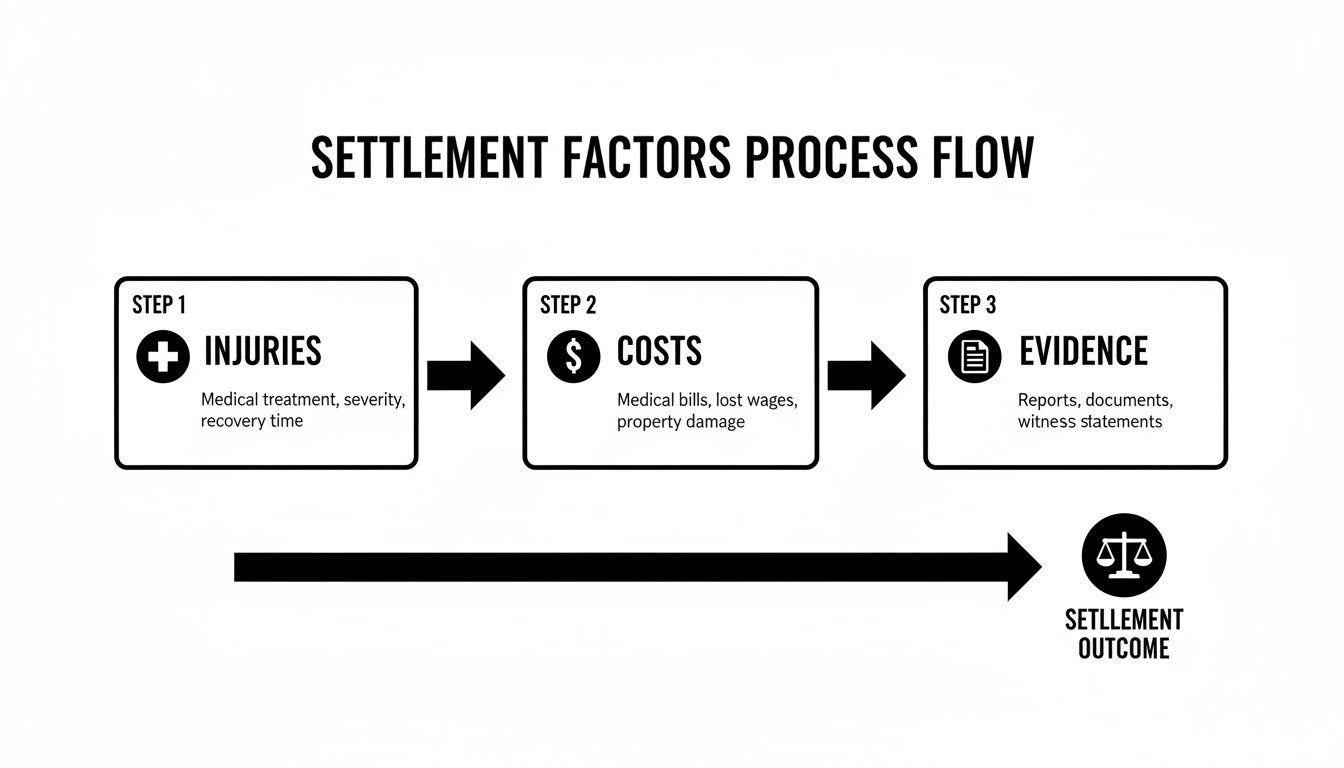
As you can see, documented injuries, calculated costs, and solid evidence are the three pillars holding up a successful negotiation.
The Art of Negotiation
Going back and forth with an insurance adjuster is a strategic game. Their job is simple: protect their company’s profits by paying you as little as possible. Your goal is the complete opposite: secure every penny you rightfully deserve.
This isn’t just a simple conversation; it’s a tactical exchange. The strength of your initial demand letter, backed by solid evidence, sets the tone for everything that follows. Every counteroffer needs to be analyzed and met with arguments based on facts, not emotion.
Patience is key here. Adjusters often use delay tactics or throw out ridiculously low offers, hoping you’ll get frustrated and take a bad deal. This is where knowing your claim’s true value becomes your biggest advantage. For a closer look at proven strategies, you can learn more about how to negotiate a personal injury settlement in our in-depth guide. If the talks hit a wall and the insurance company refuses to be reasonable, filing a lawsuit might be the next step to show them you mean business.
Disclaimer: This article is for informational purposes and not to be construed as legal advice. No attorney-client relationship exists based on the review of this article, and none of the information in this article is legal advice.
Why an Attorney Is Your Strongest Advocate
Let’s be honest. Trying to take on an insurance company by yourself after a rear-end collision is like stepping into the ring with a heavyweight champ. They have entire teams of adjusters and lawyers whose only job is to protect their company’s profits by paying you as little as possible. This is where a personal injury attorney completely changes the game.
Hiring a lawyer isn’t just another expense—it’s the single most important move you can make to level the playing field. An experienced attorney immediately takes over all communication, putting a protective wall between you and the insurance adjuster. This stops you from accidentally saying something that could wreck your claim, like downplaying your pain or guessing about how the crash happened.
Maximizing Your Compensation
A good lawyer does a lot more than just make phone calls. They dig into every detail of your case, looking for all possible sources of compensation. We’re not just talking about your current medical bills. They factor in future treatments, lost earning capacity, and the real-world impact of your pain and suffering.
Where you might just see a stack of bills, a seasoned attorney sees the full, long-term financial and personal toll the accident has taken. They make sure nothing gets missed.
Adjusters have a playbook full of tactics—they’ll make a quick, lowball offer to close the case fast or try to twist the facts to blame you. An attorney knows this playbook inside and out and knows exactly how to shut them down with solid evidence and tough negotiation. Their only goal is to get you every penny you are rightfully owed.
Catastrophic rear-end collisions often lead to the largest settlements, sometimes pushing past $1 million for life-altering injuries like paralysis or a severe TBI. And remember, even if you were partially at fault, California’s pure comparative fault rules mean you can still recover damages.
The Advantage of Contingency Fees
One of the biggest things holding people back from getting legal help is the fear of how much it will cost. That’s why nearly all reputable personal injury attorneys work on a contingency fee basis. Think of it as a no-risk partnership.
Here’s how it works:
- No Upfront Costs: You don’t pay a single dime out of your pocket to hire the lawyer.
- Fees Paid from Settlement: The attorney’s fee is simply a pre-agreed percentage of the final settlement or verdict they win for you.
- You Don’t Pay Unless You Win: If for some reason your attorney doesn’t get you any compensation, you owe them nothing in legal fees. It’s that simple.
This setup puts your attorney’s interests on the exact same page as yours. It gives them every reason to fight for the biggest settlement possible, because their payment is tied directly to your success. It takes the financial risk off your shoulders and gives everyone, regardless of their bank account, a fighting chance at justice. For a deeper dive, check out our guide on the benefits of hiring a personal injury lawyer.
Disclaimer: This article is for informational purposes and not to be construed as legal advice. No attorney-client relationship exists based on the review of this article, and none of the information in this article is legal advice.
Common Mistakes That Can Hurt Your Claim

Successfully getting the settlement you deserve after a rear-end collision isn’t just about what you do—it’s also about what you don’t do. Seemingly innocent missteps can cost you thousands of dollars, or worse, get your claim denied entirely. Think of the insurance company as setting traps, and this is your guide to avoiding them.
One of the biggest blunders is giving a recorded statement to the other driver’s insurance adjuster before you’ve spoken with a lawyer. These adjusters are masters of conversation, trained to ask tricky, leading questions. Their goal? To get you to downplay your pain or even admit to some shred of fault. Every word you say can be twisted and used against you to justify a lowball offer.
Traps That Undermine Your Settlement Value
Another classic mistake is jumping at the first settlement offer. Let’s be clear: the first offer is almost always a lowball. Insurance companies bank on the fact that you’re stressed, in pain, and need the money quickly. By accepting it, you sign away your right to any future compensation, even if your injuries turn out to be far more serious than you first realized.
Crucial Reminder: Your social media is not your friend during a claim. Insurance investigators will absolutely dig through your profiles, looking for anything they can use to argue your injuries are exaggerated. That photo of you smiling at a birthday party? They’ll try to frame it as “proof” that you’re not really suffering.
Critical Actions to Avoid After an Accident
To protect the true value of your rear-end collision settlement, you have to be careful. Here are a few critical things to steer clear of:
- Downplaying Your Injuries: When you talk to your doctor, be brutally honest about your pain. If you say you’re “fine” when you’re actually in agony, that statement goes straight into your medical records and becomes a weapon for the insurance company.
- Missing Doctor’s Appointments: Big gaps in your medical care or skipping physical therapy sessions send a signal to the insurer: your injuries must not be that serious. They will use this to slash their settlement offer.
- Signing Documents Blindly: Never, ever sign anything from an insurance company without having an attorney look it over first. A seemingly harmless medical authorization form could give them free rein to dig through your entire medical history, looking for pre-existing conditions to blame for your pain.
Each of these errors hands the insurance adjuster the ammunition they need to devalue your claim. Knowing what not to do is just as important as knowing what to do.
Disclaimer: This article is for informational purposes and not to be construed as legal advice. No attorney-client relationship exists based on the review of this article, and none of the information in this article is legal advice.
Frequently Asked Questions About Rear End Settlements
After getting into a rear-end collision, it’s completely normal to have a million questions running through your mind. Let’s tackle some of the most common ones we hear from clients to help clear up any confusion and build on what you’ve learned so far.
Disclaimer: This article is for informational purposes only and is not a substitute for professional legal advice. Reading this article does not create an attorney-client relationship.
How Long Do I Have to File a Claim in California?
In California, the clock starts ticking immediately after the accident. You’re up against a strict deadline called the statute of limitations. For any personal injuries you’ve suffered, you generally have two years from the date of the crash to file a lawsuit. If your claim is only for property damage to your car, you get a little more time—three years.
Miss these deadlines, and you could lose your right to get any compensation at all. It’s a harsh rule, which is why it’s so important to get the ball rolling quickly. Speaking with an attorney right away ensures all the legal paperwork is filed on time, keeping your claim alive and well.
What if I Was Partially at Fault?
This is a great question, and the answer is one of the best things about California law. Our state follows a rule called “pure comparative negligence.” In simple terms, this means you can still recover money even if you were partially to blame for the accident.
So, if a court decides you were, say, 10% responsible for what happened, your final settlement amount would just be reduced by that 10%. A key part of an experienced attorney’s job is to fight back against any unfair blame the insurance company tries to place on you, minimizing your percentage of fault and maximizing the money that goes into your pocket.
Should I Take the First Settlement Offer?
It can be tempting, but accepting the insurance company’s first offer is almost always a bad idea. Think of it as their opening bid in a negotiation, not a fair final number. Insurance adjusters are trained professionals whose goal is to close your case for as little money as possible.
These initial offers are usually thrown out before anyone really knows the full extent of your injuries or what kind of future medical care you might need. Once you accept, that’s it—the case is closed forever. You should always have a legal expert review any offer to make sure it truly covers everything you’ve lost.
Do Most Rear End Cases Go to Court?
Not at all. The vast majority of rear-end collision cases—well over 95%—are settled out of court through negotiation. A settlement is just a formal agreement between you and the other side to resolve the case for an agreed-upon amount of money.
While your attorney might need to file a lawsuit to show the insurance company you’re serious, most claims still settle long before a judge or jury gets involved. Often, the credible threat of a trial is the most powerful tool you have to bring the insurer to the table and get them to offer a fair rear end collision settlement.
If you’ve been hurt in a rear-end collision, you don’t have to take on the insurance companies by yourself. At LA Law Group, APLC, we fight to protect your rights and get you the maximum compensation you deserve. Contact us today for a free, no-pressure consultation to discuss your case by visiting our website.
Attorney Advertising. This article is general information, not legal advice, and does not create an attorney-client relationship. Prior results do not guarantee a similar outcome.