
Slip and Fall at Workplace: Your Action Plan

You’re standing at the edge of a bad day, maybe in pain, maybe embarrassed, maybe trying to decide whether you should say anything at all. Don’t downplay it. A slip and fall at workplace can turn into weeks of treatment, a disputed claim, and a fight over who pays for what, especially when the first report is handled badly or the scene gets cleaned up fast.
The law treats these incidents seriously for a reason. The U.S. Bureau of Labor Statistics reported 479,480 days-away-from-work cases involving falls, slips, and trips in 2024 (BLS workplace injury data), and that number should tell you one thing plainly, this is not a nuisance claim. This is a real injury event with real documentation needs, and the choices you make in the first few hours matter.
Immediate Actions After a Workplace Slip and Fall
This article is for informational purposes only and is not to be construed as legal advice. No attorney-client relationship exists based on your review of this article, and none of the information in this article is legal advice.
Start with your body, not the paperwork. If you hit your head, twisted a knee, landed on your wrist, or feel back pain, get medical attention right away. That visit does more than treat the injury. It creates the first clean record tying your symptoms to the workplace event, and that paper trail often matters more than people realize when the insurer starts asking questions later.
The first few hours
Tell a supervisor what happened as soon as you can, but keep it short and factual. State where you fell, what caused it, and that you need medical care. Don’t give a long recorded explanation, don’t guess about fault, and don’t let anyone steer you into saying it was “nothing” before a clinician has seen you. A rushed statement can come back later and be used to minimize the claim.
If you can safely do it, preserve the scene before it changes. Take photos of the floor, the hazard, the lighting, any missing warning signs, and your shoes or clothing if they’re relevant. Then write down the time, exact location, and the names of anyone who saw the fall or saw the hazard before it was addressed.
Practical rule: treat the first report like evidence preservation, not a conversation.
The reason for that urgency is simple. Employers and their insurers often move quickly to control the narrative, and the workplace itself often changes just as fast. If you need a process reference for how to keep a report organized, practical incident management is a useful place to see how formal documentation should work in a serious incident.
What not to do
Don’t “walk it off” and hope the pain fades. That’s how workers lose ground, because delayed treatment gives the other side room to argue the injury wasn’t serious or wasn’t caused by the fall. Don’t clean up the scene if you don’t have to, and don’t throw away the clothes or shoes you were wearing.
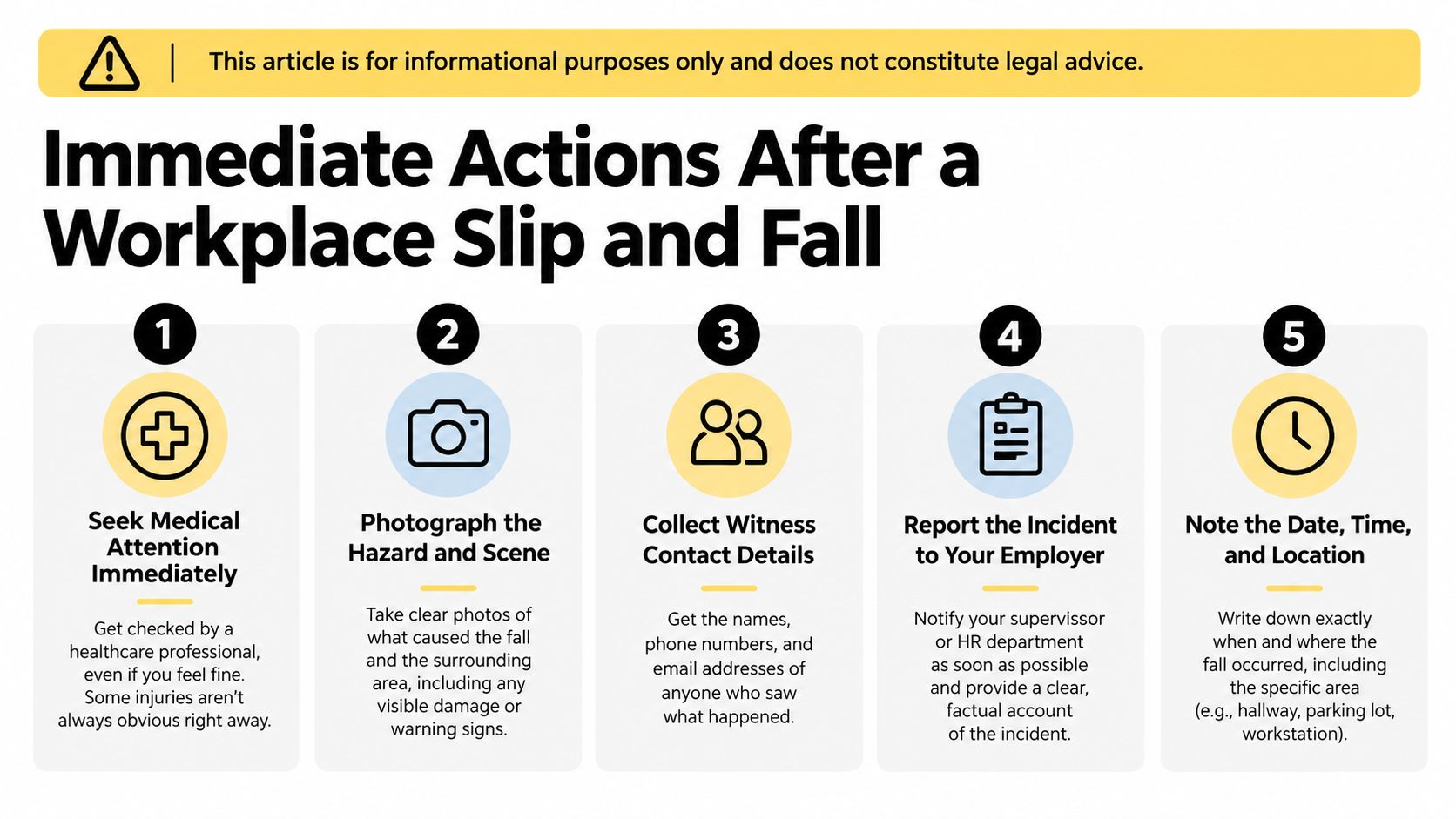
Use the incident report as your anchor point, then keep your own notes in a separate file. If the employer has a form, ask for a copy before the details get buried in HR or risk management. A fast, accurate record is often the difference between a clean claim and a messy dispute.
Preserving Evidence and Documenting the Incident
Once the initial shock passes, the next fight is over evidence. Transient hazards disappear quickly, a wet floor gets mopped, spilled product gets restocked, a loose mat gets removed, and the hazard that caused your injury can vanish within minutes. That’s why a workplace fall should be documented like a scene that won’t survive the shift.

What to capture immediately
Use your phone to take wide shots first. Show the entire aisle, room, or entryway so the reader of the file can see whether warning signs existed, whether the area was cluttered, and whether lighting or floor condition contributed to the fall. Then take close-ups of the exact substance or defect, whether it’s liquid, debris, damaged flooring, or a contaminated surface.
Witnesses matter just as much as photos. Get names, job titles if you know them, phone numbers, and a quick note about what each person saw. Co-workers often remember more in the moment than they do after a supervisor or claims adjuster starts asking follow-up questions.
A witness who saw the floor before the fall is usually more valuable than one who only saw you on the ground afterward.
Don’t miss the “near-fall” injury
A lot of people think a claim only counts if they hit the floor. That’s wrong. Injuries from twisting, bracing, or catching yourself can be every bit as serious as a full-impact fall, and the 2026 Liberty Mutual Workplace Safety Index says “slip or trip without fall” moved up to fifth place in the top workplace injury causes (WorkCompWire coverage of the 2026 index). That matters because the legal proof problem is different, but the injury is real.
Here the internal account, the photos, and the witness details do the heavy lifting. If your back, knee, shoulder, or wrist hurt after a stumble that never became a full fall, document it the same way you would a more obvious accident. The evidence standard doesn’t drop just because your body caught itself before impact.
For a related legal checklist, the guide on what to do after a slip and fall is worth reading once you’ve secured the scene.
Understanding Workers Compensation vs Third Party Claims
Workers’ compensation and third-party liability are not the same thing, and confusing them is expensive. Workers’ comp usually covers a job-related injury without requiring you to prove your employer was negligent. That’s the tradeoff, quicker access to medical benefits and wage-loss coverage, but limited recovery.
A third-party claim is different. It targets someone outside your employer whose negligence helped cause the fall, a landlord, a cleaning contractor, a delivery company, a maintenance vendor, or a product manufacturer. That claim can matter because it may reach damages that workers’ comp doesn’t cover, including pain and suffering and other broader losses.
Side by side
| Feature | Workers’ Compensation | Third-Party Liability Claim |
|---|---|---|
| Who you sue | Usually your employer is not sued directly | A negligent non-employer can be sued |
| Fault | Usually no-fault | Fault must be proved |
| Main benefits | Medical treatment and wage-loss benefits | Broader damages may be available |
| Pain and suffering | Usually not recoverable | Potentially recoverable |
| Can both apply | Yes, in the right case | Yes, alongside workers’ comp |
That table is the actual decision point. If the hazard existed because a building owner failed to maintain the common area, or a contractor created the mess and left it there, you may have two tracks at once. Don’t let anyone tell you workers’ comp is the whole story until the source of the hazard has been investigated.
A useful legal reference point on related injury issues is work injury law, especially when more than one company had control over the area where the fall happened.
Read the scene, not just the label
The label “work injury” can hide a liability problem. If the fall happened in a shared hallway, at a customer site, or in an area maintained by another company, the case may have third-party value that isn’t obvious at first glance. That’s why you should ask one blunt question early, who controlled the hazard, and who had the duty to fix it?
If the answer isn’t just your employer, the case deserves a deeper look. Workers’ comp gets the basics moving, but a third-party claim can be what protects the long-term value of the case.
Calculating and Documenting Your Financial Losses
Your damages file should be bigger than a stack of hospital bills. Start with every receipt tied to treatment, then add the smaller losses that insurers love to ignore, mileage to appointments, medication co-pays, braces, crutches, and the cost of help you had to hire for chores you can’t do yourself. Those items matter because they show the full economic cost of the injury, not just the headline medical bill.
The financial stakes are serious. CDC/NIOSH estimates that same-level slip, trip, and fall injuries cost nearly $13 billion in direct workers’ compensation-related costs each year (CDC/NIOSH bulletin). That figure is a reminder that insurers know these claims are expensive, which is exactly why they look for gaps in your documentation.
Build the file in categories
Keep the following in separate folders or tabs:
- Medical care: emergency care, follow-ups, therapy, prescriptions, assistive devices.
- Work loss: missed shifts, reduced hours, changed duties, unpaid time off.
- Out-of-pocket costs: mileage, parking, home help, medical supplies.
- Future impact: expected surgery, continuing treatment, permanent restrictions.
The future impact piece is where many workers leave money on the table. If your doctor thinks you may need more treatment, ask for that in writing before any settlement discussions get serious. A clear medical narrative on future care and work restrictions gives your claim a much stronger foundation.
Don’t ignore earning power
If the injury forces a job change or prevents you from returning to the same physical duties, your loss isn’t just a current paycheck problem. It can affect your earning capacity going forward. That’s why the records should show what you did before the injury, what you can do now, and what your doctor says you can’t safely do anymore.
Bottom line: if the injury changes your work life, document the change like a financial loss, not just a medical complaint.
A practical settlement guide like how to calculate personal injury settlement can help you think through the categories, but the value comes from clean records. Don’t wait until the end to reconstruct costs from memory. That always leaves money on the table.
Navigating Filing Timelines and Legal Deadlines
Assuming somebody else will handle the deadlines is a mistake. Employers miss things, insurers stall, and internal reporting rules are not the same as legal filing windows. If you let one deadline slip, you can weaken or even lose a claim that would otherwise have held up.
The employer’s reporting duties are separate from yours. OSHA’s severe-injury rule requires employers to notify OSHA within 8 hours after a work-related fatality and within 24 hours after a work-related inpatient hospitalization, amputation, or loss of an eye (OSHA reporting rule). That rule doesn’t replace your own filing obligations, but it can create a paper trail worth preserving if the incident was serious.
Know the deadline layers
There are usually three clocks running:
- Internal notice, your report to the supervisor or HR.
- Claim filing, the workers’ comp process required in your jurisdiction.
- Suit deadline, the statute of limitations if a third-party case exists.
Those clocks are not interchangeable. A worker can report an injury at work and still miss the deadline to file the formal claim. A worker can also pursue a third-party case and still lose it by waiting too long to file.
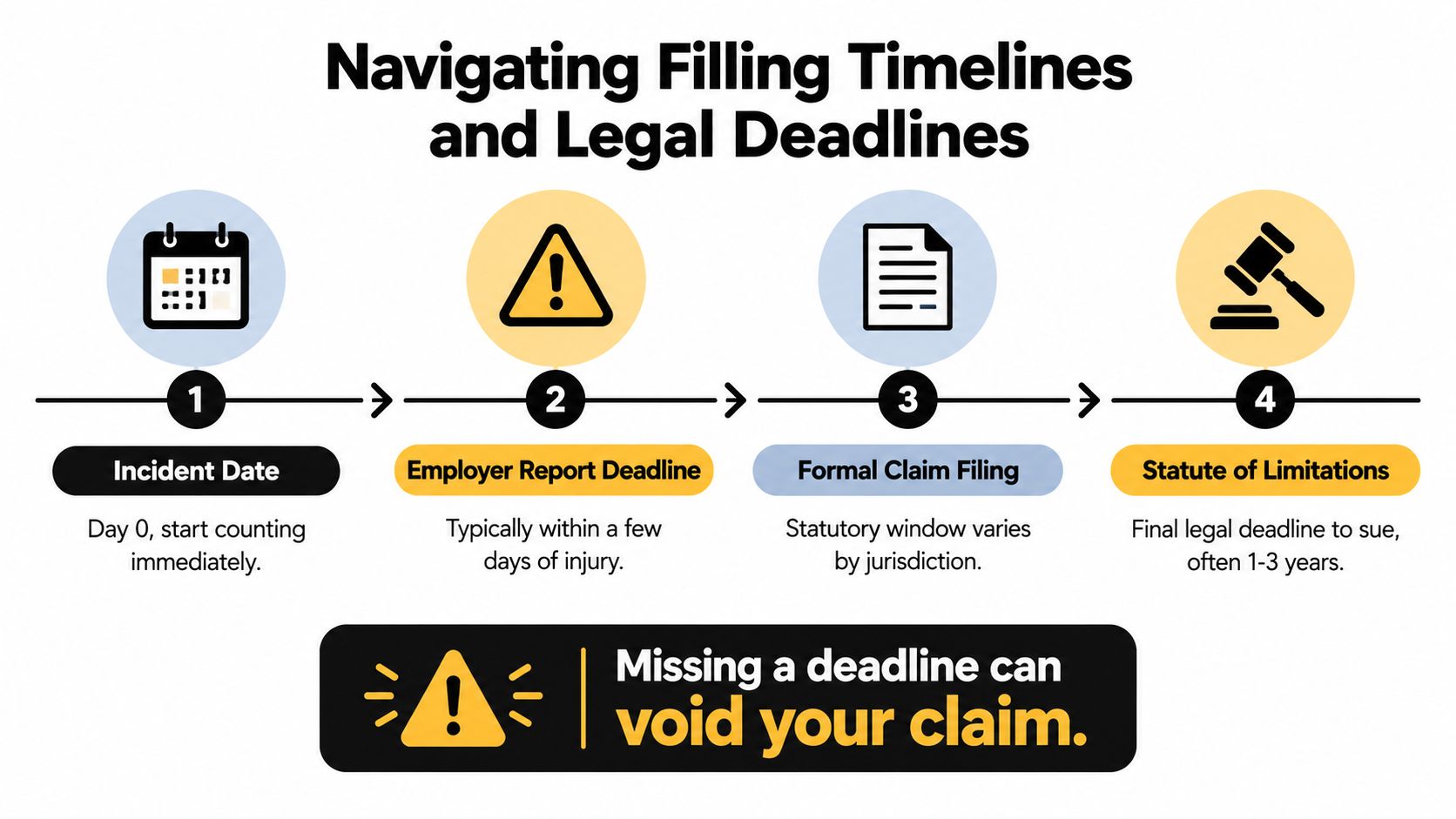
The safest move is to calendar every date the day the injury happens. If the employer gives you forms, keep copies of everything you send and receive. If an adjuster asks for time, get the request and response in writing.
Don’t let delay tactics lull you into inaction. The case doesn’t get better because everyone is being “nice” while the clock runs out. It gets worse because evidence fades and deadlines close.
When to Consult a Personal Injury Attorney
You should call for legal help early when the claim is being slowed down, narrowed, or pushed into silence. If the employer wants a recorded statement before you’ve had medical treatment, if treatment approvals are stalling, or if someone starts suggesting the fall was your fault before any real investigation, that’s a warning sign. The same is true when a third party may have contributed to the hazard, because that issue can disappear fast if nobody investigates it.
The severity level matters too. CDC/NIOSH reports that 50% of same-level falls result in more than 10 days away from work (CDC/NIOSH falls guidance). If the injury is likely to keep you out of work for more than a few days, you need someone who knows how to protect both the claim and the long-term value of the case.
What a lawyer actually does
A good lawyer takes the insurer out of your direct line of communication and handles the pressure for you. That means reviewing the accident facts, identifying third-party defendants, gathering records, and keeping the claim from being reduced to a cheap settlement before the full impact is known. It also means forcing the evidence question, who owned the hazard, who controlled the area, and who had notice of the danger?
Here’s the part injured workers should hear clearly. Early consultation is not an escalation. It’s protection. Once you sign broad releases or make sloppy statements, the damage is hard to undo.
LA Law Group, APLC handles personal injury matters and workplace injury claims, so it’s one option if you want a legal team to evaluate both workers’ compensation and third-party angles in the same case. If you want direct help with a workplace fall claim, visit LA Law Group, APLC and ask for a consultation before the claim gets boxed in by paperwork or delay.
Attorney Advertising. This article is general information, not legal advice, and does not create an attorney-client relationship. Prior results do not guarantee a similar outcome.