
Spinal Cord Injury Lawyer California: How to Choose

You’re in the worst stretch of a serious injury claim. The hospital is moving fast, the insurer is already circling, and nobody has told you what your case will cost over a lifetime or how easily California procedure can shrink it before it even gets started. A spinal cord injury lawyer California clients should hire does more than file papers, because the wrong first moves can damage recovery long before any settlement talk begins.
Your job right now is simple, even if it doesn’t feel simple. Protect the evidence, protect the medical record, and protect the claim deadline while you’re still focused on treatment. California spinal cord injury cases are built on what gets preserved early, not on what gets remembered months later.
What to Do in the First 30 Days After a Spinal Cord Injury
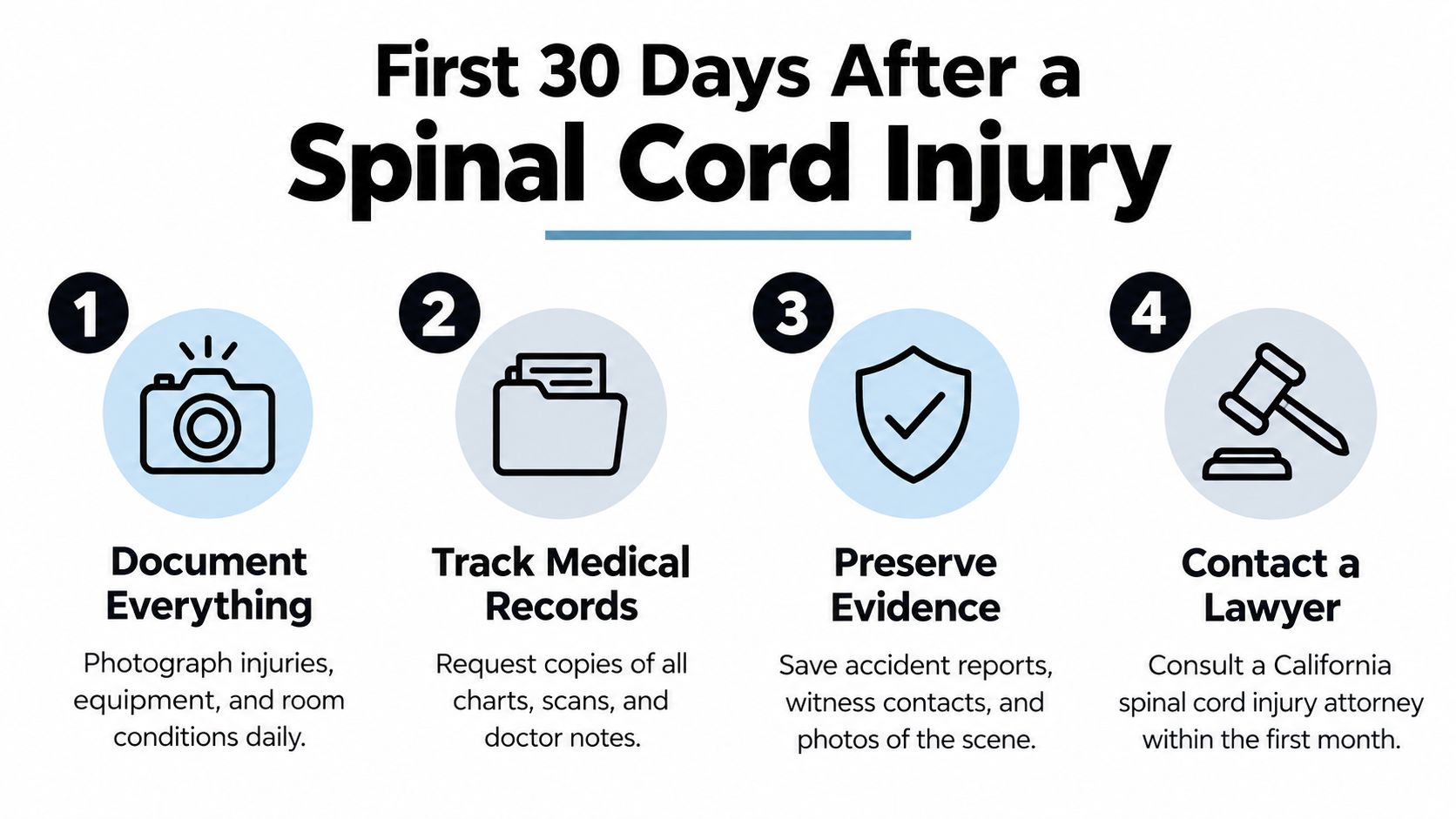
The first month is not the time to wait and see. It is the time to treat every document, photo, and note as evidence, because insurers and defense lawyers will. Transportation crashes and falls account for the largest share of traumatic spinal cord injuries, so your file needs to show both how the injury happened and how it has changed daily life from the start (National Spinal Cord Injury Statistical Center).
Lock down the basics first
Get the police or incident report, the full medical chart, and every photo or video from the scene. Save names, phone numbers, and the exact location of any witnesses. If the injury happened on someone else’s property, ask for surveillance footage right away before it gets overwritten.
Do not give a recorded statement to the insurance carrier until a lawyer has reviewed the facts. One careless answer can become a defense exhibit. Do not sign a medical release or a settlement paper because an adjuster says it will speed things up.
Practical rule: treat every early communication as evidence, not conversation.
Keep a dated journal. Record pain, transfers, sleep problems, bladder or bowel issues, missed work, mobility limits, and the tasks you can no longer do without help. That record matters because a spinal cord injury claim has to prove the long-term impact through medical records, rehabilitation notes, vocational proof, and life-care documentation. National Spinal Cord Injury Statistical Center data is useful for the injury categories, while the rehab and life-care records show how the injury will affect your day-to-day life and future treatment.
Don’t let the insurance company set the pace
California claims get squeezed when the early file is sloppy. Delayed medical proof makes it easier for the defense to argue that something else caused the symptoms, or that the harm is smaller than it is. The first 30 days should focus on preserving liability evidence, documenting the full medical picture, and tracking the costs that will keep growing over time.
That matters even more in spinal cord cases because the loss is rarely limited to the hospital stay. Mobility, housing, transportation, personal care, and work often change for years. A lawyer who models damages correctly has to build from treatment records, rehabilitation history, and future-care planning, not from a quick adjuster estimate.
The first month should produce a clean file, not a rushed deal. If you get the record right now, you give the lawyer something real to build on later.
What a California Spinal Cord Injury Lawyer Does
A serious catastrophic-injury lawyer is part strategist, part records manager, and part damage modeler. The work is to organize the facts so the case can withstand scrutiny on liability, causation, and future care. Spinal cord claims are not bigger versions of routine car-crash files, they require a different level of proof and damages work.

The lawyer has to build the medical and vocational case
The lawyer should know how neurological severity is classified through the American Spinal Injury Association Impairment Scale, then use that severity to shape the damages model. That means separating high tetraplegia, low tetraplegia, paraplegia, and motor-functional injury before anyone starts talking settlement numbers. The point is simple, the claim has to match the injury’s real functional burden, not the adjuster’s shortcut.
A competent catastrophic-injury practice also brings in the right experts. Life-care planners, vocational experts, and economists explain future rehabilitation, attendant care, equipment replacement, and loss of earning capacity. A general personal-injury shop may handle a soft-tissue settlement well. A spinal cord claim demands a different evidence and damages process.
Look for proof of trial readiness, not noise
A serious firm should speak plainly about California Superior Court experience, treating-physician coordination, and how it handles structured settlements and future care needs. If the lawyer cannot explain how a spinal cord case is documented across decades, keep looking. If the firm cannot describe how it prepares for contested liability, it is not really preparing your case.
Ask whether the office has handled claims involving public entities, comparative fault, and multi-defendant exposure. In California, those issues often decide whether recovery survives intact or gets cut down before trial.
California Deadlines and the Government Claim Trap
California deadline law is unforgiving, and spinal cord cases don’t get extra mercy because the injury is severe. Ordinary negligence claims generally must be filed within two years under Code of Civil Procedure section 335.1 (California Legislature). If a government entity is involved, the claim presentation deadline can drop to six months under the California Government Claims Act (California Legislature).
That six-month trap is the one that kills good cases. A crash on a state-maintained roadway, injury on city property, or claim involving a public vehicle can trigger the shorter fuse. Miss the claim presentation window, and the lawsuit can be dead even if the underlying injury is catastrophic.
| Defendant Type | Deadline | Governing Authority |
|---|---|---|
| Private defendant | Two years from injury | Code of Civil Procedure section 335.1 |
| Government entity | Six months to present a claim | California Government Claims Act |
California also follows comparative fault. If the other side proves you were partly responsible, your recovery gets reduced by your share of fault under Li v. Yellow Cab Co. (California Courts). The defense doesn’t have to eliminate your claim to hurt it. It only has to move the percentage.
That’s why early defendant identification is critical. A lawyer who waits to figure out whether a city, county, contractor, or private company is involved may be giving up time that can’t be recovered. If you want a plain-language overview of the timing rules, see this explanation of the California negligence statute of limitations (internal resource).
How Spinal Cord Injury Damages Are Modeled
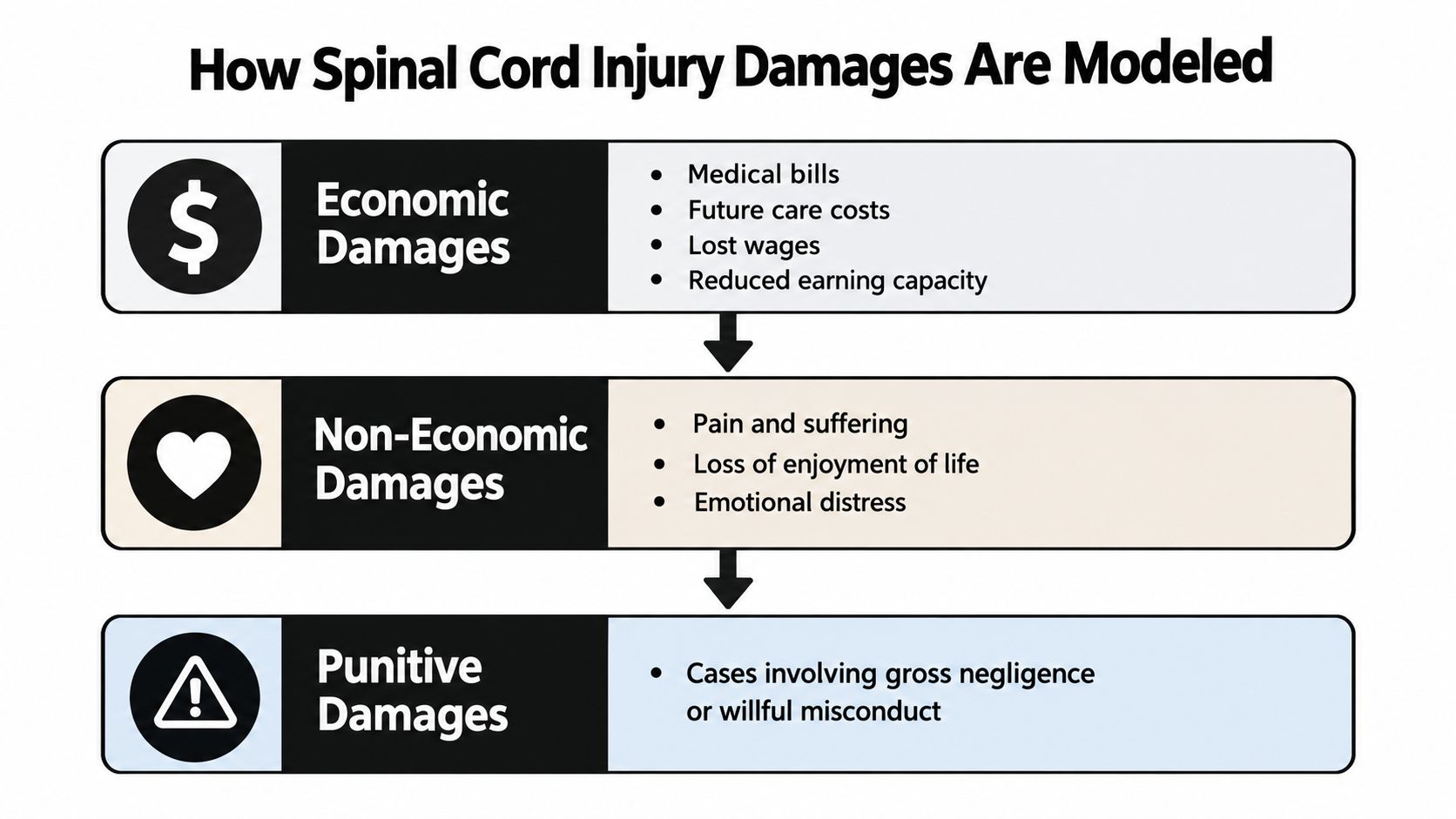
A serious spinal cord case is not valued with a rough settlement guess. It is built in layers, starting with the injury classification and ending with a present-value projection of future care. The model has to reflect what the person needs now, what those needs will become, and what it will cost to provide them over time.
Start with severity, then build the care plan
The right first step is to classify the injury, then build a life-care plan around rehabilitation, attendant care, equipment, home modification, transportation, and medical surveillance. That is the structure behind the damages model, and it is why generic calculators are a bad joke in catastrophic cases. For a useful consumer-level look at adaptive mobility equipment, this overview of what power wheelchairs cost can help frame the replacement expense a care plan may have to address (DME Superstore).
The 2025 Traumatic Spinal Cord Injury Facts and Figures estimates first-year direct expenses of $1,410,163 for high tetraplegia, $1,018,966 for low tetraplegia, $687,262 for paraplegia, and $460,224 for motor-functional injury, with discounted lifetime direct costs ranging from about $2.09 million to $6.26 million for a person injured at age 25 (MSKTC).
Don’t stop at direct medical bills
Direct care is only part of the claim. Indirect costs, including lost wages, fringe benefits, and reduced productivity, sit on top of that and have to be evaluated separately. California jury instructions also require future losses to be converted into present value rather than guessed as one lump number, which is why lawyers use worksheets, tables, and expert testimony instead of armchair estimates (California Courts).
Bottom line: the settlement number should come from a layered forecast, not a wish.
A lawyer should tie each future expense to the functional limits the injury creates, then check whether the projected care matches the person’s daily reality. That includes replacement timing for equipment, likely care changes over time, and the wage loss picture. If the attorney cannot explain how the future numbers were built, the claim is underbuilt.
For a broader breakdown of damage categories, see this guide to types of damages in California injury cases (internal resource).
Contingency Fees Case Costs and What Your Retainer Should Say
You should know exactly how the lawyer gets paid before you sign anything. In catastrophic injury work, the standard structure is a contingency fee, meaning the fee comes out of the recovery rather than from hourly billing. The contract should separate attorney fees from case costs, because those are not the same thing.
Read the fee structure like a consumer, not a gambler
A reasonable catastrophic case agreement should say who advances costs, when those costs are reimbursed, and what happens if the case doesn’t recover money. The contract should also spell out lien handling, because Medicare, Medi-Cal, ERISA plans, and hospital claims can eat into the net if they’re not resolved correctly. A good lawyer doesn’t shrug that off at the end, because the end is too late.
If you want a plain explanation of the structure, this guide on a contingent fee agreement is worth reviewing before you sign (internal resource). The point is simple, read the paperwork as if you may need to compare firms. If the terms are vague, that’s a warning sign.
Ask who pays if the case is lost
Most clients in a contingency arrangement shouldn’t be writing checks for routine firm-advanced costs if there’s no recovery, but the contract controls. Don’t assume. Structured settlements can also interact with public benefits, so the lawyer should be able to explain that issue in plain English rather than hand-waving it away.
Practical rule: if the fee agreement is hard to understand, it probably isn’t client-friendly.
The closing statement should show the gross recovery, the fee, the case costs, the lien deductions, and the net to you. If your lawyer can’t explain that cleanly, you’re signing too fast.
Questions That Expose Whether the Lawyer Is the Right Fit
The consultation is your interview of the lawyer, not the other way around. You’re trying to find out whether this person can handle a claim that involves future care, defense blame-shifting, and California-specific procedure. Good answers sound concrete. Weak answers sound smooth.
Ask questions that force specifics
Use questions that require names, examples, and process details:
- What was your last California Superior Court verdict in a spinal cord or paralysis case? A strong answer names a case type, venue, or trial posture. A weak answer talks around it.
- Do you use a life-care planner, vocational economist, and treating-physician support? Strong firms know who does what and when. Weak firms say they’ll “figure it out later.”
- How do you handle comparative fault when liability is disputed? The lawyer should explain how fault exposure gets analyzed early, not after the defense files a motion.
- How do you handle government claims, public entities, and Proposition 51 issues? If the answer is vague, the firm may not do much catastrophic work.
- What do I pay if there’s no recovery? The answer should be clear, written, and consistent with the retainer.
A good office will also be direct about communication. Some firms run a case-manager model, while others give clients direct attorney access. Either can work if the process is disciplined. What you want to avoid is silence, pressure, or a guaranteed outcome.
Watch for volume-shop behavior
Guaranteed results are a red flag. So is pressure to sign on the spot. So is a lawyer who can’t name even one verdict or explain how the injury will be valued over time.
If you want a firm-level example of the kind of representation that handles personal injury and business matters in California, LA Law Group, APLC offers spinal cord injury case evaluation, evidence collection, insurance negotiation, and court representation when needed, along with free initial consultations. That doesn’t replace your due diligence, but it does show the kind of service structure you should expect from a serious office.
After You Hire the First 90 Days and Important Disclaimers
The first 90 days after hiring counsel should feel organized, not noisy. The lawyer should send preservation letters, collect medical records, identify every liable party, and start building the demand package with treating records and expert input. If there’s a delay, you should be told why.
What should happen early
You should see progress on three tracks at the same time, liability evidence, medical documentation, and damage development. That means incident reports, rehab records, imaging, wage proof, and early expert coordination. If your lawyer is waiting for the defense to “make the first move,” that’s not strategy, that’s drift.
Use this period to evaluate whether communication is real or just polite. If the lawyer is pushing settlement before the life-care plan is complete, hiding lien exposure, or refusing to discuss comparative-fault risk, get a second opinion fast. A serious spinal cord injury case can’t be built on optimism alone.
If daily care is becoming a burden, a simple caregiver app can help track shifts, tasks, and medication reminders while the legal team works on the claim. A practical overview like this guide on how to pick a caregiver app can help families choose a tool that fits the workload (Tribulys).
This article is for informational purposes only and is not to be construed as legal advice. No attorney-client relationship exists based on the review of this article, and none of the information in this article is legal advice.
If you need a team that handles catastrophic injury claims with direct attorney access and disciplined case development, LA Law Group, APLC can evaluate your spinal cord injury claim, preserve the evidence, and push the case toward a real damages model instead of a rushed payout. Visit the firm’s site to request a consultation and get your deadline, liability exposure, and future-care issues assessed now.
Attorney Advertising. This article is general information, not legal advice, and does not create an attorney-client relationship. Prior results do not guarantee a similar outcome.