
California Statute of Limitations: Key Deadlines You Must Know

Disclaimer: This article is for informational purposes only and should not be taken as legal advice. No attorney-client relationship exists based on the review of this article and none of the information in this article is legal advice.
In California, every potential lawsuit comes with a ticking clock. This deadline is known as the statute of limitations, and it dictates the maximum amount of time you have to file a claim after something has gone wrong. The timelines can vary quite a bit depending on what your case is about. For example, a personal injury claim generally needs to be filed within two years, but if you’re dealing with a written contract dispute, you have four years.
If you miss this window, your right to seek justice through the court system could be gone for good.
Understanding the Legal Countdown Clock
Think of the statute of limitations as an expiration date on your legal rights. Just like a carton of milk in your fridge, your legal claim has a shelf life. Once that date passes, the claim essentially spoils, and you lose the ability to take it to court—no matter how solid your case might be. This is a fundamental concept in California law that trips up many people.
So, why do these deadlines exist in the first place? They’re not there to be arbitrary hurdles. They serve a few critical functions to keep the justice system fair and moving.
- To Preserve Evidence: Time is the enemy of evidence. Memories fade, paperwork gets misplaced, and physical proof can degrade or disappear entirely. Setting a deadline ensures cases are heard while the evidence is still fresh and reliable.
- To Prevent Endless Threats: Imagine if someone could sue you for something that happened 20 years ago. Without deadlines, people and businesses would live with the constant uncertainty of old claims popping up out of nowhere. These statutes create a necessary point of finality.
- To Encourage Swift Action: The law favors those who act promptly. By setting a time limit, the system encourages people with legitimate claims to move forward instead of sitting on them indefinitely, which helps resolve disputes much more efficiently.
Key Timelines at a Glance
To give you a clearer picture, here’s a quick rundown of the most common statutes of limitations you’ll find in California. Keep in mind, this is just a starting point, and we’ll dive into the specifics of each category later on.
California Statute of Limitations Quick Reference
Here is a summary table outlining the common legal deadlines for filing a lawsuit in California.
| Case Type | Time Limit to File |
|---|---|
| Personal Injury (e.g., Car Accident) | 2 years from the date of injury |
| Medical Malpractice | 1 year from discovery or 3 years from injury |
| Written Contract Breach | 4 years from the date of the breach |
| Oral Contract Breach | 2 years from the date of the breach |
| Property Damage | 3 years from the date of damage |
| Fraud | 3 years from the discovery of the fraud |
This table provides a high-level overview, but remember that exceptions can and do apply.
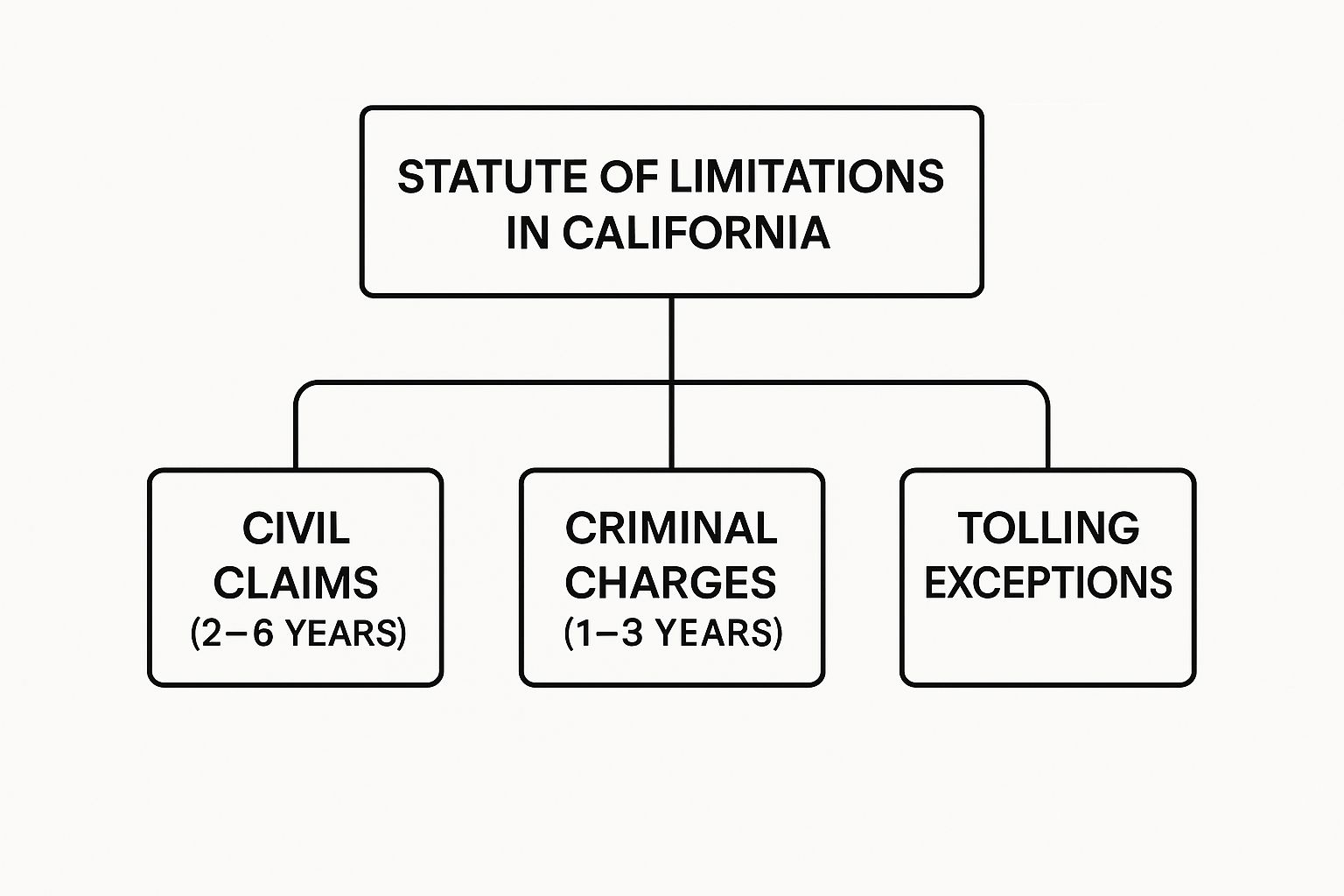
As you can see, different types of legal claims operate on very different timelines. There are also specific situations that can pause or even extend these deadlines, which is something we’ll explore in more detail.
Deadlines for Personal Injury and Medical Malpractice
When you’ve been physically hurt, the legal clock starts ticking, and it often ticks the loudest. For most personal injury claims in California—think car accidents, dog bites, or a nasty slip-and-fall—you generally have two years from the date of the incident to file a lawsuit. This two-year window is there for a reason: it helps ensure evidence is still fresh and people’s memories of what happened are still clear.
But what happens when an injury is a slow burn, not revealing its true severity right away? This is where a critical legal concept called the discovery rule comes into play. The discovery rule can effectively press “pause” on that two-year clock until you actually know, or reasonably should have known, that you were injured.

The Discovery Rule in Action
Let’s put this into a real-world context. Imagine you’re in a fender-bender and walk away with what feels like a minor sore neck. You figure it’s not worth the hassle of a lawsuit. Six months down the line, though, you start feeling severe back pain and numbness. A doctor runs some tests and diagnoses a serious spinal injury directly caused by the accident.
Without the discovery rule, your two-year clock would have started ticking on the day of the crash. But because of it, you can make a strong argument that the clock didn’t really start until you got that diagnosis—the moment you discovered the true extent of your harm. Understanding the specific nuances of the statute of limitations for car accidents in California is absolutely essential for protecting your rights in these kinds of situations.
Medical Malpractice: A More Complex Timeline
When it comes to medical malpractice claims, California has a different and more complicated set of deadlines. These cases operate under a tricky dual-timeline system that can easily trip people up.
In general, a patient has either one year from the date they discover the injury or three years from the date the injury actually happened—whichever comes first. This structure tries to balance the need for quick action with the reality that medical negligence might not be obvious for months or even years.
This means you can’t just wait around forever, even if you don’t find out about the harm for a long time. That three-year mark acts as a hard cutoff, with very few exceptions.
Let’s break this down with a practical example:
- Scenario One: A surgeon accidentally leaves a surgical sponge inside a patient during an operation on March 1, 2023. The patient feels persistent pain and an X-ray reveals the mistake on September 1, 2023. In this case, the one-year-from-discovery clock starts ticking on September 1, 2023, giving them until September 1, 2024, to file a lawsuit.
- Scenario Two: Same surgical error, same date: March 1, 2023. This time, however, the patient doesn’t have any noticeable symptoms. The sponge isn’t found until a routine scan on April 1, 2026. Here’s the tough part: even though the discovery just happened, the absolute three-year deadline from the date of the injury passed on March 1, 2026. The patient would almost certainly be barred from filing a claim.
Managing a high-volume personal injury practice means juggling these critical deadlines is part of the daily grind. To make sure no potential client slips through the cracks, many firms now use tools like AI phone answering services for personal injury lawyers to capture initial client information efficiently and never miss a call.
Disclaimer: This article is for informational purposes and not to be construed as legal advice. No attorney client relationship exists based on the review of this this article and none of the information in this article is legal advice.
Navigating Contract and Property Damage Timelines
It’s not just about physical injuries. California’s statute of limitations also draws firm lines in the sand for financial and property disputes. The rules for contracts are a big deal, especially because they treat written agreements very differently from verbal ones. Getting these timelines right is crucial for protecting your interests, whether you’re in business with a partner or filing a claim against your homeowner’s insurance.
When it comes to agreements, California law creates a massive gap between promises put on paper and those sealed with a handshake. That difference has a direct impact on how long you have to take someone to court if things go south.
- Written Contracts: If you have an agreement that’s formally written down and signed, you get four years from the day the contract was broken to file a lawsuit.
- Oral Contracts: For verbal agreements—those “handshake deals”—the window shrinks dramatically. You only have two years from the date of the breach to pursue legal action.
That two-year difference is a game-changer and really shows why getting every important agreement in writing is non-negotiable.
A Tale of Two Contractors
Let’s walk through a real-world example to see how this plays out. Imagine you hire a contractor to finally get that dream kitchen remodel done.
Scenario 1: The Written Agreement: You both sign a detailed contract spelling out the work, materials, and a firm completion date of June 1st. The contractor does a sloppy job, then completely ghosts you on June 2nd, leaving your kitchen in chaos. Because you have that signed contract, the clock starts ticking, but you have a full four years—until June 2nd four years later—to sue them for breach of contract.
Scenario 2: The Handshake Deal: Now, picture the same scenario, but you hired the contractor based on a verbal agreement and a firm handshake. He promises all the same things, but nothing is in writing. When he bails on June 2nd, your legal clock is ticking much, much faster. You’d only have until June 2nd two years later to file your lawsuit.
The longer four-year period for written contracts exists for a simple reason: the evidence is crystal clear. The document speaks for itself and doesn’t rely on anyone’s fuzzy memory. The much shorter two-year deadline for oral contracts reflects just how hard it can be to prove what was said years after the fact.
Protecting Your Property
The legal timelines shift yet again when your property gets damaged because of someone else’s carelessness or intentional act. It doesn’t matter if it’s a small fender bender or major structural damage to your house—the rule is pretty consistent.
For most claims involving damage to your property, both real and personal, the statute of limitations in California is three years. This clock starts on the date the damage actually happened. This rule covers a huge range of situations, from a neighbor’s tree crashing through your roof to another driver sideswiping your parked car.
While three years might sound like plenty of time, it can fly by when you’re busy gathering evidence and building a strong case. Many of the first steps, like documenting everything, overlap with other types of claims. You can learn more about how to file a personal injury claim to get a better sense of how crucial early evidence gathering is.
In the end, whether you’re dealing with a broken promise or a damaged car, knowing these deadlines is your first and most important line of defense. Acting fast is the only way to make sure you keep your right to seek the compensation you deserve.
Understanding How Deadlines Can Be Extended or Paused
That ticking clock on a legal claim isn’t always as rigid as it seems. While the statute of limitations in California sets firm deadlines, the law is smart enough to know that some situations make it unfair—or downright impossible—for someone to file a lawsuit on time. In these specific cases, the legal system can essentially hit the pause button.
This concept is called tolling. The best way to think about it is like pausing a stopwatch during a race because a tree fell on the track. The clock stops until the obstacle is cleared, then starts again right where it left off. Tolling makes sure people don’t lose their legal rights simply because of circumstances they can’t control.
When the Clock Stops for Minors and Incapacitated Individuals
One of the most common reasons for tolling a deadline has to do with the plaintiff’s ability to actually take legal action. California law builds in protections for individuals who aren’t legally able to file a lawsuit for themselves.
This usually comes up in two scenarios:
- Minors: If the injured person is under 18, the statute of limitations is generally paused. The clock doesn’t typically start running until they celebrate their 18th birthday. So, if a 16-year-old is hurt in a car crash, that two-year personal injury deadline won’t even begin to count down until they’re a legal adult.
- Mental Incapacity: In a similar way, if a person is legally deemed “insane” or lacks the mental capacity to make decisions when their injury occurs, the deadline is tolled. This pause can last until their competence is restored, giving them a fair shot at pursuing justice once they are able to do so.
This is a critical safeguard. It ensures our most vulnerable aren’t penalized just because they can’t navigate the complex legal system at the time of their injury.
How a Defendant’s Actions Can Pause the Deadline
It’s not just about the person filing the lawsuit; the defendant’s behavior can also put the clock on hold. The law is designed to stop people from causing harm and then simply skipping town to run out the clock.
A key rule in California law states that if a defendant leaves the state after an incident occurs, the statute of limitations clock is paused for the entire time they are gone. This prevents someone from dodging a lawsuit by moving out of California and just waiting for the deadline to pass.
Let’s say a shady contractor takes a huge deposit for a home remodel and then disappears to another state. If the statute of limitations for your breach of contract claim is four years, the time he spends outside California doesn’t count against that limit. The clock only starts ticking again if and when he returns.
This rule keeps things fair and stops defendants from gaming the system to avoid being held accountable. Understanding these tolling exceptions is a huge part of grasping the full picture of the statute of limitations in California, as they can completely change the timeline for filing a valid claim.
Disclaimer: This article is for informational purposes and not to be construed as legal advice. No attorney client relationship exists based on the review of this this article and none of the information in this article is legal advice.
How California Law Bends the Rules with Special Case Deadlines
Laws aren’t set in stone. They’re living things, constantly evolving to reflect a society’s sense of justice and fairness. The statute of limitations in California is a perfect example of this. Lawmakers often tweak these deadlines to provide better protection in unique and often difficult situations, recognizing that some kinds of harm just don’t fit neatly into a standard timeline.
These updates show how the legal system can adapt to tackle complex social issues, giving victims a more realistic shot at justice. It’s just as important to understand these special cases as it is to know the general rules because they can completely change the game for those affected.
A Wider Window for Survivors of Sexual Assault
One of the most powerful recent changes addresses the immense hurdles faced by adult survivors of sexual assault. For far too long, the standard deadlines failed to account for the deep psychological barriers that can keep a survivor from coming forward for years, sometimes even decades.
Thankfully, California lawmakers have recognized this reality and extended the filing window. A landmark 2018 law (AB 1619) significantly expanded the statute of limitations for civil claims related to adult sexual assault. This critical update gives survivors ten years from the last act of assault or three years from the discovery of the injury, whichever comes later. It’s a much more compassionate and realistic timeframe that allows survivors to process trauma on their own terms before deciding to pursue legal action.
This extension is a clear acknowledgment that the path to justice isn’t always a straight line and that healing takes time. It ensures the courtroom doors stay open for those who need more time to be ready to tell their story. For families grappling with the tragic loss of a loved one under difficult circumstances, understanding how these deadlines work is critical. You can learn more about the specific timelines in our guide on the statute of limitations for wrongful death.
Clarifying the Clock on California Lemon Law
The law also adapts to protect people in more common, everyday disputes. A perfect example is California’s lemon law, which is a lifeline for folks who’ve bought a defective vehicle that the dealer just can’t seem to fix. To clear up any confusion, lawmakers recently clarified the timeline for these specific cases.
Starting January 2025, a new law (AB 1755) sets a firm deadline for filing a lemon law lawsuit. Under this change, a claim must be filed within one year after the vehicle’s express warranty expires, but no later than six years from the original delivery date of the car. This gives consumers a well-defined window to take action.
These legislative adjustments—in areas from lemon law to sexual assault—show a real commitment to fairness. They ensure California’s statutes of limitations reflect not just changing social priorities but also the practical realities people face every day.
An Extra Year for Victims of Felonies
Another vital adaptation in California law gives victims of serious crimes an extended timeline to seek civil justice. The emotional and financial fallout from a felony can be staggering, and dealing with a criminal case often has to take priority over filing a civil lawsuit.
California Code of Civil Procedure Section 340.3 steps in here. It grants felony victims an extra one year to file a civil suit for damages, with the clock starting from the date the defendant is convicted of the crime. This extension is a crucial tool. It gives victims the breathing room they need to focus on the criminal proceedings first without losing their right to sue for compensation later. This provision makes sure that a criminal conviction doesn’t accidentally slam the door on a victim’s ability to seek financial recovery.
The History Behind California’s Filing Deadlines
Ever wonder why legal deadlines like the statute of limitations in California even exist? They aren’t just random numbers pulled out of a hat. These time limits are the product of more than a century of legal tinkering, all aimed at striking a delicate balance. On one side, you have a victim’s right to seek justice. On the other, a defendant’s right to a fair defense without the constant threat of an old lawsuit popping up years later.
The whole idea is to keep things fair and functional. Evidence gets lost, memories fade, and witnesses move away. These deadlines ensure cases are brought forward while the evidence is still fresh and reliable.
The groundwork for California’s modern legal deadlines was laid a long time ago. The state’s first real system for filing deadlines was baked into the 1872 Penal Code. Back then, things were much simpler: a one-year limit for most misdemeanors, a three-year limit for felonies, and no time limit at all for murder. You can actually trace the evolution of these rules in historical documents from the California Law Revision Commission.

From Simple Rules to a Complex System
But what started as a straightforward set of rules has gotten a lot more complicated. As California grew, so did its legal system. Lawmakers quickly realized that a one-size-fits-all approach just didn’t work for every situation.
This led to a whole series of changes over the years. Lawmakers started carving out different timelines for specific civil cases, like contract disputes and personal injury claims, recognizing that these situations needed their own unique countdown clocks. This gradual, piecemeal approach—with at least eleven major updates since 1969 alone—is how we ended up with the detailed patchwork of laws we have today.
This long history really shows a constant balancing act. Lawmakers have repeatedly tweaked the rules, weighing the need for prompt justice against the reality that victims sometimes need more time to discover an injury and build a solid case.
Core Principles That Still Stand
Even with all the adjustments, those original 19th-century ideas are still kicking. The law still generally sticks to a one-year limit for misdemeanors and keeps the unlimited timeframe for prosecuting murder, proving that some principles are truly timeless.
Ultimately, the history of the statute of limitations in California isn’t just a dry legal lesson. It’s a story about the ongoing effort to make our legal system more just and practical. Every rule, from the two-year window for personal injuries to the four-year deadline for contracts, is rooted in this long history of adaptation and trying to get it right.
Disclaimer: This article is for informational purposes and not to be construed as legal advice. No attorney client relationship exists based on the review of this this article and none of the information in this article is legal advice.
Common Questions About California Statutes of Limitations
Navigating the legal world always brings up a ton of practical questions. Even when you think you have a handle on the rules, a specific situation can throw you for a loop. Let’s tackle some of the most common questions we hear about the statute of limitations in California to help clear up any confusion.
Just remember, the answers here are for general guidance. Every case is unique, and the specific details can absolutely change how these rules apply.
What Happens If I Miss the Deadline?
To put it bluntly, if you miss the statute of limitations deadline, your legal claim is almost certainly gone for good. This is one of the harshest realities in the legal system.
Even with a mountain of undeniable evidence and a perfect case, a judge will be forced to dismiss it if the other side brings up the missed deadline. It’s a non-negotiable roadblock. This is exactly why it’s so critical to act fast after an incident and talk to a lawyer right away.
Does the Discovery Rule Apply to Every Case?
No, and this is a common point of confusion. The discovery rule isn’t a catch-all for every situation. It’s most often used in cases where the injury or harm isn’t immediately obvious, like in some medical malpractice or fraud claims. The whole point is to start the clock when you discover—or reasonably should have discovered—the problem.
For many other claims, though, the clock starts ticking the moment the event happens. With a written contract, for instance, the four-year deadline starts on the date the contract was breached, whether you knew about it that day or not. The discovery rule’s application really hinges on the specific facts and the type of legal claim you have.
The core idea is fairness: the discovery rule prevents an unjust outcome when a victim couldn’t possibly have known they were harmed. But for straightforward disputes, the law expects prompt action from the date of the event.
Are Deadlines Different for Suing the Government?
Yes, absolutely—and this is a critical distinction that trips a lot of people up. Suing a government entity in California is a completely different ballgame with a much shorter, stricter timeline. Before you can even think about filing a lawsuit, you first have to file a formal administrative claim.
This initial claim often needs to be filed within just six months of the incident. If the government agency denies your claim, you then have another very short window—usually only six more months from the denial date—to file an actual lawsuit. If you miss any of these steps or deadlines, your case is barred forever. It’s one of the most rigid procedural hurdles in California law.
Disclaimer: This article is for informational purposes and not to be construed as legal advice. No attorney client relationship exists based on the review of this this article and none of the information in this article is legal advice.
If you’re facing a legal challenge and need to understand your rights and deadlines, don’t wait. The experienced team at LA Law Group, APLC is ready to provide the clear guidance and dedicated advocacy you need. Contact us today for a free consultation to ensure your rights are protected. For more information, please visit https://www.bizlawpro.com.
Attorney Advertising. This article is general information, not legal advice, and does not create an attorney-client relationship. Prior results do not guarantee a similar outcome.