
T Bone Accident Attorney Guide: What to Do in California
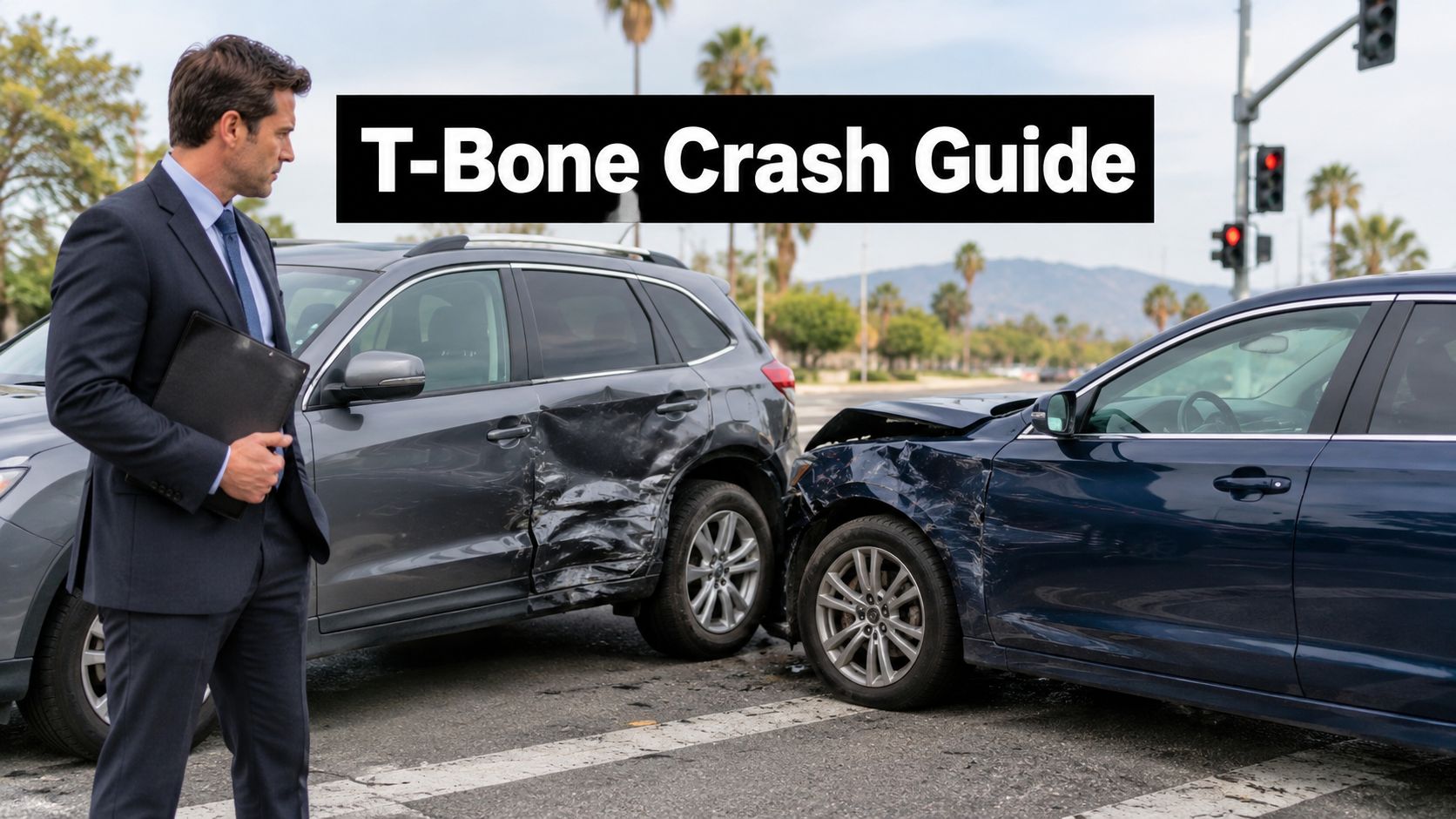
You’re on a green light in California, halfway through the intersection, when the passenger door explodes inward. Glass, airbags, a horn that won’t stop. Your neck hurts, your passenger is holding her ribs, and the other driver is already saying you ran the light. That first hour feels chaotic, but the choices you make in it shape both your medical record and any later claim. A T-bone accident attorney can’t undo the impact. What counsel can do is preserve the geometry, the signal evidence, and the injury proof before they disappear.
This article is for informational purposes only and is not legal advice. No attorney-client relationship exists based on your review of this article, and none of the information here creates one.
What to Do Immediately After a T-Bone Crash
A driver waiting to clear a California intersection has almost no warning in a side impact. One moment you’re watching cross traffic, the next the front of another vehicle is in your door. Don’t try to sort out fault in that moment. Work through safety, medical help, and basic facts in order.
Your First Minutes at the Scene
Check yourself and your passengers for bleeding, chest pain, head injury, and trouble moving. Call 911 and stay at the scene unless you need emergency transport. If the cars can be moved safely out of active lanes, do that after noting their positions, but don’t leave the area to handle it privately.
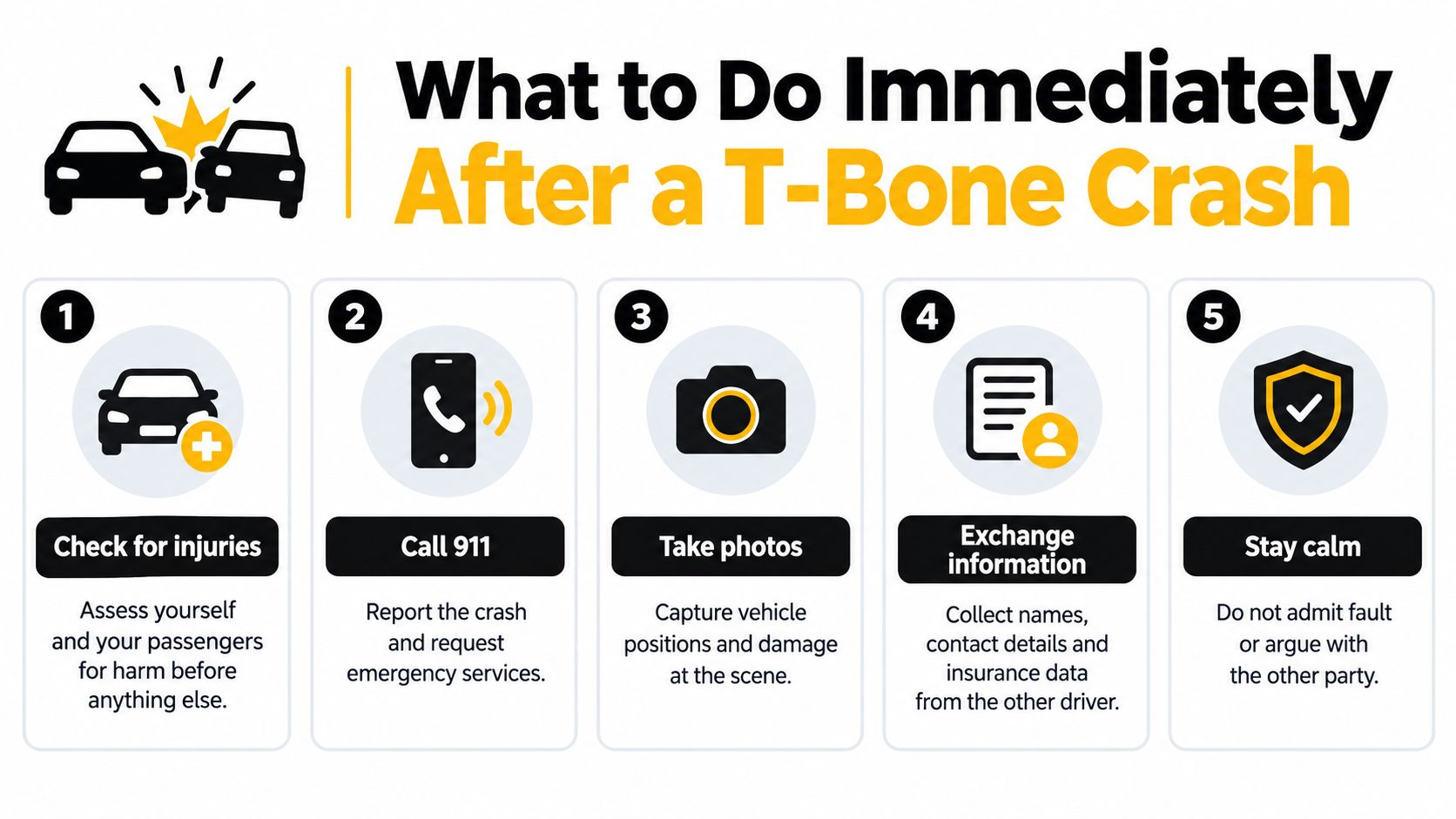
Exchange names, license information, and insurance details. Keep the conversation short and factual. Don’t apologize, speculate about the signal, or agree that you’re fine before you’ve been examined.
A polite apology at the curb can be quoted later as an admission. State what you saw, not what you think it means.
That caution matters because side impacts are not minor by default. T-bone crashes are classified as side-impact crashes, where the front of one vehicle strikes the side of another, and a NHTSA evaluation of Federal Motor Vehicle Safety Standard 214 found side impacts accounted for approximately 33% of passenger-car occupant fatalities, with 4,120 side-impact fatalities in the studied data, including 2,666 near-side occupants and 1,454 far-side occupants. The person sitting on the struck side faces the greatest danger because there’s far less structure between that occupant and the striking vehicle than in a frontal crash.
Small Details People Miss
Notice which side was hit and where each person was seated. Note whether side airbags deployed and whether a belt locked or feels loose afterward. If a belt won’t retract after the crash, don’t force it or cut it, since its condition is evidence, and resources on how to fix locked seat belt after accident can help you understand the repair issue once preservation is addressed.
Get checked even if you plan to drive home. Adrenaline masks pain, and head, chest, and abdominal injuries don’t always declare themselves at the curb. Early treatment also creates a contemporaneous record that an insurer can’t easily dismiss as an afterthought.
Documenting the Crash and Your Injuries
Evidence in a T-bone case has a short shelf life. Cars get towed, signals keep cycling, witnesses drive off, and surveillance video gets overwritten. Your job in the first days isn’t to prove the whole case. It’s to capture the raw material a reconstruction later depends on.
What to Photograph and Preserve
Photograph both vehicles from every angle, then move closer. Capture the point of impact, door and B-pillar crushing, intrusion into the cabin, deployed airbags, skid marks, debris fields, traffic signals, lane markings, and any sightline obstruction. Take wide shots that show final resting positions in relation to the intersection, not just dent close-ups.
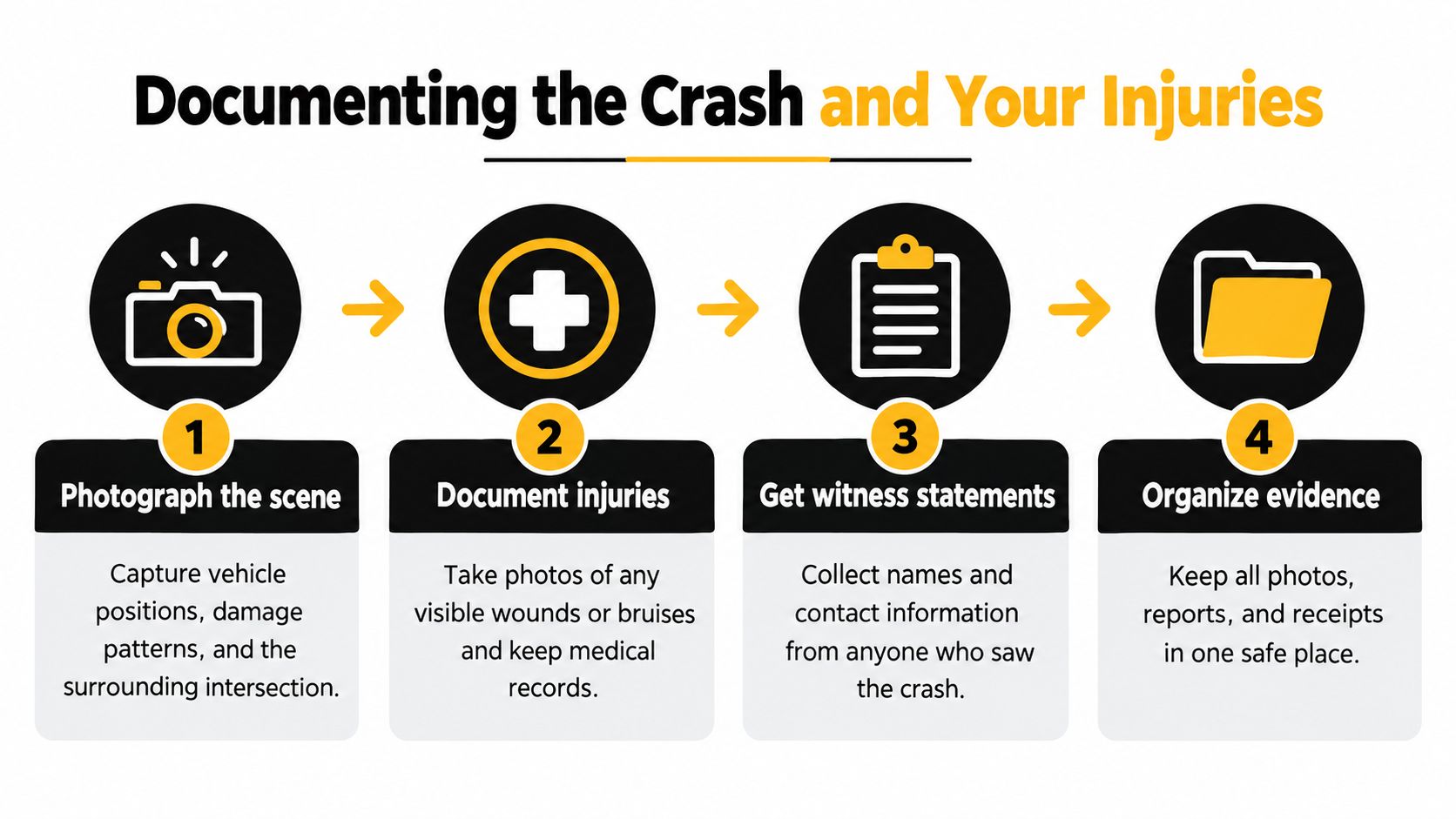
- Vehicle facts: Record make, model, size, license plates, and which vehicle struck which side.
- People facts: Write down seating positions, belt use, and the names and phone numbers of independent witnesses.
- Scene facts: Note weather, road surface, signal sequence as you observed it, and nearby businesses that may have cameras.
- Medical facts: Photograph bruising and swelling as they evolve and keep discharge papers, imaging reports, and prescriptions together.
A sound investigation follows a defined sequence. Preserve the vehicles and event-data records, obtain scene photographs and measurements, map resting positions and debris, collect signal or surveillance footage, interview independent witnesses, and then reconstruct the dynamics. As NHTSA explains about event data recorders, EDRs can record information for only seconds before, during, and after a crash, including pre-crash vehicle dynamics, driver inputs, crash signature, restraint deployment, and seat-belt status.
Building Your Injury Timeline
That brief recording window is why you shouldn’t authorize repair or disposal of a badly damaged vehicle without first asking whether an inspection or a qualified EDR download is needed. Once the car is repaired or scrapped, crush patterns and module data may be gone.
For your body, build a simple chronology. List the ambulance and emergency findings, each follow-up visit, imaging, specialist referrals, work restrictions, and symptoms by date. Don’t leave gaps unexplained. If you missed therapy because you had no ride or the pain flared, write that down and tell your provider at the next visit.
Practical rule: Match every claimed injury to an objective finding and a medical record created close in time to the crash.
A reconstruction also can’t rest on side damage alone. Damage shows contact, not right-of-way. Speed, braking, visibility, turning movements, signal timing, vehicle masses, and possible third-party or roadway contributions still have to be tested.
Dealing with Police, Insurers, and Medical Providers
Consider a typical sequence. An officer arrives, separates the drivers, and asks each what happened. By that evening an adjuster has called twice, and the next morning an urgent care doctor asks where it hurts. Each conversation serves a different purpose, and treating them the same way creates problems.
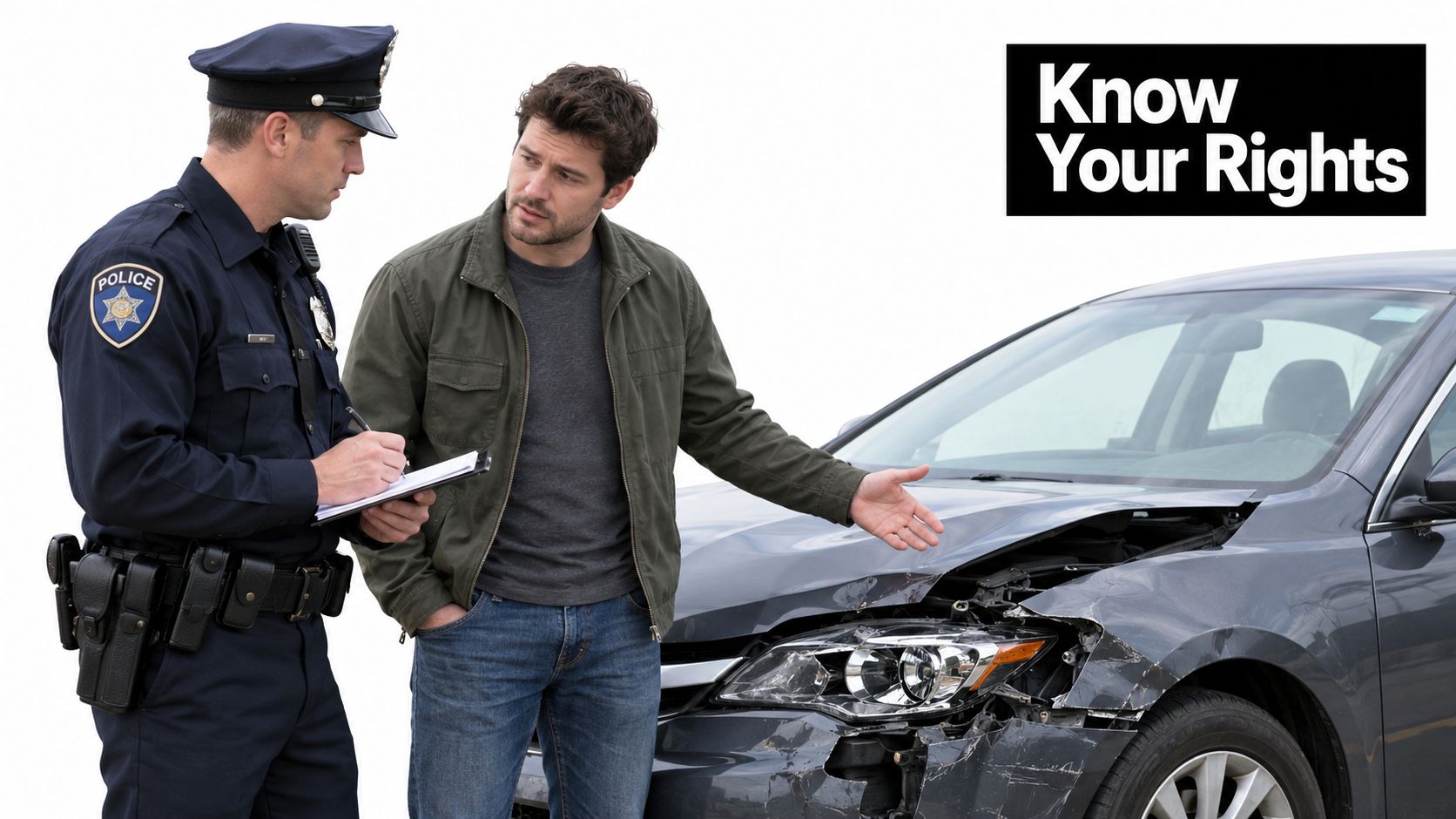
The scene below shows the kind of roadside exchange that often becomes the foundation of the police report.
Three Conversations With Different Rules
With police, be accurate and brief. Give your direction of travel, the signal you observed, your speed in general terms if you know it, and where the impact occurred. Don’t guess at distances or fill gaps to sound helpful, and ask how to obtain the report later so you can check it for errors in names, diagrams, and witness listings.
With insurers, report the crash promptly to your own carrier, but be careful with the other driver’s adjuster. Early calls often come before you know the extent of your injuries, and a recorded statement given while you’re medicated or unsure can lock you into incomplete answers. Guidance on dealing with insurance adjusters after a California crash can help you prepare before that call, especially if a quick settlement offer arrives with a release.
With medical providers, do the opposite of minimizing. Describe head impact, loss of consciousness if any, chest or abdominal pain, numbness, and symptoms that appeared hours later. Providers can’t document what you don’t mention, and consistent follow-through matters more than dramatic language.
The following video offers additional context on handling the conversations that follow a serious collision.
None of this caution is overreaction. Federal data summarized in an overview of NHTSA 2022 angle crash classifications counted 1,343,312 angle crashes, representing 22.7% of all reported crashes, including 480,976 injury crashes and 7,168 fatal crashes, with nearly 400,000 occupants injured and 5,886 killed in side-impact crashes during 2022. Insurers know these claims can be significant, which is why early statements deserve care.
Understanding Liability and Damages in California
Most clients assume fault is binary. Either the other driver ran the light or you did. California doesn’t allocate responsibility that way, and vehicle geometry complicates the injury side even when fault looks clear. Liability and damages are related questions, but they’re proven with different evidence.
How Comparative Fault Changes the Math
Under California Civil Jury Instruction CACI No. 405 on comparative fault, a defendant asserting comparative fault must prove both that the plaintiff was negligent and that the negligence was a substantial factor in causing the harm. If proven, damages are reduced by the plaintiff’s assigned percentage, so $100,000 in total proven damages with 20% responsibility assigned to the plaintiff becomes an $80,000 award. In multi-party cases the percentages must total 100%, and total damages are determined before that reduction is applied.
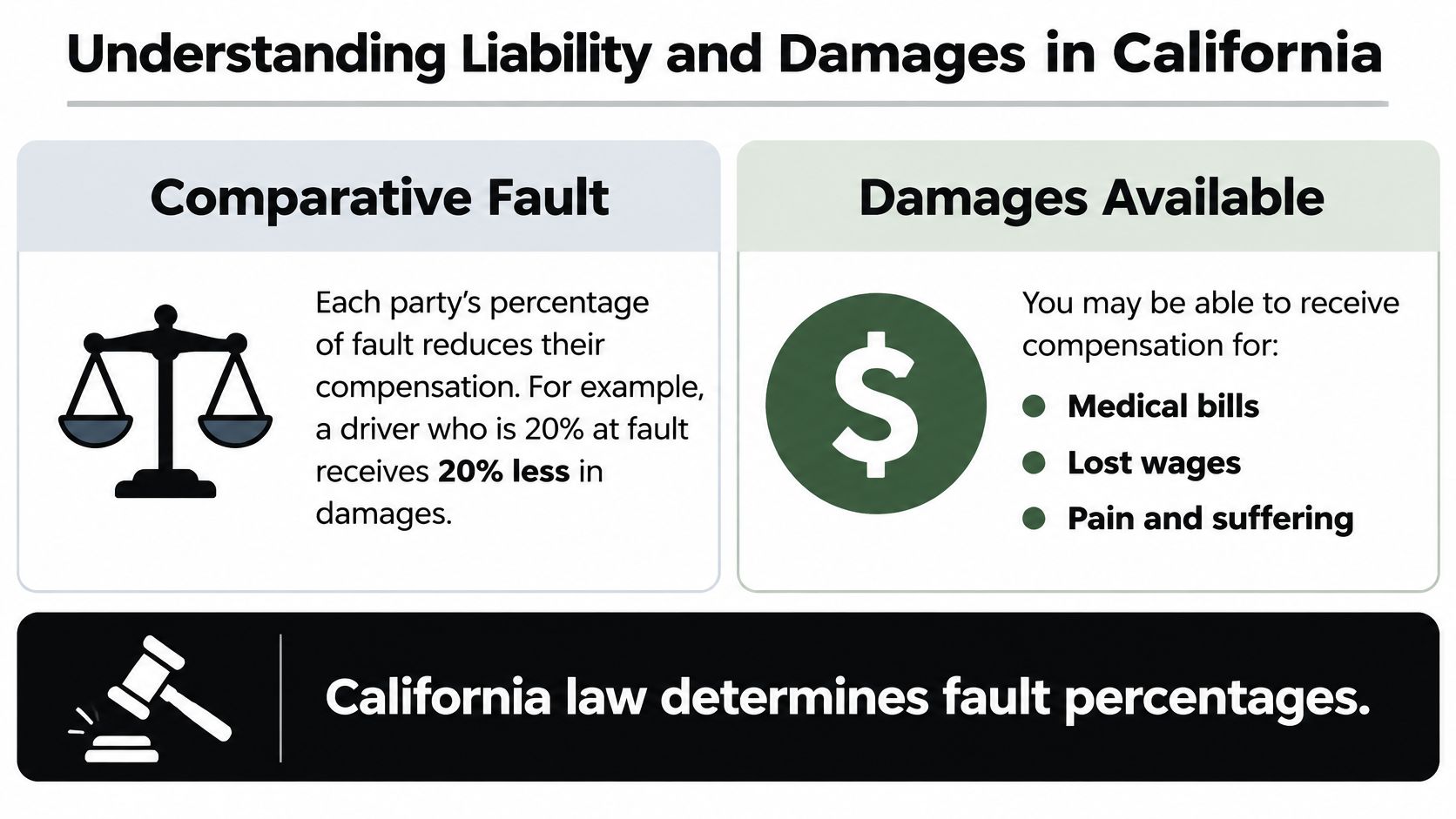
That’s why insurers probe speed, distraction, signal timing, and failure to yield so aggressively. Shifting even a modest share of responsibility reduces what they pay. Broader background on California vehicle accident laws and fault rules helps explain how those arguments fit together, but the outcome in your case turns on admissible evidence, not on who tells the simpler story.
Damages generally fall into economic and non-economic categories. Medical expenses, future care, lost wages, and reduced earning capacity need bills, records, and employer documentation. Pain, suffering, and functional loss need a credible treatment chronology and consistent testimony about what you can no longer do.
Why Vehicle Size Is Not a Side Issue
Crashworthiness is separate from fault. A well-rated car can reduce injury risk without eliminating serious injury, and a safety rating doesn’t tell a jury who entered the intersection unlawfully. What matters for damages is how force reached the occupant, including striking vehicle weight and height, impact location, intrusion, airbag performance, and seating position.
A larger SUV or pickup striking a smaller passenger car creates a mismatch that investigators should document through photographs, repair records, and expert inspection before evidence is lost. If the at-fault driver’s policy is too small to cover the losses, your own uninsured and underinsured motorist coverage may become central, subject to your policy language and proof of fault and damages. Don’t assume coverage applies automatically, and don’t assume the first policy you identify is the only one.
When and How to Hire a T-Bone Accident Attorney
Not every fender contact needs counsel. A T-bone with disputed signals, a totaled door, and a trip to the emergency department is a different matter. The question isn’t whether you’re allowed to handle it yourself. It’s whether the evidence and medical issues have outgrown a do-it-yourself claim.
Signs Representation Is Worth Pursuing
- Serious or evolving injuries: Head, chest, spine, or abdominal symptoms, surgery, or work restrictions raise both value and proof problems.
- Disputed right-of-way: Competing signal accounts, a left-turn conflict, or an adjuster already assigning you fault.
- A large striking vehicle: A pickup, SUV, or commercial vehicle increases the need for prompt preservation and expert review.
- A fast low offer: Money offered before treatment stabilizes usually requires a release that ends the claim.
Ask any prospective T-bone accident attorney how side-impact cases differ from rear-end cases in their practice. Listen for specifics. IIHS research on side-impact intrusion and death risk reports that each additional centimeter of B-pillar intrusion was associated with a 3% increase in death risk, while a 10-millimeter increase in torso deflection corresponded to a 12% increase in driver death risk. Occupants struck by vehicles with higher front structures also face greater risks of serious head and chest injuries unless effective head-protecting side airbags are present, which is exactly the kind of geometry a competent investigation should examine rather than ignore.
Questions to Ask Before You Sign
Ask who will handle your file, how often you’ll receive updates, and what evidence the firm will move to preserve in the first weeks. Ask how fees and case costs work, whether the fee is contingent on recovery, and what happens if the case doesn’t settle. General guidance on how to choose a car accident lawyer in California can sharpen that list before your consultation.
Bring the police report if you have it, scene photos, insurance declarations, medical discharge papers, and a short written timeline. Don’t bring a theory you’re committed to defending. Bring facts, and let counsel tell you where the gaps are.
The best consultation leaves you knowing what evidence is missing, not just hearing that you have a great case.
Expect investigation first, then a demand once treatment and damages are documented, then negotiation. Litigation becomes likely when liability stays disputed, coverage is contested, or the offer doesn’t reflect the medical proof. An attorney who promises a number before seeing imaging, records, and policy limits is guessing, and you shouldn’t pay for a guess with your signature.
Frequently Asked Questions About T-Bone Claims
Common Questions After a Side Impact
Can I still recover if I share some fault? Potentially, yes. California reduces proven damages by your assigned percentage of responsibility rather than treating any share of fault as an automatic bar in the comparative-fault framework described earlier. The practical fight is over the percentage, which is why signal evidence, witness accounts, and reconstruction matter so much.
What if the at-fault driver has no insurance or too little? Your own policy may help. The California Department of Insurance guide to uninsured motorist coverage explains that uninsured-motorist bodily-injury coverage pays for injuries to the insured and occupants when an uninsured driver is at fault, and that underinsured-motorist coverage can apply when the at-fault driver’s limits are insufficient. You’ll still need documentation of injuries, medical expenses, and lost wages, plus compliance with policy requirements. Coverage is policy dependent and doesn’t guarantee payment.
How long do I have to act? Don’t anchor on a single deadline you read online. California claim deadlines, insurance notice requirements, and available remedies can depend on the accident date, government-entity involvement, policy language, injuries, and the identities of the responsible parties. Treat every notice and filing deadline as urgent and get case-specific advice promptly, because waiting also risks losing video, vehicle data, and witness memory.
How long does a claim take? It depends on treatment length, fault disputes, coverage, and whether suit is filed. Settling before your condition stabilizes can leave future care unpaid, while waiting without preserving evidence creates a different risk. A realistic timeline balances medical clarity against evidence decay.
Does a high safety rating weaken my claim? No. A rating may explain why injuries weren’t worse, but it doesn’t establish who caused the collision and it doesn’t erase documented injury. Fault, crashworthiness, and medical causation remain separate inquiries.
This article is solely general informational material, is not legal advice, and must not be construed as legal advice. No attorney-client relationship exists based on your review of this article, and the California Civil Jury Instructions describe how comparative responsibility may be evaluated at trial without determining the outcome of your particular case.
If you’re sorting through medical bills, a disputed signal, and an insurer that wants answers before you have them, LA Law Group, APLC can review your T-bone collision, explain how California fault and coverage issues may affect your claim, and outline the evidence that should be preserved now. Visit LA Law Group, APLC to request a consultation and discuss your next steps with counsel who handles California automobile injury claims.
Attorney Advertising. This article is general information, not legal advice, and does not create an attorney-client relationship. Prior results do not guarantee a similar outcome.