
Truck Accident Lawyer Los Angeles: A Practical Guide
In 2023, 5,472 people were killed in traffic crashes involving large trucks nationwide, an 8% decrease from 5,969 deaths in 2022. Of the 2023 total, 3,837 deaths, 70%, were occupants of other vehicles, 961, or 18%, were occupants of large trucks, and 674, or 12%, were pedestrians and pedalcyclists, according to FMCSA large truck and bus crash facts. The person in the car, or the person on foot, is usually the one who absorbs the harm.
That split is why a truck accident lawyer Los Angeles families look for is not doing a bigger version of a car-crash file. A police report is the start of the evidence search. Logs, cameras, brake files, and loading papers sit with a carrier, a broker, a shop, or a warehouse, and several of those records disappear while you are still getting treated.
This article is for informational purposes only. It is not legal advice, and reading it does not create an attorney-client relationship.
What a Los Angeles Truck Accident Lawyer Actually Handles
In 2022, approximately 503,000 police-reported crashes involved large trucks in the United States. Of those crashes, 5,279, about 1%, were fatal, and approximately 114,000, about 23%, involved injuries, according to FMCSA large truck and bus crash facts for 2022. The same year, 6,050 large trucks and buses were involved in fatal crashes, a 2% increase from 2021.
A car crash often has one driver, one insurer, and a repair estimate. A commercial crash on the 710, the 5, or a port-adjacent street can involve a driver, a motor carrier, a freight broker, a maintenance contractor, and the company that loaded the trailer. Federal safety rules add a second layer of records that a personal auto policy never creates.
Electronic evidence is the other difference. Duty logs, cab video, and telematics can be overwritten on a short cycle. Waiting for the pain to “settle down” can mean the file that would have shown hours, speed, or a missed brake check is already gone.
| Stage | What the lawyer does | Why it matters |
|---|---|---|
| Early investigation | Sends preservation demands to the carrier and insurers | Electronic logs and dashcam video can be overwritten within weeks |
| Liability mapping | Identifies driver, carrier, broker, maintenance and loading parties | One crash can involve several insurance policies |
| Damages documentation | Collects medical records, bills, wage loss and future care estimates | Settlement value depends on documented losses |
| Insurer communication | Handles adjuster contact and recorded-statement requests | Early statements can be used to narrow fault |
| Negotiation or litigation | Negotiates, files suit if needed and prepares for trial | Credible trial preparation shapes the offers made |
Call early if the injury is serious or lasting, if someone died, if fault is disputed, if a trucking company or its insurer is already calling you, or if more than one vehicle was involved. None of this article is legal advice, and reviewing it does not make anyone your lawyer.
Immediate Steps After a Los Angeles Truck Crash
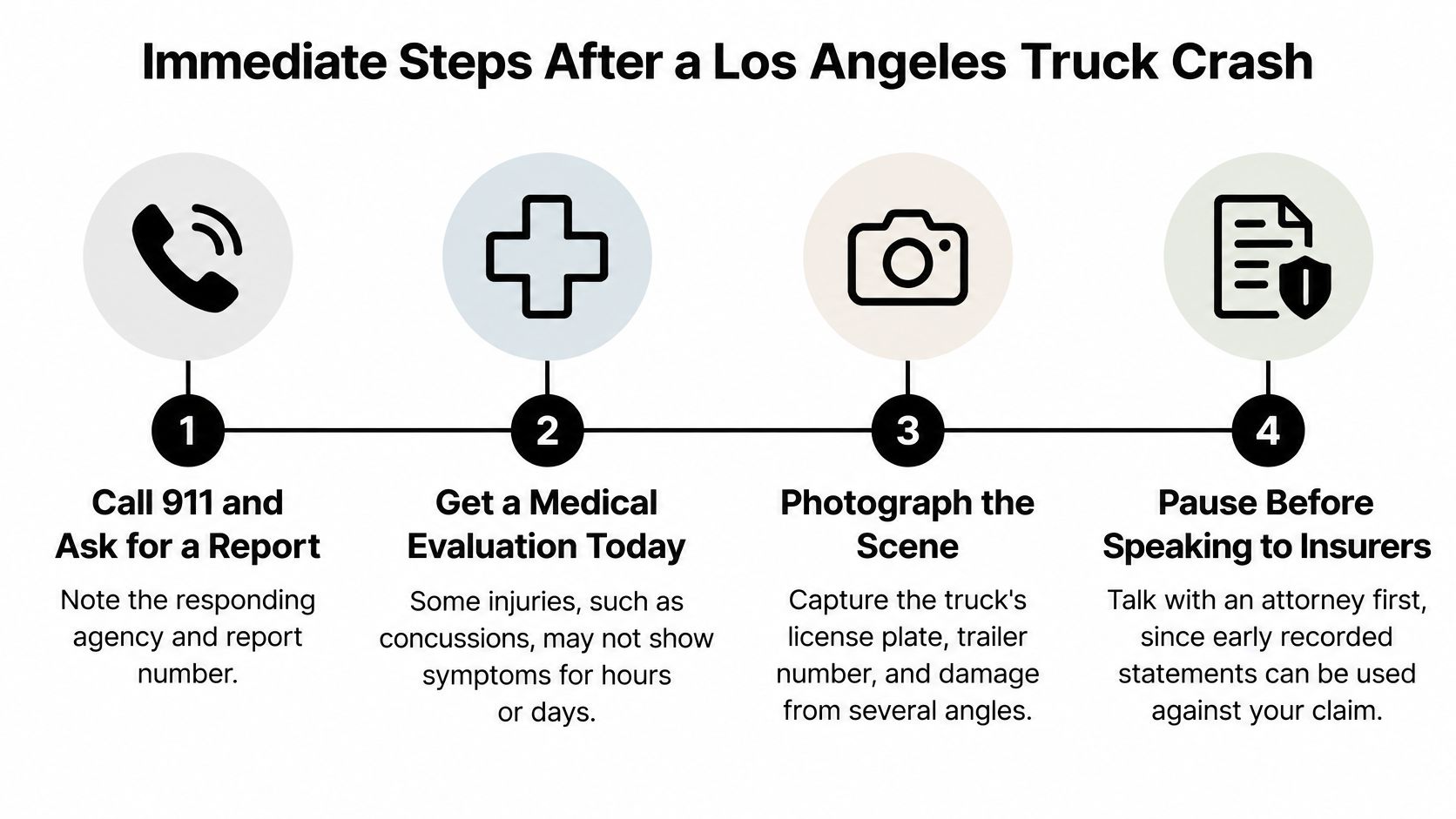
The hours after a commercial truck crash work against you. The truck gets towed and repaired, witnesses drive away, and the carrier’s insurer may send its own investigator while you are still in the emergency room. Each step below protects a fact you cannot recreate later. A longer walkthrough of the first day sits in this guide on what to do after a truck accident.
- Call 911 and ask for a report. Note the responding agency and the report number before you leave. That number is how you pull the narrative, the diagram, and the listed parties, including the carrier name and insurer the officer records.
- Get a medical evaluation the same day, even if you feel fine. A concussion, a disc injury, or internal bleeding can surface hours later, and a same-day visit ties the symptoms to the crash.
- Photograph the truck before it moves. Capture the DOT number, the carrier name on the door, the trailer number, any placards, the load if it is visible, and damage to your vehicle from several angles. The DOT number identifies the operating company even when the driver names a different employer.
- Write down people, not just vehicles. Record the driver’s name, license, employer, and insurer, plus names and phone numbers of witnesses. Memories fade by the next morning.
- Keep a daily symptom journal. Note pain, missed work, and every appointment. A journal is often the only record of how a Tuesday felt three months later.
- Keep every receipt and bill. Towing, prescriptions, rides to therapy, and a rental car all belong in one folder.
- Do not give a recorded statement or sign a release for the trucking company’s insurer before you have advice. A short answer about “feeling okay” gets replayed as proof the injury was minor.
- Call a lawyer within days, not months. Trucking companies often field a rapid-response team that reaches a serious crash scene early, and your side needs someone gathering the same information while it still exists.
What a report does not prove
California also requires drivers to file an SR-1 accident report with the DMV when a crash causes injury, death, or significant property damage. File it. It is a reporting duty, not a finding of fault, and the DMV does not decide who pays.
Public crash files are a starting point, not complete proof. The federal Motor Carrier Management Information System records only federally reportable commercial-vehicle crashes, generally those with a fatality, an injury requiring treatment away from the scene, or disabling damage requiring a tow. The public FMCSA Crash File contains 59 data elements drawn from state police reports, and driver information is excluded from released files for privacy reasons, as described in the federal motor carrier crash data catalog. California’s 2025 crash file exists as raw state data, but a download will not name every responsible company or save a camera that overwrites itself.
A police report also reads flatter than the case really is. The diagram may show one truck and one driver, while the cab, the trailer, the freight, and the maintenance history each trace back to a different company. The officer writes down what was visible at the scene. The reasons behind the crash sit in records the report only points toward.
Practical rule: If the only document you have is the police report, the investigation has not started.
Evidence That Decides a Commercial Truck Case
A truck case is built on records other people hold. The first job is to stop those records from being deleted, repaired over, or thrown out.
| Evidence | Where it is held | What it can show | Risk of loss |
|---|---|---|---|
| ELD and duty-status logs | Carrier’s ELD provider and driver device | Driving hours, on-duty time and rest breaks | Retention periods are limited; request early |
| Dashcam and mirror-camera video | Truck cab and fleet telematics | Lane position, following distance, signals and attention | Often overwritten on a rolling cycle |
| Brake and tire maintenance records | Carrier maintenance files and repair shops | Out-of-adjustment brakes and worn tires | Repairs can erase the defect |
| Driver vehicle inspection reports | Carrier pre-trip and post-trip records | Defects reported before the trip | Lost if not requested in time |
| Cargo loading and securement records | Shipper, warehouse and carrier | Shifted, overweight or poorly secured loads | Held by third parties who may discard them |
| Dispatch messages and GPS data | Carrier systems and phones | Schedule pressure, route and delivery deadlines | Some systems auto-delete messages |
| Nearby business and traffic-camera video | Businesses and city systems | Sequence of the crash | Often overwritten within days |
Brakes, tires, and the load
Mechanical review should focus on braking capacity, tires and wheels, and cargo securement. The federal Large Truck Crash Causation Study identified those as the three principal vehicle-related critical factors. Brake problems were coded in almost 30% of involved trucks, compared with 5% of passenger vehicles, in the report to Congress on the Large Truck Crash Causation Study. Out-of-adjustment brakes made a truck 1.8 times as likely to be the vehicle that precipitated a crash, and brake violations mattered most in rear-end and crossing-path collisions.
A defect on a work order is not enough. The file has to connect that defect to stopping distance, loss of control, cargo movement, or the sequence of the collision. Say a tractor rear-ends a sedan on a downhill grade near the port. A soft pedal on last month’s inspection report only matters if reconstruction shows the truck needed more distance than the gap it had.
What reconstruction actually tests
Reconstruction compares the truck’s available braking performance with roadway grade, speed, following distance, and the damage to the passenger vehicle. The question is physical, not moral. Could this truck have stopped in time if the brakes, the tires, and the following distance had been what the rules require?
That comparison also separates a carrier that skipped maintenance from a shipper or warehouse that loaded the trailer badly. Preserve the tractor, the trailer, ELD data, the post-crash inspection, preventive-maintenance files, driver vehicle-inspection reports, repair invoices, tire photographs, and cargo-loading papers before anyone alters or scraps them.
A preservation letter should go out before the carrier’s routine retention period ends. Once a shop replaces the brakes, the part that failed is often in a scrap bin.
Who Can Be Liable Beyond the Driver
The common mistake is treating the driver as the only person who can be responsible. The driver may have changed lanes badly. The company that hired, scheduled, maintained, or loaded the truck may have set that mistake up.
Motor carrier. Negligent hiring, supervision, or dispatch pressure is tested with the hiring file, the safety record, and dispatch messages.
Owner or lessor. A failure to maintain a leased truck is tested with the lease and the maintenance contract, not with the driver’s story.
Freight broker. Choosing an unsafe carrier is tested with the broker’s carrier-selection file.
Maintenance contractor. Poor brake or tire work is tested with invoices and parts records.
Shipper or loader. An unsecured or overweight load is tested with the bill of lading and loading photos.
Parts manufacturer. A defective brake or sensor is tested with component records and recall notices.
The driver’s own conduct, speeding, distraction, or an unsafe lane change, is tested with video, phone records, and mirror geometry. A government or contractor truck can add still more defendants, which is the point of asking whether you can sue after a USPS truck accident.
Fatigue is not a yes-or-no log violation
Federal rules for property-carrying trucks say a driver may drive no more than 11 hours after 10 consecutive hours off duty and may not drive beyond the 14th consecutive hour after coming on duty, under the FMCSA hours-of-service summary. Research summarized by the Insurance Institute for Highway Safety found that truck drivers behind the wheel for more than eight hours were twice as likely to crash.
A clean electronic log does not prove the driver was rested. In a 2025 notice, FMCSA proposed collecting duty logs, crash and incident records, inspection violations, and demographic information because it still lacks enough evidence to quantify how specific schedules affect crash risk. The same notice described pilot programs for 6/4 or 5/5 off-duty splits and pauses of up to three hours inside a 14-hour period. Schedule design, a second job, a long dock delay, or bad sleep can matter even when the log looks legal. A technical log error does not, by itself, prove fatigue caused this crash. You still have to connect the schedule, the rest, any medical evidence, and the collision sequence.
A short explanation of how those duty records get read in a real file is here:
California Claim Rules That Set Your Timeline
Ten days. That is the first clock, and it is already running before the injured even leave the hospital. If anyone was hurt or killed, or property damage topped $1,000, California requires an SR-1 accident report to the DMV within that window. The police report is the start of the record, not the finish, and each deadline below runs on its own schedule. The filing periods that apply to most injury suits are laid out in this overview of the California auto accident statute of limitations.
| Rule | Typical value | What it means for a truck case |
|---|---|---|
| Personal injury filing deadline | 2 years from the crash | Starts on the crash date; a late filing usually bars the claim |
| Wrongful death filing deadline | 2 years in most cases | Usually brought by heirs or an estate representative |
| Property damage claim | 3 years | Covers the vehicle and other property damage |
| Claim against a public entity | 6 months to present a written claim | Applies if a city, county or state agency maintained the road |
| Accident report to DMV (SR-1) | 10 days | File after injury, death, or property damage over $1,000 |
| Fault allocation | Pure comparative negligence | Your recovery is reduced by your share of fault, not eliminated |
| Federal liability floor, interstate freight | Set by federal rules | A minimum only; actual limits are often higher and several policies can stack |
| Medical liens | Paid or negotiated before disbursement | Health plans or providers may claim part of the settlement |
Most personal injury claims must be filed within two years under California Code of Civil Procedure section 335.1. Wrongful death claims generally use that same two-year period and are usually brought by heirs or an estate representative. Property damage has a three-year period.
The shortest window is the one people miss. If a city, county, or state agency maintained the road, you generally have six months to present a written claim, and a missed window can bar a later suit. In a truck case that matters twice over, because the same weeks are when the maintenance file, dispatch records, and electronic logs are still intact. Wait for the claim window to close and the records that would have assigned responsibility often went first.
Fault shares and insurance floors
California uses pure comparative negligence. If you share some fault, your recovery is reduced by your percentage. Say a jury finds the truck 80% responsible and you 20% responsible for a lane position. You can still recover, at 80% of the proven losses.
California requires commercial vehicles entering the state to carry proof of financial responsibility, and Caltrans treats insurance documentation as an applicable requirement for commercial vehicles. Proof that a carrier carried the required coverage does not establish negligence, causation, or the amount of damages. Someone still has to match the motor carrier, owner, lessee, and insurer to the registration, the operating authority, and the crash itself.
Federal rules set a minimum liability floor for interstate freight carriers. That floor is not a measure of your medical bills, your lost earnings, or a death claim. Actual policy limits are often higher, and more than one policy may apply, since coverage can sit with the carrier, the trailer owner, or another company in the chain.
What a claim can include
Recoverable categories usually include past and future medical costs, lost wages and earning capacity, pain and suffering, and property loss. A wrongful death claim can add funeral costs and lost financial support.
Health plans and medical providers often hold liens, and a lien is a claim on the settlement itself. Those liens have to be resolved before you receive funds, which is why the number on a release is not the number that reaches your account.
Real Crash Scenarios and How the Case Changes
These three illustrations are hypothetical. They show how the first move changes with the facts. The law does not decide, by itself, which company pays. The records do.
A rideshare passenger on the 405. You are in the back seat of a rideshare when a semi changes lanes into the car. The claim can touch the rideshare company’s coverage tiers, the truck carrier’s policy, and your own auto policy. The first task is identifying which policy responds to which phase of the trip. The key evidence is the app trip record plus lane-change video. Until those two items are saved, arguing about “who had the right of way” is guesswork.
A rear-end on a congested freeway. Traffic compresses near a downtown connector and a box truck does not stop. The first move is preserving the brake and maintenance file and the electronic log. Reconstruction then tests whether the truck could have stopped given the grade, the speed, and the following distance. A police citation for the truck driver does not answer that mechanical question.
A right turn at a city intersection. A delivery truck turns right and strikes a pedestrian in the crosswalk. Blind-spot geometry and mirror placement become central. The delivery company, its contractor, and possibly the shipper may all be relevant, because the truck, the route pressure, and the load did not have to come from one company. The first priority is the turn video and the mirror setup, not a debate about whether the walker “should have waited.”
In a truck case, the first question is usually who else holds the evidence and the insurance.
How to Evaluate a Los Angeles Truck Accident Lawyer
A lawyer who handles a steady volume of car crashes may be excellent at those files and still have no plan for a motor carrier. Truck cases need experience with carriers and their insurers, people who can pull electronic records, and a reconstruction resource you can name with confidence.
| Criterion | What good looks like | Red flag |
|---|---|---|
| Truck-case experience | Has litigated against motor carriers and their insurers | Mostly ordinary car-accident work with no trucking examples |
| Who works the case | Named attorney with direct access to you | Your case handed off to staff you never meet |
| Investigation resources | Access to reconstruction and records specialists | No plan for ELD, video or maintenance records |
| Fee terms | Written contingency terms and clear cost treatment | Vague fees or pressure to sign immediately |
| First consultation | Free review with a candid assessment | Unclear charges for the first meeting |
| Communication | Timely updates and language support, including Spanish if needed | Hard to reach with no language help |
| Local court familiarity | Experience in Los Angeles County courts | No local litigation practice |
| Office access | Los Angeles-area office for in-person meetings | Remote-only with no meeting option |
What the first conversation should sound like
Ask who sends the preservation letter, and whether it goes out after the first call. Ask for the list of records they would request in your crash, not a generic speech about “fighting for you.” A candid lawyer will also name a weakness, such as a gap in medical treatment or a difficult lane-change video.
On fees, you want a written contingency agreement that says how costs are advanced and how they are repaid if you win or if you do not. A free initial review should come with a clear assessment, not a surprise invoice.
If you need Spanish, ask directly whether Spanish-language communication is available. Do not assume a Los Angeles address means the person on your file speaks it. The same question applies after hours. A firm that uses an after-hours answering service so a nighttime crash call reaches a person, rather than a full voicemail, is easier to reach while video is still on the truck.
One option among firms that take these cases is LA Law Group, APLC, founded in 2017 and led by Mr. Aryan Amid. The firm offers free initial consultations, direct attorney access, and offices in Los Angeles, Santa Monica, Chatsworth, and Fremont, and it handles personal injury alongside other practice areas. Compare that setup with at least one other firm using the table above. An office you can sit in, and a named lawyer you can call, matter more than a homepage slogan.
Confirm Your Deadlines and Book a Free Review
Three clocks are already running. Most injury and wrongful death filings have a two-year period from the crash. A claim against a public agency that maintained the road generally needs a written claim within six months. The SR-1 report to the DMV is due in 10 days when injury, death, or property damage over $1,000 is involved.
Before a consultation, gather the police report number, your photos, the carrier and insurer details, medical records and bills, the symptom journal, wage records, and any letters from insurers. Bring the questions from the evaluation list, plus any worry that video or logs are about to be overwritten.
Waiting is a mistake when the injury is serious, when someone has died, when fault is disputed, or when an insurer wants a recorded statement. Book a free initial consultation, bring that packet, and ask what will be preserved in the first week.
This article is for informational purposes only. It is not legal advice. Reading it does not create an attorney-client relationship.
LA Law Group, APLC offers free initial consultations and direct attorney access for people hurt in commercial truck crashes, including help identifying carriers, insurers, and the records that disappear first. If you were injured in the Los Angeles area and need a practical read on deadlines, evidence, and next steps, visit LA Law Group, APLC and bring your report number, photos, and any insurer letters to a free review.
Attorney Advertising. This article is general information, not legal advice, and does not create an attorney-client relationship. Prior results do not guarantee a similar outcome.