
Trucking Accident Lawsuit: How to Pursue Your Claim

You may still hear the air horn when you close your eyes. The impact with a commercial truck happened in an instant, but the legal consequences can continue for months or years. You may be dealing with pain, missed work, medical appointments, an insurance adjuster asking for a recorded statement, and no clear explanation of who is responsible.
A trucking accident lawsuit isn’t just a larger version of an ordinary car accident claim. The driver, motor carrier, freight broker, maintenance contractor, trailer owner, cargo company, parts manufacturer, and technology provider may all hold pieces of the evidence. What you do in the first hours can determine whether those pieces remain available.
This article is for informational purposes and isn’t to be construed as legal advice. No attorney-client relationship exists based on your review of this article, and none of the information in this article is legal advice.
The Moments After a Collision With a Commercial Truck
For half a second, I couldn’t tell whether I was still moving. The steering wheel jumped in my hands, glass cracked across the cabin, and the smell of diesel filled the air. An air horn blared somewhere above me, then stopped. The silence afterward felt almost louder than the crash.
That disorientation is common after a collision with an 18-wheeler. A truck’s height and weight distort your sense of distance, speed, and impact. Your body releases adrenaline, which can hide neck pain, internal injuries, concussion symptoms, or the seriousness of a fracture until the immediate danger has passed.
Before emergency responders arrive, people make decisions they later remember only in fragments. Someone apologizes. Someone moves a vehicle before photographs are taken. Someone accepts a call from the carrier’s insurer and tries to explain what happened while still shaking. Those moments can later appear in a trucking accident lawsuit as statements about fault, the severity of an injury, or the condition of the vehicles.
The first objective isn’t to prove your case at the roadside. It’s to stay safe, obtain medical care, and prevent important evidence from disappearing.
Federal crash data shows the scale of the harm behind these claims. The Federal Motor Carrier Safety Administration reported 4,807 deaths in large-truck crashes in 2023, compared with 5,417 in 2022, an 11% decline reported in its Large Truck and Bus Crash Facts materials. Other reporting cited 4,354 deaths in 2023, with about 65% involving occupants of passenger vehicles and 17% involving pedestrians, cyclists, or motorcyclists. The figures differ by reporting methodology, but both sources show why victims are often people in smaller vehicles or vulnerable road users.
The raw moment becomes legal strategy through simple actions: medical documentation, scene photographs, witness information, and rapid evidence preservation. Once you’re physically safe, don’t argue with the truck driver or speculate about fault. Focus on the steps below.
Immediate Actions That Protect Your Health and Your Case
Some actions buy time. Others cost you options. Treat the roadside as an emergency scene first and a potential legal case second.
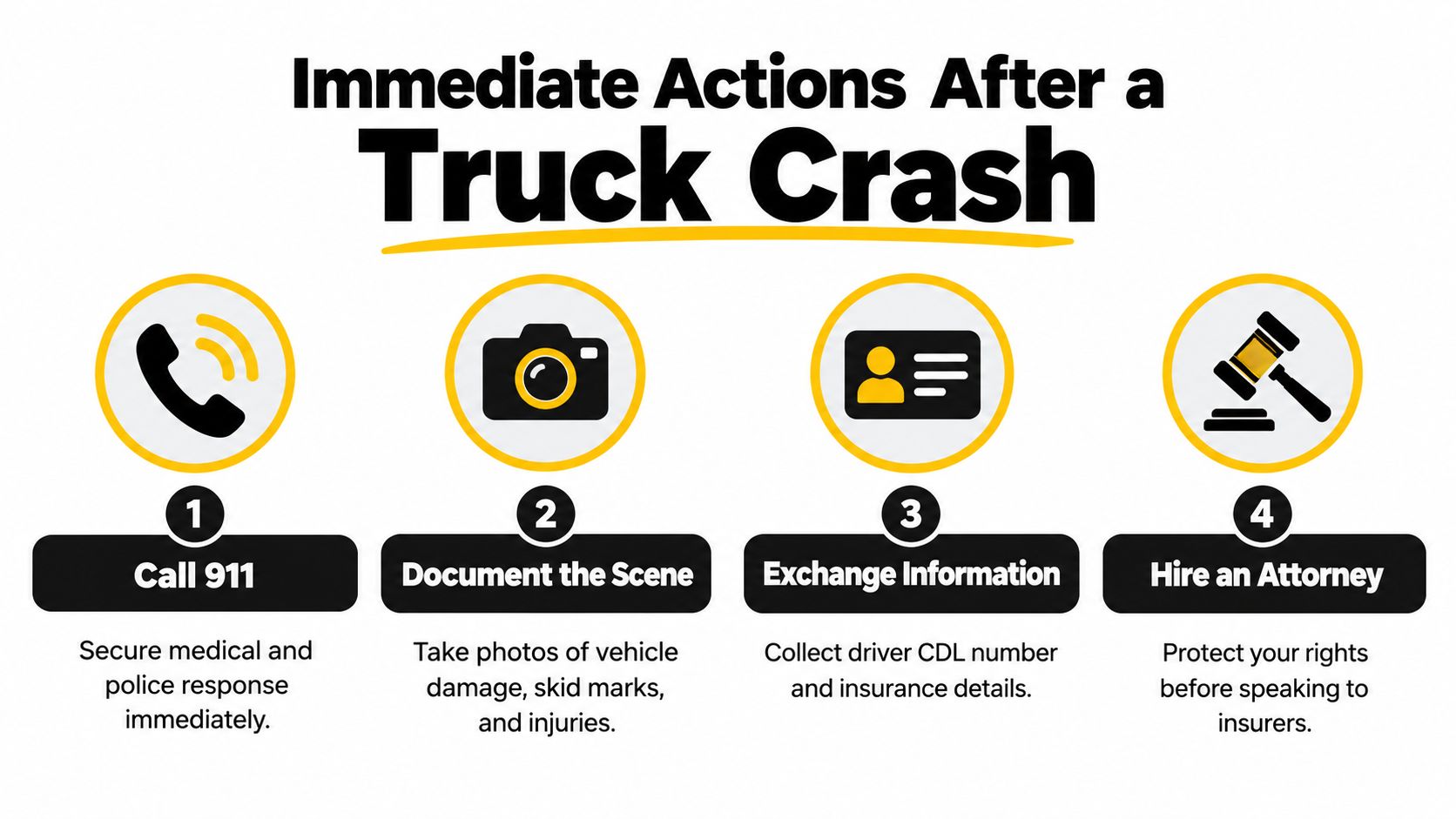
Call 911, even if the impact seems minor. Ask for police and emergency medical response, and describe your symptoms accurately. Accept an evaluation at the scene or go to the emergency department if responders recommend it. Adrenaline can disguise injury, and a gap between the crash and treatment gives an insurer an argument that the collision didn’t cause your condition.
If you’re physically able, photograph the scene before vehicles are moved or tow trucks arrive. Capture the truck and your vehicle from several angles, the road position, skid marks, debris, traffic controls, visible injuries, cargo, license plates, and damage inside the passenger compartment. Ask witnesses for their names and contact information. Save your dashcam footage immediately if the device may lose power or overwrite older files.
Collect identifying information without confronting anyone. Write down the truck driver’s name, CDL number, carrier name displayed on the door, DOT number, and insurance details. Photograph the truck’s markings if you can’t safely copy them. Don’t rely on memory or a later insurance search to identify every company involved.
- Don’t argue about fault: A roadside apology or accusation rarely helps and may create a statement the insurer uses against you.
- Don’t give a recorded statement: The carrier’s insurer may ask questions designed to establish comparative fault or minimize your injuries. Politely say you need legal advice before providing one.
- Don’t post about the crash: Photos, comments, and casual statements can be taken out of context.
- Write down your account: Record what you remember about the truck’s movement, lights, lane position, sound, weather, and your symptoms while the details are fresh.
A short video can help you remember the basic sequence, but it can’t replace a medical evaluation or a case-specific investigation.
Preserving Evidence Before It Disappears
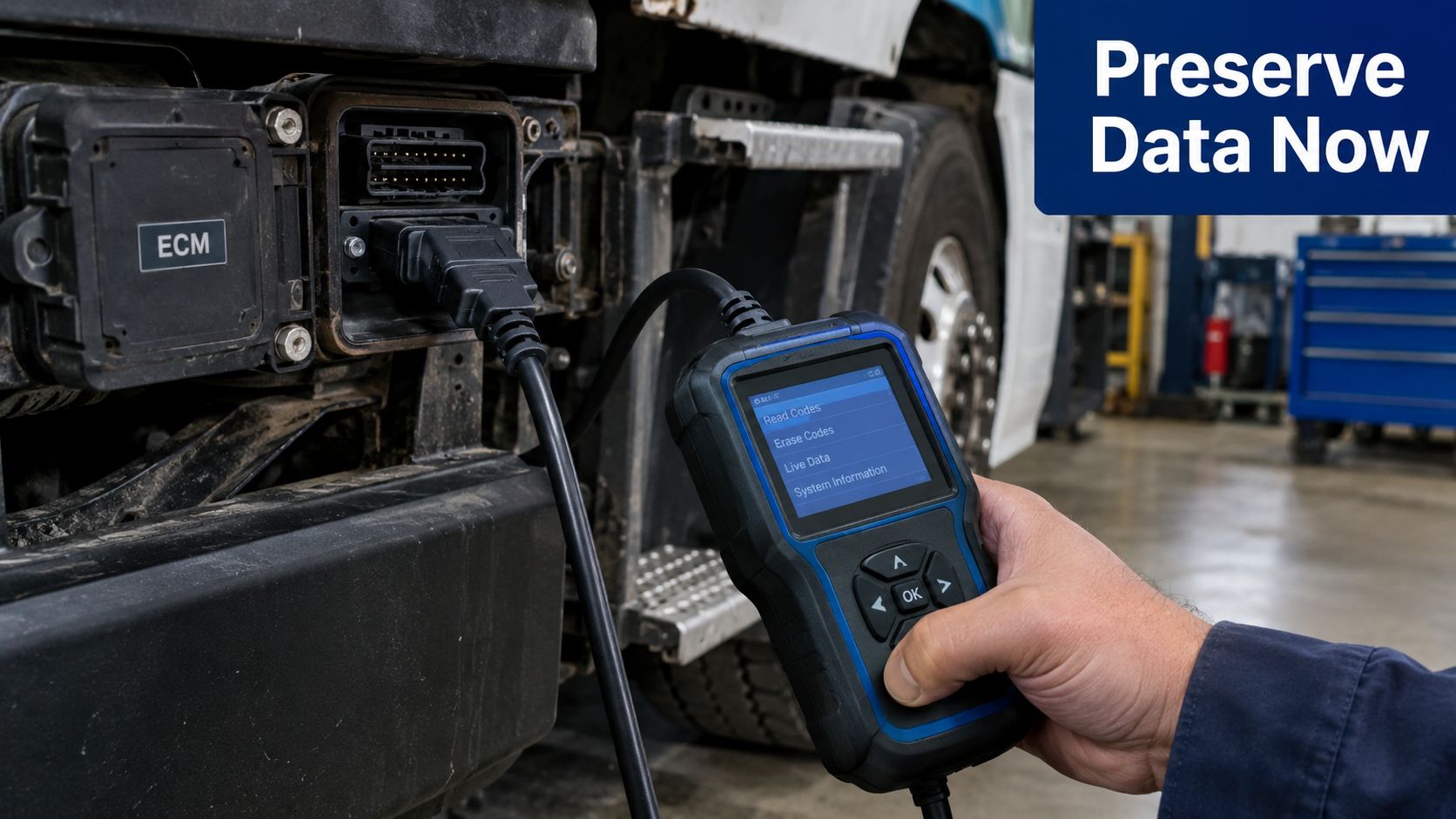
Evidence preservation is a race against automatic deletion, not a polite exchange with an insurance adjuster. Electronic logging device records, engine control module data, event data recorder information, dashcam footage, GPS history, dispatch messages, and telematics may exist only for limited periods.
Federal-regulation-based practice commonly identifies retention periods of about six months for hours-of-service and ELD records and 12 months for inspection records.
Send the right demands quickly
A lawyer should send a preservation letter to the carrier, driver, broker, maintenance company, trailer owner, cargo company, and relevant technology provider. The letter should identify the crash and demand preservation of vehicle data, driver logs, dispatch communications, inspection records, repair files, personnel and qualification records, cargo documents, route information, onboard video, and insurance information.
Later, formal discovery may include requests for production under Rule 34. That process matters, but it shouldn’t be your first preservation effort. By the time a lawsuit is filed and a formal demand is served, a short-cycle recording system may already have overwritten the evidence.
Preserve more than the truck’s computer
The strongest reconstruction often combines multiple sources:
- Electronic data: ELD records, ECM or EDR downloads, GPS history, telematics alerts, dashcam video, and driver-assistance records.
- Human communications: Driver text messages, dispatch instructions, broker emails, load tenders, and phone screenshots.
- Independent footage: Traffic-camera recordings, nearby business surveillance, residential doorbell video, and photographs from witnesses.
- Physical evidence: Vehicle damage, tires, brakes, lighting, cargo securement, roadway debris, and the truck’s condition before repairs.
- Regulatory history: The carrier’s prior safety information and crash history available through the FMCSA Safety Measurement System.
License-plate images can help identify a vehicle, but you should handle them carefully and preserve the original file and surrounding context. A plain-language discussion of legal facts about license plates can help you understand why an image may identify a vehicle without proving who caused the collision.
The practical lesson is simple: speed beats polish. An early preservation letter and a prompt inspection by an accident reconstruction expert can matter more than a perfectly worded demand sent after routine deletion. Information about accident reconstruction expert costs can help you understand why this work may be necessary.
Who Can Be Held Liable in a Trucking Accident Lawsuit
The driver-versus-carrier model is too narrow for many modern truck cases. A complaint may name several defendants because each participant controlled a different risk, record, or decision that contributed to the crash.
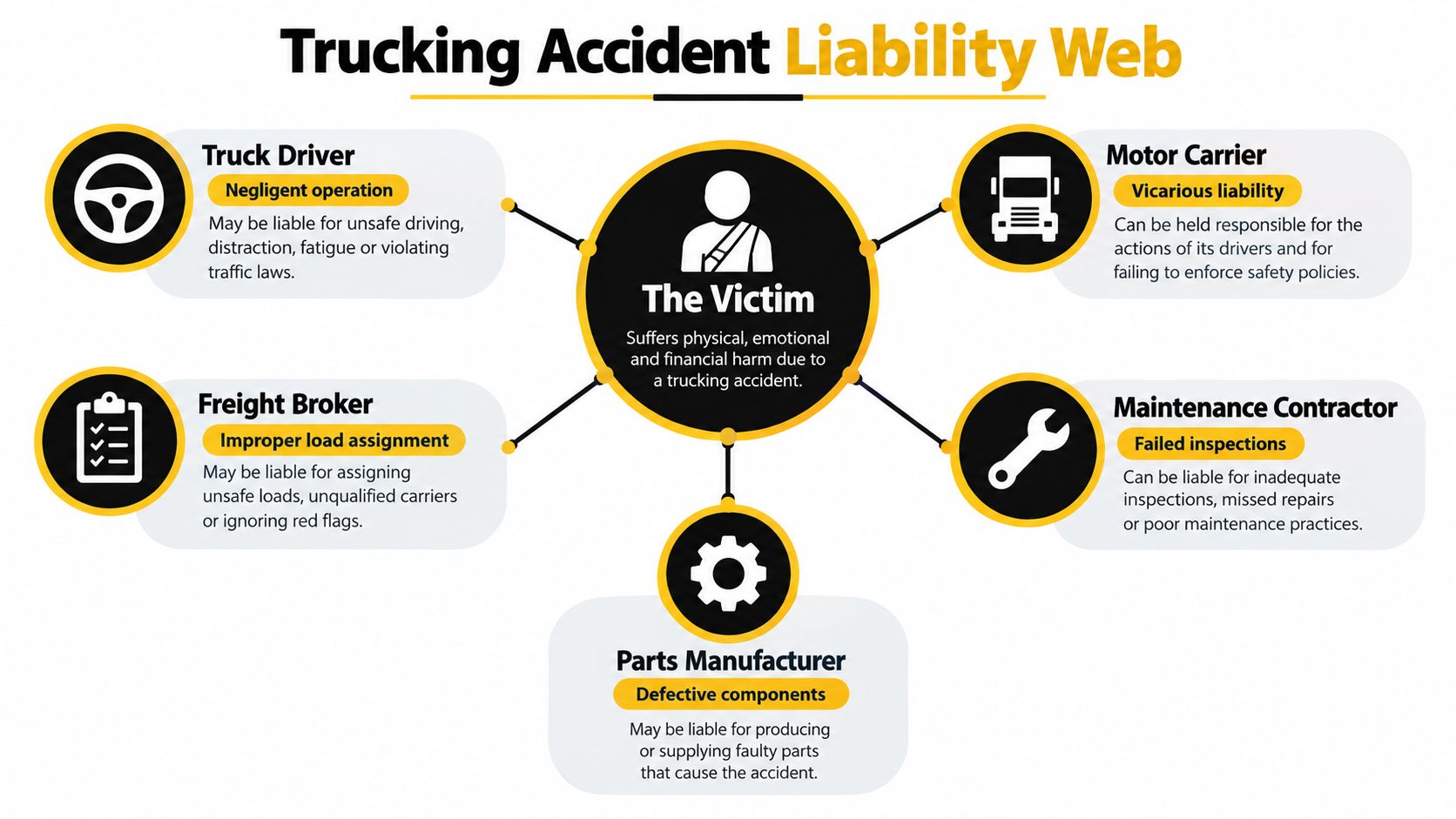
The driver may face allegations of negligent operation, distraction, fatigue, speeding, or impaired driving. The motor carrier may face direct claims for negligent hiring, training, supervision, retention, or maintenance, along with vicarious liability for conduct within the scope of employment. The distinction matters because a carrier can be responsible for its own safety failures even when it disputes what the driver did.
A freight broker may become relevant when it selected or retained an unsafe carrier, ignored available safety information, or made load and routing decisions that created unreasonable risk. The legal environment is changing. A 2026 Supreme Court decision discussed in the ruling on negligent-hiring suits against freight brokers held that federal law didn’t shield freight brokers from state claims alleging negligent hiring of dangerous motor carriers. That doesn’t make every broker automatically liable. It makes the broker’s selection process and safety review worth investigating.
Follow the chain of control
A careful investigation asks who controlled each part of the operation:
- Driver: Did the driver operate safely, follow the route, and comply with fatigue and inspection duties?
- Motor carrier: Did the company hire, train, supervise, and monitor the driver appropriately?
- Freight broker: Did the broker select a reputable carrier and communicate accurate load requirements?
- Maintenance contractor: Did it inspect and repair brakes, tires, steering, lights, and other safety-critical systems?
- Trailer or cargo owner: Did loading or securement create an unstable or shifting load?
- Parts manufacturer: Did a defective tire, brake component, steering part, or other product fail?
- Software or telematics provider: Did a system record, transmit, alert, or preserve safety information that may reveal what happened?
The chain of custody matters. Investigators should trace the load tender, dispatch instructions, carrier contract, maintenance history, trailer assignment, driver records, and digital data from collection through analysis. Early identification can reveal additional insurance coverage and prevent one defendant from controlling the entire story.
Families facing a fatal crash also need a disciplined process for records, interviews, medical evidence, and family-loss documentation. A practical overview of what families should expect in an investigation can help explain why these investigations extend beyond the police report.
For a deeper explanation of employer responsibility, review vicarious liability in California. The key point is strategic: name the right parties before evidence and insurance information become harder to obtain.
Federal Regulations and How They Shape Negligence Claims
Commercial carriers operate under the Federal Motor Carrier Safety Regulations in 49 CFR Parts 300 through 399, not merely the traffic rules that apply to ordinary drivers. A rule violation doesn’t automatically win a case, but it can provide concrete evidence that a defendant failed to follow a safety duty. In appropriate circumstances, a violation may support negligence per se, as explained in this overview of truck accident liability and federal regulations.
Hours-of-service records often receive close attention. Federal rules limit a driver to 11 hours of driving within a 14-hour on-duty window after at least 10 consecutive hours off duty. They also limit work to 60 hours in seven days or 70 hours in eight days, and require pre-trip inspections and reporting of defects involving brakes, tires, steering, lights, and other safety equipment, according to this discussion of trucking liability and safety rules.
A jury can understand the basic question: Was the driver legally allowed to be driving, and did the carrier maintain a safe vehicle? Lawyers may obtain driver qualification files, drug and alcohol testing records, ELD data, inspection reports, repair records, cargo-securement documents, and regulator communications through discovery and agency records.
Key FMCSA Regulations and Negligence Hooks
| Regulation Area | Core Rule | Evidence of Violation |
|---|---|---|
| Hours of service | Limits driving and on-duty time, with required off-duty periods | ELD records, log edits, dispatch messages, and delivery pressure |
| Driver qualification | Requires the carrier to assess whether a driver is qualified | Application materials, license records, training files, and personnel records |
| Vehicle inspections | Requires safety inspections and reporting of critical defects | Pre-trip reports, repair orders, inspection history, and photographs |
| Maintenance | Requires carriers to keep equipment in safe operating condition | Brake, tire, steering, lighting, and service records |
| Cargo securement | Requires cargo to be loaded and secured safely | Bills of lading, loading photos, weight records, and post-crash inspection |
| Drug and alcohol compliance | Requires regulated testing and related records | Testing records, policies, and qualification files |
Don’t assume a missing log entry proves fatigue, or that a maintenance record proves a defect caused the collision. The evidence must connect the violation to the crash. That connection is where reconstruction, medical testimony, vehicle inspection, and dispatch records become important.
Damages You Can Recover in a Trucking Accident Case
A serious truck crash can produce several categories of damages, and the gross number on a demand letter isn’t the same as the amount a client ultimately receives. The claim must account for medical costs, income loss, future limitations, pain, family impact, insurance liens, and any comparative-fault argument.
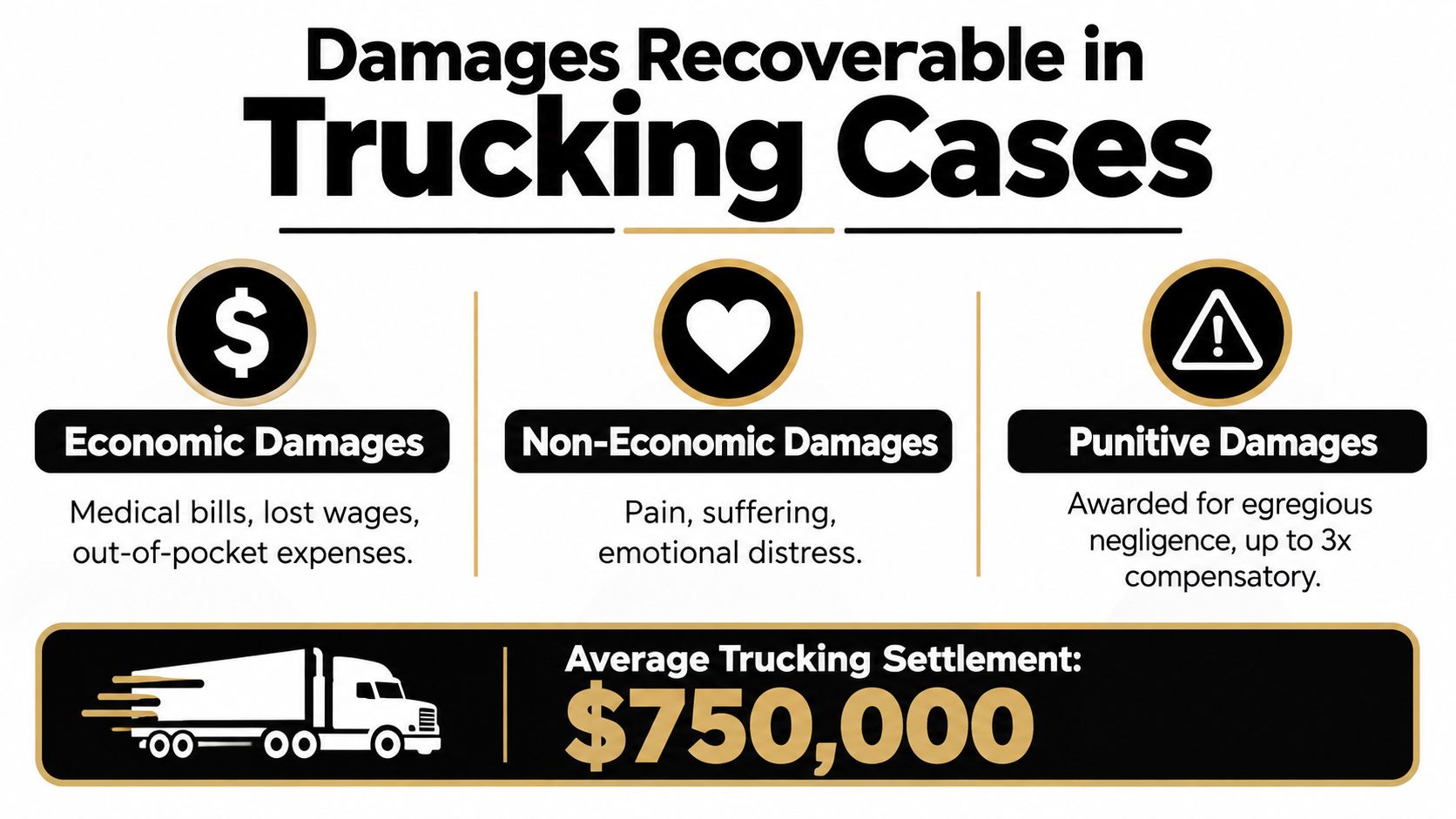
Economic damages include past and future medical care, rehabilitation, medication, lost wages, reduced earning capacity, property damage, transportation, and other documented out-of-pocket expenses. Keep bills, pay records, mileage logs, disability notes, and receipts. A permanent injury requires more than a stack of invoices. It may require medical and vocational evidence explaining the effect on work and daily life.
Non-economic damages address pain, suffering, emotional distress, disfigurement, loss of enjoyment of life, and disruption of family relationships. A detailed recovery journal can help document sleep problems, limitations, therapy, missed activities, and the ordinary tasks that became difficult.
Punitive damages are different. They generally depend on proof of especially egregious conduct, not just an ordinary mistake. Knowingly putting an unqualified driver on the road, consciously ignoring a serious safety defect, or falsifying important records may raise that issue, but the facts and governing state law control.
The U.S. Chamber Institute for Legal Reform review of trucking litigation outcomes illustrates the wide range of commercial truck case results. Its review of 154 verdicts and settlements from June 2020 through April 2023 reported a mean plaintiff award of $27,507,334 and a median award of $759,875. In a subgroup of 641 cases resolved below $1 million, the average payment was $427,336 and the median was $210,000. Those figures aren’t a valuation of your case. They show why averages can mislead and why injury severity, proof, liability, and available coverage matter more than a headline result.
A settlement valuation should start with documented harm and provable responsibility, not an internet average.
Health-insurance reimbursement claims, Medicare issues, attorney fees, litigation costs, structured payments, and comparative-fault deductions can reduce the net recovery. Review those items before accepting an offer.
Settlement Versus Going to Trial
Settlement gives you control over whether to accept the result. Trial gives a jury control over the result. That difference matters more than slogans about being aggressive or reasonable.
A settlement can resolve uncertainty, protect privacy, and deliver funds without asking you to testify before a jury. It may also allow structured payments when that arrangement fits your medical and financial needs. The tradeoff is that you give up the possibility of a larger verdict and usually agree to release claims against the settling defendants.
Trial may produce a substantially larger award when liability evidence is strong, the injuries are permanent, and the defense’s final offer doesn’t reflect the documented damages. It also brings risk. A jury may accept the carrier’s account, assign comparative fault, reject a causation theory, or award less than the last settlement demand. A defense verdict can leave limited appellate options, and an appeal doesn’t guarantee a new result.
What actually changes the decision
The decision should turn on evidence, not impatience.
- Liability strength: Clear video, independent witnesses, vehicle data, and regulatory violations can strengthen the case at trial. Conflicting accounts and missing records create risk.
- Damages proof: Consistent medical treatment, credible physicians, employment records, and practical evidence of daily limitations make a serious claim easier to value.
- Insurance and defendants: A carrier’s available coverage matters, but so does whether additional defendants or policies may apply. Identifying every responsible party can change negotiation power.
- Defense conduct: Commercial defendants may use in-house counsel, defense experts, and repeated requests for medical or employment records. A low offer may reflect a genuine dispute, or it may test whether you will give up early.
- Personal cost: Depositions, medical examinations, discovery, and trial preparation take time and emotional energy. Court filings are generally public, and testimony becomes part of the litigation record.
- Net recovery: Compare the offer to the likely result after fees, costs, liens, taxes where applicable, and the risk of receiving nothing at trial.
Commercial truck litigation also requires counsel who understands more than auto claims. It is worth asking whether the lawyer has reviewed FMCSA records, analyzed ELD and telematics evidence, worked with accident reconstruction professionals, taken trucking depositions, and tried cases involving commercial carriers. It is also worth asking for a clear written explanation of the fee split, case expenses, decision authority, and who will personally handle important hearings and depositions.
Fewer crashes can coexist with greater lawsuit exposure. One 2026 industry report described heavy-duty truck crash rates falling 2.6%, injury crash rates falling more than 15% from the 2019 peak, and fatal crash rates falling nearly 14%, while liability costs continued to rise, as reported by Trucking Info’s analysis of crash rates and insurance costs. The same report attributed the tension to severity, verdict size, and litigation economics rather than crash frequency alone. Another 2026 report said trucking and auto verdicts nearly tripled in 2025 to $3.4 billion across 12 cases, but that information should be treated as industry reporting, not a prediction of an individual recovery.
Telematics creates more evidence, but it also creates more preservation disputes. Brokers create more possible decision-makers, but their involvement doesn’t establish negligence by itself. Defendants may also challenge which state’s law applies or argue that federal law limits state claims. Your lawyer should identify those issues early instead of discovering them after a demand has been rejected.
Questions clients ask before choosing a path
Does the trucking company’s insurance matter?
Yes. Available commercial coverage can affect collectability and negotiation, but policy limits aren’t the same as case value. The investigation should identify all potentially applicable policies and defendants.
How does comparative negligence affect a settlement?
If the defense proves you contributed to the crash, the law may reduce your recovery, depending on the jurisdiction. Your own statements, social media, lane position, speed, and treatment history may become evidence in that dispute.
How does a trucking accident lawyer settle an insurance claim?
Counsel investigates liability and damages, preserves evidence, identifies coverage, prepares a demand supported by records, negotiates with the insurers, and files suit when negotiation doesn’t produce a fair result. A settlement should be documented in a release that clearly identifies which claims and parties are being resolved.
What is the filing deadline?
The statute of limitations depends on the state, the injury, the defendant, and whether a government entity is involved. Don’t rely on a general online deadline. Have a lawyer calculate it from the facts of your crash.
Should I give a recorded statement?
Not before you understand what the insurer is asking and how the statement may be used. Provide emergency information, but don’t guess about fault, prior symptoms, speed, or future medical needs.
Can I use social media?
Assume public posts, private messages, photographs, check-ins, and comments may be requested or used to challenge your account. Don’t discuss the collision, your injuries, or the claim online.
Is an early investigation really worth it?
Yes, particularly when video, ELD data, vehicle condition, dispatch records, or witness memories may disappear or change. A prompt, case-specific investigation can answer questions that a police report alone can’t.
The right choice isn’t always settlement or trial at the beginning. Build the evidence first, calculate the net value, understand the risks, and then decide with current information instead of pressure from an insurer or fear of litigation.
LA Law Group, APLC offers truck accident representation that includes investigating crash reports, maintenance logs, driver records, and insurance issues, negotiating with insurers, and pursuing litigation when a fair settlement isn’t available. Visit LA Law Group, APLC to request a free consultation about preserving evidence and evaluating your trucking accident claim.
Attorney Advertising. This article is general information, not legal advice, and does not create an attorney-client relationship. Prior results do not guarantee a similar outcome.