
Types of Premises Liability Cases: California Guide 2026
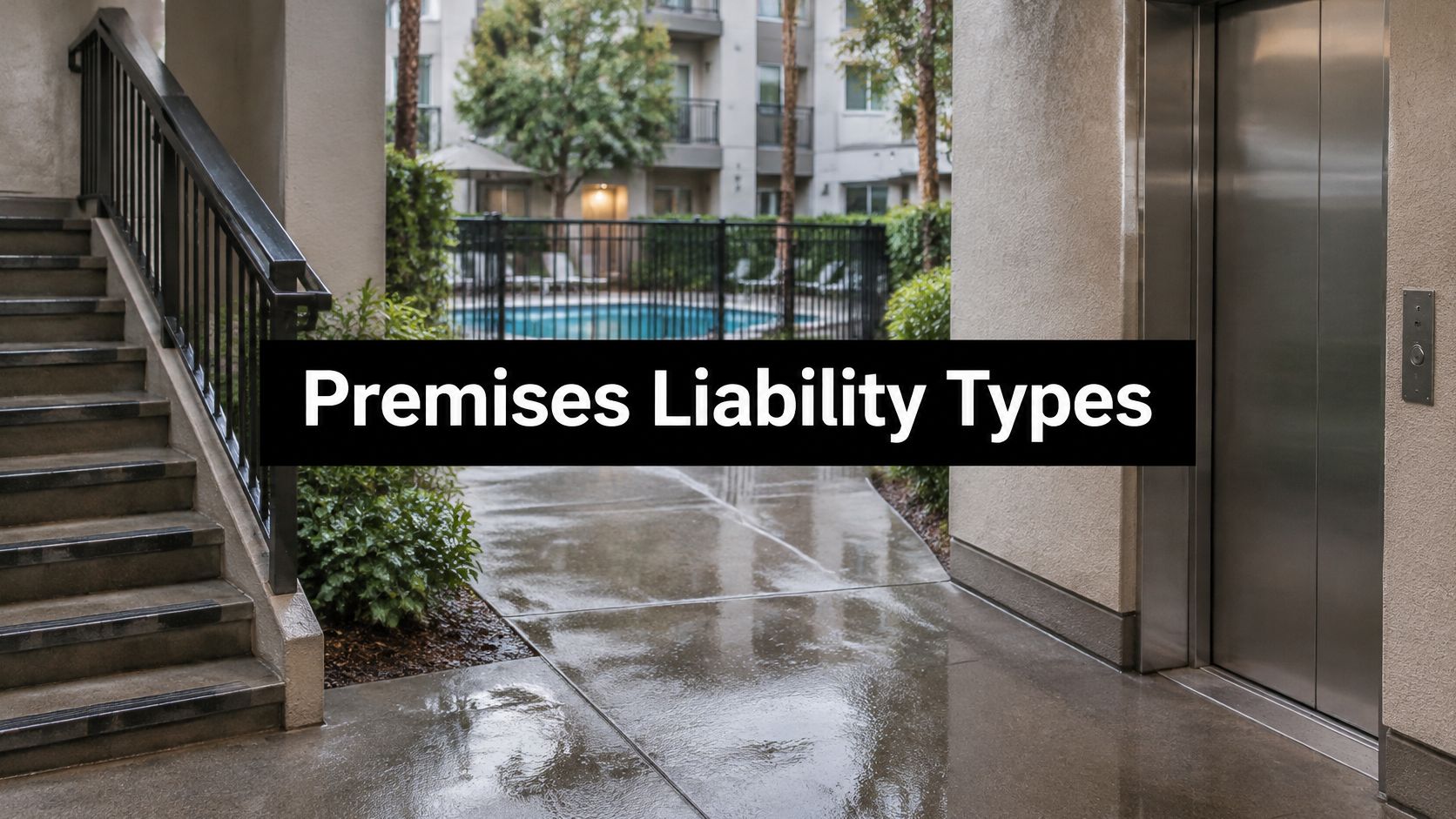
If someone gets hurt on a property, does the owner automatically owe compensation? Not necessarily. Across the different types of premises liability cases, the important questions are who controlled the danger, what that person knew or reasonably should have discovered, and whether a failure to act caused the injury.
A supermarket spill, an apartment assault, and a defective public sidewalk may all involve unsafe premises, but they don’t follow identical rules. Understanding those differences helps you preserve the right evidence and avoid treating every accident as the same kind of claim.
What Premises Liability Covers and Who Can Be Responsible
Premises liability concerns injuries caused by unsafe conditions on land or inside buildings. An owner, occupier, or manager may be responsible when their unreasonable use or maintenance of property causes someone harm.
The defendant isn’t always the person named on the deed. A tenant may control a store aisle, a property manager may handle stair repairs, and a contractor may maintain an elevator. Government-controlled property requires a separate statutory analysis.
The basic questions are:
- Duty: What reasonable precautions did the defendant owe under the circumstances?
- Control: Who possessed, occupied, maintained, or had authority over the area?
- Unsafe condition and notice: What was dangerous, and did the defendant know or reasonably have reason to discover it?
- Causation: Did the failure to take reasonable precautions contribute to the injury?
- Damages: What physical, financial, or other compensable harm resulted?
You may encounter the traditional terms invitee, licensee, and trespasser. Although visitor status can matter, California generally evaluates reasonable care rather than mechanically assigning duties through those labels alone. Why someone entered, what the defendant could foresee, and any applicable statutory exception remain important.
The injured person’s conduct also matters. A dangerous condition doesn’t remove the need to examine how the incident happened.
Starting point: Identify the person or organization responsible for the particular area, not simply the property’s mailing address.
The case-matching table below separates hazards before the more detailed discussions of evidence, defenses, and overlapping responsibility.
This article is for informational purposes only and must not be construed as legal advice. None of its information is legal advice, and reviewing it creates no attorney-client relationship. Website information is general, and prior results don’t guarantee a similar outcome.
Premises Liability Case Types at a Glance
The category helps identify the investigation you need. A photograph may establish a broken stair, but a security claim needs evidence about criminal risk, while an exposure claim may require environmental and medical analysis.
Premises liability case types and the question that decides each
| Case type | Typical hazard | Question that usually decides it |
|---|---|---|
| Slip, trip and fall | Wet floors, uneven pavement, defective stairs, poor lighting | Did the owner know or should they have known, and fail to fix or warn? |
| Negligent security | Assault or robbery in parking structures, hotels and apartments | Was the crime foreseeable from prior incidents or known risks? |
| Pool and drowning | Unfenced pools, missing drain covers, slippery decks | Were barriers, gates and warnings adequate for children? |
| Dog bite | Dog attack on lawful premises | Who owned, kept or harbored the dog, and was the victim lawfully present? |
| Falls from heights and structural failure | Balcony collapse, unguarded stairs, elevator or escalator malfunction | Was the structure or equipment inspected and maintained? |
| Toxic exposure | Mold, lead, asbestos, carbon monoxide, chemical releases | Was the hazard known, disclosed or tested before exposure? |
| Public property dangerous condition | Potholes, sidewalk defects, park and transit hazards | Did the public entity have notice in time to repair or warn, or did its employee negligently create the condition? |
| Recreational land | Injuries on land opened for hiking, camping, fishing or similar use | Did the owner willfully or maliciously fail to guard or warn, or does another immunity exception apply? |
Use the question, not just the label
These questions identify a starting point, not a complete legal test. For example, a dog owner’s statutory responsibility differs from a landlord’s possible responsibility for a tenant’s dog. Likewise, public-property liability can involve an employee-created condition rather than advance notice alone.
Start by describing the physical event without drawing a legal conclusion. “My shoe caught a raised slab outside the entrance” is more useful than “the store was negligent.” The first description directs attention to measurements, boundaries, maintenance, and visibility.
One incident can fit several rows. A pool visitor might slip because of a neglected deck, while a child’s access to the same pool raises different questions about gates and supervision.
Ownership doesn’t settle the category
A park-like setting isn’t necessarily public property, and a government-owned building isn’t necessarily maintained entirely by government employees. Check ownership, occupancy, and maintenance arrangements separately.
The right-hand column helps prevent misplaced effort. If the dispute concerns foreseeable violence, documenting a broken lock matters most when you can connect it to a known risk and the way the attacker entered.
Slip, Trip and Fall Claims
Did the person responsible know about the hazard, or should a reasonable inspection have revealed it? That question often matters more than whether the floor was slippery when someone fell.
Actual notice means someone responsible had direct information, such as an employee seeing a spill. Constructive notice concerns what a reasonable inspection should have uncovered. The investigation therefore needs a timeline, not just a photograph taken afterward.
Connect the hazard to its history
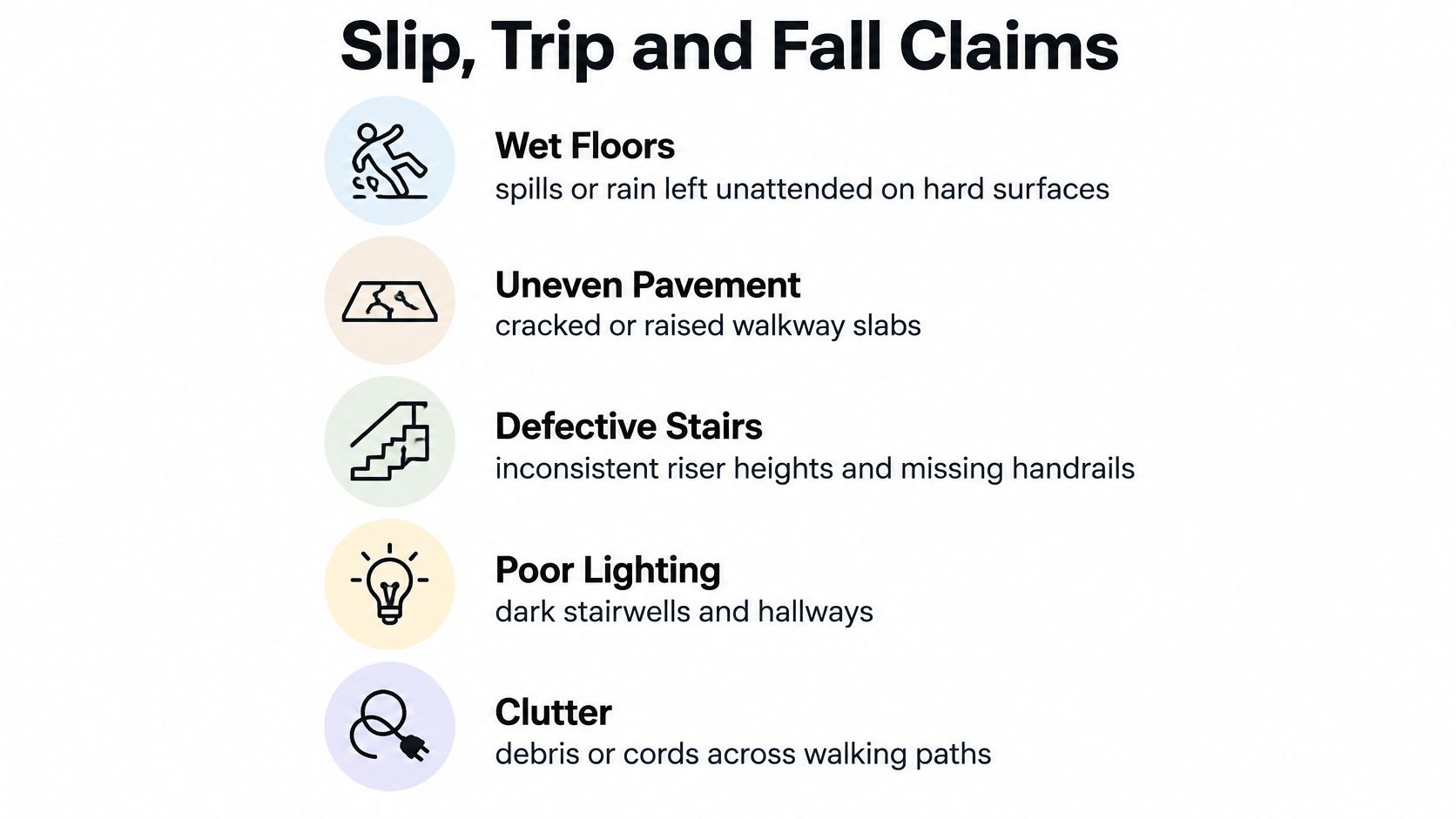
Common conditions include unattended spills, rain tracked onto tile, uneven pavement, inconsistent stair risers, missing handrails, dark corridors, obstructed aisles, and snow or ice. Outdoor defects may require investigating drainage, recurring movement, or grounds maintenance.
For raised walkways near established trees, Prestonwood Commercial Grounds Services’ discussion of managing underground tree root damage provides practical background on a possible maintenance issue. It doesn’t establish who caused a particular defect or whether anyone had legal notice.
The following visual highlights common walking-surface hazards.
Federal occupational reporting illustrates the seriousness of fall-related hazards, although the Bureau of Labor Statistics workplace fatality release isn’t a count of customer, tenant, or visitor premises claims. Workplace safety information should never be presented as a direct measure of California premises lawsuits.
Preserve evidence that answers the notice question
Suppose surveillance shows a grocery spill remaining for forty minutes before a customer falls, and the store produces no sweep log. That hypothetical interval isn’t an automatic liability threshold. It raises questions about traffic, employee observations, inspection practices, and whether the spill was reasonably discoverable.
Useful evidence includes:
- Scene photographs: Show the substance or defect, surrounding walkway, lighting, and a ruler or other scale reference.
- Incident documentation: Preserve the report, employee names, witness contacts, and any statements about earlier complaints.
- Time-sensitive records: Request preservation of surveillance, inspection logs, and cleaning schedules.
- Physical items: Keep the footwear and clothing worn during the fall without altering their condition.
OSHA’s walking-surface safety guidance identifies recognized practices for controlling workplace slip and trip hazards. Those practices can inform an investigation, but workplace rules don’t automatically define the duty owed to every visitor.
A wet-floor sign may support a warning defense, but its location, visibility, and usefulness still need examination. A sign doesn’t necessarily make an otherwise unreasonable walking route safe, and distraction by the injured person may affect allocation of fault rather than automatically defeat the claim.
Negligent Security and Third-Party Crimes
Suppose a hotel parking structure experienced three car break-ins during the prior four months, and two lights remained out when a guest was assaulted. Those hypothetical facts justify investigation, but they don’t automatically establish that the hotel should have anticipated that particular attack.
Negligent security differs from an ordinary property-defect claim because another person commits the immediate harmful act. The question is whether the defendant failed to take reasonable precautions against a legally foreseeable criminal risk.
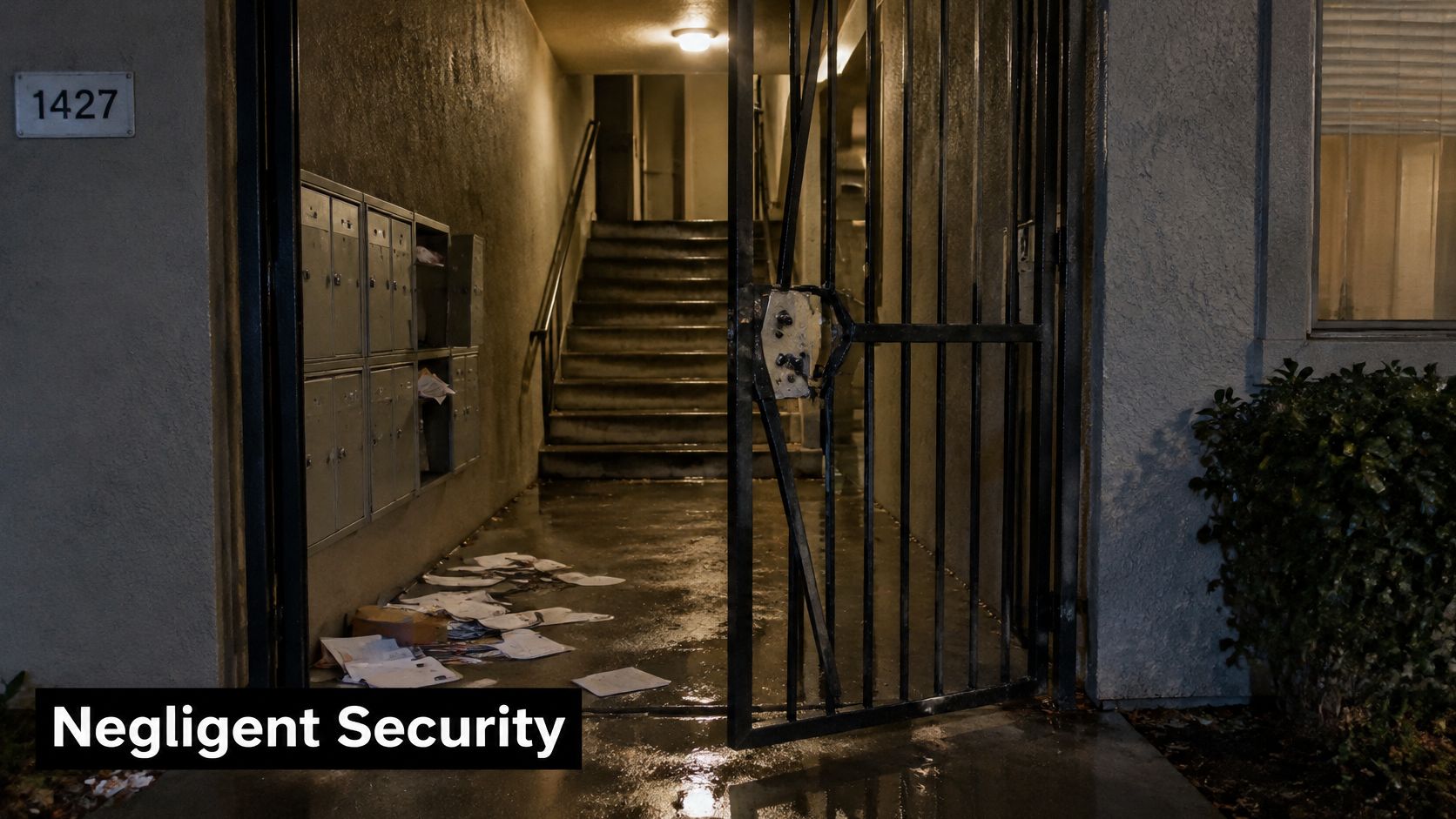
An entry defect can be relevant when it affected how someone gained access.
Foreseeability isn’t one universal test
As outlined in IntelliSee’s discussion of negligent-security foreseeability, jurisdictions may examine specific imminent harm, prior similar incidents, the Timberwalk factors of proximity, recency, frequency, similarity, and publicity, or the totality of the circumstances. These are comparative approaches, not interchangeable California instructions.
California analysis requires attention to the particular precaution sought and the circumstances supporting it. Replacing a broken entry lock and requiring an extensive guard program don’t necessarily present the same duty question.
In the hotel scenario, prior property crimes may have some relevance, but the investigator must examine their locations, circumstances, and relationship to the later assault. General neighborhood crime information is less useful without a connection to the property and the risk at issue.
No identical prior crime doesn’t automatically end every negligent-security analysis. It also doesn’t relieve the claimant of proving why the danger called for the precaution alleged.
Separate access failures from causation
Consider an apartment building where tenants repeatedly reported a propped-open entry door. If an attacker entered through that door, the reports, repair history, and entry footage may connect the maintenance failure to the incident.
If the attacker was an authorized guest who entered another way, the same door defect may have little causal significance. A missing precaution must connect to the harm, not merely look unsafe afterward.
For practical background on controlled entry, Nimbio’s explanation of gated community access control helps identify features worth documenting, such as entry permissions and gate operation. A product description doesn’t establish what precautions a particular property legally required.
This video provides additional context for the topic.
Build a property-specific record
Preserve police calls to the location, prior incident reports, relevant crime information, photographs of failed lights or locks, and unanswered tenant or employee complaints. Written security promises, staffing records, and video can help distinguish what management represented from what happened.
These issues arise at hotels, apartments, parking structures, retail centers, nightlife venues, and campuses. Our explanation of a negligent security lawsuit provides further context, but the investigation must remain tied to the particular property, foreseeable risk, and alleged precaution.
Pool, Dog Bite and Animal Injury Claims
Pool injuries require an access and equipment investigation
Pool claims can involve drowning, nonfatal drowning, slippery decks, defective gates, or unsafe drain covers. Identify who controlled the pool, who inspected its equipment, and whether children could enter without an adult opening the barrier.
Check whether gates self-close and latch, rather than assuming installed hardware works. Federal pool and spa safety rules address certain drain-cover hazards, while applicable local requirements can govern fencing and barriers. The pool’s type and location matter when identifying the governing requirements.
You may hear the phrase attractive nuisance, referring generally to dangerous features that children may not appreciate. California doesn’t treat that label as a standalone substitute for its negligence analysis. A child’s foreseeable access and ability to understand the danger still deserve careful investigation.
Preserve photographs of fences, latch height and operation, drain covers, rescue equipment, posted warnings, and the route used to reach the water. Don’t operate questionable equipment merely to recreate an incident.
Dog owners and non-owners face different questions
Under California Civil Code section 3342, a dog owner generally faces strict liability for a bite occurring in a public place or while the injured person was lawfully on private property. Prior knowledge of aggression generally isn’t required for that statutory owner claim; our California dog bite law guide explains the distinction.
A landlord or non-owner keeper isn’t automatically subject to that same owner-based rule. Their possible negligence requires a separate examination of knowledge, control, and ability to take protective action.
Consider a child bitten while visiting a friend’s backyard or a mail carrier bitten on a porch. Establish who owned the dog, why the person was present, where the bite happened, and who controlled the enclosure.
- Animal records: Obtain animal-control reports, licensing information, and vaccination records.
- Injury documentation: Preserve medical records, wound photographs, and witness statements.
- Property evidence: Photograph the gate, fence, enclosure, and any route through which the animal escaped.
A bite and another animal-related injury, such as being knocked down, may require different legal theories. Don’t assume every animal injury falls under the bite statute.
Falls From Heights and Structural Failure Claims
Suppose an apartment balcony railing gives way after two earlier tenant complaints. The hypothetical claim concerns more than the eventual collapse: who received the complaints, who could authorize repairs, and whether anyone restricted access while investigating?
Falls from stairs, ladders, balconies, roofs, and scaffolding require close attention to guardrails, fall protection, anchoring, and structural maintenance. Falling merchandise or ceiling materials can present related questions about loading, installation, and deterioration.
Height changes the investigation
In 2023, falls, slips, and trips caused 421 construction deaths, and portable ladders and stairs were identified as the primary source in 109 construction fatalities, according to the Bureau of Labor Statistics fatal occupational injury release. Most construction fall deaths involved falls to a lower level from heights between 6 and 30 feet.
These occupational figures demonstrate severity, not the number of visitor lawsuits. Injured employees often pursue workers’ compensation, although potential claims against other responsible parties require separate review; tenants and customers may present a different premises-liability analysis.
Structural investigation should distinguish visible deterioration from its cause. Restore Heroes’ guide to warning signs of a wet foundation offers background on moisture-related warning signs, but an engineer must evaluate any claimed connection to structural failure.
Identify who maintained the equipment
Elevator doors, sudden stops, escalator steps, and moving handrails introduce equipment-specific questions. An owner may oversee building access while a specialist contractor handles inspection and repair, so the maintenance contract can be as important as the equipment itself.
Collect records before assuming a malfunction proves negligent maintenance:
- Maintenance history: Service logs, repair tickets, recurring fault reports, and tenant complaints.
- Inspection materials: Certificates, inspection findings, and records showing whether recommended work occurred.
- Equipment information: Model identification, relevant manufacturer recall notices, and component replacement records.
- Responsibility documents: Maintenance contracts and communications authorizing or delaying repairs.
Preserve the failed component when possible through an appropriate written request. Repairs may be necessary for safety, but documenting the pre-repair condition can prevent later disagreement about what failed.
Toxic Exposure and Hazardous Substance Claims
A tenant repeatedly reports water entering a bedroom. The landlord paints over the stains without correcting the leak, and the tenant later develops respiratory symptoms. That scenario raises a serious investigation question, but the sequence alone doesn’t prove that a particular substance caused the illness.
Toxic-exposure claims can involve mold, lead paint, asbestos, carbon monoxide, chemical releases, or contaminated water. Investigators need to identify the substance, exposure pathway, responsible party, and medical connection.
Build an exposure timeline
Record where the person lived or worked, when the condition appeared, when complaints were sent, and when symptoms began. Include periods away from the property and other potential exposure sources rather than selecting only facts that support one explanation.
Relevant records include:
- Environmental findings: Sampling methods, laboratory results, inspection reports, and remediation documents.
- Notice records: Dated leak complaints, testing requests, repair orders, and landlord or employer communications.
- Medical evidence: Diagnosis, symptom onset, treatment, and the clinician’s exposure history.
- Property history: Renovations, disturbed materials, equipment problems, and earlier water intrusion.
Disclosure rules can create a separate investigation track. Federal lead-based paint disclosure requirements generally concern covered housing built before 1978, but disclosure paperwork doesn’t replace analysis of the actual exposure or injury.
Don’t confuse discovery with the exposure date
Some illnesses appear long after contact with the substance. Filing rules may depend on when the injury and its cause were discovered or reasonably should have been discovered, so neither the move-out date nor the first visible stain should be treated as an automatic deadline.
Environmental professionals and medical experts may be needed to connect a measured condition with a person’s injury. Our discussion of working with a toxic exposure attorney explains why preserving both property records and medical information matters before repairs or remediation change the evidence.
Public Property Dangerous Condition Claims
A sidewalk outside a business may look like an ordinary private-property case, but government ownership changes the analysis. For a hypothetical city pothole with three prior service complaints, the investigation must connect those complaints to the same location and condition.
Follow the public-property intake sequence
- Identify the responsible entity. Determine whether the location belongs to a city, county, state agency, transit district, or another entity. A nearby government sign doesn’t establish who maintained the exact area.
- Document the condition and route. Photograph and measure the defect, record surrounding visibility, and map how the injured person approached it.
- Connect the condition to the injury. Preserve witness accounts, footwear, video, and medical information explaining the event and resulting harm.
- Investigate creation or notice. Request complaints, work orders, inspections, construction records, and repair history.
- Check claim presentation immediately. Government claims involve procedural requirements separate from filing an ordinary lawsuit.
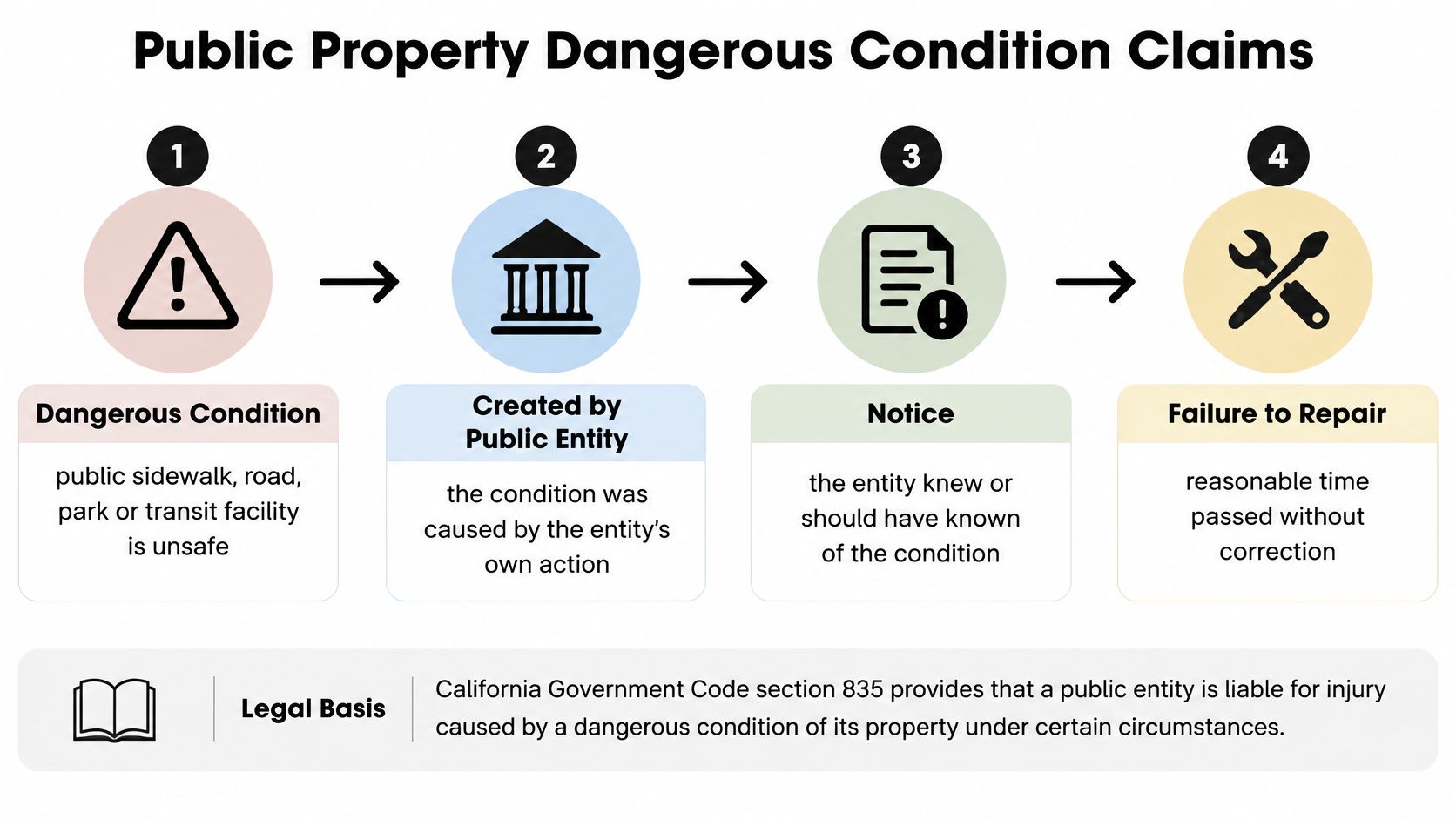
Under California Government Code section 835, the claimant must establish a dangerous condition at the time of injury, causation, a reasonably foreseeable risk of that injury, and either negligent or wrongful creation by a public employee or sufficient actual or constructive notice to permit protective measures. In the pothole example, complaint dates matter only if they identify the relevant condition and allowed a reasonable opportunity to respond.
The visual summarizes the investigation, but employee creation and advance notice are alternative statutory routes, not requirements that must always both be proved.
Distinguish a defect from a statutory dangerous condition
Under the California dangerous-condition jury instruction based on Government Code section 830, the condition must create a substantial risk of injury during reasonably careful, foreseeable use; a merely minor risk doesn’t qualify. Measurements therefore need context, including slope, visibility, pedestrian movement, and surrounding conditions.
A public entity may also raise the statutory reasonableness defense, weighing foreseeable injury probability and severity against the practicality and cost of protective measures. Document feasible alternatives, not merely the fact that a repair was possible.
Deadline caution: A public-property claim requires an early procedural review even while records requests and medical treatment remain ongoing.
The practical flow is identify the entity, preserve the scene, establish the statutory condition, investigate creation or notice, and complete the applicable claim process. Don’t wait for the entity’s investigation to finish before checking your own obligations.
Control, Comparative Fault and Common Defenses
A hazardous condition alone doesn’t win a premises case. The claimant must connect the right defendant to negligent conduct and connect that conduct to compensable harm.
The Judicial Council’s premises-liability verdict form first asks whether the defendant owned, leased, occupied, or controlled the property; a negative answer ends the inquiry against that defendant under that form. If that relationship exists, the jury considers negligence, whether it substantially contributed to the harm, and damages.
The courtroom inquiry separates these questions rather than assuming responsibility from the accident’s location.
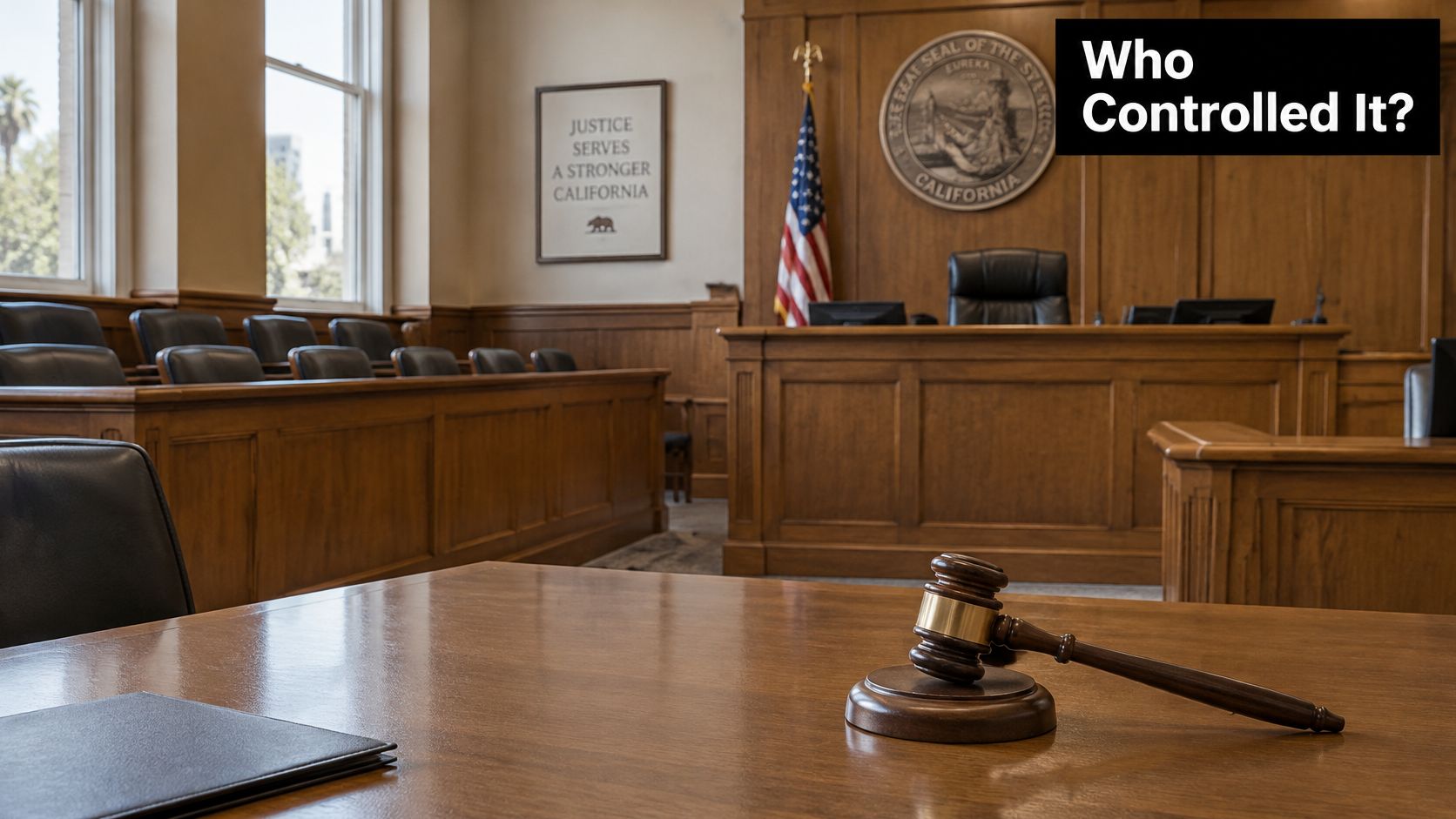
Match each defense to the missing evidence
Common premises liability defenses and the evidence that answers them
| Defense | How it works | Evidence that answers it |
|---|---|---|
| No ownership or control | Defendant didn’t own, lease, occupy, or control the area | Lease terms, maintenance contracts, management records |
| No notice | Condition existed too briefly for reasonable inspection to find it | Inspection logs, cleaning schedules, video timing |
| Open and obvious hazard | Defendant argues the danger was visible and avoidable with ordinary care | Photographs, lighting conditions, weather records |
| Comparative fault | Claimant’s own conduct reduces the award | Witness accounts, footwear, phone-use records |
| Recreational use immunity | Qualifying recreational use may limit the owner’s duty to guard or warn | Land use, permission terms, payment or invitation evidence, willful or malicious conduct |
| Missed government claim deadline | Claim wasn’t presented within the required period | Dated notices, filing receipts, calendar entries |
An obvious condition isn’t automatically the end of every claim. Whether someone reasonably needed to encounter it, and whether other precautions remained appropriate, can matter.
Shared fault and recreational use require separate analysis
California’s comparative-fault premises verdict materials permit examination of both the defendant’s negligence and the injured person’s conduct when allocating responsibility. A tenant texting on a poorly lit stair could therefore receive a reduced award if the evidence establishes responsibility on both sides, rather than necessarily losing outright.
Historical Bureau of Justice Statistics findings summarized by TriHamlet News and Stacker placed premises liability at about 11% of tort trials in state courts of general jurisdiction and found plaintiff negligence reduced compensatory awards in roughly two-fifths of plaintiff-won premises trials. Those historical trial findings aren’t a prediction for an individual claim.
California Civil Code section 846 generally limits a qualifying landowner’s duty toward recreational users, including people hiking, camping, or fishing, subject to statutory exceptions. Willful or malicious failure to guard or warn is one important exception; payment and express invitation also require review.
The defense identifies the immediate evidence priority. A control dispute calls for contracts, while a notice dispute calls for a reliable timeline.
How Overlapping Hazards Change the Claim
A dark exterior stair with a loose tread and a distracted pedestrian presents several issues at once. Lighting and repair records address the property’s condition, while witness accounts and phone-use evidence address the pedestrian’s actions. Neither issue cancels the other automatically.
An apartment courtyard shooting involving a gate broken for weeks combines a physical defect with third-party violence. The questions under Negligent Security and Third-Party Crimes still include foreseeability and causation: evidence that management ignored repair requests won’t by itself prove that a working gate would have prevented the attack.
Separate each defendant’s role
A sidewalk trip outside a store may involve a public entity, a private business, or both. Establish the property boundary, the source of the defect, and any maintenance undertaking rather than assuming the storefront controls everything outside it. The statutory analysis in Public Property Dangerous Condition Claims applies to the public entity, not automatically to every private defendant.
Owners, tenants, contractors, and managers may have different responsibilities for the same location. Assess each party’s authority, knowledge, and conduct separately.
Use this order:
- Identify the hazard using Premises Liability Case Types at a Glance.
- Determine control over the exact area, equipment, or activity.
- Establish notice through complaints, observations, inspections, or the condition’s history.
- Test causation by asking how the alleged failure contributed to the injury.
- Evaluate defenses using Control, Comparative Fault and Common Defenses, including warnings and procedural requirements.
A mixed case needs separate explanations for each defendant’s responsibility, not a single accusation that everyone failed to keep the property safe.
Confirm Your Claim Type and Deadlines Before You Act
Write down the hazard’s exact location, the date, and the time today. Separate what you personally observed from what someone else told you.
- Photograph the scene: Include a scale reference and note whether repairs have changed the condition.
- Preserve personal evidence: Keep footwear, clothing, receipts, and medical records.
- Protect witness and video evidence: Collect names and send a written surveillance-preservation request.
- Identify responsible parties: Record the owner, manager, tenant, contractor, or public entity.
Calendar the procedural review
For California personal-injury government claims, presentation is generally required within six months. Private-property personal-injury lawsuits generally have a two-year limitations period under Code of Civil Procedure section 335.1. Exceptions and separate filing requirements can change the analysis, so have a licensed attorney check the applicable dates promptly.
At LA Law Group, APLC, we handle the personal-injury claim process and deal with insurers on clients’ behalf. Many of our personal-injury cases take six months to settle, while some lawsuits could take up to three years; those durations aren’t filing deadlines or promises.
This article is for informational purposes only, isn’t legal advice, and must not be construed as legal advice. Reviewing it creates no attorney-client relationship.
LA Law Group, APLC offers a free consultation in which an attorney reviews your injury-claim options. Bring your photographs, incident details, and available property information so we can discuss the possible claim category and deadlines. Visit LA Law Group, APLC to request a consultation.
Attorney Advertising. This article is general information, not legal advice, and does not create an attorney-client relationship. Prior results do not guarantee a similar outcome.